Unsubscribe The OpenAI and Anthropic IPO wave is getting real (From StockEarnings)
Why Abbott Laboratories Stock Is Suddenly Winning Back Wall Street
Written by Thomas Hughes
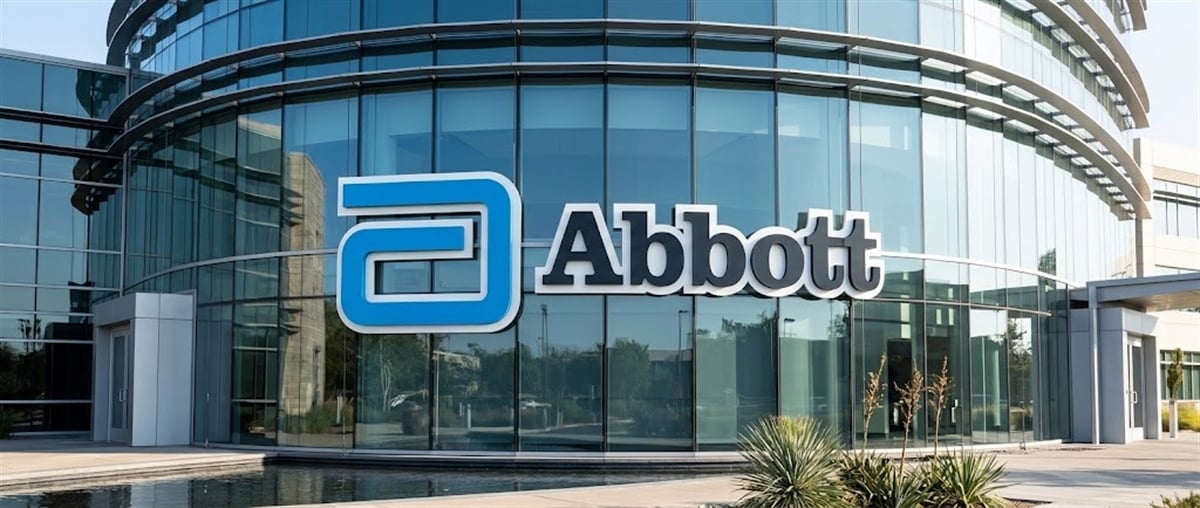
Abbott Laboratories (NYSE: ABT)gave the market what it wanted in its Q2 earnings report, affirming that the Exact Sciences acquisition was a good one. The critical takeaways are that comp growth is solid, the Exact Sciences business has traction, and the near-term margin impairment the acquisition brought is less than expected.
Looking forward, profitability metrics have improved, leading to improved guidance, strengthened market sentiment, and a robust rebound in the share price.
The share price rebound is an operative factor in the second half of 2026. Abbott’s market was overly depressed, given its historical value and capacity for capital returns, signaling a buying opportunity for investors.
The post-release surge not only confirms support at the existing lows but is also backed by MACD and stochastic signals, suggesting a full reversal is in play. The market completely misjudged the Exact Sciences deal, focusing too intently on near-term margin pressure and execution risk, rather than the long-term commercial impact on revenue, margins, and earnings.
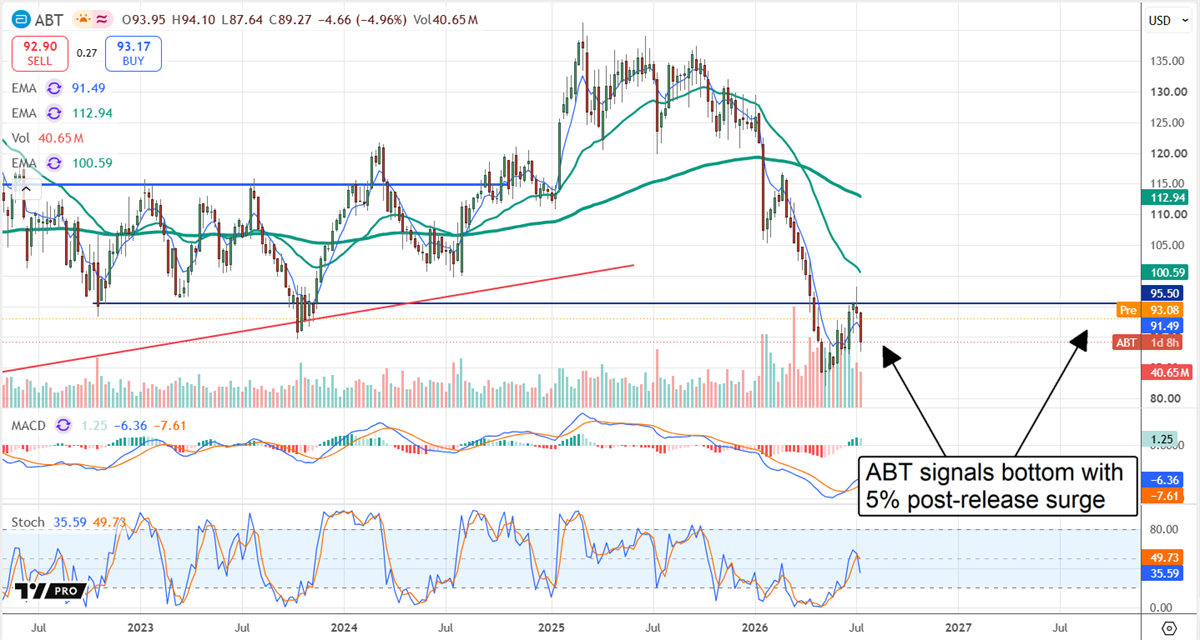
Abbott Laboratories Q2 Report a Balm for Frayed Investor Nerves
Abbott Laboratories’ Q2 report is solid, with reported growth of 13% and organic growth of 4.8%. Strength was underpinned by Exact Sciences and the 42.3% increase in Diagnostic services it brought, aided by an 8.4% increase in Established Pharmaceuticals and a 7.9% increase in Medical Devices. Nutrition, among the smaller segments, declined by 3.1%. Regionally, strengths were seen domestically and abroad.
Margin news was the catalyzing factor. The company’s margins contracted but less than expected, leaving gross margin, operating and net income above analysts’ forecasts. The critical takeaway is that $1.31 in adjusted earnings per share (EPS) outperformed by 235 basis points and is sufficient to sustain financial health while reinvesting and returning capital to shareholders.
Guidance is another catalyzing factor for back-half trading. The company maintained its forecast for organic revenue growth but improved the outlook for earnings, lifting the midpoint and narrowing the range for full-year results. With momentum building and results forecasted to accelerate in the back half, the guidance is likely to be cautious, setting the stage for additional catalysts by year’s end.
Abbott’s Capital Return Outlook Improves
Abbott’s capital return was never in any real danger, but the threat of margin compression and cash flow impairment was sufficient to weigh on sentiment. The takeaway from the Q2 release, however, is that concerns are misplaced. Capital returns will continue to flow, including the dividend and share buybacks, and buybacks may accelerate.
As it stands, Abbott is a Dividend Kingwith nearly 55 consecutive increases to its credit, a manageable 70% payout ratio, and buybacks to offset the impact of annual increases and build shareholder leverage. The dividend yield is more than attractive, as of mid-July, at a historical high of approximately 2.8%, and Q2 buybacks reduced the count by 0.45%.
Analysts and Institutional Trends Reveal Optimistic Support for ABT Shares
Analysts’ trends reflect the dividend safety and deep value opportunity presented this year. While price targets have moderated, the market overreacted and moved below the low end of the target range. Price targets suggest a floor near $90, with potential for substantial upside at the consensus. Valuation metrics suggest the upside will run into the triple digits over time.
The likely outcome is that analysts’ price targets begin to firm, increasing conviction in the consensus and potential for a full stock price recovery. Until then, institutional activity suggests this group limits risk in 2026, owning more than 75% of the shares and buying on balance. Buying is broad-based, including funds, mutual funds, public retirement accounts, and private wealth managers.
Abbott’s risks center on legacy issues related to its baby formula business, competition in the MedTech sector, and the integration of Exact Sciences. Integration risks now appear limited, given the Q2 release and guidance update, leaving competition and legacy issues as the primary hurdles. Competition is being mitigated through pipeline investment, with numerous positive developments reported this quarter. Legacy issues relate to baby formula manufacturing processes, regulatory scrutiny, and the unresolved legal issues they bring.
This year’s catalysts include the successful integration of Exact Sciences, the revenue and margin boost from Cologuard, and the expansion of Medtech wearables. Libre Duo, the world’s first dual glucose/keytone monitoring system, received the EU’s CE Mark, enabling its sales throughout the region, while pipeline news includes advances in two critical cardiovascular devices. What the market gets wrong is that ABT isn’t just a legacy healthcare company and bond proxy but an innovative med-tech company expanding margins while investing in growth. READ THIS STORY ONLINE
The Lithium Gold Rush Minted A New $1B Unicorn (Ad)

The Lithium Gold Rush Minted A New $1B Unicorn
This lithium producer surpassed a $1B private valuation, joining some of America’s most powerful startups.NOW YOU CAN INVEST IN ENERGYX ALONGSIDE GLOBAL GIANTS LIKE GENERAL MOTORS, BUT ONLY THROUGH JULY 16.
Revving Up Returns: Big Banks Race Through the Rate Plateau
Written by Jeffrey Neal Johnson

Headline earnings beats across money-center banks frequently mask deep divergences in net interest income sustainability and operational leverage. A rapid glance at big bank second-quarter 2026 earnings reports shows broad consensus beats across the board.
However, peeling back the layers reveals a stark operational bifurcation. Bank of America Corporation (NYSE: BAC)and JPMorgan Chase & Co. (NYSE: JPM) continue to convert sticky deposit bases into pristine margin expansion. The Goldman Sachs Group, Inc. (NYSE: GS) rides the cyclical wave of an artificial intelligence-driven mergers-and-acquisitions supercycle. Wells Fargo & Company (NYSE: WFC)battles to outrun margin compression via raw loan volume.
Calibrating Portfolios for Elevated Rates
Analyzing this divergence can help investors identify the business models that are best calibrated to compound shareholder returns in a prolonged elevated-rate environment.
Investors seeking to navigate this terrain need to look past the top-line revenue to examine how efficiently these banks manage their liability costs and capitalize on secular growth trends. Understanding how these engines operate under pressure provides a clear roadmap for investing effectively.
How Bank of America Laps Wells Fargo
Bank of America provides a textbook example of a liability-insensitive balance sheet functioning optimally. The company grew second-quarter revenue 15% year-over-year to $31.6 billion.
The underlying engine of this success is 450 basis points of operating leverage generated in the first half of the year. Operating leverage occurs when revenue grows faster than expenses, signaling efficient core operations.
With net interest income reaching $16.2 billion, Bank of America management confidently revised full-year net interest income guidance to the upper end of its 6% to 8% growth target. Fixed-rate asset repricing against a loyal, low-cost deposit base creates a formidable margin-expansion engine that requires no pressure to chase high-cost deposits.
Bank of America improved its efficiency ratio to 59%, proving that traditional banking operations can thrive without aggressive risk-taking.
Conversely, Wells Fargo & Company faces a fundamentally different reality. Despite netting a 16.5% year-over-year increase in net income to $6.4 billion, Wells Fargo experienced a post-earnings drop as investors digested underlying net interest margin compression.
The catalyst keeping Wells Fargo competitive is the Federal Reserve’s 2025 removal of its $1.95 trillion asset cap. Unshackled from this regulatory constraint, the company expanded average loan balances by 12% year over year. Management expects margin stabilization by the fourth quarter of 2026.
Until that inflection point arrives, Wells Fargo remains reliant on raw loan origination volume to outpace the pricing pressures on its deposit base. The inability to seamlessly translate loan volume into expanding margins exposes inefficiencies relative to peers such as Bank of America.
Trading in the Fast Lane: Goldman Meets JPMorgan
When elevated rates place ceilings on consumer borrowing, dealmaking, and trading, volatility must step in to bridge the revenue gap. Goldman Sachs reported an exceptional 25.5% return on tangible equity, capitalizing heavily on the multi-trillion-dollar AI infrastructure capital expenditure cycle.
Corporate clients seeking scale are driving sector-wide consolidation, pushing Goldman Sachs advisory revenues up 17% and sending its investment banking backlog to a five-year high. Equities financing skyrocketed 91% year over year, driven largely by robust demand across Asia-Pacific.
Because Goldman Sachs holds minimal traditional net interest income exposure, its earnings quality relies heavily on this capital markets momentum. The company currently operates as a high-octane cyclical play, tethered directly to corporate restructuring and tech infrastructure financing rather than sustained interest rate spreads.
JPMorgan Chase & Co. offers a masterclass in balance sheet agility and revenue diversification. Generating a 23% return on tangible common equity on $16.9 billion in net income highlights a fortress balance sheet operating at peak efficiency.
While Goldman Sachs relies almost exclusively on capital markets, JPMorgan fired on all cylinders, with investment banking fees rising 30% and equities trading climbing 86%. Crucially, the company management matched this capital markets dominance by revising its ex-markets net interest income guidance upward to $96.5 billion.
This dual-engine approach insulates JPMorgan Chase from sudden drops in mid-cycle mergers-and-acquisitions activity while still capturing upside yield from traditional lending. Executive transitions that established Doug Petno and Troy Rohrbaugh as co-presidents set a clear succession framework, removing lingering leadership uncertainty from JPMorgan’s risk premium.
How Banks Provision for Potholes
Strong top-line revenue means little if a bank fails to provision accurately for future loan losses. Underlying consumer and commercial credit health remains the ultimate barometer of systemic stability. Bank of America recorded flat net charge-offs of $1.4 billion, accompanied by improving consumer card delinquency metrics.
JPMorgan Chase booked a highly calculated $149 million net reserve build alongside $2.4 billion in net charge-offs. These highly controlled provisioning metrics confirm that the consumer remains resilient. Standardizing delinquency rates across the sector represents a normalization from historic, stimulus-driven lows, rather than signaling acute macroeconomic deterioration.
A stabilizing regulatory environment also contributes to this sector-wide confidence. Commentary across earnings calls indicates an easing of headwinds regarding Basel III endgame adjustments and G-SIB surcharge methodologies. This regulatory clarity effectively lowers the risk premium previously priced into financial equities, allowing institutions to focus capital on client deployment rather than defensive hoarding.
Victory Lap: Dividends, Buybacks, and Strategic Positioning
Unprecedented earnings inevitably lead to aggressive capital return programs, and the second quarter of 2026 proved highly lucrative for shareholders. JPMorgan Chase intends to hike its quarterly dividend to $1.65 per share. Goldman Sachs approved a 25% bump, raising its payout to $5 per share while executing a $4 billion share repurchase program. Bank of America and Wells Fargo returned $8 billion and $3 billion, respectively, through aggressive buybacks and dividend payouts.
Investors building an allocation strategy for a prolonged higher-for-longer rate environment might prioritize JPMorgan Chase or Bank of America for core portfolio defensibility and proven margin expansion capabilities.
Those with a higher risk tolerance could add Goldman Sachs to their watchlist for exposure to the artificial intelligence infrastructure and dealmaking supercycle. Cautious investors may prefer to wait for clear stabilization of Wells Fargo’s net interest margin before taking a heavy position. READ THIS STORY ONLINE
The OpenAI and Anthropic IPO wave is getting real (Ad)

OpenAI and Anthropic are moving closer to the public markets – and that shift could pull serious capital into AI infrastructure, chips, cloud, and data centers.
A fresh report breaks down 9 public AI stocks positioned to benefit before, during, and after this IPO wave – including a chip name tied to U.S. AI manufacturing, a cloud play with improving momentum, and a data analytics company with enterprise upside.REVIEW THE FULL 9-STOCK AI REPORT AND SEE WHO MAKES THE LIST
Why Uber’s Biggest Deal Yet Could Unlock Its Next Growth Phase
Written by Jeffrey Neal Johnson

The gig economy once operated under a very simple, highly capital-intensive mandate: capture user market share at any cost. For years, mobility and delivery platforms set cash on fire to win individual zip codes. That era of localized land grabs has effectively concluded. Investors are watching a structural pivot unfold in real time.
The proposed takeover of Delivery Hero SE (OTCMKTS: DLVHF) by Uber Technologies (NYSE: UBER) marks the final stage of global food-delivery consolidation.
For investors, identifying when a sector transitions from top-line revenue chasing to bottom-line yield optimization often separates casual observers from strategic market participants.
From Cash Burn to Cash Cows
Uber Technologies is seeking to absorb one of its most formidable European and Asian competitors in a deal valuing Delivery Hero at roughly $12.8 billion. Trading around $73, Uber reflects a market beginning to price in this new operational reality.
Valued between $37 and $43 per share, the acquisition would provide Uber with immediate, turnkey access to international markets without the friction of organic customer subsidization. The focus is shifting entirely to margin extraction, away from the cash-burning user-acquisition strategies of the past decade.
Quiet Calories: Accumulating a 37% Stake
Acquisitions require more than just capital allocation. They demand deep regulatory foresight. Leading up to these advanced negotiations, Uber executed a calculated tactical retreat, intentionally halting organic food-delivery expansion into five new European markets.
Casual observers might interpret a market pause as an indication of operational weakness. Looking closer, this was a deliberate maneuver to appease the European Commission regulators. By reducing geographical overlap before the bid, Uber proactively smoothed the path to antitrust approval.
Simultaneously, the execution of the initial equity stake build served as a masterclass in stealth accumulation. Before initiating formal takeover proceedings, Uber secured block trades from institutional heavyweights. Activist hedge fund Aspex Management offloaded a 14.6% position directly to Uber, while Prosus transferred an additional 4.5% equity tranche.
These targeted moves allowed Uber to quietly accumulate a near-blocking 37% minority stake. Securing this position through private block trades neutralized potential rival bids and successfully skirted immediate foreign investment review thresholds that trigger upon a full buyout offer.
From Price Cuts to Pricing Power
When a regional delivery brand gets absorbed into a larger platform, the local price war it was waging ends with it. The historical vulnerability of these operators has always been their reliance on elevated debt-to-equity ratios and negative free cash flow yields to fend off well-capitalized global networks. Delivery Hero generated $15.9 billion in trailing 12-month revenues across 70 markets, but remained structurally exposed to relentless subsidization wars.
Integrating these assets into Uber paves the way for near-term EBITDA margin expansion across Europe and the Middle East for Uber. The absolute jewel in this acquisition crown is Talabat, the dominant food-delivery brand across the Gulf. Bypassing the capital-intensive customer-acquisition phase in these regions enables Uber to compound its adjusted EBITDA margins, which recently expanded to 4.6% of gross bookings.
Consolidation also fundamentally alters the platform take-rate dynamic. When multiple delivery apps battle for market share in a single city, restaurant partners set the margin terms. When that market consolidates, the prevailing platform regains pricing power.
Fattening Up Core Operating Leverage
Retail investors frequently get lost in GAAP accounting distortions, missing the underlying profitability story. Recent net income for Uber appeared artificially depressed due to a $1.5 billion pre-tax mark on legacy equity investments. Peeling back the accounting layers reveals a far more robust fundamental reality. Actual core operating income rose 56.6% year-over-year to $1.92 billion.
A structural driver of this underlying profitability is a rapidly expanding recurring-revenue moat. Uber One subscriptions recently crossed the 50 million-member threshold. This sticky, recurring revenue base provides the stabilization required to seamlessly absorb 800 quick-commerce Dmart fulfillment centers without diluting near-term liquidity.
When a digital network scales to this magnitude, the incremental cost of delivering a new service or physical good to an existing captive audience drops dramatically. This dynamic accelerates long-term free cash flow generation and gave Uber management the confidence to authorize a record $3 billion share repurchase program in early 2026.
Wall Street Bets on a Heavier Uber
Market sentiment often previews realities before they formally hit the balance sheet. Derivatives data from early July 2026 indicates immense institutional conviction surrounding this consolidation thesis. Daily options volume on Uber spiked past 102,000 contracts with an 80.42% call-to-put ratio. This volume remains highly concentrated on near-term $76 strike calls, reflecting aggressive bullish positioning from funds prioritizing high-margin technology compounders.
Even with a shifting macro environment and structural changes, such as autonomous driving partner Waymo exiting the Uber application ecosystem in Phoenix, UBER only experienced a brief 4% depression. The robust free cash flow and captive recurring revenue base insulated Uber from long-term decay, proving the resilience of a diversified mobility and logistics network.
Digesting the Next Era of Mobility
Understanding the life cycle of technology compounders like Uber remains essential for identifying long-term value creation. The era of fractured, regional delivery startups battling over pennies is ending. In its place, localized monopolies possessing the scale to dictate take-rates and optimize global logistics networks are firmly emerging. As marketing spends plummet and network density increases, corporate focus shifts entirely to yield optimization and aggressive capital returns.
Investors analyzing the global logistics sector may want to evaluate how the elimination of regional subsidization wars impacts long-term free cash flow models. Those monitoring the technology and consumer mobility space might consider adding equities demonstrating expanding EBITDA margins and strong recurring revenue bases to their watchlists as international market consolidation continues to unfold. READ THIS STORY ONLINE
Lance abandoned all his plans to meet me in Utah (Ad)
Trader Chris Pulver says a new SEC document dropping the day-trading limit to $2,000 has created the biggest retail opportunity he has seen in over 30 years.
His strategy targets what he calls Flashpoints – moments when market makers must move billions of dollars on the S-P 500 in a narrow window. Research shows one recent signal would have returned 83.7% in 36 minutes and another 62.8% in 51 minutes.
Lance Ippolito flew to Utah for a full breakdown of the method.TAP HERE TO SEE THE COMPLETE FLASHPOINT TRADING BREAKDOWN NOW
More Stories
- Which Storage Stock Is Best Positioned to Win the AI Memory War?
- Tesla’s Delivery Surprise Was Big—Earnings Need to Be Bigger
- Prepare NOW for Election Chaos(Ad)
- PayPal Stock Surges on $53 Billion Stripe-Advent Buyout Bid
- Why Conagra’s Dividend Cut Could Be the Best Thing for Investors
- Cintas Keeps Beating Expectations—And the Story Isn’t Over
- Toast’s Comeback Story Is Getting Harder for Wall Street to Ignore
The Night Owl is a financial newsletter that provides in-depth market analysis on stocks of interest to individual investors. Published by MarketBeat and Early Bird Publishing, The Night Owl is delivered around 9:00 PM Eastern Sunday through Thursday. If you give a hoot about the market, The Night Owl is the newsletter for you.
If you have questions or concerns about your newsletter, please don’t hesitate to contact our U.S. based support team at contact@marketbeat.com.
Unsubscribe
© 2006-2026 MarketBeat Media, LLC.
345 N Reid Pl. #620, Sioux Falls, S.D. 57103-7078. United States..
See Also: The Lithium Gold Rush Minted A New $1B Unicorn(From EnergyX)


