Unsubscribe Before SpaceX goes public, watch this tiny supplier closely (From Weiss Ratings)
Strait of Hormuz Tensions Spike Tanker Trade: These 2 Stocks Are Set to Benefit
Written by Dan Schmidt

During the Iran war, the market’s most reliable winners haven’t been extractors or refiners. Instead, it’s the companies that own the tankers setting the market pace, especially those operating Very Large Crude Carriers (VLCCs).
VLCCs each haul around 2 million barrels of crude oil per voyage. And, before the conflict began, more than 100 of them would transit the Strait of Hormuzon a normal day. But these are not normal days.
The day-to-day updates surrounding the war in Iran are enough to give even the steadiest investor a headache. If you haven’t been following the news closely, sit down, grab a glass of water (and maybe some Dramamine), and dive into the latest recap:
- July 8: President Trump cancels the ceasefire as the United States strikes 80 Iranian defense targets in response to claimed attacks on commercial shipping vessels.
- July 9: Iran claims attacks on U.S. bases in Bahrain, Kuwait, and Qatar.
- July 11: Iran claims the Strait of Hormuz is closed indefinitely.
- July 12: The United States strikes an additional 140 Iranian targets.
- July 13: President Trump reinitiates the U.S. blockade and proposes a 20% fee on cargo in exchange for safe passage on tankers transiting Hormuz.
- July 14: Trump cancels plans to impose 20% toll on Hormuz traffic.
- July 15: Trump considers expanding operations in Iran, including the seizure of Kharg Island.
Got all that? Good, there’s a quiz in 20 minutes before it changes again.
For most companies in the energy sector, relentless unpredictability is a recipe for underperformance. But rampant disruption is actually beneficial to shipping tanker companies that can charge higher rates when routes and timelines are uncertain. Rates are measured in tonne-miles, which is cargo multiplied by distance. Longer voyages increase the fees tankers charge clients, which is on top of a hefty war premium. Rates haven’t yet spiked to March levels, but are still elevated and back on the acceleration.
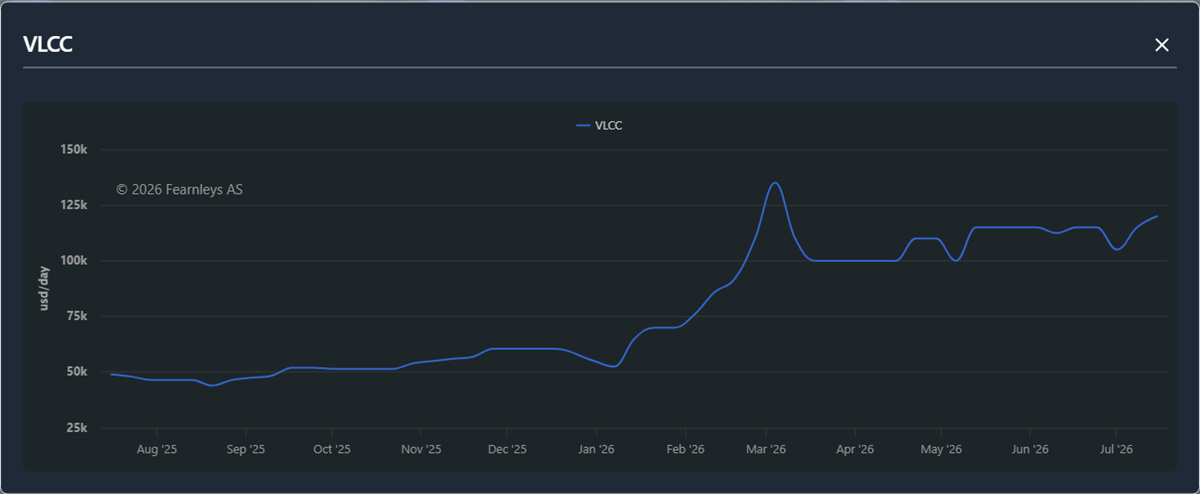
VLCCs can have breakevens as low as $15,000 per day, so elevated rates for extended periods are huge boosts to shipping company stocks, even if total volumes are much lower. Many Gulf ships have been rerouted around the Cape of Good Hope, causing rates to spike by 30% to 50% to offset longer voyages. And many of these companies are efficiently using higher rates to boost their bottom lines.
With the tanker trade back in full force, investors might want to consider this pair of stocks, each with a high-quality fleet and a potential catalyst on the horizon.
Frontline: Largest Fleet With an Array of Trading Routes
Frontline PLC (NYSE: FRO) operates the largest global shipping fleet with a variety of VLCCs, Aframax, and Suezmax vessels.
The company serves trading routes across the Middle East, Asia, the Americas, and Europe, and this strategic positioning enables it to be highly sensitive to rate-market volatility.
This was apparent in the company’s fiscal Q1 2026 earnings report, released late May, which showed revenue spiked 67% year-over-year (YOY).
More than 80% of its VLCC days were already booked for Q2 at the time of the release, and the Q2 report is scheduled for Aug. 31.
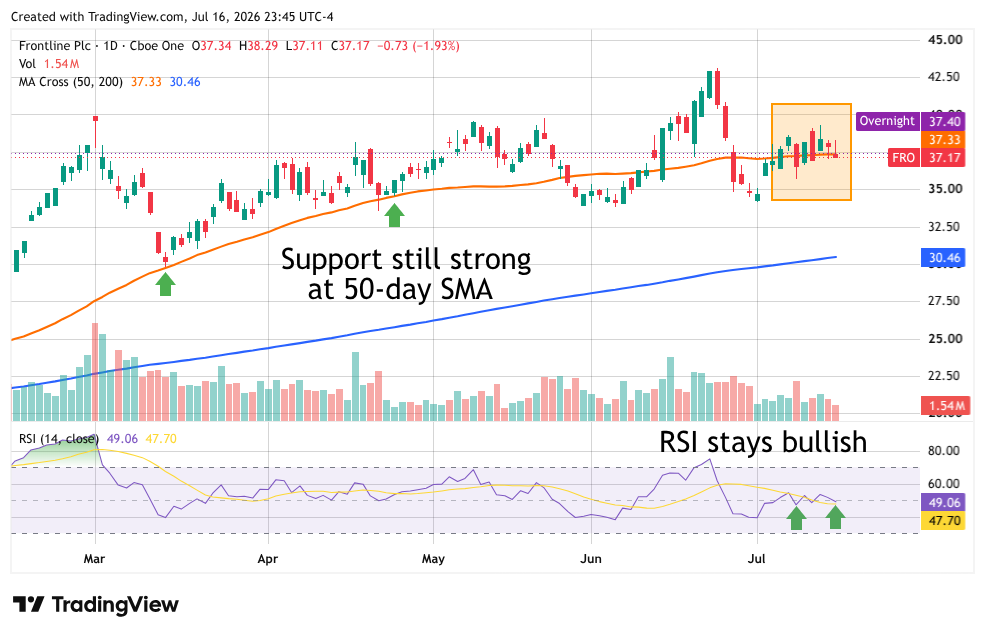
Support at the 50-day moving average has been strong for FRO shares throughout the conflict, although the stock remains stuck at the same price it was in March. But the 50-day continues to hold, and the Relative Strength Index (RSI) hints that upward momentum is brewing.
DHT Holdings: The Steady Compounder With Healthy Balance Sheet
Not only do the VLCCs owned by DHT Holdings Inc. (NYSE: DHT) have some of the lowest breakevens in the industry at around $15,000 per day, but the company itself has almost no debt (rare for a shipper) and pays a strong dividend.
Using a mix of spot and time charters, DHT transports crude oil barrels from the Gulf to refiners in Asia, North America, and Europe.
Despite having more than 50 VLCCs trapped in the Strait of Hormuz in fiscal Q1 2026, the company still reported YOY revenue growth of nearly 135%.
One point of contention: the dividend is looking increasingly risky at 14.75% with a payout ratio of 124%.
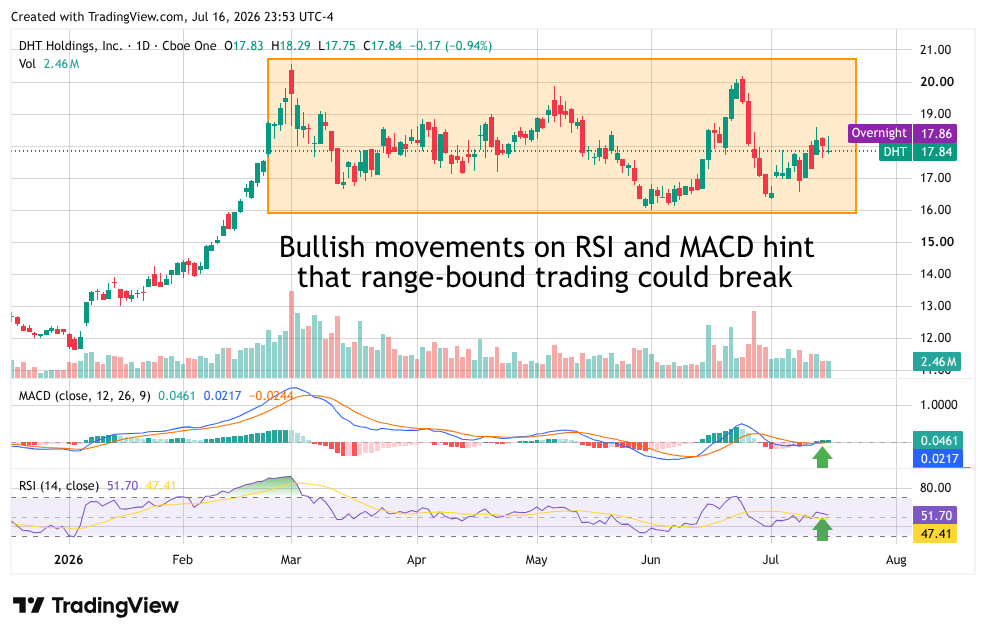
Like many of its VLCCs, DHT shares have been stuck in neutral, trading in a tight range after spiking in the buildup to the war. The stock recently spiked off the low end of this trading range, and signals on the RSI and the Moving Average Convergence Divergence (MACD) indicator show bullish momentum accelerating once again.
The company’s next earnings release is for fiscal Q2 2026 results on Aug. 5, and investors will be eagerly awaiting an update on the condition of the VLCC fleet.
Elon’s next move will be bigger than the IPO – and it could happen any day now (Ad)

Hedge fund legend Larry Benedict – who delivered a 279% return on cash in 2025 and went on a 20-year winning streak – says the SpaceX IPO wasn’t the main event. It was the trigger.
He’s identified what he calls the ‘Final Phase of Elon’s Master Plan,’ and one specific ticker he believes could see billions forced into it within days. It’s not SpaceX, Tesla, or any company you’d associate with Elon Musk. Larry is revealing the ticker free today.WATCH LARRY BENEDICT’S PRESENTATION AND GET THE ONE TICKER NOW
Shopify’s Quiet AI Strategy Could Be Its Biggest Advantage Yet
Written by Sam Quirke

While much of the technology worldhas spent the past few years scrambling to bolt artificial intelligence (AI) features onto existing products, Shopify Inc. (NASDAQ: SHOP) has been playing a quieter, and potentially far smarter, game.
Rather than treating AI as a marketing add-on, the e-commerce platform has been methodically positioning itself at the very center of what’s increasingly being called agentic commerce. And that bet is now starting to look compelling.
The stock has been reflecting some of that renewed optimism, climbing about 13% over the past month. It’s worth keeping that in perspective, though, as shares are still down over 20% year to date and are trading back at December 2020 levels, which shows just how far sentiment had swung against it.
But with a fresh vote of confidence from Wall Street this week and a key earnings report now less than three weeks away, the argument that Shopify is emerging as one of the biggest long-term winners in the AI shopping shiftis gaining real traction.
Why Shopify’s Positioning Is So Compelling
The core of the bullish argument comes down to where Shopify sits in the commerce ecosystem. The company is already deeply embedded in how hundreds of thousands of merchants run their businesses, handling everything from storefronts and payments to inventory and logistics. That deep integration makes it a natural control layer for the next wave of AI-driven shopping, the point through which automated, agent-led transactions can actually flow.
This is a crucial distinction. As AI agents increasingly begin to handle shopping tasks on behalf of both merchants and consumers, whoever owns the underlying infrastructure those agents plug into stands to benefit enormously.
Shopify isn’t trying to build a flashy consumer-facing chatbot to compete for attention. It’s positioning itself as the plumbing that makes agentic commerce work in the first place, which is a far stickier and more defensible place to be.
The early evidence suggests the strategy is working. Management has pointed to a substantial increase in AI-generated orders over the past year, a clear signal that automated shopping flows are already accelerating across the platform.
Wall Street Is Starting to See It Too
The most compelling recent endorsement came earlier this week, when Jefferies upgraded Shopify to a Buy rating and raised its price target to $160, implying almost 30% upside from current levels. It views Shopify as uniquely positioned to become the infrastructure layer for agentic commerce, or as commentary neatly put it, the “agent enablement” toolkit for merchants.
The upgrade wasn’t just built on the big-picture theme. Jefferies also pointed to third-party data that bolsters confidence that Shopify’s upcoming report will beat consensus estimates, flagging that newly announced changes to Shopify’s partner program should support near-term growth while lowering the company’s long-term sales and marketing cost structure, a rare combination of a growth tailwind and a cost improvement at once.
Perhaps most interesting was the observation on pricing. Jefferies sees a price increase as likely, which would represent a meaningful source of upside heading into 2027. Shopify last raised prices in 2023 and 2024 and has since rolled out a slew of new features, most notably its AI assistant, Sidekick, while absorbing the associated costs itself. That sets up a scenario where the company has been adding significant value without yet charging for it, leaving clear room to raise prices down the line.
The Valuation Question Can’t Be Ignored
To be sure, the bull case is not without its challengers, and the biggest pushback is the one that has followed Shopify for years: valuation. Even after a difficult first half of the year for the share price, Shopify’s triple-digit price-to-earnings ratio still feels frothy. It suggests that much of its future growth could already be baked into expectations.
Scaling AI capabilities isn’t free either, and the infrastructure costs of running inference workloads at scale could weigh on margins if not carefully managed. These are fair points, and they’re the reason this isn’t a slam-dunk. But it’s also worth remembering that Shopify remains a high-quality business with strong cash generation and a solid balance sheet—exactly the attributes you want to see in a company investing for a long-term shift.
Sights Set on August’s Report
With all of this in mind, Shopify’s upcoming earnings report is shaping up to be a pivotal moment. The most important thing to watch will be the data on AI-driven revenue, particularly further evidence that AI-generated orders are accelerating, as that’s the metric that most directly validates the entire agentic thesis.
Strong second-quarter numbers, in line with what Jefferies is anticipating, would also go a long way toward justifying the recent optimism. Deliver on that front, and a stock that has been quietly clawing back gains over the past month could find itself with a lot more room to run. READ THIS STORY ONLINE
Before SpaceX goes public, watch this tiny supplier closely (Ad)

When the railroads launched in the 1860s, Andrew Carnegie didn’t profit by riding the trains – he got rich owning the steel rails they ran on. The same dynamic may be playing out today around the anticipated $1.75 trillion SpaceX IPO.
Analyst Michael Robinson has identified a tiny, under-the-radar supplier – just 1/60th the size of SpaceX – that he believes sits at the center of Elon Musk’s broader AI infrastructure buildout.WATCH ROBINSON’S PRESENTATION AND SEE THE DETAILS BEFORE THE IPO WINDOW CLOSES
Why These 3 Nuclear ETFs Are Getting a Fresh Look as AI Power Demand Rises
Written by Nathan Reiff

More than a year after the federal government renewed a push toward nuclear energy, the industry is building momentum thanks to a streamlined process for reactor authorization, an ambitious goal of 300 additional gigawatts of capacity by 2050, and more. The timing is crucial, as AI electricity demand continues to grow and low-carbon energy generation via nuclear facilities is particularly appealing in these contexts.
To be sure, challenges remain: sourcing the high-assay low-enriched uranium (HALEU) necessary for some next-gen reactors is difficult, and supply chain and manufacturing capacity limitations, workforce shortages, and the licensing process can all hold up the industry’s capabilities to deliver nuclear energy quickly. Still, as the industry continues to evolve and grow, a number of exchange-traded funds (ETFs) can expose investors to the many potential growth opportunities in the nuclear industry. Now may be a good time to explore these options, as a sell-off in the industry in 2026 after a previous successful run can present buy-in opportunities.
A Selective Basket of Global Nuclear Stocks
The VanEck Uranium and Nuclear ETF (NYSEARCA: NLR) is one of the oldest nuclear industry ETFs on the market, having launched in the summer of 2007. The fund’s staying power may be due to its broad strategy within the industry, allowing access to the full nuclear power generation process from the sourcing and production of input materials to companies operating power plants and more.
NLR achieves this mix despite its fairly small basket of 32 stocks. With a targeted portfolio like this, investors should expect that some names will receive sizable allocations, and indeed, the largest positions here do range up to 8% or more. Still, given its global focus, NLR is able to funnel its assets into the most stable, highest-performance nuclear stocks available worldwide, aiming for both breadth and quality.
Like many nuclear funds, NLR’s year-to-date (YTD) performance is in the red: the ETF has declined by almost 12% in 2026. This valuation reset across the industry could provide an opportunity, although investors must be willing to accept NLR’s 0.56% expense ratio while they wait for the momentum to build again.
A Unique Play on Uranium Miners With a Commodities Twist
For a more targeted play on uranium itself, investors might consider the Sprott Uranium Miners ETF (NYSEARCA: URNM). This fund invests primarily in companies involved in the uranium mining industry, including those that explore, develop, produce, or hold physical uranium. This industry is a niche one, and URNM has only 31 holdingsbased on a global screen. Given the significant overlap between URNM’s portfolio and NRL’s holdings, it’s unlikely that investors would want to hold both funds at the same time.
Three positions in URNM’s basket make up nearly half of the fund’s total assets, collectively. These include uranium providers Cameco Corp. (NYSE: CCJ)and NexGen Energy (NYSE: NXE), but the third stands out: it is a position in the Sprott Physical Uranium Trust, which holds physical uranium. Thus, URNM is in part a commodities play on uranium itself. This may help to explain why the fund is somewhat more expensive than several of its nuclear peers, with an expense ratio of 0.75%.
Despite its YTD decline, URNM offers a dividend yield of 2.59%, a passive income perk even as the nuclear industry is in the midst of a reset.
An Alternative Approach to Uranium With a Standout Dividend Yield
A competitor of URNM, the Global X Uranium ETF (NYSEARCA: URA) also focuses on the material essential for nuclear power. However, URA accesses uranium via shares of companies involved in mining and production, rather than through any type of direct investment in the commodity itself. URA has the broadest portfolio of these three ETFs, with about 56 holdings from developed markets around the world. Still, it is, in some ways, also the most concentrated: Cameco shares make up nearly a quarter of the fund.
URA’s expense ratio of 0.69% lies between the two funds’ fees above, and it has a solid asset base of $5.7 billion and a hearty trading volume to match. This makes the fund appealing to investors seeking the flexibility to make frequent trades without worrying about liquidity. It may also reflect the ETF’s strong dividend yield of 5.26%. While UFA has also slipped so far this year, it has held up better than the other uranium-focused funds on this list. READ THIS STORY ONLINE
BofA: Digital Dollar Coming 2025-2030 (Ad)

Bank of America just revealed your expiration date. In their Bloomberg interview, they didn’t just predict the digital dollar. They gave us the timeline… 2025 to 2030. We’re in that window right now.
Once the digital dollar launches, every transaction you make will be tracked. Your spending could be controlled. Your accounts could be frozen.
Over 4,500 investors have already used this legal backdoor to hold assets CBDCs can’t freeze and generate yields the Federal Reserve can’t touch.WATCH HOW TO ACCESS THE LEGAL BACKDOOR BEFORE IT CLOSES.
The Night Owl is a financial newsletter that provides in-depth market analysis on stocks of interest to individual investors. Published by MarketBeat and Early Bird Publishing, The Night Owl is delivered around 9:00 PM Eastern Sunday through Thursday. If you give a hoot about the market, The Night Owl is the newsletter for you.

If you need help with your subscription, please email our U.S. based support team at contact@marketbeat.com.
Unsubscribe
© 2006-2026 MarketBeat Media, LLC. All rights protected.
345 North Reid Place #620, Sioux Falls, SD 57103-7078. U.S.A..
Today’s Featured Content: 3 AI stocks to buy before August 2026(From The Oxford Club)


