Unsubscribe Deutsche Bank Projects Gold Near 8000 an Ounce by 2031 (From Cedar Gold Group)
Qualcomm’s Data Center Bet Looks More Real After Amazon’s AI Deal
Written by Jeffrey Neal Johnson

Investors continue to seek disciplined strategies to participate in the evolving artificial intelligence (AI) economy without paying inflated multiples for standard graphics hardware. Capital remains focused on businesses positioned to sustain steady enterprise workload expansion while maintaining reasonable valuation metrics.
Whenever a major hyperscale cloud provider partners to design tailored processors for optimized operational expenditure, the broader technology sector recalibrates expectations. Analyzing this architectural evolution illustrates how established semiconductor suppliers are pivoting into essential cloud connectivity partners, creating structural tailwinds for ongoing operational expansion.
Amazon and Qualcomm Forge New Circuits
On Sept. 8, 2026, Qualcomm Incorporated (NASDAQ: QCOM)announced a multi-generational agreement with Amazon.com, Inc. (NASDAQ: AMZN) to engineer custom silicon and optical networking solutions for Amazon Web Services. Qualcomm shares rose about 9.5% intraday, opening near $180.40 before settling around $174 per share.
The core driver of this market reaction centers on the commercial structure detailed in regulatory filings with the Securities and Exchange Commission. Qualcomm granted Amazon warrants to acquire up to 25 million shares of Qualcomm common stock at an exercise price of $161.26 per share.
Rather than handing out unearned equity, this arrangement ties share ownership directly to performance. An initial block of 3.75 million shares vested at signing, while the remaining 21.25 million shares vest progressively across tiers linked to Amazon Web Services’ purchases of hardware and services up to $60 billion over a 10-year window through September 2036.
Amazon is making a concerted effort to deploy custom silicon for artificial intelligence inference, selecting Qualcomm to help challenge traditional merchant accelerator models.
Beyond the Smartphone: Qualcomm Builds Its Enterprise Engine
Qualcomm has worked to navigate consumer electronics cycles, which historically weighed on its market valuation. The company’s third-quarter earnings report showed revenue of approximately $9.95 billion, down about 4% year-over-year (YOY), primarily due to a 20% YOY decline in mobile handset processor sales. This new pact provides tangible evidence that Qualcomm is diversifying away from smartphone hardware and patent licensing dependence.
Management confirmed that commercial processors designed in collaboration with Amazon Web Services are already in production, with initial revenue recognition expected in Qualcomm’s first quarter of fiscal year 2027. During the Goldman Sachs Communacopia Conference on Sept. 8, Qualcomm management reaffirmed an enterprise goal of generating $15 billion in annual data center revenue by fiscal year 2029, building upon an intermediate target of $5 billion.
Optical Connectivity Makes the Deal Bigger Than Chips
The partnership extends beyond processing units into data center networking. Qualcomm is providing Amazon Web Services with optical connectivity systems scaling up to 1.6 Terabits per second. By applying high-speed SerDes and optical digital signal processing technologies acquired through the $2.4 billion acquisition of Alphawave Semi, Qualcomm supplies the physical communication links needed to connect thousands of custom processors across server racks.
Combining energy-efficient compute logic with proprietary high-speed optics could raise switching costs over time, embedding Qualcomm more deeply into Amazon’s physical AI infrastructure across several product generations.
Trimming Token Costs: Amazon Is Targeting Lower AI Inference Costs
For Amazon, deploying custom application-specific integrated circuits targets the escalating total cost of ownership in modern computing facilities. General-purpose merchant graphics processors handle model training effectively, yet running daily inference queries across enterprise applications demands tighter power management and lower operational cost per processed token.
Co-developing dedicated inference silicon with Qualcomm allows Amazon Web Services to lower electrical demand per rack, offer attractive pricing to cloud customers, and protect cloud operating margins against rising capital expenditures.
The relationship operates in both directions. Qualcomm will expand its reliance on Amazon Web Services infrastructure by incorporating Amazon Bedrock into its internal electronic design automation tape-out processes.
Applying cloud-hosted generative AI models to complex chip layout workflows reduces design cycles from several months to a few weeks. This integration helps curb Qualcomm’s internal research costs while generating recurring cloud service billings for Amazon.
Qualcomm’s Valuation Still Leaves Room for Repricing
Examining underlying fundamentals highlights an intriguing valuation disparity. Qualcomm currently trades near 20 times forward earnings. By comparison, enterprise custom silicon designers such as Broadcom (NASDAQ: AVGO) and Marvell (NASDAQ: MRVL) frequently trade between 28 and 32 times forward earnings.
As data center revenues begin compounding during the first quarter of 2027, Qualcomm could experience multiple expansions toward the levels commanded by dedicated cloud infrastructure suppliers.
Qualcomm supports this strategic expansion with a healthy balance sheet, including a debt-to-equity ratio of about 0.46, a return on equity of roughly 38.36%, and an annualized dividend of $3.68 per share, which yields about 2.1%. For equity investors focused on dividend growth, this cash return offers downside stability as data center revenue expands.
Wall Street analysts have begun updating expectations to reflect this development. Across 38 brokerage evaluations, the consensus analyst price target stands around $204 per share, pointing to upside potential of approximately 17%. Independent firms like Rosenblatt Securities recently reaffirmed positive ratings with a price target of $235, citing enterprise diversification as the primary driver of future earnings revisions.
The 10-Year Grid Requires Patience
Investors evaluating this landscape should balance the upside against clear business risks. The 25 million-share warrant package introduces prospective share dilution of about 2.2% against Qualcomm’s equity float, with a strike price of $161.26 per share.
Because the $60 billion commercial purchasing window unfolds over a full decade, financial gains will materialize gradually rather than immediately resetting quarterly earnings. Qualcomm also faces ongoing competition from established merchant hardware suppliers for cluster allocations.
The underlying fundamentals suggest durable strategic alignment. Amazon secures specialized, energy-conscious silicon to defend cloud profitability, while Qualcomm gains an anchor customer that can drive sustained data center growth.
Investors might use short-term price pullbacks to establish or build positions, while closely watching the first-quarter 2027 earnings releases to confirm that early enterprise silicon shipments remain on schedule. READ THIS STORY ONLINE
Grab a FREE copy of Options Trading Explained today. (Ad)

Lance Ippolito spent nearly two decades trading the markets, appearing on MoneyShow, Cheddar TV, CNN Money, and MarketBeat.
His free guide, Options Trading Explained, covers two tickers pros call their secret weapon, Wall Street’s daily hidden edge, and a strategy that targets payouts around 4 PM ET.
It also explains how to avoid overnight risk when trading options.DOWNLOAD YOUR FREE OPTIONS TRADING GUIDE NOW
GE Aerospace’s $11.75B Deal Puts Howmet Aerospace in Focus
Written by Jeffrey Neal Johnson

When the world’s commercial jet assembly lines stall, the root cause is almost always found deep inside the foundry. For years, aviation’s recovery from the pandemic has struggled against a stubborn bottleneck: the high-pressure turbine blades, vanes, and complex engine castings at the heart of every engine.
GE Aerospace (NYSE: GE) altered that landscape by agreeing to acquire Consolidated Precision Products for about $11.75 billion. This deal would lock in GE’s component supply for the industry’s top propulsion programs, while creating an immediate ripple effect across the supply chain.
Shares of independent casting specialist Howmet Aerospace (NYSE: HWM)retreated around 10% on market concerns that GE would now make more of its parts in-house. However, when weighing industrial realities and long-term order books, the data points to an expanding super-cycle rather than a zero-sum conflict.
Examining the structure of this acquisition shows why both companies sit in an advantageous position.
GE Aerospace Captures Captive Casting Power
High-temperature investment castings represent the most demanding manufacturing stage in modern aviation. Foundries pour specialized nickel and cobalt superalloys into intricate single-crystal airfoils designed to run at temperatures that exceed the metal’s own melting point.
These rotating blades and static vanes are essential to the CFM LEAP engine family, which equips most global narrowbody passenger jets. Because foundry output has set the pace of deliveries, owning the supplier would give GE Aerospace priority over its multi-year commercial backlog.
The transaction’s financial mechanics show GE’s balance-sheet discipline. The company intends to fund roughly $7 billion of the purchase price with cash on hand, covering the remainder through newly issued debt. Company leadership confirmed the purchase will boost adjusted earnings per share and free cash flow in the first full year after closing, leaving planned dividend distributions and capital allocation programs undisturbed. With annual revenue near $46 billion and net profit margins around 17.7%, GE Aerospace is moving idle cash into high-yield physical assets that insulate its assembly lines.
GE Aerospace Rewires Component Production
Consolidated Precision Products has an established industrial footprint, comprising more than 20 production facilities and approximately 6,600 specialized workers across North America and Europe. Integrating an outside parts supplier of this scope requires steady coordination, which GE Aerospace intends to execute through its proprietary Flight Deck operating model. This lean manufacturing discipline reduces casting defects, improves metallurgical yields, and accelerates production cycle times across complex turbine cases and airfoils.
The regulatory outlook appears relatively clear. GE Aerospace and Consolidated Precision Products have maintained an active commercial relationship for more than 15 years, giving antitrust regulators a familiar, stable operating precedent.
Executives expect to secure regulatory clearances and complete the purchase in the second half of 2027. By shifting from customer to owner-operator, GE Aerospace aims to protect its assembly schedule from third-party logistics disruptions while eliminating vendor markups on profitable aftermarket replacement parts.
Howmet’s Discount: Is the Drop a Hot-Metal Overreaction
The market responded to the transaction by sending Howmet Aerospace shares down roughly 10% to around $233 per share on elevated trading volume, as traders reassessed merchant demand.
This initial selling pressure assumes that internal sourcing at GE Aerospace will leave independent foundries with idle capacity. Industry fundamentals suggest otherwise. Casting capacity for advanced high-pressure hot sections remains in a severe multi-year deficit, with record backlogs across commercial airlines and defense programs that stretch into 2030.
A secondary demand catalyst is accelerating alongside commercial aviation: natural gas power generation. The rapid global expansion of artificial intelligence data centers demands constant, reliable baseload electricity, prompting utilities to order high-efficiency industrial gas turbines that use the same single-crystal airfoil castings used in jet engines.
Howmet Aerospace serves both end markets from a position of financial strength. The company maintains net profit margins above 20%, an operating return on equity near 34%, and a conservative debt-to-equity ratio of about 0.71.
Backed by proprietary metallurgical patents and multi-year supply agreements with alternative propulsion manufacturers such as Pratt & Whitney, Safran (OTCMKTS: SAFRY), and Rolls-Royce (OTCMKTS: RYCEF), Howmet retains durable pricing power. The recent pullback offers investors an attractive entry into an irreplaceable industrial producer.
Flight Plan for Capital: Balancing GE Scale With Howmet Value
Looking at both stocks through an analytical framework offers two complementary ways to invest in the aerospace supply chain. GE Aerospace trades near $322 per share, carrying a trailing price-to-earnings ratio around 38x and a forward multiple near 41x. Wall Street consensus holds a Moderate Buy rating on the stock, with an average price target of about $391 and top-tier estimates reaching $455. Securing Consolidated Precision Products reinforces this earnings trajectory by removing output limitations on lucrative, long-term commercial engine maintenance agreements.
Howmet Aerospace trades near 43x forward earnings, down from highs that reflected component scarcity. Analysts maintain a consensus price target of roughly $316 per share on the company, presenting around 35% potential upside from recent prices. While GE provides primary exposure to complete engine assemblies and expanding free cash flow, Howmet offers unique metallurgical intellectual property paired with balance-sheet liquidity, reflected in a current ratio of about 1.82.
The global aerospace manufacturing base is experiencing structural reorganization, but market demand for complex cast components continues to outpace factory output. Investors who evaluate this transaction objectively can look past short-term trading sentiment and recognize that securing vital manufacturing capacity strengthens the operating environment for both aerospace leaders. READ THIS STORY ONLINE
Deutsche Bank Projects Gold Near 8000 an Ounce by 2031 (Ad)

Deutsche Bank’s research team projects gold could reach $8,000 per ounce by 2031, roughly 80% above current prices, as central banks continue shifting reserves away from the U.S. dollar.
It’s not alone: JPMorgan sees $6,000 by year-end, Goldman Sachs $5,400, and UBS $5,900 by late 2026 – three major banks already forecasting gold above $5,000.
For retirees holding savings mostly in dollars, cash, or bonds, this shift could matter more than most realize.DOWNLOAD THE FREE WEALTH PROTECTION GUIDE TO SEE HOW YOU’RE POSITIONED
Casey’s Post-Earnings Drop May Give Investors a Better Entry Into a Quality Retailer
Written by Thomas Hughes
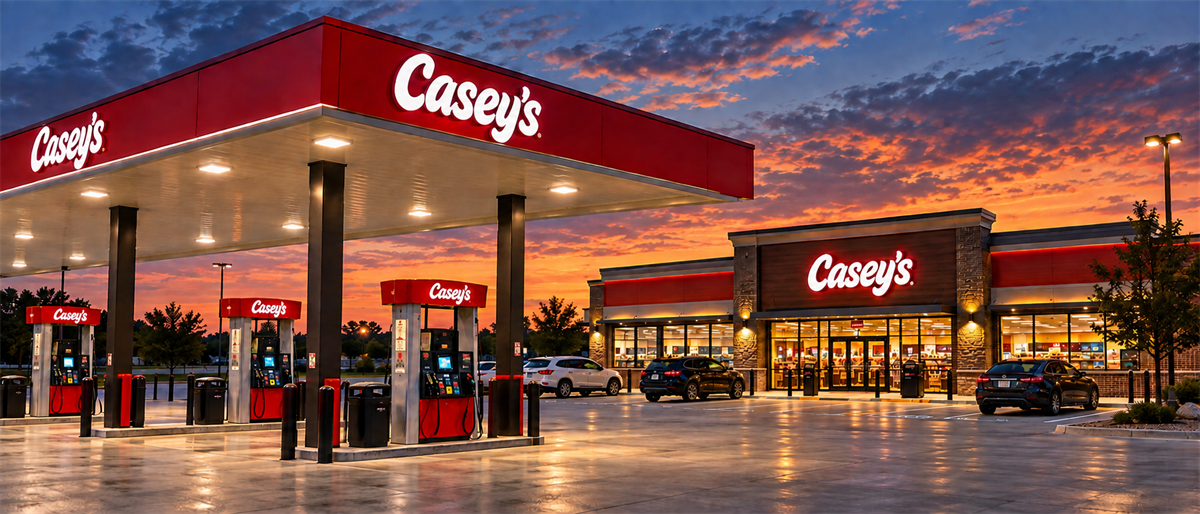
Casey’s General Store’s (NASDAQ: CASY) September stock price plunge is a thing of beauty for buy-and-hold investors. While the near-term pain is obvious, with shares down more than 10% following the first quarter fiscal year 2027 (FY2027) release and roughly 35% from their 2026 peak, the potential for long-term gain is undeniable.
Casey’s is among the best-operated businesses on Wall Street, sustaining a fortress-quality balance sheet while investing in growth and returning capital to shareholders. Its stock price action is supported by growth, margins, margin strength, cash flow, dividends, and share buybacks, all of which are expected to continue in the coming years and point to substantial value gains for investors.
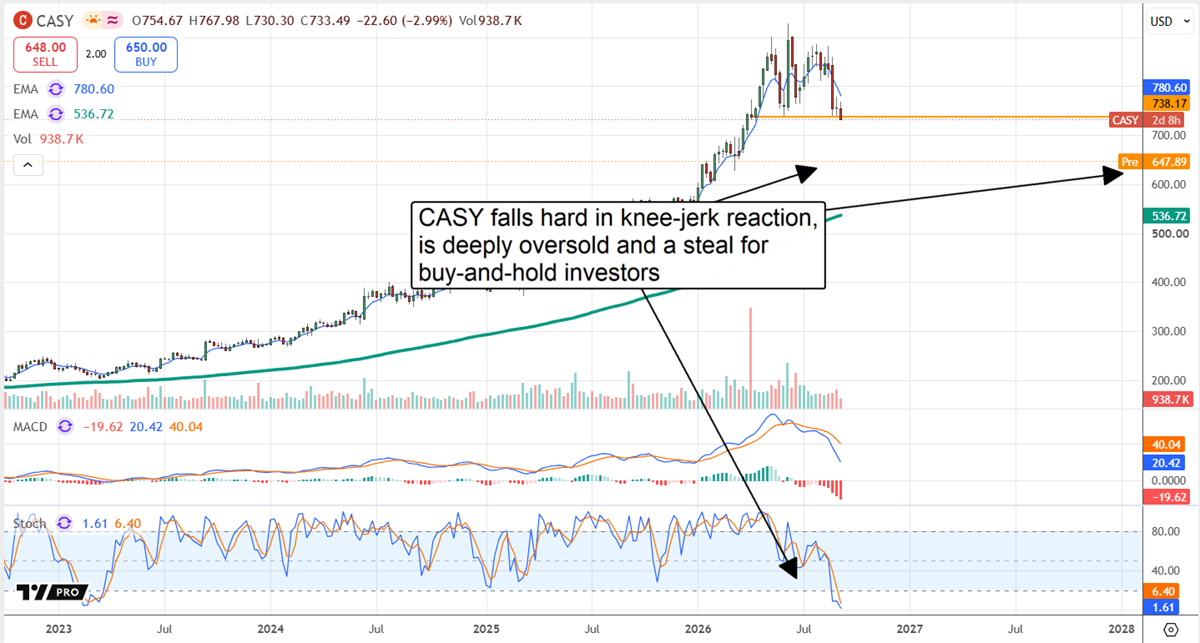
The details of the Q1 FY2027 report were more of an excuse to sell than a real trigger. While slowing growth and rising costs are a concern, outperformance, wider margins, and cash flow strength were also present, suggesting the bearish reaction is a knee-jerk response likely to be corrected quickly. The more pressing concern is the guidance, but even that provides a catalyst likely to emerge as soon as the subsequent earnings report. Guidance is positive, expecting growth, but it was maintained at the prior level rather than strengthened, which is odd given the Q1 strength. The likely outcome, however, is cautious guidance, continued strength, outperformance in Q2 and eventual improvement.
Casey’s 3-Year Plan Is Already Showing Up in Results
Casey’s General Stores revealed an ambitious three-year plan earlier this year, and the results are already starting to show. Key takeaways include a focus on food, menu offerings, customer satisfaction, store counts, and technology reminiscent of fast-casual restaurant successes such as Chipotle Mexican Grill (NYSE: CMG).
Laugh if you want, but a comparison is warranted. Casey’s is a gas station first and foremost, but it is the inside sales that drive growth, dominated by pizza and food offerings that have elevated it to 5th position in the US pizza market. Chipotle Mexican Grill’s then-CEO, Brian Niccol, accelerated growth and margin expansion with the same tactics he’s now using at Starbucks—leaning into digitization for efficiency, consumer reach, and loyalty programs, just as Casey’s is doing.
Casey’s General Store grew revenue by 24.5% to $5.69 billion on the combination of comp-store growth, new stores, and acquisitions. Revenue outpaced MarketBeat’s consensus by more than 250 basis points (bps), driven by better-than-expected comps and a faster-than-expected Fike’s integration. Inside comps grew by 3.2%, down from last year’s 4.3% but ahead of forecasts, underpinned by a 4.8% increase in food. Margin was another strength, with the inside margin improving to 42.2%. Fuel gallons sold declined marginally by 0.3%, but a substantial margin improvement offset the decline, resulting in a nearly 20% increase in segment gross profit.
Margin news is good. Operating costs rose by 8%, trailing the 24.5% top-line advance by a wide margin, leaving net earnings and GAAP earnings per share (EPS) up by 27.1% and 27.7%, respectively. Looking ahead, the company still expects solid results for the year, with inside comps forecasts up 2%-5%, but the lack of improvement helped trigger and amplify the sell-the-news event.
Analysts Remain Constructive After Casey’s Q1 Pullback
Analysts’ initial responses do not align with the stock price plunge. The few commentaries released praised the results, citing Q1 strengths such as inside sales momentum, fuel margins, and the ability to meet full-year goals, all of which deserve a price premium. As it stands, the 20 analysts MarketBeat tracks rate the stock a Moderate Buy; the data shows a Buy-side bias, no sell ratings and strong price targets. While a few late-summer price target reductions cap upside, they align with the consensus forecast, suggesting a move into the low-$900 range. The current price target of $928.53 indicates nearly 53% upside.
Institutional buyers are likely to buy this stock on the dip. They reflect strong confidence in cash flow and the capital-return outlook, owning more than 85% of the stock. They have accumulated on balance for eight consecutive quarters, ramping activity in early calendar Q3 following the three-year strategy update.
Capital returns are a significant factor, including dividends and share buybacks. The company is a Dividend Achiever, having increased its dividend for more than 25 consecutive years, and has the potential to sustain annual increases for another 25 years. The yield is low at 0.43% but reliable and compounded by growth and buybacks. Buybacks reduce the share count incrementally each quarter, except when the company preserves capital for acquisitions. There are no major acquisitions in sight, only tuck-ins and organic expansions that the company can fund with cash flow. READ THIS STORY ONLINE
This Gold Explorer Sits Right Next to Barrick’s Nevada Mines (Ad)

Barrick Mining has spent decades building one of Nevada’s richest gold districts, anchored by Fourmile, Goldrush, and Cortez Hills, deposits that could hold up to 60 million ounces of gold.
One overlooked explorer controls 142 claims bordering Fourmile and sitting less than a mile from Goldrush. New geological modeling aims to reveal what’s beneath this largely untested ground, while a planned 5% royalty spin-off could give shareholders a separate stake in the project.READ THE FULL REPORT BEFORE THE NEXT CATALYST HITS
More Stories
- Tesla’s Robotaxi Launch Wasn’t the Moment Investors Expected
- 3 Stocks to Buy and Hold for Higher Interest Rates
- [URGENT!] The Dollar Lost 12% (Here’s How to Stop the Bleed)(Ad)
- Defense, Solar, and Refining Stocks Split as the Iran Conflict Raises Energy Risk
- Lululemon’s Problems May Not Be a Warning for Every Athleticwear Stock
- PayPal’s Takeover Story Ended, But Its Turnaround Story Didn’t
- Cathie Wood Trimmed Palantir, But the Bigger Story Is Still Valuation
The Night Owl is a financial newsletter that provides in-depth market analysis on stocks of interest to individual investors. Published by MarketBeat and Early Bird Publishing, The Night Owl is delivered around 9:00 PM Eastern Sunday through Thursday. If you give a hoot about the market, The Night Owl is the newsletter for you.

If you need help with your newsletter, please feel free to email MarketBeat’s U.S. based support team at contact@marketbeat.com.
Unsubscribe
Copyright 2006-2026 MarketBeat Media, LLC.
345 N Reid Place #620, Sioux Falls, S.D. 57103-7078. United States of America..
Check This Out: Grab a FREE copy of Options Trading Explained today. (Click to Opt-In)

 RJ Hamster