I was born on 6 August 1956 in San Francisco, California to Janet and (the late) Richard Hovis.
I grew up in Santa Monica, California where I attended elementary, junior high school, and high school (graduating in 1974), in addition to involvement in sports and recreation (Little League +, the Boy’s Club ++). Further, it was in elementary school – St. Augustine’s By-the -Sea Parish School that I found, and made the choice to truly journey with God.
I attended Arizona State University from 1974 to 1977 – seeking to become an architect, however, I was not accepted, and, as such, I graduated with a Liberal Arts degree.
Upon graduation from Arizona State University, I attended Cal Poly San Luis Obispo and studied City and Regional Planning at the Master’s level. I successfully completed one (1) year in a two (2) year program – I did not complete the Master’s degree in City and Regional Planning – due to personal reasons.
I returned to Santa Monica where I started (October 1979) my career as graphic designer with Exxon Company, USA. I spent five years with Exxon Company, USA.
While working with Exxon Company, USA I was accepted into architectural school – Sci-Arc in Southern California, however, I did not attend preferring to stay with Exxon..
In 1982 I married Laura Flosi and in April 1983 we had our one and only child – Lauren Alain Hovis – a gift from God.
We moved to Phoenix, Arizona in 1984 from Los Angeles, where I went to work as a graphic designer with Kitchell CEM (from 1985 -1987).
From 1987 – 1995 I was an independent contractor, and a registered representative in mortgage finance, financial management, graphic design, and drafting.
Further, I attended the University of Phoenix and successfully obtained a Master’s in Business Administration (MBA) in 1982.
I was also a member of the Scottsdale Jaycees, where I became very involved in community events and projects.
In 1994, I accepted a cartography position with the Defense Mapping Agency in Reston, Virginia. As such, I relocated from Phoenix to Reston.
In 1998, I was accepted and worked as a Visual Information Officer with the Central Intelligence Agency. In 2002, I worked as a Support Officer until my retirement (due to a need for shoulder surgery) in September 2018.
Away from my Federal Government service, I have been involved in various organizations and activities in Northern Virginia.
In November of 2011, I married Rebecca Ouellette in Santa Monica, California. I reside in San Tan Valley, AZ with my two hamster - Jess and Timothy, our fish, our lizard - RJ Lizard., and our cats - Pearl and Grey.
As to hobbies, I enjoy playing sports, attending sporting events, mentoring individuals from financial management to hamsters, building models, photography, travel, multimedia design, managing partner for RJ Hamster, and jazz – smooth jazz to a samba or a bossa nova.
Love and God Bless,
Peter – aka RJ Hamster Jo hi
This email is never sent unsolicited. You have received this Newsmax email because you subscribed to it or someone forwarded it to you. To opt out, see the links below.
Remove your email address from our list or modifyyour profile. We respect your right to privacy. Viewour policy.
This email was sent by: Newsmax.com 362 N. Haverhill Road West Palm Beach, FL 33415 USA
Editor’s Note: Louis Navellier has spent 40+ years identifying stocks before major tech waves — his system helped him flag. Nvidia before its 82,000% run. Today, he’s revealing the three stocks at the center of the biggest AI buildout in history. Click here for the full story or read more below.
Dear Reader,
Goldman Sachs just predicted 300 million jobs will disappear.
Not in 10 years. Not in 5.
This is starting NOW.
30,000 layoffs at UPS. 16,000 at Amazon. Factories are going “lights out” with zero human workers.
And now Elon Musk’s “Project Apex” is set to accelerate this labor crisis.
A Nobel Prize-winning scientist says what Elon is building “could have an even greater impact on society than the internet.”
Nvidia’s CEO calls it “superhuman.”
And competitors are so panicked, they’re flying spy planes over the facility to figure out how it works.
I’ve spent 40+ years analyzing technological shifts like this. My proprietary system has helped me identify winning stocks before every major tech wave.
I’m telling you because on the OTHER side of this disruption is a historic investment opportunity.
The last time a technology shift this big happened, early investors in the right supply-chain stocks had the chance to see extraordinary gains. Lithium Americas: 1,452%. NIO: 1,755%. Blink Charging: 3,648%. All in under two years.
I’ve pinpointed one tiny company at the center of Elon’s AI revolution — 49 times smaller than Tesla — that’s become the “secret weapon” of Microsoft, Meta, Amazon, and Google. I’ll also share two more stocks positioned for this wave — but I believe this one is the must-own.
Insiders are buying stocks in 2026, but that doesn’t automatically make them good buys. Each company below carries risks, yet insiders’ purchases suggest upside tied to operational improvement and profit potential. Although headwinds persist, insiders have little reason to buy unless they expect gains. The key questions are timing and magnitude of any recovery. In every case there are near-term catalysts, and the upside potential begins in the double digits.
Insiders Bet Big on E.W. Scripps Rebound Potential
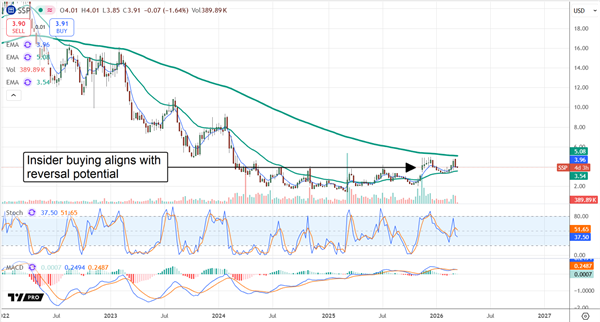
Insiders are making significant moves in E.W. Scripps (NASDAQ: SSP), suggesting they’re seeing something the market has overlooked. InsiderTrades data show executives — including the CEO, a director and several family-related holders — bought shares in March. That buying is notable both for its size and timing: insiders had not traded the stock for years, and are now suddenly active.
One driver is a push for efficiency: Scripps is integrating AI to boost productivity, cutting costs and expanding its network with a focus on sports and local broadcasting. Still, expectations are low—analyst coverage is thin and consensus forecasts show a contraction in fiscal 2027, which may overstate near-term weakness. Traditional TV faces headwinds in 2026, and Scripps is undergoing a high-risk turnaround while carrying meaningful debt.
Analyst sentiment is mixed—the consensus rating is Reduce, yet the implied upside from price targets is roughly 80%. Institutional trends are clearer: institutions own nearly 80% of the shares and have been net buyers over recent quarters. That buying, together with technical signs—a rounding base in 2024–25 and a move above key exponential moving averages (EMAs) in 2026—suggests the market may be forming a bottom.
First Financial Bankshares Insiders Buy, Buy, Buy
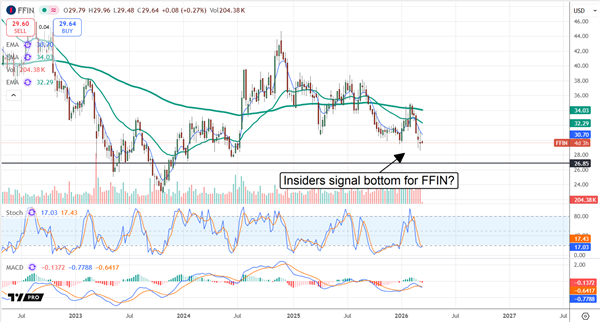
First Financial Bankshares (NASDAQ: FFIN) has seen persistent insider buying: steady quarterly purchases for the past five quarters with no insider selling. Activity was uneven through 2025 but surged in early 2026, led by directors and the CFO, who together bought more than $650,000 in shares and raised insider ownership to over 3.8%.
Reasons for the buying include a roughly 2.5% dividend (mid-March) paid at a payout below 50% of earnings, ongoing share buybacks and steady business growth. Book value increased more than 17.5% in fiscal 2025 and is expected to continue rising in 2026. Buybacks remain meaningful, though they didn’t fully offset dilution in 2025.
Analyst coverage is light—only three tracked analysts—and the consensus rating is Hold, with implied upside of about 30% from early March lows if current trends persist. Institutional ownership is stronger, at roughly 70%, and institutions have been net buyers over the past 12 months. Notably, institutional buying accelerated in Q1 2026 after a solid earnings report that reinforced the company’s capacity to return capital.
Crane Company Insiders Think It Can Fly Higher
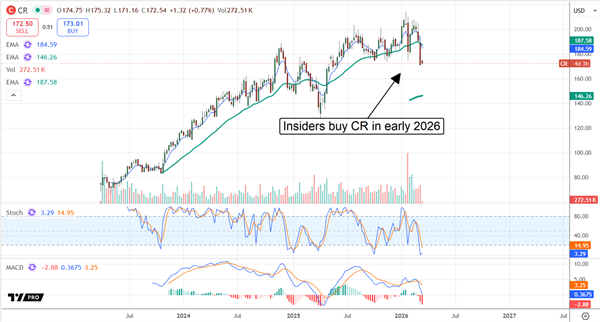
Crane Company (NYSE: CR) insiders bought shares in early Q1 after the company reported a strong quarter, raised guidance and increased the dividend by 10%. The dividend yield is modest but supported by a conservative payout ratio of about 15%, leaving room for acquisitions to drive growth. The company is forecast to grow at a mid-single-digit annual rate over the next few years while expanding margins—margin improvement is expected at a low double-digit pace.
Analysts are broadly bullish: all eight tracked analysts rate the stock a Buy and see roughly 30% upside. Institutional investors also appear confident, owning about 75% of Crane and buying aggressively in Q1—the activity balance was over $3.50 bought for every $1 sold—creating a supportive ownership base that can limit downside risk for investors.
Thank you for subscribing to StockReport.com, our daily newsletter that highlights a new stock each day.
This email content is a sponsored message for InvestorPlace, a third-party advertiser of StockReport.com and MarketBeat.
This ad is sent on behalf of InvestorPlace Media at 1125 N. Charles Street, Baltimore, Maryland 21201. If you’re not interested in this opportunity, please click here.
If you have questions or concerns about your account, feel free to contact our team at contact@stockreport.com.
If you no longer wish to receive email from StockReport.com, you can unsubscribe.
Managing Editor’s Note: After picking Nvidia in 2016, before it jumped as high as 32,000%, former tech executive Jeff Brown is back with a shocking new AI prediction. He believes Elon Musk’s new AI model will be so disruptive that it will trigger a new wave of crashes. And during a strategy session this coming Wednesday, April 8, at 2 p.m. ET, he will show you how to turn those crashes into gains of up to 287%, 476%, and 874% …in 30 days or less. Click here to RSVP or read more below.
Dear Reader,
If you’ve been reading my research, you already know that SpaceX is set to be the biggest IPO in history. I predict Elon Musk will shock the world when he begins to deploy his AI satellites into orbit.
But before the IPO… I believe Elon will create another huge opportunity for you to profit.
You see, he’s planning to release a new AI model that I predict will disrupt several companies… Leading to extreme volatility in the stock market.
To help you prepare, I’m having an urgent online strategy session this comingWednesday, April 8, at 2 p.m. ET.
And I’ll show you how you can turn all this coming volatility into huge gains.
You see, late last year… An AI company called Anthropic released a new AI model that was so revolutionary that… It triggered a wave of crashes in several software companies.
Elon Musk is about to release a new model that I believe will be even more revolutionary. It’s a model that’s set to be at least three times more powerful than the latest version of ChatGPT.
Nobody is prepared for the level of tech disruption I see coming.
Because if you’re holding the wrong stocks, you could lose everything in the coming days.
On the other hand, if you follow my “crash to cash” strategy… I believe you’ll have multiple chances to double or triple your money, or more…. All in about 30 days or less.
Every major market index is flashing caution or a sell signal – except one
Rate-cut odds just jumped from 5% to 25%, and small caps are already responding
Our AI forecasting model’s top bullish bets are clustered in two sectors
Relief on Wall Street…
Yesterday, the S&P 500 closed up 2.9% – its biggest move of the year and the third-largest daily gain of the last 12 months.
The top two?
The 9.5% jump on April 9, 2025, the week after the Liberation Day crash… and the 3.3% gain the month after that on May 12.
President Trump says the U.S. will end its war with Iran in “two or three weeks,” even without a full reopening of the Strait of Hormuz.
Traders took that as a reason to hit the buy button.
We’re enjoying the celebration just as much as anyone who owns stocks. But one good day in the market doesn’t change the trend we’ve been following for months…
Software companies – as tracked by the iShares Expanded Tech-Software Sector ETF (IGV) – have lost more than 20% year to date.
Even with a potential U.S. exit from Iran, oil is still over $100 a barrel. And if the Iranians don’t open the Strait, it’s hard to see it heading lower anytime soon.
And besides all this, we’re seeing bearish signals across most of the major U.S. indexes we track… with a few notable exceptions.
Elon Musk recently held an all-hands meeting at his closely guarded AI lab. He told employees… “We’re moving faster than any other company. No one’s even close.” Why? Because Elon built an AI breakthroughthat would take most tech CEOs four years to set up. He brought it online this year… and as early as today, April 1… Elon’s going to crank it to full blast. And potentially make ChatGPT, Claude, Gemini, and DeepSeek obsolete… While unleashing a brand-new 7,000% growth market. But here’s the twist. Neither Tesla nor SpaceX is the best way to play this opportunity. Instead, you’ll want to own the firm that controls over 38,000 patents on the technology (not semiconductors) that will power Elon’s career-defining vision. Click here for its name and ticker symbol.
Take note which major indexes are holding – or back – in the Green…
TradeSmith tracks two health indicators for stocks and indexes: Long-Term Health and Short-Term Health.
Think of them as the same instrument tuned to two different pitches.
Long-Term Health tracks a stock’s price action against its long-term historical volatility. Then it flags when it sees abnormal volatility spikes – the kind that tend to precede major trend shifts.
It’s designed for buy-and-hold investors who think in years, not months or weeks. When it flashes Red, the long-term trend has broken down. When it flashes Green, a new long-term uptrend has begun. And Yellow is a caution zone – it means to keep a close eye on things.
Short-Term Health works the same way but looks back at only a handful of months instead of a stock’s entire trading history. That makes it faster to react to early-stage trend shifts – and better suited for positions held over months, not years or decades. Green still means buy, Yellow caution, and Red sell.
Together, they give you a two-timeframe read.
Is the long-term uptrend still intact?
Is near-term momentum building or breaking down?
Right now, that two-timeframe read on the market is bearish in most key areas. But in one sector, it’s held firmly Green… and yesterday’s price action brought new life into several more.
Here are the Long- and Short-Term Health statuses on every major market index we track:
The tech-filled Nasdaq 100 has been in a Short-Term Health Red Zone since early March – its first sell signal since just before the Liberation Day crash. The S&P 500, the Dow, and the Russell 2000 are also all in Red on Short-Term Health.
The Dow is in a Long-Term Health Red Zone, too – a signal we highlighted in Monday’s issue that has only fired twice before in recent years: ahead of the Liberation Day crash and at the start of the 2022 bear market.
Japan, Canada, and Britain are in Yellow Zones on Short-Term Health. Australia just flipped Red on that same measure, and Hong Kong’s Hang Seng index flipped Red a few weeks back.
Overall, the picture across global markets is not encouraging in the short term. And many of these same indexes are Red or Yellow on Long-Term Health, too.
And yet – one index has held Green on Long-Term Health for the past 10 months – the S&P 600.
That’s the small-cap index of 600 U.S. companies with market caps between roughly $1.2 billion and $8 billion.
And in yesterday’s trading, we also saw Green signals in the small-cap Russell 2000, the mid-cap S&P 400, and the Russell 1000.
These green lights are, for now, mostly in smaller companies. And the reason it’s still on connects directly to what happened in interest rate markets over the past week.
Wall Street has shifted its expectations for interest rate cuts…
In Monday’s issue, we walked you through why unprofitable small caps had become one of the most at-risk corners of the market as rate-cut hopes evaporated.
When rates stay high – or are seen as heading higher – smaller companies with weak balance sheets feel the pain first.
That’s because smaller, unprofitable companies depend on cheap borrowing to fund their operations. Unlike large blue-chip companies, they usually can’t lock in long-term fixed rates or issue bonds on favorable terms. So when rates stay high, their borrowing costs climb – and keep climbing. For a company that’s already losing money, that can be an existential threat.
A week ago, the CME FedWatch Tool – a gauge of where traders expect the Fed to set interest at future meetings – was pricing in a 22.5% chance of a rate hike and just a 5% chance of a rate cut at the year-end December meeting.
Yesterday’s relief rally changed that.
As the White House signaled movement toward ending the Iran war, oil prices pulled back, and traders started rolling back their rate-hike bets.
As of this morning, the FedWatch Tool shows a 25.3% chance of at least one rate cut by the December 2026 Fed meeting – up from 5% just a week ago. The odds of a hike have dropped sharply from 18.5% to 0.3%.
That shift matters for small caps more than almost any other corner of the market.
Smaller companies tend to carry more short-term debt than their large-cap counterparts. Those loan interest payments rise and fall directly with the Fed’s benchmark rate. So when rates drop, so does the cost of staying in business.
That means when rates fall – or even when traders start betting on falling rates – those companies get an immediate tailwind in their stock prices.
That’s likely part of the reason the S&P 600 has stayed green while everything else has been selling off. As you’ll see in the chart below, the S&P 600 is just above flat this year while the major large-cap indexes are all in the red.
But not all small caps are created equal. As we showed on Monday, the profitable ones are holding up best. And the S&P 600 – the index that’s held its Long-Term Health Green status through the volatility this year – is unique in that it only allows new listings from profitable small companies.
The screener below shows five profitable S&P 600 stocks that flashed new Long-Term Health Green signals in just the past day, along with their price-to-earnings (P/E) ratios. (More than two dozen stocks in the index saw new Green signals yesterday, and if you subscribe to our Screener tool, you can easily find those.):
The pattern reinforces what we said Monday: When rates are uncertain and the market is under pressure, profitable small caps are where the resilience is.
Here we see Primoris Services (PRIM), an engineering and construction firm… Signet Jewelers (SIG), a specialty jewelry retailer… Ryman Hospitality Properties (RHP), a convention center resort REIT… CarMax (KMX), the country’s largest used-car dealer… and PTC Therapeutics (PTCT), a rare-disease biotech.
Every one of them is profitable, and every one just flashed a new Long-Term Health Green signal. If you’re looking for new ideas in this market, this list is a good place to start.
To building wealth beyond measure,
Michael Salvatore Editor, TradeSmith Daily
This editorial email containing advertisements was sent to pahovis@aol.com because you are subscribed to this service. To unsubscribe or change your email preferences, please click here.
To contact Customer Service, call toll free: 866-385-2076, Mon–Fri, 9am–5pm ET, or email support@tradesmith.com.
Nothing published by Monument Traders Alliance should be considered personalized investment advice. Although our employees may answer your general customer service questions, they are not licensed under securities laws to address your particular investment situation. No communication by our employees to you should be deemed personalized investment advice. We allow the editors of our publications to recommend securities that they own themselves. However, our policy prohibits editors from exiting a personal trade while the recommendation to subscribers is open. In no circumstance may an editor sell a security before subscribers have a fair opportunity to exit. The length of time an editor must wait after subscribers have been advised to exit a play depends on the type of publication. All other employees and agents must wait 24 hours after publication before trading on a recommendation.
Any investments recommended by Monument Traders Alliance should be made only after consulting with your investment advisor and only after reviewing the prospectus or financial statements of the company.
Protected by copyright laws of the United States and international treaties. The information found on this website may only be used pursuant to the membership or subscription agreement and any reproduction, copying or redistribution (electronic or otherwise, including on the world wide web), in whole or in part, is strictly prohibited without the express written permission of Monument Traders Alliance, LLC, 14 West Mount Vernon Place, Baltimore, MD 21201.
You are receiving this email because you subscribed to Liberty Through Wealth. Liberty Through Wealth is published by The Oxford Club.
To stop receiving special invitations and offers from Liberty Through Wealth, please click here. Please note: This will not impact the fulfillment of your subscription in any way.
Questions? Check out our FAQs. Trying to reach us?Contact us here. Please do not reply to this email as it goes to an unmonitored inbox.
Nothing published by The Oxford Club should be considered personalized investment advice. Although our employees may answer your general customer service questions, they are not licensed under securities laws to address your particular investment situation. No communication by our employees to you should be deemed personalized investment advice. We allow the editors of our publications to recommend securities that they own themselves. However, our policy prohibits editors from exiting a personal trade while the recommendation to subscribers is open. In no circumstance may an editor sell a security before subscribers have a fair opportunity to exit. The length of time an editor must wait after subscribers have been advised to exit a play depends on the type of publication. All other employees and agents must wait 24 hours after publication before trading on a recommendation.
Any investments recommended by The Oxford Club should be made only after consulting with your investment advisor and only after reviewing the prospectus or financial statements of the company.
Protected by copyright laws of the United States and international treaties. The information found on this website may only be used pursuant to the membership or subscription agreement and any reproduction, copying or redistribution (electronic or otherwise, including on the world wide web), in whole or in part, is strictly prohibited without the express written permission of The Oxford Club, LLC, 105 West Monument Street, Baltimore, MD 21201.
The Magnificent Seven refers to the seven leading technology companies: Apple, Microsoft, Alphabet (Google), Amazon, Nvidia, Meta Platforms, and Tesla… They are considered the most valuable and influential companies in the S&P 500.
And … every investor knows about them, so that means your chance at seeing portfolio-changing gains are slim.
Instead, consider investing in the next wave of opportunities. We’ve identified what we are calling the Next Magnificent 7. And you can get the names here…FREE.
They have all the same qualities of the original “mag 7,” like global market share, strong cash flows, and most importantly… a great value-proposition for investors.
These stocks let you get out of the crowded field of investors that are trying to jockey for the next market bump and get you on track for big gains from a group of companies that are largely ignored.
(By clicking the link above, you will get this free report and a free subscription to MarketBeat’s daily email newsletter. You are also agreeing to the terms of our privacy policy. Unsubscribe at any time.)
MarketBeat empowers individual investors to make better trading decisions by providing real-time financial information and objective market research.
If you have questions about MarketBeat, feel free to contact our U.S. based support team via email at contact@marketbeat.com or leave us a voicemail at (844) 978-6257.
This is a paid advertisement provided to customers of Schaeffer’s Investment Research. Although we have sent you this email, Schaeffer’s does not necessarily endorse this product nor is it responsible for the content of this advertisement. Schaeffer’s makes no guarantee or warranty about what is advertised above.
Strategic financial insights, macroeconomic trends, and clear investment strategies for growth-oriented investors.One AI Stat Proves a Crash Is Coming – Ad
When in doubt over picking which stocks to own it’s wise to look at what the experts are saying. Here are the 8 stocks with the highest percentage of buy ratings among analysts on Wall Street today.
DENVER (AP) — A former Colorado funeral home owner who helped her ex-husband hide in a building is asking for leniency when she is sentenced Monday, saying she was a “scared and desperate mother” who was manipulated to keep the family business operating. Continue reading ➔White House Insider Predicts New Gold Surge – Ad
WASHINGTON (AP) — First lady often commands the attention of any room she enters but all eyes — and cameras — were trained on her humanoid companion on Wednesday. Continue reading ➔
Information, charts, or examples contained in this email are for illustration and educational purposes only and not for individualized investment management. This message contains commercial elements, such as advertising and partner offers for which we may receive affiliate compensation. We only send these offers to those who have opted into our newsletter.
If you wish to no longer receive these offers, click on the unsubscribe link at the bottom of this email. Past performance is not indicative of future results. For these reasons, we strongly suggest trading in a DEMO/Simulated account.
The information provided by us is for educational and informational purposes only. We make no representations or warranties concerning the products, practices, or procedures of any company or entity mentioned or recommended in this email and have not determined if the statements and opinions of the advertiser are accurate, correct, or truthful.
If you use, act upon, or make decisions in reliance on information contained in this email or any external source linked within it, you do so at your own peril and agree to hold us, our officers, directors, shareholders, affiliates, and agents without fault.
2967 Dundas St. W. #990, Toronto, ON M6P 1Z2 | Phone Number: 917.672.7040










 Strategic financial insights, macroeconomic trends, and clear investment strategies for growth-oriented investors.
 RJ Hamster