Author Archives: RJ Hamster
I was born on 6 August 1956 in San Francisco, California to Janet and (the late) Richard Hovis.
I grew up in Santa Monica, California where I attended elementary, junior high school, and high school (graduating in 1974), in addition to involvement in sports and recreation (Little League +, the Boy’s Club ++). Further, it was in elementary school – St. Augustine’s By-the -Sea Parish School that I found, and made the choice to truly journey with God.
I attended Arizona State University from 1974 to 1977 – seeking to become an architect, however, I was not accepted, and, as such, I graduated with a Liberal Arts degree.
Upon graduation from Arizona State University, I attended Cal Poly San Luis Obispo and studied City and Regional Planning at the Master’s level. I successfully completed one (1) year in a two (2) year program – I did not complete the Master’s degree in City and Regional Planning – due to personal reasons.
I returned to Santa Monica where I started (October 1979) my career as graphic designer with Exxon Company, USA. I spent five years with Exxon Company, USA.
While working with Exxon Company, USA I was accepted into architectural school – Sci-Arc in Southern California, however, I did not attend preferring to stay with Exxon..
In 1982 I married Laura Flosi and in April 1983 we had our one and only child – Lauren Alain Hovis – a gift from God.
We moved to Phoenix, Arizona in 1984 from Los Angeles, where I went to work as a graphic designer with Kitchell CEM (from 1985 -1987).
From 1987 – 1995 I was an independent contractor, and a registered representative in mortgage finance, financial management, graphic design, and drafting.
Further, I attended the University of Phoenix and successfully obtained a Master’s in Business Administration (MBA) in 1982.
I was also a member of the Scottsdale Jaycees, where I became very involved in community events and projects.
In 1994, I accepted a cartography position with the Defense Mapping Agency in Reston, Virginia. As such, I relocated from Phoenix to Reston.
In 1998, I was accepted and worked as a Visual Information Officer with the Central Intelligence Agency. In 2002, I worked as a Support Officer until my retirement (due to a need for shoulder surgery) in September 2018.
Away from my Federal Government service, I have been involved in various organizations and activities in Northern Virginia.
In November of 2011, I married Rebecca Ouellette in Santa Monica, California. I reside in San Tan Valley, AZ with my two hamster - Jess and Timothy, our fish, our lizard - RJ Lizard., and our cats - Pearl and Grey.
As to hobbies, I enjoy playing sports, attending sporting events, mentoring individuals from financial management to hamsters, building models, photography, travel, multimedia design, managing partner for RJ Hamster, and jazz – smooth jazz to a samba or a bossa nova.
Love and God Bless,
Peter – aka RJ Hamster Jo hi
Beauty by Earth • Nature’s Finest Skincare
Beauty by Earth brings together nature’s finest ingredients and modern formulation to create skin and body care that feels luxurious without the excess. Silky textures, restorative botanicals, and visible results—crafted to elevate everyday rituals. Share them. Keep them. Either way, you’re choosing beautifully.
— Read on www.beautybyearth.com/
Buffett’s $325B Cash Hoard: Gold Next?
Warren Buffett is sitting on $325 billion in cash – his largest hoard ever.
Not because he wants to – but because he can’t find value in the usual places.
Now, as US government spending spirals out of control, Buffett knows he’s losing billions of dollars to inflation.
That’s why I predict Buffett’s next investment will catch millions of people off guard.
It’s not another bank… railroad company… or more shares of Apple.
It’s a gold company. How do I know?
Because the math doesn’t lie:
You can buy the average gold developer for $30 and get back $13 a year —
That’s a 43% ROI annually.
Over 10 years, that’s $130 on a $30 investment.
Tell me where else Buffett can get that.
But there’s one specific miner Buffett likes best:
- It’s the best-managed major gold miner in the industry…
- Has massive cash flow…
- Is trading at a deep discount to fair value…
- Positioned at the heart of Trump’s new mining push…
Don’t wait for Buffett to reveal his position in his 13F filing on February 17th…
Right now, you have the chance to front-run the greatest investor of all time. Go here and I’ll give you the name and ticker – along with details on my top four small miners.
To your wealth,
Garrett Goggin, CFA, CMT
Chief Analyst & Founder, Golden Portfolio
P.S. A lot of investors write in to tell me how much they’ve made in Bitcoin. My reply? Good for you. First off, gold investing is cyclical. You really only want to own gold at one specific time in the cycle. That time is now. Second, the world’s governments are not buying Bitcoin. They’re betting on gold. All of them. Bitcoin (does anyone really know for sure the US government didn’t create it?) will be a good bet… until it isn’t. It may end up doing great. Or it may be eclipsed by any number of tech developments.
Meanwhile, gold will continue to do what it’s done for almost 6,000 years of recorded human history: Protect wealth through chaos. Go here if you want the name and ticker of Buffett’s likely gold play… and details on my top four miners
Further Reading from MarketBeat
Vertiv: A Market Breather for an AI Infrastructure Leader
Submitted by Jeffrey Neal Johnson. Publication Date: 3/4/2026.

Key Points
- Vertiv has a significant competitive advantage by delivering complete, factory-integrated power and thermal infrastructure systems to its customers.
- The company’s massive and growing order backlog provides exceptional visibility into future revenue and confirms strong demand from top data center operators.
- The company has solidified its position as an indispensable “picks and shovels” supplier, providing the mission-critical solutions needed for the AI revolution.
- Special Report: [Sponsorship-Ad-6-Format3]
Vertiv (NYSE: VRT) has been a standout performer in the AI-driven market, delivering a remarkable 188% return to shareholders over the past year. This climb has put the company squarely on the radar of growth-focused investors. Yet, after reaching all-time highs, the stock has recently pulled back, prompting a key question: is this a temporary pause in a long-term growth story or an early warning sign for a company central to the artificial intelligence (AI)build-out?
Behind AI’s headline-grabbing advances lies a critical and rapidly expanding need for specialized infrastructure. The hardware that powers the AI revolution creates immense operational challenges, and the companies that solve those challenges are becoming indispensable. A closer look at the market dynamics suggests Vertiv is one of those key enablers.
The AI Paradox: More Power, More Problems
Have $500? Invest in Elon’s AI Masterplan (Ad)
What if you could claim a stake in what’s set to be the biggest IPO ever… starting with just $500?
Everyone is talking about Elon Musk’s SpaceX IPO.Click here to get the details and I’ll show you how to claim your stake…
A classic strategy for navigating a technology boom is the picks-and-shovels approach. During the 19th-century gold rushes, the most consistent profits were often made not by the prospectors but by businesses supplying them with essential tools. In today’s AI boom, the “gold” is computing power, and the picks and shovels are the power and cooling systems that make it all work.
This has created a significant infrastructure bottleneck. For decades, computing power improved by shrinking and optimizing processors. Now, AI relies on massively parallel processing, packing thousands of cores onto powerful GPUs. That shift creates power density — an immense concentration of energy and heat in a small space.
An AI server rack can consume enormous amounts of power, generating heat that traditional air-cooling methods — the standard for data centers for decades — can no longer adequately manage. This thermal bottleneck can limit performance and raise operating costs. Without advanced thermal management, multi-billion-dollar investments in AI processors cannot be fully leveraged, making high-end cooling and power solutions mission-critical.
The Go-To Plumber for the AI Era
Vertiv has positioned itself as a primary solution provider to this thermal challenge, building a meaningful competitive moat in the process.
- Advanced Thermal Management: The company leads in technologies that address the thermal bottleneck. Its portfolio includes a full suite of liquid-cooling solutions, including direct-to-chip systems that apply coolant directly to the hottest components. These systems provide highly efficient heat dissipation for the most demanding AI workloads.
- The System-Level Advantage: Vertiv’s edge extends beyond single products. It delivers complete, factory-integrated power and thermal infrastructure systems. This approach, exemplified by its Vertiv OneCore solution, simplifies the complex process of building a data center. For operators, it reduces on-site labor and shortens deployment schedules, accelerating time-to-revenue — the speed at which expensive AI hardware can be turned on to start generating income. This capability has led to collaborations such as its recent work with Hut 8 (NASDAQ: HUT) to accelerate large-scale AI facility deployments. Further innovation is evident in recent product launches, including a high-capacity busway system designed to optimize valuable data center floor space.
- The $15 Billion Backlog: Perhaps the clearest evidence of Vertiv’s market position is its massive order backlog, which stood at $15 billion at the end of the fourth quarter of 2025. That backlog more than doubled from the prior year and provides exceptional revenue visibility for the next 12 to 24 months. It indicates that the world’s largest hyperscale and colocation operators are signing substantial, long-term contracts and choosing Vertiv as a strategic partner for their AI roadmaps.
Price, Performance, and Perspective
After a significant run, the stock’s recent consolidation is worth noting for potential investors. The pullback looks like a natural market response following extraordinary gains, rather than a sign of deteriorating fundamentals.
The company’s price-to-earnings ratio (P/E) of roughly 72x is high and reflects elevated expectations for future growth. While valuation is rich, it is supported by meaningful forward catalysts. The visibility from the company’s large backlog helps provide a clearer path to future earnings growth. Vertiv’s price-to-sales ratio (P/S) of 9.64 is notable, but projected earnings growth of more than 24% next year helps put these metrics into perspective for a company in a high-growth phase.
Wall Street appears broadly positive, with a Moderate Buy consensus rating based on 23 analyst opinions. Following the company’s strong fourth-quarter 2025 results — including earnings per share (EPS) of $1.36, beating consensus by $0.07 — several firms reiterated their confidence and raised price targets, signaling that many analysts see further upside despite the stock’s recent gains.
Why Vertiv’s Role Is Just Beginning
The AI infrastructure build-out is a multi-year secular trend, not a short-lived event. Demand for specialized power and cooling solutions is foundational to the movement, and power-density challenges will intensify as processors become more powerful.
Vertiv’s focused expertise in this niche, its ability to deliver integrated systems, and its sizable $15 billion order book position it well to capture sustained demand. The company is not merely participating in the AI trend; it is a critical enabler. For investors looking to own the essential picks and shovels of the AI revolution, the recent moderation in Vertiv’s stock price could be a compelling reason to research this infrastructure leader further.
Featured Story from MarketBeat
Palantir Stock Rises on Iran Conflict—But Here’s the Real Story
By Chris Markoch. Originally Published: 3/2/2026.

Key Points
- Palantir stock surged on geopolitical tensions, but headline-driven rallies have historically been followed by sharp pullbacks, making timing critical for short-term traders.
- A new partnership with GE Aerospace and the U.S. Department of Defense highlights Palantir’s expanding AI-driven analytics platform, reinforcing its leadership in defense technology and operational decisioning software.
- Rapid commercial revenue growth and improving analyst sentiment suggest Palantir is evolving beyond its reliance on government contracts, positioning PLTR as a long-term AI growth stock despite valuation debates and near-term volatility.
- Special Report: [Sponsorship-Ad-6-Format3]
Palantir Technologies Inc. (NASDAQ: PLTR) stock was up more than 5% in intraday trading on Monday, March 2. The rally followed the initiation of military action by the United States and Israel against Iran. That may present an enticing trade, but remember that rapid gains can reverse just as quickly.
For example, PLTR stock experienced a similar spike when the United States took action related to Venezuela in January. The stock then pulled back quickly, trading near $130 about a week before the conflict with Iran began.
Have $500? Invest in Elon’s AI Masterplan (Ad)
What if you could claim a stake in what’s set to be the biggest IPO ever… starting with just $500?
Everyone is talking about Elon Musk’s SpaceX IPO.Click here to get the details and I’ll show you how to claim your stake…
For traders with a shorter time horizon, that pattern creates a tricky setup.
Repeated event-driven spikes followed by fast reversals make it tempting to treat Palantir as a pure geopolitical proxy rather than a business that is compounding value beneath the headlines.
That approach can work if you’re disciplined about timing entries and exits, but it raises the risk of getting whipsawed if headlines shift or the news is already priced in by the time you react.
For long-term investors, the lesson is different: don’t confuse headline-driven volatility with the company’s underlying progress. Separating short-term noise from fundamentals is one reason Palantir can still make sense as a long-term holding.
Palantir and GE Aerospace Land DoD Partnership for J85 Engine Support
Before the recent hostilities began, there was additional news that bolstered the buy-and-hold case for PLTR. Palantir and GE Aerospace (NYSE: GE) announced a partnership for a contract with the U.S. Department of Defense (DoD).
The partnership covers the J85 engines, manufactured by GE Aerospace, that power T-38 training jets. The contract with the Defense Logistics Agency runs for seven months with the potential for a four-year extension.
Specifically, GE Aerospace is working with Palantir to apply AI and data analytics to predict parts demand, detect supply-chain issues early, and speed decision-making. Prior to the announced partnership, the two companies tested over 6,000 J85 parts and reported improved visibility and fewer delays.
The Contract Highlights the Totality of Palantir’s Business
Cue the critics who will say this is further evidence of Palantir’s reliance on government contracts. That argument is short-sighted for two reasons. It’s true Palantir generates about 55% of its revenue from government contracts. However, “the government” is not a single client like the DoD; it encompasses multiple agencies and contracts, so a deal like this is additive to future growth.
More importantly, the contract could spill over into Palantir’s commercial business. While not guaranteed, GE Aerospace is using Palantir’s software for applications that have obvious crossovers into commercial aviation.
In Palantir’s most recent earnings report, U.S. commercial revenue rose 109% year-over-year for full-year 2025. In Q4 2025, U.S. commercial revenue increased 137% year-over-year versus Q4 2024.
The takeaway is that Palantir, among technology stocks, has emerged as a leader in AI decisioning software used to automate and improve decision-making. It also means the company has established credibility in both the public and private sectors.
Analysts Have Turned Bullish
There are two schools of thought on Palantir’s valuation: one says the stock must fall to justify its current price, the other that the business will grow into the valuation. Recent analyst sentiment suggested, before the military action against Iran, a tilt toward the latter view.
The Palantir analyst forecasts on MarketBeat show at least nine analysts upgraded PLTR in February. The lowest price target among those upgrades was $150, about 12% above PLTR’s close on Feb. 27.
Further support for the bull case comes from institutional ownership. Institutions hold roughly 45% of the float, and inflows have outpaced outflows by about 3:1.
How to Approach PLTR Stock
From a technical perspective, the weekly chart suggests the recent move isn’t occurring in a vacuum. Before the latest headline-driven spike, the last few weekly candles showed signs of stabilization after the recent pullback, with buyers defending the area around the rising 50-week simple moving average near the mid-$150s.
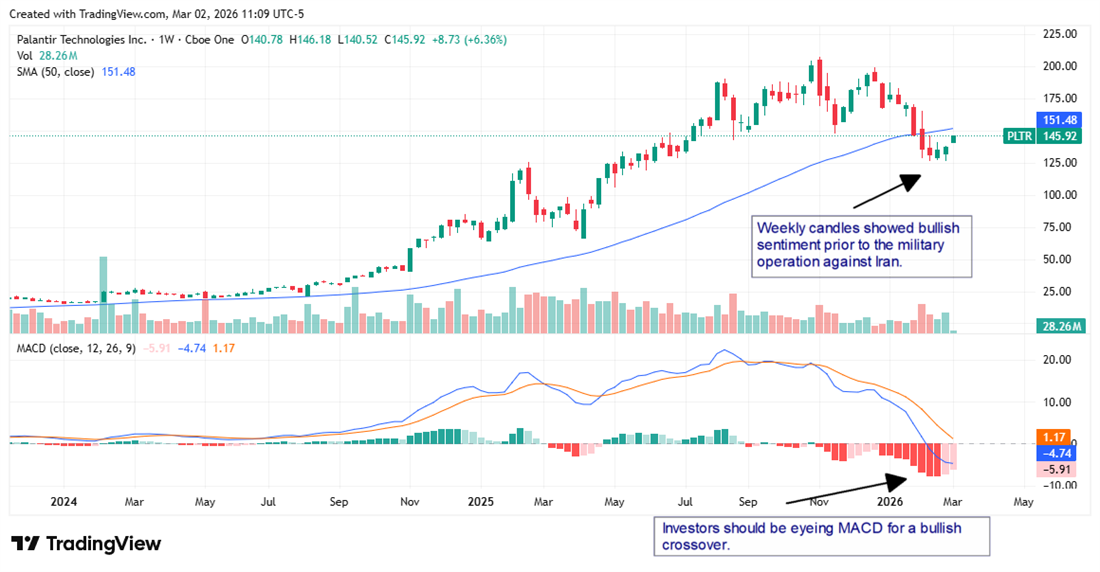
That behavior can mark the early stages of a trend resumption rather than a one-off relief rally. Volume has also begun to rise on up weeks, which may indicate institutions are accumulating on weakness rather than distributing into strength.
The one missing ingredient is a confirmed momentum shift: the weekly MACD remains negative and has not yet crossed above its signal line. Until that happens, investors should respect the risk of further volatility, even if the broader setup is starting to favor the bulls.

Thank you for subscribing to Earnings360, a morning newsletter that summarizes quarterly earnings for public companies that trade on U.S. markets.
This email content is a paid sponsorship for Golden Portfolio, a third-party advertiser of Earnings360 and MarketBeat.
If you have questions about your account, feel free to email our South Dakota based support team at contact@marketbeat.com.
If you no longer wish to receive email from Earnings360, you can unsubscribe.
© 2006-2026 MarketBeat Media, LLC. All rights reserved.
345 N Reid Pl. #620, Sioux Falls, South Dakota 57103. USA..
Featured Link: The Next Commodity Crunch (bigger than oil?)(From Awesomely, LLC)
How a Global Market Reset Will Devastate Retirement Accounts That Aren’t Protected
The 2026 Munich Security Report Just Called the Global Order “Under Destruction.” Most Americans Have Never Heard of It.
The System That Supported Markets for Decades Is Shifting. Is Your Retirement Ready?
Dear Reader,
Every year, the world’s top security and economic minds gather in Munich.
Heads of state. Central bank chiefs. Defense ministers. The people who actually see what’s coming before it arrives.
Their 2026 report just landed.
They describe the current global order in two words:
“Under Destruction.”
Trade fragmentation. Rising power conflicts. Weakened institutions. Growing instability.
The system that supported markets for decades is shifting.
>> See what’s unfolding — and the 3 steps to shield your IRA or 401(k) right now
When systems shift… markets reprice.
Now add:
- $38 trillion in U.S. debt — with foreign buyers pulling back.
- Central banks buying record amounts of gold — quietly, consistently, at scale.
- Liquidity tightening as confidence in the old system weakens.
If liquidity tightens… if confidence weakens…
Markets reset.
And if your IRA or 401(k) is heavily tied to stocks — you may be more exposed than you realize.
The people who wrote that Munich Report aren’t panicking.
They’re positioning.
Central banks are loading up on gold at record levels. Gold has crushed the S&P 500 in 2026.JPMorgan is modeling $6,300 before year’s end.
You can make the same move inside your existing IRA or 401(k) — without penalties, without taxes, without starting over.
>> Learn how to add gold to your IRA or 401(k) — tax and penalty-free — with this free Info Guide
Additional Reading from MarketBeat.com
Chaos & Crude: 3 Energy Stocks Built to Thrive in This Market
Submitted by Jeffrey Neal Johnson. Published: 3/5/2026.

Key Points
- Surging insurance costs and rerouted tanker traffic through the Strait of Hormuz are embedding a geopolitical premium into every barrel of oil.
- Exxon Mobil and Chevron’s global diversification and fortress balance sheets position them to profit from the chaos rather than absorb it.
- Occidental Petroleum’s fortified balance sheet and significant backing from a major investor create a uniquely compelling opportunity for investors.
- Special Report: [Sponsorship-Ad-6-Format3]
The daily ticker tape for the energy market can give any investor whiplash. One moment, oil futures surge on fears of a widening conflict in the Middle East; the next, they pull back on the faintest whisper of a diplomatic solution. That extreme volatility — where the price of a paper barrel is driven by algorithmic trading and headline sensitivity — makes it hard to make sound investment decisions.
Beyond the noise of speculative trading, a different and more telling story is unfolding on the high seas. In the physical world of massive steel-hulled tankers and complex logistics, the market is not volatile; it is constrained. The tangible friction in the global energy supply chain is real, costly, and getting worse. For investors who can look past daily digital fluctuations, the disconnect between speculation and physical reality reveals a compelling opportunity in a select group of resilient energy companies.
The Real Price of Passage
Have $500? Invest in Elon’s AI Masterplan (Ad)
What if you could claim a stake in what’s set to be the biggest IPO ever… starting with just $500?
Everyone is talking about Elon Musk’s SpaceX IPO.Click here to get the details and I’ll show you how to claim your stake…
The Strait of Hormuz is the world’s most important energy chokepoint. Approximately 20% of global oil consumption passes through this narrow waterway, making its security fundamental to market stability. With recent geopolitical events, tanker traffic has slowed as shipowners weigh the immense risks. That disruption goes far beyond a simple delay and carries significant financial ripple effects.
The most powerful evidence of this physical-market squeeze comes from the insurance industry. Commercial rates for tankers transiting the region have become so expensive that the U.S. government has stepped in to offer political risk insurance. That is an unmistakable signal that the logistical cost of moving oil has fundamentally increased. Every vessel that is delayed, rerouted, or forced to pay higher premiums adds to the final cost of energy.
This sustained friction creates a geopolitical premium now embedded in the price of every barrel. It establishes a supportive price floor that is detached from the day-to-day news cycle. The environment directly benefits producers with the scale and geographic diversity to navigate the chaos, rewarding their operational strength with higher sustained profitability and stronger stock valuations.
How Global Giants Thrive in Chaos
In an environment defined by logistical uncertainty, scale is not just an advantage; it is a defensive moat. Integrated supermajors, with their vast global footprint from the wellhead to the gas pump, are uniquely equipped to thrive.
Exxon Mobil: The Power of a Pristine Balance Sheet
Exxon Mobil (NYSE: XOM) operates as a financial fortress in the energy sector. It has the size and strength not just to withstand market turbulence, but to capitalize on it. That strength rests on several key pillars:
- Financial Fortitude: With a market capitalization exceeding $620 billion and a remarkably low debt-to-equity ratio (D/E) of just 0.13, the company has the firepower to absorb shocks and fund projects without financial strain.
- Geographic Insulation: A significant portion of its production growth comes from assets such as the U.S. Permian Basin and offshore Guyana, which are largely insulated from conflicts in the Middle East.
- Shareholder Reliability: That operational strength translates into investor returns. The company’s 42-year history of consecutive dividend increases is a testament to its all-weather reliability.
Chevron: Disciplined Operations, Wall Street Confidence
Chevron (NYSE: CVX) exhibits similar strength, founded on disciplined capital allocation and operational excellence. Its status as a Dividend Aristocrat, with 38 straight years of dividend growth, underscores a deep commitment to shareholder value.
The company is managing the temporary shutdown of the Leviathan gas field in the Eastern Mediterranean. That localized issue actually highlights the benefit of Chevron’s global diversification; the financial impact is manageable for a company of this scale.
Despite the regional headwinds, major Wall Street institutions have been raising their price targets on Chevron stock, signaling strong confidence from sophisticated investors in the company’s ability to navigate the current environment.
Occidental: Why This Producer Is Just Built Different
While the integrated giants offer stability, some investors may prefer more direct exposure to rising crude prices. Occidental Petroleum (NYSE: OXY), a company more focused on exploration and production, provides that exposure.
Its stock, which has already gained around 30% this year, often shows greater leverage during oil price rallies.
Normally, this focused model implies higher risk, but two powerful factors have materially de-risked the investment case for Occidental.
- The Strategic Reset: The recent sale of its chemical division was a decisive move to fortify its financial foundation. A stronger balance sheet makes the company less vulnerable to commodity swings and increases free cash flow available for shareholder returns such as dividends and buybacks.
- The Buffett Backstop: The most compelling factor is the large ownership stake held by Warren Buffett’s Berkshire Hathaway (NYSE: BRK.A). This is more than a typical institutional holding; it represents one of the world’s most respected investors making a high-conviction bet on Occidental’s asset quality and long-term value. That Buffett Backstop provides a powerful foundation of confidence for other shareholders.
Finding Clarity in the Chaos
Daily headlines will keep driving volatility in the oil sector, but the underlying fundamentals of the physical market tell a clearer story. Sustained logistical friction in the world’s most critical energy corridors is not merely temporary; it has created a durable tailwind for producers that transcends the day-to-day noise.
This environment rewards companies with the scale to manage global complexity, the financial strength to weather uncertainty, and the strategic clarity to execute their plans. ExxonMobil, Chevron, and Occidental Petroleum each offer different but compelling ways to gain exposure to this new market reality. For investors looking to position portfolios for sustained geopolitical uncertainty, the resilience and strategic advantages of these energy leaders merit careful consideration.
Further Reading from MarketBeat
Qualcomm’s Sudden Reversal Signal Could Catch the Bears Offside
Author: Sam Quirke. First Published: 2/27/2026.

Key Points
- After a brutal 30% slide that erased nearly two years of gains, Qualcomm is showing early signs of stabilization.
- A bullish MACD crossover deep below zero suggests downside momentum may be exhausting itself.
- With fresh analyst upgrades starting to land and price action firming above recent lows, a base is starting to take shape.
- Special Report: [Sponsorship-Ad-6-Format3]
After collapsing nearly 30% between the first week of January and the first week of February, tech giantQualcomm Inc (NASDAQ: QCOM) is now trading near $145. It’s been a rough start to the year for investors, with that selloff effectively dragging the stock back to 2020 levels.
Though the stock was already under pressure, the primary catalyst for the selloff was the company’s weak forward guidance in its first report of the year.
Have $500? Invest in Elon’s AI Masterplan (Ad)
What if you could claim a stake in what’s set to be the biggest IPO ever… starting with just $500?
Everyone is talking about Elon Musk’s SpaceX IPO.Click here to get the details and I’ll show you how to claim your stake…
That disappointment accelerated selling in what has long been a frustrating stock for holders, despite Qualcomm’s consistent ability to top earnings and revenue expectations.
Following the selloff, Qualcomm’s relative strength index (RSI) was pushed toward multi-year lows, sentiment collapsed, and many analysts began throwing in the towel.
For a company operating in such a critical part of the semiconductor ecosystem, the capitulation felt definitive. Yet over the past fortnight, something has shifted that’s making investors question whether the worst of the selling is already behind them. Let’s take a closer look.
A MACD Signal That Matters
In mid-February, Qualcomm’s moving average convergence/divergence indicator (MACD) registered a bullish crossover while still deeply in negative territory. That detail matters: a bullish MACD crossover above the zero line can simply confirm ongoing strength, but a crossover from below zero often suggests downside momentum has reached an extreme and is beginning to unwind.
With bears in control throughout January and early February, every bounce was sold into and momentum remained decisively negative. Now, a string of consecutive green sessions suggests short-term control may be starting to tilt back toward the bulls, particularly when viewed alongside the MACD’s bullish crossover.
The last time Qualcomm printed a similar bullish MACD crossover from deep below zero was last April, after the stock had also fallen roughly 30%. That signal marked the low and was followed by a multi-month rally of about 70%. For investors who like a comeback story, it’s a compelling setup.
Price Action Is Quietly Improving
Importantly, the recent signal is not occurring in isolation—price action is beginning to improve. The bears have been unable to push the stock below the immediate post-earnings low, despite the earlier pessimism from analysts. Instead, the stock has turned decisively northward. This doesn’t mean the downtrend is officially broken, but the relentless pressure has eased.
For a stock that surrendered two years of gains in weeks, stabilization is itself notable. When a deeply oversold name rallies in the wake of bad news rather than falling further, it often indicates the worst-case scenario is already priced in.
Analysts Are Starting to Shift
The technical improvement is being accompanied by a subtle change in tone from Wall Street. Earlier this year many analysts downgraded Qualcomm or trimmed price targets after its weak guidance.
In line with stabilizing price action and bullish technicals, that wave of caution now appears to be softening.
This week, Wells Fargo lifted its rating from Underweight to Equal Weight, while Loop Capital went further, upgrading Qualcomm to a Buy. They argued that key near-term headwinds are beginning to ease and that the company’s diversification strategy strengthens its longer-term outlook.
Both Loop Capital and Wells Fargo set fresh price targets of $185, implying roughly 30% upside from current levels and adding to the sense that Qualcomm could be a serious contender for a comeback rally.
What Needs to Happen Next
For this early reversal to develop into something more durable, Qualcomm needs to consolidate recent gains and begin forming a base around $150.
That level is psychologically important and has been a key battleground before. If the stock can hold above the recent lows and start carving out higher lows, confidence should begin to rebuild. A decisive break below $130, however, would likely invite renewed selling.
This remains a stock with real headwinds: handset demand uncertainty persists, and management still needs to restore credibility around forward growth. But markets often turn before fundamentals visibly improve. The bullish MACD crossover deep below zero suggests downside momentum may have already peaked.
Thank you for subscribing to DividendStocks.com’s daily newsletter for dividend and income investors that covers ex-dividend stocks, new dividend declarations, dividend stock ideas, and the latest market news.
This email is a sponsored email provided by GoldenCrest Metals, a third-party advertiser of DividendStocks.com and MarketBeat.
If you need help with your subscription, please feel free to contact MarketBeat’s U.S. based support team at contact@marketbeat.com.
If you no longer wish to receive email from DividendStocks.com, you can unsubscribe.
Copyright 2006-2026 MarketBeat Media, LLC. All rights reserved.
345 N Reid Place, Suite 620, Sioux Falls, S.D. 57103-7078. United States..
Today’s Bonus Content: My blood is boiling… and yours should be too (From The Oxford Club)
Verse of the Day – 2 Corinthians 4:18


March 6, 2026
Verse of the Day
So we don’t look at the troubles we can see now; rather, we fix our gaze on things that cannot be seen. For the things we see now will soon be gone, but the things we cannot see will last forever.
2 Corinthians 4:18 NLT
RELATED PLANS

Being Filled With God’s Love
3 Days

Conquering Fear
3 Days

The Things Which Are Not Seen
3 Days

3 Days Of Encouragement For Parents Of Children With Disabilities
3 Days


You are receiving this email because you are currently subscribed to YouVersion notifications.
© Life.Church / YouVersion
4600 East Second Street, Edmond, OK 73034
Do not delete, read immediately
You can feel it, can’t you?
Something big just broke…
Not the stock market, not the banks… something deeper.
The numbers say everything’s fine… but it doesn’t feel fine, does it?
The cost of living keeps rising. The divide keeps widening. The anger keeps building.
Listen, I’ve spent three decades studying financial systems, and I’ve never seen pressure like this. It’s as if the old order of the economy has cracked and something new is forcing its way through.
Most people can’t see it yet. But they sense it. They feel it in their gut.
I’ve pulled on that thread for the past year, and what I’ve uncovered is bigger than anything I’ve ever reported. And it’s happening much faster than anyone imagines.
I explain everything in my new documentary.
➡ Watch it here before it’s too late for you.
Good investing,
Porter Stansberry
Additional Reading from MarketBeat.com
Qualcomm’s Sudden Reversal Signal Could Catch the Bears Offside
Reported by Sam Quirke. Published: 2/27/2026.
Key Points
- After a brutal 30% slide that erased nearly two years of gains, Qualcomm is showing early signs of stabilization.
- A bullish MACD crossover deep below zero suggests downside momentum may be exhausting itself.
- With fresh analyst upgrades starting to land and price action firming above recent lows, a base is starting to take shape.
- Special Report: [Sponsorship-Ad-6-Format3]
After collapsing nearly 30% between the first week of January and the first week of February, tech giantQualcomm Inc (NASDAQ: QCOM) is now trading near $145. It’s been a rough start to the year for investors, with that selloff effectively dragging the stock back to 2020 levels.
Though the stock was already under pressure, the primary catalyst for the selloff was the company’s weak forward guidance in its first report of the year.
Have $500? Invest in Elon’s AI Masterplan (Ad)
What if you could claim a stake in what’s set to be the biggest IPO ever… starting with just $500?
Everyone is talking about Elon Musk’s SpaceX IPO.Click here to get the details and I’ll show you how to claim your stake…
That disappointment accelerated selling in what has long been a frustrating stock for holders, despite Qualcomm’s consistent ability to top earnings and revenue expectations.
Following the selloff, Qualcomm’s relative strength index (RSI) was pushed toward multi-year lows, sentiment collapsed, and many analysts began throwing in the towel.
For a company operating in such a critical part of the semiconductor ecosystem, the capitulation felt definitive. Yet over the past fortnight, something has shifted that’s making investors question whether the worst of the selling is already behind them. Let’s take a closer look.
A MACD Signal That Matters
In mid-February, Qualcomm’s moving average convergence/divergence indicator (MACD) registered a bullish crossover while still deeply in negative territory. That detail matters: a bullish MACD crossover above the zero line can simply confirm ongoing strength, but a crossover from below zero often suggests downside momentum has reached an extreme and is beginning to unwind.
With bears in control throughout January and early February, every bounce was sold into and momentum remained decisively negative. Now, a string of consecutive green sessions suggests short-term control may be starting to tilt back toward the bulls, particularly when viewed alongside the MACD’s bullish crossover.
The last time Qualcomm printed a similar bullish MACD crossover from deep below zero was last April, after the stock had also fallen roughly 30%. That signal marked the low and was followed by a multi-month rally of about 70%. For investors who like a comeback story, it’s a compelling setup.
Price Action Is Quietly Improving
Importantly, the recent signal is not occurring in isolation—price action is beginning to improve. The bears have been unable to push the stock below the immediate post-earnings low, despite the earlier pessimism from analysts. Instead, the stock has turned decisively northward. This doesn’t mean the downtrend is officially broken, but the relentless pressure has eased.
For a stock that surrendered two years of gains in weeks, stabilization is itself notable. When a deeply oversold name rallies in the wake of bad news rather than falling further, it often indicates the worst-case scenario is already priced in.
Analysts Are Starting to Shift
The technical improvement is being accompanied by a subtle change in tone from Wall Street. Earlier this year many analysts downgraded Qualcomm or trimmed price targets after its weak guidance.
In line with stabilizing price action and bullish technicals, that wave of caution now appears to be softening.
This week, Wells Fargo lifted its rating from Underweight to Equal Weight, while Loop Capital went further, upgrading Qualcomm to a Buy. They argued that key near-term headwinds are beginning to ease and that the company’s diversification strategy strengthens its longer-term outlook.
Both Loop Capital and Wells Fargo set fresh price targets of $185, implying roughly 30% upside from current levels and adding to the sense that Qualcomm could be a serious contender for a comeback rally.
What Needs to Happen Next
For this early reversal to develop into something more durable, Qualcomm needs to consolidate recent gains and begin forming a base around $150.
That level is psychologically important and has been a key battleground before. If the stock can hold above the recent lows and start carving out higher lows, confidence should begin to rebuild. A decisive break below $130, however, would likely invite renewed selling.
This remains a stock with real headwinds: handset demand uncertainty persists, and management still needs to restore credibility around forward growth. But markets often turn before fundamentals visibly improve. The bullish MACD crossover deep below zero suggests downside momentum may have already peaked.
Additional Reading from MarketBeat.com
Draganfly’s CEO Says Drones Are Becoming Intelligence Platforms—Not Just Hardware
Reported by Bridget Bennett. Published: 2/19/2026.

Key Points
- Draganfly is positioning drones as intelligence platforms, using real-world data and AI to move beyond airframes.
- Defense demand and “made-here” procurement trends are accelerating adoption and could tighten supply across North America.
- AFSOC-linked training and FPV work underscores a shift toward recurring services and operational integration, not just unit sales.
- Special Report: [Sponsorship-Ad-6-Format3]
The drone industry’s latest rally has been driven by a familiar mix: geopolitical urgency, fast AI adoption, and an accelerating shift toward automation.
In a recent MarketBeat conversation, CEO Cameron Chell explained why Draganfly Inc. (NASDAQ: DPRO) sees the next chapter for drones as being defined less by airframes and more by the data, intelligence, and operational capabilities layered on top of them.
Have $500? Invest in Elon’s AI Masterplan (Ad)
What if you could claim a stake in what’s set to be the biggest IPO ever… starting with just $500?
Everyone is talking about Elon Musk’s SpaceX IPO.Click here to get the details and I’ll show you how to claim your stake…
Draganfly recently traded in the mid-$7 range, and Wall Street remains optimistic about its prospects as a small-cap company, with MarketBeat’s consensus target near $16.75.
From “Drone Makers” to Intelligence Platforms
Asked what’s driving investment across the sector, Chell framed drones as an evolution story—similar to the internet era, when early winners outgrew their original labels. His central point: the “endgame” may not be a hardware category at all.
Chell believes drones are uniquely positioned to become the dominant “real-world” data collectors—capturing everything from imaging and environmental monitoring to specialized sensing that can feed into AI systems. That combination, he argued, could separate a few eventual leaders from the pack: the companies that move beyond manufacturing to become information-and-intelligence businesses.
The Pentagon’s “Drone Dominance” Demand Signal
Defense has emerged as the industry’s most visible catalyst, and Chell pointed to the scale of near-term demand as evidence that adoption is still early—despite the sector’s sharp stock moves.
A major signpost: in early December 2025, the Pentagon announced an initiative to deliver 300,000 small drones over the next several years and to strengthen domestic production capacity—an effort publicly described as “drone dominance.”
The takeaway: even one large program can strain North American supply, and the broader re-arming cycle extends beyond a single budget line. In Chell’s view, the competitive moat isn’t just parts availability—it’s the ability to build, certify, scale, and support mission-critical systems.
Why “Made Here” Is Becoming a Requirement, Not a Preference
Another theme from the interview: drones are being “re-regionalized.” Nations increasingly demand domestic or in-country production for cost, supply-chain security, and sovereignty. Chell said Draganfly already operates manufacturing in both the United States and Canada, and he expects that multi-sovereign model to expand as countries prioritize domestic control.
That push aligns with broader policy trends: restrictions on foreign-made drone technology have intensified, and national-security scrutiny has increased.
Canada’s Defense Push: What Chell Says Is at Stake
Chell highlighted a newly announced Canadian “Defence Industrial Strategy” as another example of global re-militarization and sovereign manufacturing priorities. Some figures mentioned in the interview were management commentary rather than independently confirmed program allocations, but the strategic direction is clear: Canada—like many allies—is moving toward deeper domestic capability and faster procurement cycles.
A Concrete Win: Training + FPV Drones for U.S. Air Force Special Operations
One of the most actionable parts of the conversation focused on Draganfly’s recent selection, alongside partner DelMar Aerospace, to provide Flex FPV drones and training to units within U.S. Air Force Special Operations Command (AFSOC).
The structure matters: this isn’t presented as a simple hardware shipment but as capability delivery—platform plus instruction—conducted at DelMar’s Camp Pendleton UAS training facility.
Chell said Draganfly’s operational experience and battlefield learnings—particularly from Ukraine—are a key differentiator for training and product iteration. For investors, that expands the addressable opportunity beyond unit sales into services, repeat cohorts, and operational integration.
Beyond Defense: The Commercial Use Cases Are Getting Practical
While defense drives headlines, Chell emphasized momentum in public-safety and industrial markets where ROI is often easier to quantify. He cited examples such as:
- robotic solutions for wind-turbine maintenance,
- drones used in cell-tower restoration and emergency response,
- tools deployed on power lines for monitoring and data collection.
The common thread: drones are replacing slow, risky, and expensive workflows that previously required crews, harnesses, helicopters, or complex logistics.
The Investor Question: Has the Run Already Happened?
Draganfly is a reminder of how quickly sentiment can shift in emerging categories—especially when government budgets and policy tailwinds intersect with AI narratives.
Chell argued the “beginning of the beginning” is still unfolding: major militaries spent decades experimenting with drones, but the first large and structured procurement waves are only now appearing at scale.
How smoothly that unfolds will hinge on execution—manufacturing ramps, reliability, regulatory compliance, and the ability to win repeat business in a crowded field.
Still, the combination of a large U.S. demand signal, nationalized supply-chain trends, and concrete contract wins helps explain why analysts remain constructive on the sector.
This email communication is a paid sponsorship provided by Porter & Company, a third-party advertiser of MarketBeat. Why did I receive this email?.
If you have questions about your account, please email MarketBeat’s U.S. based support team at contact@marketbeat.com.
If you would no longer like to receive promotional emails from MarketBeat advertisers, you can unsubscribe or manage your mailing preferences here.
© 2006-2026 MarketBeat Media, LLC.
345 N Reid Place, Sixth Floor, Sioux Falls, South Dakota 57103-7078. United States of America..
Today’s Bonus Content: My blood is boiling… and yours should be too (From The Oxford Club)
Read this or regret it forever
A message from our friends at Porter & Company
My name is Porter Stansberry.
I’m the founder of one of the largest financial research firms in the world. Over the last 26 years we’ve helped investors navigate almost every major economic cycle.
We’ve also been on the forefront of every big financial story from the rise of Bitcoin and MRNA vaccines to robotics and artificial intelligence – just to name a few.
But today, I’m breaking the biggest story of my career…
An economic story the likes of which we’ve not seen in centuries. In fact, the last – and only time – this happened was in 1776. But now, on the eve of America’s 250th anniversary, it’s happening again.
And as you’ll discover today, the aftershock of this event could “reset” not just your personal wealth, but the entire U.S. economic system:
How you work, how you vote, how you protect and build your wealth… it’s all being turned upside down by what one famous Stanford economist says is:
“The biggest change ever… bigger than electricity… bigger than the steam engine.”
Yet almost nobody is prepared for it. So, if you’ve been watching the chaos of the past year unfold, struggling to understand what it all means… you’re about to get many – if not all – of the answers you’ve been searching for.
And, most importantly, what it all means for you, your money, and your investment portfolio in the months ahead
Because as you’ll discover, everything from the government taking stakes in companies like Intel, Lithium Americas, and MP Materials.
To Trump’s strike on Venezuela… his deal with Greenland… his seemingly never-ending slew of executive orders… and increasingly centralized grip over the economy…
All the way to the surging popularity of radical socialist politicians like Bernie Sanders, AOC, and Zohran Mamdani…
It’s all deeply and inexorably intertwined in what is, without a doubt, the most consequential story of the year.
A turning point that one Nobel Prize winner says is dividing not just the economy but our entire society.
And, as my guest and I explain, the financial decisions you make in the face of this New 1776 Moment… they could dictate whether you’re enriched, left stuck in the past, or potentially even impoverished by the seismic changes barreling down upon America.
The stocks to buy… the stocks to sell… and the three money moves to ensure you and your loved ones end up on the winning side of this new economic reality.
It’s all laid out here for you…

Good investing,
Porter Stansberry
Just For You
Feeling Bearish? Try These ETFs That Take a Contrarian Approach
By Nathan Reiff. Originally Published: 2/23/2026.

Key Points
- The most-traded ETFs taking a short strategy have one-month average trading volumes above 53 million, ensuring liquidity for active traders.
- Three notable and highly traded bearish ETFs include SOXS, ZSL, and NVD.
- These funds provide leveraged inverse exposure to semiconductor stocks, silver, and NVIDIA shares, respectively.
- Special Report: This makes me furious (From The Oxford Club)
The S&P 500 rose about 17% in 2025 but has been essentially flat so far in 2026, leaving investors to wonder whether a prolonged rally is about to give way to a major selloff—or whether the AI-driven rally has simply been overhyped. Pessimists may prefer to focus on steadier names, including dividend payers, that can better withstand potential volatility.
Others may favor a more active bearish approach, wagering that the broader market or specific segments will weaken. Fortunately, exchange-traded funds (ETFs) offering short or inverse exposure cover many strategies and sectors. While chasing the latest popular funds isn’t always prudent, trading volume can be telling about where investors are placing bearish bets. Below are three aggressively bearish ETFs that have also seen heavy trading activity.
SOXS Is a Highly Leveraged Inverse Semiconductor Play
ALERT: Drop these 5 stocks before the market opens tomorrow! (Ad)
The Wall Street Journal is asking whether a stock market crash is coming. Research from Weiss Ratings suggests the first half of 2026 could be very tough for certain stocks as a radical shift hits the market. Some of America’s most popular names could take serious damage. Analysts have identified five stocks you should consider avoiding before this event plays out. If these are in your portfolio, you’ll want to review your positions carefully.See the five stocks to avoid and learn what’s driving this shift.
The Direxion Daily Semiconductor Bear 3x Shares (NYSEARCA: SOXS) is a highly leveraged (and therefore high-risk) bet against semiconductor stocks. The fund seeks -3x the daily performance of the NYSE Semiconductor Index, meaning it targets -300% of the index’s daily return.
Daily declines across the semiconductor space can translate into amplified gains for SOXS holders, but modest gains in the sector can similarly produce magnified losses for the ETF.
Because SOXS is a daily-leveraged fund that resets each trading day, it is designed for short-term trading rather than buy-and-hold investing. Active traders should find liquidity ample: SOXS’s one-month average volume is about 599 million shares, and assets under management are roughly $1 billion.
Investors pay a premium for this strategy—the expense ratio is 0.97%—but the potential for outsized returns on days when semiconductor stocks fall may justify the cost for bearish traders.
A Bearish Play on Daily Silver Price Movement
After a meteoric rise in much of 2025, silver plunged early in 2026, suggesting the rally had run its course. Still, silver is up roughly 141% over the last year and about 14% year-to-date (YTD), far outperforming the S&P 500 over those periods.
Investors expecting another pullback might consider the ProShares UltraShort Silver (NYSEARCA: ZSL), which seeks -2x daily exposure to silver via the Bloomberg Silver Subindex using futures contracts. Because ZSL is based on futures rather than spot silver, its returns can deviate from spot-price moves, particularly over longer holding periods.
Like SOXS, ZSL’s -2x exposure resets daily, so it’s intended for short-term tactical use. Liquidity is strong—ZSL’s one-month average volume is about 349 million shares—so active traders should not face execution issues. The fund’s expense ratio is 0.95%.
Double Inverse Exposure to the World’s Largest Public Company
As the largest publicly traded company, NVIDIA Corp. (NASDAQ: NVDA)serves as a bellwether for tech, AI and, at times, the broader market. Despite shares rising nearly 1,200% over the past five years, NVDA remains vulnerable to sharp daily selloffs. The GraniteShares 2x Short NVDA Daily ETF (NASDAQ: NVD) aims to profit from those declines by seeking -2x the daily return of NVIDIA’s common stock.
NVD is designed to perform well on days when NVDA drops. Its trading volume is lower than the commodity and semiconductor inverse funds above but is still substantial for active traders—NVD’s one-month average volume is around 53 million shares.
The trade-off for the fund’s targeted exposure is a relatively high expense ratio of 1.35%. For traders who can time short-term moves in NVDA, the potential returns on down days may outweigh that cost.
All three ETFs described are structured for short-term, active trading and carry elevated risks, including leverage, daily reset behavior and tracking differences. They are generally unsuitable for long-term buy-and-hold strategies. Investors should understand these risks, consider how these funds fit their objectives, and consult a financial advisor if unsure.
Thank you for subscribing to TickerReport, where we work around-the-clock
to bring you the latest market-moving news.
This email is a sponsored message for Porter & Company, a third-party advertiser of TickerReport and MarketBeat.
Contact Us | Unsubscribe
Copyright 2006-2026 MarketBeat Media, LLC dba TickerReport. All rights reserved.
345 N Reid Pl., Sixth Floor, Sioux Falls, South Dakota 57103. United States of America..
[SABR.Notes] This Week in SABR: March 6, 2026

Welcome to “This Week in SABR” on Friday, March 6, 2026.
Click here to view this newsletter on the web.

Check out highlights, photos from 2026 SABR Analytics Conference
Doug Fearing honored with SABR Analytics Conference Lifetime Achievement Award
Apply for a Yoseloff Scholarship to attend SABR 54 in Cleveland
Subscribe to the Baseball Research Journal before April 1
Join us for virtual Town Hall on March 12
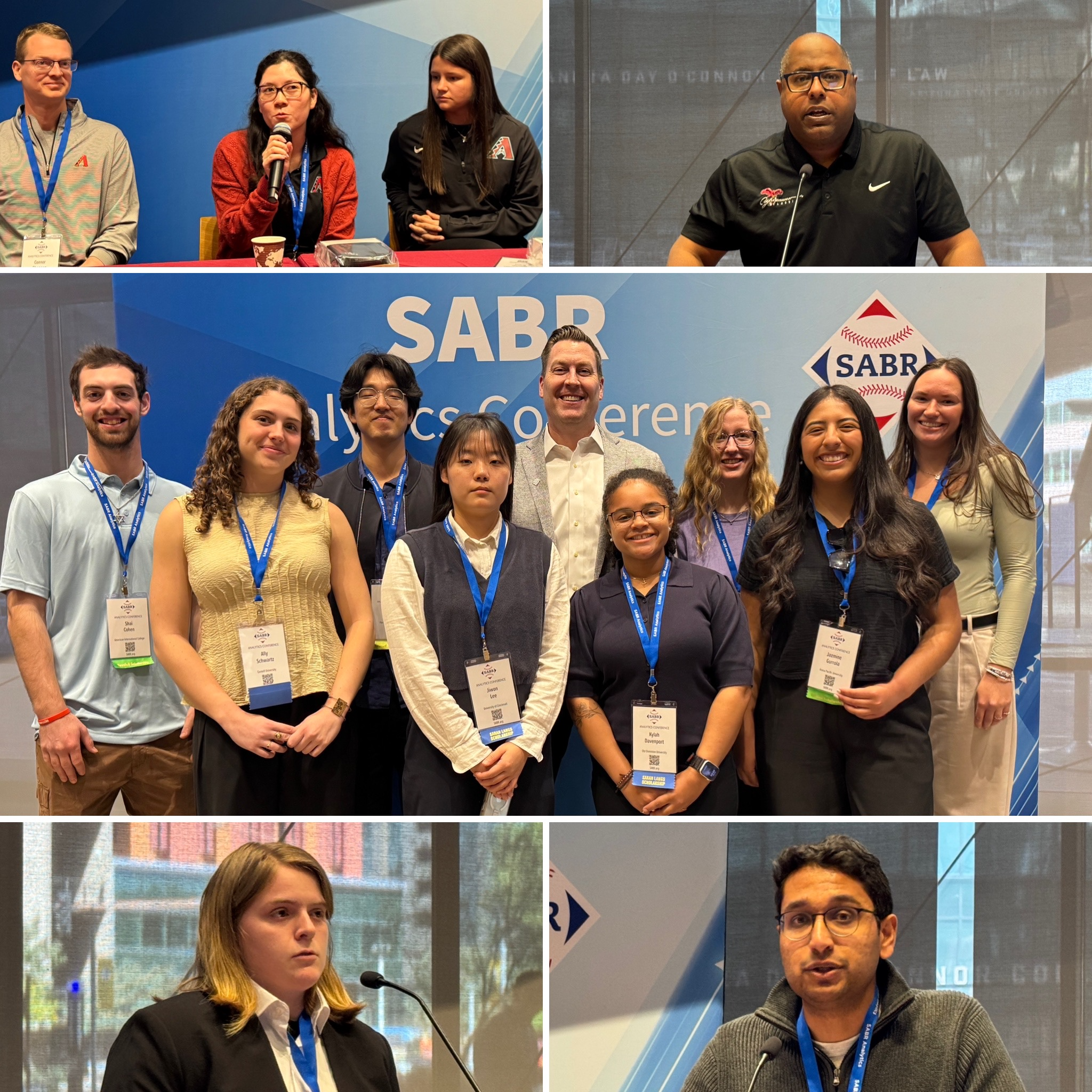
Check out highlights and photos from the SABR Analytics Conference
The 15th annual SABR Analytics Conference was held in person from February 27–March 1, 2026, at the Beus Center for Law and Society on Arizona State University’s Downtown Phoenix Campus in Phoenix, Arizona. For more highlights and clips from the 2026 SABR Analytics Conference, click on a link below:
- Doug Fearing honored with 2026 SABR Analytics Conference Lifetime Achievement Award
- Kristen M. Stewart wins 2026 Dr. Mike Marshall Baseball Biomechanics Research Award
- Michael Rosen, Richard Staff, R.J. Anderson, Daniel R. Epstein win 2026 SABR Analytics Conference Research Awards
- Diamond Dollars Case Competition winners: Rice University, Vanderbilt University, Texas A&M University
- Check out photo galleries from each day at the SABR Analytics Conference
- Download the SABR Analytics Conference digital program (PDF)
Stay tuned for more highlights, clips, and stories at SABR.org/analytics!

Doug Fearing honored with SABR Analytics Conference Lifetime Achievement Award
Doug Fearing of Teamworks Intelligence was honored with the SABR Analytics Conference Lifetime Achievement Awardon Saturday, February 28 in Phoenix, Arizona.
Fearing is the Chief Data Officer at Teamworks Intelligence. He was also the co-founder and CEO of Zelus Analytics. Following Zelus’s acquisition by Teamworks in 2024, he now leads the expansion of its advanced analytics capabilities across the Teamworks operating system. He founded and led the Los Angeles Dodgers’ Baseball Research and Development team and he also worked with the Tampa Bay Rays as a Senior Advisor with their R&D team.
Click here to read the full article at SABR.org.

Kristen M. Stewart wins Dr. Mike Marshall Baseball Biomechanics Research Award
Kristen M. Stewart was announced as the winner of the Dr. Mike Marshall Baseball Biomechanics Research Award on Saturday, February 28 at the SABR Analytics Conference in Phoenix, Arizona.
Stewart was honored for her presentation on “Individual Muscle Capacity to Generate Elbow Varus Moment during a Fastball Pitch.” She is a PhD candidate in mechanical engineering with an emphasis in biomechanics at the University of Texas at Austin.
Click here to read the full announcement at SABR.org.
SABR Analytics Conference Research Award winners announced
Congratulations to Michael Rosen, Richard Staff, R.J. Anderson, and Daniel R. Epstein, winners of the 2026 SABR Analytics Conference Research Awards. They were recognized in an awards ceremony during the SABR Analytics Conference on Saturday, February 28 in Phoenix, Arizona.
- Contemporary Baseball Analysis: Michael Rosen, “How Much Do Trail Runners Matter? An Investigation,” FanGraphs, September 8, 2025.
- Contemporary Baseball Commentary: Richard Staff, “The Secret Brotherhood of the Phantom Ballplayers,” Defector, July 21, 2025.
- Historical Baseball Analysis/Commentary: R.J. Anderson, “What MLB’s salary cap history can tell us about the upcoming CBA negotiations,”CBS Sports, December 1, 2025.
- John Dewan Defensive Analytics: Daniel R. Epstein, “Stand in the Place Where You Are,” Baseball Prospectus, May 5, 2025.
Click here to read the full announcement at SABR.org.

Early registration now open for SABR 54 in Cleveland
Join us in Cleveland, Ohio, this summer for SABR’s 54th annual convention on July 29–August 2, 2026, at the Hilton Downtown Cleveland hotel! Conference and hotel registration for SABR 54 is now available online. Click here for complete details on SABR 54 Early-Bird Registration and optional sessions.
SABR 54 will feature a Major League speaker lineup we know you’ll love, alongside an invigorated social experience emphasizing SABR’s ability to unite all of us in baseball fellowship. Whether you’re attending your first SABR convention or returning as a longtime regular, this is a great year to be part of the experience. Newcomers will find plenty of opportunities to connect and build baseball friendships, while veteran attendees can look forward to a richly layered event. It promises to be an unforgettable week of baseball fellowship in “The Land,” and we hope you’ll join us!
Visit SABR.org/convention for complete details. All baseball fans are welcome to attend.
Students, apply for a Yoseloff Scholarship to attend SABR 54
With generous funding from The Nanar and Anthony Yoseloff Foundation, Inc., SABR will award up to 4 scholarships to high school or college students to attend SABR 54 on July 29–August 2, 2026, in Cleveland, Ohio. This scholarship will pay for registration, transportation and lodging (double occupancy) up to a total value of $1,250. All applications must be postmarked or e-mailed to Scott Carter at scarter@sabr.orgno later than May 15, 2026.
Click here to read the full announcement at SABR.org.

Robert Elias to receive SABR Seymour Medal at NINE Conference
Robert Elias, author of Dangerous Danny Gardella: Baseball’s Neglected Trailblazer for Today’s Millionaire Athletes, will receive his SABR Seymour Medal award during the 33rd annual NINE Spring Training Conference on Saturday, March 7 in Tempe, Arizona. To learn more about the NINE conference, visit nineconference.com.
The Dr. Harold and Dorothy Seymour Medalhonors the best book of baseball history or biography published during the preceding calendar year.
Click here to read the full announcement at SABR.org.

Subscribe to the Baseball Research Journal before April 1
In 2026, all SABR members will exclusively receive the Baseball Research Journalelectronically twice a year. The Spring 2026 issue will be sent out in April. However, if you are interested in a paperback copy of BRJ for your personal library, we have rolled out a subscription option at a significantly discounted rate: $7 per issue for members, compared to $19.95 at retail.
- To subscribe and receive a printed edition of BRJ, visit SABR.org/subscribe by April 1, 2026
(If you have any questions about your subscription, please email brjsubscribe@sabr.org.)
Click here for a short video on how to subscribe to printed copies of BRJ.
SABR Board of Directors to host virtual Town Hall on March 12
SABR’s Board of Directors invites all members to join us for a virtual Town Hall meeting at 8:00 p.m. Eastern on Thursday, March 12, 2026.
SABR CEO Scott Bush will provide an overview on new initiatives and other upcoming activities and events. Board President Dan Levitt will provide a strategic planning update. Board Vice President Allison Levin will provide an update on research committees and local chapters. Board Treasurer Pat Filippone will provide a financial update and introduce himself to the membership. Other members of the Board of Directors will also be available for questions afterward.
Levitt was appointed as President in November and will serve the rest of the term through 2027. Filippone was appointed in December to complete the rest of the Treasurer’s term, which concludes following the Annual Business Meeting in 2026.
Deadline to submit new project proposals to SABR Editorial Board is April 1
SABR’s Editorial Board welcomes new project proposals from members to be considered for publication through the Digital Library, SABR.org, or any other multimedia formats. We strongly encourage new proposals that involve collaboration between SABR research committees and/or chapters, and web-based projects with an eye toward enhanced multimedia presentation.
- Click here to submit a SABR project proposal
Next deadline: April 1, 2026 (for publication in late 2027 or 2028)
SABR seeks to publish 2-4 web-based multimedia projects and 6-8 books per year. Book projects should be of a scope that can fit in a single volume, typically between 100,000 and 200,000 total words.
Click here to read the full announcement at SABR.org.

Find new updates to the SABR Research Collection below, including the Baseball Biography Project, Games Project, and Oral History Collection.

1 new story published at SABR BioProject
- George Frazier, by Lance Levine (first-time author)
Visit SABR.org/bioproject to learn more about the SABR Biography Project or to get involved.
5 new stories published at SABR Games Project
- September 5, 1965: Jim Gilliam’s pinch-hit triple leads first-place Dodgers over Astros, by Steven C. Weiner
- July 31, 1972: Dick Allen’s two inside-the-park home runs against Bert Blyleven spark White Sox win, by Thomas J. Brown Jr.
- October 14, 1985: Ozzie Smith’s walk-off home run in NLCS makes Cardinals fans ‘Go Crazy!’, by Andrew Heckroth
- June 30, 1992: Boston’s Bob Zupcic robs Mickey Tettleton of home run, then hits game-winning grand slam, by Bill Nowlin
- July 17, 2011: In a scoreless game featuring 15 pitchers, Red Sox finally win in 16th inning, by Bill Nowlin
Visit SABR.org/gamesproject to learn more about the SABR Games Project or to get involved.


Henry Aaron
Edited by Bill Nowlin and Glen Sparks
Visit SABR.org to download the free e-book edition or save 50% off the paperback edition of all Digital Library books.

Here are some SABR headlines from recent weeks that we don’t want you to miss:
- New Research Resources portal and member login launched
- Dangerous Danny Gardella by Robert Elias wins 2026 SABR Seymour Medal
- Fourth course in SABR Analytics Certification program is now available
- SABR appoints Pat Filippone as Treasurer of Board of Directors
- Gary, Vicki Gillette make gift to support Jerry Malloy Negro League Conference through 2030
- Learn more about new SABR Institutional Memberships
- Negro Leagues statistics added to SABR Lahman Baseball Database
- View a collection of nearly 100,000 player surveys in the Weiss Baseball Questionnaires collection
- SABR Digital Library: Vinotinto Venezuela Béisbol, 1939–2024: 85 Years of Venezuelans in the Major Leagues
- Hundreds of ProQuest US newspapers added to SABR Research Resources
- Find complete collection of SABR-Rucker Archive baseball images online
- Get a gift for baseball fan in your life with the SABR Store @ CafePress

Please give a warm welcome to all new SABR members who joined this week! View more Members-Only resources at members.sabr.org or click here to download the Membership Handbook. Find contact information for any SABR member in the online Membership Directory.NAMEHOMETOWN NAMEHOMETOWNTim BennettJackson, MS Brian GrossKensington, MDRob BrognaWakefield, MA Joshua GuptelOakland, MEJames CaudillFredericksburg, VA James JohnstonKenmore, WARobert ColalucaCambridge, MA Brian LewisNorth Bethesda, MDJoe DuffyOlmsted Falls, OH Edward MearsTokyo, JPNAlex DvorkinSomerville, MA Douglas MolinaBolingbrook, ILTyler EvjeMilton, GA Hiroaki MoritaTokyo, JPNDaniel FogelMontclair, NJ Seth ParkNew York, NYAlexandru FoltaTempe, AZ Aaron SchmulensonScottsdale, AZBrian FordPittsburgh, PA Paul StreletskyHaverhill, MACody GarnerHillsboro, OR Nik TurleyGilbert, AZJack GreenbergSaint Louis, MO Vanessa ViolaNew York, NY

Here is a list of SABR supporters for the month of February 2026.NAME NAMECharles Alexander Daniel LevittBob Archer Henry LevyBen Baschinsky Jake LudingtonJake Bell Peter MancusoClifford Blau Peter MarcusD. Bruce Brown Deborah MarshallBruce Bumbalough Bruce McClureRalph Caola Ernestine MillerKen Carrano Linda NicholsVincent Comparato Andrew NorthRichard Dempsey Bill NowlinChris Dial Terry PhelpsMark Drucker John RallMark Dugo Michael RosenwasserHelen Edwards Charles RousselDaniel Evans Bob RussonDavid Firstman Jason SchellerAdam Foldes Douglas SchoppertEdward Fong Mary SheaVince Gennaro Rob SheinkopfStuart Hall Thomas StoneLeslie Heaphy Wesley StoryTimothy Herlich Joseph ThompsonRockwell Hoffman Neal TravenDavid Hughes Marlene VogelsangRob Janes Steve WestDonald Jensen Beach WiresRobert Kenney Jeffrey WoodOwen King Don Zminda
Want to become a Friend of SABR? Click here to make a recurring monthly contribution or click here to learn more about our Giving Circles to make a one-time contribution.


- Events Calendar: Find details of all upcoming SABR events.
- Video Replays: This week, we heard from Seth Tannenbaum (Bleacher Seats and Luxury Suites); Liz Thompson (“Preserving the Art and Joy of Keeping Score”); and Vanessa Viola and Fabio Montella (“Storytelling & Visual Representation of Negro Leagues Stadiums Through GIS Mapping”). Click here to view video replays of virtual SABR events.
Upcoming Virtual Meetings
- March 7: Women in Baseball Diamond Stories: Laura Hirai (10:00 a.m. EST)
- March 9: American Baseball Biomechanics Society Journal Club meeting (4:00 p.m. EDT)
- March 9: Clyde Sukeforth (NH/ME) Chapter meeting with Justin Mckinney(7:00 p.m. EDT)
- March 9: Central Illinois Chapter meeting with Seth Tannenbaum (7:00 p.m. CDT)
- March 10: 19th Century Speaker Series: Bruce Allardice (8:00 p.m. EDT)
- March 10: Games and Simulations meeting with Robert Gamble (8:00 p.m. EDT)
- March 11: Elysian Fields (NJ) Chapter meeting with Kazimierz Kochan (7:00 p.m. EDT)
- March 11: Ballparks Committee meeting with Tim Murphy (8:00 p.m. EDT)
- March 12: Sweet Lou Johnson Lexington (KY) Chapter meeting with Dixie Tourangeau (7:00 p.m. EDT)
- March 12: SABR Board of Directors Virtual Town Hall (8:00 p.m. EDT)
- March 14: Bob Davids Chapter: Talkin’ Baseball with John W. Miller (9:00 a.m. EDT)
- March 15: Luke Easter (NY) Chapter meeting with Rob Sheinkopf (2:00 p.m. EDT)
Upcoming In-Person Meetings
- March 6-7: NINE Spring Training Conference (Tempe, AZ)
- March 7: Pee Wee Reese Chapter SABR Day meeting (Louisville, KY)
- March 7: Rocky Mountain Chapter baseball cards meeting (Denver, CO)
- March 12: Magnolia Chapter monthly meeting (Sandy Springs, GA)
- March 14: Halsey Hall Chapter Hot Stove Saturday Morning (Fridley, MN)
- March 14: Baltimore Babe Ruth Chapter meeting (Baltimore, MD)
- March 14: Elysian Fields Chapter: Game Changers panel discussion (Little Falls, NJ)
- March 14: Ken Keltner Badger State Chapter meeting (Milwaukee, WI)
To add your SABR event to our calendar listings, please contact Jacob Pomrenke.

- Games and Simulations: We are looking for your feedback for any and all baseball tabletop games that you have played or owned. Click here to learn more and fill out a brief survey.
Sign up for SABR research committee announcements at SABR.org/research/committees.

- Ken Keltner Badger State Chapter:March 2026 newsletter (Milwaukee, WI)
- Rocky Mountain Chapter: March 2026 newsletter (Denver, CO)
Sign up for SABR chapter announcements at SABR.org/chapters.
Click here to learn more about SABR chartered communities.

Here are some recent articles published by and about SABR members:
- Steve Gardner: Fantasy baseball draft tips: How NL LABR experts managed their auction at SABR Analytics (USA Today)
- Tyler Kepner: Inside a managing master class: Dave Roberts breaks down a World Series Game 7 for the ages (The Athletic)
- Davy Andrews: Teammate Connections During World Baseball Classic Pool Play(FanGraphs)
- Stephanie Apstein: The World Baseball Classic Has Finally Captured Team USA’s Full Attention (Sports Illustrated)
- Adam McCalvy: Andy Brown quit his job to paint baseball games. Now he’s Great Britain’s team artist. (MLB.com)
- Rob Mains: Do The Braves Actually Make Any Money? (Baseball Prospectus)
- Bradford William Davis: Pat Ellington Jr. reclaims the fullness of Black history through the lens of baseball (Eyeblack)
- Jimmy Parker: Bringing Baseball Gloves Back to Life with Jimmy Lonetti (Beauty of a Game)
- Jay Jaffe: Mets Search for the Right Choice(s) in Their New-Look Outfield(FanGraphs)
- Stephen J. Nesbitt: How MLB ticket prices and TV blackouts are impacting the fan experience (The Athletic)
- Mark Simon: Stat of the Weak (Contact) (Sports Info Solutions)
- Steven Goldman: Profar and the Damage Done (Baseball Prospectus)
- Jayson Stark: Will ABS kill the managerial ejection? We asked ejection king Aaron Boone (The Athletic)
- David Laurila: Athletics Prospect Jamie Arnold Has Two Changeups and a Major League Mindset (FanGraphs)
- Ginny Searle: The Angels Invent the Anti-Extension (Baseball Prospectus)
- Matt Monagan: Josh Gibson really, may have, hit a ball 600 feet in Puerto Rico(MLB.com)
- Jeff Miller: In Texas’s “Biggest Little Baseball City,” J.W. Wingate Broke the Color Barrier. Then He Was Forgotten.(Texas Monthly)
- Thomas Harding: Denver-area author teams up with KC illustrator to capture culture of Negro Leagues (MLB.com)
- Sam Gazdziak: Obituary: Mickey Lolich (1940-2026) (RIP Baseball)
- Mark Rucker: Jeff Tesreau and the Spitball (Our Game)
- Sharon Hamilton: Ernest Hemingway and Toronto Baseball (The Hemingway Society)
- Mark Kolier: Top Five Starting Pitchers in Kansas City Royals History (Almost Cooperstown)
- Tiffany Babb: Norman Rockwell’s The Dugout (The Fan Files)
- Gary Ashwill: The Uniforms of the Atlantic City Bacharach Giants, 1922-1929 (Agate Type)
- Hall of Very Good Podcast: Ryan Woodward discusses women’s baseball and IWBC involvement (Hall of Very Good)
- Tim Sokol: What Can MLB Teams and Fans Learn from the KBO About Playoff Byes? (SABR Asian Baseball)
- Thomas Love Seagull: Japan’s Favorite Players: Kazuhiro Kiyohara (SABR Asian Baseball)
- Carter Cromwell: Development of Baseball in Saudi Arabia (SABR Asian Baseball)
- Glenn Evans: Crossing the Tracks: 1917(SABR Games and Simulations)
Please note: Some articles may require a separate subscription to view online. SABR does not endorse, and is not responsible or liable for, any content that appears on a third-party website.
This Week in SABR is compiled by Jacob Pomrenke. If you would like us to include an upcoming event, article, or any other information in “This Week in SABR,” e-mail jpomrenke@sabr.org. To find past editions of TWIS, click here.
Are you receiving our e-mails? “This Week in SABR” goes out by e-mail to all members on Friday afternoons. If they’re not showing up, try adding “sabr.notes@sabr.org” to your contact list to ensure they show up in your inbox.
This email was sent to peter.hovis@gmail.com from the Society for American Baseball Research (SABR). If you wish to stop receiving email from us, you can simply remove yourself by clicking here to unsubscribe.
Mailing address: SABR, PO Box 1715, Milwaukee, WI 53201. Physical address: Cronkite School at ASU, 555 N. Central Ave. #406-C, Phoenix, AZ 85004. Website: SABR.org. Phone: 602-496-1460.
Researchers Scanned Porn Users’ Brains and Here’s What They Saw








Concert from Fei Tian Academy of the Arts Music Competition – Premieres Mar 7, 8PM ET.
March 06, 2026 TODAY IN HISTORY President James Monroe signs the Missouri Compromise, which allows Missouri to be admitted to the union as the 24th state the following year. 1820 TOP STORIES Researchers Scanned Porn Users’ Brains and Here’s What They Saw
Pornography is among the most widespread habits worldwide. While many viewers consider it harmless, an increasing amount of evidence tells a very different story.
A recent study published in Frontiers in Human Neuroscience tracked brain activity and emotional reactions in real time as participants watched pornographic content. Frequent viewers showed brain patterns resembling opioid addiction and experienced noticeable declines in cognitive function. But why?
This video explains the science behind pornography, discusses the debate on whether it constitutes an addiction, and presents evidence-based therapy that helped participants to cut their viewing by 92 percent.
SHARE* WATCH NOWThe Shift Happening in the US Job Market | Jim Bianco
Monthly job creation dropped from 150,000 to 15,000, and somehow the unemployment rate barely moved and the economy kept growing. So what is the data actually telling us? Jim Bianco,…


Vinegar, Rye, Steel-Cut Oats, and Other Fat Busters | Jason Fung MD
WATCH NOWHEALTH

2 Steps to Regain Shoulder Blade Flexibility

Hearing Music Again: One Woman’s Journey With a Cochlear Implant INSPIRING

A ‘Lost’ Rembrandt Now Authenticated

Sponsored by Gan Jing World
[GJW SUBSCRIBER] Fascinating new translations and fresh research are transforming the myth of Atlantis from the realm of fantasy into an incredible reality. Travel across continents and centuries to unlock the secrets of Plato’s final legacy – a true story of Ancient Greece, Africa, and climate change across deep time.
A WORD FROM OUR SPONSOR

You are cordially invited to a FREE concert premiere on Mar 7, 8PM ET on Shen Yun Creations, Shen Yun’s streaming platform! Bringing you classic favorites from the Baroque, Classical, and Romantic periods, these talented musicians and rising stars will leave you refreshed and inspired. After premiering, the recording will become a paid program, so don’t miss it. Sign up now to watch for FREE.
Based in New York, Fei Tian Academy of the Arts is where most of Shen Yun’s dancers and musicians receive their training. The school is dedicated to preserving, promoting, and developing traditional arts through education and performances. EPOCH BUY

Stronger Skin Starts Within: Why Collagen Production Needs More Than Collagen LIFESTYLE

Mini Meatloaf Recipe EPOCH FUN Freecell SolitaireArrange cards by suit in ascending order to win.PLAYSpot the DifferenceFind the differences between 2 images.PLAYWord WipeCreate words to eliminate tiles.PLAY
Share this email with a friend.
Received this email from a friend?
Trouble viewing this email?
Advertisement:

Copyright © 2026 The Epoch Times, All rights reserved. The Epoch Times. 229 W. 28 St. Fl. 7 New York, NY 10001 | Contact Us * When sharing an article, giftaccess@TheEpochTimes.com is added to the list of recipients. If your friend is not already a subscriber, we will send them a special link for free access to the article.
Our Good Evening newsletter helps you catch up on the big stories of the day followed by lifestyle and uplifting content. Manage your email preferences here or unsubscribe from Good Evening here.
NVIDIA certified CoreWeave powers Perplexity workloads

I Noticed Something Odd at the Open (From Base Camp Trading)
CoreWeave Just Landed a Deal That Signals Where AI Is Headed
Written by Jeffrey Neal Johnson on March 5, 2026

Key Points
- CoreWeave’s specialized, high-performance infrastructure provides a crucial advantage in the demanding and rapidly growing AI inference market.
- A deep technical partnership with NVIDIA, which includes a coveted industry certification, validates CoreWeave’s platform as a world-class solution.
- An extensive backlog of long-term contracts provides significant visibility into future revenue and underpins the company’s strategic growth investments.
- Special Report: Looking to sharpen your edge as a day trader? (From ProsperityPub)
A recent partnership sent a clear signal through the market about the future of artificial intelligence (AI), and it has little to do with the training hype that has dominated headlines.
When specialized cloud provider CoreWeave (NASDAQ: CRWV) saw its stock climb on news of a multi-year deal with the AI-native search company Perplexity, it was more than just another customer win.
While Wall Street has been intently focused on CoreWeave’s aggressive spending, this new alliance may have just shown investors where the real, long-term revenue in the AI revolution will be generated.
6 dimensions. 357 stocks. Here’s how our AI scores them. (Ad)
Here’s the problem with most stock recommendations:
They come from someone’s gut. An analyst who “likes the story.” A talking head on CNBC who needs to fill airtime. A newsletter writer recycling the same 5 names.
Opinions are cheap. Data isn’t.
That’s why we built an AI scoring engine that analyzes 357 stocks every single morning across 6 data-driven dimensions.*See Today’s Top 10 AI-Ranked Stocks*
A Bellwether Deal for the New AI Battleground
Perplexity, a cutting-edge company whose entire business model relies on providing fast and accurate AI-powered answers, has entrusted its critical workload to CoreWeave. Specifically, the deal is to power its AI inference operations. This distinction is crucial for investors to understand, as it highlights a fundamental shift in the AI market.
For the past several years, the AI narrative has revolved around training. This is the initial, computationally massive process of teaching a model on vast amounts of data, like building a comprehensive library of global knowledge. It’s a vital but often periodic heavy lift. Inference, on the other hand, is the continuous, high-volume process of using that trained model to generate answers and predictions for millions of users in real time. It’s the equivalent of everyone checking out books from the library, all at once, 24/7.
Inference workloads are exceptionally demanding. They require consistently low latency because real users are waiting for an answer. Any delay ruins the experience. While training is a marathon, inference is a series of never-ending sprints. The decision by a performance-obsessed AI leader like Perplexity to choose CoreWeave over established, general-purpose cloud giants is a bellwether. It signals that for the demanding, revenue-generating applications of AI, specialized infrastructure is not just a preference; it’s a necessity.
Built Different: CoreWeave’s Performance Edge
CoreWeave’s ability to win these critical inference deals stems from a fundamental architectural advantage. The company offers a GPU-first, bare-metal cloud that is purpose-built for the unique demands of artificial intelligence. This design provides clients with direct access to the underlying hardware, minimizing the software layers and operational overhead that can create latency.
This specialization creates a clear performance gap between CoreWeave and the legacy hyperscalers, whose platforms are designed to be jacks-of-all-trades. For investors, the difference can be understood simply:
- CoreWeave (Specialized): This is the Formula 1 car of the cloud world, engineered for one purpose: to deliver maximum speed and performance for demanding AI workloads.
- Legacy Hyperscalers (Generalized):This is the SUV. It’s versatile, reliable, and can handle a wide variety of tasks, such as web hosting and data storage, but it isn’t optimized for the high-octane racetrack of AI inference.
This performance edge isn’t just a marketing claim; it’s validated by the industry’s most important name: NVIDIA (NASDAQ: NVDA). NVIDIA’s deep partnership with CoreWeave goes far beyond its recent $2 billion investment. It is a profound technical endorsement. CoreWeave has earned NVIDIA’s coveted Exemplar Cloud status, a certification signifying that its platform meets the highest standards for performance, reliability, and security.
For enterprise customers, this stamp of approval de-risks their investment and guarantees they are running workloads on a world-class platform. This deep alignment also grants CoreWeave early access to next-generation technology like the Rubin platform, ensuring its competitive moat remains for years to come.
I wasn’t going to give this away, until I noticed something interesting (Ad)
The majority of traders barely break even, blowing their accounts day in and day out chasing the next shiny gimmick without first understanding the rules that make consistent traders. I originally reserved these rules for my paying students, but after seeing how much better they approached the market when they applied these rules, I knew I had to get these Cheatsheets in the hands of as many traders as possible.Go here to pick up your free Ultimate Day Trading Cheatsheet
Investing in Certainty, Not Speculation
The primary concern among some market observers is CoreWeave’s aggressive spending and current net losses. The company has guided for $30 to $35 billion in capital expenditures for 2026, a figure that understandably raises questions about near-term profitability. However, viewing this spending in isolation misses the most important part of the story. This is not speculative spending; it is a calculated investment to fulfill a massive, pre-sold pipeline of demand.
The most compelling counterpoint to any spending concerns is the company’s $66.8 billion in contractually secured revenue backlog. CoreWeave is not building data centers hoping customers will come; it is manufacturing capacity that has already been purchased through long-term contracts. The quality of this backlog further de-risks the company’s financial position. The average contract length has increased to roughly five years, providing exceptional visibility and stability for future cash flows.
The company’s ability to successfully raise over $18 billion in capital in 2025 while simultaneously lowering its average cost of borrowing demonstrates strong institutional confidence in this strategy. This aggressive investment is what secures CoreWeave’s leadership position for years to come.
What the Market May Be Missing
This strategic positioning in the inference market directly informs CoreWeave’s valuation potential. While the stock currently trades around $79.50, the consensus price target among 30 Wall Street analysts is $124.34, representing healthy upside from current levels.
This apparent gap suggests that the market may still be valuing the company based on the high costs of its current build-out phase rather than the massive, recurring revenue its infrastructure will generate in the era of inference.
The company’s own projections, backed by its backlog, call for exiting 2026 with an annualized revenue run rate of $17 to $19 billion, more than doubling its revenue base in a single year. As CoreWeave continues to convert its backlog into revenue and announce more high-profile inference customers like Perplexity, this valuation gap may begin to close.
An Essential Cloud for the Inference Era
For investors evaluating the dynamic AI landscape, the key may be to look past the training headlines and focus on the less-discussed but potentially more lucrative inference market. The companies building the essential, high-performance infrastructure for this next phase are positioning themselves for durable, long-term growth.
The recent deal between CoreWeave and Perplexity is powerful evidence that CoreWeave has firmly established itself as a primary contender in this new gold rush era.
Further Reading
- Rocket Lab Finds Its Footing as Post-Earnings Support Takes Shape
- The AM Trigger Worth Watching(From Base Camp Trading)
- Cash Flow Kings: 2 Stocks to Hide In, 1 to Avoid
- These 5 stocks could move before Wall Street catches on (From TradingTips)
- Ross Stores Proves the Off-Price Uptrend Is Far From Over
- Norwegian Hit Rough Seas After Earnings—Viking Cruised Through
- Micron’s New Moat: The AI Memory Supercycle

Did you find this article helpful?


Thank you for subscribing to DividendStocks.com’s daily newsletter for dividend and income investors that covers ex-dividend stocks, new dividend declarations, dividend stock ideas, and the latest market news.
If you need help with your account, please feel free to contact MarketBeat’s U.S. based support team at contact@marketbeat.com.
If you no longer wish to receive email from DividendStocks.com, you can unsubscribe.
Copyright 2006-2026 MarketBeat Media, LLC.
345 North Reid Place, Suite 620, Sioux Falls, S.D. 57103-7078. United States..
Daily Bonus Content: How to collect $1,170 a month from silver(From Investors Alley)
 RJ Hamster