I was born on 6 August 1956 in San Francisco, California to Janet and (the late) Richard Hovis.
I grew up in Santa Monica, California where I attended elementary, junior high school, and high school (graduating in 1974), in addition to involvement in sports and recreation (Little League +, the Boy’s Club ++). Further, it was in elementary school – St. Augustine’s By-the -Sea Parish School that I found, and made the choice to truly journey with God.
I attended Arizona State University from 1974 to 1977 – seeking to become an architect, however, I was not accepted, and, as such, I graduated with a Liberal Arts degree.
Upon graduation from Arizona State University, I attended Cal Poly San Luis Obispo and studied City and Regional Planning at the Master’s level. I successfully completed one (1) year in a two (2) year program – I did not complete the Master’s degree in City and Regional Planning – due to personal reasons.
I returned to Santa Monica where I started (October 1979) my career as graphic designer with Exxon Company, USA. I spent five years with Exxon Company, USA.
While working with Exxon Company, USA I was accepted into architectural school – Sci-Arc in Southern California, however, I did not attend preferring to stay with Exxon..
In 1982 I married Laura Flosi and in April 1983 we had our one and only child – Lauren Alain Hovis – a gift from God.
We moved to Phoenix, Arizona in 1984 from Los Angeles, where I went to work as a graphic designer with Kitchell CEM (from 1985 -1987).
From 1987 – 1995 I was an independent contractor, and a registered representative in mortgage finance, financial management, graphic design, and drafting.
Further, I attended the University of Phoenix and successfully obtained a Master’s in Business Administration (MBA) in 1982.
I was also a member of the Scottsdale Jaycees, where I became very involved in community events and projects.
In 1994, I accepted a cartography position with the Defense Mapping Agency in Reston, Virginia. As such, I relocated from Phoenix to Reston.
In 1998, I was accepted and worked as a Visual Information Officer with the Central Intelligence Agency. In 2002, I worked as a Support Officer until my retirement (due to a need for shoulder surgery) in September 2018.
Away from my Federal Government service, I have been involved in various organizations and activities in Northern Virginia.
In November of 2011, I married Rebecca Ouellette in Santa Monica, California. I reside in San Tan Valley, AZ with my two hamster - Jess and Timothy, our fish, our lizard - RJ Lizard., and our cats - Pearl and Grey.
As to hobbies, I enjoy playing sports, attending sporting events, mentoring individuals from financial management to hamsters, building models, photography, travel, multimedia design, managing partner for RJ Hamster, and jazz – smooth jazz to a samba or a bossa nova.
Love and God Bless,
Peter – aka RJ Hamster Jo hi
Your love and generosity are a brightly shining light of Christian love to the whole House of Israel. The needs are so great—even if the cease fire holds and there are no further attacks, there are tens of thousands of precious people who have lost everything, and we must help them put their lives back together. Together we are telling, and more importantly showing, the people of Israel that they are not alone. We have received a generous matching gift challenge that will double your gift to help twice as many people—so please be as generous as you can when you send your gift today.
Your support of the Friends of Zion today allows us to comfort the people of Israel who have been devastated by the war, continue to purchase and deliver food, medicine, clothing, and other necessities of life for the poor Holocaust survivors and refugees of Ukraine, continue to operate the Friends of Zion Museum, and to meet urgent humanitarian needs among the poor Jewish people living in Israel.
Thank you so much for being part of this vital worldwide prayer movement.DONATE NOW
Weekly Prayer Service
Pray with us for Israel and submit your prayer requests.
“Let there be an out-flowing of provisioning to anyone who comes there for refuge and aid. Let these provisions be supernaturally multiplied to them, just as Jesus multiplied the five loaves and two fishes to the multitude in need, in Jesus’ Name. I pray that You will comfort, heal, and provide for the poor of Israel and especially the elderly survivors of the Holocaust.”
Defend the cause of the weak and fatherless; maintain the rights of the poor and oppressed. Rescue the weak and needy; deliver them from the hand of the wicked. Psalm 82:3-4
Join with us and millions of others around the world in prayer for Israel:PRAY WITH US
Global evangelical voices unite in Jerusalem, urging continued Trump support for Israel
Evangelical leaders and Israeli officials gathered in Jerusalem to mark Israel’s 78th Independence Day, with speakers emphasizing continued U.S. support for Israel and highlighting the political influence of evangelical Christians. READ MORE
Hamas awaits the end of the Iran war while preparing for continued fighting
The current situation in Gaza illustrates Hamas’s dual strategy: steadfast pursuit of its political demands and continued military buildup, aimed at strengthening its power while waiting for regional developments.READ MORE
Stay Connected
There is no better way to keep up with what is really happening in Israel and the world—the truth the liberal media won’t tell you—than with the redesigned and upgraded FOZ app. We have prepared this app to allow us to stay in touch with you and provide the most up-to-date news and prayer requests. This powerful tool will help you shape and focus your prayers, receive updates from Dr. Evans, and so much more. It is a must-have for every friend of Israel.APPLE APP ANDROID APP DONATE NOW
One of the most important discoveries in science was hidden for decades in a set of handwritten notes.
The data was there all along – it just took the right lens to make sense of it.
That same idea is at the heart of today’s Friday Digest takeover from TradeSmith CEO Keith Kaplan.
Below, Keith draws a fascinating parallel between that breakthrough moment and what’s happening in today’s stock market. Investors now have more data than ever to analyze, but until recently, most of it has been impossible to interpret in any meaningful way.
Now, thanks to AI, that’s starting to change.
Keith and his team have been using machine learning to uncover repeatable “signals” buried inside massive datasets – patterns that have historically pointed to high-probability trades, many with striking consistency across very different market environments.
In today’s essay, Keith explains how this system came together, and how it’s turning an overwhelming amount of information into a surprisingly simple, actionable strategy.
Tycho Brahe’s mission in life was to be the first to explain how the planets really moved.
So this obsessive 16th century Danish astronomer spent more than two decades building the most precise record of planetary motion the world had ever seen — and then guarded it so jealously almost no one was allowed to see it.
In Brahe’s time, there were no telescopes. Every measurement he took was with the naked eye, using instruments he designed and built himself on a small island off the coast of Denmark.
It was a data set unlike anything that had ever existed — page after page of handwritten figures and precise planetary positions.
He couldn’t interpret all that data alone. So he brought on a brilliant young German mathematician named Johannes Kepler. But Brahe, afraid Kepler might make the discovery first, handed his apprentice only just enough data to be useful and locked the rest away.
That arrangement lasted barely a year. In October 1601, Brahe died suddenly. Kepler inherited his notebooks and studied them intensely for the next four years.
What he found was proof that everything astronomers had assumed since ancient Greece was wrong.
Kepler realized that planets didn’t move in perfect circles. They moved in ellipses — slightly flattened ovals, with the sun off to one side rather than in the direct center.
Almost a century later, Isaac Newton read Kepler’s laws of elliptical motion and worked out the force that explained them. He called it gravity.
One of the most important ideas in the history of science was hiding in Brahe’s notebooks for decades. The data had always been there. All it needed was someone who could make it legible.
I’m telling you this because the stock market has a Tycho Brahe problem, too.
It generates more data in a single trading day than Brahe recorded in a lifetime. The problem is, for most of its existence, only a tiny fraction of it has been readable.
But today, thanks to AI, it’s possible to find “signals” inside that data — repeating patterns that point to future moves in stocks, many with historical accuracy rates of 90% or better.
I know because my team and I at TradeSmith have created a new AI-powered trading tool that’s unearthed more than 200 of these signals across nearly 2,500 stocks.
As I showed the nearly 9,000 people who joined my AI Signals Trading Event on Wednesday, in a six-year backtest, a model portfolio of these signals trades delivered a 12x return.
And in 2022 — the worst year for stocks in half a century — they produced an average backtested gain of 16.6% while the S&P 500 fell nearly 20%.
If you missed it, the replay is still online. It’s packed full of trade examples, strategy details, and on-screen demos. Go here to watch it now.
Today, I want to share something I didn’t have time to cover on Wednesday — how much work and ingenuity went into building our new system.
When a secretive project gets a name, it means we’re closer to a breakthrough than most people think. Behind the razor wire of a hidden government lab in Tennessee, 40,000 scientists are finishing work on an AI computer 283 trillion times more powerful than today’s data centers — spanning more than 700 miles and built to speed up AI breakthroughs by 36,000%. When Golden Dawn launches, it could instantly leapfrog ChatGPT, Gemini, and Grok — and trigger a $100 trillion reset of the AI markets. Louis Navellier is revealing the one stock at the center of it — down to the ticker — but only through May 5th. Click here to get the details, free.
Can the Weather in Paris Move the Stock Market?
Our chief developer, Mike Carr, has been writing code for 40 years.
He spent 20 years in the U.S. Air Force – coding nuclear missile paths, working on cryptography for the National Security Agency, and helping install an early version of the internet at the Pentagon.
When he left the military, he went on to manage more than $200 million in client funds. He also became a Chartered Market Technician — a credential only about 4,500 people in the world hold.
Two years ago, he joined TradeSmith to help us develop new analytics and strategies. And he brought with him the kernel of an idea he’d been working on for more than 20 years.
In 2003, Mike started doing rudimentary signal studies. Every time he spotted a repeating pattern in the data that tended to precede a move in a stock — he noted it down. He traded this way for years, constantly testing what worked and what didn’t.
Then in 2016, he read a Bloomberg profile of Jim Simons’ storied hedge fund, Renaissance Technologies. One detail stuck with him: Simons had once found a tradable signal involving the weather in Paris.
If he could find a signal in Paris weather, Mike realized, the signals hiding in ordinary market data had to be almost limitless. That was the moment he decided to stop hunting for signals manually and start building a system that could hunt them at scale — one ordinary investors could actually use.
Last year, we started feeding the 150 or so signals he’d collected into an AI system and prompted it to generate more like them. We processed more than 1 trillion database rows, running every stock through 847 individual calculations. We tested every combination of price patterns, technical indicators, and calendar conditions we could find.
Then we hit a problem we hadn’t anticipated.
On any given day, our AI-powered signals generator was delivering a flood of 697 trade setups – all with historical accuracy rates of 75% or better. It was far too much for any trader to handle, no matter their level of experience.
So we spent the next six months solving a different problem: How do you take that many high-quality signals and deliver something an investor can actually use?
The answer Mike came up with was the Quality Score. It’s a 0-to-100 rating that factors each signal’s win rate and average returns and uses machine learning to figure out how effective it was during similar market conditions in the past.
Pair that with a focused model portfolio, and the flood became an actionable shortlist.
Introducing Our Three-Stock Strategy
At any given moment, it holds three S&P 500 stocks — each one selected by an algorithm based on its Quality Score and other key factors. When an exit signal fires on one of the three, a new trade recommendation takes its place.
That’s the whole strategy. Three positions, always live. Each one selected not because a human liked a chart or a story… but because an algorithm chose a mathematically optimal trade.
We backtested it from January 1, 2020 through January 30, 2026 – a stretch that covered the COVID crash, the 2022 bear market, two years of historic inflation, rising interest rates, and two wars.
It wasn’t a friendly period to stress-test a trading system against. But here’s what the Signals Master Portfolio produced:
A 54% compounded annual return— versus about 15% for the S&P 500 over the same six years
A 73.4% win rate across hundreds of trades
A maximum drawdown of 18.1% — less than the S&P 500’s maximum drawdown of 25.4%
The model portfolio’s maximum drawdown is worth pausing on.
A lot of trading systems can generate a high compounded return in a backtest. Few can generate one that also held up better than a benchmark like the S&P 500 during its worst stretch. That’s the litmus test of whether a system is managing risk effectively or just riding luck.
Which is the point of what we’ve spent the last 12 years (and in Mike’s case more than 20 years) developing. Hedge funds have been doing this kind of work for decades — pattern recognition, machine learning, disciplined rotation in and out of short-term trades. But until now, nothing like it has existed for regular investors.
I went into all the details during Wednesday’s launch event. So if you haven’t already, make sure to check it outwhile it’s still online.
Keith Kaplan CEO, TradeSmith
Manage your account We hope this timely investment research is valuable to you. As you know the markets move fast and conditions change frequently. So please check the current issue for the most recent advice. Please note that we cannot be liable for any missed bulletins caused by overzealous filters. To ensure that you continue to receive this valuable part of your service please take a moment to add services@exct.investorplace.comto your address book.
These aren’t mild downgrades or lukewarm opinions. These are true Strong Sell stocks.
Some of them may look fine on the surface. A few even have what appear to be solid fundamentals. But when analysts issue a rare Sell rating, it’s usually because something beneath the surface is deeply wrong.
Sell-side analysts may not nail every Buy call… but when they raise red flags, they’re almost always worth listening to.
If any of these stocks are lurking around in your portfolio, you may seriously want to consider dumping them.
P.S. Access to 20 Stocks to Sell Now is completely free. Don’t miss your chance to review these timely, high-conviction warnings before the market reacts.
Exclusive Article
Inflation Shock Ahead? Get Ready for Impact
Author: Thomas Hughes. Article Posted: 4/17/2026.
Key Points
Manufacturers are raising prices across industries to combat higher oil prices.
Higher oil prices raise the risk of inflation and recession, and a price shock is coming.
Resilient labor markets and an end to the conflict can keep the S&P 500 trending higher.
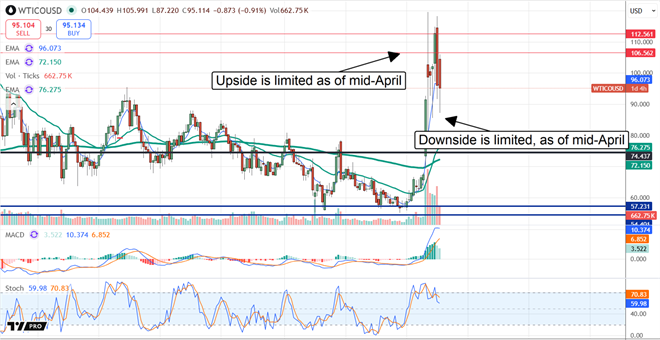
The fallout from the Iran war is mounting and is likely to trigger an inflation shock. The impact begins with oil prices, which have already pushed costs higher across the economy. Oil appears capped near $115, so upside risk is somewhat contained. Still, at mid-April levels near $95, WTI is well off its lows and is underpinning price increases across many sectors. That is a significant risk.
Among the latest to announce price increases are major appliance manufacturers Whirlpool (NYSE: WHR) and GE Appliances, a Haier Smart Home company. They cited extreme inflationary pressure in warnings to dealers and plan to raise prices in mid-June to offset those higher costs. Their warnings threaten not just their own businesses but the wider economy, since broad-based price increases can contribute to a recession. The key caveat is that oil prices are volatile and an end to the war remains possible.
Oil Prices Shot Up When the War Started. What Happens When It Ends?
A lasting ceasefire would restore freer oil trade and put downward pressure on prices. The question is when lasting peace arrives and how far prices fall when it does. With an estimated 10% or more of global production offline or otherwise impaired because of the conflict, oil prices are likely to remain elevated for some time if not near current levels.
OPEC is a wild card. The cartel has agreed to raise production quotas, but two factors limit the impact. First, any increases may not fully replace lost Middle Eastern capacity. Second, much of OPEC’s available capacity is tied to the same region and constrained by access through the Strait of Hormuz. Saudi Arabia and its neighbors can boost output, but much of that supply can’t reach global markets until the conflict eases. The risk for oil bulls is that supply recovery, particularly once the conflict ends, could be swift—driving prices back toward the $60–$70 range.
Inflation Data Reveals Impact of Higher Oil Prices: More to Come
The March CPI showed the effect of higher oil, with the headline rate jumping; further increases are likely. As inflation runs hot on both monthly and headline measures, year‑over‑year figures will accelerate, putting the Fed squarely at risk. While the Fed has little influence over oil prices—a major driver of this inflation—it may nonetheless be forced to raise interest rates to stabilize consumer prices. The best-case scenario is that the Fed stands pat and lets the war and its oil-market effects play out, but even that would weigh on market outlooks by damping investor enthusiasm for stocks.
The stock market rally is supported by earnings growth that is expected to accelerate sequentially into the high teens through the end of the year. Higher‑for‑longer interest rates raise business costs for a longer period, especially for smaller-cap, pre‑revenue, and unprofitable companies that have been outperforming in April. In that environment, flows into small-cap stocks—the so‑called Great Rotation—may slow or reverse as investors refocus on quality, profitability, and capital returns.
Labor Market Strength and Economic Resilience Hang in the Balance
Labor and broader economic data continue to point to a healthy economy. Activity is below the peaks of 2022 and 2023, but those highs were influenced by pandemic stimulus and elevated consumer spending that has largely normalized. As of Q2 2026, labor-market trends resemble past periods of expansion, with job growth, ample openings, low unemployment, and rising wages. The economy can likely withstand a shock—assuming any upcoming inflation shock is not too severe or prolonged—so the S&P 500 should be able to trend higher, with periodic corrections.
S&P 500 price action—in the index and the S&P 500 ETF (NYSEARCA: SPY)—doesn’t yet fully reflect the risk from the conflict. The market hit new highs after solid earnings from JPMorgan Chase and other financial leaders, and there is street chatter that the war will end soon. Even if it doesn’t, so far it hasn’t impaired the earnings outlook for the equities market. With earnings reports coming from major tech companies, including NVIDIA and other members of the Magnificent Seven, the market could continue to advance until it encounters inflationary pressure.
Investors should be cautiously positioned. Volatility is the bigger risk, and another correction is possible, but fundamentals remain broadly bullish, so a wholesale exit from the market is premature. Taking profits and increasing dry powder for future opportunities is prudent; completely liquidating positions in anticipation of a major meltdown is not advised.
Thank you for subscribing to MarketBeat!
We empower individual investors to make better financial decisions by providing real-time financial information and best-in-class market research.
If you have questions about your account, don’t hesitate to email MarketBeat’s U.S. based support team at contact@marketbeat.com.
These aren’t mild downgrades or lukewarm opinions. These are true Strong Sell stocks.
Some of them may look fine on the surface. A few even have what appear to be solid fundamentals. But when analysts issue a rare Sell rating, it’s usually because something beneath the surface is deeply wrong.
Sell-side analysts may not nail every Buy call… but when they raise red flags, they’re almost always worth listening to.
If any of these stocks are lurking around in your portfolio, you may seriously want to consider dumping them.
P.S. Access to 20 Stocks to Sell Now is completely free. Don’t miss your chance to review these timely, high-conviction warnings before the market reacts.
Additional Reading from MarketBeat
Golden Ceasefires: Forget Fear, It’s About the Global Reset
Author: Jeffrey Neal Johnson. Posted: 4/10/2026.
Key Points
Sovereign nations are actively diversifying their reserves by accumulating physical gold to protect themselves against the erosion of fiat currencies.
Sophisticated institutional investors are pouring capital into precious metals as a strategic hedge against long-term global inflationary pressures.
Global gold producers are well-positioned to capture significant value as the commodity undergoes a structural revaluation.
Recent developments in the Middle East have presented a puzzle for market observers. After news of a U.S.-Iran ceasefire, conventional wisdom suggested safe-haven assets such as gold would lose some of their appeal. A move toward geopolitical stability typically reduces investor fear, lowering demand for assets that serve as shelter during crises. In theory, a calmer world should be a headwind for bullion.
Yet the opposite appears to be happening. In the hours after the headlines, gold bullion and the stocks of major producers not only held their ground but extended their gains. This unusual market behavior reflects a shift in the dynamics that drive the precious metals sector, suggesting the rally has a more durable foundation than the fleeting anxieties of geopolitical conflict.
Strength in gold now looks less like a short-term reaction and more like a durable repricing driven by macroeconomic forces. The foundation supporting gold’s value is moving away from temporary fear and toward structural changes in the global financial system.
Two powerful, interconnected forces are creating a strong tailwind for gold. The first is a strategic campaign of de-dollarization led by global central banks. Sovereign nations—particularly in the East and within the BRICS+ alliance—are methodically reducing reliance on the U.S. dollar as their primary reserve asset.
Multiple datasets support this view. In March 2026 alone, China’s central bank added another five tonnes of gold to its vaults, continuing a consistent pattern of accumulation. Large-scale institutional buying like this produces steady, meaningful demand that does not depend on daily headlines, providing a reliable base for prices.
The second driver is the persistent erosion of fiat-currency purchasing power. Despite central banks’ attempts to tighten policy, inflation remains elevated in many regions, eroding the value of dollars, euros, and other government-issued currencies.
This pressure is compounded by rising sovereign debt levels, which can lead to further currency creation and long-term concerns about debasement. A recent softening in the U.S. Dollar Index is a direct indicator of this trend and supports a higher gold price. Together, these forces have established a formidable price floor, making gold more resilient to short-term shocks and setting the stage for a prolonged bull cycle.
SPDR Gold Shares: Tracking Bullion With Institutional Force
For investors seeking direct exposure to bullion, the SPDR Gold Shares (NYSEARCA: GLD) exchange-traded fund remains the institutional benchmark. The fund is designed to track the price of physical gold, less a 0.40% annual expense ratio. Its performance over the last year—a gain of roughly 50%—illustrates its effectiveness in capturing the commodity’s move.
What makes GLD especially compelling now is its fund-flow story. A recent $511 million inflow signals conviction from large, sophisticated investors. Unlike many retail decisions, institutional flows reflect calculated, strategic allocations by entities positioning for a sustained rally.
That sentiment also shows up in the options market, where more than 160,000 bullish call options significantly outnumber bearish puts. This forward-looking data suggests participants actively betting on future direction expect further upside. GLD’s liquidity also makes it the preferred vehicle for large traders who need to enter and exit positions efficiently.
Newmont Corporation: Leveraging the Rally With a Mining Leader
While an ETF like SPDR Gold Shares provides direct exposure to bullion, a premier mining company such as Newmont Corporation (NYSE: NEM) offers the potential for leveraged returns. That operational leverage is important to understand: miners have fixed costs, so each dollar the gold price rises above production cost flows disproportionately to the bottom line.
Newmont’s stock performance illustrates this dynamic, delivering a roughly 168% return over the past year and currently trading near $120.
Newmont’s financials reinforce its position to benefit from higher prices. In its fourth-quarter 2025 earnings report, the company reported EPS of $2.52, beating the consensus by $0.71. Revenue rose 20.6% year over year, showing Newmont is effectively translating higher gold prices into substantial profits.
As the world’s leading gold producer, Newmont’s geographically diverse portfolio across North and South America, Australia, and Africa helps mitigate operational and political risks that affect smaller competitors. That market leadership and financial strength have earned it a Moderate Buy consensus rating from Wall Street analysts, with an average price target of $133.78 and a high target of $175—both offering meaningful upside from current levels. A dividend yield of about 0.9% also provides an additional return stream for shareholders.
Positioning for the Next Wave in Precious Metals
The current gold market presents an asymmetric opportunity. The downside appears supported by a structural floor of central-bank buying, while the upside remains substantial, driven by longer-term inflationary pressures and fiat devaluation. While volatility will persist, near-term dips could represent strategic entry points for investors committed to the long-term thesis rather than signals to sell.
The forces driving this bull cycle are not fleeting but part of a multi-year realignment of the global financial order. For investors looking to protect purchasing power and position portfolios for this trend, the gold sector offers clear options: a benchmark ETF like SPDR Gold Shares as a core holding for direct bullion exposure, and a best-in-class miner such as Newmont for potential growth and leveraged returns in what may be a new gold supercycle.
Thank you for subscribing to MarketBeat!
MarketBeat empowers everyday investors to make better trading decisions by delivering up-to-the-minute financial information and unbiased market research.
If you have questions or concerns about your newsletter, please feel free to email MarketBeat’s South Dakota based support team at contact@marketbeat.com.
Editor’s note: Although Erez Kalir ordinarily focuses on technology, blockchain, and biotech issues in Porter & Co.’s Tech Frontiers, Porter turned over the Journal to him today so Erez could tell the story of the longer-term consequences of the extended closing of the Strait of Hormuz: erosion of the supremacy of the U.S. dollar and the Trump administration’s inability to stop it…
In the fall of 1956, the British Empire learned – in the most painful way imaginable – that it was no longer in charge.
The immediate trigger was Egypt’s decision to nationalize the strategic Suez Canal, the narrow artery through which nearly all of Europe’s oil flowed. For Britain, the canal was not merely an economic asset, but the connective tissue of an empire – the link between London and the Middle East, India, and beyond.
British Prime Minister Anthony Eden responded the only way a fading empire knows how: with force. In late October, Britain, France, and Israel launched a coordinated military operation to regain control of the Suez. Militarily, the operation succeeded.
Financially, it was a catastrophe.
The United States, Britain’s most important ally, refused to support the invasion. Worse, Washington undermined Britain using the one weapon that mattered most, the dollar.
At the time, Britain still clung to the illusion that its currency, pound sterling, remained the global reserve. But sterling’s position as the world’s dominant currency had been eroding for decades… losing ground to the ascendent U.S. greenback. And in this crucial moment of geopolitical crisis, Britain depended on foreign capital to support sterling’s stability in the foreign exchange markets. When President Dwight Eisenhower signaled that U.S. support for sterling would be withdrawn, the rest of the world’s capital followed.
Sterling collapsed… Britain’s foreign reserves evaporated – and within weeks, Prime Minister Eden was forced into a humiliating Suez withdrawal.
Historians often describe Suez as the end of the British Empire. That’s not quite right – empires rarely end in a single moment.
But Suez was the moment the world saw, unmistakably, that Britain could no longer enforce the system that underpinned its power. And once the world sees that, it can’t be unseen.
The Rise And Fall Of Empires
Ray Dalio, founder of the world’s largest hedge fund, Bridgewater Associates, has spent decades carefully studying the rise and fall of empires – the Dutch, the British, and now the American.
Dalio’s framework is both intuitive and powerful:
In the beginning, an ascending power’s naval strength protects key trade routes. Controlling key maritime trade routes makes a nation’s currency the one everyone wants to use. Reserve currency status enables that nation to borrow from the rest of the world more cheaply. Cheap borrowing helps reinforce the nation’s military strength – and so the loop closes.
An empire’s decline works through a feedback loop, too: As a dominant power borrows more, it becomes complacent, believing it can continue to borrow in perpetuity. Its debt mushrooms. At a certain juncture, the cost of maintaining the military that catalyzed the empire’s ascent begins to become painful, then prohibitive. Foreign creditors begin to question the currency. The currency’s reserve status erodes, causing borrowing costs to rise, and the military weakens. The empire falls into a terminal decline.
In this downward spiral, the crucial moment isn’t when the hegemon weakens – it’s when the world realizes it has weakened.
The Strait Of Hormuz
All of which brings us to what is unfolding today in the Strait of Hormuz.
As everyone who isn’t Robinson Crusoe knows, the Iran War has led to the closure of the Strait, through which roughly 20% of the world’s oil transits. But as I discussed in detail in the April issue of Tech Frontiers, Hormuz is a critical chokepoint for far more than oil.
Approximately 20% of the world’s liquefied natural gas (“LNG”) flows through it… along with over 20% of seaborne nitrogen fertilizers, on which the global food supply depends… and more than 30% of the global helium market – an essential, little-known input for the fabrication of the advanced memory chips that power the artificial intelligence (“AI”) buildout.
Embarrassingly for the U.S., the Strait of Hormuz was not closed before we launched this war. Iran shut it in response to our attack on February 28, making its closure what soccer players call a colossal “own goal” – points we ourselves scored for the other team.
And now, over six weeks after we initiated the conflict, we’ve belatedly discovered that re-opening the Strait is really hard, even with the world’s most expensive and technologically advanced military. Last week, a mere 19 hours after President Donald Trump posted on Truth Social that Iran had promised to keep the Strait “permanently” open as an outcome of peace negotiations, Islamic Revolutionary Guard Corp (“IRGC”) forces fired live ammunition on two civilian tankers seeking to transit the Strait, forcing them to turn around.
How The Hormuz Closure Hurts The Dollar Order
The Hormuz crisis, which the U.S. precipitated, is causing devastating injury to the dollar system in at least three ways.
1. The world is seeing – in the most painfully visible way imaginable – that the U.S. can’t keep the most important maritime trade route in the world open. The three aircraft carriers we have dispatched to the Persian Gulf, which cost U.S. taxpayers about $13 billion each to build? No match yet for the credible threat posed by the IRGC’s cheap drones and “mosquito fleet” of fast-attack speedboats. The U.S. financial backstop meant to stabilize the maritime insurance market for Hormuz transit? Hasn’t returned insurance rates anywhere close to their pre-conflict levels. Most importantly, vessels still simply aren’t transiting.
2. The Hormuz closure is wreaking havoc on the economies of U.S. allies. Europe, Japan, Korea, India, and large parts of Asia depend on energy flows implicitly secured by U.S. naval power. When these flows come to a sudden stop, their economies suffer – and for several of our key allies, the economic damage is rapidly becoming a bona fide crisis. When the dust settles, and even before, the inevitable conclusion our allies will draw is that their reliance on the Pax Americana and the dollar system at its foundation made them vulnerable, not strong.
3. A boost for China’s currency. The final development may be the most important. Because during the first six weeks of the war, while virtually all U.S.-allied vessel transit across Hormuz was halted, one other category of vessels continued to move smoothly: Chinese shadow-fleet tankers carrying Iranian crude – which China paid for in renminbi (“RMB”) not dollars, and settled using its own bespoke CIPS payment system, not the U.S. backed, dollar-based SWIFT.
The Trump administration belatedly realized that allowing Iran to facilitate Hormuz transit for Chinese vessels while zeroing out U.S.-allied vessels was a really dumb idea. We accordingly implemented our own naval blockade – effectively conceding that if we couldn’t re-open the Strait, we would at least close it for everyone, including China. But for over a month, the world got a striking, real-time demonstration of renminbi-denominated oil flowing seamlessly while dollar-based oil was totally stuck. That “proof of concept” for renminbi-denominated oil is not one the world is likely to forget.
This alone is not going to lead to the replacement of the dollar… but it’s a sign of the slow erosion of the dollar’s dominance both as a reserve currency and as a medium of exchange.
America’s Response
U.S. policymakers aren’t blind to China’s strategy. And recently, the U.S. response has begun to coalesce around two important pieces of our own, each of which can be understood as a way of updating the fading petrodollar.
The first is what we might call the “crypto-dollar.” Stablecoins – dollar-backed, blockchain-based digital assets – are extending the reach of the dollar into every corner of the global economy. Every unit of stablecoin requires backing in U.S. Treasuries. Every transaction therefore reinforces the dollar’s role as the unit of account. And because stablecoins operate outside traditional banking systems, they reach populations and markets that the old system never could. Stablecoins are, in effect, a digital version of the Eurodollar system that has helped sustain the dollar’s dominance after the collapse of the Bretton Woods agreement when President Nixon closed the “gold window” in 1971.
The second pillar is even more interesting… what might be called the “GPU-dollar.” In the 1970s, oil created structural demand for dollars, because all oil was priced in dollars. Today, a new, scarce commodity is emerging: access to AI computational power, or AI “compute.” High-end GPU chips, AI infrastructure, and the compute + energy “stack” are increasingly becoming essential inputs for economic competitiveness and growth. In this new world, GPUs are the new oil, Nvidia is the new Saudi Aramco, and AI infrastructure is the new foundation of global economic power. If the U.S. can ensure that access to this “stack” is mainly dollar-denominated, it can replicate the logic of the old petrodollar order:
America’s strategy – to advance the dollar’s reign by advancing stablecoins and AI compute – is elegant and smart.
But there’s a problem.
Dalio’s framework reminds us that innovation and even control over scarce resources don’t sustain a reserve currency. At its core, reserve currency status depends on something more basic: The ability to enforce the system, through a combination of military and economic might.
In the 1970s, that meant guaranteeing oil flows. Today, it means guaranteeing the trade routes, physical and digital, on which the system depends.
Which brings us back to the Strait of Hormuz.
If the United States cannot demonstrate that it can keep the Strait open – if it cannot restore dollar-based flows – then the entire dollar order begins to wobble.
The crypto-dollar can extend the system.
The GPU-dollar can evolve it.
But neither can replace the foundation. The foundation is military credibility – the power to enforce our will on the trade routes that make the global economy run.
Which is why we almost certainly have not seen the end of this conflict.
For investors, the Hormuz crisis isn’t a garden-variety geopolitical story. Instead, to paraphrase Soviet leader Vladimir Lenin, it’s a period of weeks when decades happen.
Because resources, currencies, capital flows, and technological systems all rest on the same underlying question: Who enforces the rules?
For over 75 years, the answer has been the United States. In the waters of the Persian Gulf today, that answer is being tested.
The outcome of the test will determine the course of the global economy over the rest of our lifetimes.
P.S. Three of the current open positions in Tech Frontiers are up more than 100% since Erez recommended them – and he exited three now-closed positions far above 100%. Erez will release his next Tech Frontiers issue in early May. To get access to his next recommendations and all archives, click here now.
New AI could double your portfolio by detecting the day’s most profitable trades among 2,467 stocks, 90 minutes before they occur. It solves the market like a Rubik’s Cube. Today’s market opens perfect conditions for this new strategy. Featuring 3 free picks in a major event backed by four Wall Street legends. See it now, before it goes offline.
Editor’s Note: Keep in mind, we only accept advertising from publishers we know to offer well-researched ideas vetted by a legal team, excellent customer service, and reasonable refund policies. TradeSmith is one such partner. We do not, however, under any circumstances make any representations about their investment ideas or strategies, nor will we warrant them as equal to our own. We do recognize that the markets are tempestuous and, at times, ideas that we may not endorse prove valuable.
3 Things To Know Before We Go…
1. The ESG bubble has popped. Environmental, social, and governance (“ESG”)-related fund flows as a percentage of overall ETF flows have collapsed to their lowest levels since 2018. According to Morningstar, global sustainable funds hemorrhaged $84 billion in 2025 – the first annual net outflow since tracking began. ESG was never a performance strategy – it was a political strategy dressed up in performance language. You cannot exclude the most profitable sectors on Earth (energy, tobacco, defense) and compete with a broad index. This is why we own Philip Morris (PM), ExxonMobil (XOM), and other energy-related names in Complete Investor and Porter’s Permanent Portfolio.
2. Technology takeover of the U.S. manufacturing. The production of computers, semiconductors, and communications equipment is up 90% since 2017, while the rest of the U.S. manufacturing sector has declined 4% over the same period. The AI revolution has accelerated a long-running trend of technology playing an increasingly larger role in the U.S. economy.
3. AI now dominates both U.S. equity and credit markets. AI-related stocks account for a record 45% of the S&P 500’s market cap, up 20 percentage points since ChatGPT launched in November 2022. Meanwhile, 15.4% of all investment-grade debt is now tied to AI, with AI-related debt nearly doubling since 2020 to $1.4 trillion. No single theme has ever gripped both markets this completely at the same time.
Chart Of The Day… Kinsale Capital
Yesterday, Complete Investor recommendation Kinsale Capital (KNSL) reported Q1 earnings – the property and casualty insurance company’s business fundamentals remain robust, with an industry-leading 77.4% combined ratio and 24% operating return on equity. As happens after almost every KNSL positive quarterly earnings report, shares dropped significantly. As such, its valuation is more than 30% below its five-year average, offering an attractive entry point.
Today’s Poll… New Fed Chair And Interest Rates
Mailbag
In yesterday’s Daily Journal, Porter wrote the third part of his “A Turning Is Coming in 2029” series. Readers share their thoughts…
“A Desperate Government May Raid Roth IRA Accounts”
Franz B. writes:
Dear Porter,
I am worried about your projection for a 2029 fiasco. During our working careers, both my wife and I saved and accumulated substantial 401(k) and pension assets. When we retired together, we transferred it all to traditional IRA accounts for each of us. We activated Social Security, worked part-time, and took minimum required IRA distributions to pay living expenses and taxes. When the government created the Roth IRAs, we both started a gradual annual program to convert our traditional IRA accounts to Roths. Now this program has been completed. My concern is that a desperate government will raid Roth IRA accounts by changing taxation rules.
Porter Comment: I think it’s virtually certain that the government will default on its promises to Social Security recipients within the next four years. How it will do so remains to be seen, but it will certainly include both more wealth confiscation and lower payouts (at least in real terms).
“Comment On Generation Theory”
Bruce F. writes:
I want to thank you for your excellent articles on the Turnings. I especially like your focus on the economic consequences. I know you have previously discussed strategies for protecting oneself from the collapse. I look forward to future articles as the government response evolves.
The four Turnings should be familiar, as they work on a microscale. As a young person, you have lots of energy. You are, hopefully, self-reliant and independent. During this first phase, you work hard and build your wealth. In the second phase, you can enjoy the benefits of your wealth. You travel, eat at fine restaurants, and, perhaps, buy a sports car. In the third phase, your body starts to demand more of your time and resources. Much like a growing welfare population that politicians need to cater to. You are faced with addressing the welfare needs of your aging body. We have all seen what the fourth phase collapse looks like. If you believe in reincarnation, you can look forward to starting another first phase.
“Canceling European Vacations”
Tom A. writes:
Porter,
Your analysis is sound.
I think the situation in the Strait of Hormuz is a black swan hiding in plain sight.
A friend in NYC said people are talking about having to cancel their European vacations this summer for a lack of jet fuel.
“Your Response To Selling Insurance Companies”
Arthur G. writes:
Porter,
I am very upset with your response to Stan W.’s question yesterday regarding selling the property and casualty (P&C) insurers. You were very condescending and confusing in your answer to a somewhat difficult concept. However, I would venture to say that most of your Partners are well educated with graduate or other advanced degrees. We can all understand nuance if properly explained. IMHO your answer to Stan was confusing and could have been more to the point. I originally felt like Stan did. Why sell the P&C’s if their bond holdings will return more? P&C’s generally do well in a rising rate environment. It took me several readings of the original post as well as your answer to him to understand your “nuanced concept” as to why individuals nearing retirement might want to sell off their P&C holdings to lighten the load.
I hope my understanding is correct, otherwise you will probably be patronizing me:
Investors who cannot tolerate a 20% or more drawdown (I am one of them at age 71… although still working making a large income) need to be very cautious with their stock and bond portfolios. P&C companies will have two problems when interest rates rise. First, while the rise in interest rates will increase their returns on the float investments, their bond portfolios will actually fall in value (yield up, price down). Second, we need to remember that P&C’s are simply stocks. As we all are aware, when the shit hits the fan, they will be sold off like almost every other stock in the market. Hence lighten up your exposure.
Not too difficult or nuanced to understand when simplified.
Porter Comment: Arthur –
Thanks so much for letting me know. I’ve got a wonderful suggestion.
Would you like to try explaining it to everyone for me? Because, in at least half a dozen different emails, I’ve said exactly the same thing.
I think there’s going to be a bear market.
I think inflation / higher interest rates will cause it
A war could easily be the catalyst
If we hit 5% on the 10-year Treasury, then it’s time to raise cash
Here’s how to hedge the risks of the war — Venture Global (VG), APA (APA), CF Industries (CF), ExxonMobil (XOM)
And if you can’t handle a 20% drawdown this year, then think about selling P&C and raising cash now
I don’t know how to say it any clearer – or I would have!
But, I’m happy to publish your version.
Just tell me what you want me to print —
Porter
Please note: The investments in our “Porter & Co. Top Positions” should not be considered current recommendations. These positions are the best performers across our publications – and the securities listed may (or may not) be above the current buy-up-to price. To learn more, visit the current recommendations page of the relevant service, here. To gain access or to learn more about our current recommendations, call our Customer Care team at 888-610-8895 or internationally at +1 443-815-4447.
You have received this e-mail as part of your subscription with Porter & Company, LLC. If you no longer want to receive e-mails, unsubscribe here.
Porter & Company, LLC welcomes comments or suggestions at support@porterandcompanyresearch.com. For questions about your account or to speak with customer service, call 888-610-8895 Monday-Friday, 9 a.m.-5 p.m. Eastern time.
Please note: The law prohibits us from giving personalized financial advice.
Disclaimer: Nothing in this email should be considered personalized financial advice. Do not consider any communication between you and Porter & Company, and its employees or writers as financial advice. This work is based on SEC filings, current events, interviews, corporate press releases, and what we’ve learned as financial journalists. It may contain errors, and you shouldn’t make any investment decision based solely on what you read here. Insight is provided to help readers gain knowledge and experience. All investments carry risk. Readers should not trade if they cannot handle a loss and should not trade more than they can afford to lose. Consider consulting with a professional before making investment decisions. Please be aware that by accessing this publication, you acknowledge and agree that Porter & Co. and its editors and affiliates may, at any time, buy or sell securities discussed in this publication without prior notice. This may result in potential conflicts of interest, as Porter & Co., its editors, and affiliates may have a financial interest in the securities mentioned. The views expressed in this publication are subject to change without notice and reflect the personal opinions of the authors and speakers.
By submitting a response or feedback, you hereby grant Porter & Co. the right to use, reproduce, and publish your feedback in any and all marketing materials, including but not limited to online platforms, print advertisements, and promotional content. Your review may be edited for clarity and length, but the substance of your feedback will remain unchanged. Please note that your personal information will be kept confidential and will not be disclosed without your explicit consent. If you have any questions or concerns regarding this agreement, please contact us at support@porterandcompanyresearch.com or to speak with customer service, call 888-610-8895 Monday-Friday, 9 a.m.-5 p.m. Eastern time.
If you choose to no longer receive our free newsletter and daily market updates, click here to UNSUBSCRIBE
Disseminated on Behalf of Pacific Ridge Exploration (TSXV: PEX | OTCQB: PEXZF)
Hey,
I told you I’d share the one thing most investors are missing about our sponsor, Pacific Ridge (TSXV: PEX | OTCQB: PEXZF) .
Here it is.
Most people following this story are watching for drill results. Understandably. The 2026 exploration season is starting soon. Multiple programs. Multiple targets. There’s a lot to watch.
But the detail that doesn’t get enough attention is what happened in December 2025.
Pacific Ridge signed formal exploration agreements with the Takla Nation — covering both Kliyul and RDP — before the 2026 field season began.
First Nations consultation in British Columbia isn’t a formality. It’s a foundational step in the permitting process. Projects stall for years waiting to get this right. Companies that skip it or handle it poorly face delays that no amount of good geology can fix.
Pacific Ridge had these agreements signed and in place before a single drill hole turns in 2026.
Combined with the infrastructure advantages at Kliyul — eight kilometres from an existing resource road, adjacent to a 230-kilovolt power line — you have a project that’s not just geologically interesting. It’s operationally positioned.
That’s the detail worth sitting with as this field season gets underway.
We’ll keep covering Pacific Ridge as results come in throughout 2026. When there’s something worth sharing, you’ll hear from us.
The full special report remains available if you want the complete picture.
Thanks for reading. We hope the research has been useful.
— The Traders on Trend Research Desk
FULL DISCLOSURE & DISCLAIMER
Traders on Trend is a marketing company operated under FinPubMax Media LLC. We have been compensated by or on behalf of Pacific Ridge Exploration Ltd. (TSXV: PEX | OTCQB: PEXZF | FSE: PQW) to produce and distribute this report. This compensation represents a conflict of interest. Any information we share about the company is in the form of a paid advertisement — not independent research, not independent analysis, and not journalism.
This report is provided for informational purposes only. Nothing in this report constitutes financial, investment, tax, or legal advice. This is not a solicitation to buy or sell any security. Do not interpret anything in this report as a recommendation to purchase or sell shares of Pacific Ridge Exploration Ltd. or any other security.
All investment decisions carry risk. Small-cap and micro-cap securities are speculative and highly volatile. You may lose your entire investment. Past performance is not indicative of future results.
All statements in this report are based on publicly available information — company press releases, NI 43-101 technical reports, securities filings, and publicly available market data — and are believed to be accurate as of the date of publication. We make no guarantee of their accuracy. Forward-looking statements are subject to risks and uncertainties that could cause actual results to differ materially from those described.
Mineral resources described in this report are Inferred Mineral Resources under NI 43-101 standards. Inferred resources have a lower level of confidence than Indicated or Measured resources. Mineral resources are not mineral reserves and do not have demonstrated economic viability. There is no certainty that all or any part of the mineral resources will ever be converted into mineral reserves.
SEC Rule 17(b) Disclosure: Traders on Trend / FinPubMax Media LLC has received cash compensation in connection with the preparation and distribution of this report.
Nothing in this disclaimer limits or waives the rights of any reader under applicable securities law.
Always conduct your own research and due diligence. Consult a licensed financial professional before making any investment decision.
Disclaimer:
Trading foreign exchange, stocks, options, or futures on margin carries a high level of risk, and may not be suitable for all investors. Before deciding to trade, you should carefully consider your objectives, financial situation, needs and level of experience.
This newsletter provides general information that does not take into account your objectives, financial situation or needs. The content of this newsletter or our website must not be construed as personal advice. FinPub Max Network is not registered or licensed by any governing body in any jurisdiction to give investing advice or provide investment recommendation.
The possibility exists that you could sustain a loss in excess of your deposited funds and therefore, you should not speculate with capital that you cannot afford to lose. You should be aware of all the risks associated with trading on margin. You should seek advice from an independent financial advisor.
Any past performance presented is not necessarily indicative of future success.
Always do your own research and consult with a licensed investment professional before making an investment. This communication should not be used as a basis for making any investment.
Advertising Disclosure: This email contains paid advertisements and we have been paid in some fashion to send this advertisment to our readers.
If you do not wish to receive this email, then we apologize for the inconvenience. You can immediately discontinue receiving this email by clicking on the unsubscribe link and you will no longer receive this email. If you have any questions, please send an email with your questions to Editor@tradersontrend[.com]
We strongly urge you to read our full disclaimer @ tradersontrend[.com]/legal-disclaimer/
In 2003, I picked up a 1965 Porsche for $12,500. It is now insured for $125,000. In 2009, I bought an $18,000 Rolex Daytona for $9,000 and sold it days later for $12,000.
In 2010, when the housing market fell apart, I bought four condos at $40,000 each, collected $12,000 a year per condo for twelve years, then sold them for three to four times what I paid.
My father taught me this.
He was not a rich man, but he knew the value of a dollar, and he knew that everything in life is negotiable.
That lesson followed me into the stock market, and it has made me more money over 46 years than every car, watch, and condo deal combined.
I call the strategy a phantom bid.
Here is how it works. A company you want to own is trading at $44 a share.
You tell the market you will only buy it at $30. The moment you make that offer, the market pays you cash upfront just for showing up.
From there, one of two things happens.
If the stock never drops to $30, your offer disappears, and you keep every dollar the market paid you. If the stock drops to $30, you buy a world-class company at a price nobody else got, and you still keep the cash you collected upfront.
Either way, you win.
You either walk away with the premium or you walk away with the stock at your price, plus the premium on top of it.
The offer disappears like a phantom. The cash does not.
On Wall Street, this is known as selling a put.
The name alone has kept most investors away from it for decades. I have been doing it for my entire investing career.
My record stands at 161 wins out of 169 trades. The losses on the eight trades I did not win were capped at exactly what I risked going in.
Nothing more.
SPONSORED
Wall St. Insider Warns: This Could Leapfrog Elon’s SpaceX IPO
Elon Musk could take SpaceX public in 2026, at an estimated $1.75 trillion valuation.
The IPO would include Elon’s AI model, Grok.
But according to Louis Navellier, a radical new AI model will launch this year… over 1,000 times more powerful than Elon’s.
And the company behind it could outperform SpaceX in the process.
Warren Buffett has been using phantom bids for decades. In 1993 he sold puts on Coca-Cola and collected $7.5 million in premium. The puts expired worthless.
He kept every dollar without buying a single share. When asked about it, he described it as getting paid to agree to buy something you want at a price you want to pay.
The average Iranian earns only $80 a month. One gram of gold in Iran costs $110.
And guess what… they’re still buying more of it. Not because they want to. Because they have no choice. Their currency is worthless. Tragic for them.
But this isn’t about buying gold. It’s about using Iran’s panic-buying to acquire the world’s best gold assets for up to 50% less than what everyone else is paying. It’s a strategy I’ve used 169 times and won 161 times.
You are receiving this email because you subscribed to Trade of the Day. To unsubscribe from Trade of the Day, click here.
Questions? Check out our FAQs. Trying to reach us? Contact us here. Please do not reply to this email as it goes to an unmonitored inbox.
To cancel by mail or for any other subscription issues, write us at: Trade of the Day | 14 West Mount Vernon Place | Baltimore, MD 21201 North America: 800.507.1399 | International: +1.443.353.4977 Website | Privacy Policy Keep the emails you value from falling into your spam folder. Whitelist Trade of the Day.
Nothing published by Monument Traders Alliance should be considered personalized investment advice. Although our employees may answer your general customer service questions, they are not licensed under securities laws to address your particular investment situation. No communication by our employees to you should be deemed personalized investment advice. We allow the editors of our publications to recommend securities that they own themselves. However, our policy prohibits editors from exiting a personal trade while the recommendation to subscribers is open. In no circumstance may an editor sell a security before subscribers have a fair opportunity to exit. The length of time an editor must wait after subscribers have been advised to exit a play depends on the type of publication. All other employees and agents must wait 24 hours after publication before trading on a recommendation.
Any investments recommended by Monument Traders Alliance should be made only after consulting with your investment advisor and only after reviewing the prospectus or financial statements of the company.
Protected by copyright laws of the United States and international treaties. The information found on this website may only be used pursuant to the membership or subscription agreement and any reproduction, copying or redistribution (electronic or otherwise, including on the world wide web), in whole or in part, is strictly prohibited without the express written permission of Monument Traders Alliance, LLC, 14 West Mount Vernon Place, Baltimore, MD 21201.
Editor’s Note: I have a message for you from Matt Insley at Paradigm Press. I thought you might find it interesting – check it out here or read more below.
– Jonathan Rodriguez, Senior Managing Editor
GOLD SHOCK COMING
Dear Reader,
White House, Pentagon, and CIA insider Jim Rickards is widely considered to be among the top gold experts in the world…
He even wrote the definitive book on gold, titled The New Case for Gold – which was praised by The Wall Street Journal, Forbes, and more.
You are receiving this email because you subscribed to Liberty Through Wealth. Liberty Through Wealth is published by The Oxford Club.
To stop receiving special invitations and offers from Liberty Through Wealth, please click here. Please note: This will not impact the fulfillment of your subscription in any way.
Questions? Check out our FAQs. Trying to reach us?Contact us here. Please do not reply to this email as it goes to an unmonitored inbox.
Nothing published by The Oxford Club should be considered personalized investment advice. Although our employees may answer your general customer service questions, they are not licensed under securities laws to address your particular investment situation. No communication by our employees to you should be deemed personalized investment advice. We allow the editors of our publications to recommend securities that they own themselves. However, our policy prohibits editors from exiting a personal trade while the recommendation to subscribers is open. In no circumstance may an editor sell a security before subscribers have a fair opportunity to exit. The length of time an editor must wait after subscribers have been advised to exit a play depends on the type of publication. All other employees and agents must wait 24 hours after publication before trading on a recommendation.
Any investments recommended by The Oxford Club should be made only after consulting with your investment advisor and only after reviewing the prospectus or financial statements of the company.
Protected by copyright laws of the United States and international treaties. The information found on this website may only be used pursuant to the membership or subscription agreement and any reproduction, copying or redistribution (electronic or otherwise, including on the world wide web), in whole or in part, is strictly prohibited without the express written permission of The Oxford Club, LLC, 105 West Monument Street, Baltimore, MD 21201.
SMX Emerges as a Critical Shield for U.S. National Security as Conflict Threatens Rare Earth Flows
The strategic importance of rare earth minerals has skyrocketed amid the rising confrontation between the United States and Iran, as these materials underpin the technology, defense, and energy sectors that power national security.
Australia, a leading producer of rare earths, faces pressure to provide secure, verifiable, and compliant supply chains to meet U.S. demands. SMX (Security Matters) Public Limited (NASDAQ: SMX) offers a transformative solution: a molecular identity platform that embeds an indelible, verifiable signature into each mineral, enabling precise origin tracking from mine to market.
By converting supply chains into intelligent, self-verifying networks, SMX addresses vulnerabilities that can otherwise be exploited during geopolitical instability, including counterfeiting, tampering, and unauthorized diversion of critical resources.
Operating from Singapore and leveraging Southeast Asia’s stable environment, SMXdelivers a globally neutral, resilient, and scalable platform for supply-chain security.
Its technology not only verifies materials but strengthens regulatory compliance, industrial accountability, and defense readiness.
In times of conflict, such as the current Iran-U.S. tensions, this capability becomes indispensable: it ensures that essential rare earths are authenticated, traceable, and shielded from interference.
For governments, multinational enterprises, and defense partners, SMX represents more than innovation—it is a safeguard against uncertainty, a reinforcement of national security, and a commitment to transparency in a world where trust is fragile.
The Nasdaq’s Historic Rally Doesn’t Mean the Risk Is Gone
Authored by Bridget Bennett. Article Posted: 4/19/2026.
Key Points
Chaikin Analytics rates software and cybersecurity stocks as sectors to sell into this rally, citing AI disruption from models like Claude Mythos as a structural headwind for legacy names.
Seven stocks across semiconductors, construction and engineering, optical networking, and mining earn bullish ratings, though Chaikin recommends waiting for pullbacks before buying.
The S&P 500 is approaching all-time highs after a historic Nasdaq 100 rally, but Strait of Hormuz uncertainty could trigger a reversal.
The S&P 500 has pushed to a new all-time high, and the Invesco QQQ Trust (NASDAQ: QQQ), which tracks the Nasdaq 100, has logged its longest winning streak on record in terms of consecutively higher closes. Investors everywhere are asking the same question: Is it safe to buy?
Marc Chaikin, founder of Chaikin Analytics and creator of the Power Gauge stock rating system, says the answer depends on where you look. The rally is real, but so are the risks still lurking beneath the surface.
Because my research has led me to believe we’re risking World War 3 with Iran for a completely different reason.Click here to find out what it is.
Chaikin sees a market running on hope that could stumble at the first sign of disappointment.
A Rally Built on Ceasefire Hopes—Now Getting a Reality Check
The catalyst for the market’s V-shaped recovery was last week’s announcement of ceasefire negotiations tied to the Iran conflict. That news pushed the S&P 500 through its 50-day and 200-day moving averages in a single session, clearing resistance that had capped prices for weeks.
At the time of Chaikin’s analysis, neither pillar of the bull case was firmly in place—no agreed-upon ceasefire existed, and the Strait of Hormuz remained effectively closed to normal commercial traffic. Since then, the situation has shifted: an Israel-Lebanon ceasefire took effect, and Iran’s foreign minister declared the Strait “completely open” for commercial vessels for the duration of the ceasefire.
Whether that progress holds remains an open question. Chaikin’s broader point still applies: markets that climb on optimism tend to be vulnerable when the details disappoint. The Strait may be open today, but the underlying conflict is far from resolved.
2 Sectors Worth Trimming: Software and Cybersecurity
Rather than chasing the rally, Chaikin views this as an opportunity to prune weak positions—and two sectors top his sell list.
Software stocks, which once made up about 16% of the S&P 500, now represent roughly 8%. Names like Salesforce (NYSE: CRM), Atlassian (NASDAQ: TEAM), and Adobe (NASDAQ: ADBE) have underperformed the broader market for more than nine months. The Power Gauge labels many of these names bearish, and Chaikin’s proprietary money-flow data shows persistent institutional selling. The cause is structural: advances in AI—from Anthropic and OpenAI to Google and Meta—are putting real pressure on the SaaS business model that powered these companies for two decades.
Microsoft (NASDAQ: MSFT) doesn’t escape scrutiny. The stock carries a neutral Power Gauge rating and remains more than 20% below its October peak despite rallying from under $360 to above $400. Chaikin sees Microsoft and the rest of the Magnificent Seven as legacy beneficiaries now facing competitive headwinds from the next wave of AI innovation.
Cybersecurity is the other sector Chaikin would trim. Palo Alto Networks (NASDAQ: PANW) has been in a clear downtrend, and the bearish case extends beyond technicals. Anthropic’s Claude Mythos Preview—announced earlier this month—demonstrated the ability to discover thousands of zero-day vulnerabilities across major operating systems and browsers, exposing flaws in infrastructure that legacy cybersecurity firms had certified as secure. That kind of disruption creates a credibility problem for incumbents. If AI can uncover back doors that existing platforms missed, the market will eventually reprice who deserves the cybersecurity franchise.
Semiconductors: Bullish, But Buy the Pullback
The semiconductor space has been the backbone of this rally, and Chaikin remains constructive on the group—with a caveat. These names have run too far, too fast to chase at current levels.
NVIDIA (NASDAQ: NVDA) is recovering after a sharp drawdown, and Chaikin acknowledges it as the dominant force in AI chips. Still, the more compelling opportunities may sit further down the supply chain.
Lam Research (NASDAQ: LRCX) is critical to chip manufacturing, holding near-duopoly positioning in etch and deposition equipment. The stock has rallied sharply, but a pullback toward its moving averages could offer a cleaner entry.
Onto Innovation (NYSE: ONTO) specializes in quality control for semiconductor manufacturing and has carried a bullish Power Gauge rating since last August. Shares have surged from around $100 to above $280, but Chaikin says a retreat toward the stock’s 21-day average would make it attractive again. B. Riley recently raised its price target on the stock to $310.
The AI Buildout’s Picks and Shovels
Beyond chips, Chaikin is focused on the physical infrastructure powering AI—the construction, cooling, and data-transport layers of the buildout.
Quanta Services (NYSE: PWR) has been building power plants and clearing land for electric utilities for decades. With AI data centers demanding enormous new power capacity, Quanta sits at the intersection of energy infrastructure and AI demand. The stock recently hit an all-time high near $596, so patience for a pullback is warranted.
Comfort Systems USA (NYSE: FIX) handles the cooling and HVAC systems that keep data centers operational—a constraint that only tightens as compute density rises. The company has delivered 35% quarterly revenue growth and shows strong profitability relative to peers.
Inside data centers, moving information at speed is the next bottleneck. Optical networking stocks have been on fire, and Chaikin recently took a quick 15% profit in Coherent (NYSE: COHR) after a two-week hold. The stock has continued climbing, recently hitting an all-time high above $310 after being added to the S&P 500 in March.
Ciena (NYSE: CIEN) is another name in this space, with first-quarter revenue up 33% year over year and raised full-year guidance to as much as $6.3 billion. Both are stocks Chaikin would consider re-entering on a pullback.
Copper, Not Silver, Fuels the Wiring
Finally, raw materials matter. Freeport-McMoRan (NYSE: FCX) is the world’s largest publicly traded copper miner, and copper is essential for the fiber-optic wiring and internal infrastructure of data centers.
The stock has carried a bullish Power Gauge rating since last year and recently set a new all-time high near $70 before pulling back.
Freeport also has a major mine offline that is expected to return to production this fall—a potential catalyst that could add meaningful supply to a copper market already running tight.
Stay Disciplined as the Market Tests New Highs
The setup is compelling: AI demand is real, the infrastructure buildout could last five years or more, and these names are positioned at critical points along the supply chain. But with the S&P sitting at all-time highs on ceasefire optimism while the Strait of Hormuz remains contested, Chaikin’s message is clear—don’t chase the rally. Identify the stocks doing differentiated work, wait for pullbacks, and let discipline do the heavy lifting.
This message is a paid advertisement for SMX (NASDAQ: SMX) from Equiscreen and Interactive Offers. MarketBeat Media, LLC receives a fixed fee for each subscriber that clicks on a link in this email, totaling up to $14,000. Other than the compensation received for this advertisement sent to subscribers, MarketBeat and its principals are not affiliated with either Equiscreen or Interactive Offers. MarketBeat and its principals do not own any of the stocks mentioned in this email or in the article that this email links to. Neither MarketBeat nor its principals are FINRA-registered broker-dealers or investment advisers. The content of this email should not be taken as advice, an endorsement, or a recommendation from MarketBeat to buy or sell any security. MarketBeat has not evaluated the accuracy of any claims made in this advertisement. MarketBeat recommends that investors do their own independent research and consult with a qualified investment professional before buying or selling any security. Investing is inherently risky. Past-performance is not indicative of future results. Please see the disclaimer regarding SMX (NASDAQ: SMX) on Interactive Offers’ website for additional information about the relationship between Interactive Offers and SMX (NASDAQ: SMX).
If you need help with your subscription, please feel free to email MarketBeat’s South Dakota based support team at contact@marketbeat.com.



















.jpg)





 News for you, Peter
 Today’s game
 Trending now1.
 RJ Hamster