Author Archives: RJ Hamster
I was born on 6 August 1956 in San Francisco, California to Janet and (the late) Richard Hovis.
I grew up in Santa Monica, California where I attended elementary, junior high school, and high school (graduating in 1974), in addition to involvement in sports and recreation (Little League +, the Boy’s Club ++). Further, it was in elementary school – St. Augustine’s By-the -Sea Parish School that I found, and made the choice to truly journey with God.
I attended Arizona State University from 1974 to 1977 – seeking to become an architect, however, I was not accepted, and, as such, I graduated with a Liberal Arts degree.
Upon graduation from Arizona State University, I attended Cal Poly San Luis Obispo and studied City and Regional Planning at the Master’s level. I successfully completed one (1) year in a two (2) year program – I did not complete the Master’s degree in City and Regional Planning – due to personal reasons.
I returned to Santa Monica where I started (October 1979) my career as graphic designer with Exxon Company, USA. I spent five years with Exxon Company, USA.
While working with Exxon Company, USA I was accepted into architectural school – Sci-Arc in Southern California, however, I did not attend preferring to stay with Exxon..
In 1982 I married Laura Flosi and in April 1983 we had our one and only child – Lauren Alain Hovis – a gift from God.
We moved to Phoenix, Arizona in 1984 from Los Angeles, where I went to work as a graphic designer with Kitchell CEM (from 1985 -1987).
From 1987 – 1995 I was an independent contractor, and a registered representative in mortgage finance, financial management, graphic design, and drafting.
Further, I attended the University of Phoenix and successfully obtained a Master’s in Business Administration (MBA) in 1982.
I was also a member of the Scottsdale Jaycees, where I became very involved in community events and projects.
In 1994, I accepted a cartography position with the Defense Mapping Agency in Reston, Virginia. As such, I relocated from Phoenix to Reston.
In 1998, I was accepted and worked as a Visual Information Officer with the Central Intelligence Agency. In 2002, I worked as a Support Officer until my retirement (due to a need for shoulder surgery) in September 2018.
Away from my Federal Government service, I have been involved in various organizations and activities in Northern Virginia.
In November of 2011, I married Rebecca Ouellette in Santa Monica, California. I reside in San Tan Valley, AZ with my two hamster - Jess and Timothy, our fish, our lizard - RJ Lizard., and our cats - Pearl and Grey.
As to hobbies, I enjoy playing sports, attending sporting events, mentoring individuals from financial management to hamsters, building models, photography, travel, multimedia design, managing partner for RJ Hamster, and jazz – smooth jazz to a samba or a bossa nova.
Love and God Bless,
Peter – aka RJ Hamster Jo hi
🦉 The Night Owl Newsletter for May 5th
Unsubscribe The #1 stock to buy BEFORE the June S-1 filing (From Behind the Markets)
Shopify’s Valuation Crisis Creates Opportunity in 2026
Written by Thomas Hughes
The most pressing problem with Shopify (NADAQ: SHOP) stock is its valuation. The stock commands a significant premium, trading at over 120X trailing earnings, but it is well-deserved and prices in a robust outlook. The company self-funds growth, sustains a high-20% growth pace, and points to compounding results in the upcoming year.
Looking ahead, the forward estimates are robust, placing this stock in the low teens by 2035, suggesting a solid upside. In this scenario, Shopify’s stock could rise by 70% or more simply to align with broad market trends, and that’s not counting its emerging position as an AI-powered eCommerce leader.
The company is leaning hard on its 20 years of eCommerce data, using it to power agentic and assistant AI tools internally and for its customers. Internal uses increase productivity and throughput while the client-facing ones enable quick, easy, scalable online business construction, maintenance, client acquisition, sales, and payments. Execs say the advantage puts them in a category of one and expect results to compound in 2026.
Shopify Accelerates Growth in Q1: Guides Hot
Shopify had a robust quarter, which is saying something for a company that has sustained high growth for many years. The Q1 results reflect an acceleration compared to the prior quarter and the prior year, with revenue up 34.3% and outpacing the consensus by 250 basis points (bps). Strength was driven by all geos, merchant sizes, and channels, with gross merchandise volume up 34.7%, monthly recurring revenue up by 16.5%, and strength in both subscriptions and merchant services. Subscriptions were weakest, rising by only 21%, but were compounded by services penetration, which increased by nearly 40%.
Margin was another area of strength, despite the contraction in GAAP results, caused by a non-cash one-off. The company experienced gross margin pressure but navigated the environment well, with gross profit growth trailing revenue growth by only 210 bps, and operational strengths offsetting the difference. Operating income increased by 88% and, equally important, the free cash flow margin was maintained at 15%.
Guidance is a bullish catalyst for this market, though it was insufficient to immediately support the price action after the release. The company forecasts revenue in the high-20% range compared to the consensus 26.75%, with a mid-teens free cash flow margin. Among the sticking points are increased spending, which is cutting into the profitability outlook. The caveat is that investment in operations and AI has been paying off for the business and is likely to continue doing so.
Bullish Analysts Enter Wait-and-See Mode
The analyst response was ultimately bullish for the stock price, although near-term headwinds have emerged. No analyst revisions were issued immediately after the release, but several commentaries were, highlighting slowing growth and increased spending.
The critical detail is that the group of 44 provides a high conviction in the Moderate Buy rating, as there is a 77% Buy-side bias, coverage has been increasing, and the price target trend is positive as of early May. Consensus forecasts a 40% upside relative to critical support targets, with the high-end adding double-digits.
Institutions are a concern for Shopify investors in 2026. The group owns nearly 70% of the stock and has been distributing aggressively, with activity ramping sequentially into Q1 2026. The pace is also high, about $3.5-to-$1, and central to the stock price action over the past few quarters. The good news is that early Q2 activity reverted to accumulation, helping cement the market floor. However, there is a risk that institutions sell into any rally that forms.
Shopify Stock Is at Rock Bottom in 2026
Shopify stock may struggle to advance until later this year, but it is not expected to fall significantly either. The market shows clear support at the 150-week exponential moving average, a trigger point for long-term buy-and-hold investors, including institutional traders. The likely outcome is that Shopify trends sideways within its existing range, possibly retreating to the $110 level or slightly lower before rebounding within it.
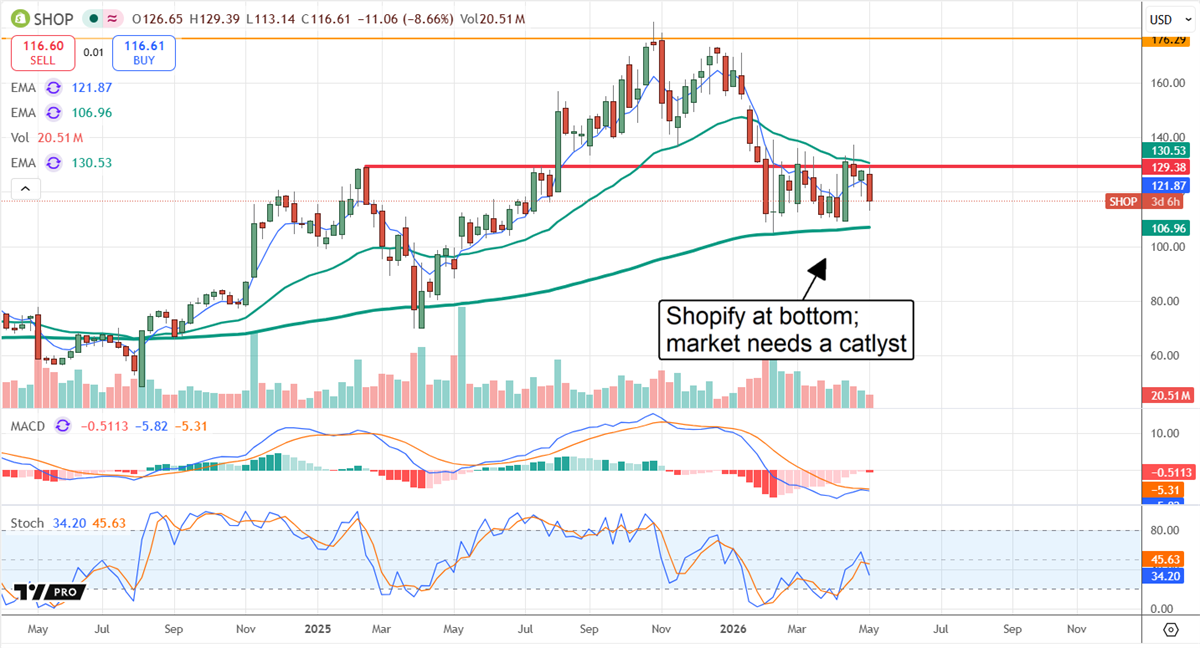
Catalysts in 2026 include the buyback authorized at the end of FY2025. Worth $1 billion, it underscores management’s confidence in the company’s financial position and has begun providing shareholders with leverage. While incremental, sequential share count reduction will add up over time and help lift this market. Future catalysts include the potential to accelerate returns, such as additional buyback authorization and dividends. Risks include increased competition from names like Amazon (NASDAQ: AMZN) and Mercado Libre (NASDAQ: MELI), which continue to take commerce share in developing and emerging markets. READ THIS STORY ONLINE
Ticker Revealed: Pre-IPO Access to “Next Elon Musk” Company (Ad)

We’ve found The Next Elon Musk… and what we believe to be the next Tesla.
It’s already racked up $26 billion in government contracts.
Peter Thiel just bet $1 Billion on it.👉 UNLOCK THE TICKER NOW AND GET IT COMPLETELY FREE.
Palantir Drops After a Blowout Q1—What Investors Should Know
Written by Chris Markoch

Palantir Technologies (NASDAQ: PLTR) delivered a blockbuster Q1 2026 earnings report after the market closed on May 4. But 85% year-over-year (YOY) revenue growth and a Rule of 40 score of 145%, among other highlights, weren’t enough to cheer investors. PLTR dropped 7% the day after the report.
The predictable concern was the company’s valuation. The company delivered earnings per share of 33 cents. That was 5 cents above projections for 28 cents. The number was also 153% higher YOY. On a GAAP basis, the earnings beat was even more impressive. GAAP EPS of 32 cents was 325% higher YOY.
To put that in even more perspective, Palantir chief executive officer, Dr. Alex Karp, made this observation in his letter to shareholders, “Indeed, we generated nearly as much in profit in the first quarter of the year as we did in revenue only twelve months ago.”
This is key to reconciling the PLTR price. Analysts are projecting earnings growth of around 43% in 2026. The company is on pace to do far better than that. But critics of Palantir’s valuation only need to be right once. And at least the day after earnings, momentum was on their side.
Government and Commercial Growth Both Accelerate—A Rare Double
As in the past several quarters, Palantir registered strong growth on both the government and commercial sides of its business. U.S. commercial revenue grew 133% YOY to $595 million, and U.S. government revenue grew 84% YOY to $687 million.
It’s hard to understate the importance of this growth, as Palantir critics often continue to miss the massive growth story that’s occurring on the commercial side of the business. The company was born through its business with the U.S. government, but it’s become much more than that.
As the numbers show, both sides of the business continue to grow and grow strongly. In fact, Palantir raised its full-year outlook for both revenue and earnings. That’s impressive after the quarter it just posted.
Wall Street Is Raising Targets While Burry Shorts the CEO
The real signal for Palantir investors comes from the analyst community. Dan Ives of Wedbush was quick to reiterate its Outperform rating and $230 price target for PLTR. Rosenblatt Securities also reiterated a Buy rating and raised its price target from $200 to $225.
It’s worth noting that some analysts have been lowering their price targets on the stock. But in all cases, it would confirm a range-bound state that has been in place for much of this year. There’s also more news from one of Palantir’s favorite bears, Michael Burry, who says he is now outright shorting PLTR. However, Burry said he’s not just shorting the stock based on valuation, he’s “shorting the business model. I am shorting the entire premise upon which the company rests. I am shorting the CEO.”
This is a continuation of a feud that’s existed between Burry and Karp since the end of 2025 when Burry announced he had taken out put options against PLTR. The stock is down over 20% in 2026, and institutional selling outpaced buying in the first quarter. Some would say that proves Burry right. Others would reference a broken clock.
Is Palantir Being Punished for Its Past Success?
The reality of Palantir in 2026 is different than it was just a few years ago. Investors who expect the stock to climb 550% in the next five years, as it has in the last five years, will likely be disappointed. The company has a lot of growth priced into it.
But that doesn’t mean it’s not worth a premium valuation. Institutions will continue to own PLTR, and analysts (with some exceptions) continue to raise their price targets. It’s possible that PLTR will continue to chop around for 2026 while investors sort out the winners and losers in the AI software space.
But just as was the case in 2021 and 2022, that patience is likely to be rewarded for retail investors, many of whom are content to hold the stock after taking out their initial investment.
The Eye Test Still Matters—And Palantir Keeps Passing It
Palantir is a victim of the self-fulfilling prophecy. At this point, the critics have nothing more to say other than valuation, and they’re confident that at some point, that will be reflected in the stock price.
I’m not going to argue math with anyone. That’s like debating metrics like expected batting average or WAR+ with baseball purists.
But in sports, as in investing, the eye test still matters. Palantir isn’t going to make the cut for investors who focus solely on valuation. There are plenty of other stocks that they can own and still sleep at night.
However, the eye test is compelling. Look at it this way. If you had one player to send to the plate for one at-bat in a “gotta have it” moment, there are a lot of players who come to mind that wouldn’t check the boxes as a great hitter. But will you bet against them in the moment? Probably not.
That analogy works for Palantir on two levels. Palantir not only met the moment, it crushed it. Furthermore, it suggested that there’s even stronger growth to come, which almost doesn’t seem possible. And it would be dubious, except that Palantir has continued to do surprise quarter after quarter.
But it also illustrates what Palantir means to its customers on both the commercial and business sides. They rely on Palantir’s Ontology to deliver the insights that they can’t get in any other way.
It’s not a valuation darling. Its business model is misunderstood and, in some cases, misrepresented. But investors who are waiting for PLTR to get the analysts’ stamp of approval will be kept waiting. Meanwhile, the stock is likely to move higher over time. READ THIS STORY ONLINE
The #1 stock to buy BEFORE the June S-1 filing (Ad)

When the SpaceX IPO launches, most retail investors will be locked out. The banks, funds, and insiders get in early – while everyone else waits on the sidelines.
But one small infrastructure supplier – a critical piece Musk can’t scale the Colossus network without – is still trading well under institutional radar. A new briefing reveals the name and ticker at no cost.GET THE SPACEX INFRASTRUCTURE STOCK NAME AND TICKER HERE
TSLA: 3 Reasons the Stock Could Hit $400 in May
Written by Sam Quirke

Having initially traded down following last month’s earnings report, shares of Tesla Inc (NASDAQ: TSLA) are once again pointing north. The stock is currently trading around $390, putting it within touching distance of $400. This means that Tesla has not only recovered the ground it lost following April’s report but has actually pushed past its pre-earnings price, a clear sign that sentiment has swung to the bulls’ side.
That kind of price action matters, especially given the multi-month downtrend that had been gathering pace. As we head into the start of summer, it’s looking more and more like Tesla has flipped the narrative back in its favor, and the path toward $400 looks increasingly clear. Let’s take a look at the bull case and the top three reasons in particular that Tesla should be back trading above that level in the coming weeks.
Reason #1: The Earnings Reset Has Reopened the Bull Case
As MarketBeat noted at the time, Tesla’s latest earnings report didn’t need to be perfect. It just needed to be good enough to stabilize the story and remind investors of the company’s underlying strength—which is exactly what it did.
Margins improved, profitability held up better than many had feared, and the company’s Services revenue grew strongly. Taken together, these factors helped shift the focus away from short-term concerns around demand and pricing pressure and back toward Tesla’s ability to generate sustainable earnings.
More importantly, the report addressed one of the key bearish arguments that had been building in recent months. That is, Tesla’s core business was losing momentum in a way that could not be easily offset by exciting, but as yet unrealized, future ambitions.
Instead, what the results showed was a business that is adjusting, not collapsing. This distinction is crucial. When a stock is under pressure, the first step toward a recovery is removing the worst-case scenario from the table. Tesla has done that, and in doing so has diminished, if not completely removed, one of the stronger headwinds that was pushing the stock down in recent weeks.
Reason #2: The Growth Story Is Now Bigger Than Cars
If the earnings report stabilized the downside, then Tesla’s evolving growth narrative has been driving the upside. Thanks in large part to clear messaging on this in last month’s report, the company is increasingly being viewed through the lens of artificial intelligence, autonomy, and robotics rather than just as an electric vehicle manufacturer. This is a shift Tesla has been trying to achieve for months now, and it looks like it’s finally starting to stick.
Developments around full self-driving, the ongoing buildout of its robotaxi ambitions, and progress in areas like Optimus are all contributing to a broader story that extends well beyond car sales. Tesla continues to invest heavily in these areas, and the path to clear returns is becoming clearer. That’s helping to reposition the shift in investors’ minds from a theoretical pivot to an actual strategic plan.
In terms of what this means for the stock, the key point is that the company’s growth potential is expanding rapidly. While Tesla’s automotive business remains important, it’s no longer the sole driver of the valuation, and arguably isn’t even the primary driver of valuation anymore.
Investors are instead starting to price in the potential for entirely new revenue streams, which is creating room for the stock to move higher—hence why $400 could soon become the new floor.
Reason #3: Momentum and Sentiment Are Now Aligned
Perhaps the most important factor in the near term is the alignment between price action, sentiment, and positioning. Tesla’s recovery from last week’s post-earnings dip has been decisive, especially when you consider the stock had been selling off continuously since December.
The setup is, for now at least, looking less like a short-term bounce and more like the start of a fresh uptrend. At the same time, analyst sentiment is moving in the same direction. Recent updates over the past two weeks have seen HSBC upgrade the stock to a Buy rating, while Tigress Financial, Deutsche Bank, and President Capital all reiterated bullish positions. The updated price targets are also supporting the case for further upside from here, with President Capital’s fresh $428 target in particular suggesting that a move beyond $400 is imminent.
Add in a broader risk-on backdrop that’s driving equities to all-time highs, with investors increasingly happy to lean back into growth names like Tesla, and the setup becomes even stronger. The stock has quickly moved from the defensive to the offensive, and while it still needs to deliver, $400 now looks like the next step rather than an ambitious target. READ THIS STORY ONLINE
5 Space Stocks Set to Watch as the New Space Race Heats Up (Ad)

With NASA’s Artemis missions underway and launch costs falling dramatically, the space economy is evolving into a long-term infrastructure play with contracts and recurring revenue to match.
A new free report highlights five publicly traded companies across launch, satellites, defense, and space-based intelligence – from a rocket company expanding into spacecraft manufacturing to a real-time satellite intelligence firm selling data to governments and corporations.READ THE FREE REPORT AND DISCOVER ALL FIVE SPACE ECONOMY STOCKS
More Stories
- NVIDIA’s China Connection: Investor Risks With Earnings Ahead
- Amazon Weaponizes Logistics, Triggering Sector-Wide Selloff
- Trump Admin to Pump $1 Billion into this “Off-the-Radar” AI Stock(Ad)
- Atomic Dividends: Big Tech’s New Energy Bet
- onsemi Stock Dips After Earnings: Why the Dip Is Buyable
- Norwegian Cruise Line Cuts Outlook as Headwinds Build
- Monolithic Power Systems: AI Stock Beat, Raised and Upgraded Post-Earnings
The Night Owl is a financial newsletter that provides in-depth market analysis on stocks of interest to individual investors. Published by MarketBeat and Early Bird Publishing, The Night Owl is delivered around 9:00 PM Eastern Sunday through Thursday. If you give a hoot about the market, The Night Owl is the newsletter for you.
If you have questions or concerns about your account, please feel free to contact our U.S. based support team at contact@marketbeat.com.
Unsubscribe
© 2006-2026 MarketBeat Media, LLC. All rights reserved.
345 N Reid Pl. #620, Sioux Falls, S.D. 57103. United States of America..
Featured Link: Ticker Revealed: Pre-IPO Access to “Next Elon Musk” Company(From Banyan Hill Publishing)
The Bull Market’s Dangerous Disconnect



Delivering World-Class Financial Research Since 1999
The next phase in the Persian Gulf… Highs for stocks – and gas prices… A small housing thaw… Homebuilders aren’t following… A dangerous disconnect… An inflection point for semiconductors…
The new state of play…
Despite ammunition flying both ways between the U.S. military and the Islamic Revolutionary Guard Corps yesterday, “right now, the ceasefire certainly holds,” Secretary of Defense Pete Hegseth said earlier today.
The U.S. is not “restarting major combat operations at this point,” Joint Chiefs of Staff Chair General Dan Caine said today. But the military isn’t backing down from a fight, either… And it’s leaving open the possibility of ramping up attacks in Iran.
Meanwhile, Project Freedom – the name given to the U.S effort to escort stranded commercial ships out of the Persian Gulf – “is defensive in nature, focused in scope, and temporary in duration,” Hegseth said.
There are hundreds of ships waiting to pass through the Strait of Hormuz safely. But as of our last check, traffic through the strait is still moving at a crawl. U.S. forces escorted only two ships out of the Persian Gulf yesterday, and global energy supply remains seriously disrupted.
Still, after a spate of volatility yesterday, Mr. Market absorbed this information as a good thing. Oil futures fell more than 3%, and the benchmark S&P 500 Index and tech-heavy Nasdaq Composite Index traded back toward their highs today.
At the gas pumps this morning, there were new highs, too…
The national average for a gallon of regular gasoline in the U.S. is now $4.48, about $1.70 more than at the start of the year. Diesel is close to $5.66 per gallon, on average, less than 20 cents from its all-time high set in the summer of 2022. And pity the Californians paying $6.13 per gallon of regular gas.
But people are going to work. Trucks are going to jobs. At a gas station north of Baltimore earlier today, there were various folks filling up almost two dozen vehicles around me (Corey McLaughlin). “$4.20 a gallon?” one construction worker asked aloud. He started filling up anyway.
So did I, although I’m thinking it might be wise to start applying an investing concept – dollar-cost averaging – to gas purchases. Filling up regularly could help hedge against potential future higher prices.
As our colleague Mike Barrett wrote in last week’s Select Value Opportunitiesupdate…
After seven weeks of war, energy analytics firm Kpler estimates that the global oil market has lost approximately 500 million barrels worth of oil supply.
That’s roughly equivalent to the amount of fuel all vehicles worldwide consume in 11 days.
Mike noted that various nations – like South Korea, Pakistan, and Slovenia – are already rationing fuel. And “demand destruction” – “a sustained, and possibly permanent, decline in product demand due to changes in market structure” like limited supply resulting in higher prices – might not be limited strictly to oil…
“The Iran war has altered the market for food imports into Iran and the Middle East,” Mike wrote. “That’s destroying demand for the crops grown by American farmers…” In other words, we’ve only just started to see the economic impacts from the war in Iran.
Looking elsewhere, some good news…
In March, sales of newly constructed homes rose to an annual rate of 682,000. That pace is still in the same range of between 600,000 and 700,000 homes that it has been stuck in since 2023, but the rate was up more than 7% from February, and 3% higher than the year before.
This could be a sign that the housing market is thawing (which we’ve written about here), especially because it comes in the face of higher mortgage rates in March. But mortgage rates moved lower again in April.
However, related housing stocks aren’t telling the same story…
The State Street SPDR S&P Homebuilders Fund (XHB) is down more than 1% this year, versus a 6% gain for the S&P 500 Index. And two significant stocks in XHB are down much more than that…
Home Depot (HD) and Lowe’s (LOW) are far and away the two largest housing retailers in the U.S. They’re also two of the top 10 largest retailers in the country by revenue. So you would expect these two companies to thrive as housing sales bounce back.
But so far in 2026, the exact opposite has happened…
Home Depot shares are down more than 8% this year and are 26% lower from their September high. The stock now sits near its lowest level in more than two years.
As for Lowe’s, the stock is down 7% in 2026 and has fallen more than 20% from its most recent high.
Both of those companies will report their first-quarter results in two weeks. So we’ll have to wait until then to see if their businesses saw the same bounce the housing market did in February and March.
But with how the stocks have been performing, investors aren’t optimistic that these companies will ride the tailwinds. So what gives?
It’s a disconnect between the ‘real’ economy and the broader stock market…
This is a theme we’ve frequently covered about various parts of the economy, like mounting consumer debt and the growing cracks in the labor market while headline stock indexes hit new highs…
This isn’t totally unusual behavior. It has often been said that the economy is not the stock market and vice versa.
In other words, the economy and stock market can behave as if they’re living on different timelines. Economic data represents the past, while stock prices are tied to investors’ expectations for how companies will perform (or casino-like speculation in some cases).
We’ve seen markets rebound plenty of times before major risks to the U.S. economy are resolved… most recently, during the COVID-19 pandemic panic and rebound or the Liberation Day panic and rebound.
Today, war volatility aside, AI remains the biggest story for investors. And the strength in the top AI names during a multiyear bull market has allowed many folks to overlook what’s going on elsewhere.
As we wrote last week, AI-related spending accounted for more than 40% of all growth in the first quarter, according to U.S. gross domestic product (“GDP”) data.
But while the broader stock market has been giving the appearance of “all clear” lately, all is not well under the hood.
Housing accounts for about 16% of all economic growth in the U.S., and the housing “freeze” of the past few years has been a headwind for the total economy’s growth. Even with the two-month rebound in new home sales, that’s still the case.
Existing home sales (which make up 90% of all housing sales) hit a nine-month low in March, and related stocks are among the worst performers of the year. You just wouldn’t know it if you only follow the headline indexes.
But you might soon…
A signal of weakening health…
The S&P 500’s advance-decline line – a measure of market breadth – has shown that over the recent three-week surge to new all-time highs, fewer stocks are participating in the rally.
As Ten Stock Trader editor Greg Diamond wrote to subscribers today, the Dow Jones Industrial Average looks weakest of the major U.S. indexes right now and appears to have “topped.” The others could follow.
Home Depot and Lowe’s are perfect examples of large companies not following the market. This isn’t a sign of a healthy rally, but a warning that the market is ripe for another sell-off – especially if shares of the AI leaders powering the market falter in the weeks ahead.
An ‘inflection point’ ahead…
Thanks to the AI boom, semiconductors might also be at an “inflection point,” according to Stansberry Research senior analyst Brett Eversole.
In this morning’s DailyWealth newsletter, Brett noted that semiconductor stocks jumped a massive 47% in just 18 trading days amid the stock market rebound over the past two months.

Looking at this chart, “you might feel incredibly bullish… or fearful,” Brett wrote. “History justifies both reactions.”
This kind of semiconductors performance has happened only 10 other times since 1994. At a broad level, the results look good, showing a roughly 11% average return after six months and around a 19% average return one year later.
However, digging deeper into the 10 prior instances, the sector saw gains one year later only half the time. And you didn’t want to be on the wrong end of the bet if these stocks went lower. As Brett wrote…
In cases where semiconductors rise, they soar an average of 76% over the next year. But when they fall, the sector crashes 38% on average.
That’s why semiconductor stocks are at an inflection point today.
As investors, we should prepare for both possibilities…
Brett’s staying put right now – riding the trend for semiconductors higher but being prepared for the sector to possibly head lower.
We’re not saying it’s time to go “all out” of semiconductors (or the AI boom, for that matter), but it’s certainly not time to go “all in” either. Be selective, as it looks like these stocks (and the bull market) are nearing an important turning point.


Recommended Links:
Until Tomorrow: Will You Be Left Behind?
Two financial legends predict a paradigm shift will reset the market, cause Magnificent Seven stocks to plummet, and define the true winners of the next AI era. Fifty-year Wall Street legend Marc Chaikin and Silicon Valley insider Jeff Brown recently sat down together to share how you can access the names of SIX companies that could get left behind in the next era of AI. Click here for more details.
SpaceX’s ‘Dark Energy’ Could Replace Foreign Oil
For years, we’ve been told that SpaceX is a rocket company. But according to new satellite images from 300 miles above the Earth’s surface, there is something very strange going on at SpaceX right now that has nothing to do with space. It could soon replace our need for foreign oil forever and ignite a $10 trillion boom for the stocks involved. Click here to learn more.
New 52-week highs (as of 5/4/26): Atlas Energy Solutions (AESI), Amazon (AMZN), Alpha Architect 1-3 Month Box Fund (BOXX), CBOE Global Markets (CBOE), Chord Energy (CHRD), Ciena (CIEN), Cisco Systems (CSCO), Simplify Managed Futures Strategy Fund (CTA), DigitalOcean (DOCN), DXP Enterprises (DXPE), Emcor (EME), iShares MSCI Emerging Markets ex China Fund (EMXC), iShares MSCI South Korea Fund (EWY), FirstCash (FCFS), Flex LNG (FLNG), iShares Convertible Bond Fund (ICVT), Liberty Energy (LBRT), Lumentum (LITE), Marathon Petroleum (MPC), Pembina Pipeline (PBA), Roku (ROKU), ProShares Ultra Technology (ROM), USCF SummerHaven Dynamic Commodity Strategy No K-1 Fund (SDCI), and Viper Energy (VNOM).
In today’s mailbag, some replies to a question raised in yesterday’s mail… Do you have a comment or question? As always, e-mail us at feedback@stansberryresearch.com.
“RE: Troy J’s comment, ‘what benefit would YOU like to give up to help the situation?’
“ALL OF THEM! I don’t want any government help; I just want them the hell out of my life (and pocket). I’ve earned my Social Security ‘benefits’ and would have done much better if left to handle my own retirement. Those aren’t really benefits, they’re just returning some of the value they stole from me.
“The problem with this country is that everyone THINKS they can get (or are getting) more OPM (other people’s money) from the government. It can’t work with a behemoth in the middle, consuming a significant portion of the resources. TAKE CARE OF YOURSELVES!” – Subscriber Mike M.
“Since Troy J. asked in Monday’s Digest, here’s a short list of the ‘benefits’ I would like to give up to go back to gold money:
“The Internal Revenue Service… The Federal Reserve… The Ukraine war… Day care benefits for my 75 imaginary adopted Somali children… The social security checks I collect on behalf of my great, great, great, great grandparents… Cryptocurrency (a scramble for sound money that consumes much talent and computing power)… [Editor’s note: Point taken, but we find value in cryptocurrencies too.] Un-affordable housing… Buying industrial production from abroad… Endlessly expanding government bureaucracy that may or may not be able to answer e-mail.
“Thank you for the invitation [for the list].” – Stansberry Alliance member Paul J.
All the best,
Corey McLaughlin and Nick Koziol
Baltimore, Maryland
May 5, 2026
Stansberry Research Top 10 Open Recommendations
Top 10 highest-returning open stock positions across all Stansberry Research portfolios. Returns represent the total return from the initial recommendation.InvestmentBuy DateReturnPublicationMSFT
Microsoft11/11/101,372.0%Retirement MillionaireMSFT
Microsoft02/10/121,335.3%Stansberry’s Investment AdvisoryCIEN
Ciena10/20/22853.4%Stansberry Innovations ReportGOOGL
Alphabet12/15/16844.1%Retirement MillionaireADP
Automatic Data Processing10/09/08817.2%Extreme ValueBRK.B
Berkshire Hathaway04/01/09761.9%Retirement MillionaireALS-T
Altius Minerals03/26/09668.1%Extreme ValueLITE
Lumentum04/15/21616.4%Stansberry Innovations ReportWRB
W.R. Berkley03/15/12616.2%Stansberry’s Investment AdvisorySII
Sprott01/11/18604.9%Extreme Value
Please note: Securities appearing in the Top 10 are not necessarily recommended buys at current prices. The list reflects the best-performing positions currently in the model portfolio of any Stansberry Research publication. The buy date reflects when the editor recommended the investment in the listed publication, and the return shows its performance since that date. To learn if a security is still a recommended buy today, you must be a subscriber to that publication and refer to the most recent portfolio.
Top 10 Totals3Extreme ValueFerris3Retirement MillionaireDoc2Stansberry Innovations ReportEngel2Stansberry’s Investment AdvisoryPorter
Top 5 Crypto Capital Open Recommendations
Top 5 highest-returning open positions in the Crypto Capital model portfolioInvestmentBuy DateReturnPublicationBTC/USD
Bitcoin11/27/182,023.9%Crypto CapitalWSTETH/USD
Wrapped Staked Ethereum12/07/181,898.2%Crypto CapitalONE/USD
Harmony12/16/191,008.7%Crypto CapitalPOL/USD
Polygon02/26/21642.7%Crypto CapitalQRL/USD
Quantum Resistant Ledger01/19/21448.2%Crypto Capital
Please note: Securities appearing in the Top 5 are not necessarily recommended buys at current prices. The list reflects the best-performing positions currently in the Crypto Capital model portfolio. The buy date reflects when the recommendation was made, and the return shows its performance since that date. To learn if it’s still a recommended buy today, you must be a subscriber and refer to the most recent portfolio.
Stansberry Research Hall of Fame
Top 10 all-time, highest-returning closed positions across all Stansberry portfoliosInvestmentDurationGainPublicationNvidia (NVDA)^*5.96 years1,466%Venture Tech.Microsoft (MSFT)^12.74 years1,185%Retirement MillionaireInovio Pharma. (INO)^1.01 years1,139%Venture Tech.Rocket Lab (RKLB)^2.35 years1,034%Venture Tech.Seabridge Gold (SA)^4.20 years995%Sjug Conf.Berkshire Hathaway (BRK-B)^16.13 years800%Retirement MillionaireIntellia Therapeutics (NTLA)1.95 years775%Amer. MoonshotsRite Aid 8.5% bond4.97 years773%True IncomePNC Warrants (PNC-WS)6.16 years706%True Wealth SystemsMaxar Technologies (MAXR)^1.90 years691%Venture Tech.
^ These gains occurred with a partial position in the respective stocks.
* Editor Dave Lashmet closed the first leg of this Nvidia position in November 2016 for a gain of about 108%. Then, he closed the second leg in July 2020 for a 777% return. And finally, in May 2022, he booked a 1,466% return on the final leg. Subscribers who followed his advice on Nvidia could’ve recorded a total weighted average gain of more than 600%.
Stansberry Research Crypto Hall of Fame
Top 5 highest-returning closed positions in the Crypto Capital model portfolioInvestmentDurationGainAnalystBand Protocol (BAND)0.31 years1,169%Crypto CapitalTerra (LUNA)0.41 years1,166%Crypto CapitalPolymesh (POLYX)3.84 years1,157%Crypto CapitalFrontier (FRONT)0.09 years979%Crypto CapitalBinance Coin (BNB)1.78 years963%Crypto Capital
You have received this e-mail as part of your subscription to Stansberry Digest. If you no longer want to receive e-mails from Stansberry Digest click here.
Published by Stansberry Research.
You’re receiving this e-mail at pahovis@aol.com. Stansberry Research welcomes comments or suggestions at feedback@stansberryresearch.com. This address is for feedback only. For questions about your account or to speak with customer service, call 888-261-2693 (U.S.) or 443-839-0986 (international) Monday-Friday, 9 a.m.-5 p.m. Eastern time. Or e-mail info@stansberryresearch.com. Please note: The law prohibits us from giving personalized financial advice.
© 2026 Stansberry Research. All rights reserved. Any reproduction, copying, or redistribution, in whole or in part, is prohibited without written permission from Stansberry Research, 1125 N Charles St, Baltimore, MD 21201 or stansberryresearch.com.
Any brokers mentioned constitute a partial list of available brokers and is for your information only. Stansberry Research does not recommend or endorse any brokers, dealers, or investment advisors.
Stansberry Research forbids its writers from having a financial interest in any security they recommend to our subscribers. All employees of Stansberry Research (and affiliated companies) must wait 24 hours after an investment recommendation is published online – or 72 hours after a direct mail publication is sent – before acting on that recommendation.
This work is based on SEC filings, current events, interviews, corporate press releases, and what we’ve learned as financial journalists. It may contain errors, and you shouldn’t make any investment decision based solely on what you read here. It’s your money and your responsibility.
What Happens When the AI Bubble Pops?

Everyone is talking about the AI bubble. Even people with no money in the markets are sounding the alarm.
Houston breaks down why in yesterday’s Daily below and what it means for the stocks sitting in your retirement account right now.
But here’s what most people aren’t talking about.
While the biggest tech stocks in the world swing violently on every earnings report, a handful of companies are quietly winning. They’re not the flashy AI names making headlines. They’re the ones building the infrastructure behind it all. The energy. The grid. The data centers.
And subscribers who got positioned in these stocks back in December are now outperforming the S&P 500 by 3x. One position already delivered a 139% win.
Another has 1,833% upside potential still ahead.
In case you missed it, here’s Big T’s Digital Asset Daily
You know it’s serious when the economic conversation spills over onto the usually “fun” side of social media.
A few days ago, a post crossed my Instagram feed with this warning: “The AI bubble is 17x larger than the dot-com bubble,” it read. “And 4x larger than the 2008 Financial crisis.”
People swarmed the comments. They wanted to know what happens to their savings… or the cash under the mattress… if the bubble pops.
“What if I’ve avoided AI this whole time?” one person asked. “How will it affect me?”
They’re not wrong to ask. If we look at the last two bubbles, the effects when they popped rippled beyond people’s stock accounts.
The dot-com crash contributed to an eight-month recession in 2001. By the spring of 2004, an estimated 403,300 jobs had been lost in the IT sector alone.
The effects of the 2008 crash were even deeper.
A Frontline article published in 2012 (four years after the stock market’s collapse) showed that:
- There were still 12.5 million people out of work, not saving for retirement, and not contributing to the GDP.
- The government had poured about $23 trillion into a host of programs and bailouts.
- Real estate had lost roughly $7 trillion, stocks $11 trillion, and retirement accounts another $3.4 trillion.
- The Census Bureau’s 2010 estimate said 46.2 million people were in poverty – the largest number in 52 years.
I’m not saying this to scare you. But with the AI bubble getting bigger each day, we can’t afford to bury our heads in the sand.
And what nobody mentioned in that discussion I read last week was the story we’ve been tracking in these pages. Yet it provides the clearest answer to the one question that kept coming up: What can I do about it?
One Market, Two Signals
On April 17, I wrote to you about the Crude Oil Civil War we’re seeing. You can read that full essay here. The short version is this: There’s a civil war happening in the crude oil markets, and most people don’t know it’s connected to the AI bubble.
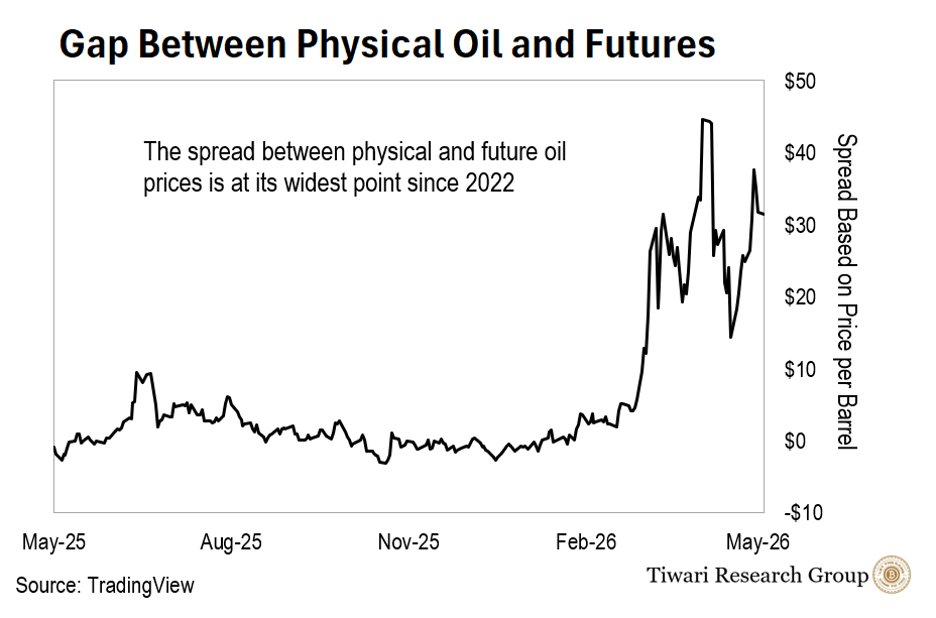
What’s happening is that the “right now” price for physical oil is telling a very different story than the “future” price traders expect to pay in the months ahead.
You can see that in the chart below, which shows the gap (or “spread”) between physical oil prices and futures prices.
That gap hasn’t been this high since 2022, when Russia invaded Ukraine.
What does it mean?
On one hand, the physical market is screaming “shortage.” Buyers need barrels NOW, and they’re paying anything to get them.
That’s because the Iran conflict has a chokehold on the Strait of Hormuz. That’s the narrow waterway through which roughly 20% of global oil supply passed before the war started in February.
On the other hand, traders are saying, “This is temporary. It’ll resolve soon.”
The problem is the market has been saying that for two months. And yet, as you can see, the gap is not really getting any smaller.
This matters because oil touches the price of everything we buy. The longer prices stay high, the more every airline, trucking fleet, chemical plant, and utility in the world will see its primary input cost rise.
And oil prices just hit fresh wartime highs on Friday.
Some of that exposure is hedged, but those hedges don’t last forever. It can take 6-12 months for the full effects to show up. By the time most people feel it, the damage is already done.
Why the “Smart” Money Is Trapped
The irony is that, at the exact moment oil is making historic moves, the institutions managing your retirement savings are legally handcuffed from owning it.
Take CalSTRS, one of the largest pension funds in America. It manages $368 billion in public equities. Between 2022 and 2025, it slashed its traditional (fossil fuels) energy weighting by 36% and moved $30 billion into low-carbon investments.
That’s exactly what I showed you on Wednesday. The “smart” money is being forced to follow ESG mandates in what could be one of the most profitable periods for oil.
Even when we zoom out to all of energy combined, it’s still one of the most underowned sectors in the market. In 2008, it represented 15% of the S&P 500.
Today, it sits at only 3.5%. Compare that to the IT sector, which represents an enormous 32% of the market.
That is a generational abandonment of energy in favor of tech. And history shows us what happens when an unloved sector gets an unexpected catalyst. It snaps back violently.
We saw this back in 2020, when energy hit a record-low weight of just 2% of the S&P 500. Most investors left it for dead after Covid lockdowns crushed oil demand.
That was a mistake. Energy went from the worst-performing sector in 2020 to the top performer in 2021. It gained 46% vs. the S&P 500’s 27%.
By 2022, energy was the only sector in the S&P 500 that finished positive, up 58%. Ten other sectors fell, and the broader index dropped 19%.
That’s a roughly 315% cumulative gain from the unloved bottom over two years, in the most hated sector in the market.
This time, with the physical oil market flashing stress signals, Daily Editor Teeka Tiwari believes we’ll see an even sharper snapback.
Just last week, Al Jazeera published a piece that asked, “When will the Strait of Hormuz be ‘safe’ for commercial shipping again?” The answer boiled down to: Not anytime soon. From that April 28 article:
About 2,000 ships remain stranded in the Gulf. Even if the strait reopens to all traffic, the United States has said it could take six months to clear mines it believes have been laid by Iran.
That is one reason maritime insurers cancelled “war risk” insurance for tankers traveling through the strait in March.
Al Jazeera reported this could push premiums up to 5% of hull value. Before the war, that number was only about 0.25%.
Hull value refers to what the ship itself is worth. Think of it like an insurance appraisal on the vessel, the same way your home has an appraised value before you can insure it. A 5% premium tells us insurers are still pricing the Strait of Hormuz like a war zone, not a shipping lane.
In other words, the crude market is only getting more fractured. And when oil sends mixed signals like this, it usually means the stress has not yet fully worked its way through the economy… and the household names in your retirement portfolio.
The “Paycheck” Strategy for This Market
This is where the oil story connects to the AI bubble.
If oil keeps rising, costs rise across the economy. That matters for every company. But it matters most for the companies already priced for perfection.
The first wave of AI gains went to the obvious names: Nvidia, AMD, Meta, Microsoft, and the rest of the high-flying tech giants.
But those stocks are now swinging violently. One day, investors are questioning whether AI companies will follow through on their promises. The next day, the same stocks are ripping higher.
We saw this with last week’s earnings. Meta and Microsoft beat analyst expectations, and yet they crashed 9% and 4%. Why? Because investors got spooked on AI spending.
That kind of volatility is exactly what we’d expect in a crowded trade. Teeka has been sounding the alarm on this since late last year. And in the January 6Daily, he wrote:
Right now, Alphabet, Amazon, Meta, Microsoft, Nvidia, and Tesla are trading at an average weighted earnings multiple of 56x. That means you have to be willing to pay up to $56 today for every $1 the company earns in a year.
These names are trading at more than 2.5x the entire S&P 500. If that’s not a red flag, I don’t know what is.
We’re not interested in chasing that. Instead, Big T believes the biggest winners from AI won’t necessarily be the flashy tech names everyone is buying today.
The real gains will come from blue-chip companies using AI to improve their margins, cut costs, and boost productivity.
That’s exactly what Teeka’s “Nvidia’s $16 Trillion Paycheck Program” is designed to do. It doesn’t involve buying a single share of Nvidia. It doesn’t involve chasing risky AI startups. And it doesn’t require you to guess which chatbot wins.
Instead, it focuses on a select group of blue-chip companies positioned to benefit from AI adoption while paying reliable dividends along the way. The next scheduled payout is May 15. You can learn more about it here before that deadline.
The bottom line is this: Even people with no money in the markets are starting to sound the alarm on the AI bubble. In times like these, you don’t want to play a high-stakes guessing game.
You want to own the companies built to win no matter what happens next… and get paid while everyone else is guessing.
Don’t Watch the Future Happen. Own It!
Houston Molnar
Update your email preferences or unsubscribe here
© 2026 Tiwari Research Group
1607 Ponce De Leon Ave
San Juan, Puerto Rico 00909, Puerto Rico
Your FOX One mobile app playbook



WATCH ON THE GOStream live and on-demand wherever you are.


CAST TO YOUR TVStart watching in the FOX One app, then tap the Cast or AirPlay icon to continue on your TV.
Learn more


STAY IN THE KNOWGet alerts when games start, breaking news hits and new episodes drop. Turn on notifications in Settings: Preferences.

FOX SHORTSSwipe through short clips to catch the biggest sports highlights, breaking news and must-see show moments in minutes.



MY STUFFRecord content to watch later or when traveling by clicking “+” on the shows, games or leagues you want to record. Watch recorded content on-demand under My Stuff.

ASK FOX AISearch for what to watch, see what’s trending and get the help you need faster than ever.

AVOID SPOILERSHide game scores in the mobile app under Settings: Preferences.


Explore the FOX One App to personalize your experience, catch up on highlights and stay connected on the go.

AVAILABLE WHERE YOU WATCH







DOWNLOAD THE FOX ONE MOBILE APP Follow Us:
Do you have a question? Click here to visit our Help Center.
Please do not reply to this message.
Unsubscribe | Manage Preferences | Terms of Use | Privacy Policy
™ and © 2026 Fox Media LLC. All rights reserved.
Fox Digital Services LLC | PO Box 900, Beverly Hills, CA 90213-0900
Your Night Prayer


Learn More About The Calling of St. Matthew

Today’s Night Prayer is brought to you by Truthly
Catholic “AI for good.” Instant answers and guidance to any question or problem. Try free for 7 days.
A Night Prayer
Jesus Christ, my God, I adore You and thank You for all the graces You have given me this day. I offer You my sleep and all the moments of this night. I place myself and all my loved ones, wherever they may be, in Your sacred side and under the mantle of Our Blessed Mother. Let Your holy angels stand watch and keep us in peace. Amen.

Quote of the Day
“Ask Jesus to make you a saint. After all, only He can do that. Go to confession regularly and to Communion as often as you can.” -Dominic Savio

Today’s Meditation
Begin your time of Eucharistic adoration [any time of prayer] with a prayer of adoration. You can find one in a prayer book or simply gaze upon Our Lord with love and a simple invocation such as “My God and My All”…Then turn to reparation. This is a good time to make an examination of conscience, to ask God’s help in difficult areas of temptation. Pray an act of contrition. …The next kind of prayer may often be overlooked: prayers of thanksgiving. Compose your own personal litany of thanksgiving: for prayers answered, for graces received…. Finally, turn to prayers of supplication. Ask Our Lord humbly, simply and directly for the things you need, for the prayer requests entrusted to you by others, for all the intentions that are on your heart.
An excerpt from Manual For Eucharistic Adoration
What if your AI didn’t spy on you — and actually aligned with your faith?
With almost 250,000 downloads, Truthly is the Catholic AI app built to help you navigate the internet faithfully. Ask anything. Get answers you can trust — grounded in truth, not trends.
Here’s what you can do with Truthly:
- Ask ANY question — from “What should I watch?” to “What does the Church teach about this?”
- Respects your privacy — your questions stay yours. No creepy tracking. No selling your data.
- Read daily Mass readings with helpful summaries and insights.
- Study Scripture deeply — tap any verse (or verses) and explore its meaning instantly.
- Find Mass, confession and adoration times (powered by our partners at Masstimes.org).
- Use simple widgets that keep truth in front of you throughout the day.
Truthly is the fastest growing Catholic startup in the world, built in partnership with trusted Catholic voices like Matt Fradd and Lila Rose.
Start your free 7-day trial.
No commitment. Cancel anytime.


Recommended Products


Examination of Conscience


The daily examination of conscience is an ancient Catholic practice. It’s very simple, and it’s designed to help us identify our sins and weaknesses so that we can improve and grow stronger in the spiritual life, while providing an excellent ongoing preparation for regular Confession. It consists of taking a few minutes at the end of the day to prayerfully review our actions in the light of God’s commandments, followed by the Act of Contrition.
Reflect on the victories and losses
Actively reflecting on the high and low points of the day can help you live more intentionally and bring a renewed sense of resolve into the following day.
- Review your actions, words, and thoughts today. Did you actively guard yourself against temptation? Where did sin creep in?
- In what moments did you practice virtue and moral courage?
- Were you attuned to the Holy Spirit’s promptings today? Where did you feel His inspiration?
- Ask Him for the graces necessary to follow His Will more purposefully tomorrow.
Act of Contrition
O my God, I am heartily sorry for having offended Thee, and I detest all my sins because of Thy just punishments, but most of all because they offend Thee, my God, Who art all good and deserving of all my love. I firmly resolve with the help of Thy grace to sin no more and to avoid the near occasions of sin. Amen.
Practice gratitude
It is God’s love that has brought you into existence and to this exact moment. Practice looking for His hand in your day.
- Where did you feel His loving gaze upon you today?
- What people or moments helped you see God in your life?
- Thank God for all these moments!
- Ask Him to help you recognize His blessings and providence tomorrow.
Renew your commitment to Christ
Remember: our Faith is founded upon a Person—Christ! Renew your personal love and devotion to Him.
- Thank God for the gift of His Son Jesus and our call to be His disciples.
- Tell the Lord of your desire to know Christ more personally.
- If possible, set an intention for your day tomorrow. Ask Our Lord to guide you in this act.
- Pray a Hail Mary, Our Father, or another beloved prayer.
Rest with God
The Mighty One, God the Lord, speaks and summons the earth from the rising of the sun to its setting. — Psalm 50:1

Compline

Want to help your organization reach 2.6 million Catholics? Click here to consider sponsoring future Night Prayers!


Please add NightPrayer@goodcatholic.comto your address book or list of approved senders.
Unsubscribe | Privacy Policy | Contact Us
Can’t see this email? View in Your Browser

A service of the Network
615 E Westinghouse Blvd Charlotte, North Carolina 28273 US
© 2026 Trinity Road, LLC. All rights reserved.
[Evening Verse] Overflow with Hope 🌟
 One Minute With GodGod Starts and Finishes your Day with Love
Evening Bible ReadingROMANS 15:1-13
We who are strong ought to bear with the failings of the weak, and not to please ourselves; let each of us please his neighbor for his good, to edify him. For Christ did not please himself; but, as it is written, “The reproaches of those who reproached thee fell on me.” For whatever was written in former days was written for our instruction, that by steadfastness and by the encouragement of the scriptures we might have hope. May the God of steadfastness and encouragement grant you to live in such harmony with one another, in accord with…
Read more TEST YOUR BIBLE KNOWLEDGEWho built the ark to survive the flood?MosesAbrahamNoahElijah Advertisement ©2026 Beliefnet
PO Box 219 Gloucester, VA 23061.
All rights reserved
Privacy Policy
Daily Movers: Jack Henry (NASDAQ:JKHY) Reports Strong Q1 CY2026

Your recap for May 5, 2026 Top stories for youJack Henry (NASDAQ:JKHY) Reports Strong Q1 CY2026Saylor’s Strategy posts wider quarterly loss on bitcoin slumpStrategy Posts $12.5 Billion Q1 Loss as Bitcoin Slump Hammers Massive HoldingsGrowth in gaming accessories pushes Logitech’s fourth-quarter sales higher‘I of all people should have known’: Michael Burry bails on GameStop holdings after surprise eBay merg…View more storiesMy portfolio highlightsDay Change +1.8%Top gainersSTXSeagate Technology771.01
+4.38%SAHSonic Automotive78.79
+4.23%FIXComfort Systems USA1,967.24
+3.98%Top losersUURAFUcore Rare Metals3.89
-8.04%EBAYeBay105.26
-3.72%JKHYJack Henry & …149.34
-2.08%Most activesGMEGameStop24.23
+1.64%MSTRStrategy Inc186.9
+1.69%DISThe Walt Disney C…100.48
-0.82%View your portfoliosUS market highlightsS&P 500
+0.81%Dow 30
+0.73%Nasdaq
+1.03%Russell 2000
+1.75%Crude Oil
-3.6%Top gainersSTRL
Sterling Infrastr…806.0
+52.22%DOCN
DigitalOcean Hold…152.77
+40.4%CIFR
Cipher Digital Inc.22.1
+23.53%Top losersIPGP
IPG Photonics Cor…90.84
-25.74%ADEA
Adeia Inc.27.82
-17.26%OSIS
OSI Systems, Inc.234.74
-17.01%Most activesINTC
Intel Corporation108.15
+12.92%NVDA
NVIDIA Corporation196.5
-1.03%NOK
Nokia Corporation…13.42
+2.13%Yahoo Finance App: Portfolio performance, news and alerts, stock data and all you need in a finance app. Download now.
Privacy Policy | Customer Support | Unsubscribe
©2026 Yahoo Inc. All Rights Reserved.
770 Broadway, New York, NY 10003
New Alert [Wednesday @ 9:30am ET]

May 5, 2026 | Unsubscribe
Hello!
Three winners in a row to start the month of May and we are just getting started.
Friday’s alert surged +25% in 2 days.
Monday’s alert jumped +23% intraday.
And today’s alert is already pushing higher, up +6% so far as we continue to monitor it for further upside.
Congratulations to everyone who benefited from these moves.
Now it is time to focus on tomorrow – and this one caught our attention for good reason.
We have a new NASDAQ alert coming tomorrow morning, Wednesday at 9:30 AM ET.
This upcoming alert trades under 0.50 and has a history of high volatility, which has previously led to very big rallies.
We believe this new alert is an under-the-radar opportunity with a compelling chart setup.
In addition, the company recently announced several big announcements.
Low price. High volatility. Fresh catalysts. This is exactly the setup we look for.
Be ready tomorrow morning, Wednesday at 9:30 AM ET.
To get all of our updates in real-time – Click hereto sign-up for free text alerts to your phone. (*We do not charge for this service, but standard carrier message and data rates may apply.)
Please make sure our emails are landing in your inbox, not spam, so you do not miss the alert.
All alerts are released only during normal market hours to ensure all subscribers get the same fair access and to avoid after-hours volatility.
See you tomorrow morning!
SmallCapStocks Team
DISCLAIMER:
You should read and understand this disclaimer in its entirety before joining the website or email/blog list of SmallCapStocks.com (the “Publisher”). The information (collectively the “Advertisement”) disseminated by email, text or other method by the Publisher including this publication is a paid commercial advertisement and should not be relied upon for making an investment decision or any other purpose. The Publisher is engaged in the business of marketing and advertising the securities of publicly traded companies in exchange for compensation. The track record, gains, upside, and/or losses mentioned in the Advertisement, if any, should not be considered as true or accurate or be the basis for an investment. The Publisher does not verify the accuracy or completeness of any information included in the Advertisement. While the Publisher does not charge for the SMS service, standard carrier message and data rates may apply. To unsubscribe from receiving promotional text messages to your phone sent via an autodialer, using your phone reply to the sender’s phone number with the word STOP or HELP for help.You are receiving this report/release because you subscribed to receive it at our website or through a third-party site. All our newsletters include an “unsubscribe” link, and you can remove yourself at any time from our newsletters by clicking on that “unsubscribe” link. You can also contact us at info@SmallCapStocks.com to change your information at any time. By your subscription to our profiles, the viewing of this profile and/or use of our website, you have agreed and acknowledged the terms of our full disclaimer and privacy policy which can be viewed at the following link: www.SmallCapStocks.com/Disclaimer and www.SmallCapStocks.com/Privacy-Policy
Update your email preferences or unsubscribe here
© 2026 Small Cap Stocks
1969 South Alafaya Trail
Orlando, Florida 32828, United StatesPowered by beehiivTerms of Service
Enter your spring birding era 🌸


Trouble viewing this e-mail? Try our web version.



Pine Warbler. Photo: Joan Risinger/Audubon Photography Awards
Welcome Birds Back with Bountiful Birdseed!Birds are on the move! Become birds’ favorite rest stop this migration season by filling your feeders with quality birdseed. Explore our birdseed, feed, and suet.
From Nyjer to dried cherry seed blends, our wide range of wild bird food can help you attract a variety of birds. Learn who likes what with our guide to birds’ seed and feed preferences.

Eastern Bluebird. Photo: Jessica Nelson/Audubon Photography Awards
The bird housing market is rough, too. There aren’t enough hollows in dead trees, cracks in old buildings, and other natural cavities to go around. Help provide a safe place for birds to raise young this nesting season! We have birdhouses built for a range of species—from bluebirds to wrens—that are designed with bird safety in mind. Check out Audubon birdhouses.

Common Yellowthroat with Black-Eyed-Susan. Photo: Ryan Shean/Audubon Photography Awards
Join the “Less Lawn More Life” Challenge!
Did you know that lawns use more water and pesticides per acre than a farm? This spring, join thousands across America restoring nature in their own backyards by signing up for the Less Lawn More Life challenge! Over the course of 12 weeks, participants will be guided through a series of fun, free, and expert-led weekly challenges that show up in their inbox. Sign up at lesslawnmorelife.com.

Celebrate Spring at Our Brand Store
With beloved designs like our Let’s Go Birding Together and Share the Shore collections, our store is your one-stop shop for celebrating the joy of birds and nature. Whether you’re revving up for spring birding or looking to add more birds to your wardrobe, find all things birds at the Audubon Brand Store.Explore Audubon Marketplace
National Audubon Society
225 Varick Street
New York, NY 10014 USA
(844) 428-3826 | www.audubon.org
© 2026 National Audubon Society
Update your email preferences or unsubscribe

