I was born on 6 August 1956 in San Francisco, California to Janet and (the late) Richard Hovis.
I grew up in Santa Monica, California where I attended elementary, junior high school, and high school (graduating in 1974), in addition to involvement in sports and recreation (Little League +, the Boy’s Club ++). Further, it was in elementary school – St. Augustine’s By-the -Sea Parish School that I found, and made the choice to truly journey with God.
I attended Arizona State University from 1974 to 1977 – seeking to become an architect, however, I was not accepted, and, as such, I graduated with a Liberal Arts degree.
Upon graduation from Arizona State University, I attended Cal Poly San Luis Obispo and studied City and Regional Planning at the Master’s level. I successfully completed one (1) year in a two (2) year program – I did not complete the Master’s degree in City and Regional Planning – due to personal reasons.
I returned to Santa Monica where I started (October 1979) my career as graphic designer with Exxon Company, USA. I spent five years with Exxon Company, USA.
While working with Exxon Company, USA I was accepted into architectural school – Sci-Arc in Southern California, however, I did not attend preferring to stay with Exxon..
In 1982 I married Laura Flosi and in April 1983 we had our one and only child – Lauren Alain Hovis – a gift from God.
We moved to Phoenix, Arizona in 1984 from Los Angeles, where I went to work as a graphic designer with Kitchell CEM (from 1985 -1987).
From 1987 – 1995 I was an independent contractor, and a registered representative in mortgage finance, financial management, graphic design, and drafting.
Further, I attended the University of Phoenix and successfully obtained a Master’s in Business Administration (MBA) in 1982.
I was also a member of the Scottsdale Jaycees, where I became very involved in community events and projects.
In 1994, I accepted a cartography position with the Defense Mapping Agency in Reston, Virginia. As such, I relocated from Phoenix to Reston.
In 1998, I was accepted and worked as a Visual Information Officer with the Central Intelligence Agency. In 2002, I worked as a Support Officer until my retirement (due to a need for shoulder surgery) in September 2018.
Away from my Federal Government service, I have been involved in various organizations and activities in Northern Virginia.
In November of 2011, I married Rebecca Ouellette in Santa Monica, California. I reside in San Tan Valley, AZ with my two hamster - Jess and Timothy, our fish, our lizard - RJ Lizard., and our cats - Pearl and Grey.
As to hobbies, I enjoy playing sports, attending sporting events, mentoring individuals from financial management to hamsters, building models, photography, travel, multimedia design, managing partner for RJ Hamster, and jazz – smooth jazz to a samba or a bossa nova.
Love and God Bless,
Peter – aka RJ Hamster Jo hi
This ad is sent on behalf of Stansberry Research, 1125 N Charles St, Baltimore, MD 21201. If you would like to optout from receiving offers from Stansberry Research please click here.
This email was sent to pahovis@aol.com by editor@dailymarketalerts.com
DailyMarketAlerts c/o CLM Global Enterprises, LLC (dba CLM Media) 45 South Park Place, #203, Morristown, NJ 07960 United States
The war in Iran has already sent multiple shockwaves through the markets. Gas prices have soared, tankers are on fire in the Strait of Hormuz, and crude oil futures are trading like 2021 meme stocks. With the resumption of normal shipping patterns at least a few weeks away, the disruption will continue to snake its way through market indices, even in energy-independent markets like the United States. When geopolitical pressure enters the picture, investors often take risk off the table and search for stable stocks that offer yield and minimal volatility.
However, because of the Middle East’s significant influence on global markets, it’s important not only to seek steady dividends but also to invest in companies that are resilient to disruption from the Iran war specifically. The two stocks discussed below were chosen because they offer strong dividends and operate primarily within the United States, minimizing exposure to Middle East risks. These qualities make them suitable for risk-averse portfolios if the conflict continues.
2 Stocks With Strong Dividends and Minimal Middle East Exposure
When seeking safe havens amid geopolitical headwinds, investors focus on sectors with predictable income and limited international exposure. In the current climate, this means selecting companies with revenue sources largely independent of the Middle East. Telecom and utilities stand out, as they offer steady revenue, healthy dividends, and operations that minimize the risk of Middle East disruptions.
Verizon Communications: Growth Finally Returns to the Telecom Dividend Fortress
A growth story from Verizon Communications Inc. (NYSE: VZ)? Believe it or not, the telecom giant is in the middle of a turnaround that’s surprising even the most optimistic analysts.
In Q4 2025, the company reported 616,000 quarterly postpaid phone net adds (best since 2019) and more than 370,000 broadband subscribers, and the Frontier acquisition added another 16 million wireless and broadband connections to the Verizon network.
Verizon also reported $20.13 billion in free cash flow for full-year 2025, up from $19.82 billion in 2024.
Only 30% of cash flow is needed to support the dividend, and Verizon has raised payouts for 20 consecutive years. Telecommunications is another sector where low growth and predictable profits add to its appeal during turbulent times.
Verizon’s revenue is 100% U.S.-based and is not affected by shipping disruptions in the Middle East. The only concern for Verizon would be rising energy prices, but this is a relatively small line item in the company’s operating expenses, typically in the single-digit percentage-wise. Despite downtrodden sentiment, U.S. consumers remain well-positioned to keep paying their cable and phone bills, as let’s face it—the last thing Americans want to cut is their access to the internet.
Can you spot on the chart where the earnings news dropped? VZ shares soared 11% following their Q4 report, then tacked on another 12% in the following three weeks. The massive surge created a Golden Cross on the 50- and 200-day moving averages, but also sent the Relative Strength Index (RSI) deep into overbought territory. Now that the parabolic momentum has faded, shares are consolidating around the $50 level while the RSI recedes back into a healthy range. Verizon’s Q4 earnings changed the stock’s outlook, and there’s now an opportunity for upside with the steady dividend income.
American Electric Power: Strong Earnings Growth Provides Upside Potential With Steady Income
The utility sector is a popular place to invest during geopolitical turmoil, largely thanks to its steady dividend payments and minimal volatility.
The American Electric Power Company (NASDAQ: AEP) is a regionally operated utility based in Ohio, serving 11 states and supplying electricity to residential and business customers. Middle East disruptions are already impacting natural gas prices, but American Electric Power’s diverse supply mix of natural gas, coal, nuclear, and renewables helps offset price shocks in any one commodity.
Regulated utilities also have adjustment clauses that pass through fuel increases to ratepayers, and the company has little exposure to shipping or commodity trading that could impact short-term margins.
The company reported strong Q4 2025results on Feb. 12, with operating EPS of $5.97, beating analysts’ expectations, and Q4 revenue exceeding forecasts. Management’s 2026 EPS guidance points to 7%-9% earnings growth. Investors also benefit from a 2.9% yield and a 57% payout ratio. The firm has raised payouts for 15 straight years, growing dividends at a 5.7% annual rate over five years.
In addition to the value proposition, AEP also boasts one of the best-looking charts a dividend seeker can ask for. The stock is in the middle of a long-term uptrend, which has propelled shares up more than 28% over the last 12 months. With strong support at the 50-day moving average and an RSI back under the Overbought threshold of 70, AEP shares could be consolidating for the next leg up in the trend.
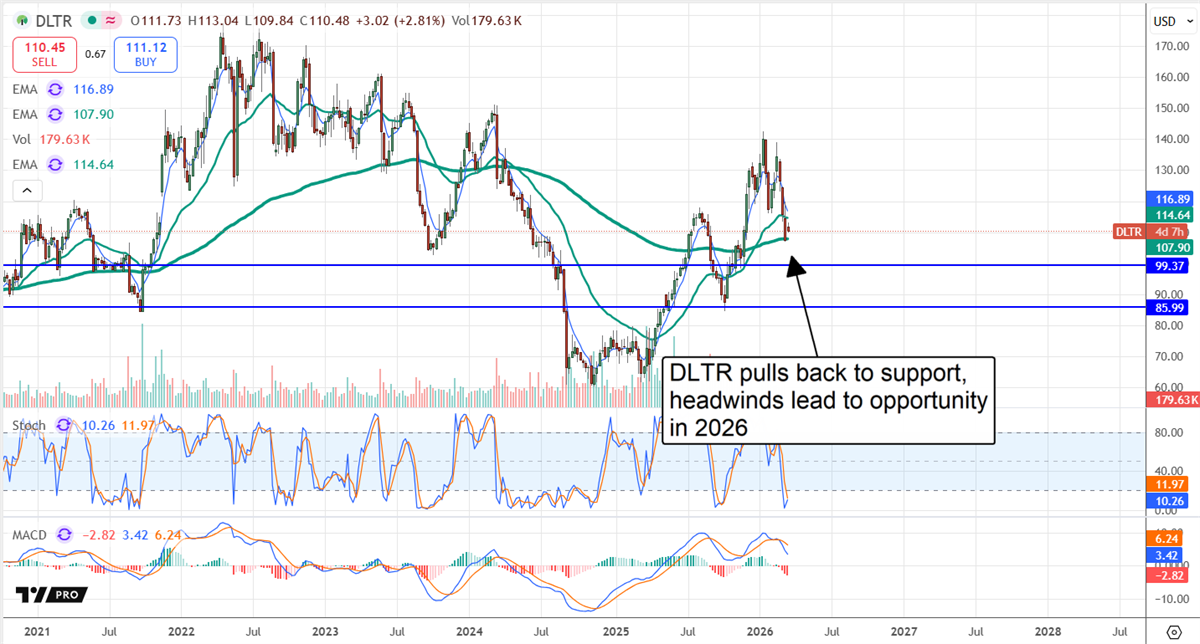
Dollar Tree’s (NASDAQ: DLTR) 2026 price action, though tepid, is almost irrelevant as the value opportunitywith shares near $110 is profound. Headwinds and risks aside, the forecasts suggest this stock trades at only 10X its 2030 consensus and 5X the 2035 forecast, providing potential for 100% to 400% upside relative to the broad market average. The only thing standing in the way is time. As it stands, the company is executing well, generating cash flow, and returning capital in value-building ways.
Dollar Tree does not pay dividends, instead choosing to aggressively repurchase shares. The fiscal 2025 activity resulted in a 7.4% average reduction in Q4 and 4.6% for the year, providing shareholders with significant leverage. The gain was offset by a slight decrease in equity; however, the 5.6% decline was marginal given the impact of buybacks and the divestiture of Family Dollar.
Critical details include a healthy cash position and low leverage. Net debt is less than 1X equity, leaving the company in a solid financial position and able to continue executing its strategy. Other pertinent details include $1.8 billion remaining under the current buyback authorization and $193 million in quarter-to-date buybacks, putting the company on track to sustain its aggressive pace in fiscal 2026.
Dollar Tree Pulls Back on Cautious Guidance
Dollar Tree had a solid fourth quarter, with revenue, excluding the impact of Family Dollar, up by 9% year over year (YOY). Strength was driven by store remodels, new stores, and an impressive 5% comp, reflecting a 6.3% increase in ticket average and 1.2% decline in traffic. Comps were also underpinned by strength in both product categories, led by a 6.2% increase in discretionary items.
Margin news was also good, with incremental improvements logged, driven in part by improved efficiency. The company’s revenue per square foot increased for the 7th consecutive year, with operational leverage improving amid turnaround efforts.
The result was a 10.7% increase in adjusted operating income and 21% increase in adjusted earnings, both accelerated relative to the revenue and more than 100 basis points (bps) better than MarketBeat’s reported consensus.
The only bad news was the company’s guidance, which came in below consensus on the top and bottom line for Q1 and the year. However, guidance is likely to be cautious, setting the stage for outperformance as the year progresses. Analysis will likely revert to a more bullish posture, providing a catalyst for a rebound that may emerge as soon as early Q2, when the Q1 earnings results are released.
Wall Street Waits for Proof as Institutional Flows Cool
Until then, the analyst responsereflects a moderated, albeit bullish, posture. The first commentaries expressed concerns about the tepid outlook while citing the positive impacts of turnaround efforts. The takeaway is that analysts remain in a wait-and-see mode, pegging the stock at Moderate Buy and forecasting a 15% upside.
Institutional activity is less supportive in early 2026. The group owns more than 97% of the shares and bought on a trailing 12-month basis, but the Q1 2026 data reflect distribution, market headwinds, and risk for investors.
Short Sellers Are a Headwind in 2026 for DLTR Shares
Short interest is another near-term risk for investors. Short interest isn’t aggressively high, but it is high enough at just over 6% to present a problem. The short sellers add strength to the institutional activity, suggesting a cap is in place until later in the year. The question is how deep a correction DLTR stock may experience before hitting bottom, which may be near $100.
Dollar Tree catalysts include ongoing restructuring and remodeling efforts. The move to multi-price-point formats resonates with consumers and is a path to unlocking margin and cash flow. There is speculation that a small dividend may be authorized later this year, which will increase interest among institutional and buy-and-hold investors. Risks include macroeconomic conditions, threats to consumer demand, and remodeling costs.
The initial price action following the release was favorable, despite the tepid guide. Shares rose nearly 1% in premarket trading, showing support at a critical exponential moving average (EMA). The 150-week EMA reflects institutional and buy-and-hold activity, suggesting a price floor of $107. In the longer term, it may take at least a quarter or two for this market to be reinvigorated and the rebound to gain traction. READ THIS STORY ONLINE
Shares of Karat Packaging Inc. (NASDAQ: KRT) have risen by more than 20% during a market move that left many investors scrambling for answers. Karat operates in a decidedly unglamorous corner of the market, manufacturing and distributing the essential disposable containers, cups, and paper bags that fuel the nation’s restaurant and foodservice industries. In a market often captivated by high-flying tech sector stocks, many investors seek to understand how a company in such a traditional sector could deliver such a healthy, single-day return.
The answer lies in Karat’s fourth-quarter earnings report that revealed far more than just strong numbers. It painted a picture of a resilient, disciplined, and strategically savvy company that is not only navigating a challenging economic environment but is actively thriving within it. The story behind Karat’s remarkable performance offers a compelling look at how operational excellence can translate directly into significant shareholder value.
The Top-Line Beat That Ignited the Rally
The initial catalyst that sent Karat’s stock price higher was its impressive top-line growth. Karat announced record fourth-quarter net sales of $115.6 million, marking a 13.7% increase compared to the same period last year. This figure comfortably sailed past Wall Street’s consensus estimate of $113.95 million, signaling to the market that Karat’s growth trajectory was accelerating faster than anticipated.
Crucially, this growth was not just driven by higher prices. It was also fundamentally driven by a significant $8.2 million increase in sales volume, a clear indicator that Karat is gaining market share and that demand for its products remains strong. Further bolstering the positive results was a notable return to pricing power.
For the first time since early 2023, Karat reported a favorable impact from its pricing and product mix, adding another $6.3 million to its revenue. This demonstrates Karat’s stronger position in the marketplace, enabling it to command better value for its products. This strength was most evident in its core customer base, where sales to chain accounts and distributors, its largest channel, jumped by an impressive 17.5%, confirming its deep and growing entrenchment in the resilient foodservice sector.
A Margin Master: Profitability Under Pressure
While strong sales grabbed the headlines, the most impressive part of Karat’s performance was its ability to protect and grow its bottom line. Karat faced a significant headwind from higher import duties and tariffs, which caused import-related costs to balloon from 8.3% of net sales to 14.5% year over year. This kind of pressure can easily erode profits, yet Karat demonstrated remarkable operational discipline.
Instead of buckling, management executed a masterful cost-control strategy. Total operating expenses actually decreased from $32.5 million to $30.9 million compared to the prior-year quarter. This was achieved through specific, targeted measures, including a $1.6 million reduction in online platform fees and a $500,000 cut in marketing expenses, all while sales were growing.
The result of this financial rigor was powerful. Despite the intense margin pressure from tariffs, Karat grew its net income by 22.8% to $7.2 million. Its earnings per share of 34 cents decisively beat the analyst consensus estimate of 28 cents. This proves Karat’s ability to convert top-line growth into tangible profit, even in a difficult cost environment. This operational discipline generates substantial cash flow, $15.4 million from operations in the fourth quarter, which confidently funds an attractive 6.69% dividend yield.
Positioned for Growth: Karat’s Playbook
Karat’s impressive quarter appears to be more than a one-time event; it is the result of a forward-looking strategy designed for durable growth. Management has issued a confident outlook for 2026, forecasting low double-digit net sales growth for the full year and anticipating continued improvement in gross margin and adjusted EBITDA margin.
Smarter Sourcing
A key element of Karat’s strategy is its intelligent and proactive approach to its supply chain. Karat has actively diversified its sourcing to de-risk its operations from geopolitical tensions and tariffs. Today, 46% of its imports come from Taiwan, with only 14% sourced from China. This foresight gives Karat a significant stability advantage.
Furthermore, Karat is successfully expanding into high-growth product categories. Its new paper bag division is gaining strong momentum and securing contracts with large national chains. This, combined with a broader push into sustainable products, has resulted in eco-friendly items now accounting for 37.3% of total revenue, up from 34.5% a year ago, perfectly positioning Karat to meet growing consumer and regulatory demand.
A Foundation for Future Value
Karat Packaging’s stock price hike was a well-earned reward for a quarter that demonstrated excellence on all fronts. Karat showcased a powerful combination of capturing strong market demand, exercising masterful cost control in the face of significant headwinds, and executing a clear and intelligent strategy for the future.
In a market constantly searching for the next big thing, Karat’s performance is a compelling reminder of the immense value that can be created by a fundamentally sound, essential business run with exceptional discipline. Its proven resilience and clear catalysts for growth establish it as a standout company to watch in the industrial sector for 2026 and beyond. READ THIS STORY ONLINE
Love steady payouts? This free report reveals 7 high-yield dividend stocks you need to know about. From Company #3, a tobacco giant innovating with smokeless products, to Company #4, famously known as “The Monthly Dividend Company,” these picks deliver steady income you can count on. PERFECT FOR INCOME-FOCUSED INVESTORS.
In a specialized facility in Manching, Germany, a pivotal shift in global defense strategy is taking shape. Two American-made Kratos (NASDAQ: KTOS) XQ-58A Valkyrie drones are being prepared for a landmark 2026 flight test equipped with a sovereign European artificial intelligence (AI)-driven mission system developed by Airbus (OTCMKTS: EADSY). This transatlantic collaboration is a technical exercise, but it is also a clear indicator that the long-promised future of autonomous, collaborative warfare is arriving faster than anticipated.
Kratos: From Disruptor to Global Power Player
The Airbus partnership is a major international endorsement for Kratos, significantly de-risking its investment case by opening a direct channel into the lucrative European defense market.
For investors, this validation is backed by a continuous stream of financial results and program wins that demonstrate a company has reached a major inflection point. The evidence suggests that Kratos’s strategy of building relevant, affordable systems now, rather than just designing concepts for later, is paying off.
Kratos’s recent performance provides a clear picture of this momentum. The fourth quarter of 2025 saw organic revenue growth of approximately 20% year-over-year, an impressive figure for any company. More telling, however, is that Kratos also reported a 1.3-to-1 book-to-bill ratio for the quarter.
For investors, this is a critical metric; a ratio above 1-to-1 means a company is securing more in new orders than it is billing in revenue, indicating its backlog and future workload are actively growing. It is the clearest sign of accelerating demand.
Looking ahead, Kratos’s financial foundation appears robust, providing investors with significant visibility into future performance:
A Secure Future: Kratos ended 2025 with a record backlog of $1.573 billion in secured future work, providing a stable revenue base.
A Vast Horizon of Opportunity:Beyond confirmed orders, Kratos has identified a record $13.7 billion pipeline of opportunities, representing a vast pool of potential future contracts that could fuel growth for years to come.
This financial strength is directly tied to the success of its flagship platform, the Valkyrie. Before its selection for European tests, the drone was already validated in the United States, having been chosen for the U.S. Marine Corps’ MUX TACAIR Collaborative Combat Aircraft (CCA) program, where Kratos is partnered with prime contractor Northrop Grumman. This dual-continent demand for the same core platform is a powerful testament to its capabilities. In response, Kratos has announced concrete plans to scale up production from approximately 8 Valkyries per year to 40 by the end of 2028.
Furthermore, Kratos is not solely dependent on a single program. Kratos is a key player in the rapidly expanding field of hypersonics, a top Pentagon priority, with involvement in major programs such as the Multi-Service Advanced Capability Hypersonic Test Bed (MACH-TB). With revenues from its hypersonic franchise projected to potentially double to around $400 million in 2026, Kratos has demonstrated it has multiple, powerful growth drivers. This diversification provides an additional layer of stability to its high-growth narrative and helps justify a valuation focused on the immense future potential of its contract pipeline.
Airbus: Winning the Future of Air Combat
For European aerospace titan Airbus, the partnership with Kratos is a shrewd and necessary strategic move. It showcases managerial agility, addresses challenges within its legacy programs, and positions Airbus to lead Europe’s next-generation defense ecosystem.
This collaboration is being accelerated by well-publicized disagreements and delays that have hampered the Future Combat Air System (FCAS), Europe’s ambitious next-generation fighter jet program.
Rather than waiting for these complex, multinational issues to resolve, Airbus is proactively securing a loyal wingman capability for its key customers now.
By partnering with Kratos, Airbus bypasses years of costly research and development. It gains immediate access to a proven, production-ready airframe, allowing it to offer a tangible solution to the German Air Force with a target in-service date of 2029, a timeline that would be impossible if starting from scratch.
This move is also aligned with a broader, continent-wide push among European nations to fast-track the development of low-cost, autonomous systems to bolster their collective security.
This deal also fundamentally shifts Airbus’s role from a simple hardware manufacturer to a high-value systems integrator. Airbus is responsible for equipping the Valkyrie with its proprietary MARS mission system, powered by MindShare AI software. In modern defense, the true value lies not just in the airframe, but in the intelligent network that commands it. By controlling this layer, Airbus positions itself to be the central nervous system for Europe’s future combat cloud, connecting various manned and unmanned platforms. This is a more defensible and potentially more profitable position in the long run.
For investors in a large-cap industrial like Airbus, this venture represents a valuable entry into the high-growth defense tech sector. It diversifies Airbus’s portfolio beyond the cyclical commercial aviation market and hedges against risks and extended timelines associated with traditional manned fighter programs. This move adds a new, dynamic growth story and demonstrates a forward-thinking strategy to secure its relevance in the next generation of air warfare.
A Clear Approach Vector
The Kratos-Airbus partnership is one of the most tangible data points yet that the global shift to autonomous, attritable air power is happening now. This is no longer a future trend discussed in strategy documents; it is a present reality with significant budget allocations and hardware being prepared in Germany.
This collaboration solidifies Kratos’s position as a premier growth vehicle in defense technology, validating its systems and opening the door to a massive new market. Simultaneously, it showcases Airbus’s strategic foresight to secure its role as a key architect of Europe’s future defense capabilities. For investors, this alliance signals that both companies are positioned on the right side of a multi-decade paradigm shift in global security, offering a compelling case for long-term value creation as the very definition of air power is rewritten. READ THIS STORY ONLINE
The Night Owl is a financial newsletter that provides in-depth market analysis on stocks of interest to individual investors. Published by MarketBeat and Early Bird Publishing, The Night Owl is delivered around 9:00 PM Eastern Sunday through Thursday. If you give a hoot about the market, The Night Owl is the newsletter for you.
I started rating the safety of banks in the early ’70s.
Over the last 50+ years, I’ve warned my readers about the bank failures of the 1980s and 1990s, the Dot-Com Bust, the 2008 housing collapse and more.
But today, I’m writing to you with a different kind of warning. One that genuinely frightens me.
This time, the threat to your money isn’t coming from reckless Wall Street bankers. It’s coming directly from the Federal Reserve itself.
Through a program outlined in the Federal Reserve Docket No. OP-1670 — known as “FedNow” — the government is quietly rewiring the entire American banking system.
Simply stated, the Fed is building a centralized hub that will process every transaction in the U.S. … giving it the ability to track every transfer, bill pay, purchase or donation you make in real time.
That, in turn, could give them unprecedented power to cut off your access to your savings if they decide you’re not in “compliance” with whatever their policy agenda dictates at the time.
Or maybe even confiscate your savings when the need arises like it happened in Cyprus in 2013.
In all my decades studying the U.S. economy and banking system, I’ve never seen anything as scary as this.
If you value your financial privacy …
If you believe your money belongs to you and not Washington …
P.S. The Fed is counting on the fact that ordinary Americans won’t read a 93-page document until it’s too late. I’ve read it and that’s why I’m begging you to act while you still can. Get the 4 “Fed-proof” steps right now.
Bonus News from MarketBeat
Nebius’ 1.2 GW Win: A $20B Bet on AI Infrastructure
By Jeffrey Neal Johnson. Published: 3/5/2026.
KEY POINTS
The approval of a new AI factory represents a pivotal milestone for Nebius, positioning the company as a key enabler for the entire AI ecosystem.
This major infrastructure project directly supports the company’s aggressive growth targets by meeting the overwhelming and secured customer demand for AI compute.
This landmark project validates the company’s focused strategy on AI infrastructure, earning positive notice and strong price targets from Wall Street analysts.
The company secured approval to build a large AI factory in the United States, a project with power capacity comparable to some of the world’s largest data centers. This development is more than a construction effort; it represents a cornerstone of a new corporate identity and a validation of Nebius’s strategy to become an essential provider of global AI infrastructure.
Our investment research analysts are going to be releasing their next investment idea tomorrow morning, around 10:00 AM Eastern time.Add yourself to the distribution list here.
At the center of this plan is a 400-acre campus in Independence, Missouri, set to become a hub of AI activity and to create more than 1,300 local jobs. The most important figure for investors is the facility’s potential power capacity: up to 1.2 gigawatts (GW). In an industry measured by computing power, access to electricity at this scale is a strategic breakthrough — 1.2 GW is an enormous amount of energy, capable of powering a large city.
Power is the most critical and scarce resource for the AI sector. Over the past year, industry discussion has focused on the availability of high-powered GPUs; as chip supply chains begin to normalize, the bottleneck is shifting to the physical space and massive electrical infrastructure needed to host and run those chips. Algorithms alone can’t scale without reliable, large-scale power. By securing this capacity, Nebius has claimed a vital piece of the infrastructure puzzle and positioned itself as a key enabler for the broader AI ecosystem.
This Missouri factory will be the flagship project for the new Nebius. The company has moved from its prior identity as the diversified tech conglomerate Yandex N.V. into a focused, pure-play AI infrastructure provider. That strategic pivot concentrates resources on what the company sees as the single largest market opportunity today, and the project serves as a tangible proof point of that new direction.
From Power to Profit
For investors, the central question is how this infrastructure investment will translate into financial growth. The answer is tied to the current supply-and-demand imbalance in AI computing. During its fourth-quarter 2025 earnings call, Nebius management said its available computing capacity was sold out months in advance. Demand for AI infrastructure is so intense that customers are committing to longer-term contracts at strong prices to secure access.
That environment makes bringing new data-center capacity online the most direct route to revenue. Nebius has guided to an annualized revenue run rate (ARR) of $7 billion to $9 billion by the end of 2026. ARR extrapolates current monthly recurring revenue across a year and gives a clearer forward-looking picture of business scale than historical quarterly revenue. Hitting this target depends on delivering the new capacity the company is building.
Such growth requires substantial investment. Nebius outlined capital expenditures of $16 billion to $20 billion for 2026. While significant, the company says about 60% of that capital is already secured through cash on hand, operating cash flow, and upfront payments from long-term customer agreements. With a strong balance sheet and minimal existing debt, management expects to finance the remainder without taking on undue risk. This expansion is positioned as a calculated, demand-backed investment rather than a speculative gamble.
A Clear Runway for Growth
The Missouri approval is a major de-risking event for Nebius. What was a plan on paper is now a tangible project with government and community backing, providing investors a clear milestone to watch. It validates the company’s aggressive strategy to capture a leadership position in high-demand AI infrastructure.
Wall Street is taking note. The stock currently carries a Moderate Buy consensus rating from analysts, with an average price target of $143.22, suggesting meaningful upside from current levels. Analyst targets range from $84 to $211, reflecting differing views but a broadly bullish outlook from some market participants. That optimism is also supported by Nebius’s underlying technology assets, including autonomous vehicle developer Avride and EdTech platform TripleTen, which add diversification to its foundation.
With its strategy validated and capacity expansion visibly underway, the focus for investors will shift to execution. This landmark project gives Nebius a clear runway to establish itself not just as a participant, but as a critical pillar of the global AI infrastructure landscape.
This information is disseminated on behalf of Metalla Royalty & Streaming.
Things are brewing traders…
The market has BEEN NUTS!!! But (NYSE:MTA) Has been starting to coming alive again..
More To follow in the morning..
👇
Full report below compensation in the disclaimer.
Metalla Royalty & Streaming (MTA): A High-Margin Gateway to Strong Gold, Resilient Silver, and Copper’s Structural Supply Crunch!
MTA is Leveraged Exposure to Record Gold, Surging Silver, and Copper’s Structural Supply Crunch — Without the Operational Risk of Mining!
Greetings All,
Gold has reasserted itself as a monetary anchor in an era defined by inflation persistence, sovereign debt expansion, and central bank accumulation. Silver’s dual role as both a store of value and a critical industrial input is amplifying upside pressure as renewable energy and electrification demand accelerates. Copper, meanwhile, is increasingly viewed as a strategic metal essential to energy security, electric vehicles, and next-generation infrastructure—just as new supply struggles to come online.
Within this backdrop, companies that can offer leveraged exposure to all three metals—without the capital intensity and operational volatility of mining—stand out.
Metalla Royalty & Streaming (NYSE: MTA) is emerging as one of those differentiated platforms.
A Royalty Model Built for Margin Expansion
MTA operates a royalty and streaming model, meaning it provides capital to mining operators in exchange for a percentage of future production or revenue. It does not operate mines. It does not bear sustaining capital costs. It does not face labor disputes, environmental liabilities, or cost overruns!
Instead, itreceives top-line exposure to metal prices and production growth.
In a rising price environment—especially one where cost inflation pressures miners—this model can produce expanding margins and scalable cash flow. As production increases across its underlying assets, revenue can grow without proportional increases in expenses. That structural advantage becomes particularly powerful during strong commodity cycles like the one that has been unfolding. Gold and silver hit record highs in early 2026.
A Clear Financial Inflection Point
The third quarter of 2025 marked a defining milestone. MTAreported its first-ever profitable quarter, with revenue more than doubling year-over-year to $4 million and net income turning positive.
Management characterized the quarter as a “step-change” moment—signaling that the company’s portfolio has reached the scale necessary to generate sustainable earnings.
This transition from portfolio builder to cash-flow generator is critical. Royalty companies often require years of disciplined asset accumulation before meaningful earnings materialize.
With profitability now established and multiple development assets advancing toward production, MTAappears to be entering a new phase of financial maturity.
Diversified Exposure Across Gold, Silver, and Copper
MTA’s portfolio includes approximately 100 royalties spanning producing, development, and exploration-stage assets across gold, silver, and copper.
This diversification reduces reliance on any single project while embedding multiple pathways to upside through mine expansions, restarts, feasibility updates, and exploration success.
Its exposure aligns closely with the dominant macro forces of 2026.
Gold’s surge reflects monetary hedging and central bank demand. Silver’s breakout is supported by accelerating industrial usage in solar and electrification. Copper faces projected structural supply deficits as electric vehicles, renewable infrastructure, and AI-driven data centers expand globally.
By holding royalties across all three metals, MTA captures both precious-metal monetary demand and base-metal industrial growth.
Built-In Catalysts Without Additional Capital Risk
A distinguishing feature of the royalty model is perpetual optionality. As operators advance projects, expand capacity, extend mine lives, or discover additional resources, the royalty holder benefits automatically—without investing incremental capital.
MTA’s portfolio includes numerous near-term catalysts: mine restarts, production ramp-ups, staged expansions, permitting milestones, and construction decisions across multiple jurisdictions. Each development has the potential to increase attributable production and royalty revenue, reinforcing the company’s ability to compound cash flow over time.
Institutional Validation and Strategic Capital
Another noteworthy development has been institutional interest. Public disclosures revealed that affiliated entities of Tether collectively hold approximately 8.9% of MTA’s outstanding shares.
As one of the largest physical gold buyers in recent quarters, Tether-linked capital entering the royalty space highlights a broader convergence between digital liquidity and hard-asset exposure.
While the investment remains passive, the presence of a well-capitalized and globally recognized financial player adds visibility and may signal confidence in the long-term thesis surrounding precious metals and diversified royalty platforms.
Why Streaming and Royalties Can Outperform Traditional Mining in Volatile Commodity Cycles
Unlike traditional mining companies, royalty and streaming businesses do not operate mines, manage labor forces, fund sustaining capital, or absorb cost overruns.
Instead, they provide upfront financing to operators in exchange for a percentage of future production (royalties) or the right to purchase metal at predetermined, discounted prices (streams).
This structure allows them to maintain exposure to rising gold, silver, and copper prices while avoiding many of the operational risks that can erode margins during inflationary periods.
When energy, labor, or equipment costs rise, miners feel the pressure directly—royalty and streaming companies generally do not. As production grows or metal prices increase, their revenue can scale with minimal incremental expense.
The Bottom Line
The metals breakout seen in early 2026 was driven by monetary instability, industrial transformation, and strategic de-risking from concentrated supply chains. Gold’s record highs, silver’s industrial acceleration, and copper’s tightening structural supply picture together form a powerful macro backdrop.
Within this environment, Metalla Royalty & Streaming (MTA) offers leveraged exposure to all three metals through a diversified, high-margin royalty model that minimizes operational risk while maximizing upside participation.
With its first profitable quarter behind it, a deep pipeline of catalysts ahead, and growing institutional attention, MTA appears increasingly positioned to benefit. Start your research!
Disclaimer
Hugealerts.com and Tradingwire.com are owned by Sideways Frequencey LLC (“Sideways Frequency”). Press releases, research reports, company profiles and other investor relations materials, publications or presentations, including web content (investor awareness services) released by Hugealerts.com and Tradingwire.com are based on publicly available data obtained from sources we believe to be reliable but are not guaranteed as to accuracy and are not purported to be complete. As such, the information should not be construed as advice designed to meet the particular investment needs of any investor. Furthermore, some of the content contained in our publications and websites may contain forward-looking statements found in information made publicly available by the companies we highlight. This forward looking information fits within the meaning of Section 27A of the Securities Act of 1933 and Section 21E of the Securities Exchange Act of 1934 including statements regarding future possible events, expected continual growth of a company, the potential value of its securities, and look forward in time which include everything other than historical information, involve risk and uncertainties that may affect a company’s actual results of operation. We therefore strongly encourage that you visit and review any and all financial information made publicly available by highlighted companies. Any opinions expressed in Hugealerts.com and Tradingwire.com reports, company profiles, or other investor relations materials and presentations are subject to change, are expressed and given as of the date of publication, and we disclaim any obligation to advise you of any change in any information contained herein. The information contained herein is not intended to be used as the basis for investment decisions and should not be construed as advice intended to meet the particular investment needs of any investor. The information contained herein is not a representation or warranty and is not an offer or solicitation of an offer to buy or sell any security. To the fullest extent of the law, Hugealerts.com,Tradingwire.comand their affiliates, specialists, advisors, and partners will not be liable to any person or entity for the quality, accuracy, completeness, reliability or timeliness of the information provided, or for any direct, indirect, consequential, incidental, special or punitive damages that may arise out of the use of information provided to any person or entity (including but not limited to lost profits, loss of opportunities, trading losses and damages that may result from any inaccuracy or incompleteness of this information). Stock market investing is inherently risky. Hugealerts.com, Tradingwire.com and their affiliates are not responsible for any gains or losses that result from the opinions expressed in press releases, on this website, in its research reports, company profiles or in other investor relations materials or presentations that it publishes electronically or in print. We strongly encourage all investors to conduct their own research before making any investment decision. For more information on stock market investing, visit the Securities and Exchange Commission (“SEC”) at www.sec.gov. and/or the Ontario Securities Commission (“OSC”) at www.osc.gov.on.ca. and/or the British Columbia Securities Commission (“BCSC”) at https://www.bcsc.bc.ca/.
Income Disclosure
Sideways Frequency has been retained by Metalla Royalty and streaming LTD (NYSE:MTA).and has received cash compensation of $150,000.00 to perform promotional and advertising services for a limited time. This agreement has been ongoing since February 2026 and is related to the engagement of investor awareness services for Metalla Royalty and streaming LTD (NYSE:MTA).. Sideways Frequency, Hugealerts.com, Tradingwire.com and their partners and affiliates may buy and sell shares of securities or options and warrants of the companies mentioned on this website at any time.
Sideways Frequency LLC and its affiliates may buy and sell shares of securities or options and warrants of the companies mentioned in this publication or website at any time but are not and will not at any time become affiliates or owners of more than 5% of the issued and outstanding stock of the highlighted companies.
Sideways Frequency and its beneficial owners and affiliates, including Hugealerts.com andTradingwire.com do not own any shares in Metalla Royalty and streaming LTD (NYSE:MTA).
Investor awareness services and programs are designed to help small-cap companies communicate their investment characteristics. Sideways Frequency, Hugealerts.com, Tradingwire.comand their investor awareness services include the preparation of a research profile(s), multimedia marketing, and other awareness services based on the publicly available information of our clients and prepared by our partners. As such, our opinion is neither unbiased nor independent, and you should consider that when evaluating our statements regarding Metalla Royalty and streaming LTD (NYSE:MTA).

















 RJ Hamster