Delivering World-Class Financial Research Since 1999
A different day in the market… Weighing the consequences of war… The Fed is back in the picture… ‘Higher for longer’ is making a comeback… Has anyone seen Kevin Warsh?… Jensen Huang’s latest prediction… AI-proof fortresses…
Oil up, stocks up…
That’s a different picture from what we’ve seen for much of the past two weeks. Oil prices initially spiked as war broke out in Iran, while bond yields rose and stocks sold off.
But today, hundreds of oil tankers remain parked in the Persian Gulf, and oil prices rose around 3%. Yet bond yields actually fell some, and the major U.S. stock indexes were up across the board. Energy stocks led again, but most major S&P 500 Index sectors were higher.
If you’re optimistic, this is perhaps another “less bad” sign to note in the market… Some investors imagine progress toward some kind of resolution in the immediate conflict, as more top Iranian leaders have reportedly been killed over the past day in methodical attacks.
On the other hand…
Nobody knows exactly what’s going to happen in the Middle East next. That’s par for the course for millennia in some respects. But there’s no denying that right now, this war has led to the largest global oil-supply disruption in decades – or ever, by some standards.
Oil prices are up 40% from the start of the conflict… and could go higher.
Traffic has been virtually stopped in the critical and Iranian-controlled Strait of Hormuz for more than two weeks (except Iran’s own ships).
Yesterday, a handful of tankers trickled out thanks to apparent agreements with some Iranian leaders. But hundreds more remain anchored in or just outside the Persian Gulf, their cargo coming or going nowhere.
In Qatar, a facility handling around 20% of global liquefied natural gas exports shut down two weeks ago and will take weeks more to come back online.
And while everyone is focused on oil and gas, other commodities that transit through the Persian Gulf and Strait of Hormuz have seen their prices spike, too…
These include fertilizer, which is critical to global food supply and prices. At least a quarter of the global fertilizer trade passes through the Strait of Hormuz. And prices are up as much as 40%, just like oil. Here’s Stacy Simunek, president of the Oklahoma Farm Bureau…
We cannot grow without it. There is absolutely no way you get around it… I’ve had many farmers tell me I can’t get it until April 1st, which starts putting them past the window of application time.
So already, the war in Iran is going to influence the economy in the weeks and months and years ahead. If it goes longer than the best-case scenarios laid out by the White House, trade and business will suffer even more.
And now it’s time to think about the Federal Reserve again, too…
The central bank began its latest two-day policy meeting today. The Fed and Chair Jerome Powell will share any decisions and have a post-meeting press conference tomorrow afternoon.
And while Powell’s time as chair is winding down, the stage is set for another potential Fed “pivot” – and maybe not the one you expect…
Last week, we covered rising commodities prices and associated inflation concerns. As we wrote…
Already, the Cleveland Fed – which runs an inflation “nowcast” – projects the CPI will climb back up to near 2.9% year over year for March’s reading.
And if the tensions with Iran send oil prices back to $100 per barrel in the next couple weeks, energy prices could drive inflation higher… which wouldn’t be good news for the broader economy.
One estimate from Apollo Global Management Chief Economist Torsten Slok is that $100 oil would boost headline inflation by 0.7 percentage points. That would put it closer to 4% than 3%, to say nothing of the Fed’s supposed 2% target.
With that said, let me alert you to a possible new shift in the market.
Investors are giving up hope for rate cuts…
And it sure looks like the war in Iran and its inflation consequences are the trigger…
We like to look at the federal-funds futures market for bond market expectations. And traders aren’t expecting the Fed to do much of anything significant tomorrow or at its meeting in late April, the last one before Powell’s term as chair is set to expire.
The short-term expectations are and have been for the Fed’s benchmark rate range to remain at 3.5% to 3.75% for the next two months.
But here’s where things start to get interesting…
By June, a new Fed chair is supposed to be in place. And it’s well known that President Donald Trump wants a new chair who’ll cut rates.
And yet, the market’s expectations for a rate cut in June have dwindled to barely 20%, according to CME’s FedWatch Tool. That’s down from 50% a month ago and even higher odds before that.
‘Higher for longer’ is making a comeback…
At the same time, expectations for rates to be “higher for longer” for the rest of the year have also grown. Fed-funds futures traders have 50% odds on rates holding steady in September, and they’re giving more than a 40% chance for them to do the same in October.
Another indicator from the Federal Reserve Bank of Atlanta tells a similar and even more significant story.
The Atlanta Fed tracks bond-trading action to assess market probability. Its tracker now shows that the bond market has started to price in the probability of a rate hike by the Fed’s meeting in June rather than a rate cut.
As Ryan Detrick from financial-services firm Carson Group pointed out on the social platform X this morning…

Has anyone seen Kevin Warsh?…
Meanwhile, we haven’t heard a peep out of Trump’s nominee for Fed chair. Warsh’s confirmation faces at least some opposition in Congress, and he could throw a curveball into everything when he starts talking during that process.
Maybe he’ll double down on being the “low interest rate” person the president has promised, and inflation (and interest rate) expectations will take off even higher. Just yesterday, Trump pushed for an “emergency rate cut” in public comments while criticizing Powell again.
Or maybe Warsh’s confirmation will stall, and Powell or someone else already in the Fed with a “higher for longer” bent becomes chair in the interim.
Or maybe the war wraps up quickly… oil and other commodity prices “drop like a rock” – as Trump predicted today… and war-related inflation doesn’t show up all that much, making it easy to justify lower rates.
In any case, here’s what we want you to know and consider…
Even if the war ends and Warsh becomes the new Fed chair, a new inflation battle may just be beginning. It’s a risk, at the very least.
And it looks like the bond market is just starting to make bets on this regime change… and that stocks haven’t responded yet.
After all, this isn’t what “everybody” is expecting. It’s funny how the market so often works like this… with bond investors picking up on trends faster than the stock market.
If rates don’t fall, stocks won’t get the juice that many investors have counted on. And if rates rise, stocks can fall. Warren Buffett has described interest rates as “gravity” for asset prices. The unprepared could be in for a shock.
Nvidia’s ‘$1 trillion’ prediction…
On another note, AI chipmaker Nvidia (NVDA) kicked off its annual developer conference yesterday. It’s what some call the “Woodstock of AI.”
And in his keynote address, CEO Jensen Huang unveiled the company’s latest offerings, including an AI chip and a new platform aimed at boosting AI in outer space (yes, really).
“Space computing, the final frontier, has arrived,” Huang said. “With our partners, we’re extending Nvidia beyond our planet – boldly taking intelligence where it’s never gone before.”
But what really grabbed headlines was Huang’s projection for the next few years on Earth…
Huang said that Nvidia now expects $1 trillion in orders for its Blackwell and Vera Rubin AI infrastructure offerings through 2027. That’s double the projection from last year’s conference.
And investors loved the news – at first… The stock spiked more than 2% yesterday afternoon following Huang’s reveal. Then it fell, ending lower than it was before Huang took the stage.
Yahoo Finance’s Brian Sozzi explained why. While $1 trillion may seem huge, Wall Street was already expecting something like this over the next couple of years. From Sozzi…
For context, this compares to consensus data center revenue estimates for 2025-2027 of ~$989 billion.
Despite the buzzy $1 trillion headline, some of this was expected, and the revenue growth rate from 2026 into 2027 for Nvidia could flatten out.
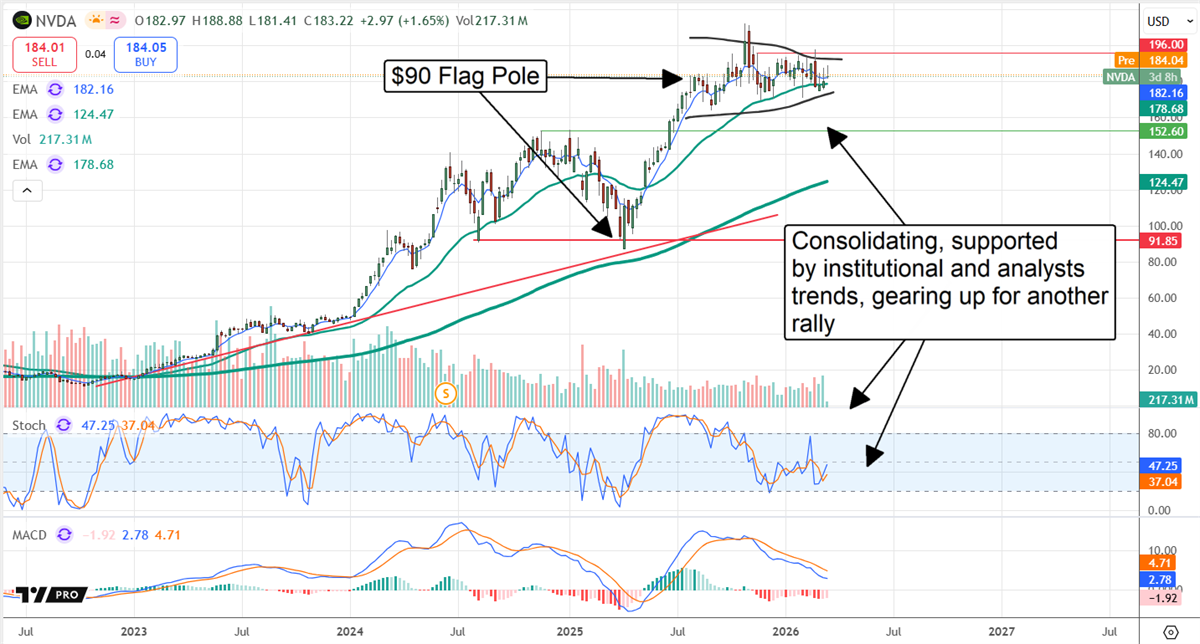
Similarly, as we wrote yesterday, Nvidia shares have traded sideways since making a new high last October.
A limiting factor for growth: ‘flattening’ energy…
As we’ve written a few times in previous Digests, AI data centers – a top Nvidia customer – use huge amounts of energy. Their energy demand has more than doubled this decade. Just take a look at this chart from the February 18 Digest…

But our current energy grid isn’t robust enough to meet the demand. That problem has increased electricity prices. And it can limit the growth of AI companies and businesses using the technology. For instance, as Huang said in his address…
If they could just get more capacity, they could generate more tokens [the fundamental “units” of text or data that an AI large language model produces], their revenues would go up.
More capacity is on the way, as we wrote in February, but it’ll take time. Even the Department of Energy’s recent $1.9 billion in funding to expand the energy grid won’t help right away.
Data-center development is taking a hit as a result…
Every quarter, research and analytics firm Wood Mackenzie releases a report on data-center construction projects. And its most recent report, from last week, flashes a big warning sign for the AI boom…
From the third quarter to the fourth quarter of 2025, data-center capacity additions fell by half. And that’s something Wood Mackenzie expects to continue into 2026. From the report…
We expect capex growth from the largest developers, including the established hyperscalers, to slow in 2026 for the first time since 2023, to US$94 billion, or 58% of last year’s growth.
That comes at a time when the hyperscalers expect to spend more than $600 billion and Nvidia projects $1 trillion in cumulative sales over the next two years. At the same time, new data-center capacity growth might actually slow.
That’s not a good sign if it’s the start of a longer trend. If hyperscalers continue to struggle to get the capacity they need, they’ll have to pull back on their investments. And if that happens, investors might not take it so well.
But no one would invest hundreds of billions of dollars into AI servers and chips without the electricity to power them.
And the AI ecosystem is interconnected, with companies trading equity stakes for orders. All it takes is one or two canceled agreements to leave a huge hole in multiple companies’ income statements.
Nvidia’s $1 trillion sales goal is the most at risk in that scenario. While AI is still a big story and a market driver today, be careful moving ahead…
Plus, there are other places to put your money that have little or nothing to do with AI and can still outperform the market.
A new index of AI-proof investments…
In the March issue of Retirement Millionaire, sent to subscribers last Wednesday, editor and MarketWise CEO Dr. David “Doc” Eifrig unveiled his “Niche Fortress Index.”
And it reminds me of a theme Doc wrote about at the end of last year – where to find a job, as in the physical trades. As Doc wrote about his Niche Fortress Index in the most recent issue of Retirement Millionaire…
It’s made of stocks that operate in different parts of the industrial economy, but that all share similar traits…
They have no natural predators… They provide critical equipment and services the economy cannot function without… And they are leaders in their respective niches.
Put simply, these companies are ones that provide “boring” but essential parts of the economy. These stocks are a far cry from the outer space-based AI infrastructure that Nvidia just promoted yesterday.
More from Doc…
We’re talking about filters for construction vehicles, precision welding equipment, hydraulic impact wrenches, and heavy-duty enclosures that keep wiring safe.
They operate out of nondescript brick factories in the Midwest or in quiet industrial parks in Europe. They don’t have visionary CEOs who trend on social media. They just have engineers who have spent 30 years perfecting one very specific, very difficult task.
And they all dominate a niche that no one else wants to enter.
That makes these companies great businesses to invest in. And they’ve handily beaten the market over the past 20 years, as Doc shared…

Altogether, Doc and his team put 20 companies in the Niche Fortress Index. Five of them are already in the Retirement Millionaire model portfolio. And Doc considers all five to be strong buys today.
Retirement Millionaire subscribers and Stansberry Alliance members can read Doc’s full breakdown of the Niche Fortress Index, get the five names in the index that are buys today, and read a review of the rest of the Retirement Millionaire model portfolio right here.
In this month’s issue, Doc also updated existing portfolio positions and told subscribers to book gains of around 270% (30% annualized), 113% (18% annualized), and roughly 29% (around 20% annualized), plus a 107% gain in just four months.
If you don’t have access to Retirement Millionaire already, click here for more information and to get started today.

Recommended Links:
‘A $10 Trillion Market Shock Is Coming’
Tomorrow, futurist Eric Fry will reveal why the mounting chaos we’re witnessing is the precursor leading up to a massive $10 trillion market shock. Eric says that while most people are sitting in stocks at risk of falling 50% or more, virtually no one is talking about a small group of stocks poised to emerge as the 10X winners of 2026. Eric, from our corporate affiliate InvestorPlace, will reveal exactly which stocks to dump and which ones are primed to soar at FutureProof 2026. Reserve your free spot now.
Gold’s recent run-up has already been nothing short of historic… But it’s far from over. In fact, we expect that gold is headed to $10,000 an ounce – and even that might be too low an estimate. One expert has even issued a $20,000 price target. But however high gold ultimately goes… it’s critical you know how to take advantage of its next big move… by checking out the BEST possible gold stock you should buy immediately.
New 52-week highs (as of 3/16/26): BAE Systems (BAESY), BP (BP), Chord Energy (CHRD), Ciena (CIEN), Coterra Energy (CTRA), Duke Energy (DUK), EOG Resources (EOG), Equinor (EQNR), State Street Energy Select Sector SPDR Fund (XLE), and ExxonMobil (XOM).
In today’s mailbag, feedback on yesterday’s Digest … which compared the current fears about oil prices and market behavior during and after past Persian Gulf conflicts… Do you have a comment or question? As always, e-mail us at feedback@stansberryresearch.com.
“I don’t think the comparison to the 1980s is a valid one. Iran today is much better armed and prepared than the 1980s. If the U.S. Navy enters the Hormuz then the ships will be attacked and potentially sunk.
“Plus there is so much oil that has been taken offline by the Iranian attacks that cannot be replaced for months, if at all. I think the better comparison is with the 1973 oil embargo, oil went from $3 to $12 – i.e., a 300% increase.
“Even when the embargo was lifted the price remained at $12. The stock market plummeted [approximately] 50% and did not bottom until December 1974.” – Subscriber S.J.I.
All the best (and happy St. Patrick’s Day),
Corey McLaughlin and Nick Koziol
Baltimore, Maryland
March 17, 2026
Stansberry Research Top 10 Open Recommendations
Top 10 highest-returning open stock positions across all Stansberry Research portfolios. Returns represent the total return from the initial recommendation.InvestmentBuy DateReturnPublicationMSFT
Microsoft11/11/101,346.4%Retirement MillionaireMSFT
Microsoft02/10/121,290.9%Stansberry’s Investment AdvisoryADP
Automatic Data Processing10/09/08809.9%Extreme ValueBRK.B
Berkshire Hathaway04/01/09782.9%Retirement MillionaireSII
Sprott01/11/18685.1%Extreme ValueGOOGL
Alphabet12/15/16653.5%Retirement MillionaireCIEN
Ciena10/20/22639.9%Stansberry Innovations ReportWRB
W.R. Berkley03/15/12637.0%Stansberry’s Investment AdvisoryHSY
Hershey12/07/07567.8%Stansberry’s Investment AdvisoryALS-T
Altius Minerals03/26/09566.2%Extreme Value
Please note: Securities appearing in the Top 10 are not necessarily recommended buys at current prices. The list reflects the best-performing positions currently in the model portfolio of any Stansberry Research publication. The buy date reflects when the editor recommended the investment in the listed publication, and the return shows its performance since that date. To learn if a security is still a recommended buy today, you must be a subscriber to that publication and refer to the most recent portfolio.
Top 10 Totals3Extreme ValueFerris3Retirement MillionaireDoc3Stansberry’s Investment AdvisoryPorter1Stansberry Innovations ReportEngel
Top 5 Crypto Capital Open Recommendations
Top 5 highest-returning open positions in the Crypto Capital model portfolioInvestmentBuy DateReturnPublicationWSTETH/USD
Wrapped Staked Ethereum12/07/181,898.9%Crypto CapitalBTC/USD
Bitcoin11/27/181,891.8%Crypto CapitalONE/USD
Harmony12/16/191,013.2%Crypto CapitalPOL/USD
Polygon02/26/21643.9%Crypto CapitalQRL/USD
Quantum Resistant Ledger01/19/21582.7%Crypto Capital
Please note: Securities appearing in the Top 5 are not necessarily recommended buys at current prices. The list reflects the best-performing positions currently in the Crypto Capital model portfolio. The buy date reflects when the recommendation was made, and the return shows its performance since that date. To learn if it’s still a recommended buy today, you must be a subscriber and refer to the most recent portfolio.
Stansberry Research Hall of Fame
Top 10 all-time, highest-returning closed positions across all Stansberry portfoliosInvestmentDurationGainPublicationNvidia (NVDA)^*5.96 years1,466%Venture Tech.Microsoft (MSFT)^12.74 years1,185%Retirement MillionaireInovio Pharma. (INO)^1.01 years1,139%Venture Tech.Rocket Lab (RKLB)^2.35 years1,034%Venture Tech.Seabridge Gold (SA)^4.20 years995%Sjug Conf.Berkshire Hathaway (BRK-B)^16.13 years800%Retirement MillionaireIntellia Therapeutics (NTLA)1.95 years775%Amer. MoonshotsRite Aid 8.5% bond4.97 years773%True IncomePNC Warrants (PNC-WS)6.16 years706%True Wealth SystemsMaxar Technologies (MAXR)^1.90 years691%Venture Tech.
^ These gains occurred with a partial position in the respective stocks.
* Editor Dave Lashmet closed the first leg of this Nvidia position in November 2016 for a gain of about 108%. Then, he closed the second leg in July 2020 for a 777% return. And finally, in May 2022, he booked a 1,466% return on the final leg. Subscribers who followed his advice on Nvidia could’ve recorded a total weighted average gain of more than 600%.
Stansberry Research Crypto Hall of Fame
Top 5 highest-returning closed positions in the Crypto Capital model portfolioInvestmentDurationGainAnalystBand Protocol (BAND)0.31 years1,169%Crypto CapitalTerra (LUNA)0.41 years1,166%Crypto CapitalPolymesh (POLYX)3.84 years1,157%Crypto CapitalFrontier (FRONT)0.09 years979%Crypto CapitalBinance Coin (BNB)1.78 years963%Crypto Capital
You have received this e-mail as part of your subscription to Stansberry Digest. If you no longer want to receive e-mails from Stansberry Digest click here.
Published by Stansberry Research.
You’re receiving this e-mail at peter.hovis@gmail.com. Stansberry Research welcomes comments or suggestions at feedback@stansberryresearch.com. This address is for feedback only. For questions about your account or to speak with customer service, call 888-261-2693 (U.S.) or 443-839-0986 (international) Monday-Friday, 9 a.m.-5 p.m. Eastern time. Or e-mail info@stansberryresearch.com. Please note: The law prohibits us from giving personalized financial advice.
© 2026 Stansberry Research. All rights reserved. Any reproduction, copying, or redistribution, in whole or in part, is prohibited without written permission from Stansberry Research, 1125 N Charles St, Baltimore, MD 21201 or stansberryresearch.com.
Any brokers mentioned constitute a partial list of available brokers and is for your information only. Stansberry Research does not recommend or endorse any brokers, dealers, or investment advisors.
Stansberry Research forbids its writers from having a financial interest in any security they recommend to our subscribers. All employees of Stansberry Research (and affiliated companies) must wait 24 hours after an investment recommendation is published online – or 72 hours after a direct mail publication is sent – before acting on that recommendation.
This work is based on SEC filings, current events, interviews, corporate press releases, and what we’ve learned as financial journalists. It may contain errors, and you shouldn’t make any investment decision based solely on what you read here. It’s your money and your responsibility.