I was born on 6 August 1956 in San Francisco, California to Janet and (the late) Richard Hovis.
I grew up in Santa Monica, California where I attended elementary, junior high school, and high school (graduating in 1974), in addition to involvement in sports and recreation (Little League +, the Boy’s Club ++). Further, it was in elementary school – St. Augustine’s By-the -Sea Parish School that I found, and made the choice to truly journey with God.
I attended Arizona State University from 1974 to 1977 – seeking to become an architect, however, I was not accepted, and, as such, I graduated with a Liberal Arts degree.
Upon graduation from Arizona State University, I attended Cal Poly San Luis Obispo and studied City and Regional Planning at the Master’s level. I successfully completed one (1) year in a two (2) year program – I did not complete the Master’s degree in City and Regional Planning – due to personal reasons.
I returned to Santa Monica where I started (October 1979) my career as graphic designer with Exxon Company, USA. I spent five years with Exxon Company, USA.
While working with Exxon Company, USA I was accepted into architectural school – Sci-Arc in Southern California, however, I did not attend preferring to stay with Exxon..
In 1982 I married Laura Flosi and in April 1983 we had our one and only child – Lauren Alain Hovis – a gift from God.
We moved to Phoenix, Arizona in 1984 from Los Angeles, where I went to work as a graphic designer with Kitchell CEM (from 1985 -1987).
From 1987 – 1995 I was an independent contractor, and a registered representative in mortgage finance, financial management, graphic design, and drafting.
Further, I attended the University of Phoenix and successfully obtained a Master’s in Business Administration (MBA) in 1982.
I was also a member of the Scottsdale Jaycees, where I became very involved in community events and projects.
In 1994, I accepted a cartography position with the Defense Mapping Agency in Reston, Virginia. As such, I relocated from Phoenix to Reston.
In 1998, I was accepted and worked as a Visual Information Officer with the Central Intelligence Agency. In 2002, I worked as a Support Officer until my retirement (due to a need for shoulder surgery) in September 2018.
Away from my Federal Government service, I have been involved in various organizations and activities in Northern Virginia.
In November of 2011, I married Rebecca Ouellette in Santa Monica, California. I reside in San Tan Valley, AZ with my two hamster - Jess and Timothy, our fish, our lizard - RJ Lizard., and our cats - Pearl and Grey.
As to hobbies, I enjoy playing sports, attending sporting events, mentoring individuals from financial management to hamsters, building models, photography, travel, multimedia design, managing partner for RJ Hamster, and jazz – smooth jazz to a samba or a bossa nova.
Love and God Bless,
Peter – aka RJ Hamster Jo hi
I stop trading at 4PM. That is when I start positioning.
The overnight 0DTE window from 4PM to 9:30AMhas handed me +365% on TSLA, +311% on META, and +236% on GOOGL. All within 24 to 72 hours. No screen-watching required.
I am revealing the full setup in a free live training tomorrow at 1PM ET.
Brandon Chapman just identified a volatility signal that preceded last April’s market capitulation. The same signal is flashing right now at the same time of year.
Dispersion, measured by DSPX, tracks the gap between the VIX and the individual volatility of S&P 500 components. It dropped to 30 in late March 2025, right before constituent volatility exploded and dragged the entire market into a capitulation event by April 7th through 9th.
Today, DSPX is sitting at that exact same level.
Brandon explained why this matters. The VIX at 30 looks elevated, but it has been artificially high relative to what the S&P 500 was actually experiencing on a daily basis. Meanwhile, constituent volatility was suppressed and declining toward 37%.
That gap has started to close over the past few days. And history shows it closes violently.
Nvidia already broke support on Friday and continued lower today. Apple, one of the few MAG seven names not yet down 20% from its peak, is sitting right at its 245 support level. Brandon expects it to break next, accelerating the dispersion expansion.
The institutions are already repositioning. Brandon screened 1,780 options trades today using the BlockHunter console and narrowed them down to 39 block trades of 1,000 contracts or more. The biggest prints tell a clear story.
Here is what showed up in tonight’s video:
Someone bought 9,850 calls on IEF, the 7 to 10 year Treasury bond ETF, signaling a risk-off rotation into government bonds as the dollar strengthens against every major currency.
Over 10,000 call contracts hit Americold Realty Trust (COLD) at the 12.50 strike, a temperature-controlled food logistics company positioned to benefit from global supply disruptions tied to the Persian Gulf conflict.
ONDS, an AI drone company, saw concentrated call buying at the $14 strike for April 2nd despite missing earnings today by a wide margin, with three squeeze bars indicating significant short interest and gamma squeeze potential.
Oneok (OKE) drew 4,500 calls at the 95 strike for April 17th, a midstream LNG exporter that could benefit from Taiwan’s dwindling 11 day supply of liquid natural gas.
Brandon sees two scenarios unfolding. A cooling of tensions in the Persian Gulf lifts travel stocks like Delta and Carnival, where institutions already placed large June call bets last week. An escalation benefits drone companies and LNG exporters like ONDS and OKE.
Either way, the dispersion setup points to the same outcome for the broad market. This week and next week line up with the exact calendar window that produced last year’s capitulation selling.
This is the perfect time to make sure you’re up to speed on your trading know-how. So I want to ensure you’ve read our free Rebel’s Guide to Trading Options – it covers all the basics of trading options. Like everything we do, the course is in plain English. It’s specially geared toward beginners but all traders will get something out of it. Yours absolutely free, of course – right here…
1. To open an account with tastytrade and enjoy an additional 6 months of TheoTRADE membership, start by clicking the button below..
2. Follow the directions on that page to open a new account.
3. Fund the account with a minimum of $2,000 in the next 30 days and keep open for at least 6 months.
4. IMPORTANT: After the new account is open AND funded email support@theotrade.com so we can verify your new account. Please note it may take us up to one week to verify your account from the time you email us.
5. TheoTrade will then provide you membership access for 6 months!
NEED HELP? LOOKING FOR MORE ADVANCED TRAINING? CALL OUR VIP CONCIERGE TEAM: (623) 244-5657
Warm regards,
Don Kaufman
Disclaimer: Neither TheoTrade or any of its officers, directors, employees, other personnel, representatives, agents or independent contractors is, in such capacities, a licensed financial adviser, registered investment adviser, registered broker-dealer or FINRA|SIPC|NFA-member firm. TheoTrade does not provide investment or financial advice or make investment recommendations. TheoTrade is not in the business of transacting trades, nor does TheoTrade agree to direct your brokerage accounts or give trading advice tailored to your particular situation. Nothing contained in our content constitutes a solicitation, recommendation, promotion, or endorsement of any particular security, other investment product, transaction or investment. Trading Futures, Options on Futures, and retail off-exchange foreign currency transactions involves substantial risk of loss and is not suitable for all investors. You should carefully consider whether trading is suitable for you in light of your circumstances, knowledge, and financial resources. You may lose all or more of your initial investment. Opinions, market data, and recommendations are subject to change at any time. Past Performance is not necessarily indicative of future results.
WARNING: If you UNSUBSCRIBE, you will be removed from ALL email lists, including any paid subscription emails. To opt out of this list only and keep other access, forward this email to support@theotrade.com and say “remove me from this particular email list.” Unsubscribe
TheoTrade 16427 N Scottsdale Rd Suite # 410 Scottsdale, Arizona 85254 United States 1 (800) 256-8876
Delivering World-Class Financial Research Since 1999
What ‘nobody knows’… The latest in a series of supply shocks… Oil prices are up 60% since the Iran war started… What’s next?… Stocks are deeper in ‘no man’s land’… The weak canary in the coal mine…
At school with the Fed Chair…
This morning, Federal Reserve Chair Jerome Powell answered questions from students at Harvard’s Principles of Economics class in a sort of parting lecture. I (Corey McLaughlin) tuned in to part of the livestream…
One student asked Powell the “question of the moment.”
After suggesting to Powell that the trillions of dollars of stimulus pumped into the economy during the COVID-19 pandemic is still influencing inflation, the student asked about the idea that “instability geopolitically” could, in part, create an “inflationary spiral.”
Powell (erroneously, in my view) brushed aside the influence of 2020’s sharply rising money supply on inflation. “My story of the pandemic inflation would not be about monetary quantities, mainly,” he said.
Instead, he said supply and demand influenced higher prices then – and will again now.
Powell pointed to the demand for cars during the pandemic because “everyone” wanted one and there were supply-chain disruptions (there were no semiconductors to be had).
When supply and demand came more into balance, Powell said the pace of inflation (eventually) came down in 2023 and 2024. Of course, we would argue jacking up interest rates and reducing the money supply starting in 2022 also helped, but began about six months too late. In any case, Powell defended Fed policy…
We got pretty close to 2% by the end of ’24. Now, we were just dealing with the effect of tariffs… We’re at about 3% inflation and somewhere between 0.5 and 0.8 of that is from tariffs. We’ve been pretty close to 2% all this time.
Then Powell brought up today’s supply worries…
Now we have another supply shock coming… First the pandemic, then a much smaller one from tariffs, and we’re getting now an energy shock. Nobody knows how big it will be. It’s way too early to know.
Powell’s right on that point there. It’s too early to know for sure how big the energy shock will be.
Waiting and seeing…
President Donald Trump continues to send various messages about the war in Iran.
In the past day or so, he has pitched the idea that “serious” negotiations with Iran to end the war are ongoing and that he has extended a deadline. Trump has also threatened to attack Iran’s oil production and energy supply if no deal is reached.
Meanwhile, thousands of U.S. troops, including reportedly Navy SEALs and Army Rangers, have freshly arrived near the Persian Gulf, and more could be on the way.
Here’s the latest from Truth Social today, which says U.S. discussions are evidently happening with a “new regime”…
The United States of America is in serious discussions with A NEW, AND MORE REASONABLE, REGIME to end our Military Operations in Iran…
Great progress has been made but, if for any reason a deal is not shortly reached, which it probably will be, and if the Hormuz Strait is not immediately ‘Open for Business,’ we will conclude our lovely ‘stay’ in Iran by blowing up and completely obliterating all of their Electric Generating Plants, Oil Wells and Kharg Island (and possibly all desalinization plants!), which we have purposefully not yet ‘touched.’
In the meantime, global oil and gas flows remain upended – with Iran essentially closing the Strait of Hormuz and taking 20% of global oil supply out of the market – and energy prices keep rising amid volatility.
Industry analysts are saying the world is now facing a daily deficit of about 10 million barrels of oil per day.
So oil prices are now up 60% since February 26. Brent crude, the international benchmark, is now around $114 per barrel. West Texas Intermediate (“WTI”), the U.S. standard, gained around 4% today to around $104 per barrel. As Dan Ferris wrote on Friday, an energy crisis is already here.
That means higher costs for a lot of businesses and investors. And the longer the immediate conflict goes on, the more risk there is that energy prices will continue to rise and influence the economy more.
We’re already seeing Wall Street analysts and media start to talk about how investors are “underestimating” the impact, which could be a sign that maximum fear has passed… or that there’s still too much optimism baked into prices right now.
Forget “shock and awe” – the military strategy of using overwhelming force, which the U.S. notably used in the 2003 Iraq war. Right now, it’s more like “shock and wait.”
Falling further into ‘no man’s land’…
Today, the major U.S. indexes were mostly lower. The benchmark S&P 500 Index was down about 0.4%, and it has fallen further into “no man’s land” – trading below its 200-day moving average, a technical measure of a long-term trend.
Similarly, the Invesco S&P 500 Equal Weight Fund (RSP) is now also below its 200-day moving average as of Friday. So the downward trend for stocks isn’t just limited to the mega-cap tech names that heavily influence the market-cap-weighted S&P 500.
The Magnificent Seven are almost in a bear market of their own, with the Roundhill Magnificent Seven Fund (MAGS) – which equally weights the stocks – down close to 20% from its most recent high in October. (More on this in a moment.)
A cautious view…
Volatility is relatively high right now. The CBOE Volatility Index (“VIX”) – which measures options activity on the S&P 500 (so the higher the reading, the more uncertainty these bets signal) – has been trending higher since Christmas. It hit around 31 today.
So today could, counterintuitively, be a good buying opportunity for stocks you’ve had your eye on. Some quality stocks are already falling into “cheaper” territory.
But we urge caution about going “all-in” on stocks.
We’re not seeing a “peak fear” environment, when everyone is scared and the VIX spikes to a suddenly higher high. Peak fear could be close, but there could still be more downside ahead for stocks before we see an “Iran war bottom,” especially if energy prices continue rising…
As Dan wrote on Friday, gas and diesel prices are soaring. That doesn’t just hit consumers at local gas stations… It also matters for virtually every consumer good. As Dan wrote…
Most of us don’t think about how goods arrive at our doors. We simply click “buy” online, and they show up.
But the truth is, we all rely on trucks for the items we consume.
As I told Ferris Report subscribers in December, “[Diesel’s] use in trucking correlates nearly perfectly with U.S. GDP growth.”
There are 15 million commercial trucks in the U.S., 76% of which run on diesel. About 97% of the largest tractor trailers (known as Class 8 vehicles) run on diesel.
International trade relies on diesel trucks, too. The U.S.’s two biggest trading partners are Mexico and Canada. Roughly two-thirds of surface trade (trucks, rail, and pipelines) with Canada is hauled by trucks, as is roughly 85% of surface trade with Mexico.
Truckers are already suffering from higher diesel prices.
Energy supply disruptions still have the potential to get worse. And then come the consequences… like higher prices.
Ten Stock Trader editor Greg Diamond says to beware a market bounce…
In his “Weekly Market Outlook” for subscribers this morning, Greg ran through the technical indicators and charts he’s looking at in the stock market right now.
He noted the developments in the Middle East, private credit, and AI that have rattled the markets this year. In short, Greg says a “downtrend is in play,” and he’d be cautious about getting too bullish right now, even if some type of deal is made with Iran.
As Greg wrote…
I can’t sit here and tell you how the geopolitical and financial catalysts will play out.
What I can say is that, if we get a bounce (or any type of relief rally) heading into April and May, that will trap a lot of investors. And the market volatility will get even more extreme.
Existing Ten Stock Trader subscribers and Stansberry Alliance members can find all the details and Greg’s analysis here.
A weak-looking ‘canary in the coal mine’…
Over the past few months, our friend Marc Chaikin has also been warning about stock market losses this year.
Marc is a 50-plus-year investing veteran and founder of our corporate affiliate, Chaikin Analytics. So when Marc talks, we listen.
Marc says one sign of market weakness today is the Magnificent Seven. As we said above, these stocks have an outsized influence on the S&P 500. That’s why Marc and his team see these stocks as a “canary in the coal mine” signal for the broader market.
Last week, in the free DailyWealth e-letter, Marc shared that his Power Gauge system doesn’t rate a single Magnificent Seven stock as “bullish” right now.
As Marc explained, his team measures the Magnificent Seven through the Roundhill Magnificent Seven Fund…
Since January 23, the fund is down nearly 11%…
Put simply, folks… the “canary” of the markets isn’t looking good.
To make matters worse, we don’t know how long the war with Iran will drag on. And the turmoil adds to the risk of a heavy downturn for the markets.
But the weakness of the Magnificent Seven is just part of the story.
Marc predicted the 2020 crash… the 2022 bear market… and called the 2023 “run on the banks.” Now, Marc says you need to have a plan for “the year of the bear.”
In his new free presentation, Marc shares his game plan for surviving this crisis, including his No. 1 move to make over the next 90 days that will not only protect your wealth but potentially lock in double-digit gains in stocks.
Plus, just for watching, you’ll hear two free recommendations that you can act on immediately. Click here to learn the full story before this presentation goes offline.
This February, Elon Musk spent millions to send a message to 125 million Americans. Most people ignored it. But Wall Street veteran Whitney Tilson couldn’t stop thinking about it, and says that what Elon was really saying explains everything about what’s unfolding in America’s economy right now. He’s sharing his full analysis for free, here.
New 52-week highs (as of 3/27/26): Antero Resources (AR), Alpha Architect 1-3 Month Box Fund (BOXX), BP (BP), CF Industries (CF), Chord Energy (CHRD), Coterra Energy (CTRA), Chevron (CVX), Diversified Energy (DEC), EOG Resources (EOG), Enterprise Products Partners (EPD), Cheniere Energy (LNG), Magnolia Oil & Gas (MGY), Marathon Petroleum (MPC), Matador Resources (MTDR), Pembina Pipeline (PBA), Invesco Oil & Gas Services Fund (PXJ), USCF SummerHaven Dynamic Commodity Strategy No K-1 Fund (SDCI), Valaris (VAL), Valero Energy (VLO), State Street Energy Select Sector SPDR Fund (XLE), and ExxonMobil (XOM).
In today’s mailbag, feedback on Dan Ferris’ Friday Digest… Do you have a comment or question? As always, e-mail us at feedback@stansberryresearch.com.
“With rising energy demand wouldn’t it be nice if we could free the world’s largest oil reserves from a narco-terrorist dictator just across the gulf of ‘merca from our Houston refineries? Or maybe remove the Islamic-terrorist premium from oil that passes through the Middle East, wouldn’t that be nice too? Maybe we’ll find out. I hope so.” – Stansberry Alliance member Paul J.
All the best,
Corey McLaughlin with Nick Koziol Baltimore, Maryland March 30, 2026
Stansberry Research Top 10 Open Recommendations
Top 10 highest-returning open stock positions across all Stansberry Research portfolios. Returns represent the total return from the initial recommendation.InvestmentBuy DateReturnPublicationMSFT Microsoft11/11/101,265.4%Retirement MillionaireMSFT Microsoft02/10/121,150.5%Stansberry’s Investment AdvisoryADP Automatic Data Processing10/09/08784.2%Extreme ValueBRK.B Berkshire Hathaway04/01/09761.9%Retirement MillionaireCIEN Ciena10/20/22686.0%Stansberry Innovations ReportSII Sprott01/11/18628.9%Extreme ValueALS-T Altius Minerals03/26/09607.6%Extreme ValueWRB W.R. Berkley03/15/12601.3%Stansberry’s Investment AdvisoryGOOGL Alphabet12/15/16576.9%Retirement MillionaireHSY Hershey12/07/07552.1%Stansberry’s Investment Advisory
Please note: Securities appearing in the Top 10 are not necessarily recommended buys at current prices. The list reflects the best-performing positions currently in the model portfolio of any Stansberry Research publication. The buy date reflects when the editor recommended the investment in the listed publication, and the return shows its performance since that date. To learn if a security is still a recommended buy today, you must be a subscriber to that publication and refer to the most recent portfolio.
Top 10 Totals3Extreme ValueFerris3Retirement MillionaireDoc3Stansberry’s Investment AdvisoryPorter1Stansberry Innovations ReportEngel
Top 5 Crypto Capital Open Recommendations
Top 5 highest-returning open positions in the Crypto Capital model portfolioInvestmentBuy DateReturnPublicationWSTETH/USD Wrapped Staked Ethereum12/07/181,664.3%Crypto CapitalBTC/USD Bitcoin11/27/181,655.3%Crypto CapitalONE/USD Harmony12/16/191,006.3%Crypto CapitalPOL/USD Polygon02/26/21640.8%Crypto CapitalQRL/USD Quantum Resistant Ledger01/19/21435.9%Crypto Capital
Please note: Securities appearing in the Top 5 are not necessarily recommended buys at current prices. The list reflects the best-performing positions currently in the Crypto Capital model portfolio. The buy date reflects when the recommendation was made, and the return shows its performance since that date. To learn if it’s still a recommended buy today, you must be a subscriber and refer to the most recent portfolio.
^ These gains occurred with a partial position in the respective stocks. * Editor Dave Lashmet closed the first leg of this Nvidia position in November 2016 for a gain of about 108%. Then, he closed the second leg in July 2020 for a 777% return. And finally, in May 2022, he booked a 1,466% return on the final leg. Subscribers who followed his advice on Nvidia could’ve recorded a total weighted average gain of more than 600%.
Stansberry Research Crypto Hall of Fame
Top 5 highest-returning closed positions in the Crypto Capital model portfolioInvestmentDurationGainAnalystBand Protocol (BAND)0.31 years1,169%Crypto CapitalTerra (LUNA)0.41 years1,166%Crypto CapitalPolymesh (POLYX)3.84 years1,157%Crypto CapitalFrontier (FRONT)0.09 years979%Crypto CapitalBinance Coin (BNB)1.78 years963%Crypto Capital
You have received this e-mail as part of your subscription to Stansberry Digest. If you no longer want to receive e-mails from Stansberry Digestclick here.
Published by Stansberry Research.
You’re receiving this e-mail at pahovis@aol.com. Stansberry Research welcomes comments or suggestions at feedback@stansberryresearch.com. This address is for feedback only. For questions about your account or to speak with customer service, call 888-261-2693 (U.S.) or 443-839-0986 (international) Monday-Friday, 9 a.m.-5 p.m. Eastern time. Or e-mail info@stansberryresearch.com. Please note: The law prohibits us from giving personalized financial advice.
Any brokers mentioned constitute a partial list of available brokers and is for your information only. Stansberry Research does not recommend or endorse any brokers, dealers, or investment advisors.
Stansberry Research forbids its writers from having a financial interest in any security they recommend to our subscribers. All employees of Stansberry Research (and affiliated companies) must wait 24 hours after an investment recommendation is published online – or 72 hours after a direct mail publication is sent – before acting on that recommendation.
This work is based on SEC filings, current events, interviews, corporate press releases, and what we’ve learned as financial journalists. It may contain errors, and you shouldn’t make any investment decision based solely on what you read here. It’s your money and your responsibility.
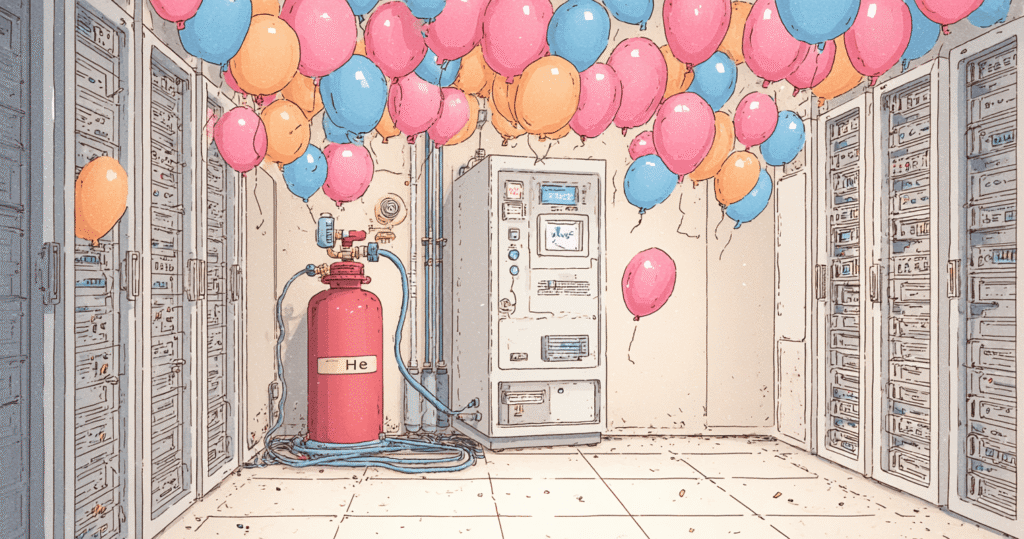
Of all the science experiments we were exposed to as kids, one of the most memorable, and certainly the funniest, was listening to our voices after inhaling a balloon full of helium (He).
Helium, a noble gas known for its extremely low chemical reactivity, is lighter than air, which is why balloons filled with it rise rather than fall.
And because it is less dense, sound travels as much as three times faster through helium than through air.
This faster speed amplifies the higher frequency resonance in our voice box, which results in the hilariously sounding higher pitch of our voices after we inhale the gas.
Lots of fun memories of giggling with a “helium voice”…
But what most don’t think of or even know – as we’re sucking in the gas – is just how critically important it is as an industrial gas.
Helium’s superpower is that it is great at transferring heat, enabling it to cool down an industrial process.
The gas is widely used in the semiconductor industry during the etching process.
As intricate circuit patterns are etched onto a silicon wafer, helium gas is blown over the wafer to keep the wafer cooled… and at a constant temperature to avoid defects in the etching process.
To say that helium is a critical part of semiconductor manufacturing is an understatement.
The industry can’t operate without it.
And there is no known replacement.
Noble Roles for a Noble Gas
Helium is also used to cool down the superconducting magnets used in magnetic resonance imaging (MRI) machines in the health care industry.
Perhaps even more surprising is that helium is used widely in the aerospace industry.
Because it doesn’t react with a rocket propellant, helium is used to pressurize fuel tanks.
This is important, as it ensures that the required pressure in the fuel tank is maintained. Without that, there’d be no way to get safely to orbit.
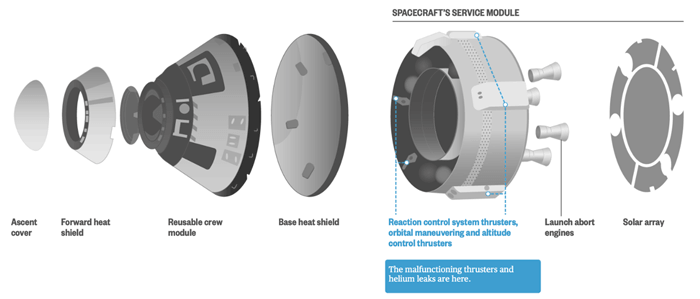
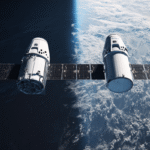
A helium leak was, in fact, the Achilles heel for Boeing and its Starliner spacecraft when it was docked to the International Space Station (ISS) in 2024.
Boeing’s Starliner Spacecraft | Source: Boeing
Due to the helium leaks, the risk of pressurization problems was too high to ensure a safe return of astronauts. Boeing had to return the spacecraft to Earth empty.
SpaceX was called upon for a rescue mission to return the astronauts using its Dragon spacecraft.
This noble gas plays a noble role in various industries.
It’s a very technology-centric gas. And suddenly, for the first time I can remember, it is getting a lot of attention.
The reason being that its sudden supply risk is a second-order effect from the current conflict with Iran.
Stuck in the Persian Gulf
The Ras Laffan natural gas plant is in Qatar.
It sits upon the world’s single largest natural gas field.
This facility produces about 30% of the world’s helium.
And since March 2nd, production of both liquefied natural gas (LNG) and helium has been shut down, due to Iran’s drone attacks on the facility.
Qatar Gas, the owner of the facility, declared force majeure on its contracts, as it is unable to produce its products for reasons completely outside of its control.
Even with a quick end to the conflict with Iran, it may take a couple of years to repair all the damage from the attacks, impacting global helium supply for an extended period of time.
Naturally, when something like this happens, my team and I are thinking about the implications for the affected industries, and more specifically, individual companies.
Yes, the industry has an inventory of helium, but the question is how long it can last.
The semiconductor industry is operating at full steam right now, with no indication of a slowdown for any kind of logic and memory semiconductors that support every artificial intelligence (AI) application.
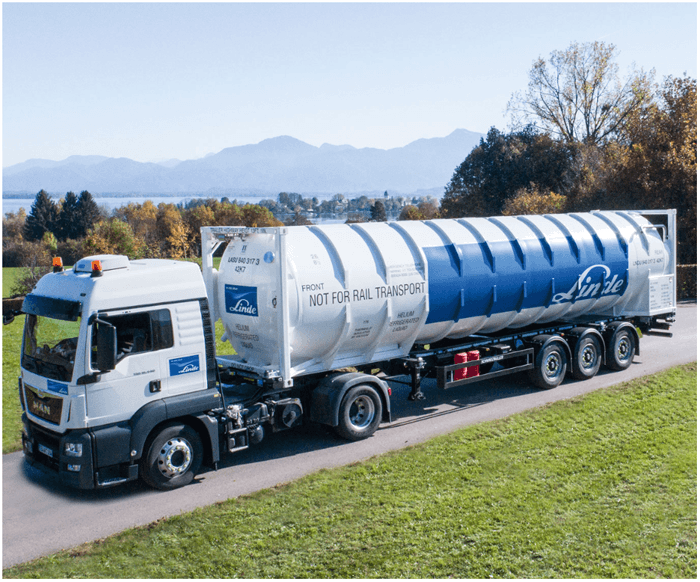
At the moment, there are about 200 41,000-liter cryogenic tanks, like the one shown below, stuck in the Persian Gulf.
The helium is cooled to -269 degrees Celsius, and the tanks are incredibly well-insulated… allowing them to last for about 45 days.
Source: GML
But the clock is ticking.
After that, the helium starts to boil… and a pressure valve on the tank bursts open… resulting in a loss of the helium into the atmosphere, which will worsen the helium supply crisis.
It’s no surprise that some are predicting some stark conclusions that the tech markets are going to crash.
The line of thinking is: 30% of the world’s helium supply is gone → no helium means no AI chips → no AI chips mean no AI data centers → no AI data centers mean AI boom screeches to a halt = the market is doomed.
Lions and tigers and bears… oh my!
It’s easy to get sucked into that sort of superficial doom loop.
But this is exactly where expertise matters.
I have to shake my head when I see things like this.
Silicon Valley Insider Jeff Brown just uncovered that a tiny chipmaker is set to supply Elon Musk 5 billion chips over the next two years. He says it’s down to Musk’s shocking new AI project. And a Musk announcement on April 24 could send shares of this little-known chipmaker (148x smaller than NVIDIA) soaring. Click Here To Get The Ticker Before April 24.
While most traders were whipsawing through tariff chaos, AI sell-offs, and rate uncertainty in 2025… “Market Wizard” Larry Benedict sent 182 winning trades to his readers. And to start off 2026, he’s 14 for 15. A 93%-win rate. His secret? A simple, low-stress system for pocketing big money from AI-driven market chaos, week after week, like clockwork… regardless of which way stocks move. Last week, he revealed everything during his AI Chaos-to-Cash event. He’s even backing it with his “50-Win Performance Guarantee.” The replay is still available, but his special offer is closing soon. Click here to watch the replay and get the details. >>>
At Risk
The Helium Doom Loop ignores the realities of how the affected industries and geographies will deal with the current supply shock in helium.
Yes, 30% of the global supply of helium is offline.
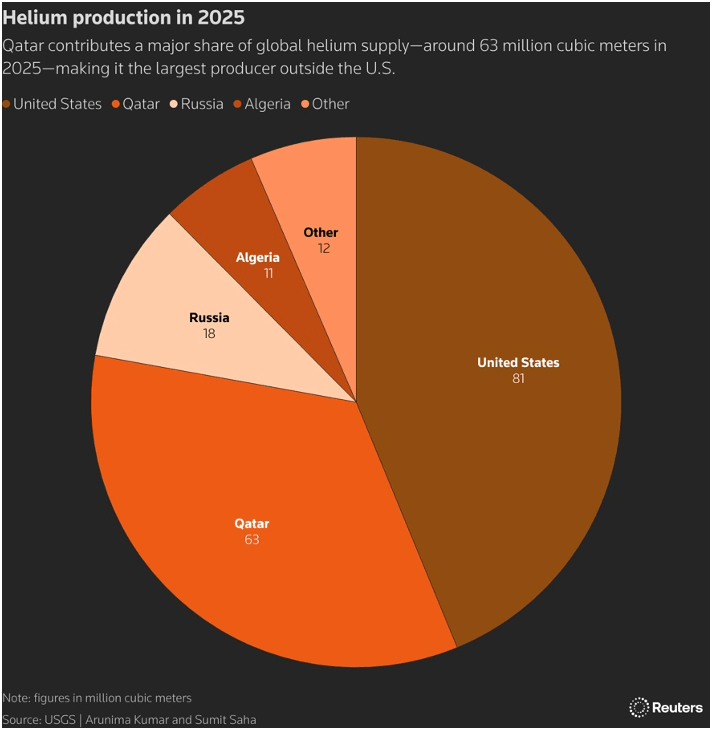
Algeria and Russia are also two of the largest suppliers of helium, but Russian exports of helium are banned, which is also not good.
But what about the world’s largest supplier of helium?
Anyone? Anyone?
Source: Reuters
It’s the United States, with about 43% of global production.
The U.S. is the largest producer of natural gas, and helium is a byproduct of natural gas processing.
Helium-4 is entrapped and mixed with natural gas. And when natural gas is processed, helium-4 is extracted and further refined to 99.9999% purity, so that it can be used in semiconductor manufacturing applications.
So the real question becomes, which countries or companies are most exposed to the Qatar shortage of helium in their operations?
The U.S. natural gas market can increase production of helium… not by an amount to completely offset the normal supply from Qatar, but enough to keep U.S.-based companies operational, along with its closest manufacturing partners.
The largest risk in the tech sector is actually South Korea.
South Korea imports about 65% of its helium from Qatar. That’s too significant a shortage to backstop.
That means that semiconductor manufacturer Samsung Electronics (SMSN) is particularly vulnerable, as is SK Hynix (Korea Stock Exchange: 000660).
Problems at Samsung Electronics could potentially negatively impact Tesla (TSLA), as Tesla outsources its semiconductor production to Samsung Electronics. But I assume that Samsung would prioritize Tesla as one of its most important customers.
Problems at SK Hynix, one of the world’s largest memory makers, would certainly positively impact U.S.-based Micron Technology (MU), which probably won’t have problems acquiring helium for its own semiconductor production.
The Obvious Beneficiaries
Other beneficiaries of the supply shortage are industrial gas suppliers that benefit from improved pricing power in a situation like this.
Companies like Linde (LIN), Air Products & Chemicals (APD), and Air Liquide (AIQUY) are all obvious beneficiaries.
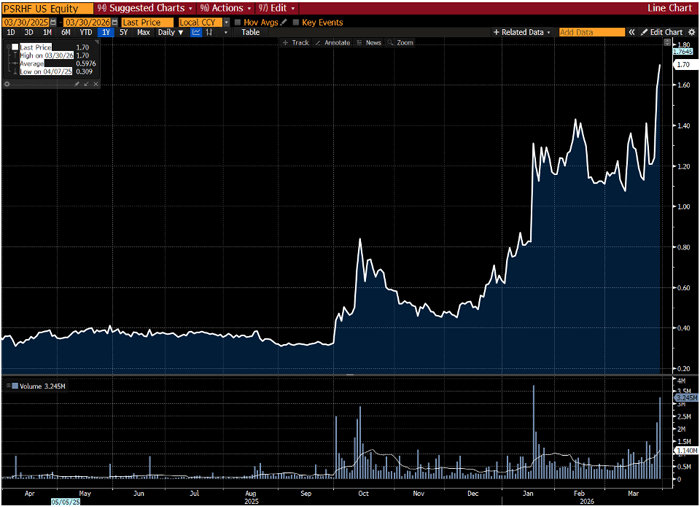
And Pulsar Helium (PSRHF), a junior exploration company developing a high-grade helium discovery in Minnesota, has experienced a remarkable rise, catalyzed by this conflict.
1-Year Chart of Pulsar Helium (PSRHF)
We can be sure that Pulsar will be leaning in and working to accelerate the development of its discovery.
In fact, it conducted a secondary offering to raise additional capital just a month ago.
So this helium shortage is not cause for panic.
It won’t slow down the AI semiconductor manufacturing at key companies like TSMC (TSM), Micron (MU), and, by extension, all the key fabless semiconductor companies like NVIDIA (NVDA), Advanced Micro Devices (AMD), and so on.
U.S.-based companies and their closest manufacturing partners will be the least negatively impacted. U.S. helium production will increase to help deal with the global supply shortages.
And it goes without saying, hopefully this conflict with Iran – and the risk of it acquiring and using nuclear weapons – subsides quickly in the weeks ahead.
To ensure our emails continue reaching your inbox, please add our email address to your address book.
This editorial email containing advertisements was sent to pahovis@aol.com because you subscribed to this service. To stop receiving these emails, click here.
Brownstone Research welcomes your feedback and questions. But please note: The law prohibits us from giving personalized advice.
To contact Customer Service, call toll free Domestic/International: 1-888-512-0726, Mon-Fri, 9am-7pm ET, or email us here.










 RJ Hamster