Stock Investor Insights: Three Gold Stocks to Buy When the Price is Right

YouTube

Three Gold Stocks to Buy When the Price is Right

03/17/2026

Hurry Before the Bell Rings

Med-X is gearing up for a Nasdaq listing (MXRX)-but the real opportunity is now, before Wall Street takes notice. Their all-natural Nature-Cide pesticides are already on shelves at e-commerce giants like Walmart, Amazon, and Kroger, with $6.4M in revenue and expansion into 41+ markets. 

As climate, regulation, and consumer demand drive a $17B industry toward natural solutions, Med-X is positioned to lead. Shares are just $4.00 through a limited Reg A+ offering. 

Don’t wait for the headlines-[Review the Med-X investment opportunity today]

Disclosures: This is a paid advertisement for Med-X’s Regulation A+ Offering. Please read the offering circular at invest.medx-rx.comClick Here…

Three gold stocks to buy when the price is right feature two of the industry’s biggest stocks and one that is on the rise. 

Among the three gold stocks to buy, the two biggest are viable ways to invest in the precious yellow metal and collect dividend payments. But BofA Global Research is suggesting that going long in gold is looking to be a “crowded trade,” according to its recent Global Fund Manager Survey. 

The strategy of going long and seeking to profit from a rise in the gold price during turbulent times is a secret. The BofA Global Fund Manager survey found gold to be the #1 “most crowded trade in March,” according to 35% of its respondents, along with the same percentage saying the same about going long in global semiconductors. Plus, 38% of the survey respondents called gold overvalued in March, compared to 31% in February, BofA reported. 

The bearish sentiment occurred amid military action in Iran, private credit concerns and “frothy bull” sentiment in recent months, BofA noted. As a result, growth optimism weakened and cash holdings climbed to 4.2%, the investment firm added. 

Three Gold Stocks to Buy When the Price is Right: NEM

For investors who may feel that they are late to participate in this modern-day gold rush, one opportunity is to invest in large gold mining stocks that pay dividends. That way, even if the share prices dip, investors receive dividend payouts for remaining patient. 

Citi Research recently offered a positive report for the outlook of Newmont Mining Corporation (NYSE: NEM), a major gold producer with stock performance usually linked to gold prices and trends. Denver-based Newmont Mining, incorporated 105 years ago in 1921, is the world’s largest gold mining corporation, with operations in the United States, Canada, Mexico, the Dominican Republic, Australia, Ghana, Argentina, Peru and Suriname. 

Analysts at Citi Research recently updated their NEM model for the mining company’s fourth-quarter 2025 results, calculating the stock trading at 7x earnings before interest, taxes, depreciation and amortization (EBITDA) and 8% free cash flow (FCF) on spot gold estimated at $5,250 per ounce, and 8x EBITDA and 7% FCF on Citi 2026E gold ($4,600/oz). 

“NEM is still pricing well below spot, in our view,” Citi Research wrote. “We believe NEM remains a strong equity vehicle for generic gold exposure, with diversified operations mostly in Tier 1 jurisdictions, achievable 2026 guidance and likely to return a lot of capital through the current cycle.” 

An unanswered question remains the future of NGM, since a possible combination of the company with another gold mining operation could be strategically desirable, but would require some middle-ground on valuation, Citi Research wrote. The investment firm recently raised its price target for NEM to $150 per share, up from $118 per share for its NYSE listing. 


Chart courtesy of www.stockcharts.com

Seasoned investment guide Jim Woods had recommended NEM in his Tactical Trader advisory service from March 18 to April 15, 2025, producing a 13.63% gain until he sent a sell signal. Concurrently, the sale of the shares was accompanied by closing out of related call options to provide a profit of 104.70% in the latter. The Tactical Trader advisory service recommends both stocks and options. 


Paul Dykewicz talks with Jim Woods, head of Tactical Traderand Forecasts & Strategies.

How Much Money Will YOU Make When Gold Hits $6,000

From dwindling supplies caused by environmental mining restrictions and central bank hoarding… to global uncertainty regarding President Trump’s policies… and stubborn inflation… Gold in the midst of a perfect storm. One that could easily send the pricing soaring to $6,000 an ounce, or possibly even higher. And my top investing expert, Jim Woods, wants to send you the details on two investments that could hand investors gains of up to 2,066%. 

Get the full story here.Click Here…

Three Gold Stocks to Buy When the Price is Right: KGC

Toronto-based Kinross Gold Corporation (NYSE: KGC), founded in 1993, is a global, senior gold mining company with operations and projects in the United States, Brazil, Mauritania, Chile and Canada. The company announced on Feb. 18 that its board of directors approved a 14% increase to its longstanding dividend, equaling $0.16 per share on an annualized basis. That boost is in addition to the dividend increase announced in November 2025, producing a total increase of 33% since third-quarter 2025. 

Kinross Gold is a current recommendation in the Forecasts & Strategies investment newsletter and currently is up 218.11% since its subscribers were advised to buy it on October 14, 2024. 

“Kinross Gold (KGC) is my preferred way to own the upside in gold and precious metals,” said Jim Woods, editor of Forecasts & Strategies. “The mining firm generates strong cash flow and high margins via its core assets, including the Tasiast and Paracatu mines. This high cash flow and margin equation is why some on Wall Street, including me, call Kinross a ‘high-margin cash machine.'” 


Chart courtesy of www.stockcharts.com

Income investors should appreciate that the Kinross Gold board of directors approved the company’s quarterly dividend for fourth-quarter 2025 of $0.04 per common share payable on March 26, 2026, to shareholders of record at the close of business on March 11, 2026. 

For Canadian shareholders, the payment is an “eligible dividend” for their domestic income taxes, while dividends paid to shareholders outside Canada will be subject to Canadian non-resident withholding taxes. 

As a Canadian-based global senior gold mining company with operations and projects in the United States, Brazil, Mauritania, Chile and Canada, Kinross Gold is focused on providing value through mining, “disciplined growth” and balance sheet strength, according to its management. Kinross Gold shares also are listed on the Toronto Stock Exchange with the ticker K, aside from its New York Stock Exchange listing under KGC. 

KGC also was a recommendation in TNT Trader portfolio from April 28 to August 11, 2020, producing a 29.68% gain when it was sold. Woods also is the leader of TNT Trader that recommends both stocks and options. 

Three Gold Stocks to Buy When the Price is Right: Perry’s Perspective

Another fan of Kinross Gold is Bryan Perry, who is recommending the stock in his Breakout Blue Chip Traderadvisory service that recommends stocks and options. Perry also leads the Cash Machine investment newsletter that averages a 10%-plus average annualized dividend yield for its 28 positions, including a gold exchange-traded fund (ETF) that has soared 162.74% since its recommendation on November 12, 2024. 


Bryan Perry heads Breakout Blue Chip Trader  and Cash Machine.

“The highly divisive narrative surrounding Iran, surging energy prices that threaten to re-ignite inflation and concerns surrounding private credit still dominate the investing landscape, where some further progress to end the war is sorely needed with Iran’s nuclear weapons ambitions eliminated entirely,” Perry wrote in his March 17 issue of Breakout Blue Chip Trader

For decades, the intellectual elite of high finance dismissed gold as a “non-productive hunk of yellow metal” that pays no dividend and serves no purpose in a digitized, high-speed economy, Perry said. But in 2026, the narrative is starting to wear thin, he added. 

“As the veneer of king dollar is showing gapping cracks due to a $38+ trillion U.S. federal deficit that is soaring like a firehose with no cutoff value, gold isn’t just a hedge, it is becoming the only remaining exit ramp from a global experiment in fiscal recklessness,” Perry apprised. 

Three Gold Stocks to Buy When the Price is Right: CEO’s Statement

Paul Rollinson, Kinross Gold’s chief executive officer, issued an upbeat statement to accompany the company’s 2025 fourth-quarter and year-end results, saying 2025 marked another “excellent year” for Kinross. 

“We met our guidance once again, delivered robust margins and generated record free cash flow of $2.5 billion, an 85% increase year over year,” Rollinson commented. “We returned approximately $1.5 billion to debt and equity holders, and achieved an end-of-year net cash position of $1 billion, further strengthening our balance sheet. These results underscore the consistency of our operating portfolio and our rigorous focus on cost discipline. 

“We recently announced that we are proceeding with three U.S.-based projects, Phase X, Curlew and Redbird, which together are expected to contribute over $4 billion of net asset value and extend mine lives. In addition to these U.S. projects, we will have meaningful catalysts in the coming year at both of our world class development projects — Great Bear and Lobo-Marte.” 

Kinross Gold is carrying “strong momentum” into 2026 and forecasting another strong year of production of roughly 2.0 million gold equivalent ounces, Rollinson continued. The company’s focus will be on margins and cash flow, while holding the line on controllable costs and maintaining capital discipline. 

“We are planning to continue with our capital allocation strategy by reinvesting in our business, further strengthening our balance sheet and returning capital to our shareholders,” Rollinson stated. “This includes investing an additional $350 million in our business and targeting 40% of free cash flow to return of capital through both share buybacks and dividends.”

Take a Break from the Chaos – Your A.I. Watchlist is Ready

Trading doesn’t have to feel like chaos. 

Sure, the market moves fast. News breaks. Volatility spikes. Sectors rotate without warning. 

But chaos is just complexity you haven’t organized yet.

Instead of drowning in charts and indicators, it’s time for a clear, actionable watchlist of what matters most for March. 

Get Your A.I. Watchlist – Register NowClick Here…

Three Gold Stocks to Buy When the Price is Right: CDE

Chicago-based Coeur Mining, Inc. (NYSE: CDE) is a precious metals mining company that operates five mines in North America. After a 25% pull back after the Iran conflict began Feb. 18, CDE “looks compelling,” said Michelle Connell, who heads Dallas-based Portia Capital Management

“As gold and gold miners benefited last year, so did CDE,” Connell counseled. “During 2025, the company’s revenue more than doubled. Coeur Mining’s free cash flow came in strong at $1.10 a share. This represents a 5% free cash flow yield.” 

Plus, Coeur Mining has achieved “impressive growth” of revenue and cash flow, and is seeking to improve its performance with the acquisition of Toronto-based New Gold Inc. (NYSEAMERICAN: NGD), Connell continued. The purchase of New Gold, approved by CDE’s board of directors, is expected to close by June 30 at the end of the second quarter. New Gold Inc. is an intermediate Canadian gold, silver and copper mining company operating the Rainy River and New Afton mines. 


Michelle Connell leads Portia Capital Management.

“If this integration progress stays on track, New Gold will add $2 billion in free cash flow for CDE’s 2026 results,” Connell told me. “However, it’s important to keep in mind that integration of two cultures could be slower than expected. All acquisitions involve this type of risk.” 

CDE currently trades at its 50-day support level, Connell said. If its share price were to fall further, the 200-day moving average could take the stock down to $16 to share, she added. 

“Many industry analysts remain enamored with the company,” Connell continued. “Five sell-side analysts have upgraded their earnings-per-share (EPS) targets for CDE.” 

As the United States keeps adding $50 billion to its debt every week, with a current level of almost $40 trillion, we can not only look forward to higher interest rates and inflation, but also government spending cuts and increased federal taxes, Connell warned. As the currency of central banks, gold will continue to benefit from a lack of fiscal discipline, she concluded. 


Chart courtesy of www.stockcharts.com

Three Gold Stocks to Buy When the Price is Right: Geopolitical Risk

Gold can be a safe haven for investors seeking to avoid the worst of market drops during times of chaos. However, the precious yellow metal has pulled back a bit during the start of the Iraq conflict. 

Reports that gold also has become overbought may have dampened some of the investor interest. While both gold and silver are commonly included under the umbrella of precious metals, their prices and underlying roles in the economy are fundamentally different. The price per ounce of silver as of Monday, March 16, traded at $80-82, far less expensive than gold’s range of $5,030-5,045 per ounce on the same day. 

Even though buying silver is much more affordable than purchasing the same amount of the precious yellow metal, gold plays a vital defensive role in markets. It’s valued less for productivity and industrial uses, and more for asset preservation and as a strategic diversifier in portfolios. 

Precious metals offer investors multiple pathways for potential returns, such as through stocks, funds or purchasing the metal outright. For example, Rich Checkan, chief operating officer of Asset Strategies International (ASI), of Rockville, Maryland, offers physical bars of silver to purchase as a tangible means of exposure for investors. 


Rich Checkan is the COO of Asset Strategies International.

Checkan, a former U.S. Army officer, expressed the view that gold and silver can be grouped together to combine their respective benefits. Gold provides a defensive holding during natural disasters, time of war and other calamities, while silver offers greater growth potential. Investors who allocate to both precious metals may be able to gain the advantages of each.

Sincerely,

Paul Dykewicz, Editor
StockInvestor.com

About Paul Dykewicz:

Paul Dykewicz is an accomplished, award-winning journalist who has written for Dow Jones, the Wall Street JournalInvestor’s Business DailyUSA TodaySeeking AlphaGuruFocus and other publications and websites. Paul is the editor of StockInvestor.com and DividendInvestor.com, a writer for both websites and a columnist. He further is the editorial director of Eagle Financial Publications in Washington, D.C., where he edits monthly investment newsletters, time-sensitive trading alerts, free e-letters and other investment reports. Paul also is the author of an inspirational book, “Holy Smokes! Golden Guidance from Notre Dame’s Championship Chaplain“, with a foreword by former national championship-winning football coach Lou Holtz. Follow Paul on Twitter @PaulDykewicz.

About Us:

Eagle Financial Publications is located in Rosslyn, VA. – Blocks from the Capitol. Our products have been helping investors build their wealth for several decades. Whether you’re a long-term investor or short-term trader, you’ll find the right strategy for you, including how to earn more steady income to spend now, preserve and grow your capital to enjoy later, and whatever other investment goals you have.

Visit Our Websites:

To ensure future delivery of Eagle Financial Publication’s emails please add the domain @info2.eaglefinancialpublications.com to your address book or contact list.

This email was sent to peter.hovis@gmail.com because you are subscribed to the Eagle Stock Investor Insights List. To unsubscribe please click here. To instantly stop receiving emails simply click here. View this email in your web browser. 

If you have questions, please send them to Customer Service

Salem Media Group – Eagle Financial Publications | 1735 N Lynn St, Suite 500, Arlington, VA 22209-2016

NVIDIA’s Extraterrestrial Announcement

NVIDIA’s Extraterrestrial Announcement

Nick Rokke

Nick Rokke

Senior Analyst


One trillion dollars…

That’s the number NVIDIA CEO Jensen Huang put on the table at this year’s NVIDIA GPU Technology Conference known as GTC. He wasn’t referring to the market cap of his company, which is far beyond that level. He was referring to the amount of revenue he expects NVIDIA will earn from 2025 to 2027.

And that implies NVIDIA is on a path to generate roughly $500 billion in 2027 alone. Only Walmart (WMT) and Amazon (AMZN) have more annual sales than that.

This is an extraordinary figure. And the reason for this is simple… AI-driven demand continues to increase, just as we’ve been predicting at Brownstone Research.

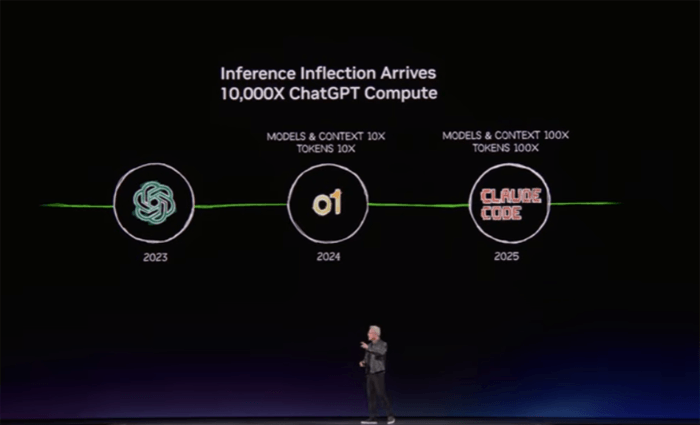
Since the release of ChatGPT in late 2022, NVIDIA estimates that token generation demand per AI task has increased 10,000x. At the same time, overall model usage has surged 100x. Together, that implies a 1,000,000x increase in compute demand in just a couple of years.

Huang doesn’t believe this is going to slow down either. Neither do we. Frontier AI model companies are clamoring for more compute. He said:

It’s the feeling that OpenAI has, it’s the feeling that Anthropic has. If they could just get more capacity, they could generate more tokens, their revenues would go up, more people could use it, the more advanced, the smarter the AI could become.

We are now at that positive flywheel system, we have reached that moment… the inference inflection has arrived.

It’s important to understand this quote. OpenAI, Anthropic, Google, xAI and Meta are all operating with the same mindset. If they can access more compute, they can scale their products, improve performance, and generate more value.

That’s why Huang described this moment as an inflection point. The industry has entered a self-reinforcing loop where demand for compute feeds on itself. The more capacity that comes online, the more it gets used.

The Next Wave Is Even Bigger

What most investors still don’t appreciate is what comes next. We are moving beyond simple prompts and responses and into the era of autonomous AI agents.

These systems don’t just answer questions. They run workflows, write code, analyze data, and make decisions. And importantly, they operate continuously.

With the release of OpenClaw – the open-source agentic AI platform that Jeff’s been covering in The Bleeding Edge – it’s now easier than ever for individuals to program their own AI agents that will continuously do work for them.

Now OpenClaw is designed to run locally on a computer, but the reality is that meaningful workloads will still be pushed into hyperscale environments where compute can scale efficiently.

This shift matters because persistent, always-on AI systems consume far more compute than the first wave of chatbot-style interactions. Which means the next surge in demand will be even greater.

And it’s not just OpenClaw. Another leading player in AI software, Perplexity, just recently launched Perplexity Computer, which has the ability to leverage all frontier AI models. Rather than being open-sourced like OpenClaw, Perplexity Computer has been productized with platform security and ease of use in mind. No programming skills are required at all.

The Problem We Can No Longer Ignore

This brings us to the real constraint… Not chips. Not software. Not capital.

Electricity.

If NVIDIA hits the scale Jensen Huang is signaling, we’re no longer talking about incremental growth in data center capacity. We’re talking about a step-function increase in global power demand.

Let’s walk through what that actually looks like.

Assume NVIDIA reaches roughly $500 billion in annual revenue by 2027, driven primarily by its next-generation Vera and Rubin systems, alongside current Grace and Blackwell platforms.

At that scale, we’re looking at deployments on the order of millions of GPUs.

Using NVIDIA’s NVL72 architecture as a baseline, each rack contains 72 GPUs and 36 CPUs. To support that level of revenue, we arrive at roughly 125,000 racks – about 9 million GPUs – deployed globally.

Now consider the power draw. Each of these racks consumes approximately 200 kilowatts. Multiply that across the full deployment, and we’re already at 25 gigawatts of electricity demand just to run the compute hardware.

But that’s only part of the story.

Modern AI data centers require advanced cooling systems, networking infrastructure, and redundancy layers. When we account for total facility overhead using a typical power usage effectiveness (PUE) factor of 1.3, total demand rises to roughly 32 to 33 gigawatts.

And that’s just NVIDIA. Once we factor in AMD systems and the growing use of custom application-specific semiconductors for AI by hyperscalers, total demand quickly approaches 60 to 65 gigawatts.

That’s the true scale of what’s coming.

A Growing Gap Between Supply and Demand

And this is where the problem becomes clear.

A majority of these AI data centers are being built on U.S. soil. Last year, the United States added about 53 gigawatts of new power generation capacity, the highest level since 2002. On the surface, that sounds like progress.

But it’s not nearly enough. Even more concerning is what kind of power we’re adding.

According to the EIA, roughly 65% of new capacity is coming from solar and wind, both of which are intermittent energy sources. Another 28% is going toward battery storage, which helps manage variability but does not generate new electricity.

When we strip all of that out, only about 7% of new capacity – roughly 6.5 gigawatts – is true baseload power capable of running continuously, the kind necessary to power AI factories.

And we’re adding only a fraction of that in reliable, always-on power.

Even under the most optimistic projections, we’re nowhere close to closing that gap. And historically, actual buildouts fall well short of what’s planned.

Yes, we can attempt to reroute intermittent energy toward less critical use cases and reserve baseload power for AI. But that’s a temporary fix, not a scalable solution.

image
image

Recommended Links


Tesla Merger Coming March 31?

New Nevada court filing reveals Tesla may be next in line for an Elon Musk Mega Merger. Last time Tesla merged well positioned investors saw 30x gains. Don’t miss out. Legendary tech angel investor shares the details in this short briefing. Click now to avoid being left behind.


The AI Dream is Crumbling… Just As Things Were Getting Good

Tech Bros thought they were gods. That AI would appear if they commanded it. But the physical world doesn’t care about what Silicon Valley wants. And the $635 billion they’re throwing at it can’t change reality. What’s coming next in the markets is a full-on Regime Change – a violent reorganization of market winners and losers. Trillions will flee the Mag 7. And the money will find its way to a surprising new class of companies… Tomorrow at 1 p.m. ET, Eric reveals exactly where, including 15 free stock tickers to watch. Instantly reserve your free spot at FutureProof 2026 by clicking here.


The Biggest Bottleneck in AI

New power is the biggest hurdle that Jensen Huang and NVIDIA face in realizing their lofty revenue targets. And this problem will get worse every year. NVIDIA’s growth doesn’t stop in 2027. Not even close.

Wall Street is already projecting another 20% growth in 2028, pushing revenue over $600 billion. If I were to make a bet, I’d take the over on that number.

And every incremental dollar of that growth means more electricity. This is the constraint Jensen is solving for.

He needs more than just faster chips. He needs a new deployment model for compute itself.

This is what made one of the most important announcements at GTC so easy to miss.

NVIDIA Looks Beyond Earth

Huang didn’t just talk about next-generation systems for terrestrial data centers. He introduced something entirely different.

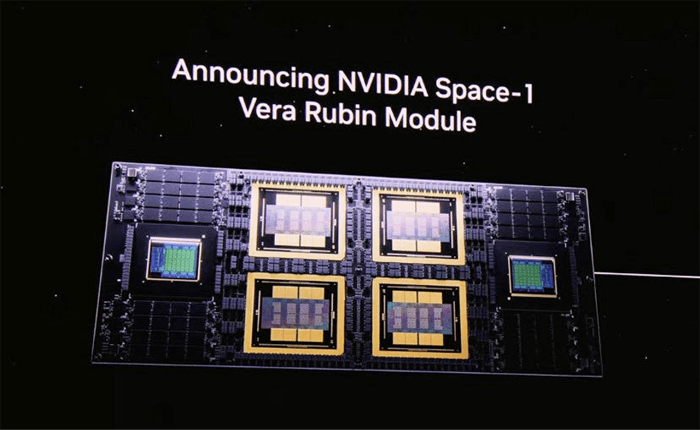
The NVIDIA Space-1 Vera Rubin module.

NVIDIA GTC Presentation | Source: NVIDIA

At first glance, it looks like a compact version of NVIDIA’s terrestrial GPU architecture. As we can see, the architecture pairs two Rubin GPUs with a single Vera CPU on a highly specialized board.

But that misses the point entirely. This system wasn’t designed for Earth. It was designed for orbital AI data centers.

Operating in space introduces a completely different set of challenges. Radiation constantly interferes with electronics, causing errors that can crash traditional systems. Instead of relying on slower, hardened chips, NVIDIA engineered around the problem.

The system runs duplicate computations across paired GPUs and compares the results in real time, instantly correcting any discrepancies. Combined with advanced error correction at the memory level, this creates a highly resilient architecture capable of operating in one of the harshest environments imaginable.

And despite those constraints, performance is staggering. The module delivers a 25x leap over prior generations, enabling real-time AI inference, autonomous decision-making, and even orbital training of advanced AI models.

A specific launch date has not yet been announced. But NVIDIA said six companies are already using its accelerated computing platforms to power next-generation space missions.

Contenders in the Space-Based Data Center Buildout

This is also why Elon Musk is looking towards outer space to expand AI data centers with his constellation of one million satellites.

In our latest issue of The Near Future Report, we said:

On Earth, building new power plants takes years. Transmission lines take even longer. Regulators slow everything down. Communities fight new infrastructure. And even when projects are approved, data centers compete for the same finite grid capacity.

But in low Earth orbit, those constraints disappear.

Approvals are easier to obtain. There is no NIMBY-ism fighting the construction. And no waiting years for utility hookups. Each AI satellite launches with its own power generation attached.

In space, solar panels generate about five times more electricity than they do on the ground. And they operate nearly 24 hours a day. Low Earth orbit (LEO) has no clouds, no inclement weather, and no night cycles when in sun-synchronous orbit.

That’s why Musk is thinking beyond terrestrial data centers.

And we are confident that Musk will achieve this.

Once Starship drives launch costs down toward $100 per kilogram – which we believe is achievable by 2028 based on the current trajectory – the economics of compute begin to shift in a way most investors aren’t prepared for.

At that point, orbital AI data centers will be the most cost efficient way to generate AI compute.

No land constraints. No grid bottlenecks. No cooling limitations. No permits to worry about. Just scalable, limitless free energy infrastructure operating in an environment purpose-built for exponential growth.

This is the moment the entire cost curve flips. And Elon Musk sees it coming.

That’s exactly why he’s now positioning SpaceX for a public offering. He wants to raise capital to accelerate his much larger vision.

Building orbital data centers isn’t just about launching satellites. It requires an entirely new supply chain from launch infrastructure to satellite components to advanced solar panels. And potentially even in-space manufacturing to power systems and next-generation compute architectures.

And Musk intends to build it all. This is a part of his AI masterplan.

Most investors are still focused on GPUs, software, and cloud providers. But the real shift is happening one layer deeper, at the infrastructure level.

More to come…

Regards,

Nick Rokke
Senior Analyst, The Bleeding Edge

P.S. Hi, Jeff’s managing editor here. If you want to learn more about this, Jeff recently put together a detailed presentation breaking down the opportunity in the new space economy and the ensuing infrastructure buildout…

He covers how this transition is unfolding, why it’s happening now, and most importantly, how to identify which companies are positioned to benefit as the data center buildout moves beyond Earth.

It’s important to position yourself now because the transition is already underway. And the biggest gains are made early, before the majority of investors realize the magnitude of this shift.

You can go here to access that presentation.

Recent Articles

Musk Pulls the Trigger on the TeraFab

Mar 16, 2026 • 6 min read

An Exciting Moment for the Nuclear Fusion Industry

Mar 13, 2026 • 13 min read

Agentic AIs Need Social Interactions Too

Mar 12, 2026 • 5 min read

1125 N Charles St, Baltimore, MD 21201
www.brownstoneresearch.com

To ensure our emails continue reaching your inbox, please add our email address to your address book.

This editorial email containing advertisements was sent to peter.hovis@gmail.com because you subscribed to this service. To stop receiving these emails, click here.

Brownstone Research welcomes your feedback and questions. But please note: The law prohibits us from giving personalized advice.

To contact Customer Service, call toll free Domestic/International: 1-888-512-0726, Mon-Fri, 9am-7pm ET, or email us here.

© 2026 Brownstone Research. All rights reserved. Any reproduction, copying, or redistribution of our content, in whole or in part, is prohibited without written permission from Brownstone Research.

Privacy Policy | Terms of Use

“I just bought 10,000 shares of a $5 stock…”

DividendStocks.com Newsletter
Donald Trump @ Freedom Fest

Unsubscribe

Sponsored content from The Oxford Club

Dear Reader,

I just bought 10,000 shares of a little $5 company…

And I suggest you do the same.

I think it could be a fantastic opportunity (as I explain here.)

Similar to when I put $50k into a little-known mining company back in 1995…

Then cashed out 3 years later for about $1.3 million.

Get the details here… then decide for yourself.

Yours for peace, prosperity, and liberty, AEIOU,

Dr. Mark Skousen
Macroeconomic Strategist, The Oxford Club

P.S. I first developed a relationship with the President when he spoke at my FreedomFest conference.

And I quickly learned that he does not want the United States dependent on foreign nations for our resources.

That’s why I’m convinced his administration will take a stake in this one company.

It is the ONLY company in America capable of providing a crucial resource… 80% of which is controlled by Russia, China, and Indonesia.

Here’s the whole time-sensitive story.


This Month’s Exclusive Content

Wall Street Loves FIGS—Why Do Price Targets Predict Pullback?

Submitted by Jennifer Ryan Woods. Article Published: 3/4/2026. 

Smiling healthcare professional in navy FIGS scrubs standing in a bright hospital corridor, symbolizing medical apparel industry growth.

Key Points

  • FIGS stock has surged nearly 260% over the past year, hitting a price not seen since shortly after its 2021 IPO.
  • Q4 revenue topped $200 million—the company’s best quarter ever—with scrubwear sales up 35% and international sales jumping 55%.
  • Despite the rally and bullish analyst commentary, the consensus price target sits almost 30% below current levels.
  • Special ReportEvery morning, an AI ranks 357 stocks for you (From TradingTips)

After a stunning plunge following its 2021 IPO, medical and lifestyle apparel company FIGS, Inc. (NYSE: FIGS) has roared back to life, trading at a price it hasn’t touched in nearly four years. The stock, currently above $17, has surged almost 260% over the past year, including a 58% spike in the last month alone.

The rally has been fueled by strong earnings reports and a wave of bullish analyst commentary. Yet despite the positive momentum, the consensus 12-month price target for the stock is just $12.25—almost 30% below its current price. This raises the question: how much of this recovery is supported by fundamentals, and how much is momentum? A closer look at FIGS’ history and recent results offers some clues.

“Fed Proof” Your Bank Account with THESE 4 Simple Steps (Ad)

Starting as soon as a few months from now, the United States government will make a sweeping change to bank accounts nationwide.

It will give them unprecedented powers to control your bank account.Learn these 4 simple steps and protect your savings before it’s too late.

Early investors saw a quick windfall after the company’s IPO, which priced at $22 per share in May 2021 and climbed to $50 within a month. The COVID-19 pandemic helped drive demand for medical apparel, but as the pandemic eased, shares reversed sharply and, within 12 months, traded below $8. In the years that followed, FIGS mostly languished in the single digits. After dipping below $4 in April 2025, however, the stock began another upward move.

Earnings Momentum Sparks Rally

After steady gains following positive Q1 and Q2 2025 earnings reports, the Q3 2025 results, released on Nov. 6, sent the stock higher. The report showed stronger-than-expected revenue growth, solid demand across its core business and healthy margins despite tariff pressures.

The company also raised its full-year guidance for net revenue and adjusted EBITDA margins. Wall Street rewarded the outlook, pushing the stock up more than 30% over the following week and prompting Zacks Research to upgrade the shares to Strong Buy from Hold.

The momentum continued with the Q4 2025 earnings report released on Feb. 26. The quarter featured a 33% jump in revenue and marked the company’s best quarterly revenue to date, with sales topping $200 million. In its earnings call, the company — which outfitted Team USA’s medical team during the Winter Olympics — pointed to broad-based strength, including growth in its active customer base and higher average order values.

Scrubwear, FIGS’ core segment that accounted for more than three-quarters of net revenue, rose 35%. International sales accelerated as well, increasing 55%. The fourth quarter capped a strong year: full-year net revenue rose 14% year-over-year to a record $630 million. Despite tariff headwinds that pressured gross margins, profitability was solid, with the full-year adjusted EBITDA margin beating its target by more than 200 basis points.

Analysts Applaud Earnings and Outlook

FIGS issued an upbeat outlook for the year ahead, citing continued demand supported in part by growth in healthcare jobs. Management outlined plans to expand into new international markets, prioritize growth across its businesses and continue its stock buyback program.

For fiscal 2026, the company expects net revenue to grow 10% to 12%, with improved profitability targets.

Analysts followed with a flurry of positive notes after the earnings release. Barclays upgraded to Strong Buy from Hold, KeyCorp moved to Overweight from Sector Weight with a $17 price target, and Goldman Sachs shifted to Hold from Strong Sell. BTIG reiterated a Buy rating with a $15 target, and Telsey Advisory raised its target to $15 from $9.

FIGS Stock Pushes Past Price Targets

Strong earnings clearly drove the stock to four-year highs. Shares started climbing even before the Q4 report, jumping nearly 14% in the session ahead of the release. After the results, the rally accelerated: the stock surged 24% on the first trading day following the report and added another 10% the next day. As of March 4, the stock was trading above $17, more than double Morgan Stanley’s $8 target issued in January and above the $17 target set by KeyCorp.

The gap between bullish analyst sentiment and relatively modest price targets suggests analysts like FIGS’ improving fundamentals but remain cautious about valuation. At current levels, shares trade at a price-to-earnings ratio near 90, implying much of the company’s expected growth may already be priced in.

There are few publicly traded direct competitors to FIGS. By contrast, lululemon athletica inc. (NASDAQ: LULU) — a dominant player in lifestyle apparel — trades at a P/E below 12 (compare stocks). The bottom line: investors are cheering the turnaround, but skepticism remains about whether the stock can sustain this ascent or is vulnerable to a pullback.

Thank you for subscribing to DividendStocks.com’s daily newsletter for dividend and income investors that covers ex-dividend stocks, new dividend declarations, dividend stock ideas, and the latest market news.

This email communication is a sponsored email for The Oxford Club, a third-party advertiser of DividendStocks.com and MarketBeat. 


This ad is sent on behalf of The Oxford Club. 105 W Monument St, Baltimore, Maryland 21201. If you would like to optout from receiving offers from The Oxford Club please click here


If you need help with your account, feel free to email MarketBeat’s South Dakota based support team at contact@marketbeat.com.

If you no longer wish to receive email from DividendStocks.com, you can unsubscribe.

© 2006-2026 MarketBeat Media, LLC. All rights reserved.
345 N Reid Pl., Suite 620, Sioux Falls, SD 57103. U.S.A..

Featured Link: Confessions of the 1% class (From The Oxford Club)

Special Titleist Offer: Buy 3 Get 1 Free on Pro V1, Pro V1x, Pro V1x Left Dash & AVX

The Buy 3 Dozen, Get 1 Free promotion on Titleist Pro V1, Pro V1x, Pro V1x Left Dash, and AVX golf balls is live NOW.

This Special Offer on Titleist Golf Balls comes around only once per year.

👉 Shop the Titleist Buy 3 Get 1 Free Offer

Take advantage of this rare offer while it lasts.

Play Well,Johnny Cox
Golfballs.com
800-372-2557 

Manage Email Preferences   |   Unsubscribe from All

Family owned since 1996: The story behind your pup’s bowl

Can’t see this email? View in Your Browser

Redbarn Logo

FOODSTREATSCHEWSSALE

Real food from a real family. That's our promise.

Your Trust is Our Foundation.

In 1996, we started with a simple belief: pets deserve real food, made with integrity. No corporate boardrooms, no marketing hype. Just a family’s commitment to doing things the right way.

Thirty years later, that hasn’t changed. We’re still family-owned and operated. We still answer to you and your pet, not shareholders.

What “Family Owned” Means for Your Dog

It means every recipe is crafted with care, not rushed. It means we choose top-notch ingredients, not fillers. It means we stand behind every product with a 100% guarantee.SHOP DOG FOODS

TOP SELLING REDBARN DOG FOODS

Image of First-Five Kibble Whole Grain Land Recipe

First-Five Kibble Whole Grain Land RecipeShop Now

Image of Air Dried Powerfood High Protein Beef Recipe

Air Dried Powerfood High Protein Beef RecipeShop Now

Image of Semi-Moist Rolled Food Beef Recipe

Semi-Moist Rolled Food Beef RecipeShop Now

Image of Powerfood Fusion Grain-Free Land Mix Recipe

Powerfood Fusion Grain-Free Land Mix RecipeShop Now

Image of Family of Foods Sample Pack

Family of Foods Sample PackShop Now

Image of Family of Foods Sample Pack - Grain Free

Family of Foods Sample Pack – Grain FreeShop Now

SHOP ALL REDBARN ››

Why Redbarn

ABOUT USWHY REDBARN?OUR BLOGCONTACT US

No longer want to receive these emails? Unsubscribe.
Redbarn Pet Products 3229 E. Spring Street Suite 310 Long Beach, CA 90806

A personal warning from Martin Weiss (Please read)

Unsubscribe

A message from Weiss Ratings

Dear Reader,

I started rating the safety of banks in the early ’70s.

Over the last 50+ years, I’ve warned my readers about the bank failures of the 1980s and 1990s, the Dot-Com Bust, the 2008 housing collapse and more.

But today, I’m writing to you with a different kind of warning. One that genuinely frightens me.

This time, the threat to your money isn’t coming from reckless Wall Street bankers. It’s coming directly from the Federal Reserve itself.

Through a program outlined in the Federal Reserve Docket No. OP-1670 — known as “FedNow” — the government is quietly rewiring the entire American banking system.

Simply stated, the Fed is building a centralized hub that will process every transaction in the U.S. … giving it the ability to track every transfer, bill pay, purchase or donation you make in real time.

That, in turn, could give them unprecedented power to cut off your access to your savings if they decide you’re not in “compliance” with whatever their policy agenda dictates at the time.

Or maybe even confiscate your savings when the need arises like it happened in Cyprus in 2013.

In all my decades studying the U.S. economy and banking system, I’ve never seen anything as scary as this.

If you value your financial privacy …

If you believe your money belongs to you and not Washington …

Now’s the time to act.

I’ve spent the last few months putting together 4 specific, legal steps to “Fed-proof” your checking and savings accounts.

I urge you to take this threat seriously.

Review these 4 steps immediately, right here.

Good luck and God bless!

Signature

Martin D. Weiss, PhD
Weiss Ratings Founder

P.S. The Fed is counting on the fact that ordinary Americans won’t read a 93-page document until it’s too late. I’ve read it and that’s why I’m begging you to act while you still can. Get the 4 “Fed-proof” steps right now.


Just For You

Okta Earnings Beat, But Growth Questions Remain

Reported by Chris Markoch. Article Posted: 3/5/2026. 

Tablet displaying the Okta logo in a modern office server room, representing Okta and cybersecurity technology infrastructure.

Key Points

  • Okta stock jumped over 10% after the company reported a strong Q4 earnings beat and improving margins.
  • Growth concerns remain, as management guided to roughly 9% revenue growth, signaling continued deceleration.
  • The AI agent security narrative could drive future demand, but intense competition from Microsoft and cybersecurity peers clouds the long-term outlook.
  • Special ReportEvery morning, an AI ranks 357 stocks for you (From TradingTips)

Okta Inc. (NASDAQ: OKTA) stock jumped more than 10% the day after the cybersecurity company delivered a double beat — beating expectations on both revenue and earnings — in its Q4 report for the 2026 fiscal year. For shareholders who endured the selloff, the rally feels overdue. Even with the post-earnings move, OKTA remains roughly 30% below its consensus price target.

At the same time, analysts have been trimming their price targets. Both things can be true: the stock may still be undervalued, yet lower targets reflect skeptical views about Okta’s longer-term growth trajectory in what should be a bullish cybersecurity market.

A Good Week for a Strong Report

Trump Did What!?!? (Ad)

Why are companies flying spy planes over Elon’s closely-guarded AI lab?

Elon did the seemingly impossible – far faster than anyone expected… And it’s sent the tech industry into PANIC MODE. ChatGPT, Claude, Google Gemini, and DeepSeek could soon become obsolete. And three little-known firms could soar 10X or higher as a result.Get the details here.

The headline numbers in Okta’s reportshowed solid growth. Total revenue was $761 million, up 11% year-over-year, with subscription revenue growing at the same pace. Remaining performance obligations climbed 15% to $4.83 billion, suggesting customers are committing to longer-term contracts.

Non-GAAP operating margins expanded nearly two percentage points to 26.5%, and free cash flow margin remained strong at 33.2%.

By most measures, this was a clean beat from a company that has quietly rebuilt operational credibility after years of post-pandemic multiple compression and a damaging 2023 security breach.

The timing helped, too. Cybersecurity was already in focus this week as renewed attention to identity-based threats reminded enterprise buyers why this space matters.

Okta was well positioned to benefit from that sentiment, which showed up in the stock’s post-earnings move.

The Guidance May Limit the Upside

The bigger question is what comes next. Okta’s outlook for the first quarter of fiscal 2027 calls for revenue of $749 million to $753 million, about 9% year-over-year growth — solid, but a slowdown from the 11% reported this quarter.

Full-year adjusted EPS guidance of $3.17 to $3.19 per share also implies roughly 9% growth, with non-GAAP operating margins guided to 25–26%, essentially flat compared with last year’s 26%. Free cash flow margins are forecast to slip to 27–28% from about 30% a year ago.

For a company trading at a premium to the tech sector and its cybersecurity peers, 9% revenue growth is not obviously commensurate with that valuation. The dollar-based net retention rate, while stable at 106%, has steadily declined from 117% two years ago.

Adding to the concern: net new customers with annual contract values (ACV) above $100,000 grew only 6% year-over-year, representing just 70 net new companies in the quarter. The top line is growing, but the engines driving that growth appear to be cooling.

The AI Agent Play: Opportunity or Hype?

Okta is making a deliberate push into what it calls “securing AI agents.” The premise: as enterprises deploy autonomous AI systems, those agents will need identities, permissions and access controls just like human users. Okta has introduced “Okta for AI Agents” for IT and security teams and “Auth0 for AI Agents” for developers building agentic applications.

On paper, the narrative is compelling. Identity must be solved before AI deployments can scale safely, and Okta sits at a logical chokepoint.

The tougher question is how durable that moat will be. Microsoft Corp. (NASDAQ: MSFT), which already controls identity infrastructure in many enterprise environments through Entra ID, is building AI agent governance capabilities. CrowdStrike Holdings (NASDAQ: CRWD)Palo Alto Networks (NASDAQ: PANW), and a wave of well-funded startups are also targeting non-human identity.

That said, Okta’s platform breadth is a genuine advantage, and its 20,000-plus customer base provides meaningful distribution. But “we authenticate AI agents” is not yet a proven revenue driver — the company has not broken out bookings from these new products. The $80 billion total addressable market (TAM) Okta cites looks attractive, but capturing that opportunity will be challenging.

Two Things Can Be True

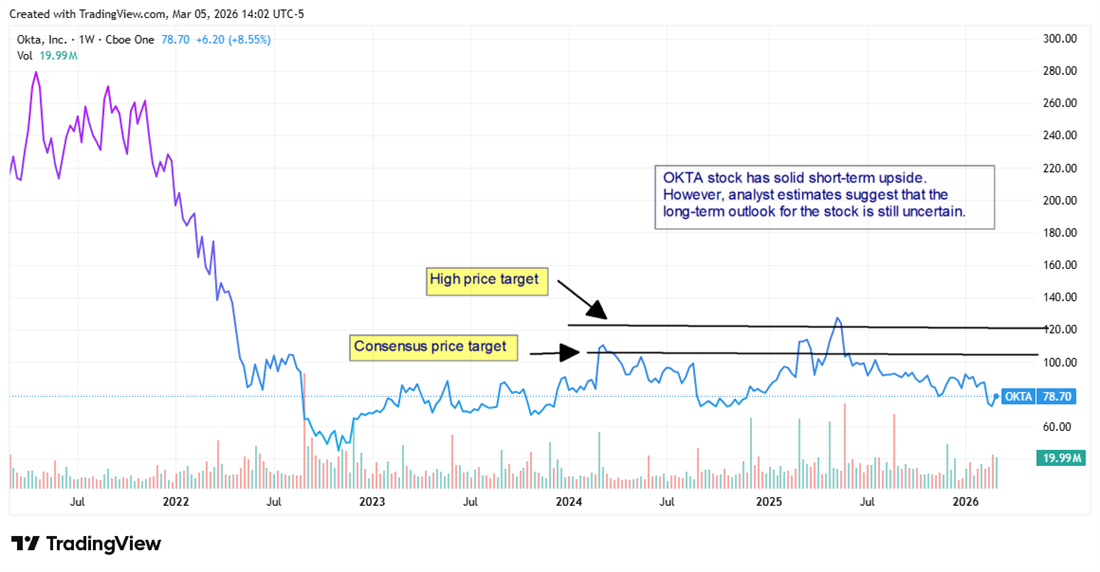
That tension is what makes OKTA stock interesting right now. The stock looked genuinely undervalued heading into this print: it spent much of the past three years range-bound between $65 and $115, far from the $290 highs of 2021. From a cost-benefit standpoint, the valuation had compressed enough that solid execution was worth buying.

But for long-term investors, the chart tells a more cautious story. Even a move to the analyst consensus price target would only bring the stock back to its 2025 highs. Returning to all-time highs would require re-accelerating revenue growth, meaningful monetization of the AI agent narrative, and a macro environment that once again rewards high-multiple software — none of which are guaranteed.

OKTA stock chart displaying the consensus analyst price target, as well as the high-end target, in comparison to historical highs.

The practical takeaway: Okta looks like a reasonable trade for investors with a 6–12 month horizon, particularly if cybersecurity tailwinds continue and the company can show even modest acceleration in Current Remaining Performance Obligation (cRPO) growth over the next few quarters. But for long-term investors seeking a compounding growth story, the deceleration trend and unanswered questions about AI differentiation suggest there may be better options.

Thank you for subscribing to TickerReport, where we work around-the-clock 
to bring you the latest market-moving news.

This email communication is a sponsored email provided by Weiss Ratings, a third-party advertiser of TickerReport and MarketBeat. 

11780 US Highway 1,
Palm Beach Gardens, FL 33408-3080
Would you like to edit your e-mail notification preferences or unsubscribe from our mailing list?


Contact Us  |  Unsubscribe

© 2006-2026 MarketBeat Media, LLC dba TickerReport. 
345 N Reid Place, Suite 620, Sioux Falls, SD 57103-7078. U.S.A..

Want the Next Monster Move?

Logo: Schaeffer's Investment Research

A message from RushTheStreet

Some of the Market’s Biggest Winners Start Quietly… Until They Don’t

RushTheStreet

Want the next underground, high-flying AI opportunity?

Or a small-cap gold explorer that could be on the verge of striking something big?

How about the next breakthrough biotech play quietly building toward major catalysts?

That’s exactly what we hunt for at RushTheStreet.

Not the crowded mega-caps everyone already owns.
Not the headlines after the move.

We focus on:

⚡ Early momentum before it hits mainstream
📊 Small caps with real catalysts and asymmetric upside
🧠 AI disruptors gaining traction under the radar
⛏️ Gold & silver explorers positioned for breakout cycles
🧬 Biotechs approaching defining trial or regulatory moments

Markets are volatile right now — and volatility is where opportunity lives.

👉 Sign up to RushTheStreet now.

(By clicking the links above, you agree to receive emails from rushthestreet.com. You can opt out at any time. – Privacy Policy)

After signing up, make sure you check your inbox and confirm your subscription so you don’t miss the next alert.

Because the next high flyer doesn’t send a calendar invite.

— The RushTheStreet Team

This is a paid advertisement provided to customers of Schaeffer’s Investment Research. Although we have sent you this email, Schaeffer’s does not necessarily endorse this product nor is it responsible for the content of this advertisement. Schaeffer’s makes no guarantee or warranty about what is advertised above. 

To stop receiving these emails, unsubscribe

Schaeffer’s Investment Research 
5151 Pfeiffer Road, Suite 450
Cincinnati, Ohio 45242

the biggest satisfying lie about your 401k

Nonprofit Professional Services

The biggest satisfying lie about your 401k

Workshop • Thursday, April 2nd • 1pm PST

Your 401k is doing exactly what is was designed to do. 

It’s saving your money. Deferring your taxes. Growing your balance. 

And it’s setting you up to hand a massive chunk of it to the IRS the moent you retire.

Every dollar you pull out gets taxed. Your income goes up. Your Medicare premiums go up. Your Social Security gets taxed. That million dollars your saved? It’s not really yours. It’s yours and the government’. 

Most people don’t figure this out until they’re 60. By then, it’s too late to undo thirty years of tax-deferred contributions.

I’ve spent 25 years and over 4,000 clients learning exactly how to fix this. And I’m doing a free live training on Thursday, April 2nd at 1pm PST where I’ll show you the #1 alternative – step by step.

Click the button below to save you seat! 

– TomReserve Your Seat!Tom Ligare

Tom Ligare, CLU®, CAP®

25+ years • Top 1% nationally • Nonprofit executive specialist© 2026 Nonprofit Professional Services • Carpinteria, CAUnsubscribe

If you no longer wish to receive these emails you may unsubscribe

7 Ways to Honor God through a Healthy Lifestyle

7 Ways to Honor God through a Healthy Lifestyle

Caring for every part of your health is a meaningful way to live out your faith day by day. The best way to do so is to set up healthy lifestyle habits. Here are seven ways to honor God through a healthy lifestyle

Continue Reading

Can We Get to Heaven with Tattoos?

With every fad or popular mainstream idea, especially the secular ones that seep into the church, it always leads to debate. There have been debates over music styles, worship, clothes, among others. On the debate stage today, we bring tattoos. 

Continue Reading

TRENDING FOR PLUS MEMBERS

Easter Word Search Game

This printable activity is a wonderful way for kids (or adults!) to reflect on the story of Easter while having fun. It’s perfect for Sunday school, church activities, homeschooling, or family time during the Easter season.

Continue Reading

What Did Jesus Do Each Day During Holy Week?

The final third of every Gospel deals with one week in the life of Christ. I want to take us on a journey through the last week in Jesus’ life, so I have listed the major activities on each day.

Continue Reading

Micah Palace Earns Simon Cowell’s Golden Buzzer with Electrifying AGT Performance

Sometimes a moment feels bigger than a stage—it feels like the whole world leaning in to listen. That’s what happened when Micah Palace earned Simon Cowell’s Golden Buzzer with an electrifying AGT performance of the song,’ Rodeo’.

Watch Now

TOP PODCAST

Why Hymns Still Strengthen Our Faith Across Generations

Robert J. Morgan shares the stories behind 50 beloved hymns and why they still strengthen faith today. His book The Origin of Hymns, featured in I Can Only Imagine 2, explores the history and meaning behind these timeless worship songs.

Listen Now

Welcoming Quintuplets Turned This Family of 4 Into a Family of 9: “I Think It’s a Miracle”

In December, a New York hospital helped deliver quintuplets born to a family of 4, making them a family of 9 overnight. All five babies were born premature but healthy. The family calls it “a miracle.”

Continue Reading

View this email in your browser
Read about Salem Web Network | Subscription Preferences | Unsubscribe


© 2026 Salem Web Network. All rights reserved. 111 Virginia Street, Suite 200, Richmond, VA 23219.

This email is never sent unsolicited. You are receiving this email because your email address, peter.hovis@gmail.com, is signed up to receive newsletters, updates, and special offers from BibleStudyTools.