☘️ Are Successful People Just Lucky?

Shield

AN OXFORD CLUB PUBLICATION

Loyal reader since August 2025 

View in browser

SPONSORED

Controversial Law (S.1582) Unleashes America’s New Money

A brand-new form of government-authorized money is about to be unleashed on America… a so-called Dollar 2.0.

Treasury Secretary Scott Bessent says the Dollar 2.0’s value could “greatly exceed” $2 trillion by 2028…

And it’s also opened up a colossal wealth-building opportunity.

As you can see here, Investors who position themselves now could see gains as high as 40X by 2032.

But the window to act is closing fast… as the next major money minting event is happening.

Go here now to make sure you get ahead of it.

Editor’s Note: Happy St. Patrick’s Day!

As I was thinking about everything we associate with the holiday – from Ireland to wearing green to shamrocks to beer – I started pondering the concept of luck. What is it, really? How much does it matter? Does it even exist at all?

It reminded me of Chief Investment Strategist Alexander Green’s latest bestselling book, The American Dream: Why It’s Still Alive… And How to Achieve It.

Having known Alex for years now, I can personally tell you how much time and energy he put into writing this book – and how strongly he feels about ideas like the American Dream, liberty, and prosperity.

If you haven’t gotten your copy yet, you can order it on Amazon here. You won’t regret it.

– James Ogletree, Senior Managing Editor

LIFESTYLE

Are Successful People Just Lucky?

Alexander Green, Chief Investment Strategist, The Oxford Club

Several times in my Liberty Through Wealthcolumns, I’ve discussed New York Times columnist Robert Frank’s thesis that the key difference between the “haves” and the “have-nots” in this country is not talent, hard work and persistence but luck.

I have a friend and neighbor whose views are diametrically opposed to Frank’s.

His name is Dr. Bob Rotella – and he is the world’s leading sports psychologist.

Bob has worked with Olympic gold medalists, world tennis champions, the winners of 84 major golf championships, NCAA champions in basketball, soccer, lacrosse, and track and field, and some of the world’s greatest musicians.

Many of today’s finest athletes, including LeBron James and Rory McIlroy, consult with him regularly.

He has also worked as a consultant to many of the world’s largest companies, including General Electric, Ford, Coca-Cola, and Merrill.

Bob has devoted his life to helping people who want to be exceptional. And he summarized some of his most important findings in his latest New York Timesbestseller, How Champions Think.

Throughout his career, Bob discovered that great achievers share many attitudes and attributes.

Here are just a few of his findings about what sets the best competitors – in business and in sports – apart from the also-rans:

No. 1: Intense Optimism

It’s tough to achieve great goals without an unwavering conviction that you will achieve them.

Exceptional people generally do this through intense, purposeful visualization. Optimism keeps them juiced, excited about their prospects and willing to work harder than others.

Optimism alone doesn’t guarantee anything, of course. But it is an essential ingredient. There is an almost perfect correlation between negative thinking and failure.

No. 2: A Confident Self-Image

We all construct a mental picture of ourselves. To a great extent, that self-image determines what we become in life. Champions view themselves as winners. And they devote their lives to making that image a reality.

No. 3: Habits of Excellence

Exceptional people follow strict habits that make success almost inevitable. Commitments are a dime a dozen. But unwavering perseverance is a virtue in short supply.

In Bob’s experience, people who struggle generally have habits that undermine their efforts.

SPONSORED

Trump’s Next Big Stock Buy?

The Trump Administration is Loading Up on Stocks.

15% Stake in MP Materials… Up 216% in 4 Months.

10% Stake in Lithium Americas… A triple in 3 weeks.

10% Stake in Trilogy Metals… Up 388% in 8 days!

Why America’s Economist Predicts THIS Could Be the administration’s Next Big Stock Buy.

No. 4: An Unwavering Commitment to Process

Exceptional people don’t just pursue a dream. They fall in love with the process that makes it come true. They don’t just work longer and harder. They work smarter. Bob claims that if you’re not aspiring to dominate, to be the very best, you’re coasting.

And you can only coast in one direction.

No. 5: Single-Mindedness

Champions don’t generally live well-rounded lives. They know they cannot be great business leaders, great parents, great athletes, great socializers and tireless contributors to their communities. They have a passion for one thing and pursue it with the zeal of the newly converted.

In Bob’s experience, champions spend most of their waking hours striving to become the very best at what they do – and spend their remaining hours with their families.

No. 6: Honest Evaluation

Many people set high standards for themselves. But then they go easy on the self-evaluations. Average achievers tend to overestimate how hard they work. Champions don’t. They define excellence in specific terms and commit themselves to the most rigorous standards.

No. 7: Resilience

Failure is inevitable in business and in life. But exceptional people don’t let it define them. They find something to cling to, some hope for the future. Each setback comes with some lesson to be learned.

“Working Hard” Is the Bare Minimum

Robert Frank would counter that plenty of people are talented and work hard but – because they aren’t lucky – don’t achieve great business or financial success.

What he doesn’t seem to realize is that working hard is the bare minimum for exceptional people.

Champions know working hard doesn’t guarantee success. It only guarantees that they can live with themselves.

With great achievers, long hours are just a starting point.

They understand that their biggest struggle is the one within themselves. Anything that causes them to prepare less meticulously or execute less perfectly is a distraction, a hindrance, an encumbrance.

That’s why they surround themselves with, and listen to, those people who will help them succeed.

As Bob writes, “The exceptional person has a vision – of great performances, of a great career, of a great something – and doesn’t care what others may say or think. He ignores information that suggests his dream is unrealistic. He just sets about making that vision a reality.”

Does this really sound like luck?

By sheer coincidence, I read the Rotella book and the Frank book at the same time. It felt like I was traveling between alternate universes.

In one, success is determined by greatness of vision, indomitable will, laserlike focus, persistent striving and uncommon resilience.

In the other, well, it’s just a roll of the dice.

Good investing,

AlexLeave a Comment

BUILD AND PROTECT YOUR WEALTH

The Secret Indicator of the World’s Best Investors

The World’s Simplest Portfolio

New IPO Signs MAJOR Deal with Apple Until 2040. Will It Be the Next Trillion Dollar Company?

Three Traders. One Ugly Day. 200% by Monday Morning.

MORE FROM WEALTHY RETIREMENT

Protect Your Wealth With the #1 Rule in Investing

3 U.S. Oil Stocks to Buy Now

Is This Industrial Stock on the Verge of a Turnaround?

Can Stanley Black & Decker Keep Its Dividend Streak Alive?

FacebookLinkedInEmail SharePush Alert

SPONSORED

Unusual Passive Income Investment
(Found on a Golf Course)

One man turned $1,000 into a decadeslong passive income stream… eventually reaching $100,000 per year!

All from a single golf course tip.

CLICK HERE TO FIND OUT HOW HE DID IT

You are receiving this email because you subscribed to Wealthy Retirement.
Wealthy Retirement is published by The Oxford Club.

Questions? Check out our FAQsTrying to reach us? Contact us here.
Please do not reply to this email as it goes to an unmonitored inbox.

Privacy Policy | Whitelist Wealthy Retirement | Unsubscribe

© 2026 The Oxford Club, LLC All Rights Reserved
The Oxford Club | 105 West Monument Street | Baltimore, MD 21201
North America: 866.237.0436 | International: +1.443.353.4540
Oxfordclub.com

Nothing published by The Oxford Club should be considered personalized investment advice. Although our employees may answer your general customer service questions, they are not licensed under securities laws to address your particular investment situation. No communication by our employees to you should be deemed personalized investment advice. We allow the editors of our publications to recommend securities that they own themselves. However, our policy prohibits editors from exiting a personal trade while the recommendation to subscribers is open. In no circumstance may an editor sell a security before subscribers have a fair opportunity to exit. The length of time an editor must wait after subscribers have been advised to exit a play depends on the type of publication. All other employees and agents must wait 24 hours after publication before trading on a recommendation.

Any investments recommended by The Oxford Club should be made only after consulting with your investment advisor and only after reviewing the prospectus or financial statements of the company.

Protected by copyright laws of the United States and international treaties. The information found on this website may only be used pursuant to the membership or subscription agreement and any reproduction, copying or redistribution (electronic or otherwise, including on the world wide web), in whole or in part, is strictly prohibited without the express written permission of The Oxford Club, LLC, 105 West Monument Street, Baltimore, MD 21201.

REF: 000142349377

Must Read: Profit From What AI Can’t Get Enough Of

Ad Image

Market360 logo

Profit From What AI Can’t Get Enough Of

VIEW IN BROWSER

Editor’s Note: My colleague Eric Fry has spent decades studying how major trends play out and how investors can profit. And he says nearly everyone is looking at AI the wrong way right now.

I completely agree. That’s because, in past tech booms, some of the best performers weren’t the obvious plays. They were the companies supplying what the industry needed to grow.

AI runs on real-world inputs like energy, materials and memory. And in the essay below, Eric shares how these bottlenecks could play a big role in determining which companies move higher from here. 

Eric will break this down in more detail during his FutureProof 2026event tomorrow, March 18, at 1 p.m. Eastern. 

If you want to know where the best under-the-radar opportunities may be forming, you can reserve your spot right here.

Sometimes, the direction of the global economy hinges on a single narrow passage.

A place where critical resources have to squeeze through a surprisingly small opening.

This week, the world got a stark reminder of one of these critical passageways.

At its narrowest point, the Strait of Hormuz is just 20 miles wide.

Yet until very recently, nearly one-fifth of the world’s oil supply flowed through that tiny stretch of the Persian Gulf every day.

As we’re seeing right now, when shipping through the strait slows or stops, the consequences ripple across the entire global economy.

Oil prices spike. Energy markets react. And Wall Street starts paying very close attention.

That’s because when a critical system narrows to a single chokepoint, everything behind it becomes vulnerable.

And right now, something very similar is happening in artificial intelligence.

AI may look like a purely digital revolution. But beneath the software and algorithms lies a physical supply chain — one that’s beginning to strain under explosive demand.

The AI boom depends on enormous quantities of copper, electricity, and memory chips.

And today, all three are facing growing constraints.

In other words, the AI Revolution is running into chokepoints of its own.

In today’s Smart Money, let’s walk you through these emerging bottlenecks, and I’ll show you why they could determine which companies win the next phase of the AI boom.

Because when supply gets tight, the companies controlling those chokepoints often become the most profitable businesses in the system…

Recommended Link

Iran. Oil at $115. Defense stocks surging overnight.X

Luke Lango’s readers weren’t surprised. He’d already identified the exact supply chain chokepoints that become national security emergencies the moment a conflict like this erupts. He’s named 100+ stocks he believes will be at the center of Washington’s next move. Free. Get the full list here.

AI’s New Chokepoints

As explosive as AI is, it still has boundaries.

Artificial intelligence ultimately runs on physical inputs: raw materials, energy, and memory chips.

Right now, the world doesn’t have enough of any of them.

Let’s start with raw materials.

Demand for data centers, computing power, and electricity is exploding. But the copper, rare earths, magnets, transmission capacity, and material supply chains needed to support that growth are constrained.

To sustain the current pace of AI expansion, we would need to mine as much copper over the next 18 years as humanity has mined in the last 10,000 years combined.

And the market seems to have figured this out.

Since 2025, copper investments have returned more than 100%.

Meanwhile, AI-focused hyperscalers like Amazon.com Inc. (AMZN)Meta Platforms Inc. ( META), and Microsoft Corp. (MSFThave averaged gains of just 1%.

And that’s just the beginning.

The next major bottleneck forming in AI is in energy.

Data centers are filled with expensive chips from companies like Nvidia Corp. (NVDA) and Advanced Micro Devices Inc. ( AMD).

But those chips must be powered the moment they’re turned on – or their value immediately begins to deteriorate.

In other words, power isn’t just important to AI growth.

It is AI growth.

Demand for power near data centers is already straining local grids. In some areas, electricity now costs up to 267% more than it did five years ago.

Meeting this demand will require an all-hands-on-deck approach – wind, solar, nuclear, natural gas.

The third bottleneck is memory, also known as DRAM…

Nvidia CEO Jensen Huang put it plainly: “The memory bottleneck is severe.”

Without enough DRAM, AI systems simply run out of room to process information.

And the shortage may persist for years.

Nearly 100 gigawatts of new data centers are scheduled to come online over the next four years. But there’s only enough DRAM to support roughly 15 gigawatts over the next two years.

Without memory, artificial intelligence quite literally can’t think.

So these bottlenecks are very real — and they will affect how the AI boom unfolds.

Some companies will struggle because of them.

But others will benefit…

The Companies Controlling AI’s Chokepoints

The companies best positioned to win in this environment aren’t purely digital businesses.

They’re the ones tied to the physical infrastructure behind AI.

Just look at the damage software stocks suffered recently.

Meanwhile, the companies producing AI’s essential building blocks are becoming increasingly valuable.

I’m talking about businesses involved in:

  • copper mining
  • power infrastructure
  • fiber-optic components
  • energy generation
  • and memory manufacturing

These aren’t flashy companies.

But they produce the tangible materials that keep the AI Revolution running.

And when supply is tight, companies controlling those materials can see their profits soar.

In fact, I’m tracking several companies that sit directly at the center of these shortages — and Wall Street still hasn’t fully priced it in.

That’s what we’ll be talking about at my upcoming event, FutureProof 2026tomorrow, March 18, at 1 p.m. ET. During this free presentation, I’ll walk through each of these emerging bottlenecks in detail – and reveal the specific companies I believe are best positioned to benefit.

Only a small number of companies will benefit from this phase of the AI story.

Because when an entire system depends on a few narrow chokepoints — whether it’s oil flowing through the Strait of Hormuz or AI running on copper, electricity, and memory — the companies controlling those bottlenecks often become the biggest winners.

So, if you want to understand where the real opportunities may be forming, I encourage you to reserve your seat.

Click here to sign up.

Regards,

Eric Fry's signature

Eric Fry
Editor, Smart Money

InvestorPlace

Don’t Dream It 💚 Drive It.

Enterprise Plus®
ribbon
Man driving with a woman in the passenger seat.
Lineup of vehicles outside an Enterprise branch
Looking for an SUV? We have thousands. Two ladies at an Enterprise dealership.
Instagram
Facebook
LinkedIn
Google Play
App Store

Take the road trip.RENTLOCATIONSLOG

Plan a getaway today.

Pick your destination and book with Enterprise® for great rates.BOOK NOW

Close to home and around the world.

We have more than 9,500 branches in nearly 100 countries and territories.VIEW LOCATIONS

The vehicle you want. The quality you deserve.

Our SUVs are hand-selected and thoroughly inspected–delivering the quality you want without the new-car price tag. Browse our selection of vehicles online or visit a dealership today!SUVS AVAILABLE NOWUnsubscribeManage SubscriptionPrivacy PolicyENTERPRISE RENT-A-CAR, ENTERPRISE, ENTERPRISE CAR SALES and the “e” logo are registered trademarks of Enterprise Holdings, Inc. All other trademarks are the property of their respective owners. © 2026 Enterprise Holdings, Inc. All rights reserved. 600 Corporate Park Dr., St. Louis, MO 63105 USA^Reflects your Enterprise Plus account status through 3/15/2026.Used vehicles were previously part of the Enterprise rental fleet &/or an affiliated company’s lease fleet or purchased by Enterprise from sources including auto auctions, customer trade-ins or from other sources, with a possible previous use including rental, lease, transportation network company or other use. Photo for illustration only.

The Market Just Split in Two (URGENT)

Editor’s Note: I have a message for you from JC Parets at TrendLabs. I thought you might find it interesting – check it out here or read more below.

– Stephen Prior, Publisher


The Market Just Split in Two (URGENT)

Dear Reader,

Something unusual is happening beneath the surface of the stock market.

Big money is fleeing one group of stocks…

And piling into another.

This kind of split has only happened a handful of times in the last 125 years.

Each time, one side of the market eventually broke down hard.

But the other side? It made people very, very rich.

10x… 20x… even 30x winners.

We are at that breaking point right now.

I’m going on camera to show you exactly which side is which.

[Watch Now]

Stay sharp,

JC Parets, CMT
Founder, TrendLabsMonument Traders Alliance

Monument Traders Alliance, LLC

You are receiving this email because you subscribed to Trade of the Day.
Trade of the Day is published by Monument Traders Alliance, LLC.

To stop receiving special invitations and offers from Trade of the Day, please click here.
Please note: This will not impact the fulfillment of your subscription in any way.

Ready to start investing? Click here now.
Questions? Check out our FAQs. Trying to reach us? Contact us here.

To cancel by mail or for any other subscription issues, write us at:
Trade of the Day | 14 West Mount Vernon Place |Baltimore, MD 21201
North America: 800.507.1399 | International: +1.443.353.4977
Website | Privacy Policy
Keep the emails you value from falling into your spam folder. Whitelist Trade of the Day

© 2026 Monument Traders Alliance, LLC All Rights Reserved 

Please do not reply to this email as it goes to an unmonitored inbox.

Nothing published by Monument Traders Alliance should be considered personalized investment advice. Although our employees may answer your general customer service questions, they are not licensed under securities laws to address your particular investment situation. No communication by our employees to you should be deemed personalized investment advice. We allow the editors of our publications to recommend securities that they own themselves. However, our policy prohibits editors from exiting a personal trade while the recommendation to subscribers is open. In no circumstance may an editor sell a security before subscribers have a fair opportunity to exit. The length of time an editor must wait after subscribers have been advised to exit a play depends on the type of publication. All other employees and agents must wait 24 hours after publication before trading on a recommendation.

Any investments recommended by Monument Traders Alliance should be made only after consulting with your investment advisor and only after reviewing the prospectus or financial statements of the company.

Protected by copyright laws of the United States and international treaties. The information found on this website may only be used pursuant to the membership or subscription agreement and any reproduction, copying or redistribution (electronic or otherwise, including on the world wide web), in whole or in part, is strictly prohibited without the express written permission of Monument Traders Alliance, LLC, 14 West Mount Vernon Place, Baltimore, MD 21201.

REF: 000142349377

New Alert [Wednesday @ 9:30am ET]

March 17, 2026 | Unsubscribe 

Hello!

We’re continuing to monitor today’s alert for a sustainable breakout higher after it rallied +10% so far today.

Now, get ready for a new alert coming tomorrow morning, Wednesday at 9:30am ET.

Our next alert is shaping up to be a standout opportunity. 

This company has shown a history of experiencing high volatility, which has previously led to significant and sustainable double-digit rallies. 

Now, it could be positioning for another big breakout higher. 

Based on the technical chart structure, we believe this alert has strong potential to deliver meaningful upside. 

Be ready tomorrow morning, Wednesday at 9:30am ET.

To get all of our updates in real-time – Click hereto sign-up for free text alerts to your phone. (*We do not charge for this service, but standard carrier message and data rates may apply.)

Please make sure our emails are landing in your inbox, not spam, so you do not miss the alert. 

All alerts are released only during normal market hours to ensure all subscribers get the same fair access and to avoid after-hours volatility. 

See you tomorrow morning!

SmallCapStocks Team

DISCLAIMER:

You should read and understand this disclaimer in its entirety before joining the website or email/blog list of SmallCapStocks.com (the “Publisher”).  The information (collectively the “Advertisement”) disseminated by email, text or other method by the Publisher including this publication is a paid commercial advertisement and should not be relied upon for making an investment decision or any other purpose. The Publisher is engaged in the business of marketing and advertising the securities of publicly traded companies in exchange for compensation. The track record, gains, upside, and/or losses mentioned in the Advertisement, if any, should not be considered as true or accurate or be the basis for an investment. The Publisher does not verify the accuracy or completeness of any information included in the Advertisement. While the Publisher does not charge for the SMS service, standard carrier message and data rates may apply. To unsubscribe from receiving promotional text messages to your phone sent via an autodialer, using your phone reply to the sender’s phone number with the word STOP or HELP for help.You are receiving this report/release because you subscribed to receive it at our website or through a third-party site.  All our newsletters include an “unsubscribe” link, and you can remove yourself at any time from our newsletters by clicking on that “unsubscribe” link. You can also contact us at info@SmallCapStocks.com to change your information at any time. By your subscription to our profiles, the viewing of this profile and/or use of our website, you have agreed and acknowledged the terms of our full disclaimer and privacy policy which can be viewed at the following link: www.SmallCapStocks.com/Disclaimer and www.SmallCapStocks.com/Privacy-Policy

Update your email preferences or unsubscribe here

1969 South Alafaya Trail
Orlando, Florida 32828, United StatesPowered by beehiivTerms of Service 

ow to Look Through the Noise of Market Headlines

CLAIM THIS EXCLUSIVE OFFER!

Hello Peter Anthony Hovis,

Open Reddit right now, and you may see the TSLA consensus: 

“Elon’s politics are killing the brand. European sales are tanking. BYD is eating market share. It’s over.”

Lots of noise, right?

However, you can quickly use TradeGPT to check if Smart Money agrees.

How? Through dark pool data and options flow.

Imagine what the flow could look like: 

  • “Over just 5 sessions, there’s over $200 million in dark pool block accumulation, clustered between $280–$295. The call/put ratio on options flow is north of 1.8, and there are multiple $2M+ call sweeps hitting the ask in the last 48 hours.”

This kind of data would be screaming that someone with very deep pockets is betting the crowd is wrong.

You can even assign TradeGPT to immediately create the Divergence Score, where it measures the gap between what retail believes and what institutional money is actually doing. When the score hits 8+, it means the narrative and the flow have completely decoupled. 

Meaning? It could be a meatball for a contrarian.

You can’t see this on a chart. You can’t find it on Reddit. You can’t piece it together from CNBC headlines. It requires scanning millions of dollars in dark pool prints, cross-referencing options positioning, and scoring the divergence in real time.

That’s what TradeGPT could do with one prompt.

Options Academy takes it further. 

When setups like this align with Bronco’s technical framework, he sends a live alert to the chat room with the exact trade: ticker, strike, entry, target.

The AI spots the divergence. The veteran executes the trade.

Both are included in the bundle — and the 60% discount closes in 4 days.LOCK IN 60% OFF BEFORE IT IS GONE!

© All Rights Reserved, Trade Alliance

Unsubscribe | Manage Preferences

AI’s Next Bottleneck Is Driving These Stocks Higher

Ad Image
InvestorPlace Digest Logo

The S&P is stuck in neutral… one corner of the market that’s soaring… the other lucrative bottlenecks… financials are warning us… when is Bitcoin a “buy”?

VIEW IN BROWSER

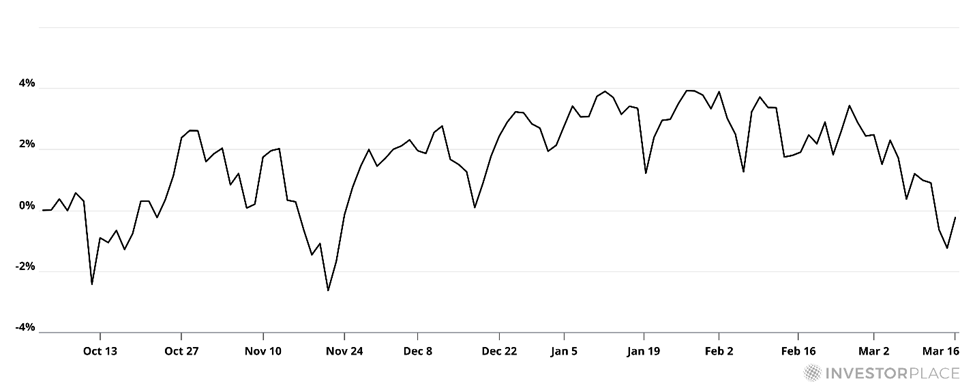
The S&P 500 hasn’t been helping your retirement goals this year…

As I write on Tuesday, it’s down 1.6% year to date.

But the underperformance goes further back. As you can see below, the S&P hasn’t gone anywhere since early October.

chart

That doesn’t mean there isn’t money to be made right now.

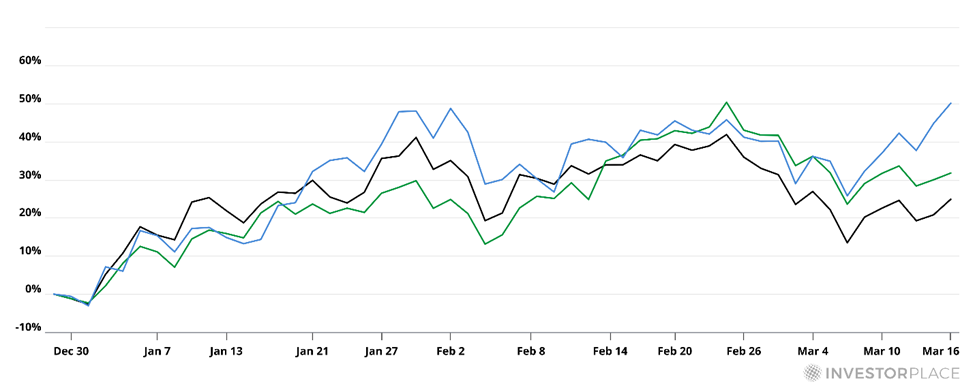
One corner of the AI supply chain – memory stocks – is soaring.

As I write, here in 2026, Lam Research (LRCX) is up 31%… Applied Materials (AMAT) has jumped 36%… and Micron (MU) has popped 60%.

chart

So, what’s happening?

Well, the market is beginning to realize something that our macro investing expert Eric Fry has been warning about for months…

Recommended Link

While markets were selling off in panic last week, one analyst’s readers already knew which stocks to watch.

Luke Lango had named them months ago — before the Iran strikes, before the oil spike, before the headlines. The full list is still free. Click here to see every stock on it.

Artificial intelligence has a memory problem

More specifically, it has a memory bottleneck.

In yesterday’s Digest, we touched on this.

Here’s Eric:

A huge bottleneck is memory, also known as DRAM… 

Nvidia CEO Jensen Huang put it plainly: “The memory bottleneck is severe.” 

To understand why this matters, it helps to think about how AI systems actually work.

The powerful GPUs made by companies such as Nvidia do the heavy lifting for AI calculations. But those chips can’t operate alone. They rely on extremely fast memory to feed massive amounts of data to train and run AI models.

In simple terms, memory acts like your office desktop for AI.

The AI processor is doing the work – but it needs space to spread out data, analyze it, and move it around.

If the desktop is too small, the system must constantly stop, move things around, and reload information. Everything slows down.

As Eric explains:

Without enough DRAM, AI systems simply run out of room to process information.

Without memory, artificial intelligence quite literally can’t think.

The newest AI systems rely on a specialized form of DRAM called high-bandwidth memory (HBM)

HBM allows enormous volumes of data to move back and forth between memory and AI processors at extremely high speeds. It’s one of the key components that allows modern AI systems to function.

The problem is that memory supply – including HBM – isn’t expanding fast enough to keep up with demand. And demand is about to surge.

Here’s Eric explaining:

Nearly 100 gigawatts of new data centers are scheduled to come online over the next four years. 

But there’s only enough DRAM to support roughly 15 gigawatts over the next two years.

In other words, the industry is building AI infrastructure far faster than advanced memory supply can keep up.

That imbalance is one reason companies connected to the memory supply chain – from chipmakers like Micron, to semiconductor equipment suppliers like Lam Research and Applied Materials – have been rallying sharply this year.

In short, investors are beginning to realize that memory may be one of the most important chokepoints in the entire AI economy.

The bottlenecks shaping the next phase of the AI boom

In yesterday’s Digest, we dug into copper’s bottleneck. And beyond today’s discussion of memory, Eric also recently flagged energy:

Demand for power near data centers is already straining local grids. In some areas, electricity now costs up to 267% more than it did five years ago.

Meeting this demand will require an all-hands-on-deck approach – wind, solar, nuclear, natural gas.

These areas represent major opportunities for investors today, thanks to severe imbalances between supply and demand. As Eric notes:

When supply is tight, companies controlling those materials can see their profits soar.

If your portfolio has been mimicking the S&P – doing nothing for months – these chokepoints are where to look for outperformance.

Tomorrow, at1 p.m. ET., Eric will explain how these constraints are developing – and highlight the companies positioned to benefit from them – during his FutureProof 2026 event.

He’ll walk through the industries and supply chains emerging as the next chokepoints in the AI economy – and reveal 15 companies already positioned to benefit from these developing constraints.

You can reserve your spot for the broadcast right here.

This sector is sending a very different signal about market health

A critically important sector is flashing warning signs today…

Financials.

Historically, financial stocks have been among the most important early warning indicators in the market.

To explain why, think about what banks and financial firms do…

They lend money, facilitate investment, support business expansion, and grease the wheels of economic growth. So, when the economy is healthy, financial stocks tend to thrive.

But when investors grow concerned about the economy – or about the stability of the financial system itself – this sector is often among the first to weaken.

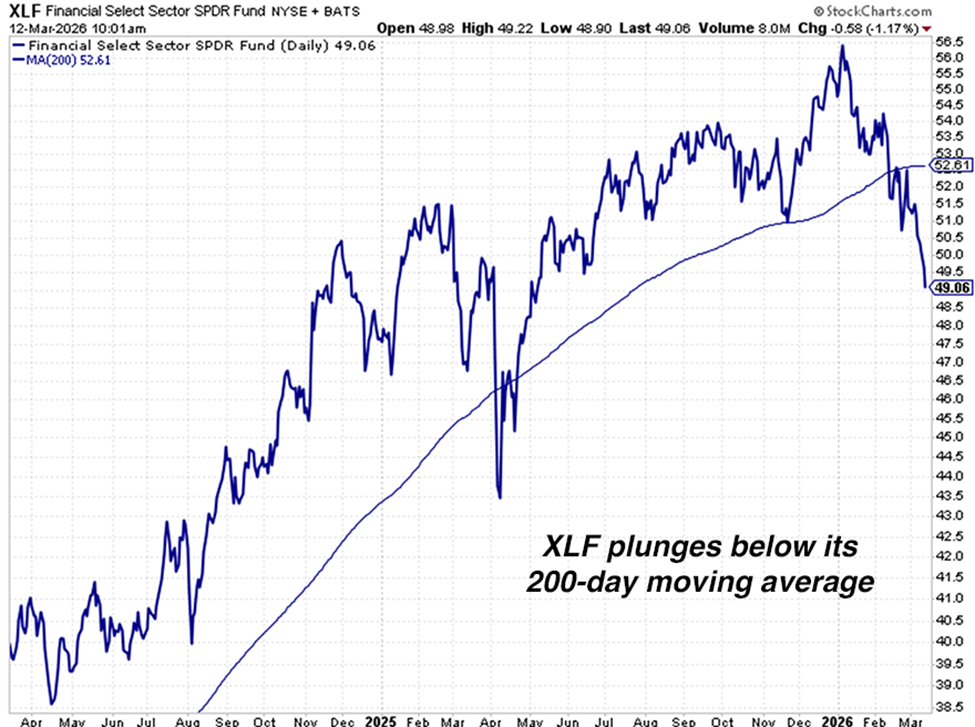
That’s why veteran investor Brian Hunt, editor of Money & Megatrends, is watching the Financial Select Sector SPDR Fund (XLF) closely right now.

XLF is the market’s largest and most liquid ETF focused on the U.S. financial sector. Its holdings include heavyweights JPMorgan Chase (JPM), Bank of America (BAC), Wells Fargo (WFC), Goldman Sachs (BS), and Visa (V).

As Brian explains:

These firms and others like them form America’s financial backbone. 

They rise and fall with America’s ability to make money, save money, start companies, service loans, invest money, and generally just “get along.”

For much of the past two years, this backbone looked strong

From late 2023 through early 2026, XLF enjoyed a steady bull market as banks and financial firms reported solid growth.

But recently, something has changed.

Back to Brian:

Over the past two months, investors have grown concerned about the health of U.S. banking and the larger economy. 

AI is threatening major industries, such as software, in which the banking industry has significant exposure. 

In addition, Operation Epic Fury could constrict supplies of critical resources and damage the economy.

The result has been a sharp shift in the chart.

XLF is now down double digits from its latest high and recently hit its lowest level in nine months.

More concerning to Brian, it has also slipped below its 200-day moving average – a technical level many investors use to gauge the market’s long-term trend.

Here’s Brian’s chart…

chart

And here’s his warning:

All the really bad things – crashes, panics, horrible bear markets – happen below the 200-day moving average.

To be clear, this does not guarantee a recession or a bear market. But it is a warning sign.

As Brian notes, for the financial sector (and our broader market) to regain its footing, XLF would need to rally roughly 6% to climb back above $53, reclaiming its long-term trend.

Until that happens, the S&P’s multi-month sideways pattern is likely to continue.

Bottom line: this isn’t the time to chase the average stock in the S&P 500. Stay selective, focusing on areas where strong structural forces continue to drive demand, such as the bottlenecks we’ve been discussing in the AI supply chain.

Speaking of staying selective, let’s check in on Bitcoin

We haven’t talked much about Bitcoin lately – and for good reason…

After peaking above $126,000 last October, Bitcoin has spent the ensuing months grinding lower – a sign of the long, frustrating bust phase that tends to follow every crypto boom. As I write on Tuesday, it trades around $74,700.

For investors, this kind of environment usually means one thing – patience.

But according to Luke, new data suggests the bottom of this cycle may be closer – and higher – than previously expected.

Luke has spent months analyzing where Bitcoin sits in its historical boom-and-bust pattern. Originally, his base case called for a deeper flush toward $40,000 sometime between late 2026 and early 2027.

But several new indicators are forcing a reassessment…

Here’s his latest thinking:

Our new base case: one more flush into the $50,000–$58,000 range, most likely Q2–Q3 2026, representing our primary accumulation target ahead of the next bull cycle.

Remember what history suggests about where we are today

It’s back in fashion to declare Bitcoin useless, pointless, and effectively “dead,” as one commodities strategist just did. He’s forecasting Bitcoin will crash to $10,000, making it uninvestable for institutional investors.

We’d be wise to view such predictions through a historical lens…

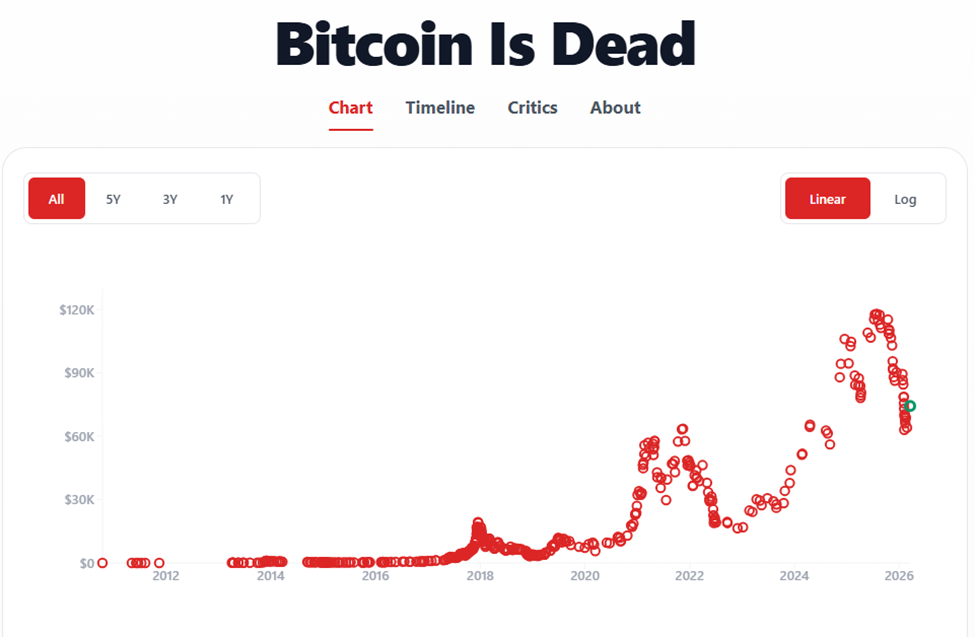
According to the website “BitcoinDeaths.com,” the cryptocurrency has been declared dead 471 times.

Here’s a fun chart that chronicles those calls alongside Bitcoin’s price.

chart

Source: BitcoinDeaths.com

Now, take a guess…

If you’d invested just $100 at each declaration of death, how much money would you have today?

A cool $77,587,553 as I write.

Wise investors understand that the best way to take advantage of tomorrow’s Bitcoin boom – which hasn’t failed yet, despite countless such predictions – is by keeping a level head and accumulating during today’s bust.

I’m not advocating that you cannonball in today. Even bulls are betting on lower prices in the months to come. But when fear replaces euphoria, history suggests opportunity isn’t far away.

Back to Luke:

Trying to nail the exact bottom tick is a fool’s errand, and we have said that consistently… 

Scale into the $50,000–$58,000 zone gradually when it arrives.

The asymmetry is what you are buying, not the number.

Bottom line: For now, Bitcoin still sits above Luke’s primary accumulation zone. But if we see another flush lower, consider scaling in with an eye toward next year and beyond.

To follow along with Luke’s real-time analysis, click here to learn more about joining him in Innovation Investor.

We’ll keep you updated on all these stories here in the Digest.

Have a good evening,

Jeff Remsburg 

InvestorPlace

Enrollment Re-Opened (A rare second chance)

Signature

Did you hear the news, Member?

Dr. Martin Weiss has authorized a rare extension for enrollment in the new private funding round, which opens Thursday, March 19.

It’s a rare chance to claim early shares in a company that’s unlocking a $60 billion/year precious metals fortune … BEFORE their planned listing on the New York Stock Exchange.

(Click this link to discover how to reserve your spot for first-day access to this deal.)

To be clear: we don’t normally do this.

But over the weekend, we took a comprehensive look at A) How many Weiss Members accepted this invitation and B) How fast we anticipate the deal will fill up.

In the past, private deals we’ve featured hit their legal funding limit in as little as one business day.

On multiple occasions, we’ve had cases of Weiss Members who could not get into the private deal because it filled up so fast.

But after reviewing all the relevant facts, including this company’s funding goal … Dr. Martin Weiss and I agreed that in this rare case, we can safely allow a few more members to reserve a spot before the deal opens on Thursday, March 19.

Look, it’s rare enough to get a second chance like this …

And it’s even rarer to be invited to join the “Alpha Round” of funding for a great company like this one.

As I explained in the Private Investment Summit, this is one of the earliest and most lucrative funding rounds.

Historically, Alpha Round investors have made as much as 552,322% returns … that’s enough to grow a $10,000 investment into $55 million.

That’s the kind of opportunity that can completely change a family tree … and ensure generations of security and prosperity.

Look, I’m not saying it’s easy to find winning deals like this. If it was, everyone and their brother would be doing it.

But what I can tell you is I’ve been doing this for a long time.

I’ve invested in 30+ private companies that were tiny startups. I found them. Today, they’re worth over $1 BILLION and counting.

I’ve helped Weiss Members get into great companies before their IPOs … like Starfighters Space, which gave readers like you up to 777% returns so far …

And Eagle Energy Metals, which owns the largest deposit of uranium in the U.S. (I just rang the opening Nasdaq bell with them last week!)

This new deal has all the markings of being a major winner.

I think it could easily be the biggest winner to date.

But your window to claim shares before the IPO is very short.

If you’re interested, here’s what to do: Click to watch the replay of the Spring 2026 Private Investment Summit, where I explain all the details.

From there, just follow the directions at the end of the video to secure your spot for Thursday’s Alpha Round deal. 

Or, call us at 855-278-9191 and one of our Weiss VIP Concierge staff will get you all set up in minutes.

You can also click here to schedule an appointment, and one of the Concierge team will call you at a time that works best for you.

Best wishes,

Chris Graebe,
Private Deal Analyst,
Weiss Ratings Private Investment Summit Follow us: 

11780 US Highway 1,
Palm Beach Gardens, FL 33408-3080, USA
Would you like to edit your e-mail notification preferences or unsubscribe from our mailing list?

MCopyright © 2026 Weiss Ratings. All rights reserved.

No, mRNA vaccines don’t cause ‘turbo cancer’

Follow @FlipboardSee More in The Daily EditionDownload App

What 100 million volts do to the body and mind

What 100 million volts do to the body and mind The Atlantic · Jacob Stern The odds of being struck by lightning in America in a year are one in 1.2 million. How does the experience reorient a person’s sense of chance, of fate? 

FLIP

March Madness used to drive vasectomies. Now abortion bans do.

March Madness used to drive vasectomies. Now abortion bans do. The 19th · Shefali Luthra Once marketed as an excuse to watch basketball, vasectomies are now a way men say they can support their partners after the fall of Roe v. Wade. 

FLIP
My unlikely existence

My unlikely existence longreads.com · Phineas Rueckert Is AI helping prospective parents game the fertility lottery? Should it? 

FLIP
No, mRNA vaccines don't cause 'turbo cancer'

No, mRNA vaccines don’t cause ‘turbo cancer’ theconversation.com · Dannell D. Boatman mRNA cancer vaccines could transform treatment and prevention — but misinformation threatens their potential. 

FLIP

Stay informed and inspired!

Download Flipboard to get the latest news and stories on the topics you care about.

What it was like to watch grieving parents stare down Mark Zuckerberg in court

What it was like to watch grieving parents stare down Mark Zuckerberg in court The Verge · Lauren Feiner Parent advocates were determined to make their presence known to Meta’s CEO. 

FLIP
How the manosphere impacts women and girls

How the manosphere impacts women and girls glamourmagazine.co.uk · Lucy Morgan “You don’t have to be a millionaire influencer to access the manosphere; it’s under our noses, all the time.” 

FLIP
Who was the first person to dye the Chicago River green?

Who was the first person to dye the Chicago River green? NPR · Jeff Dean How did this St. Patrick’s Day tradition begin? 

FLIP
Dancers loved practising in this Singapore walkway. Then the complaints came

Dancers loved practising in this Singapore walkway. Then the complaints came BBC News · Kelly Ng What happened next triggered a debate about Singapore’s fixation with orderliness, the low bar for people to complain, and its many, many rules. 

FLIP
What live/work spaces have looked like through the ages

What live/work spaces have looked like through the ages dwell · Angela Serratore People around the world have merged home and labor for centuries. 

FLIP
Where is the Seinfeld cast now?

Where is the Seinfeld cast now? Entertainment Weekly · EW Staff, Dustin Nelson See the sitcom stars over 35 years later. 

FLIP

Was this sent to you by a friend? For more like it, subscribe here.BLOG · CAREERS · ADVERTISEUpdate your email preferences or unsubscribe here.View our privacy policy here.©2026 Flipboard, Inc. Made with love at 555 Bryant St #352 Palo Alto, CA 94301

Moon Valley Monthly: Fertilizer & Growth Tips

NEW MOON VALLEY NURSERY LOGO RED WITH WHITE OUTLINE-1000x1000

This Month At Moon Valley Nurseries

Your personal outdoor living guide from the people who grow, design, and care for your trees.

Your Expert Tip Of The Month

A consistent fertilizing schedule now will help maximize growth all spring long! Learn everything you need to know about fertilizing on our YouTube channel, and check out our blog for a breakdown on our custom blended fertilizers.Read Our Blog

Moon Products At Moon Valley Nurseries

This Customer Wanted Their Own Private Sanctuary

Expert designs & world-class planters brought this project to life in under a day!

Before And After Olive Trees

See Our Transformations

The Moon Valley Difference

Premium, farm-grown trees paired with expert design, professional planting, and trusted care from start to finish.Experience The Difference

Premium Nursery Experience

Check Us Out On Social!

FacebookAsset 4@2x

Facebook

InstagramAsset 6@2x

Instagram

YoutubeAsset 7@2x

Youtube

Moon Valley Nurseries, 14000 N Pima Rd, Suite 150, Scottsdale, AZ 85260, United States

Unsubscribe Manage preferences