Every day offers a new chance to grow—so explore stories filled with real-life inspiration, practical wisdom, and ideas that fuel your next step forward. Discover uplifting content curated to support your personal growth, and join thousands of readers who visit our site daily for motivation, insight, and a positive boost.
“You don’t have to force anything into bloom—trust that what’s meant to grow will do so in its own perfect time.”
Today, resist the urge to rush or control outcomes. Instead, practice allowing things to unfold organically. Whether it’s a conversation, a project, or your own healing journey, let it happen at its natural pace. Not everything requires your effort to succeed. Sometimes the most powerful thing you can do is simply get out of your own way and trust.MORE INSPIRATION
You’re always one blessing away from a brighter day… and a bigger life. May these stories, affirmations, prayers, and insights lift your spirits and inspire you to lift others.
Beauty by Earth brings together nature’s finest ingredients and modern formulation to create skin and body care that feels luxurious without the excess. Silky textures, restorative botanicals, and visible results—crafted to elevate everyday rituals. Share them. Keep them. Either way, you’re choosing beautifully.
— Read on www.beautybyearth.com/
Garrett Goggin, CFA, CMT Chief Analyst & Founder, Golden Portfolio
P.S. A lot of investors write in to tell me how much they’ve made in Bitcoin. My reply? Good for you. First off, gold investing is cyclical. You really only want to own gold at one specific time in the cycle. That time is now. Second, the world’s governments are not buying Bitcoin. They’re betting on gold. All of them. Bitcoin (does anyone really know for sure the US government didn’t create it?) will be a good bet… until it isn’t. It may end up doing great. Or it may be eclipsed by any number of tech developments.
Vertiv: A Market Breather for an AI Infrastructure Leader
Submitted by Jeffrey Neal Johnson. Publication Date: 3/4/2026.
Key Points
Vertiv has a significant competitive advantage by delivering complete, factory-integrated power and thermal infrastructure systems to its customers.
The company’s massive and growing order backlog provides exceptional visibility into future revenue and confirms strong demand from top data center operators.
The company has solidified its position as an indispensable “picks and shovels” supplier, providing the mission-critical solutions needed for the AI revolution.
Special Report: [Sponsorship-Ad-6-Format3]
Vertiv (NYSE: VRT) has been a standout performer in the AI-driven market, delivering a remarkable 188% return to shareholders over the past year. This climb has put the company squarely on the radar of growth-focused investors. Yet, after reaching all-time highs, the stock has recently pulled back, prompting a key question: is this a temporary pause in a long-term growth story or an early warning sign for a company central to the artificial intelligence (AI)build-out?
Behind AI’s headline-grabbing advances lies a critical and rapidly expanding need for specialized infrastructure. The hardware that powers the AI revolution creates immense operational challenges, and the companies that solve those challenges are becoming indispensable. A closer look at the market dynamics suggests Vertiv is one of those key enablers.
A classic strategy for navigating a technology boom is the picks-and-shovels approach. During the 19th-century gold rushes, the most consistent profits were often made not by the prospectors but by businesses supplying them with essential tools. In today’s AI boom, the “gold” is computing power, and the picks and shovels are the power and cooling systems that make it all work.
This has created a significant infrastructure bottleneck. For decades, computing power improved by shrinking and optimizing processors. Now, AI relies on massively parallel processing, packing thousands of cores onto powerful GPUs. That shift creates power density — an immense concentration of energy and heat in a small space.
An AI server rack can consume enormous amounts of power, generating heat that traditional air-cooling methods — the standard for data centers for decades — can no longer adequately manage. This thermal bottleneck can limit performance and raise operating costs. Without advanced thermal management, multi-billion-dollar investments in AI processors cannot be fully leveraged, making high-end cooling and power solutions mission-critical.
The Go-To Plumber for the AI Era
Vertiv has positioned itself as a primary solution provider to this thermal challenge, building a meaningful competitive moat in the process.
Advanced Thermal Management: The company leads in technologies that address the thermal bottleneck. Its portfolio includes a full suite of liquid-cooling solutions, including direct-to-chip systems that apply coolant directly to the hottest components. These systems provide highly efficient heat dissipation for the most demanding AI workloads.
The System-Level Advantage: Vertiv’s edge extends beyond single products. It delivers complete, factory-integrated power and thermal infrastructure systems. This approach, exemplified by its Vertiv OneCore solution, simplifies the complex process of building a data center. For operators, it reduces on-site labor and shortens deployment schedules, accelerating time-to-revenue — the speed at which expensive AI hardware can be turned on to start generating income. This capability has led to collaborations such as its recent work with Hut 8 (NASDAQ: HUT) to accelerate large-scale AI facility deployments. Further innovation is evident in recent product launches, including a high-capacity busway system designed to optimize valuable data center floor space.
The $15 Billion Backlog: Perhaps the clearest evidence of Vertiv’s market position is its massive order backlog, which stood at $15 billion at the end of the fourth quarter of 2025. That backlog more than doubled from the prior year and provides exceptional revenue visibility for the next 12 to 24 months. It indicates that the world’s largest hyperscale and colocation operators are signing substantial, long-term contracts and choosing Vertiv as a strategic partner for their AI roadmaps.
Price, Performance, and Perspective
After a significant run, the stock’s recent consolidation is worth noting for potential investors. The pullback looks like a natural market response following extraordinary gains, rather than a sign of deteriorating fundamentals.
The company’s price-to-earnings ratio (P/E) of roughly 72x is high and reflects elevated expectations for future growth. While valuation is rich, it is supported by meaningful forward catalysts. The visibility from the company’s large backlog helps provide a clearer path to future earnings growth. Vertiv’s price-to-sales ratio (P/S) of 9.64 is notable, but projected earnings growth of more than 24% next year helps put these metrics into perspective for a company in a high-growth phase.
Wall Street appears broadly positive, with a Moderate Buy consensus rating based on 23 analyst opinions. Following the company’s strong fourth-quarter 2025 results — including earnings per share (EPS) of $1.36, beating consensus by $0.07 — several firms reiterated their confidence and raised price targets, signaling that many analysts see further upside despite the stock’s recent gains.
Why Vertiv’s Role Is Just Beginning
The AI infrastructure build-out is a multi-year secular trend, not a short-lived event. Demand for specialized power and cooling solutions is foundational to the movement, and power-density challenges will intensify as processors become more powerful.
Vertiv’s focused expertise in this niche, its ability to deliver integrated systems, and its sizable $15 billion order book position it well to capture sustained demand. The company is not merely participating in the AI trend; it is a critical enabler. For investors looking to own the essential picks and shovels of the AI revolution, the recent moderation in Vertiv’s stock price could be a compelling reason to research this infrastructure leader further.
Featured Story from MarketBeat
Palantir Stock Rises on Iran Conflict—But Here’s the Real Story
By Chris Markoch. Originally Published: 3/2/2026.
Key Points
Palantir stock surged on geopolitical tensions, but headline-driven rallies have historically been followed by sharp pullbacks, making timing critical for short-term traders.
A new partnership with GE Aerospace and the U.S. Department of Defense highlights Palantir’s expanding AI-driven analytics platform, reinforcing its leadership in defense technology and operational decisioning software.
Rapid commercial revenue growth and improving analyst sentiment suggest Palantir is evolving beyond its reliance on government contracts, positioning PLTR as a long-term AI growth stock despite valuation debates and near-term volatility.
Special Report: [Sponsorship-Ad-6-Format3]
Palantir Technologies Inc. (NASDAQ: PLTR) stock was up more than 5% in intraday trading on Monday, March 2. The rally followed the initiation of military action by the United States and Israel against Iran. That may present an enticing trade, but remember that rapid gains can reverse just as quickly.
For example, PLTR stock experienced a similar spike when the United States took action related to Venezuela in January. The stock then pulled back quickly, trading near $130 about a week before the conflict with Iran began.
For traders with a shorter time horizon, that pattern creates a tricky setup.
Repeated event-driven spikes followed by fast reversals make it tempting to treat Palantir as a pure geopolitical proxy rather than a business that is compounding value beneath the headlines.
That approach can work if you’re disciplined about timing entries and exits, but it raises the risk of getting whipsawed if headlines shift or the news is already priced in by the time you react.
For long-term investors, the lesson is different: don’t confuse headline-driven volatility with the company’s underlying progress. Separating short-term noise from fundamentals is one reason Palantir can still make sense as a long-term holding.
Palantir and GE Aerospace Land DoD Partnership for J85 Engine Support
Before the recent hostilities began, there was additional news that bolstered the buy-and-hold case for PLTR. Palantir and GE Aerospace (NYSE: GE) announced a partnership for a contract with the U.S. Department of Defense (DoD).
The partnership covers the J85 engines, manufactured by GE Aerospace, that power T-38 training jets. The contract with the Defense Logistics Agency runs for seven months with the potential for a four-year extension.
Specifically, GE Aerospace is working with Palantir to apply AI and data analytics to predict parts demand, detect supply-chain issues early, and speed decision-making. Prior to the announced partnership, the two companies tested over 6,000 J85 parts and reported improved visibility and fewer delays.
The Contract Highlights the Totality of Palantir’s Business
Cue the critics who will say this is further evidence of Palantir’s reliance on government contracts. That argument is short-sighted for two reasons. It’s true Palantir generates about 55% of its revenue from government contracts. However, “the government” is not a single client like the DoD; it encompasses multiple agencies and contracts, so a deal like this is additive to future growth.
More importantly, the contract could spill over into Palantir’s commercial business. While not guaranteed, GE Aerospace is using Palantir’s software for applications that have obvious crossovers into commercial aviation.
In Palantir’s most recent earnings report, U.S. commercial revenue rose 109% year-over-year for full-year 2025. In Q4 2025, U.S. commercial revenue increased 137% year-over-year versus Q4 2024.
The takeaway is that Palantir, among technology stocks, has emerged as a leader in AI decisioning software used to automate and improve decision-making. It also means the company has established credibility in both the public and private sectors.
Analysts Have Turned Bullish
There are two schools of thought on Palantir’s valuation: one says the stock must fall to justify its current price, the other that the business will grow into the valuation. Recent analyst sentiment suggested, before the military action against Iran, a tilt toward the latter view.
The Palantir analyst forecasts on MarketBeat show at least nine analysts upgraded PLTR in February. The lowest price target among those upgrades was $150, about 12% above PLTR’s close on Feb. 27.
Further support for the bull case comes from institutional ownership. Institutions hold roughly 45% of the float, and inflows have outpaced outflows by about 3:1.
How to Approach PLTR Stock
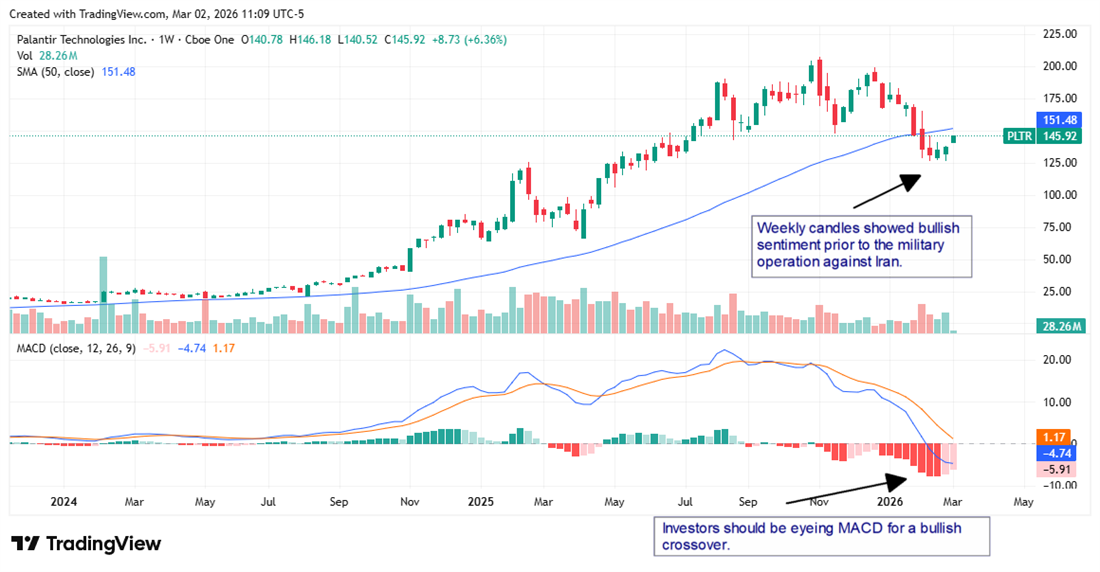
From a technical perspective, the weekly chart suggests the recent move isn’t occurring in a vacuum. Before the latest headline-driven spike, the last few weekly candles showed signs of stabilization after the recent pullback, with buyers defending the area around the rising 50-week simple moving average near the mid-$150s.
That behavior can mark the early stages of a trend resumption rather than a one-off relief rally. Volume has also begun to rise on up weeks, which may indicate institutions are accumulating on weakness rather than distributing into strength.
The one missing ingredient is a confirmed momentum shift: the weekly MACD remains negative and has not yet crossed above its signal line. Until that happens, investors should respect the risk of further volatility, even if the broader setup is starting to favor the bulls.
Thank you for subscribing to Earnings360, a morning newsletter that summarizes quarterly earnings for public companies that trade on U.S. markets.
This email content is a paid sponsorship for Golden Portfolio, a third-party advertiser of Earnings360 and MarketBeat.
If you have questions about your account, feel free to email our South Dakota based support team at contact@marketbeat.com.
If you no longer wish to receive email from Earnings360, you can unsubscribe.
Chaos & Crude: 3 Energy Stocks Built to Thrive in This Market
Submitted by Jeffrey Neal Johnson. Published: 3/5/2026.
Key Points
Surging insurance costs and rerouted tanker traffic through the Strait of Hormuz are embedding a geopolitical premium into every barrel of oil.
Exxon Mobil and Chevron’s global diversification and fortress balance sheets position them to profit from the chaos rather than absorb it.
Occidental Petroleum’s fortified balance sheet and significant backing from a major investor create a uniquely compelling opportunity for investors.
Special Report: [Sponsorship-Ad-6-Format3]
The daily ticker tape for the energy market can give any investor whiplash. One moment, oil futures surge on fears of a widening conflict in the Middle East; the next, they pull back on the faintest whisper of a diplomatic solution. That extreme volatility — where the price of a paper barrel is driven by algorithmic trading and headline sensitivity — makes it hard to make sound investment decisions.
Beyond the noise of speculative trading, a different and more telling story is unfolding on the high seas. In the physical world of massive steel-hulled tankers and complex logistics, the market is not volatile; it is constrained. The tangible friction in the global energy supply chain is real, costly, and getting worse. For investors who can look past daily digital fluctuations, the disconnect between speculation and physical reality reveals a compelling opportunity in a select group of resilient energy companies.
The Strait of Hormuz is the world’s most important energy chokepoint. Approximately 20% of global oil consumption passes through this narrow waterway, making its security fundamental to market stability. With recent geopolitical events, tanker traffic has slowed as shipowners weigh the immense risks. That disruption goes far beyond a simple delay and carries significant financial ripple effects.
The most powerful evidence of this physical-market squeeze comes from the insurance industry. Commercial rates for tankers transiting the region have become so expensive that the U.S. government has stepped in to offer political risk insurance. That is an unmistakable signal that the logistical cost of moving oil has fundamentally increased. Every vessel that is delayed, rerouted, or forced to pay higher premiums adds to the final cost of energy.
This sustained friction creates a geopolitical premium now embedded in the price of every barrel. It establishes a supportive price floor that is detached from the day-to-day news cycle. The environment directly benefits producers with the scale and geographic diversity to navigate the chaos, rewarding their operational strength with higher sustained profitability and stronger stock valuations.
How Global Giants Thrive in Chaos
In an environment defined by logistical uncertainty, scale is not just an advantage; it is a defensive moat. Integrated supermajors, with their vast global footprint from the wellhead to the gas pump, are uniquely equipped to thrive.
Exxon Mobil: The Power of a Pristine Balance Sheet
Exxon Mobil (NYSE: XOM) operates as a financial fortress in the energy sector. It has the size and strength not just to withstand market turbulence, but to capitalize on it. That strength rests on several key pillars:
Financial Fortitude: With a market capitalization exceeding $620 billion and a remarkably low debt-to-equity ratio (D/E) of just 0.13, the company has the firepower to absorb shocks and fund projects without financial strain.
Geographic Insulation: A significant portion of its production growth comes from assets such as the U.S. Permian Basin and offshore Guyana, which are largely insulated from conflicts in the Middle East.
The company is managing the temporary shutdown of the Leviathan gas field in the Eastern Mediterranean. That localized issue actually highlights the benefit of Chevron’s global diversification; the financial impact is manageable for a company of this scale.
Occidental: Why This Producer Is Just Built Different
While the integrated giants offer stability, some investors may prefer more direct exposure to rising crude prices. Occidental Petroleum (NYSE: OXY), a company more focused on exploration and production, provides that exposure.
Normally, this focused model implies higher risk, but two powerful factors have materially de-risked the investment case for Occidental.
The Strategic Reset: The recent sale of its chemical division was a decisive move to fortify its financial foundation. A stronger balance sheet makes the company less vulnerable to commodity swings and increases free cash flow available for shareholder returns such as dividends and buybacks.
The Buffett Backstop: The most compelling factor is the large ownership stake held by Warren Buffett’s Berkshire Hathaway (NYSE: BRK.A). This is more than a typical institutional holding; it represents one of the world’s most respected investors making a high-conviction bet on Occidental’s asset quality and long-term value. That Buffett Backstop provides a powerful foundation of confidence for other shareholders.
Finding Clarity in the Chaos
Daily headlines will keep driving volatility in the oil sector, but the underlying fundamentals of the physical market tell a clearer story. Sustained logistical friction in the world’s most critical energy corridors is not merely temporary; it has created a durable tailwind for producers that transcends the day-to-day noise.
This environment rewards companies with the scale to manage global complexity, the financial strength to weather uncertainty, and the strategic clarity to execute their plans. ExxonMobil, Chevron, and Occidental Petroleum each offer different but compelling ways to gain exposure to this new market reality. For investors looking to position portfolios for sustained geopolitical uncertainty, the resilience and strategic advantages of these energy leaders merit careful consideration.
Further Reading from MarketBeat
Qualcomm’s Sudden Reversal Signal Could Catch the Bears Offside
Author: Sam Quirke. First Published: 2/27/2026.
Key Points
After a brutal 30% slide that erased nearly two years of gains, Qualcomm is showing early signs of stabilization.
A bullish MACD crossover deep below zero suggests downside momentum may be exhausting itself.
With fresh analyst upgrades starting to land and price action firming above recent lows, a base is starting to take shape.
Special Report: [Sponsorship-Ad-6-Format3]
After collapsing nearly 30% between the first week of January and the first week of February, tech giantQualcomm Inc (NASDAQ: QCOM) is now trading near $145. It’s been a rough start to the year for investors, with that selloff effectively dragging the stock back to 2020 levels.
Though the stock was already under pressure, the primary catalyst for the selloff was the company’s weak forward guidance in its first report of the year.
That disappointment accelerated selling in what has long been a frustrating stock for holders, despite Qualcomm’s consistent ability to top earnings and revenue expectations.
Following the selloff, Qualcomm’s relative strength index (RSI) was pushed toward multi-year lows, sentiment collapsed, and many analysts began throwing in the towel.
For a company operating in such a critical part of the semiconductor ecosystem, the capitulation felt definitive. Yet over the past fortnight, something has shifted that’s making investors question whether the worst of the selling is already behind them. Let’s take a closer look.
A MACD Signal That Matters
In mid-February, Qualcomm’s moving average convergence/divergence indicator (MACD) registered a bullish crossover while still deeply in negative territory. That detail matters: a bullish MACD crossover above the zero line can simply confirm ongoing strength, but a crossover from below zero often suggests downside momentum has reached an extreme and is beginning to unwind.
With bears in control throughout January and early February, every bounce was sold into and momentum remained decisively negative. Now, a string of consecutive green sessions suggests short-term control may be starting to tilt back toward the bulls, particularly when viewed alongside the MACD’s bullish crossover.
The last time Qualcomm printed a similar bullish MACD crossover from deep below zero was last April, after the stock had also fallen roughly 30%. That signal marked the low and was followed by a multi-month rally of about 70%. For investors who like a comeback story, it’s a compelling setup.
Price Action Is Quietly Improving
Importantly, the recent signal is not occurring in isolation—price action is beginning to improve. The bears have been unable to push the stock below the immediate post-earnings low, despite the earlier pessimism from analysts. Instead, the stock has turned decisively northward. This doesn’t mean the downtrend is officially broken, but the relentless pressure has eased.
For a stock that surrendered two years of gains in weeks, stabilization is itself notable. When a deeply oversold name rallies in the wake of bad news rather than falling further, it often indicates the worst-case scenario is already priced in.
Analysts Are Starting to Shift
The technical improvement is being accompanied by a subtle change in tone from Wall Street. Earlier this year many analysts downgraded Qualcomm or trimmed price targets after its weak guidance.
In line with stabilizing price action and bullish technicals, that wave of caution now appears to be softening.
This week, Wells Fargo lifted its rating from Underweight to Equal Weight, while Loop Capital went further, upgrading Qualcomm to a Buy. They argued that key near-term headwinds are beginning to ease and that the company’s diversification strategy strengthens its longer-term outlook.
Both Loop Capital and Wells Fargo set fresh price targets of $185, implying roughly 30% upside from current levels and adding to the sense that Qualcomm could be a serious contender for a comeback rally.
What Needs to Happen Next
For this early reversal to develop into something more durable, Qualcomm needs to consolidate recent gains and begin forming a base around $150.
That level is psychologically important and has been a key battleground before. If the stock can hold above the recent lows and start carving out higher lows, confidence should begin to rebuild. A decisive break below $130, however, would likely invite renewed selling.
This remains a stock with real headwinds: handset demand uncertainty persists, and management still needs to restore credibility around forward growth. But markets often turn before fundamentals visibly improve. The bullish MACD crossover deep below zero suggests downside momentum may have already peaked.
Thank you for subscribing to DividendStocks.com’s daily newsletter for dividend and income investors that covers ex-dividend stocks, new dividend declarations, dividend stock ideas, and the latest market news.
This email is a sponsored email provided by GoldenCrest Metals, a third-party advertiser of DividendStocks.com and MarketBeat.
If you need help with your subscription, please feel free to contact MarketBeat’s U.S. based support team at contact@marketbeat.com.
If you no longer wish to receive email from DividendStocks.com, you can unsubscribe.
Copyright 2006-2026 MarketBeat Media, LLC. All rights reserved. 345 N Reid Place, Suite 620, Sioux Falls, S.D. 57103-7078. United States..

















 RJ Hamster