There is a tremenous energy behind this album. I felt it from the moment the title track, “Music In Me”, was written. That song was a turning point, opening a new chapter for me – one filled with curiosity and purpose.
Keith and I, along with an incredible team of support, were able to create the album we have always wanted to. And it’s doing the things I’ve always dreamed of:
Whenever these accolades come our way, it is with such gratitude that I get to share it with the people who make this all possible. Thank you for downloading, sharing, and listening!
Even though the vinyl ship date has been pushed back by at least a month, I’m sweetening the deal. If you placed an order, check your email! Choose a free merch item of your choice upon shipping, plus a signed “Music In Me” poster. This goes for new orders, as well!ORDER YOUR VINYL ships in April
Thanks for signing up for exclusive access to our “Profit Calendar” software…
If you feel you’ve received this email in error, please click here to unsubscribe from the TradeSmith Daily, as well as marketing communication from TradeSmith.
As a member of the TradeSmith Daily, you will receive critical market analysis every day from the TradeSmith team. Be sure to whitelist services@exct.tradesmith.com and info@exct.tradesmith.com to ensure you don’t miss any updates.
Want to circle specific dates on your calendar to know which stocks to buy at the right time…
TradeSmith is not registered as an investment adviser and operates under the publishers’ exemption of the Investment Advisers Act of 1940. The investments and strategies discussed in TradeSmith’s content do not constitute personalized investment advice. Any trading or investment decisions you take are in reliance on your own analysis and judgment and not in reliance on TradeSmith. There are risks inherent in investing and past investment performance is not indicative of future results.
To unsubscribe or change your email preferences, please click here.TradeSmith | 1125 N. Charles Street, Baltimore, MD 21201Terms of UsePrivacy Policy
Please join us, our Zoom Link is below for this Saturday’ssession at 8:00 AM PST 03/07/2026. I am blessed by the presence of each one of you in my life. We show gratitude to God by “giving thanks in all circumstances …” [1Thess. 5:18a]
We will continue our study of Matthew. [Matt. 5, 6, 7] These chapters are the very basics of Jesus’ teachings. He articulated them in a single teaching spoken in a relatively short period of time, a single lecture if you will. He then spent the next three years explaining what He said. WE should all reflect on that for a moment. We have thought about that before as we work our way through them. There is no rush, we do not want to miss any important elements of His teachings. In this study session we will review [Matt. 6:5-14]. It is here that Jesus lays out the proper manner we are to pray. This is a portion of the Similitudes.
The Ten Commandments, The Lord’s Prayer, and The Apostle’s Creed are foundational documents of our Christian faith. If we had no other documents, books or writings, in our daily lives, if we believed and adhered to the teachings contained in these three documents we would be assured of salvation. That is a strong statement, but as we explore what each is saying and study their words in the context of our faith, we may agree. The Lord’s Prayer/Our Father. [Matt. 6:9-13]
This prayer comes from Jesus Himself:
Introduction – Our Father, who art in heaven, [Matt. 6:9]
This is the introduction and Jesus is inviting us to believe that God is our true father and we are His true children. Thus, we may ask these things as a child
would ask his earthly father.
1. hallowed be thy name; [v. 9]
We know God’s name is holy and we pray that we keep it holy. We keep it holy when we teach His Word with truth and purity. We also ask that God help us to live holy lives according to His Word. We also pray that if anyone teaches or lives contrary to God’s Word or profanes Him, we ask God to protect us from them.
2. thy kingdom come, [v. 10]
God’s kingdom comes without us, but we pray it comes to each of us. His kingdom comes when we are given the Holy Spirit. We ask for His grace to believe His Word and lead godly lives on earth and for all eternity.
3. thy will be done, on earth as it is in heaven. [v. 10]
God’s good and gracious will is done without us, but we pray it may be done among us. God does this when He hinders every evil plan of the world and of our sinful nature. Evil does not want us to say God is holy or let His kingdom come to us. He strengthens and keeps us in His Word and faith until we die.
4. Give us this day our daily bread, [v. 11]
God gives daily bread to everyone without our action, including those who are evil. We ask God to lead us, to believe this and to be thankful daily for the opportunities that are granted to us by our Father. Daily bread means all of our support and needs: food, shelter, clothes, shoes, land, animals, money, stuff, devout spouse, children, workers, leaders, good weather, peace, Government, health, self-control, reputation, friends, neighbors and etc., etc.
5. and forgive us our trespasses, as we forgive those who trespass against us; [v. 12]
Trespass means sin. We ask that God not look at our sins and thus deny our prayer. We know we are not worthy nor deserve what God gives us, but we know He gives all things His grace. We know we sin too much and deserve to receive punishment. Thus, we should forgive and happily do good to those who sin against us.
6. and lead us not into temptation, [v. 13]
God tempts no one! We pray God guard and keep us so the devil, the ‘world’ and
our sinful nature may not deceive us or mislead us into false belief, despair, vice or shame. We pray we will overcome them all and win eternal victory.
7. but deliver us from evil. (Sed libre nos a malo) [v. 13]
We pray our Father, in heaven, rescues us from the evils that afflict our body and soul, possessions and reputation. When our last hour comes, give us a blessed end and graciously take us from this valley of sorrow to be with Him in heaven.
“Lord, teach us to pray!” So spoke the disciples to Jesus. In doing so, they were acknowledging that they were not able to pray on their own; they had to learn. “To learn to pray” sounds contradictory to us. Either the heart is so overflowing that it begins to pray by itself, or it will never learn to pray. But this is a dangerous error, which is widespread among Christians today, to imagine that it is natural for the heart to pray.
We then confuse wishing, hoping, sighing, lamenting, rejoicing—all of which the heart can certainly do on its own—with praying. But in doing so we confuse earth and heaven, human beings and God. Praying certainly does not mean simply pouring out one’s heart. It means, rather, finding the way to and speaking with God, whether the heart is full or empty. No one can do that on one’s own. For that, one needs Jesus Christ.
The disciples want to pray, but they do not know how they should do it. It can become a great torment to want to speak with God and not to be able to do it, having to be speechless before God. In such need we seek people who can help us, who know something about praying.
If someone who can pray would just take us along in prayer, if we could pray along with that person’s prayer, then we would be helped! Certainly, experienced Christians can help us here a great deal, but even they can do it only through the one who alone must help them, and to whom they direct us if they are true teachers in prayer, namely through Jesus Christ. If Christ takes us along in the prayer which Christ prays, if we are allowed to pray this prayer with Christ, on whose way to God we too are led and by whom we are taught to pray, then we are freed from the torment of being without prayer.
Yet that is what Jesus Christ wants; he wants to pray with us. We pray along with Christ’s prayer and therefore may be certain and glad that God hears us. When our will, our whole heart, enters into the prayer of Christ, then we are truly praying. We can pray only in Jesus Christ, with whom we shall also be heard. Therefore, we must learn to pray.
The child learns to speak because the parent speaks to the child. The child learns the language of the parent. Thus, we learn to speak to God because God has spoken and speaks to us. In the language of the Father in heaven God’s children learn to speak with God. Repeating God’s own words, we begin to pray to God. We ought to speak to God, and God wishes to hear us, not in the false and confused language of our heart but in the clear and pure language that God has spoken to us in Jesus Christ. God’s speech in Jesus Christ meets us in the Holy Scriptures.
If we want to pray with assurance and joy, then the word of Holy Scripture must be the firm foundation of our prayer. If we want to pray with assurance and joy, then the word of Holy Scripture must be the firm foundation of our prayer. Here we know that Jesus Christ, the Word of God, teaches us to pray. The words that come from God will be the steps on which we find our way to God. AMEN
Peter, This month’s webinar lineup is designed to help you get noticed and enhance your career.
March 12
Beyond the Degree: Practical Strategies to Gain Experience
Discover actionable ways to build skills, gain experience and stand out.
March 18
Crafting Your Curriculum Vitae
Learn how to avoid common mistakes and create a standout CV.
March 26
Navigating Challenging Interview Scenarios
Master strategies to handle tricky interview questions with confidence.
Register today
Visit our webinar page to reserve your spot for upcoming webinars.Register
This email was sent to you because you requested information about University of Phoenix. If you do not wish to receive promotional information from University of Phoenix at this email address, you may unsubscribe.
The University’s Central Administration is located at 4035 S Riverpoint Pkwy, Phoenix, AZ 85040.
From Australia to the U.S.: How SMX Shields Critical Minerals Amid Rising Iran-U.S. Conflict
As global tensions surge, particularly between the United States and Iran, nations are acutely aware that supply-chain certainty is a critical pillar of national security. Rare earth minerals, vital for everything from defense systems to renewable energy technologies, are at the center of this strategic struggle.
Australia, with its substantial reserves, is uniquely positioned to support U.S. demand—but only if traceability and verification can be guaranteed. There is where SMX (Security Matters) Public Limited (NASDAQ: SMX)enters the equation. SMX has a molecular identity technology rises to this challenge, embedding a secure, permanent digital signature into each material that survives all stages of processing and transformation.
This innovation allows stakeholders to confirm the origin, authenticity, and full lifecycle of rare earths, eliminating reliance on fragile paperwork or vulnerable certificates.
SMX’s solutions provide more than material authentication—they offer a safeguard against the growing threats of geopolitical conflict, industrial sabotage, and supply-chain disruption. By enabling governments, manufacturers, and investors to track materials in real-time, SMX fortifies defense supply chains, critical infrastructure, and high-security assets against risk.
Its presence in Southeast Asia, a hub of regional stability and trade, positions SMX as a trusted partner for global operations requiring resilience and transparency. As tensions in Iran escalate, SMX is not just securing materials—it is securing national interests, ensuring that essential minerals reach U.S. shores safely and reliably.
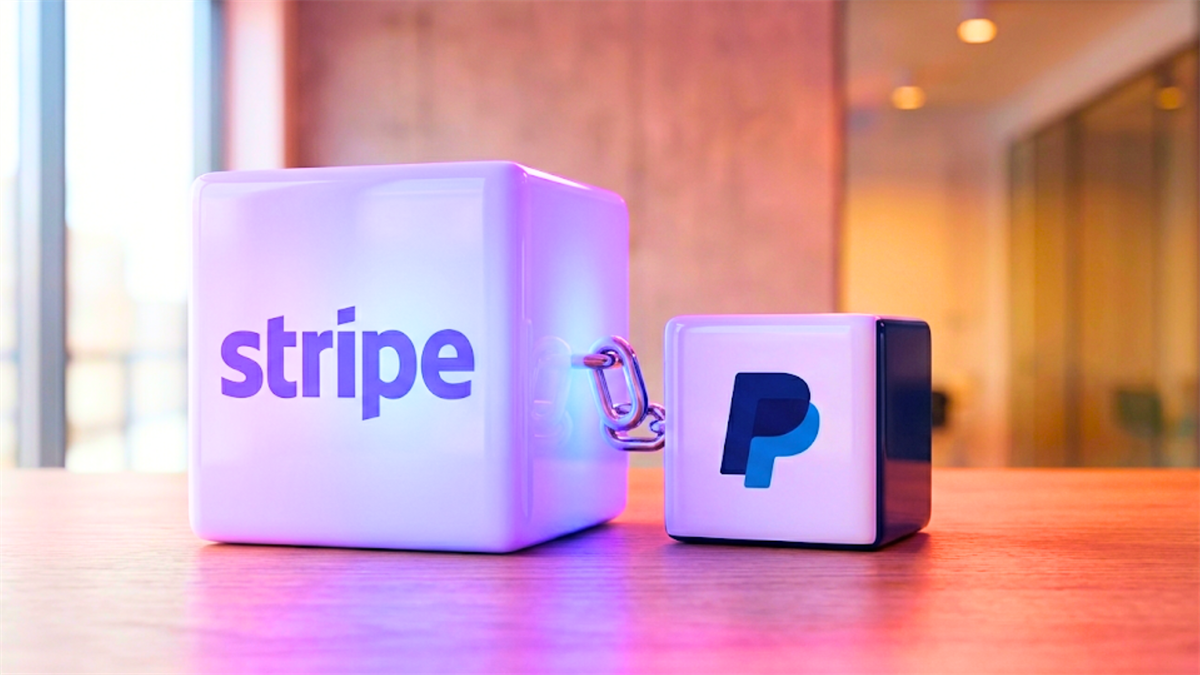
A report that Stripe is in preliminary talks to acquire some or all of PayPal triggered a volatility halt and a fast re-rating in PYPL shares.
The valuation gap between PayPal’s public market cap and Stripe’s private valuation helps explain why investors see meaningful upside in a deal scenario.
The timing—during PayPal’s leadership transition—increases the odds that the board will seriously weigh strategic alternatives, including a transaction.
The end of February shattered the silence surrounding PayPal (NASDAQ: PYPL) stock. For months, investors watched shares drift lower after a disappointing fourth-quarter earnings report and tepid guidance for the year ahead. The narrative painted the fintech pioneer as a value trap destined for slow growth — until a volatility halt froze trading screens across Wall Street.
PayPal stock triggered a Limit Up/Limit Down (LULD) circuit breaker on Feb. 24, 2026, pausing activity as buy orders flooded the market. The catalyst was a Bloomberg report that payments giant Stripe is in preliminary talks to acquire some or all of PayPal. When trading resumed, shares closed up 6.72% at $47.01. Volume spiked to nearly 200% of the daily average, suggesting institutional participation rather than only retail speculation.
This episode represents a material shift in how the market values PayPal. At roughly a $43 billion market capitalization, the company looked priced for no growth. Interest from a major competitor, however, indicates PayPal’s strategic worth may be far higher than the share price implies. The rumor has effectively put a floor under the stock, turning it from a turnaround story into a high-stakes arbitrage opportunity.
Math Problem: $159 Billion vs. $43 Billion
The financial contrast between public- and private-market valuations is stark. Stripe’s most recent funding and secondary-market activity imply a valuation near $159 billion, while PayPal’s public market cap sits around $43 billion. That gap highlights a major disconnect in how fintech assets are being priced.
Stripe: Valued at ~$159 billion. Dominates backend merchant processing but lacks a direct consumer app.
PayPal: Valued at ~$43 billion. Dominates the consumer wallet with 400 million+ active accounts but has struggled with checkout growth.
Combining Stripe’s merchant infrastructure with PayPal’s consumer ecosystem would create an end-to-end payments powerhouse. Smart-money investors look past near-term headwinds in branded checkout growth and focus on PayPal’s massive user base and roughly $6 billion in free cash flow, trading at a price-to-earnings ratio (P/E) near 8.7x. That multiple is bargain-basement territory for a tech company, usually reserved for businesses in terminal decline — not one generating billions in cash.
Consider the data synergy: Stripe knows what merchants sell; PayPal knows who buys. Together, they would close the loop between ad impression and final transaction in a way Alphabet (NASDAQ: GOOGL) and Meta (NASDAQ: META) have pursued for years. That strategic potential helps explain the market’s positive reaction to the rumor.
The Leadership Void: Why Strike Now?
The timing of the rumor is unlikely to be accidental. PayPal is navigating a sensitive leadership transition: incoming CEO Enrique Lores, formerly of HP (NYSE: HPQ), is scheduled to take the reins on March 1, 2026. That interregnum — the period between one regime ending and another beginning — creates a window of vulnerability.
Interim CEO Jamie Miller is competent, but interim leaders are typically limited in making sweeping strategic moves or rebuffing credible buyout approaches without board involvement. An acquirer like Stripe may see an incentive to move before Lores can consolidate a standalone strategy or reorganize the business in ways that would raise the acquisition price.
Investors now face two plausible scenarios for Lores:
The Dealmaker: Lores arrives with a mandate to maximize shareholder value quickly, potentially negotiating a sale or monetizing assets (for example, spinning off Venmo).
The Defender: Lores fights to keep PayPal independent, arguing his turnaround plan will generate more value than any buyout premium.
If Stripe is digging into the books, other industry players likely won’t sit on the sidelines. A takeover signal opens the door to a competitive auction.
Major Banks: Banks have capital but generally lack the consumer-facing tech stack for a seamless wallet. Buying PayPal would provide an instant, plug-and-play consumer relationship, even if integration proves messy.
Private Equity: Financial buyers prize cash flow. A leveraged buyout could allow a PE firm to take PayPal private, restructure away from quarterly scrutiny, and potentially break the company into higher-value parts.
A sum-of-the-parts analysis suggests selling Venmo separately while keeping the core processing business could unlock value well above $47 per share. Venmo’s high engagement and younger user base alone could command a valuation that accounts for a large portion of PayPal’s current market cap.
The Floor Is In: Options Traders Make Their Move
Options market activity reinforces the bullish shift. After the halt, there was aggressive buying of call options for late-February and March expirations, indicating traders are paying a premium for rights to buy stock at higher prices — a bet that momentum will continue or that a deal announcement is imminent. That flow suggests the market expects volatility to resolve to the upside.
Technically, the rumored interest establishes a more concrete support level. Before the news, shares were trading near $38, a price reflecting a worst-case scenario. With M&A on the table, the $38–$40 range now functions as a floor. It is unlikely the stock will revisit those lows while a buyout remains plausible; any dip is likely to attract buyers seeking the spread between the market price and a potential offer.
Regulatory scrutiny is a legitimate risk. The Federal Trade Commission (FTC) would examine a deal of this scale, especially one combining Stripe and PayPal. Still, for traders focused on near-term returns, the announcement of an offer typically drives the stock to near the offer price regardless of eventual antitrust outcomes. Whether the transaction closes months or years later is a separate consideration, but the immediate re-rating creates the trading opportunity.
Asymmetric Upside: The New Rules for PayPal Stock
Tuesday’s events have materially rewritten PayPal’s investment case. The story has shifted from execution and margin recovery to asset realization and strategic consolidation. Downside risk is now cushioned by the company’s cash generation and the knowledge that deep-pocketed suitors are circling.
For investors, the risk/reward looks attractive. A deal would deliver immediate, substantial upside. If no deal materializes, the stock still appears undervalued and will be managed by a new CEO focused on unlocking shareholder value. The market has signaled that PayPal is too cheap to ignore, and the circuit-breaker halt was the alarm that brought attention back to the opportunity.
This message is a paid advertisement for SMX (NASDAQ: SMX) from SmallCaps Daily and Interactive Offers. MarketBeat Media, LLC receives a fixed fee for each subscriber that clicks on a link in this email, totaling up to $27,000. Other than the compensation received for this advertisement sent to subscribers, MarketBeat and its principals are not affiliated with either SmallCaps Daily or Interactive Offers. MarketBeat and its principals do not own any of the stocks mentioned in this email or in the article that this email links to. Neither MarketBeat nor its principals are FINRA-registered broker-dealers or investment advisers. The content of this email should not be taken as advice, an endorsement, or a recommendation from MarketBeat to buy or sell any security. MarketBeat has not evaluated the accuracy of any claims made in this advertisement. MarketBeat recommends that investors do their own independent research and consult with a qualified investment professional before buying or selling any security. Investing is inherently risky. Past-performance is not indicative of future results. Please see the disclaimer regarding SMX (NASDAQ: SMX) on Interactive Offers’ website for additional information about the relationship between Interactive Offers and SMX (NASDAQ: SMX).
If you have questions or concerns about your newsletter, please don’t hesitate to email our U.S. based support team at contact@marketbeat.com.
This Week: Rep. Jim Jordan reacts to Minnesota Gov. Tim Walz’s testimony during this week’s fraud hearing. The Ohio Republican also shares the latest on Iran.
Saturday Report
Rita Cosby
Saturday at 11 a.m. ET — LIVE
This Week: Israeli diplomat Ido Aharoni talks about the latest developments in Iran.
Saturday Agenda
Rob Astorino
Saturday at 1 p.m. ET — LIVE
This Week: Washington Democrat Rep. Adam Smith, ranking member of the House Armed Services Committee, shares the latest on Iran.
War With Iran: Special Report
Saturday at 3 p.m. ET — LIVE Sunday at 2 p.m. ET — LIVE
EXTENDED LIVE COVERAGE: Stay tuned to Newsmax all weekend for in-depth continuing coverage of the war with Iran. We’ll have all the latest breaking news, with expert analysis.
Ed Henry The Big Take Weekly
Saturday at 7 p.m. ET
This Week: Ed Henry gets the take from Alabama Sen. Tommy Tuberville, a key player on the Armed Services Committee. Plus, Alabama Sen. Katie Britt calls out Democrats for refusing to fund Homeland Security.
David Harris Jr. The Pulse Weekly
Saturday at 8 p.m. ET Sunday at 10 p.m. ET
This Week: David Harris Jr. speaks with Texas Rep. Brandon Gill about the Texas primaries. And David speaks with Goldie Ghamari, host of “The Goldie Show,” about Iranians praising President Donald Trump’s military actions.
Wise Guys With John Tabacco
Saturday at 9 p.m. ET Monday at 12 a.m. ET
This Week: After President Donald Trump eliminated Iran’s terrorist leaders, Wise Guys hit the streets to get reactions; Italian Americans as the invisible minority; and NYPD officers pelted with snowballs by disrespectful kids while the mayor shrugs it off. John Tabacco breaks it down with former federal prosecutor Doug Burns, criminal defense attorney Lou Gelormino, Jackie Tobacco, Alexandra Bougher, and New York state Senate candidate Alina Bonsell.
The Right Squad
Saturday at 10 p.m. ET
This Week: The Squad discusses Democrats making fools of themselves; the Clintons’ Epstein depositions; and Gov. Tim Walz’s hearing on Minnesota fraud.
Princes of the Palace
Saturday at 11 p.m. ET
They are the princes of the kingdom — Charles, William, Harry, and young George. Now that Queen Elizabeth is gone, the Royal Family has forever changed. Go behind the palace gates and get an insider’s view of their lives.
King of Cool: The Dean Martin Story
Sunday at 1 a.m. ET
Newsmax Exclusive! Friends called him Dino, but his fans said he was the king of cool. Dean Martin sang, danced, and joked his way to stardom. Find out about the legend behind the martini glass.
Sunday Report
Jon Glasgow
Sunday at 10 a.m. ET — LIVE
This Week: Florida Republican Rep. Cory Mills, who serves on the House Foreign Affairs Committee, discusses the latest on Iran, along with Israeli diplomat and politician Danny Ayalon.
Sunday Agenda
Lidia Curanaj
Sunday at 12 p.m. ET — LIVE
This Week:Texas Republican Rep. Pete Sessions discusses the developments in Iran.
Carl Higbie This Week
Sunday at 7 p.m. ET
This Week: Carl Higbie hits on the developments in Iran, and talks to Texas Attorney General Ken Paxtonabout his upcoming runoff with John Cornyn for the incumbent senator’s seat.
Michael Savage: Savage Nation
Sunday at 8 and 11 p.m. ET
This Week: Michael Savageexplores the combined U.S.-Israeli attack on Iran and the assassination of Ayatollah Ali Khamenei, and compares President Donald Trump’s approach to Gen. George Patton.
Rob Carson’s What in the World?
Sunday at 8:30 p.m. ET
This Week: President Donald Trump’s epic takedown of the ayatollah is met with a hissy fit from Democrats. It’s grilling season, and Minnesota Gov. Tim Walz and state Attorney General Keith Ellison are on the spit. Rep. Jasmine Crockett’s swan song was a turkey in Texas. And Bill and Hillary Clinton’s bizarre and testy Epstein testimony.
Greg Kelly This Week
Sunday at 11:30 p.m. ET
This Week: Texas state Sen. Mayes Middleton joins Greg Kelly to discuss the high-stakes Senate and attorney general races. Plus, the latest on the war in Iran, and how the fake news is trying to spin this as anything less than a win for President Donald Trump.
Tell your cable company you wantNewsmax TV. We’ll connect you immediately to them. Call toll free 877-763-9762.
This email is never sent unsolicited. You have received this Newsmax email because you subscribed to it or someone forwarded it to you. To opt out, see the links below.
Remove your email address from our list or modifyyour profile. We respect your right to privacy. View our policy.
This email was sent by: Newsmax.com 362 N. Haverhill Road West Palm Beach, FL 33415 USA
Managing Editor’s Note: Before we get to today’s AMA, we’ve got a warning from Jeff…
He believes an upcoming Nvidia announcement could trigger a massive culling in the market… potentially sending a number of popular tech stocks into a tailspin.
That’s why Jeff is hosting an event next Thursday to brief people on what’s going on… because if you’re prepared, you could avoid the falling stocks entirely and snag the ones set to benefit from this disruption.
You can sign up with one click right here if you want to attend. We’re kicking things off at 2 p.m. on March 12… just go here to automatically sign up.
The last few weeks have been telling for investor interest in artificial intelligence. About a week ago, OpenAI announced its $110 billion funding round at an incredible $840 billion post-money valuation.
Backing the raise were Amazon for $50 billion, Softbank for $30 billion, and NVIDIA for $30 billion. It was a clean round with just those three giants investing. Amazon (AMZN) and NVIDIA (NVDA) – as customers for its semiconductors and web services – both have a vested interest in OpenAI’s success.
Softbank, however, has been eager to gain even more leverage in artificial intelligence. It famously sold its entire stake in NVIDIA for $5.83 billion last November to raise capital for future investments in AI. But that’s just a fraction of the $30 billion committed to OpenAI.
In the last 24 hours, SoftBank has been looking to raise as much as $40 million in debt to finance its $30 billion investment in OpenAI. It is being referred to as a 12-month bridge loan, which may be subtly suggesting what’s to come.
It would seem to indicate that an OpenAI IPO will happen in the coming months.
Softbank’s investment will have a six-month lockup after the IPO before it can sell shares. So it is possible for Softbank to raise the capital, invest $30 billion, and have liquidity within 12 months after lockup expiration, whereby it could sell all – or a portion – of its shares in OpenAI to pay back the loan.
Some might call that a gamble… Others might call it a brilliant way to make billions in less than a year. Either way, it is a bullish signal for what’s to come.
The OpenAI round followed a smaller $30 billion round at a $380 billion post-money valuation by competitor Anthropic, which found itself in hot water with the U.S. Department of War this week.
The Anthropic round had a long list of investors, 58 in total, that participated. They were big names as well – Accel, Baillie Gifford, Bessemer, BlackRock, Coatue, Fidelity, Founders Fund, General Catalyst, Goldman Sachs, ICONIQ, JPMorgan Chase, Lightspeed, Menlo Ventures, Morgan Stanley, NVIDIA, Sequoia, Temasek, D.E. Shaw, and TPG, among many others.
It was an odd mix of blue-chip venture capital firms invested at a very late stage, and a bunch of private equity and investment banks that tend to step into late-stage rounds as a precursor to an IPO.
Like OpenAI, an IPO feels imminent for Anthropic. These are very sophisticated investors that clearly believe that there is a whole lot of upside ahead.
Private investment rounds like this are illiquid. It’s not trading, it’s an investment. This is a sign of what’s coming.
Have a great weekend,
Jeff
Crypto Trojan Horse?
Hi Jeff,
What are your thoughts on the notion that Bitcoin and, more specifically, recent legislation such as the GENIUS and CLARITY Acts are essentially surveillance tools (precursors to CBDC) and a Trojan horse to weaponize the U.S. debt?
The argument is that the government will create synthetic demand for treasuries through stablecoins and then write off its debt at the expense of stablecoin users. Curious to hear your thoughts. Thanks for everything.
– Shivam S.
Hello Shivam,
I appreciate your question.
It’s important that we’re all thinking in this critical manner after the systematic governmental overreach we experienced during the pandemic, and not just in the U.S., but around the world.
The answer to your question has two perspectives.
It is true that during the 2021–2024 timeframe, the people running the U.S. intended to use central bank digital currency (CBDC) technology as a precursor to asserting even higher levels of government control.
The plan was to put the infrastructure in place and then proliferate digital wallets for everyone to use that could be centrally controlled by the government.
This infrastructure would be a mechanism to push out stimulus in a highly discriminatory manner in line with political ideology and punish those who do not exhibit the desired social behavior.
The plan was truly sinister. The blockchain industry was completely opposed to this plan. And thankfully, it came to a screeching halt in November 2024.
Sadly, plans similar to this persist in Europe and China to the detriment of those countries’ citizens. Most don’t fully understand what is being done, and I’m afraid it will be too late by the time they realize it.
Your point about debt, however, is an interesting topic. Yes, by implementing the GENIUS Act for stablecoins with clear rules around issuance and utilization, it created an entirely new market of U.S. Treasury buyers.
It’s actually brilliant, and something that we in the industry have been pushing for. In creating the regulatory framework that requires stablecoin issuers to maintain stable asset backing of their stablecoins (i.e., mostly U.S. Treasuries), the increase in stablecoin-related purchases of U.S. Treasuries offsets any politically motivated decreases in U.S. Treasury purchases by U.S. adversaries.
The goal, however, is not to pull the rug out from under those who bought U.S. Treasuries to back stablecoins.
We should remember that with clear regulations in place, it isn’t just digital assets companies purchasing U.S. Treasuries, it’s traditional financial institutions that have entered the digital assets space.
Today’s goal is to dramatically grow the digital assets industry in the U.S. and migrate the banking system onto blockchain technology in order to benefit from reduced transaction costs, immutability, transparency, and instant settlement times.
The U.S. now wants to lead the world in this industry and bring investment in the blockchain sector back to the U.S. after watching tens of billions of dollars of investment flee the U.S. markets during 2021–2024.
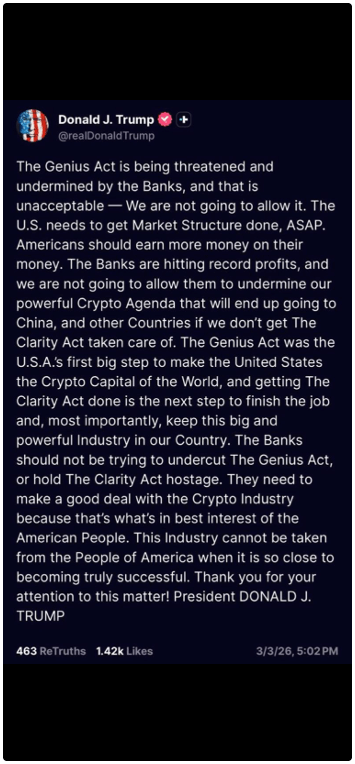
Just a few days ago, the President summed up very well the direction that he wants from the banking industry with respect to blockchain technology and digital assets.
The banks (TradFi) have been playing games for the last three months, which has been very disappointing and counterproductive. The banks have been screwing consumers by pulling in record profits and paying consumers peanuts on their deposits. The whole situation is absurd.
The game is up for traditional finance. The industry has to adapt and compete just like every other industry does.
The level of engagement right now by the industry in D.C. is incredible on CLARITY and related legislation. The work has been monumental. Designing market structure for a new class of financial assets is extremely complex. The work is getting done, and we’ll get the market structure bill passed.
Jeff Brown recommended Nvidia in 2016. But now he believes Nvidia is going to trigger a massive crash on March 16.Hundreds of popular stocks could freefall. ThisThursday, March 12, at 2 p.m. ET he’s revealing:
Why he believes this crash is a sure thing
Which types of stocks are at the highest risk
The names of a bullish pick and a bearish pick
And much, much more.
Plus, he’ll also reveal a solution unlike anything he’s ever revealed before. Click here to register with a single click >>> (When you click the link, your email address will automatically be added to Jeff’s guest list.)
Elon Musk just told his employees to hold Tesla shares “for dear life.” Why? He believes his latest AI breakthrough – one that is helping AI escape from our computer screens and manifest itself here in the real world – “could make Tesla a $25 trillion company.” That’s 8X bigger than Apple today. Click here to see Elon’s $25 trillion little-known plan before it goes mainstream.
The Next Generation of Nuclear?
Jeff Brown, are you tracking any of the companies developing the new Small Nuclear Reactors (SMRs)?
I’d be interested in researching if you have one you currently track?
– Howard D.
Hi Howard,
The simple answer to your question is all of them. I’ve been researching fourth-generation nuclear fission technology and nuclear fusion technology for more than a decade now. I follow every public and private company in the space of any significance and track these companies over the years.
With regards to nuclear fission SMRs, there are a bunch of companies that are making material progress towards commissioning their first reactors.
NuScale Power (SMR) is using a light water reactor design, which is an advanced, modular approach to well-established nuclear energy technology. In a similar category is Last Energy.
As far as true fourth-generation nuclear fission technology, there are a number of companies and approaches that are working quickly towards commissioning.
In the molten salt reactor category, we have Natura Resources, Valar Atomics, and Terrestrial Energy. For sodium-cooled reactors, we have Aalo Atomics and TerraPower. And there’s Oklo (OKLO) with its fast neutron microreactor and Radiant Industries with its heat pipe-cooled microreactor.
If I didn’t list a ticker, it means that the company is still private. Also, by listing these companies, it doesn’t mean that I am recommending them. This is a notoriously volatile sector that requires massive capital expenditures, with product revenues typically years into the future.
These are all exciting projects, however. We’ve never had the kind of pro-nuclear regulatory environment that exists today.
The technology is ready. And there is a clear need to increase energy production, preferably clean energy production, as quickly as possible to meet the increased energy demands from AI data center infrastructure.
The single most important input to accelerated economic growth is energy. Which is exactly why we track developments in energy technology so closely.
I use Grok, so can you elaborate about the “insane” comment?
Thank you for your constant stream of knowledge. Very much appreciated.
– Thomas W.
Hello Thomas,
Something very special is happening at xAI right now with respect to Grok. No other company has scaled so quickly and efficiently to build out its AI data center infrastructure.
xAI’s extraordinary progress is the result of three distinct reasons:
Scaling faster than any other frontier AI model company: xAI was the first to scale up to 1 gigawatt (GW) of compute in a single training cluster in the industry this January. xAI will be at 1.5 GW by next month (April) and operating 1 million GPUs in a training cluster by summer.
The most advanced software architecture. I’ll provide more context below.
A fanatic approach to truth and evidence-based training of the AI model. The fact is that training an AI model with mistruths, biases, and ideology results in lower-performing models at best and catastrophic errors at worst.
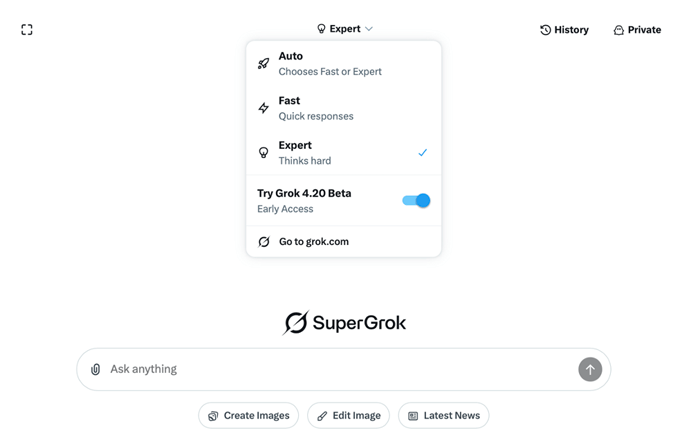
Since you use Grok, if you’d like to experiment with Grok 4.2 now, you have to toggle the switch as shown below to access the “Grok 4.20 Beta.”
Source: xAI
What’s unique about Grok 4.2 is that xAI developed an architecture that employs the use of four distinct AI agents that collaborate to respond to queries. Each agent has a different skillset and responsibility:
Grok – responsible for coordinating the research and providing the final answer
Harper – responsible for the deep research and verification of information
Benjamin – responsible for topics related to mathematics, software code, and logic
Lucas – responsible for creative thinking
Four agents with different skills and responsibilities work together, check and critique each other’s work, and produce an optimal output. It’s like having four of the most advanced AIs working in collaboration together without any bias to produce the best answer.
And for more complex queries, users can invoke the Heavy Mode, which leverages 12 more specialist agents – 16 agents in total – to solve problems. These are highly specialized. For example, one agent is a specialist in quantum chemistry, another in legal reasoning, or another in geopolitical scenario modeling.
Naturally, the more agents “working” for you, the more computational resources are required. And the more complex the problem, the same is true.
What has been proven already is that this multi-agent software architecture produces superior results compared to a single reasoning model approach. Perhaps ironically, this is also how highly performant teams of humans produce great results as well.
Also worth noting is how xAI is in a constant state of improvement with its models. It takes feedback, iterates daily, and employs updates in Grok every week. It doesn’t wait six months for its next major release of Grok. We can see it happening in real time.
Musk has publicly said that Grok 4.2 will improve by an order of magnitude from its first beta release to the formal release later this month. An order of magnitude! Absolutely insane (there’s that word again).
In short, xAI is on an accelerated path towards AGI.
To ensure our emails continue reaching your inbox, please add our email address to your address book.
This editorial email containing advertisements was sent to pahovis@aol.com because you subscribed to this service. To stop receiving these emails, click here.
Brownstone Research welcomes your feedback and questions. But please note: The law prohibits us from giving personalized advice.
To contact Customer Service, call toll free Domestic/International: 1-888-512-0726, Mon-Fri, 9am-7pm ET, or email us here.













 RJ Hamster