What analysts are saying, who’s running it, what’s actually innovative, and how earnings expectations are shifting into 2026
Vertiv isn’t just “picks and shovels” for AI. It’s closer to a scheduler – not in software, but in physics. The rack roadmap is being set by power delivery, heat removal, and how fast you can commission a site without embarrassing outages. When those constraints loosen, AI capacity shows up. When they don’t, it doesn’t. Vertiv sits right on that choke point.
That’s why the stock doesn’t trade like a normal industrial supplier anymore. It’s trading like a company that sells time – shorter build timelines, fewer do-overs, faster “ready for load.” And yes, that’s a little squishy. But it’s also how budgets actually get approved in this cycle.
Vertiv in one sentence: it’s the “physical layer” vendor that keeps AI data centers upright – power delivery, thermal management (increasingly liquid), modular deployments, and a growing services/software layer – and the market is pricing it like that’s a multi-year constraint, not a one-year capex cycle.
Also: this is one of those names where the narrative can outrun execution. The part people skip is lead times, commissioning, and whether backlog turns into shipped product on schedule (and on margin). Management is basically telling you: we’re expanding capacity as fast as we responsibly can, because customers are trying to compress timelines.
Banking. Cars. Rockets. The Internet itself. Each time, the same pattern: Elon targets an industry the world says can’t be disrupted, the experts call him crazy, the short sellers pile in… and then he does it. Now he’s preparing for his biggest takeover yet.
Vertiv sells the infrastructure around compute: UPS and power management, switchgear/busbar, thermal (CRAC/CRAH and now liquid cooling), racks/integrated systems, plus monitoring and lifecycle services.
In a “normal” cloud cycle that’s already important. In an AI cycle, it becomes existential because power density and heat flux are the limiting factors. The data hall doesn’t care about your TAM slide – it cares about watts, coolant flow, redundancy, and whether the thing can be maintained without drama.
The company’s own framing (and you can feel the product strategy behind it) is shifting from “components” to system-level architecture – treating the data center as a single unit where power + cooling + compute are designed together. That’s not just marketing; it’s how you sell larger contracts and lock in services.
Small tangent, but it matters: the “manufacturing/logistics/operational excellence” seat being prominent is basically the tell. This cycle is not won by who has the fanciest slide deck – it’s who can actually build, ship, commission, and service the stuff while everyone is fighting for the same skilled labor and components.
What analysts are saying (the tone, not just the rating)
Most “Street” commentary right now clusters around a few recurring points:
Demand visibility looks unusually high for an industrial-ish company – highlighted by the step-change in backlog and order strength exiting 2025.
Margins are expanding with volume(operational leverage) while management is also calling out tariff impacts and mitigation.
Capacity expansion becomes the swing factor: capex stepping up as they try to convert backlog to revenue.
Valuation is the pushback: the more bullish the “AI infrastructure bottleneck” framing gets, the more the stock trades like a momentum compounder, not a cyclical equipment supplier.
Concrete example of the “tone shift” post-print: Morgan Stanley raised its price target to $350(from $285) and kept an Overweight rating on April 23, 2026.
One thing to watch: public “consensus” pages can disagree (number of analysts, average target, etc.). Treat them as directionally useful, not source-of-truth. Different data providers can show different snapshots depending on feed timing and included brokerages.
What Vertiv is doing that’s actually “innovative” (not just incremental)
Vertiv’s innovation story is less “a single breakthrough product” and more a stacking of capabilities that lets them sell higher-density deployments, faster deployments, and more services over time.
Liquid cooling: moving from niche to default for AI racks.
Vertiv has been building out liquid cooling in two ways: technology (CDUs/manifolds/secondary fluid networks) and the ugly-but-essential services layer (commissioning, fluid quality, lifecycle maintenance). It has also used acquisitions to broaden both product and services capabilities in liquid cooling.
Digital twins + “unit of compute” thinking:treating the facility as an integrated machine.
Vertiv has been leaning into designing/operating the site as a single system, and has highlighted digital twins as a way to simulate, monitor, and optimize performance across the lifecycle (before and after build). This is one of those ideas that sounds like buzzwords until you realize it can reduce rework and shorten commissioning.
Energy autonomy themes: the power constraint is real, so the solution set is widening.
Power availability is turning into a gating factor. Vertiv’s framing is that operators are increasingly forced toward hybrid on-site generation + storage + microgrid-like approaches as a bridge while grid capacity catches up. That’s not a near-term revenue line item on its own, but it shapes what products/services win the next wave of projects.
Earnings: what happened, and what changed for 2026
Q4 2025 (reported Feb 11, 2026):
Net sales: $2.88B (+23% YoY; 19% organic).
Organic orders: +252% YoY; book-to-bill about 2.9x.
Backlog: $15.0B (up 109% YoY).
Adjusted diluted EPS: $1.36 (+37% YoY).
Initial FY 2026 outlook at the time: net sales $13.25B–$13.75B; adjusted diluted EPS $5.97–$6.07.
Q2 2026 guide: net sales $3.25B–$3.45B; adjusted diluted EPS $1.37–$1.43.
That guidance raise is the real event. Not the beat, not the margin line. It’s management saying: “the ramp is here and we’re leaning into it.”
Future estimates: what to track (and what can break the model)
Near-term numbers matter, but the “real” forecast inputs for Vertiv in 2026–2027 are more about mechanics:
Backlog conversion cadence: AI projects can be lumpy; a quarter with monster orders can be followed by one that looks “slow” just because of timing.
Capacity expansion and capex: 2026 capex is expected to step up as they add manufacturing/technology capacity to ship into demand.
Mix shift to liquid + services: if liquid cooling penetration accelerates, it’s not just incremental revenue – it can reshape attach rates, commissioning services, and longer-duration maintenance work (which tends to be stickier).
Tariffs / supply chain / project delays: margins can get choppy if the company eats cost to keep timelines, or if timing slippage changes quarterly mix.
If you want a single anchor point for “future estimates” right now, start with the company’s updated FY 2026 guide: adjusted EPS $6.30–$6.40 and net sales $13.5B–$14.0B. Everything else is basically the market arguing about 2027 operating leverage and how long the AI buildout stays “too fast.”
Apr 23, 2026: Morgan Stanley raised its price target (Overweight maintained) after the Q1 update.
Feb 11, 2026: Q4 2025 results highlighted massive order growth and a sharp step-up in backlog, setting the tone for 2026.
Dec 2025: completion of the PurgeRite acquisition (about $1B) to expand liquid cooling services for high-density compute.
One more industry context point: the “AI data center” buildout is pushing toward bigger, more power-dense designs, which is accelerating the shift toward liquid cooling, modular deployment, and more sophisticated monitoring/predictive maintenance.
My takeaway (and the two risks I’d respect)
The bull case is straightforward: Vertiv is positioned where AI capex has to go no matter who “wins” the model war – because the chips still need power and they still generate heat. Backlog + guidance raises imply the demand is not theoretical; it’s booked and being delivered.
Risk #1: timing games. If big projects slip, quarterly optics can get weird fast, even if the multi-year story is intact.
Risk #2: execution under compression. When customers demand “faster deployment, greater reliability, comprehensive services,” that sounds great… right up until it becomes warranty expense, expedite costs, or margin give-backs to keep schedules. Management is aware of it, but the tape doesn’t always wait.
– Stock Report
This content is for informational purposes only and should not be considered financial advice. Investing involves risk.
Stock Report is a publication of Investing Media Solutions, LLC.
Good morning! It’s Thursday. Here are today’s top stories:
A day after Virginians voted to redraw Congressional maps to favor Democrats, a state judge nullified the results. The judge ruled that the referendum, which bypassed a bipartisan redistricting commission, was unconstitutional. Virginia Attorney General Jay Jones vowed an immediate appeal.
Secretary of the Navy John Phelan is leaving the administration, the Pentagon said, without providing a reason for the departure. Under Secretary of the Navy Hung Cao will serve as acting secretary.
Who actually benefits from government subsidies for health care? Nearly all U.S. health care is government-subsidized through direct payments, assistance with premium payments, tax deductions, or tax exemptions. Our senior reporter, Lawrence Wilson, explains how taxpayers cover the cost of health care and breaks down who benefits from it.
▶️ Exclusive interview with Fidel Castro’s daughter, Alina Fernández. Fernández watched Cuba spiral into communism and suffering under her father’s tyrannical rule. After fleeing to Miami more than three decades ago, she’s been an outspoken critic of the regime.
🍵 Health: Generosity Isn’t About Kindness—It’s About Attention. The trait appears to be a skill that the brain can strengthen, not just a fixed characteristic.
A voter at a polling site during the redistricting referendum in Alexandria, Va., on April 21, 2026. (Madalina Kilroy/The Epoch Times)
A Virginia judge ruled on April 22 that the state’s redistricting referendum approved by voters a day earlier was invalid, nullifying the election results. Virginia Attorney General Jay Jones said he would immediately file an appeal.
“Virginia voters have spoken, and an activist judge should not have veto power over the People’s vote,” Jones said in an X post.
Tazewell Circuit Court Judge Jack Hurley entered an injunction blocking certification of the election.
Former Virginia Attorney General Ken Cuccinelli said the legal fight was just beginning after language used in the ballot question raised a lot of interest among the opposition.
The question voters faced was the following: “Should the Constitution of Virginia be amended to allow the General Assembly to temporarily adopt new congressional districts to restore fairness in the upcoming elections, while ensuring Virginia’s standard redistricting process resumes for all future redistricting after the 2030 census?”
Cuccinelli expects the case to move quickly through the appeals process.
“The ‘yes’ folks probably are going to look back at Tuesday and think that was the easy part because they have so badly violated several constitutional provisions,” Cuccinelli told “The Scott Jennings Show.”
The referendum faces three legal challenges in addition to the one decided on April 22.
Three of the lawsuits challenge the referendum on procedural grounds, arguing that Democratic Party lawmakers didn’t follow the law regarding timing requirements and legislative steps when passing the measure to place it on the ballot.
The fourth argument is about how the electoral districts were drawn and challenges the maps on contiguity requirements.
Tens of millions of dollars were spent to pass the redistricting referendum as Democrats across the nation continue their quest to redraw congressional seats in favor of taking back the U.S. House.
Voters approved the new map by a thin margin—51.5 percent to 48.5 percent—making Virginia the latest state to gerrymander its congressional seats in favor of Democrats. The map is intended to give the Democratic Party 10 out of the 11 congressional seats in the state, a drastic shift from the current map, in which Republicans hold five districts. (More)
IRAN WAR
Iranian forces fired on three ships in the Strait of Hormuz. It seized two of them and escorted the vessels to Iranian shores, marking the first time Iran has seized ships since the start of the war. The White House said the seizures were not a violation of the ceasefire.
An Iranian regime spokesman said that the regime still has not decided on whether it would enter talks with the United States. This came hours after Trump extended the ceasefire indefinitely pending a “unified proposal” from Iran.
Trump said the Iranian regime agreed to no longer execute eight Iranian women. The Iranian judiciary disputed that any of them were on the verge of execution.
Trump has raised new concerns about Beijing’s possible role in supporting Tehran, pointing to a recently intercepted vessel he described as maybe carrying a “gift from China.”
POLITICS
Trump is dissatisfied with the Mexican government’s response to the deaths of two CIA agents in Mexico, the White House said. The comments came as Mexican President Claudia Sheinbaum said that no U.S. officials may operate in the country without the government’s approval.
Trump criticized recent Supreme Court decisions and accused some of the justices he nominated of misrepresenting themselves during the confirmation process.
The president’s recent executive order fast-tracks the review of psychedelic drugs, including ibogaine, for mental health treatments. Here’s more on what the order did and how it’s been received.
Health and Human Services Secretary Robert F. Kennedy Jr. told senators that glyphosate, a key ingredient in herbicides like Roundup, causes cancer and that human consumption of the chemical should be minimized.
LATEST NEWS
The Department of Justice said it has settled a lawsuit filed by former Trump campaign adviser Carter Page over alleged surveillance abuses.
Seven U.S. Marines who manned a checkpoint in the face of an impending suicide bombing during the 2021 civilian evacuation from Afghanistan have had their valor awards upgraded.
A Chinese college student has been arrested after federal authorities discovered that he had illegally photographed U.S. military planes near Offutt Air Force Base in Nebraska.
A federal appeals court permanently blocked California from enforcing a new law requiring federal immigration officers to display ID when on duty in the state, ruling that it was unconstitutional.
The Southern Poverty Law Center faces federal fraud charges over an alleged scheme to defraud donors to fund informants in extremist groups. Here’s what prosecutors allege in the 11-count indictment.
CORRECTION: In the April 18 “Morning Brief,” we incorrectly stated the location of the Army’s Infantry Week. It was held in Fort Benning, Georgia. The Epoch Times regrets the error.
ADVERTISER’S NOTE:
Defending Education has identified 1,216 school districts nationwide with transgender policies affecting over 12 MILLION students.
The policies allow school staff to keep a student’s transgender status hidden from parents.
We are polling Epoch Times readers.
OFFICIAL POLL: Should local schools be allowed to enforce transgender bathroom policies that violate Title IX?
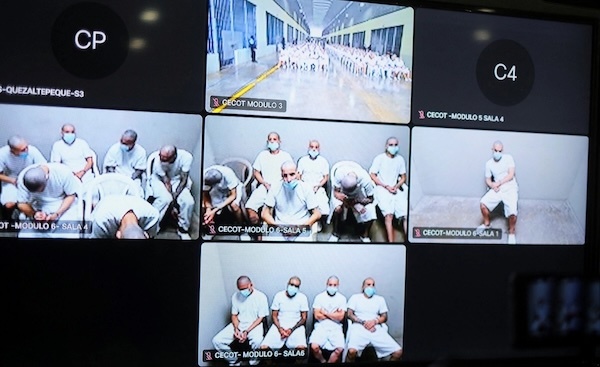
Defendants on video links as they attend the trial of 486 alleged members of the Mara Salvatrucha (MS-13) gang, accused of more than 47,000 crimes committed between 2012 and 2022, at the Judicial Center Against Organized Crime in Soyapango, El Salvador, on April 21, 2026. (Jose Cabezas/Reuters)
WORLD
A mass trial of 486 alleged members of El Salvador’s most notorious gang, the Mara Salvatrucha or MS-13, is underway in the Salvadoran capital, San Salvador. It’s the biggest trial since Salvadoran President Nayib Bukele enacted emergency powers to take on the country’s organized crime groups.
Anyone born in 2009 or later will not be able to legally buy cigarettes in the UK after lawmakers approved new legislation on smoking. The effect is that people born on or after Jan. 1, 2009, face a lifetime ban.
Trump said that the United States was considering a currency swap with the United Arab Emirates to help the Gulf state financially.
Chinese state-run media outlets have recently pushed dramatic spy-catching stories into the public spotlight, including repeatedly amplifying a single, loosely detailed case across multiple platforms. Critics say the report bears signs of fabrication.
OPINION
It’s Time for Spring Cleaning—by Jeffrey A. Tucker (Read)
The Final Battle for Your Mind—by Casey Fleming (Read)
Why We Were Never Meant to Do This Alone—by Mollie Engelhart (Read)
Anthropic’s Most Dangerous Achievement—by Mike Fredenburg (Read)
A duck and her ducklings stroll through a fountain in Rome on April 22, 2026. (Tiziana Fabi/AFP via Getty Images)
📸 Day in Photos: Teotihuacan Reopens, Illegal Sand Quarries, and Youth Detention Center (Look)
🤝 Relationships: Why Being Ghosted Hurts More Than Rejection and Is Harder to Move on From (Read)
💸 Money: Take the 52-Week Money Challenge and Save (Read)
🎵 Music: Mozart’s Piano Trio (Divertimento) In B Flat (Listen)
📚(Sponsored) Defending Educationhas identified 1,216 school districts nationwide with transgender policies affecting over 12 MILLION students. POLL: Should local schools be allowed to enforce transgender bathroom policies that violate Title IX? Vote Now >>
MUSIC
The American premiere of Mahler’s “Symphony No. 8” with the Philadelphia Orchestra conducted by Leopold Stokowski, 1916.
Gustav Mahler’s life swung between opposites: composer and conductor, Jew and Catholic, nature-lover and urbanite. One dichotomy characterized his entire composing career: symphony and song.
Song came first. Born to a large, lower-class family in Bohemia (now the Czech Republic) on July 7, 1860, Mahler wasn’t the child prodigy typical of classical music mythology. Neither a virtuoso pianist nor a composing wunderkind, Mahler tried his composing hand at age 16 with a rather perfunctory Piano Quartet that’s rarely played today. Chamber music wasn’t his strength.
He then switched emphasis to vocal music with “Das Klagende Lied” (“Song of Lamentation”) for vocal soloists, choir, and two orchestras—one onstage and one off, written between 1878 and 1880. The work presages his mammoth symphonies of later years. Then came a raft of lieder, or art songs: three lieder in 1880, a collection of five songs called “Lieder und Gesänge, Vol. I,” written 1880 to 1883, and four “Songs of a Wayfarer,” 1884–1885. All of this was, in a way, a prelude to what was coming.
Sometime in late 1887, Mahler embarked on composing his Symphony No. 1. Its instrumentation was like no other symphonic works of the time. The typical Beethoven-era orchestration consisted of woodwinds in pairs, four horns, two or three trumpets, sometimes trombones, two or three timpani played by one person, and maybe a pair of cymbals.
Contrast this with Mahler’s orchestra: four flutes, oboes, and clarinets, with numerous doublings; three bassoons, the third doubling contrabassoon; seven horns; five trumpets; four trombones; one tuba; six timpani played by two different timpanists; bass drum, cymbals, triangle; and tam-tam; harp; and the usual bowed strings—first and second violins, violas, cellos, and double basses. (More)
🎲 Games
Spot the Difference is our readers’ favorite. Play it here.
Our mailing address is: The Epoch Times, 129 West 29th Street, Fl 8, New York, NY 10001 | Contact Us
Our Morning Brief newsletter is one of the best ways to catch up with the news. Manage your email preferences here or unsubscribe from Morning Brief here.
From space systems to cybersecurity and advanced weapons, defense innovation is accelerating. These 3 stocks are tied to critical technologies shaping the future of global security.
The movement of basic materials stocks requires investors to keep a keen eye on the state of the economy to determine profitability. Raw materials such as plastic, steel, and lumber will always be in demand. Here are 7 stocks to take advantage of the growing demand!
TEHRAN, Iran (AP) — Iran, the United States and Israel reached a tentative, two-week ceasefire Wednesday in that tore across the Middle East and disrupted the global energy market, with U.S. President Donald Trump pulling back from his threats to destroy Iranian “civilization.” Continue Reading ➔
Information, charts, or examples contained in this email are for illustration and educational purposes only and not for individualized investment management. This message contains commercial elements, such as advertising and partner offers for which we may receive affiliate compensation. We only send these offers to those who have opted into our newsletter.
If you wish to no longer receive these offers, click on the unsubscribe link at the bottom of this email. Past performance is not indicative of future results. For these reasons, we strongly suggest trading in a DEMO/Simulated account.
The information provided by us is for educational and informational purposes only. We make no representations or warranties concerning the products, practices, or procedures of any company or entity mentioned or recommended in this email and have not determined if the statements and opinions of the advertiser are accurate, correct, or truthful.
If you use, act upon, or make decisions in reliance on information contained in this email or any external source linked within it, you do so at your own peril and agree to hold us, our officers, directors, shareholders, affiliates, and agents without fault.
2967 Dundas St. W. #990, Toronto, ON M6P 1Z2 | Phone Number: 917.672.7040
Big Bank Earnings Gave Financials a Lift, But Wall Street Is Still Cautious
Written by Jessica Mitacek on April 22, 2026
Key Points
Goldman Sachs, Wells Fargo, Citigroup, and JPMorgan all posted Q1 2026 earnings beats, signaling potential undervaluation across major financial stocks.
The financials sector has shed nearly 4% year-to-date in 2026 but has rebounded more than 7% over the past month amid strong bank earnings.
Analysts remain cautious despite the earnings beats, with mostly conservative price targets and low expectations for Federal Reserve rate cuts ahead.
Following a strong 2025 that saw it finish third in the index, the group has been the worst performer among the S&P 500’s 11 sectors so far in 2026, having posted a year-to-date (YTD) loss of nearly 4% (as measured by theFinancial Select Sector SPDR Fund (NYSEARCA: XLF)).
But over the past month, financials have appeared to turn a corner after posting a gain of over 7%.
That momentum can, in part, be attributed to the lead-up to big banks’ earnings week, which kicked off on April 13 when Goldman Sachs (NYSE: GS) reported first-quarter results. For investors who have been monitoring the sector with an eye on a potential bounce, here’s what we have learned from the premier financial institutions.
Because my research has led me to believe we’re risking World War 3 with Iran for a completely different reason.Click here to find out what it is.
Goldman Sachs: Earnings Growth Hints at Undervalued Shares
Goldman Sach’s Q1 2026 results may be enough to finally help the 157-year-old investment bank break even for the year.
That would build upon recent momentum that has seen shares of GS gain more than 16% from their YTD low on March 13 as they rallied into last week’s earnings release.
The firm reported earnings per share (EPS) of $17.55, beating analyst expectations of $15.92, and revenue of $17.23 billion, beating analyst expectations of $16.66 billion.
While both figures were welcomed by shareholders, the revenue beat stood out as it showed a 14.4% year-over-year (YOY) increase.
The earnings beat marked the bank’s 11th consecutive quarter of exceeding estimates, with CEO David Solomon noting in his earnings call comments that EPS, revenue, and net income all were the second highest in the company’s history.
Notably, Goldman Sachs’ Global Banking & Markets segment and its Asset & Wealth Management segment reached record revenues and record assets under management, respectively.
Solomon did note near-term headwinds, though, including geopolitical unrest and a lack of clarity about how higher energy prices could impact growth. But the CEO said that the bank “is extremely well-positioned to navigate this current environment.”
Goldman Sachs’ earnings are forecast to grow nearly 11% over the next year, from $47.12 per share to $52.07 per share. The stock is looking increasingly undervalued given its current and projected earnings growth.
Big Banks Mirror Goldman’s Lead, Post Notable Earnings Beats
While only Wells Fargo missed on revenue, the bank saw top-line growth of 6.4% YOY, with revenue for JPMorgan and Citigroupposting YOY increases of 10% and 14.1%, respectively.
For each firm, the earnings beat marked the ninth consecutive quarter of EPS exceeding analyst expectations. But more importantly—as with Goldman Sachs—the Q1 beats are evidence of undervaluation, especially when those earnings are juxtaposed alongside each stock’s P/E multiple and forecasted earnings growth over the next year:
Wells Fargo: P/E 14.67, expected EPS growth of 16.64%
Citigroup: P/E 17.26, expected EPS growth of 25.5%
JPMorgan: P/E 17.31, expected EPS growth of 7.29%
Citigroup looks particularly undervalued after four of its five core businesses delivered double-digit revenue growth, and management sent investors a bullish signal after repurchasing $6.3 billion worth of shares in Q1 as part of a $20 billion buyback plan.
But like Solomon, Citigroup’s CEO Jane Fraser acknowledged that the Iran war’s fallout presents a situation wherein “inflation is now a greater risk to growth and will likely cause central banks to lean towards more restrictive monetary policies.”
Despite the earnings beats, analysts are showing tepid enthusiasm for those four bank stocks with mostly conservative price targets. Wells Fargo and Citigroup both carry consensus Moderate Buy ratings, but only the former carries an average 12-month price target that suggests a double-digit gain from current prices.
Expectations for additional rate cuts from the Federal Reserve are low, meaning banks will be able to continue improving their net interest margins as rates remain steady. Consumer spending remains strong, as cited in numerous banks’ earnings call comments. If the week concludes with a clean sweep of earnings beats, it very well could be the catalyst that financials need to change the narrative for the remainder of 2026.
Thank you for subscribing to DividendStocks.com’s daily newsletter for dividend and income investors that covers ex-dividend stocks, new dividend declarations, dividend stock ideas, and the latest market news.
If you have questions about your subscription, don’t hesitate to email our U.S. based support team at contact@marketbeat.com.
If you no longer wish to receive email from DividendStocks.com, you can unsubscribe.
Louis Navellier Senior Quantitative Investment Analyst, InvestorPlace
P.S. Elon Musk just powered his Grok AI model with his new Colossus computer. It’s far and away the most powerful data center built to date. And it will help Elon win the chatbot race, hands down. That means SpaceX could be a great stock once it IPOs. But the stock I reveal in my new presentation could make you even more money in 2026. Go here for details – including the ticker symbol – for free.
This ad is sent on behalf of InvestorPlace Media at 1125 N. Charles Street, Baltimore, Maryland 21201. If you’re not interested in this opportunity, please click here .Stockguru LLC (dba InvestingDistrict), 2563 cherry hill ln, Hermitage, PA 16148, United StatesYou may unsubscribe or change your contact details at any time.
Karim Rahemtulla, co-founder of Monument Traders Alliance, was 17 years old.
In 2026, as we watch the Iranian regime crumble under the weight of its own failures…
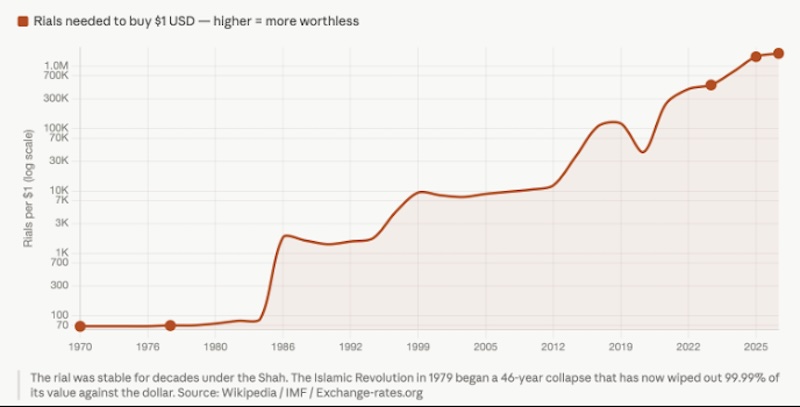
$1 can now buy 1.6 million rial.
That’s a 99.99% collapse in purchasing power over 46 years. And it’s driving 90 million Iranians to hoard gold at levels the world has never seen before.
Most investors are watching this from the sidelines and buying gold at all-time highs.
Karim is doing something completely different.
Something that he uses during chaotic markets that he has a 95.2% win rate with. And on April 29 at 2 p.m. ET he’s going to reveal this strategy and the six stocks he’s using it on right now.
This is a free live event. And this is the best setup Karim has seen in 46 years of trading.
You are receiving this email because you subscribed to Trade of the Day Wake-Up Watchlist. Trade of the Day Wake-Up Watchlist is published by Monument Traders Alliance, LLC.
To stop receiving special invitations and offers from Trade of the Day Wake-Up Watchlist, please click here. Please note: This will not impact the fulfillment of your subscription in any way.
Please do not reply to this email as it goes to an unmonitored inbox.
Nothing published by Monument Traders Alliance should be considered personalized investment advice. Although our employees may answer your general customer service questions, they are not licensed under securities laws to address your particular investment situation. No communication by our employees to you should be deemed personalized investment advice. We allow the editors of our publications to recommend securities that they own themselves. However, our policy prohibits editors from exiting a personal trade while the recommendation to subscribers is open. In no circumstance may an editor sell a security before subscribers have a fair opportunity to exit. The length of time an editor must wait after subscribers have been advised to exit a play depends on the type of publication. All other employees and agents must wait 24 hours after publication before trading on a recommendation.
Any investments recommended by Monument Traders Alliance should be made only after consulting with your investment advisor and only after reviewing the prospectus or financial statements of the company.
Protected by copyright laws of the United States and international treaties. The information found on this website may only be used pursuant to the membership or subscription agreement and any reproduction, copying or redistribution (electronic or otherwise, including on the world wide web), in whole or in part, is strictly prohibited without the express written permission of Monument Traders Alliance, LLC, 14 West Mount Vernon Place, Baltimore, MD 21201.

 News for you, Peter“Leaving Neverland” director says Michael Jackson was ‘worse than Jeffrey Epstein,’ fans…“How can you tell an authentic story about Michael Jackson without ever mentioning the fact that he was seriously acc…Entertainment Weekly ‘Looksmaxxing’ Influencer Clavicular’s YouTube Channels Removed, 6 Months After His Original Channel W…The influencer has faced growing scrutiny over his content and online behaviorPeople The Iran war is pushing Southeast Asia to debate the once unthinkable: Whether ships will need to pay …Indonesia’s finance minister has floated the idea. Singapore and Malaysia are pushing back. Thailand sees an opport…Fortune Nike announces roughly 1,400 layoffs in latest round of cutsNike announces layoffs of roughly 1,400 employees in its Global Operations team, primarily affecting its technology divisi…Fox Business Apple gets a stunning boost as smartphone rivals stumbleApple’s (AAPL) most recent victory in China is worth more than simply bragging rights about smartphones, CNBC reported. Ne…TheStreet Ex-Michigan staffer Paige Shiver says coaches knew of her relationship with fired head coach Sherrone …Shiver said that she became pregnant in 2022 but had an abortion because of her Pompe Disease and that Moore knew of her d…Yahoo Sports At Beijing auto show, Chinese carmakers flaunt new technologies as global competition heats upChina’s top automakers are showcasing their latest models and technologies from intelligent driving to ultrafast ch…Associated Press New movies to watch this weekend: See ‘Michael’ in theaters, rent ‘Tow,’ stream ‘Apex’ on NetflixIs the Michael Jackson biopic any good? Jaafar Jackson deserves praise — but reviews are brutal.Yahoo Entertainment “They are not in the mood to pay $17 million” – Brian Windhorst shares why Steve Kerr…Brian Windhorst points to financial considerations and organizational direction as key factors.Basketball Network The Strait of Hormuz chaos is just a ‘dry run’ for if war breaks out between the U.S. an…Vivian Balakrishnan said Singapore has a unique balancing act between prioritizing its own needs and maintaining close tie…Fortune More like this
 Today’s gamePlay Crushable by Candy CrushPlay, match, and spark chain reactions!
 Trending now1. NFL Draft2. Donald Trump3. Mall of Louisiana Shooting4. Rex Heuermann5. Georgia Wildfires6. Fernando Mendoza7. Knicks Game8. Elizabeth Smart9. Nikki Glaser10. Atlanta Braves














 Unlock powerful investment insights and strategies designed to accelerate your portfolio’s growth.