Behind Karman’s 14% Plunge: 47% Revenue Growth Shines

Earnings360

Unsubscribe

Ticker Revealed: Pre-IPO Access to “Next Elon Musk” Company (From Banyan Hill Publishing)


Karman Tanks 14%: Opportunity or Warning for This Defense Darling

Written by Leo Miller on March 27, 2026 

Karman Space & Defense logo on glass with blurred engineers behind, highlighting aerospace defense growth industry.

Key Points

  • Defense stock Karman took the market by storm in 2025, with the company growing to a market capitalization of above $10 billion.
  • After a 14% post-earnings drop, is there a clear road to recovery ahead?
  • A long-term continuation of defense spending increases underpins the stock’s valuation.
  • Special Report: The warnings are getting louder (From Porter & Company)

In 2025, Karman (NYSE: KRMN) was among the hottest stocks in the market. Shares ended the year near $73, rising more than 300% from their IPO price of $22. The new year has been more of a mixed bag. The stock remains up more than 15% in 2026; however, it is down around 25% from its all-time high, reached in January.

The reaction after Karman’s latest earnings report exacerbated this fall, with shares tanking nearly 14% in one day.

Karman is a supplier of mission-critical components for rapidly growing defense technologies. The company’s revenue growth in 2025 was among the highest in its industry. The firm also sported impressive margins.

Amid this backdrop, is there an opportunity in shares of Karman? Let’s dive into the firm’s latest report to assess this question.

Inside the $7 trillion computium race (Ad)

The $7 Trillion Race for America’s Critical New Resource Moody’s calls it “the new oil.” Fox News calls it the “new arms race.” Elon Musk calls it “mind-blowing.” Demand is already doubling every 6 months. And on April 20, a major global event could ignite a handful of under-the-radar stocks, setting off what could be the biggest resource boom in history.Click here now for the full story

Karman Posts Top-End Growth with Strength Across Segments

In its fiscal Q4 2025, Karman posted revenue of $134.5 million, or a growth rate of just over 47%. This figure moderately surpassed estimates. For the full year, revenue grew by almost 37% to $471.5 million. Within a group of over 20 U.S. aerospace and defense stocks with market capitalizations above $10 billion, Karman’s full-year growth rate was the second highest. Only Rocket Lab’s (NASDAQ: RKLB) growth of 38% was greater.

Within this, all of Karman’s segments exhibited impressive growth during the quarter.

  • Q4 Hypersonics & Strategic Missile Defense Growth: +41.8%
  • Q4 Space and Launch Growth: +24.6%
  • Q4 Tactical Missiles & Integrated Defense Growth: +77.0%

Meanwhile, the firm posted a full-year gross margin of 40% and an operating margin of 15.5%. These figures were in the top five and top 10, respectively, within the aforementioned group. The company’s operating margin also sits in notable contrast to Rocket Lab’s, which was -38% in 2025.

Adjusted earnings per share (EPS) nearly quadrupled year over year (YOY) from 3 cents to 11 cents. Full-year adjusted EPS nearly tripled from 13 cents in 2024 to 37 cents in 2025. The firm’s 11-cent figure in Q4 was in line with expectations.

Adjusted EBITDA margin is one of the company’s preferred profitability metrics. The figure rose 230 basis points YOY in Q4 to 31.2% and rose 10 basis points YOY in 2025 to 30.8%.

Robust Long-Term Defense Spending Is Vital to KRMN’s Outlook

Undoubtedly, Karman is putting up fantastic results, with top-of-the-industry growth and profit margins that exceed companies many times its size. Still, the stock trades at a forward price-to-earnings ratio of approximately 130x. This shows that the market is pricing in several years of high growth and long-term margin expansion.

Clearly, the company is benefiting from robust demand across key defense verticals. However, the key question is how many years this can last. The company’s $800 million backlog provides strong near-term visibility, being 1.7 times higher than its 2025 revenue. However, it does not provide visibility over five to 10 years.

Karman has shown that its products are competitive, evidenced by the combination of its strong growth and sizable margins. However, a highly bullish outlook on long-term defense spending is ultimately key to taking a bullish stance on Karman at its current price.

So, what is Karman saying on this front, and what do external developments indicate?

Fox News calls this resource -scramble “the new arms race” (Ad)

Why is the White House suddenly building a new “Fort Knox?” Hidden inside this fortress lies a critical new resource Moody’s calls “the new oil.” Demand is doubling every 6 months, and Fox News is calling it the “new arms race.” On April 20, a major event could ignite a handful of under-the-radar stocks, setting off what could be biggest commodity boom in history.Click here for all the details.

Karman Touts “Generational” Demand Increase as Conflicts Wage

Karman forecasts an even better year ahead in 2026, projecting midpoint revenue growth of 53%. The company expects its adjusted EBITDA margin to contract moderately to around 29.5% due to recent acquisitions.

The company believes it is in the midst of a “generational” increase in demand across key products. This includes missiles, interceptors, hypersonics, unmanned aerial systems, maritime defense, and space and launch. Karman says, “This is a demand environment that we expect to persist through the end of the decade and beyond.” The company also believes that additional growth vectors like the “Golden Dome” will materialize over time.

Conflicts in Ukraine and the Middle East show that tensions around the world are ratcheting up. The White House is seeking $200 billion in additional funding for the conflict in Iran. Pending congressional approval, this would be around a 24% increase versus the Pentagon’s previously approved $838.7 billion annual budget.

Furthermore, European NATO countries have committed to greatly increasing their defense spending as a percentage of gross domestic product. This rearmament effort remains in its relatively early stages. A potential conflict between the United States and China over Taiwan is another factor to consider.

These dynamics work strongly in Karman’s favor. Nonetheless, Karman remains a relatively risky bet due to its valuation. The stock’s large post-earnings drop, despite Karman’s strong results and guidance, highlights this.

Still, analysts continue to take a bullish stance on the stock. The MarketBeat consensus price target near $117 implies over 30% upside in shares. Two targets updated after the company’s earnings report are even more optimistic, averaging $126. This figure suggests the stock could rise by over 40%.

Read this article online ›

Featured Stories

MarketBeat All Access is the premier all-in-one stock research solution that helps you identify the best stocks, monitor your portfolio, and keep track of the market.

Did you learn something from this article?

I liked this article.
I did not like this article.

Thank you for subscribing to Earnings360, a morning newsletter that summarizes quarterly earnings for public companies that trade on U.S. markets.

If you need help with your account, feel free to email MarketBeat’s U.S. based support team at contact@marketbeat.com.

If you no longer wish to receive email from Earnings360, you can unsubscribe.

© 2006-2026 MarketBeat Media, LLC. All rights reserved.
345 North Reid Place #620, Sioux Falls, South Dakota 57103. United States..

Check This Out: Musk and Bezos are racing to blanket the planet – here’s why(From True Market Insiders)

Tax Review Notice: Action May Be Required

Hand-Picked Opportunity(Sponsored) SpaceX IPO Confirmed: Claim Your Stake Today Brownstone Research 


Hello, 

This is a courtesy notice regarding potential changes that may affect your 2026 tax liability.

Many taxpayers unknowingly trigger higher bills due to retirement-account decisions made too late. 

Reviewing your options now may help reduce future obligations and avoid surprises.

Get the free guide hereReagan Gold Group does not provide financial, legal, or tax advice. This material is for educational purposes only and should not be considered investment advice. All investments carry risk, including loss of principal. Past performance is not indicative of future results. Please consult a licensed financial advisor before making investment decisions.

If you no longer wish to receive promotional messages from this advertiser, please unsubscribe here. Or write to: 2029 Century Park E Suite 400, Los Angeles, CA 90067


Today’s Spotlight (Sponsored) Pelosi HUMILIATED by secret file’s release NewMarket Health Publishing Caught on Camera: The Tesla Clip That Should Terrify Every Investor Safe Money Report Must-See Breaking Trends (Sponsored) Tesla’s self-driving just crossed the line Behind the Markets Liberals humiliated by Trump brain diagnosis NewMarket Health Publishing SpaceX IPO Confirmed: Claim Your Stake Today Brownstone Research ------------- TH -------------At times, our affiliate partners reach out to the Editors at Your Trading Hour with special opportunities for our readers. The message above is one we think you should take a close, serious look at.Your Trading Hour is provided under the management of Sparks Affiliates, LLC.


Have questions? Contact us at support@yourtradinghour.com

Stop receiving our marketing communications by unsubscribing here.

848 Main St Ste 10, Billings, MT 59105.

© 2026 Your Trading Hour. Аll rights reserved.

Terms & Conditions

Privacy Policy

Unsubscribe

Tomorrow morning’s stock alert

Good day,

Our research analysts are set to release their next stock idea tomorrow morning just before 12:00 PM Eastern.

It will be sent first to investors that sign up to receive the Early Bird Stock of the Day via text, and the next morning to email newsletter subscribers.

Don’t miss your chance to be the first to see our next stock pick. Our last pick was quite popular with subscribers.

This is a free service from The Early Bird and MarketBeat. If you want to take advantage of this unique buying opportunity, simply click the link below to add yourself to our distribution list.

Get The Early Bird Stock of the Day

The Early Bird Team


Today’s Featured Content

Analyst Optimism: MarketBeat’s Most Upgraded Stocks of 2026

Submitted by Leo Miller. Article Published: 3/26/2026. 

Stack of office folders stamped “UPGRADED,” symbolizing rising analyst ratings for stocks like Micron in 2026.

Key Points

  • A few months into 2026, Wall Streetanalysts are loving these three stocks.
  • All have received more than 30 upgrades during the year.
  • This includes two names that have benefited significantly from artificial intelligence tailwinds, and a giant shipping stock persisting through headwinds.
  • Special Report: Elon Musk: This Could Turn $100 into $100,000

With nearly three months of 2026 behind us, the stock market has been anything but predictable. Many software stocks have been hammered, and every name in the Magnificent Seven is in the red. Overall, the S&P 500 Index is down more than 3% and recently slipped below its 200-day simple moving average.

Still, there are pockets of strength. Some companies are building on breakout 2025 performances, while others are staging significant recoveries. And although the market hasn’t fully rewarded it, analysts have grown increasingly bullish on one of the top Magnificent Seven names.

Inside the $7 trillion computium race (Ad)

The $7 Trillion Race for America’s Critical New Resource Moody’s calls it “the new oil.” Fox News calls it the “new arms race.” Elon Musk calls it “mind-blowing.” Demand is already doubling every 6 months. And on April 20, a major global event could ignite a handful of under-the-radar stocks, setting off what could be the biggest resource boom in history.Click here now for the full story

Earlier in 2026, MarketBeat identified three stocks among the most upgraded by Wall Street analysts, with price targets implying substantial upside.

Micron Takes Crown as Most Upgraded Stock of 2026

Leading the list is memory chip maker Micron Technology (NASDAQ: MU), which has received the most analyst upgrades so far. MarketBeat has tracked 40 upgrades on MU, a figure that reflects the stock’s strong start to 2026. Year to date, Micron is up more than 30%, adding to its roughly 240% gain in 2025.

The MarketBeat consensus price target sits near $453, implying about 20% upside. While Micron shares dipped after its most recent earnings release, analysts became noticeably more optimistic afterward.

Among analysts who updated targets following the report, the average target rose to roughly $548, suggesting more than 40% upside. Still, investors should note MU also received a couple of Hold (or equivalent) ratings after the report.

Micron’s rally has been driven in part by a shortage of a key component used in AI data centers: high-bandwidth memory (HBM). Micron is one of just three suppliers—along with Korean firms Samsung Electronics (OTCMKTS: SSNLF) and SK Hynix—that produce HBM. All three are effectively sold out of HBM capacity for 2026, giving them significant pricing power. That dynamic helped Micron’s revenue grow about 196% year over year in the last quarter, while gross margin rose roughly 1,800 basis points.

Historic Market Share Gains Help Lead FDX Shares and Price Targets Higher

A somewhat surprising entrant on this list is FedEx (NYSE: FDX), which has garnered 35 upgrades and ranks as MarketBeat’s second most upgraded stock of 2026. In 2025, FedEx underperformed the S&P 500—delivering a total return of about 5% versus the index’s nearly 18% gain. That underperformance was partly tied to tariffs and other headwinds to global trade; in April 2025, amid President Trump’s “Liberation Day” announcement, FedEx shares briefly fell as much as 31%.

Since then, the stock has staged a solid recovery. FedEx returned 28% in the second half of 2025 and is up more than 20% so far in 2026, helped by market-share gains in the U.S. and effective cost management. In its latest quarter, the company said it achieved its “strongest profitable market share growth” in over 20 years.

The MarketBeat consensus price target for FedEx sits near $394, implying just over 10% upside. The average of targets updated after the earnings release is somewhat higher at $411, nearer to 15% upside. Among roughly a dozen updated targets, about a quarter of analysts assigned a Hold (or equivalent) rating, and Morgan Stanley placed an Underweight on the stock.

Updated Targets Eye +30% Gains in GOOGL

Finally, Google parent Alphabet (NASDAQ: GOOGL)ranks as the fourth most upgraded stock of 2026 with 31 upgrades (just behind Seagate Technology (NASDAQ: STX), which has 32 upgrades but where analysts foresee less upside).

Alphabet delivered an impressive 66% total return in 2025, driven by growth across key businesses and enthusiasm for its Gemini AI model. The MarketBeat consensus price target is roughly $367, implying more than 20% upside.

There has been a notable disconnect between the stock and analyst targets since Alphabet’s last earnings report. Despite beating estimates on both revenue and adjusted EPS, the share price is down over 10%. One reason: Alphabet’s 2026 capital expenditure guidance of $175 billion to $185 billion came in well above expectations.

Still, analysts have become more bullish. Among those issuing targets after the report, the average rose to about $383, suggesting potential upside of more than 30%. Of 32 updated targets, only four were Hold (or equivalent) while 28 were Buy (or equivalent).

MU, FDX, and GOOGL Are Winning the Hearts of Analysts

Micron, FedEx, and Alphabet are clearly attracting significant analyst support. That’s a positive signal, but price targets are not guarantees — they reflect analysts’ 12-month views and can change quickly with new information. Investors should use them as one input among many when evaluating potential trades or longer-term investments.


Exclusive Content

Winnebago’s Q2 Earnings Show It Navigating a Tough Landscape 

Author: Chris Markoch. Publication Date: 3/26/2026. 

Winnebago RV parked at scenic campsite, highlighting recreational vehicle industry amid cautious consumer spending trends.

Key Points

  • Winnebago’s Q2 FY2026 earnings beat expectations, but revenue growth driven by pricing rather than volume is raising sustainability concerns.
  • Macroeconomic uncertainty, including interest rates and geopolitical tensions, is weighing on consumer confidence ahead of peak RV season.
  • Analysts remain bullish on WGO stock with over 20% upside, but increased institutional selling signals caution in the near term.
  • Special Report: Elon Musk: This Could Turn $100 into $100,000

Winnebago Industries Inc. (NYSE: WGO) is one of the leading recreational vehicle (RV) manufacturers in the country. Beyond market share, the company’s March 25 earnings report showed solid results but underscored that revenue gains are being driven more by price increases than by higher unit volumes.

Investors were skeptical of that dynamic. After the Q2 2026 earnings report, WGO shares fell nearly 7% by the close.

Inside the $7 trillion computium race (Ad)

The $7 Trillion Race for America’s Critical New Resource Moody’s calls it “the new oil.” Fox News calls it the “new arms race.” Elon Musk calls it “mind-blowing.” Demand is already doubling every 6 months. And on April 20, a major global event could ignite a handful of under-the-radar stocks, setting off what could be the biggest resource boom in history.Click here now for the full story

The results did beat expectations on both the top and bottom lines. Revenue of $657.4 million topped analyst estimates of $628 million and rose almost 6% from $620.2 million in the same quarter of 2025. Adjusted earnings per share of $0.27 met expectations and were 42% higher year over year.

Those numbers are notable given this is historically a light quarter outside peak RV season. Here’s what current shareholders and prospective investors can take away from the Q2 report.

Earnings Highlight Consumer Uncertainty Heading Into RV Season

Winnebago isn’t a broad economic bellwether, but as a consumer discretionary company its results offer insight into consumer confidence.

Heading into peak RV season, many consumers remain cautious about making large purchases. According to the Conference Board’s Consumer Confidence Index, measures “remained well below the four-year peak achieved in November 2024.”

Earlier in the year, sentiment had been improving on the back of lower gas prices, larger tax refunds and easing rates—factors that typically boost consumer willingness to spend. But as Q1 closed, new uncertainties emerged.

Geopolitical tensions involving the United States, Israel and Iran could keep oil prices elevated, which would blunt some of the benefit of tax refunds. At the same time, the direction of interest rates remains uncertain, and no analyst can say with certainty where rates will be later this year.

That said, Winnebago appears to be navigating a difficult backdrop reasonably well and could benefit if the economy grows steadily. Still, the current geopolitical and macroeconomic uncertainties make short-term forecasting challenging.

Winnebago Balances Slower Growth With Strong Financial Discipline

For perspective, Winnebago has delivered year-over-year revenue and earnings growth in each of the last three quarters—hardly the profile of a struggling company.

That growth, however, is modest compared with the surge in 2020–2021 at the height of the pandemic, when RV ownership experienced a unique boom. RVs are generally one-time purchases and the market has since become more saturated, but the continued YOY gains show that demand persists.

What Winnebago can control is financial discipline. While the RV maker reported less cash than a year earlier, it also reduced net leverage. The company is maintaining shareholder-friendly policies: the board kept the quarterly dividend at $0.35 per share, which equates to $1.40 annually and is supported by next year’s earnings projections. Winnebago also has about $180 million remaining on its stock buyback authorization, which should help bolster investor confidence.

WGO Stock Outlook Hinges on Analyst Optimism vs. Institutional Selling

Winnebago’s Q2 report hasn’t resolved the tension between analyst optimism and institutional selling. The MarketBeat analyst consensus pegs the one-year price target at $42.80, implying potential upside of more than 30% at the time of writing. That’s down from roughly $60 a year ago but has been steady for about nine months. Of 11 analysts covering the stock, the consensus rating is Hold, with four recommending Buy.

Meanwhile, institutional investors have been net sellers over the past 12 months: roughly $1.45 billion in outflows versus about $275 million in inflows. That pace of selling is the highest among institutions since Q1 2024 and has picked up over the last two quarters.

The volume isn’t extreme yet, but the trend bears watching. It’s possible analysts are anticipating a recovery before institutional activity follows. Investors should monitor analyst guidance and institutional flows in the coming weeks.

WGO stock chart displaying an interrupted rally, with recent price action below the 50-day SMA.

For long-term holders, the pullback appears driven more by macroeconomic concerns than company-specific problems. Patient investors can collect the dividend while waiting for clearer economic signals. Prospective buyers may want to watch the 50-day simple moving average— a close and hold above that level could indicate a shift in momentum.

Thank you for subscribing to MarketBeat!

MarketBeat empowers investors to make better investment decisions by delivering real-time financial information and unbiased market analysis.

This email message is a paid sponsorship sent on behalf of The Early Bird, a third-party advertiser of MarketBeat. Why did I get this email message?. 

If you need assistance with your newsletter, please email our South Dakota based support team at contact@marketbeat.com.

If you would like to unsubscribe or change which emails you receive, you can manage your mailing preferences or unsubscribe from these emails.

© 2006-2026 MarketBeat Media, LLC. All rights reserved.
345 N Reid Pl., Sixth Floor, Sioux Falls, S.D. 57103-7078. United States..

Check This Out: Secretary of Defense: This is the truth about SpaceX (Click to Opt-In)

Last week’s stock pick was quite popular…

Greetings, 

Every Monday afternoon, we send out a stock trade idea to some of MarketBeat’s best and most valued subscribers. 

We think you are one of those people…but you are not on our alert distribution list yet. 

This once a week alert is sent out via SMS so that you can see it right away. 

Last week’s alert was very popular with our subscribers, you won’t want to miss out on the next alert — and it doesn’t cost you a thing.

We’re going to send out another trade idea on Monday around noon, and I want to make sure that you’re able to see it.

Add your name to the distribution list here.

You’ll thank me on Tuesday morning.

Matthew Paulson
MarketBeat

ADD YOUR NAME TO THE LIST


Sunday’s Featured News

SaaS Apocoplyse Survivor? Why Datadog Could Be a Real AI Winner

Written by Leo Miller. Posted: 3/26/2026. 

Executive uses AI control interface with agents and analytics, signaling rising observability demand for Datadog.

Key Points

  • The so-called “SaaS Apocalypse” has resulted in somewhat indiscriminate, leading to opportunities and value traps.
  • As AI proliferates, Datadog could be a big beneficiary, yet shares remain down almost 40% from their highs.
  • Despite the stock’s year-to-date decline, analysts see DDOG rising well above the current share price.
  • Special Report: Elon Musk: This Could Turn $100 into $100,000

Over the past few months, many investors have likely encountered the phenomenon known as the “SaaS Apocalypse.” The term describes a wave of selling in software-as-a-service (SaaS) stocks as markets reassess the impact of new artificial intelligence (AI) tools.

To some extent, markets have been indiscriminately selling stocks with even a SaaS-adjacent business model. But the extent to which AI will disrupt each SaaS company is far from uniform.

Inside the $7 trillion computium race (Ad)

The $7 Trillion Race for America’s Critical New Resource Moody’s calls it “the new oil.” Fox News calls it the “new arms race.” Elon Musk calls it “mind-blowing.” Demand is already doubling every 6 months. And on April 20, a major global event could ignite a handful of under-the-radar stocks, setting off what could be the biggest resource boom in history.Click here now for the full story

That uneven impact can create opportunities in certain SaaS names poised to benefit from AI adoption rather than be replaced by it.

One tech stock that may fit this description is Datadog (NASDAQ: DDOG). While shares have recovered from recent lows, the stock is still down about 10% year-to-date in 2026 and nearly 40% from its 52-week high.

Some investors believe the market may be underestimating what Datadog’s role could look like in an AI-heavy enterprise environment.

Understanding the Drivers Behind the “SaaS Apocalypse”

One of AI’s big promises is that AI agents will be able to act autonomously within enterprise workflows.

The theory is that deploying agents will allow companies to cut costs by automating tasks that previously required expensive SaaS products or larger teams. That prospect has driven heavy selling of incumbent SaaS companies.

Proponents—including companies such as OpenAI, Anthropic, and Google’s parent Alphabet (NASDAQ: GOOGL)—argue that a single employee equipped with AI agents could replace the work of several people, reducing headcount and labor costs. Their pitch: pay to deploy AI agents, and you’ll need fewer employees.

However, AI is far from infallible and can make mistakes. Those errors are visible even with consumer-facing chatbots and can create distrust. Inside an organization, the consequences of mistakes can be larger—customer impact, revenue leakage, and operational disruption. Businesses are therefore unlikely to adopt AI agents at scale without first building trust and having fast, reliable tools to diagnose failures. This is where observability vendors say they can help.

Outsourcing Thinking: AI Agents Increase the Need for Observability

Datadog sells observability software. It collects telemetry from companies’ applications—both internal and customer-facing—so teams can detect problems, identify root causes, and resolve incidents.

While AI agents could reduce some labor costs, they also introduce complexity and generate much more observable data.

A video on Datadog’s AI Agent Monitoring toolillustrates this. The presenter describes a fictional personal-finance app called Budget Guru: a user asks the AI agents powering the app to buy $500 of a stock and remind them of an overdraft fee.

A human could perform that task in a few clicks and do the internal thinking required to execute it. Budget Guru, however, coordinated five separate AI agents to complete the request—effectively outsourcing the decision-making a human would have handled—and in the process generated a large volume of logs, traces, and events about how the outcome was reached.

AI agents create telemetry that would not exist if a human had performed the same task. As the number of moving parts grows, so do potential failure points. In that context, agents don’t eliminate the need for monitoring—they raise the bar for it.

That dynamic should increase demand for observability platforms like Datadog, turning dispersion risk into opportunity.

Datadog: Impressive Growth, Profitability, and Analyst Support

In its latest quarter, Datadog’s revenues rose 29%to $953 million. The company also generated free cash flow of $291 million, yielding a free cash flow margin of roughly 31%.

The Rule of 40 is a common metric for evaluating SaaS businesses, combining growth and profitability. Scores above 40 are considered healthy; Datadog’s score sits near 60.

Wall Street analysts also see upside. The MarketBeat consensus price target is near $180, implying more than 40% upside. Price targets updated after the company’s latest earnings report average slightly lower at about $174.

With strong growth, solid profitability, analyst backing, and potential agentic-AI tailwinds, there is reason to believe DDOG could weather—or even benefit from—the so-called “SaaS Apocalypse.”


This Month’s Bonus Story

Autonomous Security and the New AI Arms Race

Authored by Jeffrey Neal Johnson. Article Published: 3/25/2026. 

CrowdStrike logo over digital network background, highlighting tech sector alongside broader market volatility impacting energy stocks.

Key Points

  • CrowdStrike’s massive, real-time dataset provides its AI-driven security platform a significant competitive advantage.
  • Palo Alto Networks leverages its comprehensive, all-in-one platform and proven profitability to capture the enterprise market.
  • The essential industry-wide shift toward autonomous security creates a powerful and durable tailwind for both companies.
  • Special Report: Elon Musk: This Could Turn $100 into $100,000

The cybersecurity battlefield has fundamentally and irrevocably changed. A new class of autonomous artificial intelligence (AI), known as agentic AI, is being rapidly adopted by businesses to drive unprecedented productivity. But this powerful technology also creates an urgent, escalating threat: malicious actors are already weaponizing these tools to launch attacks that operate at a speed, scale, and sophistication beyond human capacity to manage.

That reality has triggered a nonnegotiable, industry-wide spending cycle. The era of relying on human-led security teams to manually triage alerts is over. To survive and operate, enterprises must now invest heavily in autonomous defense systems that can fight AI with AI.

Inside the $7 trillion computium race (Ad)

The $7 Trillion Race for America’s Critical New Resource Moody’s calls it “the new oil.” Fox News calls it the “new arms race.” Elon Musk calls it “mind-blowing.” Demand is already doubling every 6 months. And on April 20, a major global event could ignite a handful of under-the-radar stocks, setting off what could be the biggest resource boom in history.Click here now for the full story

This market shift has created a substantial investment opportunity. Leading the way are two industry titans, CrowdStrike (NASDAQ: CRWD)and Palo Alto Networks (NASDAQ: PANW), each of which has launched pioneering platforms to address this new frontier. Their strategic moves are powerful near-term catalysts that position both companies for meaningful long-term growth.

CrowdStrike: Unleashing a Data-Fueled Growth Engine

CrowdStrike has built its reputation on speed and intelligence, and its latest move into autonomous security doubles down on those strengths. The company recently unveiled its Agentic MDR platform, an AI-driven service that automates the lifecycle of threat detection, investigation, and response. Rather than simply alerting overwhelmed analysts, the system is designed to autonomously handle incidents at machine speed—precisely what’s needed to counter AI-powered attacks.

Agentic MDR is the logical evolution of CrowdStrike’s chief competitive advantage: its data. The cloud-native Falcon platform is powered by the proprietary Threat Graph, a massive dataset that processes trillions of security events each week.

That real-time data trains CrowdStrike’s AI models, giving them an exceptional view of the threat landscape. A security AI is only as effective as the data it learns from, and CrowdStrike’s data reservoir creates a meaningful and durable competitive moat.

For investors, Agentic MDR reinforces CrowdStrike’s high-growth narrative. The company is already expanding rapidly, with year-over-year revenue growth near 24%. The new platform should accelerate adoption of the Falcon ecosystem and drive add-on sales of high-margin services, directly addressing industry-wide alert fatigue. That creates a clear path to faster growth in annual recurring revenue and supports CrowdStrike’s growth-oriented valuation—a compelling catalyst for CrowdStrike’s stock.

Palo Alto Networks: The Profitable AI Security Fortress

Where CrowdStrike emphasizes data-driven speed, Palo Alto Networks is leveraging market scale and breadth to become the indispensable security partner for AI-enabled enterprises.

Palo Alto recently launched Prisma AIRS 3.0, a platform that secures the full lifecycle of AI agents. It helps organizations discover the AI tools in use across their environment, assess associated risks, and enforce consistent security policies from a single console.

This product is the capstone of Palo Alto Networks’ platform strategy. Enterprises—especially large, Fortune 500 customers—are tired of managing dozens of separate security vendors. By offering an integrated platform that spans network firewalls, cloud security, and now agentic AI, Palo Alto makes its ecosystem highly sticky. Once a large company adopts the platform, switching costs and complexity become prohibitively high, locking in long-term revenue.

That approach has created a financial fortress. For investors, Prisma AIRS 3.0 is a catalyst to deepen customer relationships and drive predictable growth. Palo Alto Networks is already profitable, with a net margin around 13% and a strong history of free cash flow generation. The new AI security capabilities should increase customer lifetime value and further expand margins, supporting Palo Alto’s stock and reinforcing its status as a blue-chip leader.

Tale of the Tape: A Data-Driven Comparison

Both CrowdStrike and Palo Alto Networks stand to benefit from the AI security wave, but they offer distinct investment profiles. Here are the key differences:

  • Market Capitalization: Palo Alto Networks is larger, at approximately $128 billion, versus CrowdStrike’s roughly $100 billion valuation.
  • Revenue Growth (YOY): CrowdStrike leads with growth near 24%, while Palo Alto Networks posts a more mature but solid rate of about 15%.
  • Profitability (Net Margin): Palo Alto Networks is profitable with a net margin around 13%; CrowdStrike remains focused on growth and currently has a negative net margin.
  • Go-to-Market Strategy: CrowdStrike uses a land-and-expand approach—winning customers with its endpoint solution and upselling new modules. Palo Alto leverages incumbency to drive platform consolidation across the enterprise.
  • Core Advantage: CrowdStrike’s case rests on an AI-native, data-centric advantage and operational agility. Palo Alto’s strength is its entrenched, all-in-one enterprise platform and established profitability.

Choosing Your Champion for the Next Wave of Cybersecurity

Autonomous security is not a distant prospect; it is already reshaping the industry and creating a durable tailwind for cybersecurity vendors. For investors, the question isn’t whether the market will generate returns, but how best to capture that growth.

If you prioritize aggressive growth and innovation, CrowdStrike offers a focused bet on a best-of-breed, data-centric approach to AI security. Its momentum and market-share potential present an opportunity for above-market returns.

If you prefer stability and proven market leadership, Palo Alto Networks is the fortified incumbent. Its deep enterprise entrenchment, strong profitability, and integrated platform strategy create a predictable, long-term growth trajectory.

Ultimately, the choice depends on your investment objectives. What’s clear is that the AI security transition is a rising tide likely to lift both companies. Their recent platform launches are strong signals that CrowdStrike and Palo Alto Networks are well positioned for the most important technology trend of the next decade, making them compelling contenders for portfolios focused on the future.

Thank you for subscribing to DividendStocks.com’s daily newsletter for dividend and income investors that covers ex-dividend stocks, new dividend declarations, dividend stock ideas, and the latest market news.

This email content is a sponsored email sent on behalf of MarketBeat Alerts, a third-party advertiser of DividendStocks.com and MarketBeat. 

If you have questions about your newsletter, feel free to contact MarketBeat’s South Dakota based support team at contact@marketbeat.com.

If you no longer wish to receive email from DividendStocks.com, you can unsubscribe.

© 2006-2026 MarketBeat Media, LLC. 
345 N Reid Place, Suite 620, Sioux Falls, S.D. 57103-7078. United States..

Check This Out: Secretary of Defense: This is the truth about SpaceX (Click to Opt-In)

Uh oh… Wall Street’s fear index is rising.

Week Ending March 27th, 2026

Friday’s Market Moves

S&P 500 – 6,368.85 (-1.67%)

Dow Jones – 45,166.64 (-1.73%)

NASDAQ – 20,948.36 (-2.15%)

Weekly Recap

  • Equity Markets: U.S. stocks closed lower on Friday, with declines led by consumer discretionary and financials stocks. The S&P 500 is down over 7% for the year, while the Nasdaq remains in correction territory. Energy once again stood out as the top-performing sector, continuing its strong start to 2026 amid rising oil prices. Globally, Asian markets were mixed, and European markets trended lower.
  • Energy Markets: WTI crude prices moved higher amid ongoing disruptions in the Strait of Hormuz. Despite near-term volatility, opportunities continue to emerge across different asset classes.
  • Economic Data: The University of Michigan consumer sentiment index for March was revised down to 53.3, below expectations of 54.0. Rising gas prices and market volatility were cited as key drivers. Short-term inflation expectations climbed to 3.8% from 3.4%, raising concerns about persistent price pressures. Meanwhile, the S&P Global U.S. Manufacturing PMI increased to 52.4 from 51.6 in February, above the 51.3 forecast, led by a strong rise in new orders, particularly in export-driven sectors.
  • Bond Market: Yields moved higher, with the 10-year Treasury yield approaching 4.44%. The Atlanta Fed’s GDPNow model revised its Q1 GDP estimate down to 2.0% from 2.3% last week.
  • Tech & Cybersecurity: Cybersecurity stocks faced heavy selling pressure. CrowdStrike (CRWD) fell ~6% and Palo Alto Networks (PANW) dropped ~4% after reports of security risks tied to a new AI model by Anthropic. Semiconductor and memory stocks also declined sharply after Google (GOOGL) unveiled a new AI model designed to reduce memory requirements. Micron (MU) has now fallen six sessions in a row, while SanDisk, Western Digital, and Seagate each dropped over 1.5%. The PHLX Semiconductor Index (SOX) fell, with Nvidia (NVDA) hitting a three-month low.
  • Precious Metals & Crypto: Gold futures hovered near three-month lows under $4,500, influenced by reduced central bank buying. Bitcoin futures (/BTC) also dropped, signaling a broader risk-off sentiment. The Bitwise 10 Large Cap Crypto Index fell 6% week-over-week.
    • Corporate Highlights:
    • Tripadvisor (TRIP) gained following a Bank of America upgrade. 
    • AstraZeneca (AZN) rose on positive clinical trial results for a COPD treatment. 
    • Meta (META) and Alphabet (GOOGL) declined after a Los Angeles jury ruled both liable in a social media addiction case. 
    • Netflix (NFLX) increased subscription prices for the first time since January 2025. 
  • Other Key Headlines:
    • Tiger Woods Arrested: The golfer was arrested for a DUI following a rollover crash in Florida, raising questions about his health and potential participation in the upcoming Masters. 
    • Global Trade: WTO members moved forward with the first baseline digital trade rules without full consensus, highlighting progress and ongoing tensions in shaping modern trade frameworks. 
    • Legal News: Bank of America agreed to a $72.5 million settlement with victims of Jeffrey Epstein, part of a series of major legal payouts involving banks linked to his trafficking network.

_____________________________________________________________


“I smile at obstacles.” – Tiger Woods

_____________________________________________________________

Notable Stocks

  • Netflix (NFLX) 
  • Apple (AAPL)
  • Palantir (PLTR)
  • Alphabet (GOOGL)
  • Nvidia (NVDA)

Weekly Notables

Trump Signs Order to Pay TSA Workers Amid DHS Shutdown Standoff

Donald Trump signed an executive action Friday to ensure Transportation Security Administration employees receive pay after Congress failed to reach a funding agreement for the Department of Homeland Security. The move is aimed at easing mounting disruptions at U.S. airports. In the order, Trump said the administration would use “funds that have a reasonable and logical nexus to TSA operations,” calling the situation an emergency that threatens national security and strains the air travel system. Markwayne Mullin said TSA employees could begin receiving paychecks as soon as Monday.

Buffett Watch: Berkshire’s Losing Streak Extends as Market Pressures Build

Shares of Berkshire Hathaway have declined for eight consecutive trading sessions, marking their longest losing streak in more than seven years. This is the company’s longest stretch of daily losses since December 2018. Both share classes have come under pressure, with Class A shares down 4.7% and Class B shares falling 4.9% since their last gains on March 17. The decline comes amid broader market weakness driven by rising energy prices and geopolitical uncertainty tied to the Iran conflict.

Earnings Spotlight: Conagra Brands (CAG)

Conagra Brands (CAG) is expected to report Q3 2026 earnings on April 1, with analysts forecasting a decline in revenue to $2.77 billion (down 2.6%) and earnings of 40 cents per share (down 21.6%). High input costs and increased promotional spending are offsetting improvements in frozen and snack volumes, leading to expected top and bottom-line pressure.

What’s Ahead

Economic:

  • Monday (March 30): no reports
  • Tuesday (March 31): Chicago PMI, Consumer Confidence, FHFA Housing Price Index, S&P Case-Shiller Home Price Index
  • Wednesday (April 1): ADP Employment Change, Construction Spending, EIA Crude Oil Inventories, ISM Manufacturing Index, MBA Mortgage Applications Index
  • Thursday (April 2): Business Inventories, Continuing Claims, EIA Natural Gas Inventories, Factory Orders, Initial Claims
  • Friday (April 3): Nonfarm Payrolls, Unemployment, Average Hourly Earnings, Average Workweek, ISM Non-Manufacturing Index

Earnings:

  • Monday (March 30): Aura Biosciences Inc. (AURA), Bicara Therapeutics Inc. (BCAX), Fermi Inc. (FRMI), ICON PLC (ICLR), Maze Therapeutics Inc. (MAZE), Progress Software Corp. (PRGS), Rezolve AI PLC (RZLV), USA Rare Earth Inc. (USAR)
  • Tuesday (March 31): Chagee Holdings Ltd. (CHA), FactSet Research Systems Inc. (FDS), McCormick & Company (MKC), nCino Inc. (NCNO), Nike Inc. (NKE), PVH Corp. (PVH)
  • Wednesday (April 1): Cal-Maine Foods Inc. (CALM), Conagra Brands Inc. (CAG), Lamb Weston Holdings Inc. (LW), MSC Industrial Direct Co. (MSM), NovaGold Resources Inc. (NG), RH Inc. (RH), UniFirst Corp. (UNF)
  • Thursday (April 2): Acuity Inc. (AYI), AngioDynamics Inc. (ANGO), Lindsay Corp. (LNN)
  • Friday (April 3): Trilogy Metals Inc. (TMQ)

Disclaimer: We are engaged in the business of advertising and promoting companies. All content on our website is for informational purposes only and should not be construed as an offer or solicitation of an offer to buy or sell securities. Neither the information presented nor any statement or expression of opinion, or any other matter herein, directly or indirectly constitutes a solicitation of the purchase or sale of any securities. Neither the owner of Trading Wire nor any of its members, officers, directors, contractors or employees are licensed broker-dealers, account representatives, market makers, investment bankers, investment advisers, analyst or underwriters. Investing in securities, including the securities of those companies profiled or discussed on this website is for individuals tolerant of high risks. Viewers should always consult with a licensed securities professional before purchasing or selling any securities of companies profiled or discussed on Trading Wire. It is possible that a viewer’s entire investment may be lost or impaired due to the speculative nature of the companies profiled. Remember, never invest in any security of a company profiled or discussed on this website unless you can afford to lose your entire investment. Also, investing in micro-cap securities is highly speculative and carries an extremely high degree of risk. Trading Wire makes no recommendation that the securities of the companies profiled or discussed on this website should be purchased, sold or held by viewers that learn of the profiled companies through our website. 

Some of the content on this website contains “forward-looking statements.” Such statements may be preceded by the words “intends,” “may,” “will,” “plans,” “expects,” “anticipates,” “projects,” “predicts,” “estimates,” “aims,” “believes,” “hopes,” “potential,” or similar words. Forward-looking statements are not guarantees of future performance, are based on certain assumptions, and are subject to various known and unknown risks and uncertainties, many of which may be beyond a company’s control, and cannot be predicted or quantified, and, consequently, actual results may differ materially from those expressed or implied by such forward-looking statements. It is hereby noted that forward-looking statements contained herein may include everything other than historical information, involve risk and uncertainties that may affect a company’s actual results of operation. A company’s actual performance could greatly differ from those described in any forward-looking statements or announcements mentioned on this website or the websites contained within. Factors that should be considered that could cause actual results to differ include: the size and growth of the market for the company’s products; the company’s ability to fund its capital requirements in the near term and in the long term; pricing pressures; unforeseen and/or unexpected circumstances in happenings; etc. and the risk factors and other factors set forth in the company’s filings with the Securities and Exchange Commission. However, a company’s past performance does not guarantee future results. 

Generally, the information regarding a company profiled or discussed on this website is provided from public sources tradingwire.com makes no representations, warranties or guarantees as to the accuracy or completeness of the information provided or discussed. Viewers should not rely solely on the information obtained through our website or in communications originating from our website. Viewers should use the information provided by us regarding the profiled companies as a starting point for additional independent research on the companies profiled or discussed in order to allow the viewer to form his or her own opinion regarding investing in the securities of such companies. Factual statements, or the similar, made by the profiled companies are made as of the date stated and are subject to change without notice and Trading Wire has no obligation to update any of the information provided. Trading Wire, its owners, officers, directors, contractors and employees are not responsible for errors and omissions. 

From time to time certain content on this website is written and published by our employees or third parties. In addition to information about our profiled companies, from time to time, our website will contain the symbols of companies and/or news feeds about companies that are not being profiled by us but are merely illustrative of certain activity in the micro cap or penny stock market that we are highlighting. Viewers are advised that all analysis reports and news feeds are issued solely for informational purposes. Any opinions expressed are subject to change without notice. It is also possible that one or more of the companies discussed or profiled on this website may not have approved certain or any statements within the website. Trading Wire encourages viewers to supplement the information obtained from this website with independent research and other professional advice. The content on this website is based on sources which we believe to be reliable but is not guaranteed by us as being accurate and does not purport to be a complete statement or summary of the available data. Third Party Web Sites and Other Information This website may provide hyperlinks to third party websites or access to third party content.Trading Wire, its owners, officers, directors, contractors and employees are not responsible for errors and omissions nor does Trading Wire control, endorse, or guarantee any content found in such sites. Trading Wire does not control, endorse, or guarantee content found in such sites. By accessing, viewing, or using the website or communications originating from the website, you agree that Trading Wire, its owners, officers, directors, contractors and employees, are not responsible for any content, associated links, resources, or services associated with a third party website. You further agree that Trading Wire, its owners, officers, directors, contractors and employees shall not be liable for any loss or damage of any sort associated with your use of third party content. Links and access to these sites are provided for your convenience only. Trading Wire uses third parties to disseminate information to subscribers. Although we take precautions to prevent others from obtaining our subscriber list, there is a risk that our subscriber list, through no wrong doing on our part, could end up in the hands of an unauthorized party and that subscribers will receive communications from unauthorized third parties. We encourage viewers to invest carefully and read the investor issuer information available at the web sites of the United States Securities and Exchange Commission (SEC). The SEC has launched an investor-focused website to help you invest wisely and avoid fraud at www.investor.gov and filings made by public companies can be viewed at www.sec.gov and/or the Financial Industry Regulatory Authority (FINRA) at: www.finra.org. In addition, FINRA has published information at its website on how to invest carefully at www.finra.org/Investors/index.htm. 


1389 Center Dr
Park City UT 84098
US

Unsubscribe   |   Change Subscriber Options

Skip Headlines Straight to Original Research

Hi there,

Our investment research analysts are going to be releasing their next investment idea tomorrow morning, around 10:00 AM Eastern time.

It will be first sent to subscribers that sign up to receive American Market News via SMS, then later in the morning to people who subscribe to our email newsletter or read our content on our website. 

Don’t miss out on your opportunity to be among the first to see our next stock idea. Our last idea was quite popular with our subscribers.

This is a free service from American Market News. If you want to take advantage of this unique research opportunity, just click the link below to be added to our priority distribution list.

Get Research Alerts from American Market News

Jessica Mitacek
Managing Editor
American Market News


Exclusive Article from MarketBeat.com

A Q2 2026 Playbook for Navigating Market Uncertainty

Authored by Chris Markoch. Posted: 3/26/2026. 

Wallet labeled “defensive plays” holding Johnson & Johnson, NextEra Energy, and Microsoft stock tabs on desk.

Key Points

  • Johnson & Johnson, NextEra Energy, and Microsoft offer a balanced mix of growth and defense, helping investors navigate uncertain market conditions.
  • Dividend strength and consistent earnings growth make JNJ and NEE reliable choices for income-focused investors seeking stability.
  • Microsoft’s Azure-driven growth and discounted valuation position it as a defensive tech stock with long-term upside potential.
  • Special Report: Elon Musk: This Could Turn $100 into $100,000

Investors often live between two extremes. One is taking aggressive swings at growth stocks, including some that are highly speculative. The other is exiting equities altogether and waiting for brighter days.

There are obvious risks to both approaches. Being too aggressive can leave investors exposed to large and unnecessary losses when the market turns. Conversely, sitting out when a bullish reversal occurs prevents investors from capturing the biggest gains.

Inside the $7 trillion computium race (Ad)

The $7 Trillion Race for America’s Critical New Resource Moody’s calls it “the new oil.” Fox News calls it the “new arms race.” Elon Musk calls it “mind-blowing.” Demand is already doubling every 6 months. And on April 20, a major global event could ignite a handful of under-the-radar stocks, setting off what could be the biggest resource boom in history.Click here now for the full story

That’s a long way of saying that attempting to time the market isn’t an ideal strategy. A better approach is to own stocks that play offense and defense at the same time — the kind of strategy that can serve investors well after a quarter marked by uncertainty and elevated volatility, leaving many questions unanswered.

JNJ: Innovation With a Defensive Core

Since spinning off its consumer products division in 2023, some investors have come to view Johnson & Johnson (NYSE: JNJ) more like a technology stock, with growth increasingly anchored in innovation.

Those views are supported by a company that has shown solid year-over-year (YOY) revenue growth. Johnson & Johnson has also delivered robust earnings despite ongoing headwinds from litigation and tariffs.

Its Innovative Medicine division has successfully mitigated the impact of the patent cliff on past blockbusters like Stelara. The company’s medtech business is also beginning to show the benefits of high-growth, high-margin products, including robotics.

But with JNJ, getting hung up on the next quarter misses the point. Don’t get me wrong: 43% stock-price growth over 12 months is impressive. Still, it’s the company’s proven financial stability that provides the foundation for defensive-minded investors.

That’s one reason Johnson & Johnson is one of the rare stocks to have joined the ranks of the Dividend Kings. It has increased its dividend for 64 consecutive years, allowing generations of investors to benefit from compounding with JNJ stock.

NEE: Powering Growth the Steady Way

NextEra Energy (NYSE: NEE) is the most defensive play in this group. While it lacks the flash of some growth names, it embodies the steady offense-defense blend long-term investors crave. As North America’s largest generator of wind and solar energy, it sits at the forefront of the clean-energy transition.

What’s often overlooked is how well NextEra balances a growth mindset with predictable, regulated cash flow from its utility business, Florida Power & Light. That dual structure helps stabilize earnings, even during market turbulence or shifting rate expectations.

After a difficult 2023 that compressed its valuation under higher interest-rate pressure, NextEra has steadily rebuilt credibility by reaffirming its earnings-growth forecast of 6% to 8% annually through at least 2027. Management’s focus on disciplined capital allocation and funding projects from operations rather than debt is also helping restore investor confidence.

Dividends are another constant. NextEra is a Dividend Aristocrat that has raised its payout for 31 consecutive years, combining utility reliability with forward-looking innovation. For investors playing the long game in an uncertain macro environment, NEE offers a rare mix of defensive income and renewable-driven upside.

MSFT: A Safe Haven in Smart Tech

Microsoft (NASDAQ: MSFT) may not typically top lists of defensive stocks, but 2026 is no ordinary year. Here’s why Microsoft can be attractive to defensive-minded investors.

It starts with Azure, the company’s cloud platform, which combines compute, storage, networking, security, data and artificial intelligence (AI) into a full-stack solution. That mix of hybrid-friendly architecture, enterprise-grade security and AI integration forms the backbone of Microsoft’s competitive moat. Saying Azure drives sticky revenue is an understatement.

That part of the Microsoft story gets lost amid concerns about Copilot and the company’s fracturing partnership with OpenAI. Azure remains Microsoft’s growth engine, expanding at roughly 30% YOY.

The company is protecting that growth by investing to own its data centers. While that raises some concerns, they are largely misplaced: Microsoft is funding the expenditures with cash on hand, so shareholders face little risk of dilution.

Investors can view the current pullback as a buying opportunity. Trading around 23x earnings, MSFT is priced at a discount to its historical average and to the broader NASDAQ-100 index.


Sunday’s Bonus Article

A Market Divided on SentinelOne’s Future

Submitted by Jeffrey Neal Johnson. Article Published: 3/17/2026. 

SentinelOne logo on purple core surrounded by tangled network cables.

Key Points

  • SentinelOne recently achieved major operational milestones, including full-year profitability and significant revenue scale.
  • An unusually high volume of bullish call options indicates that sophisticated traders expect the stock’s price to rise.
  • SentinelOne’s long-term growth and profitability forecast, supported by Wall Street analysts, points toward future upside.
  • Special Report: Elon Musk: This Could Turn $100 into $100,000

A perplexing scenario is unfolding around cybersecurity innovator SentinelOne (NYSE: S). The company recently reported a landmark fiscal year, hitting milestones that suggest it is gaining momentum. It crossed the coveted $1 billion annual revenue mark and, for the first time, delivered a full year of non-GAAP operating profitability. Despite these achievements, the market’s initial reaction to the results was nervous, and the stock came under immediate downward pressure.

Underneath that volatility, however, a strikingly different signal emerged. In the options market—where sophisticated traders often place high-conviction bets—bullish activity on SentinelOne surged. That created a clear division: a broader market reacting to a near-term forecast versus traders betting on a larger, potentially more profitable story.

Looking Past the Pothole on a Profitable Road

Inside the $7 trillion computium race (Ad)

The $7 Trillion Race for America’s Critical New Resource Moody’s calls it “the new oil.” Fox News calls it the “new arms race.” Elon Musk calls it “mind-blowing.” Demand is already doubling every 6 months. And on April 20, a major global event could ignite a handful of under-the-radar stocks, setting off what could be the biggest resource boom in history.Click here now for the full story

At the heart of this puzzle is the contrast between SentinelOne’s full-year performance and its conservative near-term outlook. For growth investors, scale plus profitability signals a maturing, sustainable business model, and SentinelOne’s fiscal 2026 results deliver that foundation.

  • Financial Milestones: Total revenue grew 22% to $1.001 billion. Annualized Recurring Revenue (ARR) climbed 22% to $1.12 billion, helped by a company-record $64 million in net new ARR in the final quarter. Reaching profitability reduces dependence on capital markets and signals operational discipline.
  • Platform Strength: SentinelOne is deepening customer relationships: 65% of enterprise clients now use three or more of its solutions. That deeper integration was validated by a major strategic win — securing internet infrastructure giant Cloudflare (NYSE: NET) by displacing a key competitor, widely understood to be rival CrowdStrike (NASDAQ: CRWD).
  • Diversified Growth Engines: SentinelOne is expanding beyond endpoint security. Its data solutions platform tops $130 million in ARR, while cloud security offerings exceed $160 million in ARR. These multiple growth pillars reduce reliance on any single segment.

That strong performance was briefly overshadowed by SentinelOne’s guidance for the first quarter of fiscal 2027. Management forecast revenue of $276 million to $278 million—just below analysts’ expectations—which prompted the initial sell-off.

The full-year outlook, though, is far more encouraging. SentinelOne projects fiscal 2027 revenue of $1.195 billion to $1.205 billion, roughly 20% growth. More notably, management is guiding to a full-year non-GAAP operating margin of about 10%, putting the company on a path toward the Rule of 40—a key benchmark for software investors that combines growth and profitability.

An Unmistakable Tell in the Options Market

While the stock chart initially reflected confusion, the options market sent a decisive message. On Friday, March 13, investors bought 19,630 call options on SentinelOne—about a 37% spike above the average daily volume. That surge came as the stock dipped in pre-market trading, suggesting traders viewed the weakness as a buying opportunity.

Institutional traders and other sophisticated participants often use options to place high-conviction bets with greater capital efficiency than buying shares outright. A call option gives the buyer the right to purchase a stock at a set price by a certain date. A sudden, large increase in call buying—especially amid seemingly negative headlines—is a strong indicator that experienced market participants believe the initial reaction is overdone and the stock may be undervalued.

The data reinforce that view. The volume put-to-call ratio that day was an exceptionally low 0.06. That compares bearish bets (puts) to bullish bets (calls); a 0.06 reading means bullish volume was more than 16 times higher than bearish volume, signaling pronounced positive sentiment.

SentinelOne’s intraday price action seemed to validate the optimism. After the pre-market drop, shares reversed and closed the regular session up nearly 5%. The options activity suggests traders expect the stock to rebound and that the guidance-induced dip may be transient.

Finding the Signal in the Noise

The narrative around SentinelOne is split between short-term noise and a longer-term signal. A cautious first-quarter forecast introduced volatility, but the company’s improving fundamentals and the options market’s emphatic message point to a bullish outlook. While some investors sold on the headline, others bought based on the substance of a profitable, growing enterprise.

That bullishness extends beyond the options pits. Despite trimming near-term price targets to reflect guidance, Wall Street analysts maintain a Moderate Buy consensus rating on the stock. The average price target of $19.43 implies upside of more than 30% from recent closing prices. For investors, the divergence between the initial market reaction and the surge in options activity makes a case for focusing on SentinelOne’s improving profitability, durable growth, and strategic position rather than reacting solely to a single quarter’s forecast.

Thank you for subscribing to Earnings360, a morning newsletter that summarizes quarterly earnings for public companies that trade on U.S. markets.

This email content is a sponsored email provided by American Market News, a third-party advertiser of Earnings360 and MarketBeat. 

If you have questions or concerns about your newsletter, please feel free to contact our South Dakota based support team at contact@marketbeat.com.

If you no longer wish to receive email from Earnings360, you can unsubscribe.

Copyright 2006-2026 MarketBeat Media, LLC. 
345 N Reid Place, Suite 620, Sioux Falls, South Dakota 57103. USA..

Check This Out: Secretary of Defense: This is the truth about SpaceX (Click to Opt-In)

3,500 Marines Arrive in Middle East


Read Online  |  March 29, 2026  |  E-Paper  | 🎧 Listen

“Well done is better than well said.” 

—Benjamin Franklin

Ivan Pentchoukov
National Editor

Good morning. It’s Sunday. Here are today’s top stories:

  • More than 3,500 U.S. sailors and Marines aboard the USS Tripoli have arrived in the Middle East as the Pentagon continues to build up forcesin the region.
  • Iran has agreed to allow 20 Pakistani-flagged ships to pass through the Strait of Hormuz unharmed, Pakistani Foreign Minister Ishaq Dar said, calling the development “a meaningful step toward peace.”
  • A month has passed since U.S. and Israeli forces jointly launched a surprise attack on Iran, delivering the opening blow in an ongoing effort the U.S. military has dubbed Operation Epic Fury. Here’s where things stand after four weeks of fighting.
  • American Family farms face tough challenges in today’s economy, but some young farmers are finding success—and believe their kids will, too.
  • 🍵 Health: This overlooked organ is linked to longevity, new researchsuggests.

U.S. Marines conduct a hike during a simulated amphibious assault on March 24, 2026. (U.S. Marine Corps photo by Cpl. Maksim Masloboev)

USS Tripoli Reaches Middle East With More Than 3,500 Troops

More than 3,500 U.S. sailors and Marines aboard the USS Tripoli have arrived in the Middle East as the Pentagon continues to build up forces in the region.

U.S. Central Command (CENTCOM) said on March 29 that the USS Tripoli had entered its area of responsibility. The amphibious assault ship is serving as the flagship of the Tripoli Amphibious Ready Group and the 31st Marine Expeditionary Unit, a combined force that includes ground, air, and naval elements.

One of the newest and most capable amphibious assault ships in the U.S. fleet, the USS Tripoli is designed to accommodate a larger air wing, including F-35 stealth fighter jets, V-22 “Osprey” tiltrotor aircraft, and other warplanes. It had been based in Japan before receiving orders nearly two weeks ago to deploy to the Middle East.

CENTCOM said the Tripoli brings transport aircraft, strike fighters, and amphibious assault capabilities to the region in addition to the Marines aboard.

The USS Boxer, another amphibious assault ship, along with the 11th Marine Expeditionary Unit, has also been ordered to the region from San Diego.

CENTCOM did not disclose more details on where the additional U.S. forces will be positioned, though they are likely to operate within striking distance of Iran, including near key locations such as Kharg Island, a major Iranian oil export terminal off the country’s coast.

In its most recent update on March 25, marking the fourth week of the campaign, CENTCOM said that more than 11,000 targets had been struck since the United States and Israel launched joint operations against Iran on Feb. 28. (More)

IRAN WAR

  • A spokesman for the Iran-aligned Houthi terrorist organization in Yemen said that the group had entered the Middle East conflict, launching a missile attack against Israel that Tel Aviv said was intercepted.
  • President Donald Trump said Friday that the United States likely doesn’t have to be there for NATO, noting that the alliance has provided little to no material support to U.S. military efforts against the Iranian regime.
  • A packed crowd at the Conservative Political Action Conference roared their approval as Iranian Crown Prince Reza Pahlavi urged President Donald Trump to reject leaving any faction of the Islamic regime in power.

LATEST NEWS

  • The partial shutdown of the Department of Homeland Security tied for the longest shutdown in U.S. history on March 28.
  • The Idaho legislature on Friday passed a bill that would make it a crime for anyone to use a public restroom or changing room of the opposite sex.

WORLD

  • Europe is going to need a “Trump-style revolution” to turn back the tide of illegal immigration that has changed the face of Europe, according to two former prime ministers.
  • The United States accused China of detaining Panama-flagged vessels in response to Panama’s termination of Hong Kong-based CK Hutchison’s concessions for two key ports.
  • The Chinese Communist Party has unveiled a long-term care insurance program that will require pensioners to continue contributing premiums, marking a significant shift in the country’s social welfare system and sparking public backlash.


OPINION: Charge Iran and China for Increasing US Gas Prices—by Anders Corr (Read)

🇺🇲American Thought Leaders: He Ran the World’s Biggest Payment Processor; Now He’s Taking on Social Security—Frank Bisignano (Watch)

🍿Film Review: “Wardriver” (Read)

🎵 Music: Junyi Tan: “Who Shall Find” (Listen)

ARTS & CULTURE

Many of the most memorable April Fools’ Day hoaxes rely on careful storytelling, convincing details, and just enough plausibility to make audiences hesitate before laughing. (Robert Couse-Baker/CC BY 2.0)

Pranks, the Press, and Three Presidents: Famous April Fools’ Jokes

On April 1, 1957, the usually staid British Broadcasting Corp. (BBC) reported that a Swiss region bordering Italy had produced an “exceptionally heavy spaghetti crop” that season due to the mild winter and the eradication of the spaghetti weevil. The camera panned farmers and gardeners picking spaghetti from trees, then sitting down to enjoy a supper of delicious pasta.

To be fair, spaghetti was unfamiliar to many Brits at the time. Other viewers immediately realized that the broadcasting giant had put together an elaborate April Fools’ Day joke, with a few in the audience upset that the BBC had broken character to run such nonsense. Yet many others swamped the station with phone calls, looking for details on how to grow their own spaghetti. BBC wits replied to these requests: “Place a sprig of spaghetti in a tin of tomato sauce and hope for the best.”

Older Americans will remember the Sidd Finch prank. The April 1, 1985, edition of “Sports Illustrated” ran George Plimpton’s “The Curious Case of Sidd Finch.” In this lengthy article, the well-known sportswriter reported the story of British orphan Hayden Siddhartha Finch, a 28-year-old versed in foreign languages, talented on the French horn, a Harvard dropout, and an aspirant Buddhist monk to boot, who might soon be pitching for the New York Mets. His throws across the plate were clocked at superhuman speeds as high as 168 mph.

Plimpton gleaned fictitious reactions from the team’s batters, whom Finch had supposedly pitched against in secret, and cited numerous conversations with Finch’s former fellow students and with Mets staff. The Mets went along with the gag, giving Finch a number and a locker. (More)

Today's Recipe

🎲 Games

Spot the Difference is our readers’ favorite. Play it here.

Play Spot the Difference

Play more games at Epoch Fun ➞

Play Word Wipe
Play Sweet Shuffle
Play Freecell
Play Blossom Word
Play Today’s Hurdle
Play Hidden Object

♥️ Support our mission and donate.

🎧 Prefer to listen? Get the Morning Brief podcast.

💬 Feedback? Reply to this email or write to ivanmb@epochtimes.nyc

👋 New to Morning Brief? Subscribe.

💡 Got a news tip? Connect with us confidentially.

▶️ Follow The Epoch Times on Facebook, X, Instagram, or Truth Social

📫 Forward this email to a friend and tell them to subscribe. (Here)

☕ Show us your love with coffee, mugs, stickers, and clothes. Check out the shop.

💼 Own a business? Reach millions of engaged readers by advertising in our newsletters.

Thanks for reading 🙏

Have a wonderful day!

—Ivan Pentchoukov, Madalina Hubert, and Kenzi Li.

Copyright © 2026 The Epoch Times, All rights reserved. 

Our mailing address is: The Epoch Times, 129 West 29th Street, Fl 8, New York, NY 10001 | Contact Us


Our Morning Brief newsletter is one of the best ways to catch up with the news. Manage your email preferences here or unsubscribe from Morning Brief here.

“I just bought 10,000 shares of a $5 stock…”

Donald Trump @ Freedom Fest

Dear Reader,

I just bought 10,000 shares of a little $5 company…

And I suggest you do the same.

I think it could be a fantastic opportunity (as I explain here.)

Similar to when I put $50k into a little-known mining company back in 1995…

Then cashed out 3 years later for about $1.3 million.

Get the details here… then decide for yourself.

Yours for peace, prosperity, and liberty, AEIOU,

Dr. Mark Skousen
Macroeconomic Strategist, The Oxford Club

P.S. I first developed a relationship with the President when he spoke at my FreedomFest conference.

And I quickly learned that he does not want the United States dependent on foreign nations for our resources.

That’s why I’m convinced his administration will take a stake in this one company.

It is the ONLY company in America capable of providing a crucial resource… 80% of which is controlled by Russia, China, and Indonesia.

Here’s the whole time-sensitive story.


Additional Reading from MarketBeat

Cintas Corporation: The Deep Value Opportunity in Plain Sight

Submitted by Thomas Hughes. Posted: 3/28/2026. 

Cintas service truck outside corporate building, representing steady business growth and institutional stability.

Key Points

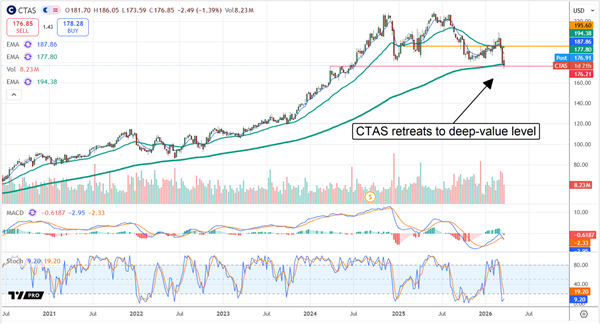
  • Cintas’ March price pullback set a new long-term low, creating a deep value opportunity for buy-and-hold investors.
  • Growth and capital returns underpin the price action, which is likely to resume upward momentum before year-end.
  • Institutions and analysts help support this market, limiting the downside in 2026.
  • Special Report: Elon Musk: This Could Turn $100 into $100,000

Cintas Corporation (NASDAQ: CTAS) is a deep-value opportunity few are discussing, perhaps because its business is unglamorous. Cintas delivers uniforms, laundry services, first-aid supplies and other essential services to businesses across industries and verticals. The critical point is that this must-have service generates recurring revenue, is growing, and is returning value to shareholders.

That growth is largely “self-funded,” enabled by execution and a fortress balance sheet, which supports dividends, share buybacks, and both organic and acquisitional expansion. The net result is apparent in the share price, which—aside from a post-stock-split correction—shows a long-term uptrend that is likely to continue.

Cintas Trades at Value Levels; Provides Opportunity for Buy-and-Hold Investors

Fox News calls this resource -scramble “the new arms race” (Ad)

Why is the White House suddenly building a new “Fort Knox?” Hidden inside this fortress lies a critical new resource Moody’s calls “the new oil.” Demand is doubling every 6 months, and Fox News is calling it the “new arms race.” On April 20, a major event could ignite a handful of under-the-radar stocks, setting off what could be biggest commodity boom in history.Click here for all the details.

Cintas’ stock was trading at historically low levels relative to earnings in late March amid a major acquisition. The previously stalled Unifirst (NYSE: UNF) takeover is now moving forward following unanimous board approval.

The cash-and-stock deal assigns a premium to Unifirst that is likely to be realized relatively quickly. The merger creates opportunities for consolidation, cost savings and operational efficiencies while expanding Cintas’ client base, product range and cross-selling potential. At face value, Unifirst’s business would add roughly 20% to Cintas’ revenue, and further earnings gains could be captured through business rationalization.

Cintas is not a bargain-basement stock, but it carries a premium for good reason. Its P/E typically runs in the high 30s, supported by strong cash flow quality and ongoing capital returns. The shares trade near 36X the 2026 consensus, but only about 14X versus the 2035 consensus, implying meaningful upside over time.

Cintas’ capital return program includes dividends, dividend growth and share buybacks. The dividend yield typically hovers around 1.0%, with annual increases often offset by stock price appreciation. The company is a Dividend Aristocrat with more than 40 consecutive years of dividend increases and has the capacity to continue robust growth. Double-digit compound annual dividend growth is supported by double-digit earnings gains and share-reducing buybacks.

Cintas’ share repurchases increased by approximately $250,000, or 36%, on a year-to-date basis as of the end of its third quarter. The pace of share-count reduction is modest—about 0.18%—but sufficient to offset share-based compensation and the dilutive effect of dividend increases. For investors, the effect is a stable-to-slightly-declining share count, which can reduce volatility and downside risk. Cintas is a lower-beta stock that can help dampen portfolio volatility.

Institutions Limit Downside in 2026

Institutional ownership and persistently low short interest also help keep volatility muted. Short interest tends to run around 2%, a healthy level for a blue-chip stock that supports day-to-day liquidity. Days to cover are relatively low at roughly four days, suggesting a quick exit for short sellers if price action picks up. Institutions own about 65% of the stock and have been accumulating over the trailing 12 months—net buyers in three of the last four quarters, with buying activity ramping in Q1 2026 as the share price declined.

The technical price action is weak in early 2026 but shows support at an important technical level that aligns with price action in 2024. That support marks the breakout point of a previous bull-market consolidation and is likely a durable floor. If the market continues to respect the stock’s 150-week EMA, a rebound is probable. CTAS stock has retreated to this level only five times in 15 years, and each time it triggered significant rallies—the last two led to quadruple- and high-triple-digit gains, respectively.

CTAS stock chart displaying a retreat to deep value territory.

The biggest risks this year include a potential economic downturn, labor-force contraction and regulatory scrutiny of the Unifirst deal. Cintas and Unifirst already overlap in some markets, and the acquisition will make the nation’s largest uniform service even larger. The risk of a tightening labor force is real; however, the latest claims data suggest employment conditions are stable and improving versus the prior year.


Further Reading from MarketBeat

More Than Just Brains: The AI Revolution’s Nervous System

Author: Jeffrey Neal Johnson. Article Published: 3/18/2026. 

Fiber optic cables transmitting light signals between data center servers, illustrating high-speed AI network infrastructure.

Key Points

  • Lumentum’s strategic partnership with NVIDIA validates its technology and solidifies its essential role within the growing artificial intelligence supply chain.
  • Nokia is strategically pivoting to capture the AI market with end-to-end optical networking solutions designed for hyperscale data center operators.
  • The fundamental shift to optical networking for AI represents a multi-year supercycle, creating a durable tailwind for foundational hardware providers.
  • Special Report: Elon Musk: This Could Turn $100 into $100,000

The investment conversation around artificial intelligence (AI) has largely focused on sophisticated software and the powerful graphics processing units (GPUs) that act as the brains of the operation. Those elements are essential, but a potentially more durable investment opportunity is emerging from the physical layer of technology. The new bottleneck isn’t processing power; it’s the network’s ability to connect thousands of processors so they can operate as a single, cohesive supercomputer.

Modern generative AI and large language models require unprecedented levels of inter-processor communication. The massive datasets used to train these models mean network speed—the system’s nervous system—has become a primary driver of performance.

Fox News calls this resource -scramble “the new arms race” (Ad)

Why is the White House suddenly building a new “Fort Knox?” Hidden inside this fortress lies a critical new resource Moody’s calls “the new oil.” Demand is doubling every 6 months, and Fox News is calling it the “new arms race.” On April 20, a major event could ignite a handful of under-the-radar stocks, setting off what could be biggest commodity boom in history.Click here for all the details.

Traditional copper cabling, long the data-center standard, cannot handle these bandwidth demands without introducing crippling latency. That physical limitation has kicked off a multi-year upgrade cycle to high-speed optical networking. This optical supercycle creates a sustained tailwind for companies building the indispensable plumbing of AI, offering a foundational way for investors to participate in the ecosystem’s growth.

Lumentum: Supplying the Speed-of-Light Components

Lumentum Holdings Inc. (NASDAQ: LITE) has emerged as a primary beneficiary of the optical upgrade, a position recently reinforced by the undisputed leader in artificial intelligence.

In early March, NVIDIA (NASDAQ: NVDA) announced a multi-billion-dollar strategic investment and purchase commitment with Lumentum to secure long-term supply of advanced laser components and 800G transceivers—critical hardware for linking clusters of AI systems.

That deal does more than support future revenue; it serves as a clear endorsement of Lumentum’s technology and cements its role in the AI supply chain, helping create a meaningful competitive moat.

The validation is already showing up in the numbers. In its most recent quarterly report, Lumentum posted a 65.5% year-over-year increase in revenue and beat earnings-per-share expectations by $0.26. Its forward guidance projects revenue growth of more than 85% for the upcoming quarter—a signal that growth is not only continuing but accelerating.

That momentum comes as the market itself expands rapidly. Lumentum is a key supplier to the global optical transceiver market, which is forecast to more than double to nearly $22.4 billion by 2029. As data-center operators accelerate AI buildouts, demand for Lumentum’s high-margin components is rising. Bolstering the investment case, Lumentum was recently added to the S&P 500 index, triggering purchases by large index funds, increasing institutional ownership and providing a stable base of demand.

Nokia: Building the Intelligent AI Superhighway

While Lumentum supplies critical components, Nokia Corporation (NYSE: NOK) leverages deep networking expertise to deliver complete, intelligent systems that form the AI data superhighway. Nokia has made a deliberate strategic pivot to capture this growing market.

On March 16, Nokia announced a suite of coherent optical solutions and routing platforms designed for AI-era networks. The move targets large, integrated contracts with hyperscale cloud providers and data-center operators that prefer end-to-end solutions from a single trusted vendor.

The strategy is already producing results in Nokia’s core segments. Its Network Infrastructure division has been a key growth driver, with the Optical Networks unit expanding 17% year-over-year in the most recent reported quarter. That growth indicates Nokia’s push into high-speed optical systems is translating into tangible financial results and market-share gains.

This progress has not gone unnoticed by Wall Street. Major firms such as Morgan Stanley have named Nokia a top pick, citing rising AI infrastructure demand as a core reason for their bullish outlook. Shifts in analyst sentiment suggest the market is beginning to price in this new growth vector for the technology giant. Nokia is using its global scale to capture part of the data-center networking market, projected to grow from about $44 billion in 2026 to more than $114 billion by 2034. As a provider of comprehensive systems, Nokia is well-positioned to benefit from that wave of capital expenditure.

2 Sides of the Same High-Growth Coin

The transition to optical networking is not a temporary trend but a foundational, multi-year supercycle required for AI’s continued advancement. The limits of older technologies have created an unavoidable shift toward optical infrastructure, presenting a clear, data-driven investment opportunity beyond the typical AI headlines.

Lumentum and Nokia offer complementary ways to play this shift. Lumentum is a high-growth, component-level play, validated and backed by NVIDIA and tied directly to the supply of essential, high-margin parts. Nokia offers a value-oriented, systems-level play, with a strategic pivot that is gaining meaningful market recognition.

For investors seeking exposure to the hardware foundation of the AI revolution, the companies building the industry’s indispensable plumbing provide a compelling and durable path to growth.

This email message is a sponsored email sent on behalf of The Oxford Club, a third-party advertiser of MarketBeat. Why did I get this email message?. 


This ad is sent on behalf of The Oxford Club. 105 W Monument St, Baltimore, Maryland 21201. If you would like to optout from receiving offers from The Oxford Club please click here


If you have questions or concerns about your newsletter, please contact MarketBeat’s South Dakota based support team at contact@marketbeat.com.

If you would no longer like to receive promotional emails from MarketBeat advertisers, you can unsubscribe or manage your mailing preferences here.

© 2006-2026 MarketBeat Media, LLC. 
345 N Reid Pl. #620, Sioux Falls, S.D. 57103. United States..

Check This Out: A personal warning from Martin Weiss (Please read)(From Weiss Ratings)

The “Iran Discount” ends March 31st

Dear Fellow Investor,

Gold didn’t “dip” from $5,423 to $5,000.

It was forced down.

After the Iran strikes, something inside the gold market broke.

This pullback isn’t weakness — it’s a setup.

While retail investors hesitate…

…the smart money is quietly loading up.

Not on gold.

On a little-known “Shadow Miner” positioned for what happens next.

Because on March 31st, a 90-year-old law could expose what’s really inside the vaults.

And when that happens…

..this “Iran discount” disappears overnight.

[See the ticker before the reset >>>]

“The Buck Stops Here,”

Dylan Jovine, CEO & Founder

Behind the Markets


Additional Reading from MarketBeat

Big Tech Just Got Hit—Why This Lawsuit Could Change Social Media Forever

Submitted by Nathan Reiff. Date Posted: 3/27/2026. 

Smartphone with Facebook, Instagram and YouTube apps labeled Exhibit A as judge presides over Meta and Google antitrust trial.

Key Points

  • The verdict against Meta Platforms and Google in late March 2026 in a trial surrounding the role of social media in personal injury to users may have massive implications.
  • Though the financial damages are minor for these tech giants, the verdict may pave the way for much larger legal battles and, potentially, new regulations surrounding the design of social media platforms.
  • At risk is significant volumes of ad revenue, capital expenditures potentially needed to redesign platforms, market share threats, and much more.
  • Special Report: Elon Musk: This Could Turn $100 into $100,000

Popular social media platforms may now be exposed to personal-injury liability following the recent landmark case against Meta Platforms Inc. (NASDAQ: META) and Alphabet Inc. (NASDAQ: GOOG).

The tech giants behind Instagram, Facebook, and YouTube were ordered to pay millions in compensatory and punitive damages to a plaintiff who accused the companies of designing highly addictive products that harmed their mental health.

Fox News calls this resource -scramble “the new arms race” (Ad)

Why is the White House suddenly building a new “Fort Knox?” Hidden inside this fortress lies a critical new resource Moody’s calls “the new oil.” Demand is doubling every 6 months, and Fox News is calling it the “new arms race.” On April 20, a major event could ignite a handful of under-the-radar stocks, setting off what could be biggest commodity boom in history.Click here for all the details.

Those damages are small relative to the companies’ market value, but the implications—and the potential fallout—could be far more consequential for social media platforms and their investors.

Both firms’ shares fell sharply around the verdict, with Meta down about 13% and Alphabet down about 8% over a five-day period at the end of March 2026.

There may be a buying opportunity for some investors, but the larger question is whether Big Tech’s business models will be forced into broader restructuring—and, if so, how that could affect market share, valuation, and other fundamentals.

Potential Impacts on Future Trials and Products

This trial is high profile but not unique: social media companies routinely face lawsuits about their platforms. Still, the finding here could change the legal landscape and influence multiple cases expected to go to trial as soon as this year.

In the near term, that could mean more damage judgments and unwanted publicity for these and other tech giants. More importantly, investors may see Big Tech pushed into a position similar to Big Tobacco decades ago, when cigarette makers were held liable for the addictive and harmful nature of their products.

Companies like Meta and Google have long relied on Section 230 of the Communications Decency Act of 1996 to shield themselves from liability for user-posted content. There is a real risk that this defense could weaken, shifting claims toward treating platforms themselves as defective products that require redesign.

If the law evolves in that direction, major changes to services like Facebook and Instagram may follow, although the precise form of those changes is uncertain. Key features highlighted in the trial—such as infinite scroll, autoplay content, and algorithmic recommendations—could come under scrutiny and even affect how advertisements are delivered.

What Investors Should Keep In Mind

Social media is a major revenue source for companies such as Meta and Alphabet, which have depended on steadily rising engagement to drive ad sales. For example, in the last quarter of 2025 Meta reported ad revenue growth of 24% year-over-year, helped by AI-driven ad performance and roughly 3.5 billion daily users across its products.

Beyond lost ad revenue—which would itself be sizable—industry-wide legal exposure if platforms are deemed defectively designed could reach the tens of billions of dollars and create mass-arbitration risks. At that point, even mega-cap firms in the tech sector could see meaningful impacts to their financial health.

Investors should also expect companies to invest heavily to comply with any new safety regulations that may arise from this or subsequent trials.

This could compress operating margins and add to already-high capital expenditures, many of which are being driven by the costs of integrating AI into products and ads. It could also open space for alternative platforms with different designs to capture market share.

That said, the latest verdict alone may not be cause for investors to abandon META and GOOG positions. Meta’s consensus price target implies roughly 60% upside, while Alphabet’s implies about 25%—and both remain favored by many analysts.

Still, the relatively small financial impact of this single case could trigger a ripple effect with far larger consequences for social media generally and for these companies in particular.


Additional Reading from MarketBeat

AI Wingman: Kratos & Airbus’s Game-Changing Pact

Submitted by Jeffrey Neal Johnson. Date Posted: 3/16/2026. 

Autonomous drone hovering indoors near a brushed metal Kratos Defense & Security Solutions sign, highlighting defense technology and unmanned systems development.

Key Points

  • Kratos’s record backlog and major program wins demonstrate its successful transition into a key global defense technology provider.
  • Airbus positions itself as a lead systems integrator for Europe’s future combat cloud by partnering on a proven drone platform.
  • The transatlantic collaboration provides tangible evidence that the era of autonomous, collaborative air warfare is rapidly becoming a reality.
  • Special Report: Elon Musk: This Could Turn $100 into $100,000

In a specialized facility in Manching, Germany, a pivotal shift in global defense strategy is taking shape. Two American-made Kratos (NASDAQ: KTOS) XQ-58A Valkyrie drones are being prepared for a landmark 2026 flight test equipped with a sovereign European artificial intelligence (AI)-driven mission system developed by Airbus (OTCMKTS: EADSY). While primarily a technical exercise, it also signals that the long-promised future of autonomous, collaborative warfare is arriving faster than many anticipated.

Kratos: From Disruptor to Global Power Player

The Airbus partnership is a major international endorsement for Kratos, significantly de-risking its investment case by opening a direct channel into the lucrative European defense market.

Fox News calls this resource -scramble “the new arms race” (Ad)

Why is the White House suddenly building a new “Fort Knox?” Hidden inside this fortress lies a critical new resource Moody’s calls “the new oil.” Demand is doubling every 6 months, and Fox News is calling it the “new arms race.” On April 20, a major event could ignite a handful of under-the-radar stocks, setting off what could be biggest commodity boom in history.Click here for all the details.

For investors, that validation is reinforced by a steady stream of strong financial results and program wins that indicate Kratos has reached a meaningful inflection point. The company’s strategy of delivering relevant, affordable systems now—rather than only designing concepts for later—appears to be paying off.

Kratos’s recent performance underscores this momentum. The fourth quarter of 2025 produced organic revenue growth of roughly 20% year-over-year, and the company reported a 1.3-to-1 book-to-bill ratio for the quarter.

That book-to-bill ratio is notable: a figure above 1-to-1 means the company is securing more new orders than it is billing in revenue, which indicates an expanding backlog and growing future workload.

Looking ahead, Kratos’s financial foundation appears solid, giving investors greater visibility into future performance:

  • A secure backlog: Kratos ended 2025 with a record backlog of $1.573 billion in secured future work, creating a stable revenue base.
  • A large opportunity pipeline: Beyond confirmed orders, Kratos has identified a record $13.7 billion pipeline of opportunities, representing a deep pool of potential future contracts that could sustain growth for years.

The company’s flagship platform, the Valkyrie, is central to this outlook. Before its selection for European tests, the drone was validated in the United States when it was chosen for the U.S. Marine Corps’ MUX TACAIR Collaborative Combat Aircraft (CCA) program, where Kratos is partnered with prime contractor Northrop Grumman. That dual-continent demand for the same core platform underscores its capabilities.

In response, Kratos has announced plans to scale production from roughly eight Valkyries per year to 40 by the end of 2028.

Kratos also has diversified growth drivers beyond the Valkyrie. It is an active participant in the rapidly expanding hypersonics field—a Pentagon priority—with involvement in programs such as the Multi-Service Advanced Capability Hypersonic Test Bed (MACH-TB). Revenues from its hypersonic franchise are projected to roughly double to about $400 million in 2026, providing an additional growth vector that supports the company’s valuation tied to its contract pipeline.

Airbus: Winning the Future of Air Combat

For European aerospace titan Airbus, the partnership with Kratos is a strategic, timely move. It demonstrates managerial agility, helps address challenges within legacy programs, and positions Airbus to lead the continent’s next-generation defense ecosystem.

The collaboration comes against the backdrop of well-publicized disagreements and delays that have hampered the Future Combat Air System (FCAS), Europe’s ambitious next-generation fighter jet program.

Rather than waiting for those complex, multinational issues to be resolved, Airbus is proactively securing a loyal wingman capability for key customers now.

By partnering with Kratos, Airbus avoids years of costly development. It gains immediate access to a proven, production-ready airframe and can offer a tangible solution to the German Air Force with a target in-service date of 2029—an accelerated timeline that would be difficult if starting from scratch.

This move also aligns with a broader, continent-wide push to fast-track low-cost, autonomous systems to bolster collective security.

Importantly, the deal shifts Airbus’s role from primarily a hardware manufacturer to a high-value systems integrator. Airbus will equip the Valkyrie with its proprietary MARS mission system, powered by MindShare AI software. In modern defense, value increasingly resides not only in the airframe, but in the intelligent networks that command it. By controlling this mission-system layer, Airbus positions itself to be a key node in Europe’s future combat cloud, connecting manned and unmanned platforms—a more defensible and potentially more profitable role over time.

For investors in a large-cap industrial like Airbus, the venture provides exposure to high-growth defense tech while diversifying away from the cyclical commercial aviation market. It hedges against the risks and extended timelines of traditional manned fighter programs and adds a forward-looking growth story that helps secure Airbus’s relevance in the next generation of air warfare.

A Clear Approach Vector

The Kratos-Airbus partnership is among the most tangible data points yet that the global shift toward autonomous, attritable air power is happening now. This is no longer an abstract trend discussed in strategy papers; it is a present reality with meaningful budget allocations and hardware being prepared in Germany.

The collaboration validates Kratos as a premier growth vehicle in defense technology, opening the door to a large new market. At the same time, it highlights Airbus’s strategic foresight in securing its role as a principal architect of Europe’s future defense capabilities. For investors, the alliance signals that both companies are positioned on the favorable side of a multi-decade paradigm shift in global security, offering a compelling case for long-term value creation as the definition of air power evolves.

Thank you for subscribing to Earnings360, a morning newsletter that summarizes quarterly earnings for public companies that trade on U.S. markets.

This email is a sponsored email provided by Behind the Markets, a third-party advertiser of Earnings360 and MarketBeat. 

If you need help with your newsletter, please don’t hesitate to email MarketBeat’s South Dakota based support team at contact@marketbeat.com.

If you no longer wish to receive email from Earnings360, you can unsubscribe.

Copyright 2006-2026 MarketBeat Media, LLC. All rights protected.
345 N Reid Place, Suite 620, Sioux Falls, South Dakota 57103-7078. United States of America..

Check This Out: A personal warning from Martin Weiss (Please read)(From Weiss Ratings)