This ad is sent on behalf of Banyan Hill Publishing. P.O. Box 8378, Delray Beach, FL 33482.
If you would like to unsubscribe from receiving offers for Grey Swan, please click here.
Stockguru LLC (dba InvestingDistrict), 2563 cherry hill ln, Hermitage, PA 16148, United StatesYou may unsubscribe or change your contact details at any time.
The market just handed options traders a gift—and most people won’t even notice it.
Volatility is spiking.
And when that happens, option premiums surge.
Options traders love it.
And so do I!
Because while everyone else is watching their portfolios swing wildly and losing sleep over whether to sell, options traders are cashing in on the chaos.
You can collect more income in one volatile week than you’d normally make in a month of calm markets.
The opportunities right now are exceptional. But they won’t last forever.
Volatility always settles down—and when it does, these premium levels disappear.
That’s why, in a few days, my team is hosting a free, live Power of Options Masterclass where we’re showing you exactly how to capitalize on these high-premium environments and what to do when the market gets cold.
You’ll learn how to collect significantly larger income checks. How to do it safely. And how to take advantage before this window closes.
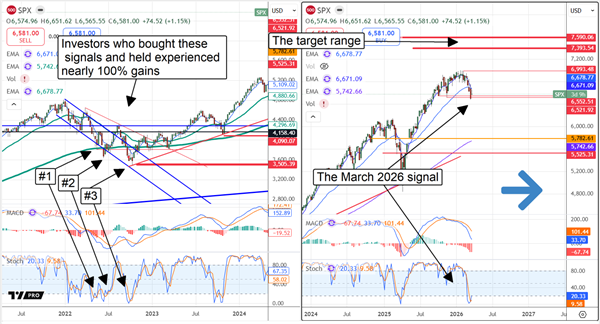
The S&P 500 moved into oversold territory on its weekly candlestick charts late in March, triggering a buying signal with a 100% accuracy rate over the trailing 15-year period. “Oversold,” as measured by the stochastic indicator, describes a market pushed below a reasonable valuation — a situation in which most sellers who needed, wanted or had an excuse to sell probably already have. That leaves a bias toward buyers, which in turn increases the likelihood of an upward move, a dynamic that the signal has already confirmed.
Technical, Analyst and Valuation Trends Converge: Upside Potential Offsets Risks
Chart watchers will note there were three similar signals in 2023. The first produced only a tepid rebound, but it was followed by two stronger signals that led to more meaningful recoveries and a full market reversal. That 2023 reversal was driven largely by AI gains and has so far produced roughly a 50% rise in the index.
Why is the White House suddenly building a new “Fort Knox?” Hidden inside this fortress lies a critical new resource Moody’s calls “the new oil.” Demand is doubling every 6 months, and Fox News is calling it the “new arms race.” On April 20, a major event could ignite a handful of under-the-radar stocks, setting off what could be biggest commodity boom in history.Click here for all the details.
The takeaway for investors is that current signals look similar: near-term headwinds may slow price action, but fundamentals and long-term forecasts provide support. The most likely path is consolidation within the current range followed by a renewed push higher to new highs later this year.
Analyst sentiment aligns with that outlook. Barclays is the latest firm to raise its S&P 500 target, pointing to stronger-than-expected earnings and forward forecasts that offset macro headwinds. It lifted its index target to 7,650 — a 250-point increase that places the index near the high end of its expected year-end range.
The value is there, if not uniformly across every sector. The S&P 500 trades near 20X earnings as of late March, roughly in line with long-term averages, but market leaders show deeper discounts. NVIDIA (NASDAQ: NVDA) — the single most influential stock in the market, representing about 7% of the S&P 500’s market cap — trades at roughly 20X current-year earnings, which assigns little or no premium to the world’s leading AI company.
NVIDIA and other large-cap tech names often trade in the 30X–35X range when fully valued, implying potential upside of 50%–75% from valuation expansion alone. If long-term forward earnings projections are applied — forecasts that in some scenarios place the stock at roughly 5X projected 2035 earnings — the theoretical upside over a longer horizon can be substantially larger.
S&P Set Up to Hit 7,500 This Year
The immediate support and resistance levels given for the S&P 500 Index are 6,521.92 (support) and 6,993.48 (resistance). For the S&P 500 Index tracking ETF (NYSEARCA: SPY), the equivalent price levels are about $64.72 and $69.78.
Support is expected to be significant but could be breached; if that occurs, the next support area is near 6,400 (about $64 on SPY). Resistance could also remain firm until headwinds ease, effectively capping near-term upside to roughly 471 index points (about $4.75 on SPY). Over a longer horizon, that 471-point range implies a move toward the 7,464 level for the index ($74.65 on SPY) as a baseline target, with upside toward 7,500 at the higher end of the range.
The catalyst for such a move is likely to be multifaceted, but it will be centered on the earnings outlook. Current forecasts call for sequential acceleration in earnings growth starting in Q1 2026 and extending into Q2 and Q3, with high-teens growth projected through year-end.
These trends suggest leaders such as NVIDIA will continue to outperform, helping drive a stronger finish for the market. Other, more average companies could contribute an additional few percentage points of upside — roughly 3% to 5% — as the earnings cycle progresses. Earnings season begins in mid-April with JPMorgan Chase & Company (NYSE: JPM), but the most market-moving results may come later when NVIDIA and other AI leaders report.
Among the clear risks is oil. The conflict in Iran has pushed oil toward long-term highs, feeding cost pressures and broader inflationary forces. At these levels, oil can negatively affect corporate earnings and lead to weaker guidance, which would pressure performance. High oil prices and persistent inflation also make it less likely the Fed will cut rates, presenting another hurdle for markets to overcome.
Just For You
Energy Stocks Surge on Oil Spike: Buy, Hold, or Take Profits?
Written by Chris Markoch. Article Published: 3/25/2026.
Key Points
Energy stocks are rising amid geopolitical tensions, with volatility in oil prices creating both risks and opportunities for investors.
Chevron, Valero, and Enbridge highlight different ways to gain exposure across upstream, midstream, and downstream segments.
Dividend yields and pricing power make energy stocks attractive, even as investors weigh whether to take profits or remain invested.
Since hostilities against Iran escalated on Feb. 28, energy stocks have been one of the few clear winners for bullish investors. That changed briefly after a social media post by President Trump pushed the price of oil lower—and with it, many oil stocks—reminding investors that markets on a knife’s edge can move sharply on small triggers.
It’s worth noting that Chevron Corp. (NYSE: CVX)CEO Mike Wirth says markets are underpricing the potential supply shock from Iran closing the Strait of Hormuz. Wirth argues the market is trading on “scant information” and “perception.” While investors are facing a firehose of information, the accuracy of that information remains in question.
Why is the White House suddenly building a new “Fort Knox?” Hidden inside this fortress lies a critical new resource Moody’s calls “the new oil.” Demand is doubling every 6 months, and Fox News is calling it the “new arms race.” On April 20, a major event could ignite a handful of under-the-radar stocks, setting off what could be biggest commodity boom in history.Click here for all the details.
Investors shouldn’t simply dismiss this as an oil executive “talking his book.” Wirth runs a major integrated oil company with decades of operations in Venezuela; he has firsthand experience with what a disrupted market looks like and how long it can take to return to normal.
Even if oil avoids a worst-case outcome—like the $200-per-barrel forecast floated by Citigroup (NYSE: C)—consumers may face higher pump prices for some time. For investors who’ve stayed on the sidelines during this rally, there are still opportunities across different parts of the energy complex.
Big Oil Strength: Chevron Leads the Charge in a Tight Supply Market
The rally accelerated after U.S. military operations related to Venezuela; Chevron is one of the few companies permitted to operate there, which has given it a unique exposure to potential supply shifts.
It’s reasonable to ask whether CVX could pull back if hostilities in the Strait of Hormuz ease. Today Chevron trades roughly 11% above its consensus price target, but analysts have been raising those targets—most notably Piper Sandler, which boosted its target to $242 from $179.
Over the past three years, CVX has delivered a total return of about 50%. That may not thrill pure growth investors, but it underscores Chevron’s standing as a Dividend Aristocrat. For investors seeking both growth and reliable income, CVX remains attractive: even after the recent run-up, the stock yields about 3.5%, roughly $7.12 per share annually at current prices.
Refining Advantage: Valero Thrives on Volatility and Margin Expansion
If Chevron represents the upstream exposure, Valero Energy (NYSE: VLO) offers a different play: a pure refining business that can prosper when crude is volatile. That distinction makes Valero an attractive option in the current environment.
Most energy stocks move with the price of crude, but refiners like Valero make money on the spread between crude input costs and refined product prices—the crack spread. Supply disruptions that hurt producers can widen these margins and boost refiners’ profits.
Valero is the world’s largest independent petroleum refiner, operating 15 refineries across the U.S., Canada and the U.K. That scale provides a competitive moat and operational flexibility to adapt to shifting crude supply routes—an advantage if Strait of Hormuz disruptions force changes in sourcing.
VLO has climbed more than 45% in 2026 and sits about 20% above its consensus price target, though analysts have been raising forecasts. The stock looks somewhat extended, but Valero also offers steady income, with a dividend yield near 2%, about $4.80 per share annually at current prices, combining cyclical upside with income.
Midstream Stability: Enbridge Offers Income and Volume-Driven Growth
Another way to play the energy rally is through midstream companies—the pipeline operators that act like toll booths for oil and natural gas. These businesses earn fees to move product regardless of commodity prices; their returns depend primarily on volumes, not prices.
Currently, volumes are high, with throughput near record levels in early 2026, which benefits pipeline operators.
That makes Enbridge Inc. (NYSE: ENB) worth considering. The Canada-based company manages more than 18,000 miles of pipeline and handles roughly 30% of North American crude production. It also transports about 20% of the natural gas consumed in the United States.
Over the last three years ENB has returned around 80% in total, illustrating the steady performance typical of midstream firms. The consensus price target of $65 implies nearly 20% upside from current levels, and that potential is complemented by a reliable dividend that yields about 5.1%, roughly $2.78 per share annually based on current prices.
Thank you for subscribing to The Early Bird, MarketBeat’s 7:00 AMnewsletter that covers stories that will impact the stock market each day.
This email content is a sponsored email from Paradigm Direct, a third-party advertiser of The Early Bird and MarketBeat.
If you need help with your subscription, feel free to contact MarketBeat’s South Dakota based support team at contact@marketbeat.com.
If you no longer wish to receive email from The Early Bird, you can unsubscribe.
GE Vernova: AI’s Thirst for Power Creates a New Class of Winner
Authored by Jeffrey Neal Johnson. Originally Published: 3/25/2026.
Key Points
The unprecedented growth of artificial intelligence is creating a massive and sustained demand for new power generation, which directly benefits the company.
GE Vernova’s leadership in both high-efficiency gas turbines and grid modernization offers a complete end-to-end solution for AI’s power needs.
Strong analyst upgrades and recent dividend increases reflect growing market confidence in the company’s long-term growth trajectory and financial health.
The artificial intelligence (AI) revolution is being powered by a less glamorous — but hugely consequential — utility bill. While investors often focus on the makers of advanced microchips and software, a more fundamental truth is emerging: AI’s expansion depends on access to massive, reliable, and growing supplies of electricity.
Projections show that by the end of the decade, data centers alone could consume as much electricity as entire countries. That unprecedented demand creates a clear, tangible investment theme that reaches beyond Silicon Valley to the industrial backbone powering this global transformation.
A $1.5 trillion valuation. That is what industry experts are projecting for the highly anticipated SpaceX IPO, expected to be announced on April 20th — potentially surpassing the combined market caps of the six largest U.S. defense contractors.
Consider what Tesla’s IPO meant for early investors: a $50,000 position held for 10 years grew to $1.5 million. The SpaceX IPO is projected to be even larger.
Before April 20th, there is still a backdoor way to secure a pre-IPO stake in SpaceX. Here is how to get positioned.Claim Your Pre-IPO Position
As the market wakes up to this energy reality, GE Vernova (NYSE: GEV) is emerging as a key beneficiary. The company — a global leader in power generation and grid technology — has seen its stock reach new highs.
This rise isn’t driven by hype but by a direct link between surging power needs from AI and GE Vernova’s core business of creating and delivering electricity. As the digital world expands, companies that provide essential power infrastructure, like GE Vernova, are becoming among the most important enablers of the future.
More Intelligence, Unprecedented Power Demand
The energy challenge stems from AI’s nature. Training and running advanced models is far more energy-intensive than most traditional computing. These processes use thousands of specialized processors that run continuously, generate tremendous heat, and consume vast amounts of power.
That creates a strict operational requirement for data centers: a constant, uninterrupted flow of electricity, or baseload power. Even a momentary outage can disrupt critical workloads and cause major financial losses, so reliability is non-negotiable.
The result is a two-fold challenge for the global energy system. First, there’s an urgent need for additional power generation capacity. Second, much of the existing grid — much of it decades old — is not equipped to transmit new power supplies to the specific locations where data centers are being built. That mismatch has created a multi-billion-dollar opportunity for companies that can solve both problems.
New Power Plants: A surge in demand for facilities, particularly natural-gas-fired plants, that can deliver consistent 24/7power.
Grid Modernization: An urgent need for transformers, substations, and advanced software to upgrade and expand the electrical grid.
Sustainable Solutions: Growing pressure from corporations to integrate renewable energy to help offset the large carbon footprint of their data centers.
How GE Vernova Wins the Power Race
GE Vernova is well positioned to capitalize on this trend with a comprehensive portfolio across the energy value chain. Its end-to-end capabilities — from generation to delivery — give it a distinctive advantage.
The Gas Power Workhorse
Central to GE Vernova’s strategy is its Power segment, which builds and services the world’s most advanced gas turbines. The company’s flagship H-Class turbines are known for industry-leading efficiency and have become a common choice for providing the reliable baseload power data centers need.
The data back this up: GE Vernova recently reported a 65% organic increase in orders for this segment, creating a large backlog that offers strong visibility into future revenue and underscores its role in the energy build-out.
The Essential Grid
Generating electricity is only half the equation; it must also be delivered efficiently and reliably. GE Vernova’s Electrification segment supplies the hardware and software — from high-voltage transformers to grid management systems — required to modernize and expand power networks.
As utilities and data center developers invest billions to upgrade infrastructure, this segment represents a substantial, parallel revenue stream. It ensures GE Vernova benefits not only from building generation capacity but also from delivering power — a capability that has become a primary bottleneck for new data center construction.
The Competitive Edge
Other industrial companies — including Siemens Energy (OTCMKTS: SMEGF) — are also benefiting from this trend. But GE Vernova’s deep expertise and market leadership in high-efficiency gas turbines, combined with its electrification offerings, give it a meaningful competitive advantage. Its integrated approach lets the company offer a more complete solution to customers building AI infrastructure.
Market Signals Validate GE Vernova’s AI Power Play
The investment community has noticed GE Vernova’s position. That attention shows up in both its stock performance and strong institutional support — more than $50 billion in inflows over the past year versus roughly $17 billion in outflows.
Management has signaled confidence in the company’s financial outlook. It recently announced it was doubling its quarterly dividend, returning more cash to shareholders. The board also authorized a sizable stock buyback program, suggesting leadership views the shares as attractive at current levels.
Analysts have grown increasingly optimistic, often tying their bullish views to the AI-driven demand story:
Morgan Stanley raised its price target to $960, citing strong turbine pricing and robust electrification demand.
Rothschild & Co upgraded the stock from Sell to Buy and set a high target of $1,100.
Of the 27 analysts covering the stock, the vast majority rate it a Buy or Strong Buy, reflecting broad positive sentiment.
GE Vernova was also added to the S&P 100 index, increasing the stock’s visibility and prompting many index-tracking funds to purchase shares. That creates steady, underlying demand from some of the world’s largest investment managers.
The Foundational Power Play for the AI Era
As AI reshapes the global economy, rising electricity demand is one of its most certain byproducts. Companies that provide the foundational power infrastructure stand to benefit from sustained growth. Unlike many speculative technology stocks, GE Vernova is a tangible industrial business building indispensable infrastructure for the digital future.
For investors seeking exposure to the AI megatrend through a company with a healthy backlog, essential assets, and a clear role in global infrastructure, GE Vernova presents a compelling, long-term thesis. This is not about a single quarter’s results but about powering decades of innovation to come.
Sunday’s Featured News
Carvana’s 5-for-1 Split: Green Light for a New Growth Era
Submitted by Jeffrey Neal Johnson. Posted: 3/16/2026.
Key Points
Carvana’s decision follows record-breaking sales volume and a significant return to profitability last year.
The stock split aims to make share ownership more psychologically accessible for retail investors and Carvana’s team members.
Wall Street analysts have a positive outlook, with consensus price targets suggesting considerable potential upside from current trading levels.
Carvana’s (NYSE: CVNA) board of directors recently approved its first-ever 5-for-1 forward stock split, marking a notable new chapter for the online auto retailer. The market reacted positively, with shares rising in the session after the announcement. That response underscores a broader point: Carvana’s move is more than a technical adjustment to its share count.
After navigating a dramatic turnaround, the stock split reads as a confident signal. It signals a shift from a period of recovery to a phase focused on ambitious, forward-looking growth. Executed from a position of renewed strength, the split offers insight into Carvana’s strategy and what it could mean for investors.
A $1.5 trillion valuation. That is what industry experts are projecting for the highly anticipated SpaceX IPO, expected to be announced on April 20th — potentially surpassing the combined market caps of the six largest U.S. defense contractors.
Consider what Tesla’s IPO meant for early investors: a $50,000 position held for 10 years grew to $1.5 million. The SpaceX IPO is projected to be even larger.
Before April 20th, there is still a backdoor way to secure a pre-IPO stake in SpaceX. Here is how to get positioned.Claim Your Pre-IPO Position
To appreciate the significance of the split, consider the foundation that made it possible. Not long ago, Carvana faced serious operational and financial challenges — including a heavy debt load and questions about profitability — that raised doubts about its future. Since then, the company has engineered one of the more notable turnarounds in recent markets, driven by sharper operations and a successful debt restructuring.
The proof is in Carvana’s 2025 financial results. The company delivered strong growth and returned to profitability, quieting many critics. Key highlights include:
Record Sales Volume: Carvana sold 596,641 retail units, a 43% increase year-over-year.
Surging Revenue: Full-year revenue rose to $20.3 billion, up 49% from the prior year.
A Return to Profitability: Carvana reported a full-year net income of $1.9 billion, reversing prior losses.
Fourth-quarter 2025 earnings per share came in at $4.22, well above analyst consensus of $1.10, highlighting improved operational execution. This level of financial health provides the context for the stock split, framing it as a timely and well-earned step forward for the company.
Why a Stock Split, and Why Now?
Subject to shareholder approval at the Annual Shareholder Meeting on May 5, 2026, the split will take effect on May 6, 2026. After that date, investors will receive four additional shares for every share they own, increasing the share count fivefold while reducing the per-share price to one-fifth of its previous value. For example, a $300 stock would trade at $60 after the split. The total value of an investor’s holding is unchanged by the split itself.
The primary purpose of the split is to improve accessibility. A lower per-share price can have a meaningful psychological impact: many retail investors find a $60 stock more approachable than a $300 stock, even though the underlying value remains the same. That perceived affordability can broaden the investor base.
Carvana’s leadership framed the split as an effort to keep the stock “accessible to all of our team members,” according to Chief Financial Officer Mark Jenkins. Making shares easier for employees to own can strengthen alignment between the workforce and shareholders. Executed from a position of financial strength, the split is a deliberate, confidence-expressing move whose timing is significant.
Primed for a New Wave of Interest
Beyond accessibility, the split could accelerate Carvana’s next growth phase. Management has emphasized scaling operations to capture a larger slice of the used-car market, with CEO Ernie Garcia targeting a long-term goal of selling 3 million vehicles annually.
Carvana is already expanding capabilities to support that ambition. For example, it recently rolled out same-day delivery in the competitive Los Angeles market — a move that enhances customer value and signals improving logistics and execution in key regions. A broader investor base and the added trading liquidity that often follow stock splits can provide a tailwind for an aggressive growth strategy.
The stock’s high beta of 3.60 — a measure of volatility relative to the market — can also affect how the split plays out. A beta above 1.0 indicates greater volatility, which tends to attract momentum traders seeking significant price swings. By lowering the price of entry, the split could re-engage that class of investors and spark renewed trading interest.
The Road Ahead: A Green Light from Analysts
Carvana’s 5-for-1 split functions as a symbolic capstone on its turnaround, a tactical move to broaden its shareholder base, and a potential catalyst for the company’s next growth chapter. It reflects confidence from management in both operations and balance sheet stability, shifting the narrative from recovery to expansion.
That optimism is reflected on Wall Street. Among 25 analysts covering Carvana, the consensus rating is a Moderate Buy. The average analyst price target is $440.59, implying potential upside of more than 46% from the stock’s recent trading level, suggesting many analysts see room for further valuation gains.
For investors, the stock split may mark a clear turning point — the end of a difficult recovery period and the start of a renewed push for market share and growth.
Thank you for subscribing to Earnings360, a morning newsletter that summarizes quarterly earnings for public companies that trade on U.S. markets.
This message is a sponsored message sent on behalf of Trend Labs, a third-party advertiser of Earnings360 and MarketBeat.
If you need help with your subscription, please email MarketBeat’s South Dakota based support team at contact@marketbeat.com.
If you no longer wish to receive email from Earnings360, you can unsubscribe.
This company’s sales are up 28% year over year. It holds over 30,000 patents in wireless and video technology. And it just earned an A-rating in my proprietary Stock Grader system.
That’s the same system that helped me flag Nvidia back in 2005 — before its 82,000% run.
In fact, this system has identified the top-performing S&P 500 stock for 12 years running. Over the years, it has cost me $9 million to build and maintain. And right now, it’s flashing its highest possible rating on this AI play.
P.S. My Stock Grader system has cost $9 million to build and maintain. It helped me flag Nvidia at $1 split-adjusted. Today it’s flashing its highest rating on one AI stock and I’m giving you the name free. Click here before this briefing comes down.
This ad is sent on behalf of InvestorPlace Media at 1125 N. Charles Street, Baltimore, Maryland 21201. Advertising Disclosure: This email contains paid advertisements. This email is from our associates at InvestorPlace Media.
Legal Entity Information: Investing Ideas Daily is owned and operated by Darwin Investor Network, a DBA of The Darwin Agency, Inc.
Disclaimer: Nothing in this email should be considered personalized financial advice. Always conduct your own due diligence when investing. We urge you to read our full disclaimer by clicking on the terms of use link below.
Unsubscribe: You are receiving this email as part of your complimentary subscription to the Investing Ideas Daily E-Letter. If you would like to unsubscribe, you can do so by clicking on the unsubscribe link below.Darwin Investor Network 2319 N Andrews Avenue, Fort Lauderdale, FL 33311 support@investingideasdaily.com | 1-800-496-9838Investing Ideas Daily | Privacy Policy | Terms of Use Unsubscribe | View Online
Smithfield Foods’ (NASDAQ: SFD) stock price is rocketing higher and on track to keep moving, as the high-quality, deep-value company is firing on all cylinders amid tailwinds.
The tailwinds include increased demand and pricing for pork products, underpinned by export growth and high beef prices. Estimates vary, but pork demand is expected to remain strong this year, leading to a 2% average price increase per unit as consumers shift away from higher-priced beef.
The outlook and safety are evident in the board’s decision to increase the dividend payment to $1.25 per share this year. At $1.25, the payment is more than attractive, yielding about 4.80% with shares near their post-IPO highs, and it is cheap to own. More importantly, the payout ratio and growth outlook suggest that the dividend payment is reliable for future years and that distribution growth is likely to continue.
Valuation metrics align with a robust increase in stock price. SFD trades at approximately 9x earnings, about 6 handles shy of its major competitor, Hormel. Hormel, trading at approximately 15x earnings, is also at value levels, as it tends to trade above 25x when fully valued. That premium is tied to its dividend and growth outlook, which are robust in the first case and improving in the second.
In this scenario, both Hormel and Smithfield Foods are positioned to advance over the coming quarters and years, but Smithfield is poised to outperform.
A $1.5 trillion valuation. That is what industry experts are projecting for the highly anticipated SpaceX IPO, expected to be announced on April 20th — potentially surpassing the combined market caps of the six largest U.S. defense contractors.
Consider what Tesla’s IPO meant for early investors: a $50,000 position held for 10 years grew to $1.5 million. The SpaceX IPO is projected to be even larger.
Before April 20th, there is still a backdoor way to secure a pre-IPO stake in SpaceX. Here is how to get positioned.Claim Your Pre-IPO Position
Smithfield Foods Grows and Widens Margin in FQ4
Smithfield Foods had a solid fourth quarter, with revenue growing by 7.1% to $4.23 billion.
Strength was seen across segments, with Packaged Meats up 4.3%, Fresh Pork up 2.1%, and Hogs up 3.3%. The strongest growth was seen in the Other category, which grew by neary 43% for the quarter. It includes high-demand quick-serve, value-added, and convenience products such as cooked ribs and snacks.
Margin news is also good. The company experienced margin pressure in the Other and Packaged Meats segment but mitigated the decline with quality improvements and strength in the other segments. Operating profit in the Fresh Pork and Hogs segments increased by 25% and reversed a loss, respectively, leading to a 20% year-over-year systemwide improvement.
Guidance assumes pricing strength will continue, and includes plans for operational improvements. Among them is a new state-of-the-art Sioux Falls facility that incorporates modern automation and superior product flow.
Signs Point to $30 SFD Share Price
The company’s momentum is seen clearly in the guidance. Smithfield expects revenue growth to slow, but to only to 3%, 200 basis points better than expected.
The coverage isn’t robust, with about a half dozen reports tracked, but the revisions are leading the market higher, forecasting a 25% upside at the high-end, and putting this market at fresh all-time highs.
This is a critical detail, as the move entails breaking out of a post-IPO trading range. The stock price could rise by 20% to 25% in that instance, aligning with analysts’ high target price.
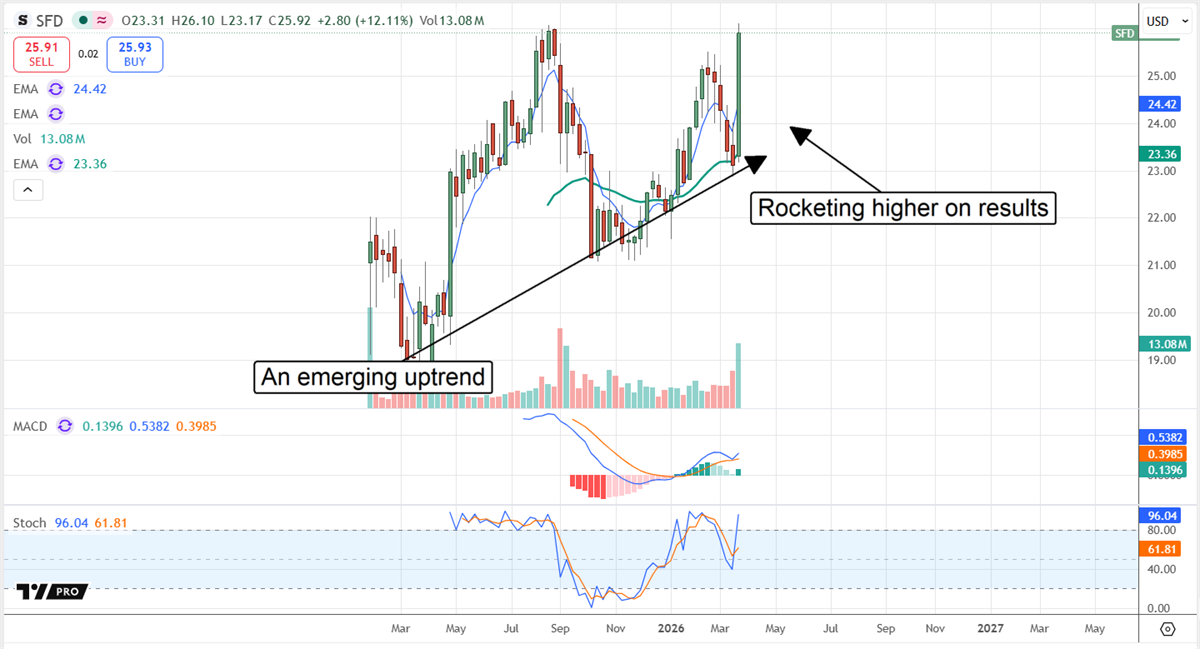
The post release price action is robust, lifting the stock by $4 to just over $26. The move creates a large green candle, reflecting solid support and confirming the uptrend. The market also shows a high probability of extending the move, with trading volume, the MACD, and stochastic indicators aligning with trend-following entries.
Critical resistance is near the existing all-time high, just above $26, and is likely to be crossed soon. In that event, the market may reach the $30 level within days to a few weeks and may continue higher if the news flow strengthens the outlook for profits.
Among this year’s catalysts is the acquisition of Nathan’s Famous hot dogs, which is part of a broader strategy focused on high-margin packaged meat products. The purchase turns the company into the brand owner, transitioning from manufacturer, and will increase profitability immediately. The move removes licensing fees, enabling Smithfield to capture 100% of available margin. Institutions are also in the mix, accumulating the stock at a 4-to-1 pace since the IPO and underpinning the uptrend.
Greenland is a land of vast possibility, where the landscapes are as dramatic as they are diverse. From south to north, east to west and into the remote reaches of its national park, each region reveals a distinct character—and a different way to explore.
Aboard the ice-class vessels in the National Geographic-Lindblad Expeditions fleet, venture deep into this wild frontier—navigating iceberg-filled bays, tracing remote fjords and accessing communities and wildlife-rich regions far beyond the reach of conventional cruising. Explore one region in depth, pair Greenland with Iceland or Arctic Canada, or journey farther still on an epic voyage through the Northwest Passage.
*Air Credit Offer: Book by April 15, 2026 and receive air credit of $1,000 per person, deducted from air fare with the purchase of cabin fare on select 2026 departures. To qualify for the offer, airfare must be ticketed by Lindblad Expeditions. In the case that airfare at the time of booking is higher than $1,000 per person, guest will be required to pay any amount in excess of $1,000 per person. Valid for new bookings only on select 2026 departures, subject to availability, not applicable on extensions. Not combinable with any other offers. Baggage fees may incur additional costs and seat assignments may not be guaranteed. Valid for US and Canadian residents only.
*Kids Offer: Book from March 18 to April 30, 2026 and receive savings of 50% deducted from cabin fare on select 2026 voyages for children 18 and under at time of travel. Applicable savings will be deducted from cabin fare after any additional savings with the purchase of cabin fare. Additional restrictions may apply. Promotional offer valid on new bookings only for select 2026 departures, subject to availability and offer may be withdrawn at any time without prior notice, not applicable on airfare or extensions, and may not be combined with other promotions. Call to book or for additional details.
*Group Offer: Book from March 18 to May 6, 2026: Receive savings of 10% deducted from cabin fare when you book a party of 6 or more on voyages departing on or after April 1, 2026, through 2028. To qualify for the offer, parties must be 6 or more across a minimum of 3 cabins. Applicable savings will be deducted from cabin fare after any additional savings with the purchase of cabin fare. Discount is subject to be removed upon cancellation of party members if group drops below 6. Additional restrictions may apply. Savings offer valid on new bookings only, subject to availability, and offer may be withdrawn at any time without prior notice, not applicable on airfare or extensions, and may not be combined with other promotions. Call to book or for additional details.