Which Hall of Famer pitcher led the National League in strikeouts for seven straight seasons, five of those also leading the majors?
Hint: #1 His nickname “Dead Shot”, although it easily could have been, was not about his pitching accuracy.
Hint: #2 His ERA title one season was so dominant that it eclipsed the number of the second-place finisher by more than a run and a quarter.
Tuesday’s question answered:
Q. Who led his league ineluctably toward the Year of the Pitcher by leading his league with a 2.18 ERA?
Hint: #1 That same season, he also led in WAR, strikeouts and ERA+ & made the All-Star team (Striking out Pete Rose & Frank Robinson and inducing Joe Torre to hit into an inning ending double-play) yet only finished seventeenth (17th!) in Most Valuable Player voting, including finishing behind four other pitchers.
Hint: #2 He was the subject of one of the most famous trades of his era.
– Ans. McDowell’s 2.176 was in 1965, and, as omen of things to come, the “Year of the Pitcher” recognized as 1968. Three pitchers in the NL posted even lower ERAs that season. Sandy Koufax 2.038, Juan Marichal 2.133, Vern Law 2.153.
– #1 The 1965 AL MVP voting. Alas, he was also listed as the 1965 ASG’s losing pitcher. McDowell’s league-leading numbers were WAR 8.3, 325 K & an ERA+ of 161.
– #2 In November 1971, he was traded to the Giants in exchange for future Hall of Famer Gaylord Perry & Frank Duffy.
P.S. Once the clock hits midnight, the St. Patrick’s Day special ends and the additional $100 discount is gone. If you want the savings, now is the time to act. 🍀
There is a very high degree of risk involved in trading. Past performance is not necessarily indicative of future results. Spyrol Group (“SG”) and all individuals affiliated with this site assume no responsibility for your trading and investment results. All the material contained herein is believed to be correct, however, SG will not be held responsible for accidental oversights, typos, or incorrect information from sources that generate fundamental and technical information. Trading carries significant risk. Futures and futures options trading carries significant risk. Trading securities, security options, futures and/or futures options is not for every investor, and only risk capital should be used. You are responsible for understanding the risk involved with trading. Any performance results discussed herein represent past performance, not a guarantee of future performance, and are not indicative of any specific investment. Due to the timing of information presented, investment performance may be adjusted after. There can be no assurance that the future performance of any specific investment, investment strategy, or product made reference to directly or indirectly will be profitable, equal any corresponding indicated historical performance levels or be suitable for your portfolio. All data is provided for informational purposes only and is not intended for trading or investing purposes. SG expressly disclaims the accuracy, adequacy, or completeness of any data and content provided by financial exchanges, individual issuers, their respective affiliates and business partners and shall not be liable for any errors, omissions or other defects in, delays or interruptions in such data, or for any actions taken in reliance thereon. SG makes no express or implied warranties or representations and shall have no liability whatsoever with respect to any data contained herein. The data may not be further redistributed or used to create indices or other financial products. The views expressed herein are subject to change at any time based upon market or other conditions (such as domestic and global economic trends) and are current as of the date of publication hereof. The information, analysis, and opinions expressed herein are for general information only and are not intended to provide specific advice or recommendations for any individual or entity. SG emphasizes that investment in the securities of smaller companies can involve greater risk than is generally associated with investment in larger, more established companies, and can result in significant capital losses that may have a detrimental effect on the value of your investments. Nothing contained here within is intended to constitute legal, tax, securities or investment advice, nor an opinion regarding the appropriateness of any investment. The general information contained in this publication should not be acted upon without obtaining specific legal, tax and investment advice from a licensed professional. Please remember that all investments carry some level of risk, including the potential loss of principal invested. They do not typically grow at an even rate of return and may experience negative growth. As with any structuring of a portfolio of investments, attempting to reduce risk and increase return could, at certain times, unintentionally reduce returns. The information, analysis and opinions expressed herein are for general, impersonal information only and are not intended to provide specific advice or recommendations for any individual entity.
AI gets the headlines, but the metals behind it are building. Copper builds the data centers. Nickel powers the batteries. Titanium supports defense. The digital boom still depends on physical assets. The U.S. Govt. is backing domestic supply loud and clear. And this explorer controls five of those metals. See the Metals Powering the AI Boom. This message is sent on behalf of Green Bridge Metals Corp. (GBMCF). Musth Corp receives a fixed fee for each subscriber that clicks on a link in this email. See our disclaimer for further details.Ex-funeral home owner faces 20 years in prison after giving families fake ashes
DENVER (AP) — A former Colorado funeral home owner who helped her ex-husband hide in a building is asking for leniency when she is sentenced Monday, saying she was a “scared and desperate mother” who was manipulated to keep the family business operating. More Info ➔SpaceX IPO Confirmed: Claim Your Stake Today – Ad
Elon Musk is about to take SpaceX public in what’s set to be the biggest IPO ever. But there’s no need to wait for the company to go public. You can claim your stake today. The New York Times predicted it “will unleash gushers of cash for Silicon Valley and Wall Street.” More Info ➔FAA grounds all JetBlue flights after request from airline
A 52-week low is a technical indicator used by some of the world’s top traders and investors to determine the current and future value of a stock. In this report we reveal today’s top 5 stocks about to reach their 52-week lows.
US officials seek access to survivors from Cuban forces, who say a speedboat opened fire near Cayo Falcones, leaving 4 dead. Tensions rise between US-Cuba. More Info ➔REVEALED: Biggest AI Growth Story of 2026 – Ad
Public clash between Ackman and Mamdani escalates debate over US military strikes on Iran and moral responsibility. More Info ➔
Information, charts, or examples contained in this email are for illustration and educational purposes only and not for individualized investment management. This message contains commercial elements, such as advertising and partner offers for which we may receive affiliate compensation. We only send these offers to those who have opted into our newsletter.
If you wish to no longer receive these offers, click on the unsubscribe link at the bottom of this email. Past performance is not indicative of future results. For these reasons, we strongly suggest trading in a DEMO/Simulated account.
The information provided by us is for educational and informational purposes only. We make no representations or warranties concerning the products, practices, or procedures of any company or entity mentioned or recommended in this email and have not determined if the statements and opinions of the advertiser are accurate, correct, or truthful.
If you use, act upon, or make decisions in reliance on information contained in this email or any external source linked within it, you do so at your own peril and agree to hold us, our officers, directors, shareholders, affiliates, and agents without fault.
2967 Dundas St. W. #990, Toronto, ON M6P 1Z2 | Phone Number: 917.672.7040
Imagine opening your retirement statement this year…
And realizing that a simple decision – one most retirees never even think about – could reshape your taxes, your diversification, and even your long-term financial stability.
Every year, Americans over age 73 are forced to withdraw tens of billions of dollars from their retirement accounts. And year after year, most people follow the same path:
Take the RMD in cash and move on.
Not because it’s the best choice.
But because no one ever tells them there’s another way.
Your decision today could influence your strategy for years to come.
Allegiance Gold, LLC is not a broker-dealer and does notprovide investment, tax, or legal advisory services. No statement in this communication should be construed as a recommendation to purchase or sell any security, or as investment, tax, or legal advice. Precious metals, like all investments, carry risk, are not suitable for all investors, and past performance does not guarantee future results. We do not guarantee any investment performance. Please consult your own investment, tax, or legal advisor prior to making any investment decision. Third-party information quoted or presented by us in this communication represents only the opinions of the third party and we do not endorse any third-party source of information. We are not affiliated with the U.S. Mint or any government agency. Copyright Allegiance Gold, LLC 2026
This email is never sent unsolicited. You have received this Newsmax email because you subscribed to it or someone forwarded it to you. To opt out, see the links below.
Remove your email address from our list or modifyyour profile. We respect your right to privacy. Viewour policy.
This email was sent by: Newsmax.com 362 N. Haverhill Road West Palm Beach, FL 33415 USA
This information is disseminated on behalf of Metalla Royalty & Streaming.
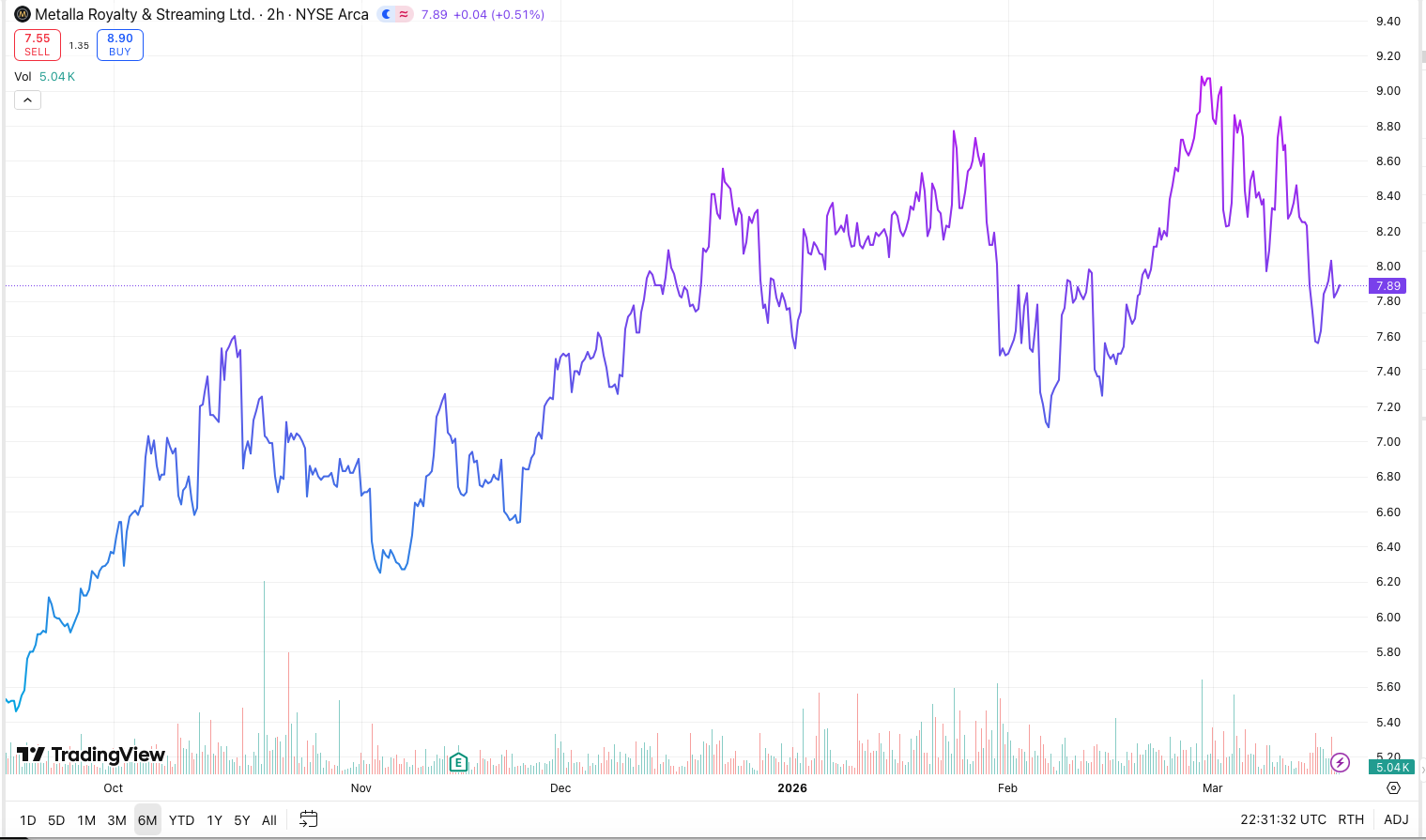
*MTA* Shows Signs of life at the open Runs then pulls back a bit BUT…
The post market ticker tape is back over $8.00…
We’re gonna keep this one going. Gold Was down but this was Up!!
there’s more unfolding to this story.. We can feel it!
So here we go!
ROUND 2 Starts tomorrow!
*NYSE:MTA*
and this still looks GOLDEN (6 month chart)
Full report below compensation in the disclaimer.
Metalla Royalty & Streaming (MTA): A High-Margin Gateway to Strong Gold, Resilient Silver, and Copper’s Structural Supply Crunch!
MTA is Leveraged Exposure to Record Gold, Surging Silver, and Copper’s Structural Supply Crunch — Without the Operational Risk of Mining!
Greetings All,
Gold has reasserted itself as a monetary anchor in an era defined by inflation persistence, sovereign debt expansion, and central bank accumulation. Silver’s dual role as both a store of value and a critical industrial input is amplifying upside pressure as renewable energy and electrification demand accelerates. Copper, meanwhile, is increasingly viewed as a strategic metal essential to energy security, electric vehicles, and next-generation infrastructure—just as new supply struggles to come online.
Within this backdrop, companies that can offer leveraged exposure to all three metals—without the capital intensity and operational volatility of mining—stand out.
Metalla Royalty & Streaming (NYSE: MTA) is emerging as one of those differentiated platforms.
A Royalty Model Built for Margin Expansion
MTA operates a royalty and streaming model, meaning it provides capital to mining operators in exchange for a percentage of future production or revenue. It does not operate mines. It does not bear sustaining capital costs. It does not face labor disputes, environmental liabilities, or cost overruns!
Instead, itreceives top-line exposure to metal prices and production growth.
In a rising price environment—especially one where cost inflation pressures miners—this model can produce expanding margins and scalable cash flow. As production increases across its underlying assets, revenue can grow without proportional increases in expenses. That structural advantage becomes particularly powerful during strong commodity cycles like the one that has been unfolding. Gold and silver hit record highs in early 2026.
A Clear Financial Inflection Point
The third quarter of 2025 marked a defining milestone. MTA reported its first-ever profitable quarter, with revenue more than doubling year-over-year to $4 million and net income turning positive.
Management characterized the quarter as a “step-change” moment—signaling that the company’s portfolio has reached the scale necessary to generate sustainable earnings.
This transition from portfolio builder to cash-flow generator is critical. Royalty companies often require years of disciplined asset accumulation before meaningful earnings materialize.
With profitability now established and multiple development assets advancing toward production, MTAappears to be entering a new phase of financial maturity.
Diversified Exposure Across Gold, Silver, and Copper
MTA’s portfolio includes approximately 100 royalties spanning producing, development, and exploration-stage assets across gold, silver, and copper.
This diversification reduces reliance on any single project while embedding multiple pathways to upside through mine expansions, restarts, feasibility updates, and exploration success.
Its exposure aligns closely with the dominant macro forces of 2026.
Gold’s surge reflects monetary hedging and central bank demand. Silver’s breakout is supported by accelerating industrial usage in solar and electrification. Copper faces projected structural supply deficits as electric vehicles, renewable infrastructure, and AI-driven data centers expand globally.
By holding royalties across all three metals, MTA captures both precious-metal monetary demand and base-metal industrial growth.
Built-In Catalysts Without Additional Capital Risk
A distinguishing feature of the royalty model is perpetual optionality. As operators advance projects, expand capacity, extend mine lives, or discover additional resources, the royalty holder benefits automatically—without investing incremental capital.
MTA’s portfolio includes numerous near-term catalysts: mine restarts, production ramp-ups, staged expansions, permitting milestones, and construction decisions across multiple jurisdictions. Each development has the potential to increase attributable production and royalty revenue, reinforcing the company’s ability to compound cash flow over time.
Institutional Validation and Strategic Capital
Another noteworthy development has been institutional interest. Public disclosures revealed that affiliated entities of Tether collectively hold approximately 8.9% of MTA’s outstanding shares.
As one of the largest physical gold buyers in recent quarters, Tether-linked capital entering the royalty space highlights a broader convergence between digital liquidity and hard-asset exposure.
While the investment remains passive, the presence of a well-capitalized and globally recognized financial player adds visibility and may signal confidence in the long-term thesis surrounding precious metals and diversified royalty platforms.
Why Streaming and Royalties Can Outperform Traditional Mining in Volatile Commodity Cycles
Unlike traditional mining companies, royalty and streaming businesses do not operate mines, manage labor forces, fund sustaining capital, or absorb cost overruns.
Instead, they provide upfront financing to operators in exchange for a percentage of future production (royalties) or the right to purchase metal at predetermined, discounted prices (streams).
This structure allows them to maintain exposure to rising gold, silver, and copper prices while avoiding many of the operational risks that can erode margins during inflationary periods.
When energy, labor, or equipment costs rise, miners feel the pressure directly—royalty and streaming companies generally do not. As production grows or metal prices increase, their revenue can scale with minimal incremental expense.
The Bottom Line
The metals breakout seen in early 2026 was driven by monetary instability, industrial transformation, and strategic de-risking from concentrated supply chains. Gold’s record highs, silver’s industrial acceleration, and copper’s tightening structural supply picture together form a powerful macro backdrop.
Within this environment, Metalla Royalty & Streaming (MTA) offers leveraged exposure to all three metals through a diversified, high-margin royalty model that minimizes operational risk while maximizing upside participation.
With its first profitable quarter behind it, a deep pipeline of catalysts ahead, and growing institutional attention, MTA appears increasingly positioned to benefit. Start your research!
Disclaimer
Hugealerts.com and Tradingwire.com are owned by Sideways Frequencey LLC (“Sideways Frequency”). Press releases, research reports, company profiles and other investor relations materials, publications or presentations, including web content (investor awareness services) released by Hugealerts.com and Tradingwire.com are based on publicly available data obtained from sources we believe to be reliable but are not guaranteed as to accuracy and are not purported to be complete. As such, the information should not be construed as advice designed to meet the particular investment needs of any investor. Furthermore, some of the content contained in our publications and websites may contain forward-looking statements found in information made publicly available by the companies we highlight. This forward looking information fits within the meaning of Section 27A of the Securities Act of 1933 and Section 21E of the Securities Exchange Act of 1934 including statements regarding future possible events, expected continual growth of a company, the potential value of its securities, and look forward in time which include everything other than historical information, involve risk and uncertainties that may affect a company’s actual results of operation. We therefore strongly encourage that you visit and review any and all financial information made publicly available by highlighted companies. Any opinions expressed in Hugealerts.com and Tradingwire.com reports, company profiles, or other investor relations materials and presentations are subject to change, are expressed and given as of the date of publication, and we disclaim any obligation to advise you of any change in any information contained herein. The information contained herein is not intended to be used as the basis for investment decisions and should not be construed as advice intended to meet the particular investment needs of any investor. The information contained herein is not a representation or warranty and is not an offer or solicitation of an offer to buy or sell any security. To the fullest extent of the law, Hugealerts.com,Tradingwire.com and their affiliates, specialists, advisors, and partners will not be liable to any person or entity for the quality, accuracy, completeness, reliability or timeliness of the information provided, or for any direct, indirect, consequential, incidental, special or punitive damages that may arise out of the use of information provided to any person or entity (including but not limited to lost profits, loss of opportunities, trading losses and damages that may result from any inaccuracy or incompleteness of this information). Stock market investing is inherently risky. Hugealerts.com, Tradingwire.com and their affiliates are not responsible for any gains or losses that result from the opinions expressed in press releases, on this website, in its research reports, company profiles or in other investor relations materials or presentations that it publishes electronically or in print. We strongly encourage all investors to conduct their own research before making any investment decision. For more information on stock market investing, visit the Securities and Exchange Commission (“SEC”) at www.sec.gov. and/or the Ontario Securities Commission (“OSC”) at www.osc.gov.on.ca. and/or the British Columbia Securities Commission (“BCSC”) at https://www.bcsc.bc.ca/.
Income Disclosure
Sideways Frequency has been retained by Metalla Royalty and streaming LTD (NYSE:MTA).and has received cash compensation of $150,000.00 to perform promotional and advertising services for a limited time. This agreement has been ongoing since February 2026 and is related to the engagement of investor awareness services for Metalla Royalty and streaming LTD (NYSE:MTA).. Sideways Frequency,Hugealerts.com, Tradingwire.com and their partners and affiliates may buy and sell shares of securities or options and warrants of the companies mentioned on this website at any time.
Sideways Frequency LLC and its affiliates may buy and sell shares of securities or options and warrants of the companies mentioned in this publication or website at any time but are not and will not at any time become affiliates or owners of more than 5% of the issued and outstanding stock of the highlighted companies.
Sideways Frequency and its beneficial owners and affiliates, including Hugealerts.com and Tradingwire.com do not own any shares in Metalla Royalty and streaming LTD (NYSE:MTA).
Investor awareness services and programs are designed to help small-cap companies communicate their investment characteristics. Sideways Frequency, Hugealerts.com, Tradingwire.com and their investor awareness services include the preparation of a research profile(s), multimedia marketing, and other awareness services based on the publicly available information of our clients and prepared by our partners. As such, our opinion is neither unbiased nor independent, and you should consider that when evaluating our statements regarding Metalla Royalty and streaming LTD (NYSE:MTA).
$131.44+0.17 (+0.13%)(As of 04:00 PM ET)30 DAY PERFORMANCE-7.85% 90 DAY PERFORMANCE +6.83%1 YEAR PERFORMANCE +45.33%
MARKET CAPITALIZATION
$8.56B
P/E RATIO
10.67
DIVIDEND YIELD
2.28%
ABOUT POPULAR
Popular, Inc., headquartered in San Juan, Puerto Rico, is a financial holding company and a leading provider of banking services in the United States mainland and Puerto Rico. Through its primary subsidiaries—Banco Popular de Puerto Rico and Popular Bank—the company delivers comprehensive commercial and consumer banking solutions. It offers deposit products, lending facilities, cash management services and payment-processing solutions designed for individuals, small businesses and large corporations. The company’s product suite encompasses checking and savings accounts, certificates of… Read Full Profile ▷
BPOP COMPANY CALENDAR
DEC 5, 2025Ex-Dividend for 1/2 DividendJAN 2, 2026Dividend PayableJAN 27, 2026Last EarningsMAR 17, 2026TodayMAR 18, 2026Ex-Dividend for 4/1 DividendAPR 1, 2026Dividend PayableAPR 22, 2026Next Earnings (Estimated)DEC 31, 2026Fiscal Year End
The Wall Street Journal is asking whether a stock market crash is coming. Research from Weiss Ratings suggests the first half of 2026 could be very tough for certain stocks as a radical shift hits the market. Some of America’s most popular names could take serious damage. Analysts have identified five stocks you should consider avoiding before this event plays out. If these are in your portfolio, you’ll want to review your positions carefully.See the five stocks to avoid and learn what’s driving this shift. ▷
Nebius Group is well-positioned to deliver on its swelling backlog, but there is a hurdle, and it’s debt. The good news is that it will be an easy jump.Read The Full Story ▷
Can the differentiated cybersecurity stock Rubrik stage a recovery with its shares down over 30% in 2026? The several factors point to the answer being yes.Read The Full Story ▷
Palantir and NVIDIA are launching a sovereign AI system that lets governments and enterprises control their data while deploying AI infrastructure at scaleRead The Full Story ▷
Ollie’s Bargain Outlet posted strong revenue growth in Q4 despite slim misses on earnings and guidance, with both comp-store sales and store expansion outpacing expectations.
The Big Lots bankruptcy is creating a customer conversion opportunity that analysts believe has years left to play out—and isn’t yet reflected in the stock price.
Institutional investors own nearly all of the float and have been steady buyers, backing a company that funds its own growth and trades below every analyst’s target.
Ollie’s Bargain Outlet’s (NASDAQ: OLLI) stock price downtrend is over. The Q4 2025 results are in, and they reaffirmed a robust outlook. Although the report was below the consensus forecast and guidance followed suit, the misses were slim, growth and outlook are robust, and the weakness wasn’t as unexpected as the consensus suggested.
Analysts at RBC issued cautionary statements ahead of the release while highlighting the company’s position, aggressive expansion, and potential for outperformance in the coming years. In their view, the Big Lots bankruptcy and customer conversion to Ollie’s are multi-year events yet to play out, and it’s not priced into the stock.
Ollie’s had a strong quarter despite revenue growth falling short of the consensus estimate. The company’s $779.26 million in net revenue is up 16.8% year-over-year, well ahead of competitors, underpinned by better-than-expected comp and store-count growth. The comp came in at 3.6%, slightly better than RBC’s forecast, while store count increased by 15.4%.
Margin news is also solid despite falling short, with spending control and revenue leverage offsetting store opening expenses. Adjusted EPS missed the consensus by two cents, but the miss is slim, and earnings growth outpaced revenue by a narrow margin. Looking ahead, opening expenses are coming and should return to trend, providing visibility into margin and earnings quality improvements over the next two to three years.
Guidance is likewise tepid relative to MarketBeat’s reported consensus, narrowly falling short of consensus, although expecting solid growth. As it stands, the company expects revenue in the range of $2.985 billion to $3.013 billion, with a midpoint just short of the $3 billion consensus, and an earnings midpoint of $4.45 versus $4.53 expected, which amounts to about 10% on the top line.
Ollie’s Cautious Guidance Sets Stage for Bullish Revision Cycle
Among the opportunities for investors is the potential for cautious guidance, which is significant. Not only is there last year’s 15.4% store-count growth to consider, but the company plans to add another 11.6% in stores this year, and there are other tailwinds brewing. Analysts forecast potential for consumer tailwinds tied to tax season. Not only are returns being delivered, but the average check is more than 10% larger than last year, providing liquidity to Ollie’s consumer base. In this scenario, Ollie’s will outperform guidance, improve it as the year progresses, leading analysts into a similarly bullish cycle.
Ollie’s carries a Moderate Buy consensus rating with no Sell ratings among the 16 analysts tracked by MarketBeat. No revisions were issued immediately after the Q4 release, but several analysts commented, highlighting the growth potential and strength in loyalty members (up 12.1%), while expressing concern about future comparisons. Not all believe in the long-term strength of the Big Lots conversion, but the group is bullish on the stock price, forecasting an average upside of roughly 30%. Ollie’s stock trades below the low end of the analysts’ range in early March, underscoring the deep-value opportunity and potential for a rebound.
Institutions reveal the real opportunity, as they own almost 100% of this stock and buy on a quarterly basis. Reasons for them to own it include the fortress balance sheet, self-funded growth, growth outlook, and cash flow. The capital return potential adds another layer.
The company doesn’t pay dividends, choosing to reinvest instead, but it does buy back shares in sufficient quantity to offset any dilution. The share count decline is incremental, but there, providing a base from which future returns can grow. Competitors and industry leaders such as TJX Companies (NYSE: TJX) are well-known dividend and share-repurchase machines, a status Ollie’s is growing into.
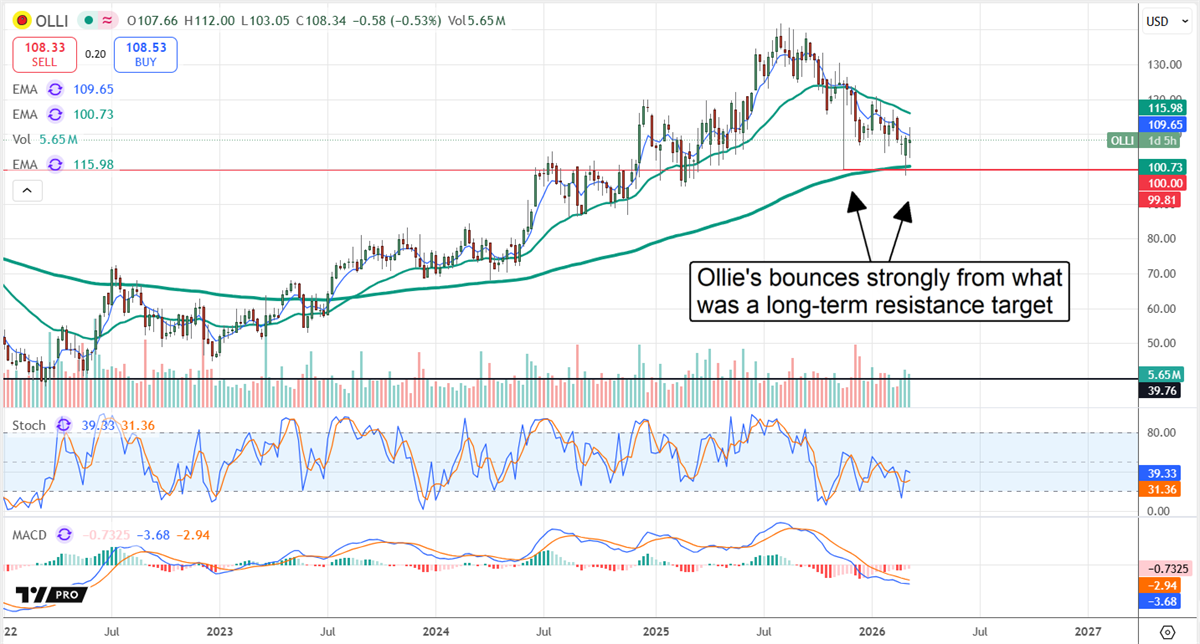
Ollie’s stock price hit rock bottom late in 2025, rebounded quickly, and retested the level again in early 2026. Following the guidance update, shares rose more than 5%, confirming support at this crucial level. This level is significant because it was a resistance target set in 2019 that was broken in early 2025 and is now confirmed as a new, strong support level for this market. The likely outcome is that this market will continue advancing in 2026, potentially accelerating the move as the year progresses.
Vertical Options Trader subscribers are scheduled to receive their next set of trade recommendations Friday morning, March 20th.
If you sit this one out, you’ll miss up to 5 trade ideas this Friday, all built using Bernie’s vertical spread approach and designed to target gains of up to 300% while keeping risk clearly laid out before you ever enter the trade.
Here are a few recent examples of what that approach has delivered:
☑️ 101.3% on IonQ
☑️ 453.9% on Alphabet (Class A)
☑️ 423.9% on Tesla
☑️ 248.8% on Rigetti Computing
As you can imagine, results like these don’t come cheap…
If you were to rush to our official store page and look for Vertical Options Trader, you’d be met with the yearly subscription fee of $1,995.
And considering the trade volume and the type of triple-digit gains this strategy is built to target month after month, that price really isn’t a bad bargain if you ask me… just one solid trade can go a long way toward covering your subscription.
In other words, this is designed to be something you can come back to again and again, without worrying about renewals, re-billing, or whether your access is going to disappear.
This is a deal you won’t see again after this email. Either you take us up on it, try the service for yourself, and see what this approach can do… or you pass and miss out entirely.
Your call. I’m hoping when I log on tomorrow, I see that your name was added to our distribution list.Join Right Now!
Avoid risky picks! The Safe Stock Selector Checklist reveals how to find strong, reliable stocks before the crowd catches on. Get Your Free Report Now. [ad]
Louis Navellier spent 46 years building a system that measures what institutions measure before they buy. When his grading system upgrades a stock from C to B, it means: BlackRock, Vanguard others could be about to deploy billions. That’s when retail investors should buy – not 6 months later when CNBC covers it. Get 3 FREE STOCK SEARCHES and see how YOUR stocks grade right now. [ad]
Conflict in Iran has sent oil prices up, prompting some experts to worry that stagflation, or low economic growth and high inflation, could be possible for the U.S. economy.
Privacy Policy | Advertiser DisclosureDISCLAIMER: Stocks and options trading have large potential rewards, but also large potential risk. You must be aware of the risks and be willing to accept them in order to invest in the stocks and options markets. Don’t trade with money you can’t afford to lose. This is neither a solicitation nor an offer to Buy/Sell stocks or options. No representation is being made that any account will or is likely to achieve profits or losses similar to those discussed in this report. The past performance of any trading system or methodology is not necessarily indicative of future results. All trades, patterns, charts, systems, etc., discussed in this report are for illustrative purposes only and not to be construed as specific advisory recommendations. Information contained in this correspondence is intended for informational purposes only and was obtained from sources believed to be reliable. Information is in no way guaranteed. No guarantee of any kind is implied or possible where projections of future conditions are attempted.
Stockguru LLC (dba InvestingDistrict), 2563 cherry hill ln, Hermitage, PA 16148, United StatesYou may unsubscribe or change your contact details at any time.

 Insights, trends, and perspectives shaping today’s investment landscape.