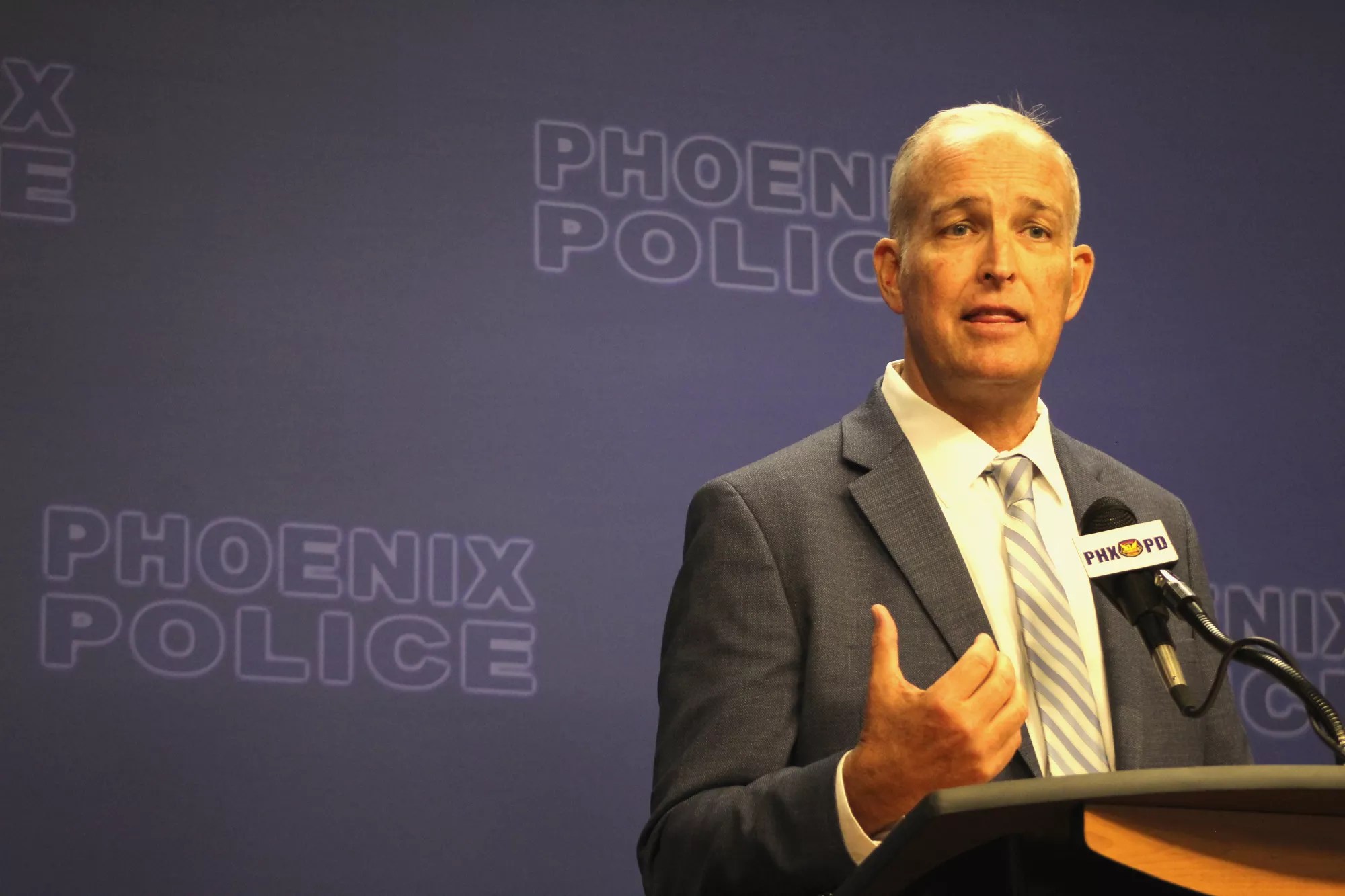
With our childcare waitlist containing that many names, it’s bad for Arizona’s economy. Different reports cite different numbers, but either way the results are clear. The lack of affordable childcare costs Arizona billions of dollars every single year!
Love New Times? Thanks to a recent Google update, you can now select us as a preferred source to see our stories first in search results. Thank you in advance for your ongoing support of local journalism.
Formula One Digital Media Limited is a company registered in England and Wales with registered number 8915039 with its registered office at N° 2 St James’s Market, London, SW1Y 4AH.The F1 FORMULA 1 logo, F1 logo, FORMULA 1, F1, FIA FORMULA ONE WORLD CHAMPIONSHIP, GRAND PRIX and related marks are trademarks of Formula One Licensing BV, a Formula 1 company. All rights reserved.
The real struggle with credit card debt isn’t just the balance — It’s the sky-high interest that keeps piling up, making it feel like you’re stuck in place no matter how much you pay.
But this St. Patrick’s Day, there’s a little luck on your side.☘️
CardCritics has rounded up the best balance transfer cards that let you pause interest for nearly 2 years, so your payments can actually go toward paying down your balance — not just the interest.
These cards can make a real difference with: 🧾 0% intro APR on balance transfers 💰 Major savings on interest — potentially hundreds or even thousands 🚫💳 $0 annual fees — so you’re not paying just to keep the card
This email is never sent unsolicited. You have received this Newsmax email because you subscribed to it or someone forwarded it to you. To opt out, see the links below.
Remove your email address from our list or modifyyour profile. We respect your right to privacy. Viewour policy.
This email was sent by: Newsmax.com 362 N. Haverhill Road West Palm Beach, FL 33415 USA
The Permanent Campaign is brought to you today in partnership with Inside Scoop
Issue: 3/16/2026
$10B TikTok Fee for White House
The Trump administration is set to collect roughly $10 billion from investors who took control of TikTok’s U.S. operations, according to reports from the Wall Street Journal, a near-unprecedented fee for a government’s role in brokering a private deal.
Oracle, Silver Lake, and Abu Dhabi investor MGX paid the Treasury about $2.5 billion at the deal’s close in January, with additional payments scheduled to continue until the total reaches $10 billion.
Vice President JD Vance has said the new U.S. entity is valued at about $14 billion, a figure some analysts say dramatically undervalues the platform and its 170 million American users. The deal adds to a growing list of administration moves extracting value from the private sector, including a 10% stake in Intel and a cut of Nvidia chip sales to China.★★★ Iran Rejects Talks with US
President Trump said Saturday that Iran wanted to make a deal but that the terms weren’t good enough, demanding Tehran abandon its nuclear ambitions and adding that he’s hearing the new supreme leader may “not be alive”.
Iran’s foreign minister fired back Sunday, saying Tehran has never asked for a ceasefire and insisting the new leader is in “good health,” though he has yet to appear publicly.
Israel said it struck more than 200 targets across Iran on Sunday alone, expanding operations into western and central Iran, while Gulf states reported fresh waves of Iranian drone and missile attacks.
Germany became the first major ally to publicly decline Trump’s call for warships in the Strait of Hormuz, though South Korea, Britain, and Japan said they were reviewing the request.★★★ Trump Rallies World on Hormuz
President Trump is building an international coalition to reopen the Strait of Hormuz, telling reporters aboard Air Force One he’s spoken to “about seven” countries about sending warships to secure the critical waterway.
Defense Secretary Pete Hegseth is deploying the USS Tripoli and its Marine expeditionary unit to the region as Brent crude hovers near $105 a barrel.
Trump posted on Truth Social that the U.S. has “destroyed 100% of Iran’s Military capability” but acknowledged lingering threats from drones and mines, vowing to keep “bombing the hell out of the shoreline” until the Strait is open.
He also spoke on Sunday by phone with U.K. Prime Minister Keir Starmer about reopening Hormuz to end the disruption to global shipping. Texas Runoff Heats Up
MAGA voters are pressuring Trump not to endorse Sen. Cornyn in his May 26 runoff against AG Ken Paxton, who offered to drop out if the Senate kills the filibuster to pass the SAVE Act. Trump has yet to pick a side.
★★★ Senate Map: GOP Plays Offense
Fox News Digital’s new breakdown of the top 10 Senate battlegrounds shows Republicans eyeing flips in Georgia and Michigan while defending open seats in Maine, North Carolina, Iowa, and Alaska.
★★★ Wiles Diagnosed, Staying on the Job
President Trump announced Monday that Chief of Staff Susie Wiles has been diagnosed with early-stage breast cancer and will begin treatment immediately while continuing to work full-time at the White House. Trump called her prognosis “excellent.”
ICE Scales Up Detention
ICE plans to boost detention capacity to 92,600 beds under a $38 billion overhaul, including eight mega-centers and 16 processing sites, funded through the One Big Beautiful Bill.
★★★ Mullin Hearing Wednesday
Sen. Markwayne Mullin’s confirmation hearing to lead DHS is set for March 18 before the Senate Homeland Security Committee, chaired by Sen. Rand Paul. Trump wants him in the job by month’s end.
★★★ SAVE Act Floor Takeover
Trump allies led by Sen. Mike Lee are planning a Senate floor takeover this week to force a marathon debate on the SAVE America Act, modeling it after the 60-day battle that preceded the 1964 Civil Rights Act.
Today’s section is brought to you by:
These Sheets Prevent 99.7% of Bacteria (And Feel Better Than a Hotel Bed). Say goodbye to stale, sweaty sheets.Miracle Made’s silver-infused bedding stays cooler and fresher, helping prevent up to 99.7% of bacteria growth—so you can enjoy a cleaner, more comfortable, hotel-fresh sleep every single night. (LEARN MORE)
Trump Approval Jumps to 44% — Trump at 44% approve, 54% disapprove, with a Presidential Approval Index of -15. Thirty percent strongly approve while 45% strongly disapprove.
Senate Battleground — Fox News Digital’s analysis of the top 10 Senate races shows Republicans defending seats in Maine, North Carolina, and Alaska while eyeing flips in Michigan and Georgia.
SAVE Act Popular — A Harvard CAPS/Harris poll found 71% of registered voters support the SAVE America Act’s voter ID and proof-of-citizenship requirements — yet every Senate Democrat has vowed to filibuster it.
Iran War Successful — Sixty-one percent of likely voters say Operation Epic Fury has been successful so far, including 35% who call it “very successful.” Just 29% disagree.
Art of the Deal, TikTok Edition The White House is pocketing $10 billion just for brokering a deal that saved 170 million users’ favorite app and kept American data on American soil. Try getting that kind of return from a government program.
Iran’s Phantom Leader Trump openly questioned whether Mojtaba Khamenei is even alive. The new supreme leader hasn’t appeared publicly, hasn’t spoken on camera, and his “first statement” was read by a news anchor holding a framed photo. Not exactly a show of strength from Tehran.
Obama’s Own Guys Say Dems Are Cooked Two former Obama campaign managers told Axios the Democratic Party is a directionless mess. Jim Messina admitted the party’s midterm strategy is “85-90% driven by opposition to Trump” with no affirmative message. David Plouffe warned Dems can’t win “in what are now red states.” When Obama’s brain trust says you’re lost, you’re lost.
Cuba Is Next While Iran burns, Cubans are torching Communist Party headquarters as Trump’s diplomatic moves spark hope across the island. House Intel Chair Rep. Rick Crawford says flat-out: “Cuba is done. It’s just now a question of when, not if.” The dominoes are falling.
Michigan Synagogue Attack: The Threat Is Here The attacker who stormed a Michigan synagogue and kindergarten last week was a Lebanese national who lost family members in Israeli strikes on Lebanon. The FBI is investigating it as a targeted act of violence against the Jewish community. This is exactly the kind of threat Trump warned about when he secured the border.
“Iran wants to make a deal, and I don’t want to make it because the terms aren’t good enough yet.” -President Donald Trump, NBC News interview, March 14, 2026
Trump’s GENIUS Act has given crypto its first official federal framework. While attention stays on Bitcoin, one overlooked coin could benefit the most—backed by skyrocketing volume, early fund activity, and pro-crypto policy momentum.
The market’s holding its breath. US equity futures slipped lower Tuesday morning while oil prices pushed higher, a combination that tells you everything about where investor attention sits right now. The Federal Reserve’s upcoming policy meeting dominates the conversation, and traders aren’t waiting around to find out what happens next. This pre-meeting jitters pattern has become familiar territory.
Miss this and you could miss tomorrow’s best moves. The American Market Brief delivers early insights on sectors, stocks, and market strategies. It’s free, fast, and clear.
Privacy Policy / DisclosuresAdvertising Disclosure: This email contains paid advertisements. This email is from our associates at The Wealthiest Investor.
Legal Entity Information: The Wealthiest Investor is owned and operated by Darwin Investor Network, a DBA of The Darwin Agency, Inc.
Disclaimer: Nothing in this email should be considered personalized financial advice. Always conduct your own due diligence when investing. We urge you to read our full disclaimer by clicking on the terms of use link below.
Unsubscribe: You are receiving this email as part of your complimentary subscription to the The Wealthiest Investor E-Letter. If you would like to unsubscribe, you can do so by clicking on the unsubscribe link below.Darwin Investor Network 2319 N Andrews Avenue, Fort Lauderdale, FL 33311 support@thewealthiestinvestor.com | 1-800-496-9838The Wealthiest Investor | Privacy Policy | Terms of Use Unsubscribe | View Online
Editor’s note: As Silicon Valley power players battle to achieve Artificial General Intelligence (“AGI”), a more powerful force threatens to stop AI’s progress dead in its tracks.
According to futurist Eric Fry from our corporate affiliate InvestorPlace, as this critical bottleneck comes to light, investors will witness a market-wide regime change, violently ejecting today’s winners and replacing them with a brand-new class of unexpected companies.
Eric is sharing the full list of companies he says to buy and sell as this $10 trillion market shock unfolds, which you can learn about below…
Dear Reader,
On the morning of August 12, 2024, I sat down in a recording studio in Baltimore and said something that sounded absurd to almost everyone in the room.
I declared that artificial general intelligence (“AGI”) — superhuman AI with its own version of free will — would emerge from Silicon Valley labs in 2026.
At the time, the expert consensus said we had until 2030.
Fast forward to today, and multiple reputable sources are confirming what I predicted: AGI is here.
This is, without question, the most significant technological development in human history.
The market shock is the counterintuitive call nobody wants to hear — but that could save you from ruin…
AGI is the holy grail that Elon Musk, Mark Zuckerberg, and Sam Altman have spent hundreds of billions of dollars racing to achieve.
And now that it’s beginning to emerge… the Magnificent Seven stocks that funded that race are the last place you want your money.
I know how that sounds. But it wouldn’t be the first time one of my absurd calls became tomorrow’s reality.
In 2000, when the Internet boom was still booming — and companies like Cisco were growing revenues by 50% a year — I told my readers to get out of tech.
The crowd called it absurd. The charts called it absurd. The headlines called it absurd.
Then the crash came.
Tech stocks I said to sell fell 64% to 85%. Investors who didn’t listen watched years of gains evaporate almost overnight.
But the readers who followed my buyrecommendations into overlooked, asset-heavy companies?
They saw gains of 159%… 206%… 271%… even 1,004% — while everyone else was picking up the pieces.
Here’s exactly how my buy and sell calls looked, side by side:
That’s what happens when you get out in front of a regime change instead of being run over by it.
I believe we are at that same inflection point right now, except…
This time around, the stakes are even higher…
Beginning April 24, a series of announcements out of the world’s most powerful AI companies will expose cracks in the AGI story that Wall Street is not prepared for.
First, the headlines will insist everything is fine.
Then the selling will start.
By the time the average investor figures out why the biggest names in the market are falling by as much as 50%, it will be too late to protect themselves — let alone position for what comes next.
That’s why I’m hosting FutureProof 2026 onWednesday, March 18, at 1 p.m. Eastern time— a free live event where I’ll release my complete Market Shock Profit Playbook, including 15 stock names and tickers I predict could receive an influx of $10 trillion in capital in the wake of the Market Shock.
The readers who acted on my dot-com calls didn’t wait until after the crash to do so.
I’ll show you exactly which stocks to sell, which to buy, and where I believe the smart money is moving next.
The time to get futureproofed is now.
Sincerely,
Eric Fry Futurist and Senior Analyst, InvestorPlace
You are receiving this e-mail because you are a subscriber to Chaikin Analytics content. To unsubscribe from special offers like this one, click here to unsubscribe.
Published by Chaikin Analytics, LLC.
You’re receiving this e-mail at pahovis@aol.com. For questions about your account or to speak with customer service, call +1 (877) 697-6783 (U.S.), 9 a.m. – 5 p.m. Eastern time or e-mail info@chaikinanalytics.com. Please note: The law prohibits us from giving personalized financial advice.