A Manager’s Guide to Clear And Effective Communication
Managers often carry an exhaustion unrelated to workload.
It’s the exhaustion of being misunderstood, of speaking and seeing your words land differently than intended, of sensing a gap between intention and what is heard.
This gap is not a personal failure. It’s a pattern. And it has a name; unclear connection.
The Real Work
Good communication isn’t about being a better talker. It’s about being a steadier presence first.
When you’re regulated—when your nervous system isn’t in reaction—your words find their landing spot more naturally. Your team hears not just the content, but the intention behind it. They feel safe enough to pose clarifying questions rather than occupy the silence with assumptions.
This is what I mean by corporate connection; it’s the alignment between what you intend to say and what actually lands. It happens in small moments. A one-on-one conversation. A team meeting. A difficult feedback conversation.
The key is clarity of intention and a calm, steady presence.
What This Invites
When you communicate from a centred place, something changes.
Your team stops defending and starts listening. Misunderstandings become fewer. Trust builds slowly, steadily.
This is not a quick win. But it is a practice you can deepen.
Uncover your Leadership Communication
Personality
Get the five steps to taking your leadership communication to the next level!Take the quiz now!
In the “Mailbag” below, a dear paid-up subscriber takes me to task about not treating our revered political leaders with more respect.
He objected to my “Ms. Boozy McMumbles” literary flourish. And, like all fanatics tend to do, accused me of being unfairly prejudiced against his “team.”
How did he miss my repeated use of the popular slur “Orange Man”? Or my invention of the moniker “Obama!” almost 20 years ago? Or my adoption of the retard-inspired nickname “The Decider” during our disastrous Iraqi war? Or any of my other notorious and disrespectful critiques of our bankrupt, corrupt, vile government, and the sociopaths who populate it?
About two weeks ago, I led my analysis of our latest foreign war with an essay inspired by Eric Hoffer’s book The True Believer (1951).
I didn’t realize most of my dear, paid-up subscribers had never heard of him.
Hoffer is the greatest American-born philosopher – a man whose entire understanding of human nature was formed by our country and its development. Hoffer lived through America’s transition from a limited republic to an all-powerful, mob-ruled democracy. And he tried to warn what would happen.
Hoffer was born in New York City in 1902. When he was five, he and his mother fell down a flight of stairs. She died. He went blind. For eight years, he couldn’t see. His vision inexplicably returned at age 15. Driven by the fear he would lose his sight again, he began to read voraciously and constantly – a practice he continued his entire life.
His father died in 1920, leaving Hoffer without a family. He began a life of itinerant labor, working as a migrant farmworker, doing odd jobs around Los Angeles, and, finally, in 1943, becoming a San Francisco longshoreman. Through these experiences he observed people from all walks of American life and developed hard-won insight into human nature. He authored 10 books and received the Presidential Medal of Freedom from Ronald Reagan in 1983. He led an incredible life.
If you’ve never read his books about how human nature can lead to fanatical political beliefs, I recommend The True Believer and The Passionate State of Mind (1955). These books, along with Hannah Arendt’s The Origins of Totalitarianism (1951) and Stanley Milgram’s Obedience to Authority (1961) offer a stark warning about the world we see unfolding today.
Arendt’s study of the Nazi movement uncovered a key insight that Hoffer’s work also described: the inherent human need to belong. As Arendt explained:
What prepares men for totalitarian domination in the non-totalitarian world is the fact that loneliness, once a borderline experience usually suffered in certain marginal social conditions like old age, has become an everyday experience of the ever-growing masses of our century.
Think about how social media and the government’s response to COVID has increased social isolation. More Americans spend more time consistently alone than ever before. And for these people, the need to belong to something – to anything – becomes overwhelming. That’s why embracing even the most obvious and absurd lies becomes the gateway to belonging.
Arendt observed:
Instead of deserting the leaders who had lied to them, they would protest that they had known all along that the statement was a lie and would admire the leaders for their superior tactical cleverness.
How many times in the past year have I heard otherwise very intelligent and sophisticated people say that U.S. President Donald Trump is playing “4-D chess” to magically wave off obvious lies and absurd economic claims?
As longtime readers know, I do not believe our latest military adventure in the Persian Gulf will end cheaply or easily – just as the others did not.
I know that our military capabilities are virtually unlimited. I don’t think it’s likely that Iran will be able to strike back in any strategically meaningful way. What I suspect will happen is a long period of increasing unrest in the region. It’s nothing that will threaten American sovereignty. But it will be a big enough problem to make trillions of dollars in profits for our largest defense contractors and our biggest energy companies.
The bigger, long-term risk lies in the Republican Party’s adoption of tariffs as a means of generating government revenue.
These lies are particularly insidious because they have conservatives – who typically oppose raising taxes – joyfully extolling the virtues of them!
And… when I explain (as I’ll do below) that tariffs are merely taxes and more government is never the answer? You see the true believers emerge. Contrary facts do not change their minds. They deepen their conviction.
Nevertheless, it’s only facts I have to offer.
So let me show you, in detail using specific companies, why tariffs are no panacea. In fact, it’s because America is the largest, free-trade economy that tariffs pose such a threat to our wealth. We can’t win a trade war because we have the most to lose.
Let’s start with Nike (NKE).
Nike’s global brand dominance pays huge dividends for America. It – along with Coke (KO), McDonald’s (MCD), Microsoft (MSFT), Disney (DIS), and Hollywood – demonstrates the sheer power and quality of our free-market economy to the entire world.
But Nike, like virtually every other major U.S. business, is not a traditional “American manufacturer” in the old sense. It doesn’t own factories – it orchestrates a global, multi‑country supply chain. Nike matches each task in its apparel business to the country that can do it best.
These country-specific advantages have been created over decades through heavy investments into distinct regional ecosystems.
Almost all of Nike’s shoes and a large chunk of its apparel are made in low‑cost Asian hubs like Vietnam, China, and Indonesia. These regions have built entire ecosystems – raw materials, specialized component suppliers, skilled line workers, and localized logistics – around footwear and textiles.
The U.S., meanwhile, specializes in the high-value, high-return work: design, intellectual property, marketing, finance, and e‑commerce.
By marrying these two advantages, Nike creates enormous value. Nike is monetizing these comparative advantages all across the global economy.
When you look at the cost of a typical Nike shoe, the labor component in Vietnam or Indonesia is only a few dollars per pair. The total factory production cost might be in the mid‑teens. That is what enables Nike to produce high-quality shoes for around $100.
Nike’s massive profit margin – and its massive global marketing budget – is created by the efficiency of this supply chain.
By letting each area of the world do what it does best, America gets to keep all the highest-paid staff: the designers, R&D engineers, marketers, accountants, lawyers, and executives.
When new tariffs hit the countries where Nike shoes are made, the result is a massive, recurring tax bill that costs the company billions.
Nike cannot realistically avoid these tariffs by moving shoe production to the United States. The U.S. no longer has a full end‑to‑end athletic footwear ecosystem. The molds, tooling, and trained workforce are in Asia. Rebuilding that ecosystem here would consume an enormous amount of capital and take years – and even then, our factories likely couldn’t produce shoes as well or as cheaply. By the time that ecosystem was built, Nike would be bankrupt. This kind of work – stitching, gluing, finishing – simply doesn’t scale here. More importantly, Nike shouldn’t invest its capital into those kinds of factories, because the return on that capital would be extremely low.
Tariffs will not create an American comparative advantage in low‑margin, labor‑intensive manufacturing. That industry migrated offshore for good reasons: U.S. entrepreneurs found better, cheaper ways to make shoes that required less of their capital, resulting in cheaper products and bigger profits. That is good for America!
As a bonus, this globalized system allows U.S. trading partners to share in the bounty of capitalism, raising their standard of living and fostering global stability.
If you think Nike is an outlier, look at the rest of the American economy. The collateral damage of tariffs is visible across virtually every sector:
Apple (AAPL): Apple is the ultimate example of U.S. intellectual property leveraging overseas assembly. The U.S. doesn’t just lack the cheap labor to build iPhones. It lacks the localized ecosystem of specialized screws, glass, and rare-earth components heavily concentrated in Asia. Tariffs won’t force Apple to build factories in Texas – they simply force Apple to pass a massive tax onto U.S. consumers.
Ford Motor (F): Tariffs actively harm domestic manufacturers, too. When the U.S. taxes the import of steel and aluminum, legacy companies like Ford take a massive hit. A modern vehicle’s supply chain crosses the U.S., Mexican, and Canadian borders dozens of times. Taxing these raw materials raises Ford’s production costs, forcing it to hike car prices and making the company less competitive globally.
Walmart (WMT): Walmart’s model relies on global supply chains to provide everyday goods at rock-bottom prices. Tariffs on imported clothing and electronics act as a highly regressive tax, disproportionately hurting lower- and middle-income Americans because Walmart’s margins are too thin to absorb a 25% tariff. The cost is immediately passed to the consumer.
Deere & Co. (DE): Tariffs trigger a deadly “double whammy” for companies like tractor maker John Deere. First, their input costs skyrocket due to metal tariffs. Second, tariffs trigger international retaliation. When foreign countries respond by taxing American agricultural exports (like soybeans), it crushes the income of American farmers – Deere’s core customers.
Sonos & iRobot: Mid-sized tech companies perfectly illustrate why tariffs fail to bring jobs back to America. When faced with sweeping tariffs on Chinese goods over the last few years, smart-speaker maker Sonos and Roomba creator iRobot didn’t reshore production to the Midwest. Instead, they spent millions uprooting their supply chains and moving them to Malaysia and Vietnam. Tariffs forced them to burn capital on an inefficient “supply-chain shuffle” rather than investing that money into American engineering jobs.
So, what happens when you slap a 25% tariff on a globally integrated U.S. company? They are forced into three bad choices:
Raise prices on U.S. consumers
Swallow lower margins and reduce investments in high-value American R&D and marketing
Play the Washington, D.C., power game, spending a fortune on lobbyists to get their specific supply chains excluded
All of these options are bad for America. They make our companies less efficient and less competitive internationally, and empower politicians. Most importantly, they act as a direct tax on the American consumer.
For a country like the U.S. – which is deeply specialized in the high‑value, wealth-generating pieces of the global supply chain – tariffs are the worst of all worlds. We bear the cost in higher prices and weaker multinational companies, without gaining a meaningful domestic manufacturing base in return.
But what about jobs?
America doesn’t lack for jobs. Unemployment is less than 5%. If you have a pulse, you can have a job in our economy. These tariffs will result in massive job losses, as our very best companies will have to lay off high-paying jobs in R&D, design, and marketing because the profit margins will all be reduced by these tariffs.
If you want America to have more wealth and to have more high-paying jobs, then you should insist that the government find a different way to raise revenue. Tariffs will destroy America’s economy.
Finally… My favorite true believer rebuttal to the tariff lie is that it’s not fair that Germany and Japan have tariffs but we don’t. To which I simply reply: why would we copy anything about their economic structures? Do we want those economies? America is vastly wealthier than all of the other major economies (and our lead is growing) because we have free trade.
Starting wars and enacting tariffs will not make us freer or richer.
Editor’s Note: Keep in mind, we only accept advertising from publishers we know to offer well-researched ideas vetted by a legal team, excellent customer service, and reasonable refund policies. Crowdability is one such partner. We do not, however, under any circumstances make any representations about their investment ideas or strategies, nor will we warrant them as equal to our own. We do recognize that the markets are tempestuous and, at times, ideas that we may not endorse prove valuable.
3 Things To Know Before We Go…
1. Oil execs warn the Iran energy crisis is likely to get worse. The CEOs of ExxonMobil (XOM), Chevron (CVX), and ConocoPhillips (COP) told White House officials last week that the Strait of Hormuz closure is creating a supply crisis with no quick fix. Crude oil prices are above $95 per barrel this morning, roughly 1,000 tankers remain stranded, and the International Energy Agency’s coordinated 400-million-barrel reserve release will cover just 26 days of the estimated 15-million-barrel-per-day shortfall. President Trump is now pressuring NATO, the UK, and China to send warships to reopen the strait – but so far, no country has committed forces. The administration says it wants the waterway reopened in weeks, not months, but that’s looking increasingly unlikely today.
2. An AI transformation for Credit Acceptance (CACC). New Credit Acceptance CEO Vinayak Hegde is repositioning the subprime auto lender (and Complete Investor recommendation) as an AI-powered lending platform – leveraging 30 years of data to achieve two-second loan approvals (10x faster), 70% faster tech deployment, and flat headcount despite growth. Citron Research has flipped its short position into a bullish $714 price target – a 60% bump from the current $445 per share.
3. Eli Lilly’s $3 billion China expansion. Eli Lilly (LLY) has announced a $3 billion, decade-long expansion into China aimed at localizing the production of orforglipron, its highly anticipated once-daily obesity pill. By shifting from complex injectables to a locally produced pill, Lilly aims to bypass global supply-chain logistics and critical syringe shortages to capture a GLP-1 market in China – where adult obesity rates are 50% – that could reach $14 billion by 2030.
Chart Of The Day… Big Coupang Insider Buy
Coupang (CPNG) board member and venture capitalist Neil Mehta purchased 7.35 million shares, worth roughly $136.5 million, of the South Korean e-commerce giant last week, following a 40% drop due to data breach.
Mailbag
“Your Letter From March 12 – Boozy McMumbles”
Eric H. writes:
Concerning your paragraph on war in the Gulf and impending inflation: thanks for your financial advice. However, the two bits of advice you offered are already painfully obvious.
Let me be clear – I have a real problem with the leader of a company (you) who refers to the former United States Vice President as “Boozy McMumbles.” You refer to the current president with respect by using his full name despite his destruction of the world economy. Let me remind you that she earned her status in law and government by hard work and integrity. She didn’t get there through any form of DEI. This shows very poor judgment on your part.
You probably thought, “Oh, I can just say whatever I think of her,” in a letter sent out to thousands of Americans – many of those who voted for her! Take note of this… every time a white man publicly degrades a very accomplished woman of color, people remember it! Some think it’s fine, while others see you as perpetuating the racial issues that have plagued this country for centuries. Either way, these are not beneficial effects.
Furthermore, you should issue a public apology to all those you offended. I am telling you right now that you offended a whole lot of people! I won’t be recommending your services to anyone I know anywhere at any time!
Porter Comment: Boot licker.
“If Harris Were Elected, There’d Be No War”
Doug W. writes:
I have followed you for years and have the utmost respect for your economic judgement. But being in the Cult, you’re not past throwing out complete BS.
E.g., when you write: “This isn’t about politics. I’m not saying we should have elected Ms. Boozy McMumbles.”
Who you recommend for political office isn’t about politics? And this is in spite of the extreme likelihood that if Kamala Harris had been elected, there’d be no war, the deficit would be significantly less (typical with Democratic presidents), and our streets would be much safer, as they were under President Joe Biden. And the rule of law would not be jeopardized by the actual boozy clowns in the incoherent infant’s cabinet.
Oh, there are the ultra-rich’s tax breaks that would not have happened. As if they need it, or won’t use it for anything other than PACs and similar vehicles to ensure the oligarchy obliterates the rule of law.
Maybe you don’t think so, but I believe that we all have a responsibility to chip in and do our part to make our country “great.” I’m happy to pay my taxes (especially when they don’t fund stupid wars), but why is this only for “suckers” as Trump would have it, and not for the ultra-rich who can afford it. I think that Eisenhower had it right.
Porter Comment: I don’t think you can look at Biden’s economic decisions or his open borders and claim he was good for our country. But either way, I don’t believe Harris would have made a good president. I think she would have been a national embarrassment, like Biden. At least Trump was promising (some of) the right things. But, because he dumped DOGE, started another war, and overseen an incredible expansion of government spending and deficits, the Dems will take back Congress and probably the presidency in 2028. I pray they will elect someone who understands economics and supports enforcing all the laws. But I’m certain they won’t. Countries don’t come back from these kinds of economic mistakes without massive consequences.
“Moving To Defcon III”
Glen G. writes:
C’mon Porter, tell us what you really think! Quit holding back!
While there is a certain satisfaction in seeing Iranians worldwide celebrating a potential new future in their home country, nothing will change in Iran as long as the present regime remains unchallenged on the ground.
I believe your assessment is spot on. Of course, here in California, it will be a complete missed opportunity, given that we are experiencing the closure of another refinery due to oppressive rules voted in by our legislature and signed by the governor. We are also seeing offshore production dying.
I am surprised that there has been no legal action by the federal government since we will no longer be able to supply Travis Air Force Base, Oregon, Washington, or bases in Nevada with their fuel needs, particularly when our pipeline(s) collapse from lack of supply. Even now, we are receiving shipments of Summer gas formulated in Bermuda (I am still checking that one!)
Thank you also for listing the one-off impacts, as well as the investment opportunities.
Please note: The investments in our “Porter & Co. Top Positions” should not be considered current recommendations. These positions are the best performers across our publications – and the securities listed may (or may not) be above the current buy-up-to price. To learn more, visit the current portfolio page of the relevant service, here. To gain access or to learn more about our current portfolios, call our Customer Care team at 888-610-8895 or internationally at +1 443-815-4447.
You have received this e-mail as part of your subscription with Porter & Company, LLC. If you no longer want to receive e-mails, unsubscribe here.
Porter & Company, LLC welcomes comments or suggestions at support@porterandcompanyresearch.com. For questions about your account or to speak with customer service, call 888-610-8895 Monday-Friday, 9 a.m.-5 p.m. Eastern time.
Please note: The law prohibits us from giving personalized financial advice.
Disclaimer: Nothing in this email should be considered personalized financial advice. Do not consider any communication between you and Porter & Company, and its employees or writers as financial advice. This work is based on SEC filings, current events, interviews, corporate press releases, and what we’ve learned as financial journalists. It may contain errors, and you shouldn’t make any investment decision based solely on what you read here. Insight is provided to help readers gain knowledge and experience. All investments carry risk. Readers should not trade if they cannot handle a loss and should not trade more than they can afford to lose. Consider consulting with a professional before making investment decisions. Please be aware that by accessing this publication, you acknowledge and agree that Porter & Co. and its editors and affiliates may, at any time, buy or sell securities discussed in this publication without prior notice. This may result in potential conflicts of interest, as Porter & Co., its editors, and affiliates may have a financial interest in the securities mentioned. The views expressed in this publication are subject to change without notice and reflect the personal opinions of the authors and speakers.
By submitting a response or feedback, you hereby grant Porter & Co. the right to use, reproduce, and publish your feedback in any and all marketing materials, including but not limited to online platforms, print advertisements, and promotional content. Your review may be edited for clarity and length, but the substance of your feedback will remain unchanged. Please note that your personal information will be kept confidential and will not be disclosed without your explicit consent. If you have any questions or concerns regarding this agreement, please contact us at support@porterandcompanyresearch.com or to speak with customer service, call 888-610-8895 Monday-Friday, 9 a.m.-5 p.m. Eastern time.
Med-X is gearing up for a possible Nasdaq listing (ticker: MXRX). But the real opportunity is now – before they hit the big stage.
Their all-natural pesticides have outperformed chemical brands in independent lab tests, providing safer solutions without sacrificing results. Their products are already available through e-commerce giants like Walmart, Amazon, and Kroger, and they plan to expand internationally.
With $6.4M in sales in just four years, they’re getting ready for the next step.
For investors, the announcement marks a clear shift in strategy. It raises the question of whether Upstart is reacting to market pressures or deliberately building a more durable, long-term business model. The change looks like the latter: a purposeful effort to gain direct control over funding, which could unlock significant shareholder value over time.
Our investment research analysts are going to be releasing their next investment idea tomorrow morning, around 10:00 AM Eastern time.Add yourself to the distribution list here.
Upstart’s core business has been successful: its AI platform originates loans for a network of partner banks and institutional investors. That asset-light model enabled rapid scale without holding large loan balances on the balance sheet. But it also created a dependency on third-party capital—funding whose availability and cost can be unpredictable. During economic stress or rising interest rates, that capital can become more expensive or scarce, posing a meaningful headwind to growth and profitability.
Management has been addressing this funding challenge well before announcing the bank charter. Rather than a sudden pivot, the charter pursuit appears to be the culmination of a deliberate plan to diversify and secure capital. Upstart has issued asset-backed securities, including the recent $292 million Upstart Securitization Trust 2026-1, and established forward-flow agreements—such as a $200 million deal with Wafrato purchase auto loans originated on its platform. Those steps have strengthened its funding base; pursuing a bank charter is the most powerful move toward funding independence and insulation from market volatility.
Unlocking Profitability With a Bank Charter
The primary reason investors should view the bank charter bid as a major bullish catalyst is the financial upside it can deliver. Converting to a bank directly tackles the cost side of the business and creates a clearer, more sustainable path to higher, more consistent profitability.
Access to Low-Cost Capital: FDIC-insured consumer deposits are among the most stable and least expensive funding sources available. By attracting its own deposits, Upstart can materially lower its cost of capital, improving its core cost structure and making lending operations significantly more profitable.
Massive Margin Expansion Potential: A lower funding cost directly increases Net Interest Margin (NIM) — the spread between loan yields and deposit costs. For example, if a loan earns 11% and market-based funding costs 6%, the margin is 5%. If the same loan is funded with deposits costing 2%, the margin rises to 9% — an 80% increase on that loan. Apply that NIM expansion across billions in originations, and the earnings upside becomes substantial.
An All-Weather Business Model: A stable deposit base makes the business far more resilient. Competitors dependent on capital markets may need to slow or stop lending in downturns; a deposit-funded Upstart could continue originating loans, maintain revenue, and capture share when others retreat—creating a durable competitive advantage.
This Is an Evolution, Not a Gamble
Moving to a regulated bank charter is a major undertaking that brings increased oversight and compliance costs from regulators such as the Office of the Comptroller of the Currency (OCC) and the FDIC. Investors should view those costs as a strategic investment in long-term stability, credibility, and customer trust.
Upstart is not charting unknown waters. Other fintechs, most notably SoFi Technologies (NASDAQ: SOFI), have followed this path and used a low-cost deposit base to lower their cost of capital and accelerate progress toward sustained profitability. That precedent provides a playbook and demonstrates the transition can be value-enhancing.
Moreover, Upstart’s technological sophistication—developed over years of building AI models and automation—gives it an advantage. The company can leverage those capabilities to handle regulatory reporting and risk management more efficiently than many traditional institutions, helping to mitigate the impact of higher compliance costs.
A New Era of Value Creation Begins
Upstart’s pursuit of a national bank charter is a strategic, transformational move intended to build a more profitable and defensible long-term business. The company aims to combine its AI-driven loan origination platform with the stable, low-cost funding of a depository institution.
That combination could create a formidable market leader with a durable competitive edge. The key catalyst to watch now is the regulatory approval process: a successful outcome would be a major de-risking event and could unlock the next significant phase of value creation for the stock.
Thank you for subscribing to The Early Bird, MarketBeat’s 7:00 AMnewsletter that covers stories that will impact the stock market each day.
This email message is a sponsored email provided by Med-X, a third-party advertiser of The Early Bird and MarketBeat.
If you need assistance with your newsletter, please contact MarketBeat’s U.S. based support team at contact@marketbeat.com.
If you no longer wish to receive email from The Early Bird, you can unsubscribe.
Copyright 2006-2026 MarketBeat Media, LLC. 345 North Reid Place, Sixth Floor, Sioux Falls, S.D. 57103-7078. United States of America..
Everyone from my colleagues Louis Navellier to Luke Lango… and Jeff Brown to Keith Kaplan are adamant that the upcoming $10 Trillion Market Shock I’m predicting is something readers need to know about NOW.
And given the chaos already unfolding across global markets right now, I couldn’t agree more.
See, what started out as a personal mission to simply “fact check” the claims Silicon Valley was making about AI has turned into something much bigger.
Ultimately, it led to me nailing down an exact date where I believe we will witness major casualties in the tech companies that virtually everyone is holding in their accounts.
When you attend FutureProof 2026 this Wednesday, you’ll discover:
How I was able to prove Big Tech’s AI assumptions dead wrong – and why you won’t ever be fooled by them again after you see the evidence… (Sign up here)
How the $635 billion gamble that Mag 7 companies are making on AI data centers could cut their share prices in half… while sending a small class of their in-demand suppliers to the moon… (More details here)
Why $10 trillion is at stake because of what Big Tech companies are going through with beginning April 24th— and how you can capture your slice of that sum IF you know how to position your portfolio in advance… (Get 15 free stock names and tickers at the event)
I’ve already closed out massive gains for my readers thanks to this major shift underway…
From partial gains of 287%… 304%… 349%…. up to 1,772% so far in 2026.
Yet, these winners I’ve delivered are just the beginning…
The Market Shock will ignite a full-on regime change across the entire market — and the biggest winners at the end of 2026 will be stocks you’ve probably never even heard of yet.
But you WILL hear about them on Wednesday at FutureProof 2026when I reveal 15 stock names and tickers that stand to be at the receiving end of this massive influx of up to $10 trillion in capital.
And because the valuations of these companies are just a fraction of the Mag 7, they could hand investors gains even bigger than we saw with some of AI’s biggest players.
So if you missed Nvidia’s 46,000% run over the past 3 years, this is your second chance to capture the next wave of growth in the market’s new top dogs.
This ad is sent on behalf of Stansberry Research, 1125 N Charles St, Baltimore, MD 21201. If you would like to optout from receiving offers from Stansberry Research please click here.
If you’re tired of the endless market swings and looking for a way to generate consistent income, then stop everything you’re doing and read this.
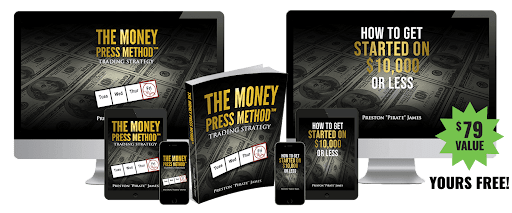
Your FREE copy of “The Money Press Method: How to Generate Consistent Income Using Weekly Options” is ready to ship (US customers only).
The Money Press Method is kinda like creating little AirBnB rental properties in the stock market that create weekly rent checks
Simply visit this page, and enter your details to claim your complimentary copy PLUS the complete Money Press Method tutorial bundle, FREE. (limited time)
Throughout the course of this comprehensive, 100-page book, you’ll learn everything from the basics of options to one of the most powerful strategies on the planet, the Money Press Method.
Here’s a glimpse of what you’ll get when you act today:
✔ INSTANT Digital Access to the Money Press Method before your book arrives
✔ Physical Copy of the guidebook rushed directly to your doorstep
✔ 2 Bonus Quick-Start Training Videos, including the Money Press Method strategy training, and the popular…
✔ “How To Get Started On $10,000 or Less” training
✔ Our highly-praised “Money Press On-Ramp” to get you profiting in as little as a few days
Normally this bundle retails for $79.00. But not today.
Once you have the Money Press Method in hand, you’ll immediately discover these timely benefits:
Weekly incomepotential (the Money Press gives you this while carefully managing risk)
Because it’s a “market-neutral” strategy, the Money Press works under any set of market conditions, including NOW…
Minimal Time Commitment: trades can be executed in approx. 30 minutes each week
Sleep-At-Night protection is built right in – no more nervous checking your account day and night
Small account OK! Trade the world’s top stocks (even if they’re $600, $700, or more) with accounts less than $10,000
And that’s just scratching the surface.
What People Are Saying About The Money Press Method
“I never thought I’d see the day, but last Thursday my account was up $150K in a single day! Compared to every other program I’ve tried, your methods rock! Keep those good trades coming!” – Jeff S., NC
“Thank you and your team for what you do. I’ve tried lots of investing and trading approaches and nothing compares with your methods.” – Sunil M., CA
“I have been sucked in by other programs and have not made a penny. You are the ONLY person I want to follow and have been for the last 2 years. Please keep up the GREAT work.” – J. Hurrell, FL
Remember, this offer is only available while supplies last. Claim your FREE book and tutorial bundle before it’s too late.
Don’t miss out on this life-changing opportunity. Secure your copy and start your journey to consistent weekly income today.
To your success,
Preston James Traders Edge Network
Today’s Featured Article
CooperCompanies Insiders Buy as Rebound Setup Forms
Written by Thomas Hughes. Originally Published: 3/9/2026.
Key Points
CooperCompanies insiders bought shares in late 2025, highlighting a value opportunity that has reemerged in early 2026.
Analysts and institutions are accumulating this stock, and have its price set up to reverse course as the year progresses.
Capital returns, specifically share buybacks, provide leverage and increase value for investors, underpinning a robust outlook for a stock price rebound.
CooperCompanies (NASDAQ: COO) insiders signaled confidence in the company’s growth outlook by buying shares in December, extending a trend that began the month before. Insiders — including the CEO, several directors, and other C-suite executives — bought shares when the stock was at long-term lows, helping catalyze a rebound. The story, however, is not finished.
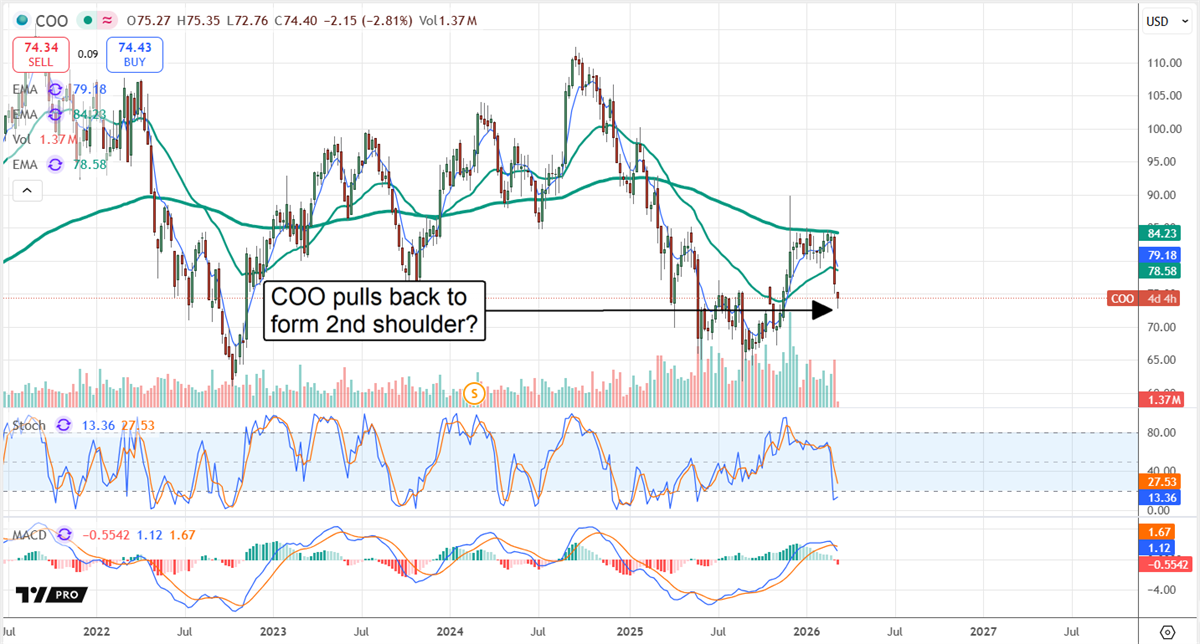
COO pulled back in early March following an otherwise healthy earnings report, offering another opportunity to consider the stock. Headwinds remain, but the long-term outlook is constructive, supported by growth, profitability, and capital returns.
CooperCompanies is well-positioned to drive growth and cash flow as a leading consumer-focused medical device company. It operates two main lines: vision and women’s/family health. The vision segment is best known for contact lenses that are widely regarded among the top three globally. The women’s health division is a major player in contraception, fertility, and gynecology. Long-term forecasts project mid-to-moderate single-digit revenue growth through the middle of the next decade, with earnings growing somewhat faster.
Capital Returns Keep Analysts and Institutions Interested in COO Stock
CooperCompanies’ capital return program consists entirely of share repurchases. Those buybacks are substantial and sustainable, and they amplify returns for remaining shareholders. Fiscal Q1 2026 activity, combined with prior-quarter repurchases, produced a nearly 2.25% year-over-year decline in shares outstanding, and the repurchase pace is expected to continue into upcoming quarters.
The balance sheet shows no red flags and reinforces the buy case. Quarter-ending highlights include increased cash and assets, reduced debt and liabilities, and a rise in shareholders’ equity despite aggressive buybacks. Equity increased about 1.5%, and leverage is very low, suggesting the company can continue executing its strategy: expanding product lines and pursuing targeted acquisitions. CooperCompanies has a history of selectively acquiring high-quality, niche products that augment its core segments.
Analyst sentiment reflects confidence in the business, with a Moderate Buy rating. Although one Sell rating is recorded, the consensus breakdown is roughly 50% Buy and 49% Hold, with coverage increasing on a trailing-12-month basis. Price targets firmed following the March earnings update. As of early March, consensus implies about 25% upside, and a move toward the $90 consensus target would set a long-term high, break critical resistance, and support a broader reversal.
Technical Reversal Is in Play: Head-and-Shoulders Reversal Underway
The pattern is not complete, but COO’s price action, combined with its fundamentals and growth outlook, suggests a head-and-shoulders reversal may be forming. The first shoulder appeared in early 2025, the head developed mid-year, and the second shoulder is now taking shape. There is a risk of further downside — potentially testing support near $70 or $65 — but that seems less likely given the company’s outlook, cash flow, and capital-return program.
Institutional trends add to the case for a reversal. Institutional holdings remain modest at about 25%, but the group is accumulating shares and activity is increasing. Selling has risen alongside buying, though at a slower pace, which could keep volatility elevated until another catalyst emerges. One potential catalyst is the conclusion of the company’s strategic review, begun last year; resolving that review could reinvigorate market interest.
CooperCompanies Retreats After Solid Report
CooperCompanies delivered a solid Q1, with top- and bottom-line results above consensus. A slight gross-margin contraction, partly driven by tariffs, was offset by operational improvements and discipline, producing profit-margin expansion. Adjusted earnings grew by nearly 20% for the quarter and are likely to continue outpacing estimates as the year progresses. Management’s guidance, improved versus the prior outlook, appears conservative.
Momentum from newer product lines such as MyDay and MiSight — lenses that help slow the progression of myopia in children — supports the outlook and long-term growth potential.
Today’s Featured Article
CoreWeave Just Landed a Deal That Signals Where AI Is Headed
Written by Jeffrey Neal Johnson. Originally Published: 3/5/2026.
Key Points
CoreWeave’s specialized, high-performance infrastructure provides a crucial advantage in the demanding and rapidly growing AI inference market.
A deep technical partnership with NVIDIA, which includes a coveted industry certification, validates CoreWeave’s platform as a world-class solution.
An extensive backlog of long-term contracts provides significant visibility into future revenue and underpins the company’s strategic growth investments.
A recent partnership sent a clear market signal about the future of artificial intelligence (AI) — and it’s less about the training hype that has dominated headlines.
While Wall Street has focused on CoreWeave’s aggressive spending, this alliance highlights where long-term, recurring revenue in the AI revolution is likely to come from.
A Bellwether Deal for the New AI Battleground
Perplexity, whose business depends on delivering fast, accurate AI answers, has entrusted its inference workload to CoreWeave. That distinction matters: training is the computationally massive, periodic process of teaching a model on vast datasets, while inference is the continuous, high-volume work of using those trained models to generate answers for millions of users in real time.
Inference workloads demand consistently low latency — real users are waiting for responses, and any delay degrades the experience. If training is a marathon, inference is a never-ending series of sprints. Perplexity’s decision to choose CoreWeave over established, general-purpose cloud giants is a bellwether. For demanding, revenue-generating AI applications, specialized infrastructure is increasingly a necessity rather than a preference.
Built Different: CoreWeave’s Performance Edge
CoreWeave’s edge comes from architecture. It offers a GPU-first, bare-metal cloud purpose-built for AI, giving clients direct access to hardware and minimizing software layers and operational overhead that can add latency.
That specialization creates a performance gap between CoreWeave and legacy hyperscalers, whose platforms are designed to be jacks-of-all-trades. For investors, the difference is simple:
CoreWeave (Specialized): The Formula 1 car of the cloud world, engineered to deliver maximum speed and performance for demanding AI workloads.
Legacy Hyperscalers (Generalized): The SUV: versatile and reliable for many tasks like web hosting and storage, but not optimized for the high-octane racetrack of AI inference.
This performance advantage is validated by NVIDIA. NVIDIA (NASDAQ: NVDA) has a deep partnership with CoreWeave that goes beyond its recent $2 billion investment. CoreWeave has earned NVIDIA’s Exemplar Cloud status, a technical endorsement that signals its platform meets high standards for performance, reliability, and security.
For enterprise customers, that stamp of approval de-risks deployments and signals they’re running on a world-class platform. The alignment also gives CoreWeave early access to next-generation technology like the Rubin platform, helping preserve its competitive moat.
Investing in Certainty, Not Speculation
Some market observers worry about CoreWeave’s aggressive spending and current net losses. The company has guided for $30 to $35 billion in capital expenditures for 2026, which understandably raises questions about near-term profitability. But viewed in context, this spending is a calculated investment to satisfy a large, pre-sold pipeline of demand.
CoreWeave reports a $66.8 billion contractually secured revenue backlog — it isn’t building facilities on hope, it’s manufacturing capacity already purchased through long-term contracts. The average contract length has risen to roughly five years, providing visibility and stability for future cash flows.
The company’s ability to raise more than $18 billion in capital in 2025 while lowering its average borrowing cost further underscores institutional confidence in the strategy. This aggressive investment is intended to secure CoreWeave’s leadership for years to come.
That gap suggests the market may still be valuing the company based on the current build-out costs rather than the recurring revenue its infrastructure is likely to generate once inference demand fully ramps.
CoreWeave projects an exit to 2026 with an annualized revenue run rate of $17 to $19 billion, more than doubling its revenue base in a year. As the backlog converts into revenue and more high-profile inference customers like Perplexity are announced, that valuation gap could begin to close.
An Essential Cloud for the Inference Era
For investors assessing the evolving AI landscape, the important shift may be to look past training headlines and focus on the inference market — the high-volume, latency-sensitive workloads that will drive recurring revenue. Companies building the high-performance infrastructure for that phase are positioning themselves for durable, long-term growth.
The CoreWeave–Perplexity deal is strong evidence that CoreWeave has established itself as a primary contender in the inference era.
This ad is sent on behalf of Stansberry Research, 1125 N Charles St, Baltimore, MD 21201. If you would like to optout from receiving offers from Stansberry Research please click here.
Guardian Financial Publishing, 3571 Far West Blvd · Texas · Austin · 78731 · United StatesNo longer want to receive these emails. Unsubscribe
“Rule No. 1: Never lose money. Rule No. 2: Never forget rule No. 1.” – Warren Buffett
Since the war in Iran broke out, stocks have headed south, and no one is sure when it will end. That always makes investors nervous.
I know we are told to “buy and hold,” and most of the time, it pays to be patient. J. Paul Getty advises, “The seasoned investor buys his stocks when they are priced low, holds them for the long-pull rise and takes in-between dips and slumps in his stride” (The Maxims of Wall Street, Page 136).
But as Steve Forbes observes, “Everyone is a disciplined, long-term investor… until the market goes down” (Page 135).
And as technical trader Mike Turner warns, “Nothing is more difficult than holding on to your stocks in a bear market” (Page 109).
Is there a way to protect yourself, following Warren Buffett’s rule of “never losing money”?
Buffett’s rule is easier said than done. His own investment firm, Berkshire Hathaway, has lost money in bear markets over the years – as much as 40%! But if you held on, you became a millionaire.
I have on my shelf a book entitled Wealth Without Risk, written by the late Charles Givens. Is “wealth without risk” possible?
The Danger of Market Timing
Certainly you can buy put options to protect yourself without selling your favorite stocks, but then you have to decide when to sell your put option position. Study after study shows that it’s almost impossible to decide when to buy and when to sell.
DALBAR’s 2017 “Quantitative Analysis of Investor Behavior” concludes, “Investors lack the patience and long-term vision to stay invested in any one fund for much more than four years. Jumping into and out of investments every few years [or every month!] is not a prudent strategy because investors are simply unable to correctly time when to make such moves.”
Conservative investors and retirees have always dreamed of an investment that could make money during the good times and avoid losing big money during the bear markets, like what we are experiencing now.
I have good news! There is such an investment. No, I’m not talking about market timers who promise to make you money in bull markets while always avoiding the bear market through “guaranteed” technical trading systems.
High-frequency trading is no guarantee of success during a bear market. These systems often result in getting whipsawed in and out of markets.
I’m talking about a product offered by the major insurance companies: stock-indexed annuities.
Stock-Indexed Annuities to the Rescue
These annuities are not for everyone, but they may be a good alternative for conservative investors who can’t stomach a crash or bear market.
My wife bought stock-indexed annuities right before the 2008 financial crisis and more than doubled her money.
The annuity was with Midland Life and had a 40% participation rate in the stock market, which allowed her to earn a decent return from the stock market with no downside risk. From 2000 to 2025, there were four major bear markets, and owners of the annuity avoided all four.
Now that’s what I call “peace of mind” investing.
Stock-indexed annuities are issued by insurance companies. They guarantee your principal every year. If the market drops 30%, you lose nothing.
These annuities take all the guesswork out of investing. If the stock market goes up one year, you make money. If it crashes the next year, you don’t lose money. Your principal is intact – at the higher level!
Today, you can claim the Ultimate Dividend Package…
For FREE. (No credit card required!)
Inside, Marc Lichtenfeld – bestselling author of Get Rich with Dividends and world-renowned income expert – is giving away his top five dividend picks.
In most cases, the contract limits your upside when stocks go up. For example, Cincinnati-based Mass Mutual has a new index annuity called the American Legend 7 that allows you to earn up to 9% a year in the S&P 500 index. That means that if the stock market goes up 30%, you make only 9%. But if stocks drop, you lose nothing.
It also offers you the chance to invest in gold with an annual limit of 12% on the leading gold ETF, SPDR Gold Shares (NYSE: GLD), and no downside risk. But if gold goes up 50%, you only make 12%.
How do insurance companies offer this guarantee without losing money? Traditionally, they hedge their positions by purchasing 70% to 80% in high-grade bonds and government securities and then invest 20% to 30% in stock index call options or gold futures options.
Financial experts have criticized annuities for being too expensive with hidden fees, which is something you need to watch out for. The Mass Mutual annuity charges 1.2% a year. It also has a built-in surrender charge that gradually declines from 9% to 0% in seven years.
The annuity also offers a death benefit and a fixed income annuity feature.
What is the real risk? There’s only one: You want to make sure you buy an index annuity with an insurance company that will stay in business. Index annuities are not insured by the government like your bank account is. If the insurance company goes under, you could lose your investment.
The key is to stay with top insurance companies rated A or better by AM Best or Standard & Poor’s. MassMutual is rated A++ by AM Best and AA+ by Standard & Poor’s.
If you are 85 years old or younger, you qualify for the American Legend 7. Stock index annuities are not for everyone, but they may be suitable for part of your portfolio.
For more information, contact Todd Phillips, the president of Estate Planning Specialists, Inc., in Gilbert, Arizona, at 888.892.1102 or email him at todd@epmez.com. You can also visit Estate Planning Specialists’ website: www.epmez.com.
I’ve known Todd and his father, David T. Phillips, for decades. They are reliable experts in all fields of insurance and estate planning.
The Calming Influence of the Bible of Wall Street!
During times of crisis, religious people turn to the Bible for comfort.
Where do investors turn for comfort during a financial crisis? Many subscribers are turning to my classic bestseller, The Maxims of Wall Street: A Compendium of Financial Adages, Ancient Proverbs, and Worldly Wisdom.
It even has quotes from the Bible!Yours truly and a subscriber cruising with The Maxims of Wall Street.View larger image
Demand for my book has been especially strong with the market turning south. It’s now in its 12th edition. I’ve received several letters from investors lately who say that reading quotations from Maxims has been comforting in these trying times when the market is struggling. I’ve been around the markets since the 1970s and have endured many crashes and busts. It never gets easy.
Warren Buffett recently wrote, “The stock market can go from green to red without stopping at yellow” (see Page 111 of Maxims). He’s a big fan of my book.
And consider this quote from Wendell Brock: “Nothing can make the spirit fly higher than finding a bargain when you’re the buyer. And nothing can make the spirit sink deeper than finding it later a whole lot cheaper” (Page 34).
J. Paul Getty advised, “Owners of sound securities should never panic” (Page 111).
This quote comes from Oxford Club Chief Investment Strategist Alexander Green on why you should stay invested for the long run: “It’s tough to catch the train after it has left the station” (Page 177). He considers my book a “classic.”
And last but not least, there’s Dick Russell’s famous line, “In a bear market, the winner is he who loses the least” (Page 108).
If you want a copy of the new 12th edition, go here. The price is only $22 for the first copy and $12 for all additional copies (they make great gifts). If you buy a box of 32 copies, the price is only $337, which is just $10.50 apiece. I sign all books and mail them at no extra charge inside the U.S.
Economist and financial analyst Dennis Gartman says it best: “It’s amazing the wisdom one can gain from just one line in your book. I read it every day.”
Nothing published by The Oxford Club should be considered personalized investment advice. Although our employees may answer your general customer service questions, they are not licensed under securities laws to address your particular investment situation. No communication by our employees to you should be deemed personalized investment advice. We allow the editors of our publications to recommend securities that they own themselves. However, our policy prohibits editors from exiting a personal trade while the recommendation to subscribers is open. In no circumstance may an editor sell a security before subscribers have a fair opportunity to exit. The length of time an editor must wait after subscribers have been advised to exit a play depends on the type of publication. All other employees and agents must wait 24 hours after publication before trading on a recommendation.
Any investments recommended by The Oxford Club should be made only after consulting with your investment advisor and only after reviewing the prospectus or financial statements of the company.
Protected by copyright laws of the United States and international treaties. The information found on this website may only be used pursuant to the membership or subscription agreement and any reproduction, copying or redistribution (electronic or otherwise, including on the world wide web), in whole or in part, is strictly prohibited without the express written permission of The Oxford Club, LLC, 105 West Monument Street, Baltimore, MD 21201.
– Stephen Prior, Publisher, Monument Traders Alliance
Dear Reader,
Market uncertainty and geo-political volatility are everywhere you look…
Iran tensions are choking the Strait of Hormuz with no off-ramp in sight – spiking oil up to $100 per barrel.
The S&P is down on the year – after shedding $500 billion in market cap in a single day.
Non-farm payrolls dropped 92,000 in February – a shocking loss where gains were expected – pushing unemployment toward 4.4%.
Corporate insiders are rushing for the exits – as they’ve dumped $4.9 billion in shares (versus just $271 million in buys).
As a result, the VIX Fear Gauge peaked at 35.3 earlier this month.
In short, investors and traders alike are getting more nervous.
And unfortunately, the news flow won’t ease up anytime soon.
Looking specifically at this week…
NVDA GTC 2026 Kicks Off Today: Keynote speaker and NVDA founder Jensen Huang will kick off Nvidia’s big event this week, which runs today through Thursday. The supply outlook will be front and center for investors, which could create more intraday volatility in the entire tech sector.
Fed Wednesday: Then, you have the Federal Open Market Committee on Wednesday – which is widely expected to keep rates unchanged at 3.5% to 3.75%. Chairman Powell’s term ends in May, and the specter of this upcoming Fed Chief hand-off could trigger even more volatility into the markets this week.
Navigating this mess is a real pain for long-term investors.
But for traders? This is a perfect environment for “Flipping” stocks.
I’m sure you’re familiar with flipping houses…
That’s when you buy a house on the cheap, fix it up, sell it for a profit.
But when it comes to real estate, flipping houses is a long and labor-intensive process.
Doing it right can tie up $100,000 (or more) for years… and you might still lose money.
So, I’ve found a better way.
Instead of tying up six figures for a year…
How about using “Stock Flips” to make ONE trade at 3:30 p.m.?
Then you simply log off for the day…
And sell the very next morning for a chance at gains like 224%… 384%… even 667%!
This former CIA counterterrorism officer believes that President Trump could launch one of the biggest tech initiatives in U.S. history…
And he believes this one initiativecould give early investors a chance to make a fortune over the next decade.
Don’t miss out on what could go down as the single greatest wealth-building opportunity of your life. Click here now for details.
What’s the best way to flip stocks?
I’ll reveal everything in our LIVE (and free) event this Wednesday.
At this live event, I’ll reveal the exact Stock Flipping Formula backed by over a decade of historical data.
You’ll get a list of the 30 BEST stocks to flip and our exact criteria – completely FREE – just for attending.
If the timing is right, you just might be able to make your first Stock Flip trade that very day before the closing bell!
Best of all…
March 19 could kick off the BEST 60 days for flipping stocks.
You can start with as little as a $2,500 account…
And potentially build a $109,000 portfolio!
Don’t miss it!
YOUR ACTION PLAN
This “Stock Flips” live event happens this Wednesday! You’re going to love this new methodology – so be sure to RSVP for this Wednesday’s exciting event!
Learn the strategy backed by 10+ years of data and an 87% statistical edge to target $5,000 overnight (or MORE!) by “flipping” stocks for quick doubles.
Note: Earlier this morning, our members reported another big 80% stock flip winner on META. Another member closed two stock flips for a 101% gain – all in ONE trading day.
Join me this Wednesday to see for yourself how these real-live examples are creating major flip winners!
You are receiving this email because you subscribed to Trade of the Day. To unsubscribe from Trade of the Day, click here.
Questions? Check out our FAQs. Trying to reach us? Contact us here. Please do not reply to this email as it goes to an unmonitored inbox.
To cancel by mail or for any other subscription issues, write us at: Trade of the Day | 14 West Mount Vernon Place | Baltimore, MD 21201 North America: 800.507.1399 | International: +1.443.353.4977 Website | Privacy Policy Keep the emails you value from falling into your spam folder. Whitelist Trade of the Day.
Nothing published by Monument Traders Alliance should be considered personalized investment advice. Although our employees may answer your general customer service questions, they are not licensed under securities laws to address your particular investment situation. No communication by our employees to you should be deemed personalized investment advice. We allow the editors of our publications to recommend securities that they own themselves. However, our policy prohibits editors from exiting a personal trade while the recommendation to subscribers is open. In no circumstance may an editor sell a security before subscribers have a fair opportunity to exit. The length of time an editor must wait after subscribers have been advised to exit a play depends on the type of publication. All other employees and agents must wait 24 hours after publication before trading on a recommendation.
Any investments recommended by Monument Traders Alliance should be made only after consulting with your investment advisor and only after reviewing the prospectus or financial statements of the company.
Protected by copyright laws of the United States and international treaties. The information found on this website may only be used pursuant to the membership or subscription agreement and any reproduction, copying or redistribution (electronic or otherwise, including on the world wide web), in whole or in part, is strictly prohibited without the express written permission of Monument Traders Alliance, LLC, 14 West Mount Vernon Place, Baltimore, MD 21201.
Many products or pieces of hardware usually age quickly in the tech world… but that doesn’t mean they can’t find new meaning.
At least that’s the case with central processing units (CPUs).
CPUs used to be the most important component in managing a computer’s activity, speed, and capabilities, acting as the “brain.” Their importance remained, but when artificial intelligence emerged, tech companies quickly learned that graphics processing units (GPUs) were better suited to run AI models, performing technical calculations faster and more efficiently than CPUs.
That made Nvidia Corp. (NVDA) the AI chip king… and its investors hugely successful.
Over time, demand for GPUs rose, creating a compute shortage that we discussed last Thursday in Smart Money. That put Nvidia in a good spot, to say the least.
But now, there’s a fundamental change in compute needs thanks to the rise of agentic AI.
Because AI agents are task-oriented, CPUs are the ideal fit for running them, as they have fewer powerful cores than GPUs when running consecutive general-purpose tasks. And Nvidia is once again ready to profit from this shift.
It’s already sending that message by recently boasting about the success of its deployment of Grace CPUs in powering Meta Platforms Inc.’s (META) data centers, a partnership that began just last month. In a press release, Nvidia stated the CPUs’ ability to improve performance per watt in Meta’s data centers.
Today is the first day of the Nvidia GTC AI conference, an expo where thousands of developers, researchers, and business leaders share and discuss tech’s latest AI breakthroughs.
Leading up to the event, Nvidia’s head of AI infrastructure expressed the “exciting opportunity” CPUs present, and noted that they are “becoming the bottleneck in terms of growing out this AI and agentic workflow.”
This afternoon, the company revealed its new 88-core Vera data center CPUs, which deliver 50% performance gains over traditional CPUs. Nvidia also announced details about its new Vera CPU Rack, which integrates up to 256 liquid-cooled CPUs into a single rack for CPU-centric workloads, improving core sustainability and enabling twice the energy efficiency.
Now, many investors will join Nvidia as it profits from the rise of agentic AI… but I’d like to offer you an even more profitable approach.
It’s true that Nvidia is a spectacular, industry-leading company. But because it is trading at a spectacularly high valuation, investors are putting themselves in a vulnerable position. Nvidia may be the most obvious investment choice to ride the CPU demand wave, but that doesn’t mean it will be the most profitable.
But before I share how investors should prepare for agentic AI’s takeover, let’s look at what we covered here at Smart Moneythis past week…
Conflict in the Middle East has made oil prices unpredictable, complicating the investment landscape. So, in Wednesday’s issue, Tom Yeung shows readers how to navigate the market calmly and reveals one stock that should do well regardless of oil’s movement, and shares how to find two more benefiting from oil’s high prices. Click here to read more.
Energy costs are soaring. Gas prices are through the roof. And now, your retirement savings are at risk of taking a major hit beginning April 24th. Three announcements in the final week of April could send up to $10 trillion flooding out of big-name stocks everyone owns and into a new, little-known class of “futureproof” companies — potentially sending some stocks soaring as high as 10X. Get the full list of 15 tickers you need to know at this week’s FutureProof 2026event.
Wall Street legend Louis Navellier, who managed $7 BILLION in assets, has released a controversial video from his Palm Beach estate. He warns of an economic event unlike anything in history, creating both unprecedented wealth and devastating losses. Watching this may be the most consequential few minutes you spend this year.
As we’re seeing right now with the Strait of Hormuz, when shipping slows or stops, the consequences ripple across the entire global economy. Something very similar is happening in artificial intelligence. The AI boom depends on enormous quantities of copper, electricity, and memory chips. And today, all three are facing growing constraints. Click here to learn how to profit from following the companies that will thrive.
Tech Bros thought they were gods. That AI would appear if they commanded it. But the physical world doesn’t care about what Silicon Valley wants. And the $635 billion they’re throwing at it can’t change reality. What’s coming next in the markets is a full-on Regime Change — a violent reorganization of market winners and losers. Trillions will flee the Mag 7. And the money will find its way to a surprising new class of companies… On March 18th, Eric reveals exactly where, including 15 free stock tickers to watch. Reserve your free spot at FutureProof 2026.
Now that CPUs are becoming increasingly essential, investors will want to invest in their demand correctly. According to Bank of America, the CPU market could more than double by 2030, rising from $27 billion in 2025 to $60 billion.
The need for CPUs collides with each of the AI bottlenecks I described on Saturday. CPUs require raw materials for construction, memory to function, and energy to operate in data centers.
But CPUs are only part of the AI bottleneck story.
As a whole, the AI Revolution simply isn’t scaling fast enough. The shortages that are forming will reshape the entire investment landscape… and I want to make sure you’re prepared.
So, on Wednesday at 1 p.m., in less than 48 hours, I urge you to attend my free FutureProof 2026 presentation. I will further explain the specific shortages arising from AI’s insatiable demand and walk you through a list of tickers I believe will surge as a result.
A market shock is likely to hit as AI’s constraints become impossible to ignore. I believe it will trigger a massive rotation of capital away from today’s dominant tech names – like Nvidia – and toward companies that supply AI’s physical needs.
Manage your account We hope this timely investment research is valuable to you. As you know the markets move fast and conditions change frequently. So please check the current issue for the most recent advice. Please note that we cannot be liable for any missed bulletins caused by overzealous filters. To ensure that you continue to receive this valuable part of your service please take a moment to add services@exct.investorplace.comto your address book.






























 RJ Hamster