I was born on 6 August 1956 in San Francisco, California to Janet and (the late) Richard Hovis.
I grew up in Santa Monica, California where I attended elementary, junior high school, and high school (graduating in 1974), in addition to involvement in sports and recreation (Little League +, the Boy’s Club ++). Further, it was in elementary school – St. Augustine’s By-the -Sea Parish School that I found, and made the choice to truly journey with God.
I attended Arizona State University from 1974 to 1977 – seeking to become an architect, however, I was not accepted, and, as such, I graduated with a Liberal Arts degree.
Upon graduation from Arizona State University, I attended Cal Poly San Luis Obispo and studied City and Regional Planning at the Master’s level. I successfully completed one (1) year in a two (2) year program – I did not complete the Master’s degree in City and Regional Planning – due to personal reasons.
I returned to Santa Monica where I started (October 1979) my career as graphic designer with Exxon Company, USA. I spent five years with Exxon Company, USA.
While working with Exxon Company, USA I was accepted into architectural school – Sci-Arc in Southern California, however, I did not attend preferring to stay with Exxon..
In 1982 I married Laura Flosi and in April 1983 we had our one and only child – Lauren Alain Hovis – a gift from God.
We moved to Phoenix, Arizona in 1984 from Los Angeles, where I went to work as a graphic designer with Kitchell CEM (from 1985 -1987).
From 1987 – 1995 I was an independent contractor, and a registered representative in mortgage finance, financial management, graphic design, and drafting.
Further, I attended the University of Phoenix and successfully obtained a Master’s in Business Administration (MBA) in 1982.
I was also a member of the Scottsdale Jaycees, where I became very involved in community events and projects.
In 1994, I accepted a cartography position with the Defense Mapping Agency in Reston, Virginia. As such, I relocated from Phoenix to Reston.
In 1998, I was accepted and worked as a Visual Information Officer with the Central Intelligence Agency. In 2002, I worked as a Support Officer until my retirement (due to a need for shoulder surgery) in September 2018.
Away from my Federal Government service, I have been involved in various organizations and activities in Northern Virginia.
In November of 2011, I married Rebecca Ouellette in Santa Monica, California. I reside in San Tan Valley, AZ with my two hamster - Jess and Timothy, our fish, our lizard - RJ Lizard., and our cats - Pearl and Grey.
As to hobbies, I enjoy playing sports, attending sporting events, mentoring individuals from financial management to hamsters, building models, photography, travel, multimedia design, managing partner for RJ Hamster, and jazz – smooth jazz to a samba or a bossa nova.
Love and God Bless,
Peter – aka RJ Hamster Jo hi
Catholic “AI for good.” Instant answers and guidance to any question or problem. Try free for 7 days.
A Night Prayer
Jesus Christ, my God, I adore You and thank You for all the graces You have given me this day. I offer You my sleep and all the moments of this night. I place myself and all my loved ones, wherever they may be, in Your sacred side and under the mantle of Our Blessed Mother. Let Your holy angels stand watch and keep us in peace. Amen.
Quote of the Day
“It is better to be a child of God than king of the whole world.” -St. Aloysius Gonzaga
Today’s Meditation
“Suffering has a cleansing effect on the soul, so that the man who has endured, however much against his wishes, emerges bruised, perhaps, but detached. [True] Resignation makes a man free of the preoccupations that harass the man who is forever complaining about his trouble and looking everywhere for a way out. The man who aims at eliminating pain and sadness from his life is doomed to disillusion. Not so the man who aims at meeting these things head-on, coming to terms with them, and refusing to be governed by them. The resigned soul rests on the text from Tobias: Because you were acceptable to God, it was necessary that these trials should prove you. (Tob 12:6).” —Hubert Van Zeller, O.S.B., p.79
What if your AI didn’t spy on you — and actually aligned with your faith?
With almost 250,000 downloads, Truthly is the Catholic AI app built to help you navigate the internet faithfully. Ask anything. Get answers you can trust — grounded in truth, not trends.
The daily examination of conscience is an ancient Catholic practice. It’s very simple, and it’s designed to help us identify our sins and weaknesses so that we can improve and grow stronger in the spiritual life, while providing an excellent ongoing preparation for regular Confession. It consists of taking a few minutes at the end of the day to prayerfully review our actions in the light of God’s commandments, followed by the Act of Contrition.
Reflect on the victories and losses
Actively reflecting on the high and low points of the day can help you live more intentionally and bring a renewed sense of resolve into the following day.
Review your actions, words, and thoughts today. Did you actively guard yourself against temptation? Where did sin creep in?
In what moments did you practice virtue and moral courage?
Were you attuned to the Holy Spirit’s promptings today? Where did you feel His inspiration?
Ask Him for the graces necessary to follow His Will more purposefully tomorrow.
Act of Contrition
O my God, I am heartily sorry for having offended Thee, and I detest all my sins because of Thy just punishments, but most of all because they offend Thee, my God, Who art all good and deserving of all my love. I firmly resolve with the help of Thy grace to sin no more and to avoid the near occasions of sin. Amen.
Practice gratitude
It is God’s love that has brought you into existence and to this exact moment. Practice looking for His hand in your day.
Where did you feel His loving gaze upon you today?
What people or moments helped you see God in your life?
Thank God for all these moments!
Ask Him to help you recognize His blessings and providence tomorrow.
Renew your commitment to Christ
Remember: our Faith is founded upon a Person—Christ! Renew your personal love and devotion to Him.
Thank God for the gift of His Son Jesus and our call to be His disciples.
Tell the Lord of your desire to know Christ more personally.
If possible, set an intention for your day tomorrow. Ask Our Lord to guide you in this act.
Pray a Hail Mary, Our Father, or another beloved prayer.
Rest with God
My people will abide in a peaceful habitation, in secure dwellings, and in quiet resting places. — Isaiah 32:18
We’re sweetening our fundraiser: Happy hour is on New Times
The old adage that if you’re not mad, you’re not paying attention needs an update in 2026. This year, if you’ve been paying attention in the least, you could probably use a bar night.
We’re going to toast our members on Tuesday, April 28, starting at 6 p.m. in a space where we expect everyone to feel at home: Gracie’s Tax Bar, a bastion of inclusivity and chopped cheese sandwiches alike.
The first 25 members will get a complimentary drink. (Don’t worry; the happy hour specials are straggler-friendly.) We’ll also be delivering swag to people who give at swag-worthy levels. If you’d rather just arrive at the bar with a credit card and a dream, we’ll hook you up with a custom shirt or tote bag. As usual, we’re employing a talented local artist — the inestimable Ryan Liebe, in this case — for our original, limited-edition designs.
Since 1970, Phoenix wouldn’t be Phoenix without New Times. And New Times wouldn’t be working for the entire Valley without the support of our readers. Can’t wait to hoist a glass and celebrate the next 50-plus years of giving as good as we get.
When you become a New Times member, you’re not just supporting local journalism — you also get access to member-only events. Join as a member today and join us!
Thanks for signing up for MarketBeat Daily Ratings—we’re excited to have you on board.
Every weekday, you’ll get a curated summary of new “Buy” and “Sell” ratings from Wall Street’s top-rated analysts, the latest stock news, and bonus investing content—all delivered straight to your inbox.
You’re just two quick steps away from completing your sign-up:
1. Make sure our emails go to your inbox
Gmail users: Mobile: Tap the three dots (…) in the top right and select Move to Inbox or Move to Primary Desktop: Click the folder icon at the top and select Move to Inbox or Primary
Apple Mail users: Tap our email address at the top (next to From: on mobile), then select Add to VIP
Other providers: Reply to this message and add newsletters@analystratings.net to your contacts
2. Confirm your subscription
Click this link to confirm your subscription. This verifies your account and ensures you receive your newsletters without interruption instead of getting stuck in your spam filter.
After you confirm, feel free to download our popular free report, “7 Stocks to Buy and Hold Forever” with this link.
Thanks again for subscribing—we look forward to being part of your investing journey.
Matthew Paulson Founder and CEO, MarketBeat.
P.S. If you didn’t mean to subscribe, no problem—you can unsubscribe here.
Additional Reading from MarketBeat Media
This New ETF Aims to Capitalize on Surging AI Memory Chip Demand
Authored by Jessica Mitacek. Publication Date: 4/13/2026.
Key Points
Specialized memory stocks have eclipsed traditional AI leaders as the market shifts its focus from processing power to data storage.
The “RAMmageddon” shortage is projected to last through 2028, providing manufacturers with massive pricing power due to the years-long lead times required to build new production capacity.
The newly launched Roundhill Memory ETF (DRAM) offers a targeted way to play this supercycle, bundling market dominators like Micron and Samsung into a single, high-growth portfolio.
The explosive growth of artificial intelligence (AI) over the past few years has produced a crowded field of semiconductor stocks. And while companies like NVIDIA (NASDAQ: NVDA) have grabbed much of the limelight, some lesser-known names have generated gains that dwarf those of the Magnificent Seven mainstays.
Take, for instance, Sandisk (NASDAQ: SNDK), which designs, develops and manufactures data flash storage solutions.
Because my research has led me to believe we’re risking World War 3 with Iran for a completely different reason.Click here to find out what it is.
While NVIDIA shares have gained more than 70% over the past year, Sandisk’s stock has surged nearly 2,440% over the same period.
Much of that outperformance is driven by AI-fueled demand for memory chips—the semiconductors that store digital data—whose need is rising as the AI build-out accelerates.
In 2026, a severe global shortage, nicknamed RAMmageddon, has emerged as manufacturers shift production to satisfy AI’s voracious appetite for memory. The resulting supply constraints have pushed prices higher for makers of DRAM and NAND flash memory chips.
For investors looking for a straightforward way to gain exposure to this trend, a newly launched exchange-traded fund (ETF) offers an all-in-one portfolio solution.
Roundhill Positions Itself to Capitalize on the Memory Chip Shortage
Industry consultant Grand View Research estimates the global semiconductor memory market was worth more than $111 billion in 2023 and could grow to over $240 billion by 2030 — a compound annual growth rate (CAGR) of 11.6%. That expansion is driven by broader adoption across industries such as automotive, consumer electronics, IT and telecommunications.
Zooming in, the U.S. memory chip market—which represents nearly 20% of the global industry—is expected to grow at an even faster pace, with a forecast CAGR of 12.2% through 2030.
Because building new fabrication capacity can take years, the memory chip shortage is expected to persist through 2028, putting the fund in a favorable position to benefit from the trend.
The Roundhill Memory ETF is a thematic, sector-specific vehicle that gives investors concentrated exposure to memory chips, their cyclicality and related innovations in a single fund.
The fund focuses on firms across the memory semiconductor supply chain, including companies involved in DRAM and NAND design and development, wafer fabrication, packaging and testing, and the manufacturing of semiconductor capital equipment and materials.
By targeting the memory segment rather than the broader semiconductor industry, DRAM offers focused exposure to companies whose primary businesses are tied to memory chips and related technologies.
An Actively Managed Basket of Memory-Making Market Dominators
Those five companies alone have a combined market cap exceeding $831 billion and have averaged nearly 930% one-year gains. Past performance is not indicative of future results, but analyst sentiment on these holdings bolsters a bullish case for the year ahead:
Samsung: 3 of 3 analysts assign SSNLF a Buy rating.
Sandisk: 17 of 24 analysts assign SNDK a Buy rating.
Seagate: 19 of 25 analysts assign STX a Buy rating.
Western Digital: 21 of 24 analysts assign WDC a Buy rating.
The fund carries an expense ratio of 0.65%, which is in the typical range for actively managed ETFs. As a recently launched fund, DRAM currently has $244.56 million in assets under management and an average daily trading volume of about 7.14 million shares, which could pose short-term liquidity considerations.
However, given the rapid growth of AI and the global memory chip shortage, both assets and trading volume are likely to rise in the coming months.
DRAM’s Timing Places It at the Forefront of the Memory Chip Supercycle
The launch of Roundhill’s DRAM fund was timely. The ETF — which, according to its fact sheet, offers a pure-play alternative to broader semiconductor funds — arrives amid a memory chip shortage that supports durable pricing power across the industry.
MarketBeat’s Jeffrey Neal Johnson cautions that rapid price gains could eventually trigger oversupply, but he argues this cycle differs from prior ones because of manufacturing constraints. He said, “This physical limitation creates a supply floor,” and added, “the AI Trade has evolved. It is no longer just about the logic chips that do the thinking.”
That thesis aligns with Grand View Research, which calls memory chips “essential electronic device[s]” and notes their specialized nature contributes to a low level of product substitution.
Thank you for subscribing to MarketBeat!
MarketBeat empowers investors to make better investment decisions by offering real-time financial information and objective market research.
If you have questions about your account, please email MarketBeat’s South Dakota based support team at contact@marketbeat.com.
Thanks for signing up for MarketBeat Daily Ratings—we’re excited to have you on board.
Every weekday, you’ll get a curated summary of new “Buy” and “Sell” ratings from Wall Street’s top-rated analysts, the latest stock news, and bonus investing content—all delivered straight to your inbox.
You’re just two quick steps away from completing your sign-up:
1. Make sure our emails go to your inbox
Gmail users: Mobile: Tap the three dots (…) in the top right and select Move to Inbox or Move to Primary Desktop: Click the folder icon at the top and select Move to Inbox or Primary
Apple Mail users: Tap our email address at the top (next to From: on mobile), then select Add to VIP
Other providers: Reply to this message and add newsletters@analystratings.net to your contacts
2. Confirm your subscription
Click this link to confirm your subscription. This verifies your account and ensures you receive your newsletters without interruption instead of getting stuck in your spam filter.
After you confirm, feel free to download our popular free report, “7 Stocks to Buy and Hold Forever” with this link.
Thanks again for subscribing—we look forward to being part of your investing journey.
Matthew Paulson Founder and CEO, MarketBeat.
P.S. If you didn’t mean to subscribe, no problem—you can unsubscribe here.
Today’s Featured News
Frozen Out: Lamb Weston Beats Earnings, but the Stock Still Slides
Author: Chris Markoch. Publication Date: 4/2/2026.
Key Points
Lamb Weston stock appears undervalued after its post-earnings decline, with much of the negative sentiment around margin pressure already priced in.
The company’s Focus to Win initiative, cost-cutting efforts, and declining input costs could help drive margin recovery and improved profitability in fiscal 2027.
With steady demand, a nearly 4% dividend yield, and over 30% implied upside based on analyst targets, LW stock presents an asymmetric opportunity for long-term value investors.
But investors continue to freeze out LW stock, which is down more than 8% year to date in 2026. The chart suggests much of the bad news is already priced in—and that could make LW an asymmetric opportunity.
During Tesla’s last earnings call, Elon Musk outlined a new AI-driven approach he says could generate $30,000-$50,000 a year in passive income with minimal effort and modest upfront costs.
U.S. Senator Ted Cruz called it ‘a total game-changer,’ and millions of Americans are reportedly eligible to participate. This is a new business model, and early movers could be positioned for significant returns.Watch the free presentation and learn how to get started today
The company reported quarterly revenue of $1.56 billion, beating estimates of $1.49 billion and topping the $1.52 billion posted in Q3 FY2025.
Adjusted earnings per share (EPS) also beat expectations: Lamb Weston delivered $0.72 versus the $0.63 analysts expected. However, that was down sharply from adjusted EPS of $1.10 in Q3 FY2025, underscoring a theme investors have watched for several quarters.
Right Strategy, Wrong Timing
Investors’ core concern is that Lamb Weston continues to grow sales amid a challenging macro environment but is seeing declining earnings.
Management attributed the quarter’s margin pressure to factors such as industry supply, factory utilization, and softer demand in certain markets. Many of those elements are outside the company’s control. This pressure surfaced in 2023 with the company’s aggressive international expansion, which has introduced its own set of challenges.
Those challenges have been exacerbated by a slowdown in restaurant traffic in several key international markets, further compressing earnings.
Partly in response to outside pressure from an activist investor, the company launched its Focus to Win initiative at the start of fiscal 2026. It also set a cost-savings goal of $250 million, which management says is on track to be exceeded this fiscal year.
What the Results Don’t Show
The post-earnings reaction appears tied to the company’s outlook for continued operating-margin pressure. That’s a legitimate concern and one the company may have limited control over in the near term.
The combination of low single-digit revenue growth and negative earnings growth isn’t ideal. Still, in a difficult market, revenue growth is meaningful: North American sales continue to grind higher.
That trend runs counter to a narrative that consumers are abandoning processed foods at home or when dining out. It’s also notable that Lamb Weston supplies McDonald’s (NYSE: MCD), a company that is also holding up better than some peers.
Lower Input Costs May Help Build Cash
One underappreciated tailwind is what’s happening at the farm level.
Management noted North American potato crop contract prices for 2026 are expected to decline by a low-to-mid single-digit percentage, while European contracted raw potato costs could fall by the mid-teens versus 2025.
Lower input costs flowing through in fiscal 2027 could be a meaningful catalyst for margin recovery, especially if North American volume momentum holds. With $339 million in year-to-date free cash flow and a capital-expenditure budget trimmed by $100 million, the company’s financial-discipline story looks more credible than the stock price currently suggests.
LW Stock Now Looks Like a Deep Value
The LW stock chart isn’t pretty, but it does offer hope for patient, value-oriented investors. The stock sold off sharply after the December 2025 earnings report—an apparent panic-driven event that likely shook out many sellers.
Since then, the stock’s swings have been milder. The post-earnings drop isn’t ideal, but with the stock trading at levels not seen since 2017, a value thesis could be forming.
Analysts aren’t exuberant, but Lamb Weston’s forecasts on MarketBeat show a consensus price target of $51.50, implying roughly 31.5% upside. That sits alongside a dividend that has increased for nine consecutive years and currently yields 3.9%.
It’s also constructive to consider the company’s fundamentals.
By conventional measures (price-to-earnings, price-to-sales, price-to-book), Lamb Weston looks undervalued versus its historical averages and is trading at a discount to the broader consumer staples sector.
This is the kind of setup where a long-term investor might see asymmetric risk/reward: much of the bad news appears priced in; the key question is how long the international drag persists.
That isn’t easy to answer, and investors won’t find the full picture in the chart alone.
But with a dividend that pays investors to hold, Lamb Weston may offer attractive upside in the second half of the year.
Thank you for subscribing to MarketBeat!
We empower everyday investors to make better investment decisions by offering real-time financial information and independent market research.
If you need assistance with your account, please don’t hesitate to contact MarketBeat’s South Dakota based support team at contact@marketbeat.com.
1 Stock To Buy And 1 To Sell If The War In Iran Ends
Author: Sam Quirke. Originally Published: 4/6/2026.
Key Points
American Airlines looks positioned for a rebound if oil prices fall, with some analysts pointing to around 30% in potential upside.
Exxon Mobil has benefited from elevated oil prices, but some recent weakness and neutral analyst ratings suggest its rally may be running out of steam.
The setup is clear, but timing is uncertain, and investors will need to be very reactive.
The sharp move in oil since early February—driven by escalating tensions in the Middle East and the closure of the Strait of Hormuz—has created one of the clearest macro-driven divergences in the market. In just a few weeks, Brent crude has surged roughly 60% to about $110 per barrel, while sectors exposed to fuel costs have taken a significant hit.
At the center of that trade sits American Airlines Group Inc (NASDAQ: AAL), trading just under $11 and down roughly 30% since early February. On the other side is Exxon Mobil Corporation (NYSE: XOM), which was up around 35% year to date as March closed. It’s still holding onto gains, but has pulled back more than 10% in recent sessions as hopes of a resolution have begun to emerge.
During Tesla’s last earnings call, Elon Musk outlined a new AI-driven approach he says could generate $30,000-$50,000 a year in passive income with minimal effort and modest upfront costs.
U.S. Senator Ted Cruz called it ‘a total game-changer,’ and millions of Americans are reportedly eligible to participate. This is a new business model, and early movers could be positioned for significant returns.Watch the free presentation and learn how to get started today
That sets up a simple but potentially powerful scenario. If tensions show meaningful signs of easing and oil falls, the reversal could be just as sharp as the move higher. The question is whether that opportunity is already priced in or still ahead.
American Airlines Looks Like a Recovery Trade Waiting to Happen
Airlines in general, and American Airlines in particular, have been among the most direct casualties of the oil spike. Fuel is one of the industry’s largest costs, and a sustained, surprise rise in oil prices quickly pressures margins.
The recent action is notable. Despite oil trading well above $100 a barrel and remaining volatile, American Airlines has traded largely sideways over the past month. At one point in recent sessions, the stock was trading at roughly the same price it had been one week after the conflict began. That suggests much of the potential downside may already be priced in.
On that basis, the setup becomes asymmetric. Even if oil remains elevated going into Q2, the downside for American Airlines shares is likely limited given how much they’ve already fallen.
But if the price of oil starts to decline, the recovery in American shares could be as sharp—and one-directional—as the fall.
Analysts are beginning to lean into this thesis. Both Citigroup and UBS reiterated their Buy ratings on American Airlines in the past fortnight, with fresh price targets up to $14—implying roughly 30% upside from current levels. That reinforces the idea that the market may be underestimating how quickly airlines can rebound if input costs ease.
Exxon Mobil’s Rally Looks Increasingly Stretched
On the other side, energy stocks like Exxon Mobil have been clear beneficiaries of higher oil prices this year, with Exxon’s stock up about 35% since the first week of January. That move made sense as higher realized oil prices flow directly into higher revenue.
But, as with American Airlines, recent price action in Exxon is telling.
After hitting an all-time high earlier this week, the stock has dropped nearly 10% as hopes grew for a meaningful de-escalation and a potential resolution to the conflict.
At the same time, analyst sentiment toward Exxon has started to cool. Citigroup rated it Neutral on Thursday, echoing moves from Mizuho and HSBC in recent weeks. That suggests much of the upside tied to higher oil prices may already be priced in.
In that scenario, any sign that the Strait of Hormuz is reopening—and oil prices fall back toward pre-conflict levels in the mid-$60s—could spell near-term trouble for Exxon.
Positioning Matters More Than Prediction
The key takeaway is that this trade is less about picking winners and losers and more about understanding positioning. American Airlines has effectively absorbed a worst-case scenario in many respects, while Exxon may already reflect something close to a best-case outcome. That creates a rare setup in which both sides are driven by the same variable but move in opposite directions.
If tensions ease and oil retraces, the unwind could be swift. Airlines would see immediate relief from lower fuel costs and improved margin expectations, while energy stocks would lose the tailwind that propelled their recent surge. That doesn’t make Exxon a bad long-term hold, but it does make the near-term risk-reward less compelling at current levels.
At the same time, the biggest risk isn’t being wrong on direction but on timing. With headlines shifting daily, this remains a highly reactive market, and investors will need to match conviction with discipline.
Featured Content from MarketBeat.com
Why Dave & Buster’s Stock Is Ripping Higher Despite Ugly Earnings
Author: Thomas Hughes. Originally Published: 4/2/2026.
Key Points
Dave & Buster’s is set up for a short-covering rally and potentially a squeeze as turnaround efforts bear fruit.
Store remodels, new games, and new offerings invigorate comp sales; management plans to accelerate change.
Institutions and analysts suggest robust rebound potential, with consensus forecasting triple-digit gains this year.
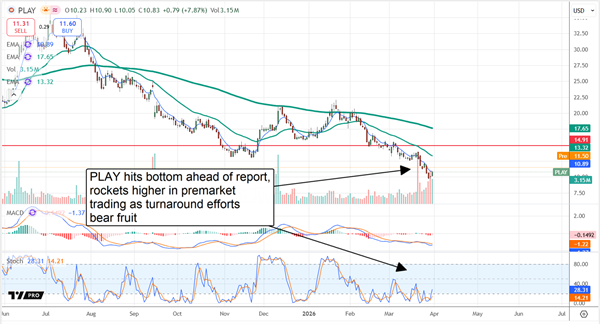
Dave & Busters (NASDAQ: PLAY) missed top- and bottom-line estimates for fiscal Q4 2026, yet the stock surged before the report and extended gains afterward. The price action suggests short-covering is in play — a meaningful signal for investors.
Dave & Buster’s Back-to-Basics strategy appears to be working: internal metrics and guidance show improvement, traction and an inflection point for the business.
Because my research has led me to believe we’re risking World War 3 with Iran for a completely different reason.Click here to find out what it is.
And the potential is significant. The stock had fallen more than 70% heading into the report, with short-sellers heavily positioned. Short interest, up 10% as of the March report, was running near 30%, creating a notable headwind for price action.
Key takeaways from the earnings report that may have triggered short-covering include clear signs of business traction. Storm-adjusted results beat expectations, and sequential improvements throughout the quarter carried into early 2026. Strength came from store remodels — new games and offerings that increased customer spend and produced significantly better comparable-store sales than legacy locations.
PLAY Analysts Point to Robust Rebound Potential
No analysts issued revised ratings immediately after the release; it may take more than one report to spur broader activity. Still, the eight analysts tracked by MarketBeat rate the stock a Moderate Buy.
The consensus shows a 37.5% Buy-side bias and a projected upside of roughly 90% to the consensus target. The lowest analyst target of $18—about 80% above recent March lows—underscores the depth of the value opportunity. Q2 2026 results could reinforce this range and strengthen the upside case over time.
Institutional trends suggest these investors will be active buyers of PLAY in Q2. Institutions own more than 90% of the company and were net buyers for two consecutive quarters. Selling activity remains high, so volatility is possible given the elevated short interest, but Q1’s net buying points to accumulation. If that buying continues, the short-covering rally could evolve into a squeeze: days-to-cover remain elevated at over eight.
The price-to-earnings multiple looks stretched because the company lost money in 2025 and is expected to be unprofitable again in 2026. The caveat is analysts’ forecasts do not yet reflect Q1 improvements or the free-cash-flow outlook, which is expected to exceed $100 million. In that scenario, Dave & Buster’s would be in a stronger financial position with reliable capital returns. The main risk is a slowdown in share buybacks, but annualized share-count reduction is still expected in the current and subsequent fiscal years. Dave & Buster’s reported its official share count fell by more than 13% in 2025.
Dave & Buster’s Stock Price at an Inflection Point in Q2 2026
The balance sheet reflects the effects of the turnaround, operational headwinds and share-count reductions. Year-end highlights show increased cash and assets and sufficient liquidity to sustain operations through 2026 while the company returns to comp-store growth. Comp-store growth, additional remodels, new store openings and margin improvements are expected in 2026.
The post-release price action is notable. PLAY fell initially, then rebounded quickly as investors and short-sellers digested the results. The market gapped significantly higher the day after the report, a move that confirmed support at recent lows and the potential for an extended rebound.
If short-sellers and institutions continue buying, the pace of the stock’s rise remains the key question. The base case is a steady recovery; the bull case is a short squeeze pushing the shares to $18 or higher. That $18 level aligns with the long-term 150-week exponential moving average and represents a key resistance point for this restaurant stock.
Catalysts include improving cash flow, disciplined capital allocation and an accelerating remodel and game pipeline. Remodels should drive comparable-store sales, potentially producing outperformance as the year progresses. The market response will likely accelerate once an inflection to growth is evident. Execution remains the biggest risk, but management changes made in 2024–25 appear to be paying off now.
This message is a paid advertisement for Stansberry Research, a third-party advertiser of MarketBeat. Why was I sent this email message?.
This ad is sent on behalf of Stansberry Research, 1125 N Charles St, Baltimore, MD 21201. If you would like to optout from receiving offers from Stansberry Research please click here.
If you have questions about your account, please contact our U.S. based support team at contact@marketbeat.com.
The numbers say everything’s fine… but it doesn’t feel fine, does it?
The cost of living keeps rising. The divide keeps widening. The anger keeps building.
Listen, I’ve spent three decades studying financial systems, and I’ve never seen pressure like this. It’s as if the old order of the economy has cracked and something new is forcing its way through.
Most people can’t see it yet. But they sense it. They feel it in their gut.
I’ve pulled on that thread for the past year, and what I’ve uncovered is bigger than anything I’ve ever reported. And it’s happening much faster than anyone imagines.
Because my research has led me to believe we’re risking World War 3 with Iran for a completely different reason.Click here to find out what it is.
That traction — visible in revenue growth and margin improvement — continued over the ensuing quarters and strengthened further in fiscal Q1 2026, when the turnaround narrative gained momentum.
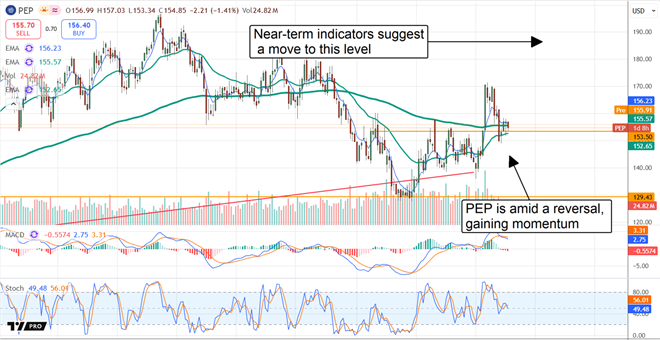
Q1 results beat expectations, showing strength across both core and growth markets. Stock price action confirmed support at a critical level, indicating the reversal is fully underway and likely to continue through the year. The critical level sits near $153.50, aligning with prior resistance and the baseline of a head-and-shoulders reversal pattern. A head-and-shoulders pattern consists of a low, a lower low, and then a higher low, and it is not confirmed until the baseline is broken.
The baseline is a pivot point; when price moves above it, market dynamics shift from distribution to accumulation. Head-and-shoulders patterns are meaningful to technical traders because they often precede short-term rallies roughly equal to the pattern’s magnitude, and can lead to longer-term uptrends that are supported by fundamentals. In this case, PepsiCo appears positioned to sustain growth over the next several years, meaning its uptrend can continue until the outlook changes.
PepsiCo on Track for New All-Time Highs This Year
PepsiCo’s reversal pattern measures roughly $24, from a low near $129.50 to $153.50. Projecting that dollar move from the baseline implies a target of about $177.50; projecting the percentage move (roughly 18%) implies a target near $181.15. That target range corresponds to 18-month highs for the stock and is achievable given the stock’s valuation as of mid-April 2026.
Trading near $155, PEP is priced at under 18X forward earnings, roughly six points below par. Given that relative undervaluation, the stock could potentially rise by more than $50 to exceed $200 in the near-to-mid term, establishing a fresh all-time high. Over a longer horizon, the stock is trading below 12X its 2035 forecast—which may be conservative—suggesting upside of more than 100% over an extended period, if forecasts and execution improve.
Institutional activity supports the case for a durable bottom. Institutional investors own more than 70% of the shares and have been net accumulators for eight consecutive quarters. Activity accelerated in Q1 2026, hitting a multi-year high, with more than $3 bought for each $1 sold—an important tailwind that could continue into Q2 and the rest of 2026. While the stock may correct if a negative catalyst emerges, institutions are likely to buy shares unless fundamentals deteriorate.
Analysts are likewise supportive of PepsiCo’s price action and could provide an additional catalyst in Q2. The 20 analysts tracked by MarketBeat give the stock a consensus rating of Moderate Buy, with a 40% buy-side bias. At the time of the release, the consensus price target implied about 10% upside, though some recent target reductions have compressed the high end of that range.
A broader market re-rating—driven by upgrades and higher price targets—could accelerate gains. Until then, consensus sentiment and targets have remained relatively stable on a trailing 12-month basis despite active revisions, reflecting steady conviction among analysts.
PepsiCo Grows and Outperforms in Q1: Capital Returns Are Safe and Reliable
PepsiCo reported a solid quarter, with revenue up 8.5%, supported by 2.6% organic growth, 2.5% acquisition-driven growth, and a 3.4% currency tailwind. Top-line and organic growth accelerated sequentially and outpaced last year’s levels, driven by strength across all segments. Europe, the Middle East, and APAC led performance (around 7% growth), with notable gains in the International Beverage Franchise, Latin America, and core U.S. markets.
Growth reflected brand investments and pricing initiatives designed to improve affordability; importantly, pricing dynamics helped drive volume in key categories and contributed to systemwide margin expansion. Operating margin improved by 210 basis points, producing adjusted EPS of $1.61—about a 9% increase, outpacing the 8.5% revenue gain and beating expectations by more than a nickel.
Investors should also note the strength of cash flow and its impact on capital returns. Net income approached $2.3 billion for the quarter—ample to cover the dividend and keep the company in a healthy financial position. Dividends yield roughly 3.65% annually, and share repurchases totaled nearly $2.1 billion, modestly reducing share count year over year. Balance sheet metrics show no immediate red flags: cash, assets, and equity rose during the quarter, with long-term debt around 2X equity.
This Month’s Bonus News
Stream if You Want to Go Faster: Netflix’s New $120 Target
Written by Jeffrey Neal Johnson. Originally Published: 4/7/2026.
Key Points
Netflix has successfully shifted its strategy to prioritize strong profitability through pricing power and new revenue streams.
Netflix is expanding beyond streaming into gaming and live events to increase user engagement and solidify its long-term market leadership.
Recent bullish analyst upgrades confirm that Netflix has evolved into a durable media powerhouse worthy of a core position in investment portfolios.
In a market often focused on uncertainty, a decisive signal on April 6, 2026, captured investors’ attention. Prominent financial institution Goldman Sachs (NYSE: GS) upgraded Netflix (NASDAQ: NFLX) to a Buy and set an ambitious $120 price target.
Retail investors should view this as an endorsement signaling a fundamental shift in the narrative around the streaming giant.
Because my research has led me to believe we’re risking World War 3 with Iran for a completely different reason.Click here to find out what it is.
For years, Netflix’s story was primarily a land grab for subscribers. That narrative has evolved: Wall Street is moving away from valuing Netflix solely on user growth and focusing instead on a more sustainable engine of earnings, expanding profit margins, and strategic innovation.
This transition—from a high-growth, speculative tech sector stock into a durable, profitable media powerhouse—creates a compelling new outlook for investors and suggests a turning point for Netflix and its shares.
The Profitability Fortress: How Netflix Flipped the Script
At the core of Wall Street’s renewed bullishness is Netflix’s pivot from global expansion at any cost to a disciplined focus on durable profitability. That transition rests on three strategic pillars now delivering measurable financial returns and supporting a higher valuation.
First is Netflix’s demonstrated pricing power. The company has implemented price increases across subscription tiers with minimal churn, signaling that the service is seen as a household staple rather than a discretionary luxury. That brand loyalty gives Netflix the leverage to raise prices, which boosts average revenue per user (ARPU) and overall profitability.
The second pillar is the ad-supported subscription plan. Initially met with skepticism, the ad tier has provided a lower-cost entry point for price-sensitive consumers while unlocking a high-margin advertising business. This dual approach grows the user base and diversifies revenue in a way that benefits the bottom line.
Finally, the monetization of account sharing has turned a long-standing revenue leak into a meaningful growth driver. By converting millions of non-paying viewers into paying members, Netflix has added an immediate lift to revenue and reinforced the perceived value of its content.
The success of these strategies shows up in the numbers. Netflix’s Q4 2025 earnings reportrevealed a 17.6% year-over-year increase in revenue and a trailing-12-month net income of $10.98 billion. A net margin of 24.3% highlights the company’s efficiency in converting sales into profit.
Those results help explain the broad analyst optimism: the market consensus is a Moderate Buy rating with an average price target near $115.10, reflecting confidence in Netflix’s direction.
More Than a Streamer: The Future in Gaming and Live Events
With a profitable foundation in place, Netflix is building its next chapter by expanding its entertainment ecosystem. Moves into gaming and live events are intended to deepen user engagement, widen its competitive moat, and create long-term growth opportunities beyond streaming video.
Netflix’s push into gaming is strategically important. The launch of Netflix Playground, an ad-free gaming app, is part of a broader plan to make the subscription more indispensable—particularly for families—by bundling games based on its own intellectual property with the core video service. That bundling increases user stickiness, reduces churn, and lifts lifetime customer value.
In parallel, Netflix is taking a selective, financially disciplined approach to live sports and events. Rather than entering costly bidding wars, the company is targeting high-impact cultural events that attract large, engaged audiences. These events provide marketing leverage to win new subscribers and generate premium ad inventory without the budget strain that has afflicted traditional media companies.
By diversifying into gaming and selective live programming, Netflix is assembling a multifaceted entertainment hub that will be difficult and expensive for competitors to replicate, strengthening its market leadership for the long term.
Why Netflix Has Earned Its Blue-Chip Status
Netflix has completed a critical strategic evolution and emerged as a mature, profitable media powerhouse. The combination of pricing power, dual revenue streams from subscriptions and advertising, and new growth verticals in gaming and live events creates a resilient business model. Goldman Sachs’s upgrade and the recent wave of analyst bullishness validate that pivot. Increasingly, the evidence suggests Netflix is not only the dominant streamer but also a blue-chip media leader worthy of consideration as a core holding in a modern investment portfolio.
This email message is a paid advertisement from Porter & Company, a third-party advertiser of MarketBeat. Why did I receive this message?.
If you have questions or concerns about your subscription, please email our U.S. based support team at contact@marketbeat.com.
I grew up listening to all different kinds of music…
My mom had an extensive record collection. My dad could play a little bit of every instrument he picked up. My older brother, Nate, who I share a 10-year age gap with, had many iterations of punk rock bands rehearsing in the garage. My sister had a great music collection that I wanted to build mine just like. And though we didn’t grow up together, my other older brother, Bill, loves music and concerts, as well! I guess it’s in the genes.
I think I was 7 or 8 when I started picking out my own cassettes. I was diverse. I remember having No Doubt, Backstreet Boys, & Dave Matthews, among a few. But I was always stealing my sister’s KRS One tape because I wasn’t allowed to listen. I loved spinning my mom’s records, too. We’d play George Harrison, Elvis Costello, The Beatles, Aretha Franklin, The Supremes, Karen Carpenter. There was a LOT of music being played around the house growing up.
I was born in 1988, so CDs quickly replaced cassettes, and by the time I was 12, I was big into Mariah, Brandy, Aaliyah, Monica, Mya – you name it. If there was a beautiful voice singing R&B, I was all about it.
Another R&B voice that I always loved was Mr. Anthony Hamilton. I loved “Po’ Folks” when it came out with Nappy Roots. My friends and I all grew up on “Charlene”, “The Point Of It All”, and “Coming From Where I’m From”. Anthony had that authentic, soul sound.
Working with Anthony to create “Best In Me” was a dream come true. And yesterday, the dream exceeded itself when we shot a music video together for the song! We filmed it in Charlotte, NC, which is Anthony’s hometown. It was an incredible experience and I can’t wait to share the final product with you all!
Thank you all for following along this journey. I am truly grateful!
And there is more to come! Please, stay tuned. And in the meantime, come see a live show:
5 Baby Boomer Stock Favorites Now Trading at a Discount
Written by Ryan Hasson. Originally Published: 4/6/2026.
Key Points
Five popular Baby Boomer stocks are trading in discount territory, with MSFT down 23% YTD, RCL 25% off its highs, and VZ and KMB offering yields above 5%.
Microsoft trades at a forward P/E below 20, Verizon offers a 5.58% yield with a forward P/E below 10, and Kimberly-Clark’s yield has climbed to 5.33%.
Despite the pullbacks, analyst sentiment remains broadly bullish across all five names, with Microsoft leading the way at nearly 58% implied upside from current levels.
The current market selloff is creating something that has been hard to find in recent years: genuine discounts on high-quality companies. With the S&P 500 under pressure from Middle East tensions, rising oil prices, and fading rate-cut expectations, several of the market’s most battle-tested names are trading at valuations that are hard to ignore. These are the stocks that have helped build real wealth over the past few decades and have long been favorites among the baby boomer generation. Right now, several are on sale or fast approaching value territory.
Here are five popular stocks with the baby boomer generation that are quickly approaching value territory.
Microsoft: One of The World’s Largest Companies Trading at a Bargain P/E
Because my research has led me to believe we’re risking World War 3 with Iran for a completely different reason.Click here to find out what it is.
Microsoft (NASDAQ: MSFT) needs little introduction. From the PC era to cloud computing to artificial intelligence, it has reinvented itself multiple times. The 10-year return speaks for itself: the stock is up almost 600%. Zooming out even further, one can see why this has been one of baby boomers’ most cherished stocks. Since the tech giant’s debut in 1986, it has returned a staggering 274,230%, adjusted for inflation and including reinvested dividends.
After a 22% year-to-date decline, the stock now trades at a trailing P/E of just 23 and a forward P/E of 19 — well below its historical averages and significantly lower than the broader technology sector. Earnings are expected to grow 12.39% in the coming year to $14.70 per share. The stock also has an income component: the company has increased its dividend for 23 consecutive years and carries a yield of about 1%.
Analysts remain broadly bullish — 40 of 45 rate the stock a Buy — and the consensus price target of $588.97 implies more than 50% upside. From a technical perspective, MSFT has retraced into a major area of potential support; the lows from 2025 near $350 have so far held. If MSFT can stay above those 2025 lows, the stock could firm up and stage a recovery bounce.
Berkshire Hathaway: Warren Buffett’s Legacy at a Reasonable Valuation
Few stocks carry the same weight with long-term investors as Berkshire Hathaway (NYSE: BRK.B). Warren Buffett’s holding company has delivered an exceptional compound annual return since 1965. Between 1965 and 2024, the stock averaged a 19.9% annual gain, vastly outperforming the S&P 500 and rewarding baby boomer investors over time.
Year-to-date the financial giant is down just 5%, holding up relatively well amid the broader selloff. It trades at a trailing P/E of 15, below the market average, with a forward P/E of 24. CEO Greg Abel recently resumed share buybacks as the leadership transition continues. With more than $300 billion in cash on hand, Berkshire is sitting on enormous firepower to deploy in dislocations like these.
Wall Street is optimistic, with the consensus price target implying double-digit upside — the $537 target suggests roughly 12% potential. On a longer timeframe, the stock is nearing critical support around $450. Holding above that zone would preserve the uptrend, while a sustained break below could signal further downside. Given its relative strength and cash position, current levels could be an attractive entry point for long-term investors.
Verizon: A Telecom Giant With a 5.5% Yield and a Forward P/E Below 10
Verizon Communications (NYSE: VZ) has been a reliable income staple for decades. The telecom giant offers about a 5.5% dividend yield and has increased its dividend for 20 consecutive years. For investors prioritizing income, that consistency is as important as any price target. Since its debut, the stock has returned close to 9.2% a year, including reinvested dividends, dating back to 1984.
Despite a strong run over the past year — the stock is up more than 20% year-to-date and nearly 11% over the prior 12 months — the valuation remains attractive. Its trailing P/E sits near 12, while the forward P/E has compressed to about 10, placing it squarely in value territory. A $25 billion share buyback program provides additional shareholder support.
The most recent earnings report delivered solid results, including the best postpaid phone subscriber additions in six years. Q4 2025 results (posted Jan. 30) topped EPS estimates and showed quarterly revenue growth. The ongoing 5G buildout continues to drive subscriber momentum, and if rate-cut expectations return later this year, high-yield defensive names like VZ often attract strong buying interest.
Royal Caribbean: A Leisure Favorite With Almost 30% Upside
Royal Caribbean (NYSE: RCL) has been a strong wealth creator since its IPO in April 1993. Since then, the stock has returned over 2,000%, adjusted for inflation. More recently, the stock has delivered impressive gains — more than 300% over the past three years. But geopolitical tensions and rising fuel costs have pressured cruise names, pushing RCL well off its 52-week high and creating a pullback that historically rewards patient buyers. The stock is down more than 25% from its 52-week high and is slightly negative year-to-date, down about 2%.
That selloff may have created an opportunity. The stock trades at a P/E of 17 and a forward P/E of 13 — modest for a company growing earnings at double-digit rates. Booking levels remain strong, new Icon-class ships are expanding capacity, and the private-island destination strategy continues to add high-margin revenue.
Analysts lean bullish, with a consensus Moderate Buy rating based on 22 analyst ratings and a price target of $353.30, implying nearly 30% upside. Technically, RCL is trading near multi-year support around $250. To keep the weekly uptrend intact, the stock would need to hold that support band and reclaim its 200-day simple moving average near $300.
Kimberly-Clark: Consumer Defensive Income With a 5.3% Yield
Kimberly-Clark (NYSE: KMB) isn’t as flashy as Microsoft or Berkshire Hathaway, but its returns for baby boomers have been notable. It makes household staples such as Huggies, Kleenex, and Depend — brands people buy in bull markets, bear markets, recessions, and wars. Since 1980, the stock has returned a respectable 1,488%, adjusted for inflation and including reinvested dividends. Not as dramatic as Microsoft’s return, but impressive given its defensive positioning.
The stock has faced headwinds in recent years from shifting consumer preferences and volume pressure in North America. Still, the selloff has pushed the dividend yield to about 5.3% and compressed the forward P/E to roughly 12, making it more attractive for income-focused investors.
Analysts are generally neutral, with a consensus Hold rating. However, the consensus price target of $115.85 implies nearly 20% upside. Reclaiming $100 and the 50-day simple moving average in the coming weeks would be an early sign that momentum is shifting and could mark the first step toward a higher-timeframe bottom.
Today’s Exclusive Article
$330M Bitcoin Binge: When Others Pause, Strategy Pounces
Written by Jeffrey Neal Johnson. Originally Published: 4/9/2026.
Key Points
The recent acquisition of digital assets reinforces Strategy’s standing as a leading institutional player in the rapidly evolving crypto ecosystem.
Strategic capital management through innovative preferred stock offerings enables continued treasury expansion without immediate share dilution.
Management continues to position the corporate treasury to anticipate predictable market scarcity events and maximize long-term value for all shareholders.
In a market wrestling with indecision and reacting to every geopolitical headline, Strategy (NASDAQ: MSTR) has chosen to act with resounding clarity.
Strategy, a pioneer in weaving Bitcoin (BTC) into its corporate identity, has re-entered the market, acquiring an additional 4,871 bitcoins for $329.9 million. The purchase was executed as Bitcoin’s price hovered near the pivotal $69,000 level, closely watched by traders worldwide.
For Strategy, this was not a moment for hesitation but for calculated action. More than a line item on Strategy’s balance sheet, it is a direct reaffirmation of the company’s core mission.
During Tesla’s last earnings call, Elon Musk outlined a new AI-driven approach he says could generate $30,000-$50,000 a year in passive income with minimal effort and modest upfront costs.
U.S. Senator Ted Cruz called it ‘a total game-changer,’ and millions of Americans are reportedly eligible to participate. This is a new business model, and early movers could be positioned for significant returns.Watch the free presentation and learn how to get started today
While market volatility has prompted many to adopt a wait-and-see stance, Strategy’s leadership has shown contrarian conviction, viewing the current environment as an opportunity to bolster its already sizable treasury. Investors gauging institutional sentiment could view this decisive return to accumulation as a powerful bull signal and a clear expression of Strategy’s long-term vision.
Inside Strategy’s Latest Treasury Move
To appreciate the weight of this commitment, the details of the acquisition matter. This was not a speculative, one-off buy but the continuation of a methodical plan to increase holdings at a deliberate pace. The execution underlines the seriousness of its corporate strategy.
The data shows the scope of the buying:
Execution Window: The 4,871 bitcoins were acquired over five days, from April 1 to April 5, 2026.
Average Price: Strategy secured the coins at an average price of $67,718 per bitcoin, inclusive of fees and expenses.
A Fortified Treasury: This purchase brings Strategy’s total Bitcoin holdings to 766,970 coins.
This treasury — one of the largest held by any publicly traded company — was built with an aggregate investment of $58.02 billion. That figure underscores that Strategy’s approach is focused on long-term, disciplined accumulation of what it considers a superior store of value. Each purchase is another brick in a digital fortress, founded on conviction that extends well beyond short-term price moves.
Intelligent Leverage: How Strategy Creates Shareholder Value
This premium to Net Asset Value (NAV) — the underlying value of its assets — is not an anomaly; it reflects Strategy’s unique structure and the additional value it provides beyond simply holding coins. Investors are backing a dynamic operating company with a sophisticated financial engine.
That engine is powered by a two-pronged capital strategy. First, an adaptable At-The-Market (ATM) program efficiently issues shares to fund operations and acquisitions. Second, the company’s Series A Perpetual Stretch Preferred Stock attracts income-focused investors with an 11.5% annual dividend. Together, these provide a sizable capital pipeline for buying Bitcoin without immediate, large-scale dilution of common stock.
This intelligent use of capital is the core of the Strategy Advantage and the reason for its premium valuation. The market is effectively buying a package that includes:
Leveraged Bitcoin Exposure: By using capital from debt and preferred stock, Strategy amplifies the upside for common stockholders when Bitcoin appreciates.
A Functioning Business: An established enterprise-software business supplies an operational backbone and an additional revenue stream from the tech sector.
A Regulated and Simple On-Ramp: Strategy provides a trusted, liquid, and accessible vehicle for gaining Bitcoin exposure through a standard brokerage account.
With over $49 billion in combined remaining capacity from its stock programs, Strategy has a long runway to continue executing this approach, signaling that its growth phase is far from over.
Positioning for Bitcoin’s Next Big Catalyst
Strategy’s buying spree is a forward-looking move positioned ahead of the next programmed event in the Bitcoin ecosystem: the 2028 halving.
The halving, which occurs roughly every four years, cuts the reward for mining new blocks by 50%, effectively halving the issuance of new bitcoin and creating a supply shock.
With less new supply entering the market, existing supply becomes relatively scarcer. Historically, halvings have preceded significant bullish price cycles as steady demand meets shrinking issuance. By accumulating aggressively now, Strategy is increasing its stake before this predictable scarcity event and positioning its treasury to benefit from any subsequent repricing.
Moreover, Strategy’s actions ripple across the financial world. As a public company, its transparent accumulation strategy serves as a blueprint and confidence signal for other corporate treasurers and institutional investors. Each major purchase helps normalize Bitcoin as a reserve asset, aiding market maturation and broader adoption. In that sense, Strategy isn’t just investing in Bitcoin — it is actively shaping the landscape for its future acceptance.
A Clear Signal in a Complex Market
In the end, Strategy’s decision to invest another $330 million into Bitcoin is an unambiguous vote of confidence from a management team with a long-term view.
The move provides investors a tangible data point that rises above daily market noise and reaffirms Strategy’s commitment to its pioneering approach.
The firm’s ability to raise capital and leverage its corporate structure creates the distinct Strategy Advantage — a vehicle offering more than passive exposure to a digital asset.
It represents an active, leveraged bet on Bitcoin’s future appreciation, managed by a team that has staked its corporate identity on the outcome. For investors who share that bullish conviction and seek a regulated, liquid way to amplify their exposure, Strategy makes a compelling, strategically coherent case for consideration.
This email message is a sponsored email sent on behalf of Investors Alley, a third-party advertiser of MarketBeat. Why was I sent this email message?.
Information contained in this email and websites maintained by Magnifi Communities LLC (dba Investors Alley) are for educational purposes only and are neither an offer nor a recommendation to buy or sell any security.
Past performance is not necessarily indicative of future results. Trading and investing involve risk, and you may lose your principal investment.
All information contained herein is copyright 2025, Magnifi Communities LLC.
If you have questions or concerns about your subscription, feel free to contact MarketBeat’s U.S. based support team at contact@marketbeat.com.
– Ans. On 14-Jun-2006, Finley, the first player to come to bat, started the game against his erstwhile teammates with the 300th of his 304 career HRs. He had stolen the 300th of his career 320 stolen bases 2 years before. Other members of this “Club” include Wille Mays & Andre Dawson & Alex Rodriguez.
– #1 Pete Harnisch, Curt Schilling & he were traded to the Houston Astros for Glenn Davis on 10-Jan-1991. Davis’ career WAR from that point on was 0.7. The collective WAR of the 3 players traded for him was 141.3 after the trade. (Seems the “locals” have a case!)
– #2 Finley’s GG in 2004 was the 5th of his career.