🦉 The Night Owl Newsletter for November 25th

Unsubscribe48-Hour Alert: This Signal Just Flashed on (TICKER) (From Daily Edge Report)

Warner Bros. Sale Rumors Heat Up: What Investors Need to Know

Written by Leo Miller

Warner Bros. logo incorporated into landscape display.

While many stocks have come under considerable pressure over the past month, entertainment giant Warner Bros. Discovery (NASDAQ: WBD)continues trudging higher. As of the Nov. 24 close, shares are up approximately 8% during the past 30 days.

Warner Bros’ gains have persisted as rumors around a potential acquisition of the firm heat up. Below, we’ll dive into the latest news around this stock and detail what it means going forward. 

Warner Bros. Eyes Year-End Deal, PSKY, NFLX, and CMCSA Submit Bids

The last time MarketBeat covered Warner Bros, the firm had just put up its proverbial “for sale” sign. WBD said on Oct. 21 that the company had received multiple unsolicited offers for some or all of the firm. It initiated a review of these offers to “maximize shareholder value.”

At this point, the serious bidders for Warner Bros. include Paramount Skydance (NASDAQ: PSKY)Netflix (NASDAQ: NFLX), and Comcast (NASDAQ: CMCSA). Recent reports indicate that a deal may be finalized sooner rather than later. According to CNBC, Warner Bros. is looking to announce the company’s path forward by the middle or end of December.

All three firms have sent in their first round of non-binding bids. Paramount Skydance is reportedly looking to acquire the entire firm, including WBD’s linear television networks like CNN and TNT Sports.

Meanwhile, Netflix and Comcast are only interested in the company’s film production and streaming assets. Film production includes DC Studios, which holds valuable intellectual property, such as Superman and Batman. Streaming is primarily centered around HBO Max, which is one of the world’s top five players in video streaming with 128 million subscribers as of last quarter.

Paramount’s Bid Offers the Clearest Path Forward

Among the offers, Paramount’s bid appears to be the most comprehensive and straightforward. Reports emerged that Paramount was planning to offer $71 billion for the firm through a group investment with the sovereign wealth funds of Saudi Arabia, Qatar, and Abu Dhabi.

This price would represent an approximately 25% premium over the stock’s Nov. 24 market capitalization of just under $57 billion and a share price between $28 and $29. However, this report appears to be inaccurate, as Paramount denies these claims.

According to Bloomberg Intelligenceanalyst Geetha Ranganathan, Paramount’s offer is likely between $25 and $27 per share. An offer price in this range would represent an approximate 9% to 18% premium over WBD’s Nov. 24 closing price. This would still be a solid win for shareholders, who would receive the offer price upon acceptance of a deal. Importantly, Ranganathan also indicated that the sale process could extend beyond WBD’s year-end timeline.

Potential Deal Denial Creates Risks

If no buyer meets WBD’s price expectations, the company could opt to split its business into two separate entities: one for film and streaming, and another for its linear TV assets.

This scenario is likely the biggest near-term risk for WBD shares. The current stock price likely already has a significant takeover premium baked in. If no takeover materializes, then the premium could dissipate quickly.

When Warner Bros. first announced that the company would split in June, shares were trading at around $10. Today, they sit around $23. In the event of a split, it’s difficult to predict how shares could behave, but it would not be surprising to see a significant drop. However, it is also possible that this path could create the most value long-term for WBD, making up for any short-term impacts.

WBD Shares and Price Targets on the Rise

The market continues to bid up WBD stock, indicating that hopes of a sale are rising. Wall Street analysts also continue to push up their price targets.

The consensus target on WBD sits just below $22, implying around 4% downside in shares.

However, among targets issued after Oct. 22, the average is just above $25, implying 9% upside to align with statements made by Ranganathan.

It’s difficult to say what will happen next for WBD. Markets could react differently depending on which firm strikes a deal with WBD—or if no deal is reached at all.

Investors should consider this risk and should also evaluate the relative merits of the stock if WBD is not acquired. READ THIS STORY ONLINE

5 Stocks That Could Double in 2026 (Ad)

5 Stocks That Could Double in 2026

While everyone’s making predictions about what might happen in 2026, we’ve identified 5 stocks with catalysts that are already locked and loaded.

These aren’t hopes or projections. These are scheduled events, signed contracts, and approved projects that will play out over the next 12 months.

The difference between 100% gains and missing out completely? Positioning before 2026 arrives.CLICK HERE TO GET YOUR FREE COPY OF THIS REPORT

From Science Project to Solvent: WeRide’s 761% Revenue Surge

Written by Jeffrey Neal Johnson

WeRide company logo on smartphone.

For years, the autonomous vehicle (AV) sector has been defined by a frustrating narrative of high cash burn and distant promises. Investors have watched billions of dollars vanish into research and development (R&D) with very little revenue to show for it. Now as November ends, that narrative is beginning to shift.

WeRide (NASDAQ: WRD) shares jumped 14.7% to $8.26 after its third-quarter earnings release. Despite geopolitical headwinds and a 73.8% year-to-date (YTD) decline, WeRide finally gave investors something concrete: real revenue growth and improving margins.

How WeRide Turned the Corner

WeRide reported a 761% year-over-year (YOY) jump in robotaxi revenue, which marks a potential inflection point for the industry. For the first time, the firm is offering evidence that it has moved from R&D mode to commercial viability, and Wall Street has taken notice. 

Total revenue for the quarter hit RMB 171 million (approx. $24 million USD), representing a 144.3% increase compared to the same period last year. This growth was driven by two distinct engines:

  • Product Revenue: This segment, which includes the sale of Robobuses and autonomous sweepers, grew 428% to $11.1 million.
  • Service Revenue: This segment, primarily robotaxi fares and data services, grew 66.9% to $12.9 million.

Perhaps the most critical data point for long-term investors is gross margin. In the third quarter of 2024, WeRide’s gross margin was a thin 6.5%, typical for a hardware-heavy manufacturing phase. In this latest report, that figure expanded to 32.9%.

A rising gross margin indicates that a company is scaling efficiently. It signals a shift away from expensive hardware testing toward high-margin software and service operations. This is the holy grail for tech sector investors, as it suggests the business can grow without costs spiraling out of control.

While WeRide is not yet profitable, it is moving in the right direction. The net loss for the quarter narrowed by 71% to $43.2 million. Adjusted for non-cash items, the loss was $38.7 million. This reduction is significant because it shows that revenue growth is outpacing operating expense growth.

A Blueprint for Profit: The Abu Dhabi Model

WeRide’s revenue jump is not an accident—it is the direct result of a strategic pivot. While the United States has effectively closed its doors to Chinese autonomous technology, WeRide has found a lucrative market in the Middle East.

In October 2025, WeRide secured the world’s first city-level fully driverless robotaxi permit outside the U.S. in Abu Dhabi, a transformative agreement. The permit allows the company to remove the safety driver from the front seat, the biggest expense in the robotaxi business model. 

Partnering with Uber (NYSE: UBER), WeRide sells the vehicles and provides the autonomous tech, while Uber handles customer acquisition. This structure delivers upfront product revenue and ongoing service revenue—without the need for a consumer-facing fleet.

CEO Tony Han revealed that a robotaxi breaks even at roughly 12 trips per day. The company’s current utilization target is 25 trips per day with 24/7 service, which would make each vehicle a standalone profit generator. 

Cash Is King: A Billion Dollar War Chest

Autonomous driving is a capital-intensive business. Critics often cite high cash burn rates as a reason to steer clear of this part of the transportation sector. However, WeRide’s latest report offers a strong rebuttal to liquidity concerns.

As of Sept. 30, 2025, WeRide held approximately $764.1 million in cash, cash equivalents, and wealth management products.

This figure excludes the roughly $308 million raised during the company’s recent dual listing on the Hong Kong Stock Exchange in November.

When combining these figures, WeRide effectively has over $1 billion in accessible liquidity—a massive competitive advantage. The case provides a multi-year runway to continue R&D (which currently accounts for 73% of operating expenses) without the immediate need to dilute shares further.

Because of these facotors, WeRide is financially positioned to weather economic downturns while competitors may struggle to raise funds.

The Geopolitical Pivot: Risk vs. Reward

Investors must acknowledge the elephant in the room: The U.S. Commerce Department has issued a final rule banning Chinese connected vehicle software starting in 2027. This effectively locks WeRide out of the American market.

However, the market reaction to the Q3 earnings suggests this risk is already priced in. By succeeding in the UAE and securing new permits in Singapore and Switzerland, the company has proven that the Total Addressable Market (TAM) outside of the United States is large enough to support a viable business.

WeRide now holds autonomous driving permits in eight countries, including Belgium, France, and Singapore. The company has accumulated over 55 million kilometers of Level 4 (L4) autonomous mileage, a data advantage that is difficult for new entrants to replicate. The company’s success in the Middle East validates the thesis that autonomous driving is a global revolution, not just an American one.

Beyond the Taxi: The Dual Flywheel Effect

While the robotaxi segment is grabbing headlines, WeRide is not a one-hit wonder. The company operates a dual-flywheel strategy that leverages its technology to generate immediate cash flow while the robotaxi network scales. The company’s WePilot 3.0 system achieved Start of Production (SOP) in November 2025.

WePilot 3.0 is an Advanced Driver Assistance System (ADAS) sold directly to automakers for mass-market passenger cars. WeRide is currently rolling this out with partners and has been nominated by the GAC Group for future models.

Selling software to carmakers generates immediate revenue and provides vast amounts of driving data, which in turn helps refine the algorithms used in the robotaxis.

Despite the 14.7% rally, WeRide shares are still trading down approximately 74% YTD. This steep decline attracted significant short interest, which rose nearly 35% in October. The strong earnings report likely triggered a bit of a short squeeze, forcing bears to buy back stock to cover their losses. 

For new investors, the Abu Dhabi Model offers tangible proof of concept. If WeRide can replicate this unit-economic success in Singapore and Dubai, the current valuation (trading significantly below its IPO levels) could represent a deep-value opportunity in the  artificial intelligence sector. READ THIS STORY ONLINE

48-Hour Alert: This Signal Just Flashed on (TICKER) (Ad)

48-Hour Alert: This Signal Just Flashed on (TICKER)

Years before it became a household name, Shopify showed an early momentum pattern that experienced traders used to catch a 120% move — and that same repeatable signal has just appeared on a new small-cap ticker that hasn’t hit the mainstream yet. Our free Momentum Trading Report breaks down how to spot these stealth setups and reveals which names are flashing right now.GET EARLY ACCESS TO THE FREE MOMENTUM TRADING REPORT HERE

Will the S&P 500 Rally in December? These 3 Signals Point to a Big Move Ahead

Written by Thomas Hughes

Finger flipping an arrow upward to show an S&P 500 trend reversal.

Risks remain, but the S&P 500’s (NYSEARCA: SPY) uptrend is intact. The November correction was more of a broad-market consolidation, setting the market up for another leg of the rally, likely to unfold in December. This is an examination of three major themes driving S&P 500 price action and why it’s set up to advance to new highs before year-end. 
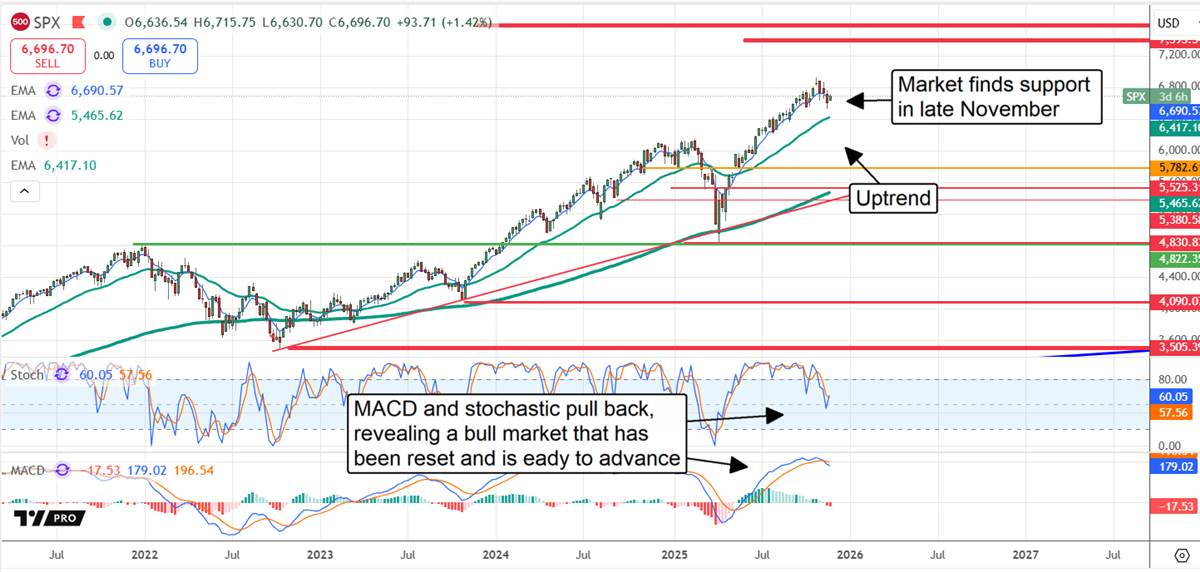
S&P 500 chart showing uptrend support with MACD and stochastic resetting.

Macro-Economic Headwinds Ease 

Macroeconomic uncertainty has been causing significant concern among investors throughout the year. Uncertainty is linked to trade relations, tariff impacts, and, more recently, the government shutdown. The story for December is that the government shutdown is over, trade relations aren’t deteriorating, and there has been some relief regarding tariffs. 

Primarily, the impact of tariffs on Q3 results was far less than expected. The average S&P 500 company outperformed its consensus estimate by more than 600 basis points, which is well above average, and the Q4 season is likely to follow a similar trend.

While the Q3 results outperformed, and most companies improved their guidance, the Q4 consensus forecast remained unchanged. The likely outcome is that Q4 results will outperform by a similarly large margin.

Meanwhile, the FOMC remains on track to cut rates in 2026. The outlook for cuts has dimmed, but there is still an expectation of another two to three 25-basis-point cuts by next summer. The odds for a cut in December are also significantly high and may increase as the month progresses.

With the government shutdown over, government-collected data is being released, and it aligns with healthy, albeit cooler, economic conditions compared to the previous year.  

Retail Earnings Were Good, Guidance Was Increased

There were some areas of weakness in the retail sector’s earnings data, but the overall trend was bullish. Most retailers grew revenue and earnings, produced solid margins, and provided favorable guidance. The takeaway is that Black Friday and Cyber Monday sales events mark the beginning of the holiday shopping season and are likely to exceed forecasts. 

As it stands, holiday spending is expected to increase by 3% to 3.5% with strength centered in eCommerce. Deals and value will be a driver, positioning off-price retailers and Walmart as winners. Among the critical factors for investors is that retail leaders like Walmart (NYSE: WMT) and The TJX Companies (NYSE: TJX) have solid cash flow, pay attractive dividends, and repurchase shares, sometimes aggressively.

The next visible catalyst is the Q4 reporting cycle in January. Still, analysts could drive this sector higher before then with revenue, earnings, and stock price target revisions linked to Q3 results and early holiday spending data. 

The AI Trade Is Reignited

Fears of an AI bubble bursting were laid to rest by NVIDIA’s (NASDAQ: NVDA)Q3 results, which showed stronger-than-expected growth, and by subsequent news that Amazon (NASDAQ: AMZN) plans to invest up to $50 billion in AI infrastructure for U.S. government contracts. Together, these developments reinforce the durability of AI demand across both commercial and public sectors.

The NVIDIA release confirms that its AI business is larger than initially thought, growing faster than anticipated, and accelerating in the second half of the year. This has it set up to outperform in the current and following quarters and to sustain strength long into the future.

The S&P 500 remains on course to hit the 7,300 mark soon. The move may not occur before the year’s end, but the rebound is likely to start by then, and new highs will quickly follow. Notable technical indicators include the stochastic oscillator, which has retreated to the middle of its range, indicating a market that has rebalanced itself and has ample room to move higher. READ THIS STORY ONLINE

Black Friday Warning: Gold Lockdown (Ad)

Black Friday Warning: Gold Lockdown

Central banks and major institutions have been increasing their gold holdings at one of the fastest paces in decades — and Dr. David Eifrig believes this trend reflects deeper shifts in the financial system that most everyday investors aren’t seeing. After four decades in the markets, including time on a trading desk during 1987’s Black Monday, he says this surge isn’t just a reaction to price movements but part of a broader realignment that could influence savings, investments, and even borrowing costs.

Eifrig recently released a new briefing explaining what’s driving this global accumulation, what it may mean for individual investors, and the practical steps he recommends considering now. During Stansberry’s Black Friday event, his latest research is also available at the lowest access price of the year.CLICK HERE TO GET THE FULL BRIEFING AND BLACK FRIDAY ACCESS

More Stories

The Night Owl is a financial newsletter that provides in-depth market analysis on stocks of interest to individual investors. Published by MarketBeat and Early Bird Publishing, The Night Owl is delivered around 9:00 PM Eastern Sunday through Thursday. If you give a hoot about the market, The Night Owl is the newsletter for you.

The Night Owl Newsletter.

View as a Web Page

If you have questions about your subscription, don’t hesitate to email our South Dakota based support team at contact@marketbeat.com.

Unsubscribe

© 2006-2025 MarketBeat Media, LLC. All rights reserved.
345 North Reid Place, Sixth Floor, Sioux Falls, South Dakota 57103. USA..

Read More: The window for preparation isn’t just closing — it’s slamming shut. (From InvestorPlace)

This Sector is Booming: Get in Now

Dear Reader,

Louis Navellier here with a quick update on a sector I believe every American needs to pay close attention to…

I’m talking about the world’s largest undeveloped deposits of metals that are critical for artificial intelligence.

These metals are used in the wiring inside microchips…

And they’re also a critical component in data centers, including power cables, electrical connectors, and heat exchangers.

These data centers are popping up all over the country.

And they all require a huge amount of these metals.

That’s a big reason why I believe a select handful of under-the-radar companies — which are well positioned to mine and distribute these metals…

Won’t remain cheap for much longer.

In fact, the Trump administration is already fast-tracking companies tied to America’s most important mineral reserves.

Click here to get all the details.

Regards,

Louis Navellier
Senior Quantitative Investment Analyst, InvestorPlaceStockguru LLC (dba InvestingDistrict), 2563 cherry hill ln, Hermitage, PA 16148, United StatesYou may unsubscribe or change your contact details at any time.

Unlock Gains from $1 Trillion Holiday Boom ETF

Unsubscribe

Buy this Gold Stock Before The New Year(From Golden Portfolio)


Holiday Spending to Hit $1 Trillion—Time to Buy This Retail ETF?

Written by Jordan Chussler on November 24, 2025 

The Mall of America, a major shopping center in the Twin Cities, during holiday shopping.

Key Points

  • Consumer discretionary stocks have been uninspiring in 2025, but with Christmas approaching, that could change. 
  • For the first time ever, holiday spending in the United States is projected to surpass $1 trillion.
  • The VanEck Retail ETF can provide exposure for investors hoping for a near-term rally through the end of the year.

Between tariffs, sticky inflation, and ongoing weakness in the U.S. dollar, it has been a difficult year for the consumer discretionary sector. When household budgets are strained, consumers focus their purchasing power on essential goods and services, while new cars, electronics, vacations, and restaurant meals take a back seat. 

Such has been the case in 2025, with the consumer discretionary’s year-to-date gain of 0.51% representing the second-worst performance of all of the S&P 500’s 11 sectors. Only the consumer staples sector, down 0.90%, has fared worse this year.  

Those trends are likely to persist into 2026. But with the holidays just around the corner, all short-term bets are off. According to the National Retail Federation (NRF), holiday spending in the United States is projected to be between $1.01 trillion and $1.02 trillion for the first time ever.

This marks an increase of 3.7% over 2024, when that figure reached $976.1 billion.

And while the consumer discretionary sector has broadly underperformed this year, the Van Eck Retail ETF (NASDAQ:RTH) can provide investors with exposure to top companies in that space, which have the potential for a near-term rally that could carry through the end of the year.

48-Hour Alert: This Signal Just Flashed on (TICKER) (Ad)

Years before it became a household name, Shopify showed an early momentum pattern that experienced traders used to catch a 120% move — and that same repeatable signal has just appeared on a new small-cap ticker that hasn’t hit the mainstream yet. Our free Momentum Trading Report breaks down how to spot these stealth setups and reveals which names are flashing right now.Get early access to the free Momentum Trading Report here

The Who’s Who of Consumer Discretionary Stocks

The fund’s nearly 11% gain in 2025 trails the S&P 500, but it has outperformed the overall consumer discretionary sector. 

That has a lot to do with the RTH’s holdings. According to the ETF’s prospectus, it aims to replicate as closely as possible the performance of the MVIS® US Listed Retail 25 Index (MVRTHTR). This index tracks the overall performance of companies involved in retail distribution, e-commerce, multi-line and specialty retail, and food staples. 

In short, the RTH can put some of the biggest consumer names into your portfolio leading up to the holiday season. Among its top holdings are mega-cap giants, including Amazon (NASDAQ: AMZN)Walmart (NYSE: WMT), and Costco Wholesale (NASDAQ: COST), which account for nearly 38% of the fund’s portfolio. 

The remaining 62% is spread across some of the most prolific consumer discretionary stocks in the S&P 500, including home improvement retailers Home Depot (NYSE: HD) and Lowe’s (NYSE: LOW), off-price apparel and footwear stores TJX Companies (NYSE: TJX) and Ross Stores (NASDAQ: ROST), and retailers such as Ulta Beauty (NASDAQ: ULTA)lululemon athletica (NASDAQ: LULU)Best Buy (NYSE: BBY), and Target (NYSE: TGT).

A DIY Santa Claus Rally for Your Portfolio

In total, the RTH offers 80.5% exposure to specialty retail, which should pan out nicely for shareholders as consumer spending ramps up during the last week of November. Despite waning sentiment, consumers are still expected to spend aggressively. The University of Michigan’s Index of Consumer Sentiment fell to 51.0 in November from 53.6 in October—and a significant drop from 71.8 one year ago.

Yet despite that lower consumer confidence, Americans are still expected to spend big bucks on discretionary purchases through the end of the year. According to a study by Talker Research, nearly 1 in 3 Americans expects to slip into debt this holiday season. At the same time, the study found that over half of shoppers (51%) have created a holiday budget this year, but of those, a majority (64%) have already overspent or anticipate doing so. 

That isn’t just good news for Amazon, Walmart, Best Buy, and company—it’s good news for shareholders of the VanEck Retail ETF, who get access for a low-cost expense ratio of 0.35%, which is entirely offset by the fund’s dividend, which currently yields 0.70%, or $1.73 per share annually at current prices.

Trump’s Next Ban – Coming January 19, 2026 (shocking) (Ad)

Trump’s Next Export Ban Could Reshape the Global Economy

It’s not semiconductors, AI chips or quantum computers. But none of those technologies can exist without it. On January 19th, 2026, Trump is expected to ban exports of something every tech company desperately needs—forcing them all to relocate to U.S. soil.See what he’s about to ban here…

Is RTH a Buy Ahead of Black Friday? 

While the fund doesn’t boast significant institutional ownership at less than 26%, buyers have outnumbered sellers over the past 12 months to the tune of $45.14 million in inflows versus just $6.33 million in outflows. 

Meanwhile, Wall Street’s bears are largely staying away from the ETF as the holiday season approaches. Short interest currently stands at a miniscule 0.69%—a nearly 7% decrease since last month, suggesting that the smart money is also expecting big retail numbers in Q4. 

The fund’s average daily volume is light, with just 5,005 shares traded per day, which may limit liquidity for some investors. But of the fund’s 25 holdings, out of 628 analyst ratings, not one company in its portfolio is recommended as a Reduce, Sell, or Strong Sell. 

For investors eyeing a potential Santa Claus rally, the VanEck Retail ETF offers diversified exposure to top-performing retail names during a time of historically strong consumer spending.

Read this article online ›

Featured Stories:

MarketBeat All Access is the premier all-in-one stock research solution that helps you identify the best stocks, monitor your portfolio, and keep track of the market.

Did you like this article?

I liked this article.
I did not like this article.

Thank you for subscribing to MarketBeat!

MarketBeat empowers individual investors to make better investment decisions by offering up-to-the-minute financial information and independent investment analysis.

If you need help with your account, don’t hesitate to email MarketBeat’s U.S. based support team at contact@marketbeat.com.

If you would like to unsubscribe or change which emails you receive, you can manage your mailing preferences or unsubscribefrom these emails.

© 2006-2025 MarketBeat Media, LLC. 
345 N Reid Place, Sixth Floor, Sioux Falls, South Dakota 57103. USA..

Today’s Featured Link: 5 Stocks That Could Double in 2026 (Click to Opt-In)

Stock Investor Insights: Three Energy Stocks to Buy for Fueling Profits

YouTube

Three Energy Stocks to Buy for Fueling Profits

11/25/2025

The $17B Pest Control Industry’s Natural Disruptor

Med-X (preparing for a Nasdaq listing under ticker MXRX) is shaking up pest control with its eco-friendly Nature-Cide products—already trusted by pros and sold through e-commerce giants like Amazon, Walmart, Kroger, and more. With $6.4M in revenue and expansion into 41+ global markets, Med-X is riding the wave of climate, regulatory, and consumer demand for safer, plant-based solutions. 

Shares are currently available at $4.00 through a Regulation A+ offering. 

Become a Med-X Shareholder Before Their Nasdaq Plans Unfold

Disclosures: This is a paid advertisement for Med-X’s Regulation A+ Offering. Please read the offering circular at invest.medx-rx.comClick Here…

Three energy stocks to buy for fueling profits have been trending upward despite a recent market dip in technology and Bitcoin. 

The three energy stocks to buy for fueling profits do not compete with each other but each is championed by a market forecaster who has a proven track record of ascending share prices. For investors who are open to purchasing stocks that may not be high-flyers, but positive performers, this trio of investments may be of interest. 

When some industries like technology or cryptocurrencies such as Bitcoin lose favor with investors, others can gain popularity. That situation may be about to unfold with energy investments. 

Three Energy Stocks to Buy for Fueling Profits: NVGS

Navigator Holdings Ltd. (NYSE: NVGS) describes itself as the owner and operator of the world’s largest fleet of “handysize liquefied gas carriers” and a global leader in the seaborne transportation services of petrochemical gases, such as ethylene and ethane, liquefied petroleum gas (LPG) and ammonia. The company also has a 50% share in a joint venture for an ethylene export marine terminal at Morgan’s Point, Texas, on the Houston Ship Channel. 

The stock has risen more than 10% since it was recommended in the Five Star Trader advisory service led by Mark Skousen, PhD, who also heads the Forecasts & Strategies investment newsletter. Skousen also is a Presidential Fellow and economics professor at Chapman University, as well as an occasional contributor of op-eds for the Wall Street Journal


Mark Skousen leads Five Star Trader and Forecasts & Strategies.

Navigator’s fleet now consists of 56 semi- or fully refrigerated liquefied gas carriers, 25 of which are ethylene and ethane capable. The company plays a key role in the liquefied gas supply chain for energy companies, industrial consumers and commodity traders. 

In addition, Navigator has sophisticated vessels that provide an efficient and reliable “floating pipeline,” its officials said. Navigator’s fundamentals have “strengthened materially” in the past year with both its shipping fleet and ethylene export terminal performing well to produce consistent profitability, they added. 

As energy infrastructure grows, demand for Navigator’s existing ethylene capable carriers should continue to improve, according to the company. 


Chart courtesy of www.stockcharts.com.

Trump’s $200 Billion Revolution Changes Everything

100X faster. 90% less energy. Current AI systems obsolete. 

And three companies control the technology. 

The “iPhone predictor” reveals their names. 

Discover the Trillion Dollar Triangle here.Click Here…

Three Energy Stocks to Buy for Fueling Profits: UEC

Bryan Perry, whose Cash Machine investment newsletter offers subscribers an average dividend yield of more than 10% before adding gains from capital appreciation, is a Wall Street veteran who more than doubled the initial investment he produced in a fledgling uranium company to members of his Micro-Cap Stock Trader advisory service. His recommendation of Uranium Energy Corporation (NYSE: UEC) in Feb. 2024 soared 120.13% by the time he advised its sale on October 16, 2025. 


Bryan Perry heads Micro-Cap Stock Trader and Cash Machine

Additional good news came on Nov. 7 with the U.S. government decision to add uranium in the U.S. Geological Survey’s (USGS) Final 2025 Critical Minerals List, as published in the Federal Register. The designation recognized uranium’s “essential role in America’s energy and national security” and resulted in praise from Amir Adnani, president and chief executive officer of Uranium Energy Corporation. 

Particularly, praise was offered for U.S. Interior Secretary Doug Burgum and the U.S. Geological Survey for taking an “important step” toward fulfilling President Trump’s vision of restoring America’s leadership in critical minerals and achieving true U.S. energy dominance, Adnani said in a statement. 

“UEC is heeding that call with ramp-up and development activities at our three licensed hub-and-spoke production platforms in Texas and Wyoming,” Adnani continued. “In parallel, we’re advancing the United States Uranium Refining & Conversion Corp. to help restore and expand America’s domestic nuclear fuel conversion capabilities.” 

The Energy Act of 2020 allows the Secretary of the Interior to designate a mineral as critical when another federal agency, such as the Department of Energy or another relevant agency, determines it is strategic and critical to U.S. defense or national security. The Department of Energy recommended uranium’s inclusion, citing its importance in energy production and defense applications, and the Department of Defense also emphasized its national security significance. 


Chart courtesy of www.stockcharts.com.

Three Energy Stocks to Buy for Fueling Profits: COP

Conoco Phillips (NYSE: COP) is a “solid energy company” that is expanding its international liquid gas (LG) portfolio, said Michelle Connell, who heads Dallas-based Portia Capital ManagementCOP has strong fundamentals, she added. 

“When they announced their latest earnings on November 6, they reiterated that they’ll be adding an additional $7 billion in free cash flow between now and 2029,” Connell counseled. “These monies will be the result of an expanding international liquid natural gas (LNG) portfolio and the Willow project, an oil production facility in Alaska.” 


Michelle Connell heads Portia Capital Management.

In the same Nov. 6 earnings announcement, COP increased its dividend by 8% and reiterated a goal of retiring $6 billion of the company’s shares, Connell continued. Through November, the company had retired $4 billion in stock. Embedded in this $6 billion share retirement is the company’s desire to retire the shares issued for the acquisition of Marathon Oil over the next few years, she added. 

COP’s increasing free cash flow reflects an energy company with solid fundamentals, Connell told me. The company offers a current dividend yield of 3.84%, supported by the increasing free cash flow and the declining share count. Connell said she expects COP’s dividend yield to increase substantially in the years ahead. 


Chart courtesy of www.stockcharts.com.

In America, We Think for Ourselves

Billions of dollars could vanish like flipping a switch in the next market crash, yet not everything will suffer. Giants like Tesla, Apple, and Nvidia may survive the next ‘Market Tsunami’ but offer limited upside. Discover the fast growers and hidden opportunities in our FREE live A.I. training and see which assets are set to surge before the next wave hits.Click Here…

Geopolitical Risk Stays Significant

President Trump and his diplomats are trying to forge a peace agreement between Ukraine and Russia, but it remains unfinalized. An earlier draft called for Ukraine, the country whose sovereign territory has been invaded, to relinquish some of its precious land to the aggressor, Russia. Such proposals in the past have been most unpopular with the Ukrainian people, who have sacrificed greatly to defend their freedom and protect themselves against the yoke of oppression Russia exerted after World War II on its nearby nations. 

Claims to the contrary by Russia’s leaders belie the reality of increased prosperity for the countries that have the greatest freedom. Skousen, who also is the Doti-Spogli Chair of Free Enterprise at Chapman University in Orange County, California, is a free-market economist who travels the world to praise freedom as a key to opening opportunities for prosperity across the globe. 

A war zone remains in Ukraine after Russia invaded the nation nearly four years ago. President Trump has advocated that other countries defang Russia’s war machine and boycott its oil. The idea has had gained support, but not enough to stop the war so far. 

Despite Trump’s call for peace and an end of the killing, Russia’s President Vladimir Putin and his empire-building cadre of leaders remain undeterred. The war is threating to worsen further if Putin and his comrades in the country’s leadership continue to keep ignoring damage to their nation’s economy and force its citizens to fight and die, despite negligible gains. 

Russia’s miliary strikes keep killing children, women and elderly civilians in Ukraine with little apparent regard for human life. The latest resulted in seven deaths this week when civilian sites were struck in Ukraine’s Capitol far from the front lines. Russia’s tactic of charging forward to gain portions of Ukraine’s territory after Russia’s initial invasion nearly four years ago has been criticized by military strategists around the world. Thus far, Russia’s leaders have opted for a protracted war, not prosperity aided by new trade agreements that President Trump has proposed. 

Paul Dykewicz, www.pauldykewicz.com, is an accomplished, award-winning journalist who has written for Dow Jones, the Wall Street JournalInvestor’s Business DailyUSA Today, the Journal of Commerce, Seeking Alpha, GuruFocus and other publications and websites. Paul is the editor of StockInvestor.com and DividendInvestor.com, a writer for both websites and a columnist. He further is the editorial director of Eagle Financial Publications in Washington, D.C., where he edits monthly investment newsletters, time-sensitive trading alerts, free e-letters and other investment reports. Paul previously served as business editor of Baltimore’s Daily Record newspaper. Paul also is the author of an inspirational book, “Holy Smokes! Golden Guidance from Notre Dame’s Championship Chaplain,” with a foreword by former national championship-winning football coach Lou Holtz. Follow Paul on Twitter @PaulDykewicz.

Sincerely,

Paul Dykewicz, Editor
StockInvestor.com

About Paul Dykewicz:

Paul Dykewicz is an accomplished, award-winning journalist who has written for Dow Jones, the Wall Street JournalInvestor’s Business DailyUSA TodaySeeking AlphaGuruFocus and other publications and websites. Paul is the editor of StockInvestor.com and DividendInvestor.com, a writer for both websites and a columnist. He further is the editorial director of Eagle Financial Publications in Washington, D.C., where he edits monthly investment newsletters, time-sensitive trading alerts, free e-letters and other investment reports. Paul also is the author of an inspirational book, “Holy Smokes! Golden Guidance from Notre Dame’s Championship Chaplain“, with a foreword by former national championship-winning football coach Lou Holtz. Follow Paul on Twitter @PaulDykewicz.

About Us:

Eagle Financial Publications is located in Rosslyn, VA. – Blocks from the Capitol. Our products have been helping investors build their wealth for several decades. Whether you’re a long-term investor or short-term trader, you’ll find the right strategy for you, including how to earn more steady income to spend now, preserve and grow your capital to enjoy later, and whatever other investment goals you have.

Visit Our Websites:

To ensure future delivery of Eagle Financial Publication’s emails please add the domain @info2.eaglefinancialpublications.com to your address book or contact list.

This email was sent to pahovis@aol.com because you are subscribed to theEagle Stock Investor Insights List. To unsubscribe please click here. To instantly stop receiving emails simply click here. View this email in your web browser. 

If you have questions, please send them to Customer Service

Salem Media Group – Eagle Financial Publications | 1735 N Lynn St, Suite 500, Arlington, VA 22209-2016

Behind Circle’s Fall: Growth Potential and Risks

Earnings360

Unsubscribe

The $150 setup that doesn’t rely on a stock’s direction (From Base Camp Trading)


Why Circle Stock Is Falling—and Why Some Analysts See Big Upside

Written by Nathan Reiff on November 24, 2025 

Stablecoin symbols against stock exchange.

Key Points

  • Circle Internet has fallen far from its post-IPO highs, dropping by close to 50% in November alone.
  • The company’s significant revenue growth and stablecoin transaction volume bode well, but they may be outweighed by rising costs and margin concerns.
  • On a macro level, a declining interest rate environment poses a challenge to Circle’s model, and regulatory uncertainty exacerbates the issue.

Circle Internet Group (NYSE: CRCL), the fintech best known as the issuer of the stablecoin USDC, has been on a tumultuous share price path since going public in June.

The stock quickly ballooned to almost $250, then fell, before rallying again over the summer. As of late November, shares have dropped by more than 42% in the past month, falling below $72.

While this volatility is notable, what really makes Circle’s story interesting for investors is its ambitious price target. Analysts collectively see the stock more than double to $150.33 per share.

Below, we’ll explore the drivers behind the recent selloff and whether there is still a bullish case to be made for this beleaguered new entrant to the fintech stock space.

How options trading is broken (in a good way) (Ad)

Most traders spend all day glued to charts, hoping for a big move — but Graham Lindman says the easiest gains this year have come from a simple pricing quirk that appears in blue-chip options over and over again. By entering select $1-or-less contracts on names like Apple, Nvidia, and Google, he’s shown how small moves in the stock can still deliver fast 100%+ wins — without timing the market or relying on complex setups. Now he’s setting up the next round of these “$1 trades” and revealing exactly how he finds them.Click here to see how the $1 trade setup works and where the newest opportunities are

A Closer Look at Circle’s Selloff

The recent selloff, which brought Circle in line with its debut price from early June, seems counterintuitive based on the company’s recent earnings performance.

For the third quarter, Circle’s year-over-year (YOY) revenue improvement reached 66%, an acceleration over the prior quarter’s already-impressive gains.

Revenue of $740 million came alongside an improvement in adjusted EBITDA to $166 million from $126 million a year earlier.

A portion of the recent decline in Circle’s price is likely tied to its exposure to the broader crypto space, which has tumbled as Bitcoin plunged by nearly 23% in the last month.

Despite Circle’s focus on the stablecoin corner of the crypto sphere, this market is still not sufficiently disentangled to avoid the situation in which a major correction in Bitcoin impacts firms that are only loosely linked to BTC.

But the bigger problems for Circle may have been its anticipated costs and the external headwinds of changing interest rates. Circle announced in its latest earnings that it would raise its full-year guidance for adjusted operating expenses as high as $510 million, putting pressure on margins.

Additionally, a significant portion of its revenue is tied to interest earned on cash and Treasuries backing USDC. With potential U.S. interest rate cuts looming, this revenue stream may shrink in the coming quarters.

Analysts Split on CRCL’s Future as Price Target Holds Firm

Wall Street is divided regarding CRCL stock, with 10 analysts rating the stock as a Buy, nine saying it’s a Hold, and three marking it as a Sell.

So far in November, firms including Wells Fargo and Needham & Co. have lowered their price targets—but kept their ratings.

Others, like Baird and JPMorgan, are in a small group that believes CRCL’s decline could be a prime opportunity to buy the dip—these firms have actually upgraded CRCL targets in the last several weeks.

The bullish thesis is rooted in USDC’s rapid adoption. In the latest quarter, USDC’s circulation more than doubled YOY, and on-chain transaction volume surged 580%. If this momentum continues, it could drive long-term gains for CRCL.

Broader stablecoin adoption in the face of a declining greenback, inflation, or other macro pressures may also fuel growth. Finally, if Circle continues to expand its infrastructure revenue, making it less reliant on the success of USDC, investors may find it worthwhile to reward this diversification.

The phenomenon that billion-dollar hedge funds quietly depend on (Ad)

Man Group’s record AUM made headlines, but the real story is the market force that firms like D.E. Shaw, Citadel, and Renaissance have been quietly using for years. It’s the same phenomenon I first saw while working inside a major Wall Street trading shop — a pattern powerful enough to pinpoint which stocks are about to attract unusually heavy attention each morning.

Nate Tucci and I recently broke down how we track this flow and how it identifies the #1 ticker to watch each day. No guarantees, of course — but the method has correctly flagged setups on AAPL, TSLA, NVDA, and more with strong consistency, and the next signal is already flashing.Tap here to see the full story and today’s #1 ranked ticker

Can Circle Really Double?

To be sure, Circle’s challenges are many—the company faces intense margin pressure, increasing competition from other stablecoins, and a shifting regulatory landscape marked earlier this year by the passage of the GENIUS Act. The company’s successes will have to outweigh these risks by a wide margin if it is to reverse course from its current decline, let alone double in value.

Investors willing to take a risk on a company that could generate significant returns may appreciate the opportunity that Circle’s dip presents. Similarly, long-term fintech bullsbelieving that stablecoins are likely to be widespread might be drawn to CRCL. For most investors, though, CRCL’s recent selloff may seem to be justified, so long as the risks remain.

Read this article online ›

Featured Articles:

MarketBeat All Access is the premier all-in-one stock research solution that helps you identify the best stocks, monitor your portfolio, and keep track of the market.

Did you find this article helpful?

I liked this article.
I did not like this article.

Thank you for subscribing to Earnings360, a morning newsletter that summarizes quarterly earnings for public companies that trade on U.S. markets.

If you need assistance with your newsletter, please feel free to contact our U.S. based support team at contact@marketbeat.com.

If you no longer wish to receive email from Earnings360, you can unsubscribe.

© 2006-2025 MarketBeat Media, LLC. All rights reserved.
345 North Reid Place, Suite 620, Sioux Falls, S.D. 57103. United States of America..

Today’s Featured Link: 5 Stocks That Could Double in 2026 (Click to Opt-In)

Bad market news can’t stop The Good Morning Cash Trade

It stunned the world –

January 27th, 2025.

Nvidia crashed. And the AI sector buckled. Triggering a $1 trillion sell-off. 

In a flash, investors saw years of savings vaporized. If that happened to you, it’s not your fault.

You don’t have a crystal ball to predict the market.

But you don’t need to. At least not anymore…

Dave Aquino, a former Wall Street insider with 25 years of experience…

Says there was a directionless trade you could’ve placed that morning. It could’ve handed you a $150 payout. 

Depending on your position size, you could’ve made more than…

  • $200…
  • $250…
  • $350…
  • $400 in a single morning…

During the worst tech crash in recent history. 

This is a repeatable, virtually fire-proof trading plan that doesn’t require you to know market direction.

It’s unlike anything you’ve seen before. 

We call it “The Good Morning Cash Plan.”

And you could be just 90 minutes away from your first winning trade.

Check out Dave’s FREE training to place your first trade. 

Access the $150 Daily Cash Plan HERE now.

To your trading success

Drew Day
Founder, Base Camp Trading


Just For You

HIMS Has Been a Roller Coaster Ride. Should Investors Hop On?

Written by Jordan Chussler. Published 11/19/2025. 

Hims and Hers Health logo positioned with telehealthcare provider in background.

Key Points

  • Shares of HIMS have seen gains of 173% and 146% this year, but they’ve also seen massive double-digit corrections after each run-up in price. 
  • The company’s management was able to achieve profitability just three years after its IPO.
  • Analysts’ forecast an average 12-month price target nearly 25% higher than where the stock is trading today.

Most headlines in the health care sector are dominated by Big Pharma giants. Legacy companies such as AbbVie (NYSE: ABBV)Eli Lilly (NYSE: LLY)Pfizer (NYSE: PFE), and Merck (NYSE: MRK)—and their lineup of game-changing drugs—receive the lion’s share of attention. But one newcomer is making a splash, and investors seeking growth opportunities in the health space should be paying attention. 

Founded in November 2017, Hims & Hers Health (NYSE: HIMS) went public in January 2021. By the end of 2024, the consumer-focused health platform posted its first profitable year, reporting net income of $126 million. 

I interviewed 600 crypto millionaires – here’s what’s coming (Ad)

The smartest minds in the market are positioning themselves for something unprecedented…

Learn how to capitalize on the early stages of a historic crypto bull run before it’s too late.Get your FREE copy of “Crypto Revolution” now

While that figure is small compared with mega-cap peers, it demonstrates a level of financial discipline rarely seen among companies less than five years removed from their IPO. Combined with operations at the intersection of several high-demand industries, this makes Hims & Hers an intriguing buy-and-hold prospect for some investors.  

A Turbulent Year for Shareholders 

On the fundamentals side, the young company’s debt management has been notable. That strength is underscored by a nearly 244% increase in net cash from operating activities from 2023 to 2024. 

When Hims & Hers Health reported Q3 financials on Nov. 3, it missed earnings by just 3 cents and beat revenue expectations, reporting $598.98 million, a 49.2% year-over-year increase.

In his comments, CEO and cofounder Andrew Dudum highlighted that “At the end of the quarter, subscribers using personalized solutions grew 50% year-over-year, helping drive nearly 50% in year-over-year revenue growth.” 

Notably, the company’s debt-to-equity ratio of 1.67 and its forward price-to-earnings (P/E) ratio of 52.79—a marked improvement from its trailing 12-month P/E of 67.33—suggest analysts expect earnings to rise next year, from $0.29 per share to about $0.52 per share (more than 79%). 

Since 2021, Hims & Hers has averaged annual EBITDA growth of 37.14%, revenue growth of 77.85%, and earnings per share (EPS) growth of 169.63%.

Despite these solid fundamentals, 2025 has required a strong stomach for HIMS shareholders. The stock’s performance this year has resembled a roller coaster, with rapid rallies followed by sharp declines. 

From Jan. 2 to Feb. 19, HIMS gained nearly 173% before giving back more than 63% by April 22. By May 19 it had climbed nearly 146% again, then plunged about 36% by June 25. At the end of July it had regained roughly 60%, and at the time of writing the stock is about 45% below that high.

HIMS Is at the Center of Multiple High-Growth Industries 

Overall, since going public the stock is up nearly 139%. Hims & Hers has shown rapid growth while management has produced disciplined balance sheets. The company’s accessible, direct-to-consumer telehealth model places it at the intersection of several high-growth markets.

According to market consultancy Grand View Research, the sexual health supplement market is projected to grow at a compound annual growth rate (CAGR) of 10.4% from 2024 through 2030.

The hair thinning market is forecast to expand at a CAGR of 10.85% in the same period, while the telehealth market is expected to grow at a CAGR of 24.68%. 

Perhaps most notably, Hims & Hers also offers compounded GLP-1 injections, which use the same class of active ingredients found in Novo Nordisk’s (NYSE: NVO) Ozempic and Wegovy. The GLP-1 weight-loss market is projected to grow at a CAGR of about 18.54% during the forecast period. 

Additionally, Dudum said on the company’s Q3 earnings call that Hims & Hers is in ongoing discussions with Novo Nordisk to distribute both injection and oral formulations of Wegovy on its platform, pending FDA approval.

Here’s What Wall Street Thinks of HIMS

Ten of the 15 analysts covering Hims & Hers rate it a Hold, and the stock carries a consensus Reduce rating. Still, the 15 analysts’ average 12-month price target is $45.27, implying potential upside of about 24.5%. 

However, the current level of short interest may give prospective investors pause: it stands at roughly 37.54% of the company’s float. For long-term investors, though, institutional ownership—nearly 64%—offers a countervailing vote of confidence.

Underscoring that institutional bullishness, over the past 12 months 425 institutional buyers have added about $2.31 billion in inflows, compared with 194 institutional sellers who withdrew roughly $1.17 billion.

This email communication is a sponsored message provided by Base Camp Trading, a third-party advertiser of MarketBeat. Why did I receive this message?

If you need help with your account, please contact our South Dakota based support team at contact@marketbeat.com.

If you would no longer like to receive promotional emails from MarketBeat advertisers, you can unsubscribe or manage your mailing preferences here.

© 2006-2025 MarketBeat Media, LLC. All rights reserved.
345 North Reid Place, Sixth Floor, Sioux Falls, S.D. 57103-7078. U.S.A..

Today’s Bonus Content: Markets React: Shutdown Drama, Tariffs & a Moody Consumer (Click to Opt-In)

Ukraine Hurdles Remain; DOJ Gun Rights Office

Breaking News from Newsmax.com

• DOJ Plans Gun Rights Office Within Civil Rights Unit

Special: Americans Born Between 1941-1979 Can Receive These 10 Benefits This Month

• Newsmax Exclusive: Big Hurdles Yet to Come in Drive for Ukraine Peace


SPONSOR


ADVERTORIAL

Americans Born Between 1941-1979 Can Receive These 10 Benefits This Month

Retirees: Don’t Miss Out on These 2025 Money Perks

Think senior discounts stop at restaurants and retail stores? Think again.

There are surprising programs available right now that could help you cut monthly expenses, lower insurance premiums, and even boost your retirement savings.

We’ve rounded up some of the smartest financial opportunities for seniors in 2025 — but many of these programs won’t stick around forever.

If you’re 55 or older, it’s worth taking a few minutes to see what you might qualify for.👉See What You Could Be Missing

This email is never sent unsolicited. You have received this Newsmax email because you subscribed to it or someone forwarded it to you. To opt out, see the links below.

Remove your email address from our list or modifyyour profile. We respect your right to privacy. Viewour policy.

This email was sent by:
Newsmax.com
362 N. Haverhill Road
West Palm Beach, FL 33415 USA

DM881819
010504mfxm87

If you hate money, ignore this email

Dear Reader,

Black Friday deal inventory:

❌ $4 latte
❌ $4 impulse junk
❌ $4 lottery ticket
✅ Four weeks of Nate Bear’s Profit Surge Trader

→ Live Monday trading sessions
→ 4 trade recommendations
→ Aftershock Scanner
→ Chatroom
→ Training vault

All for $4.

If you hate money, close this email.

If not…

[Claim the Most Profitable Black Friday Deal Available]

Ryan Fitzwater
Publisher, Monument Traders Alliance

P.S. Includes Nate’s Opening Bell Aftershock Scanner tool plus three exclusive trading guides – FREE today only.


Today’s Featured Article

NVIDIA Just Proved the AI Boom Is Bigger Than Anyone Thought

Written by Thomas Hughes. Published 11/20/2025. 

NVIDIA logo positioned in front of rising stock chart.

Key Points

  • NVIDIA’s Q3 release and guidance update indicated that the AI trade is still alive, with the industry larger and growing faster than anticipated.
  • Revenue growth is accelerating, and forecasts for 2026 suggest analyst estimates are as much as 100% too low.
  • Analysts are lifting their targets, pointing to a steep price increase over the next 12 months.

If there were any doubts about the AI trade and its health ahead of NVIDIA’s (NASDAQ: NVDA) Q3 earnings release, they have been laid to rest. The company delivered another standout quarter, accelerating revenue growth to over 60% year-over-year and beating consensus estimates.

NVIDIA’s stunning outperformance suggests the AI boom is larger and expanding faster than anticipated. The company’s Q4 guidance was about $3 billion above MarketBeat’s reported consensus—nearly 500 basis points—and trends suggest NVIDIA could again exceed expectations. CEO Jensen Huang said GPUs and GPU capacity are sold out, with clear visibility through the end of next calendar year. 

Everyone’s selling… but smart money is targeting this memecoin (Ad)

Something with massive upside potential is still flying under the radar…

Discover the brand-new memecoin that is poised to soar next.Discover the #1 Memecoin to Own Right Now

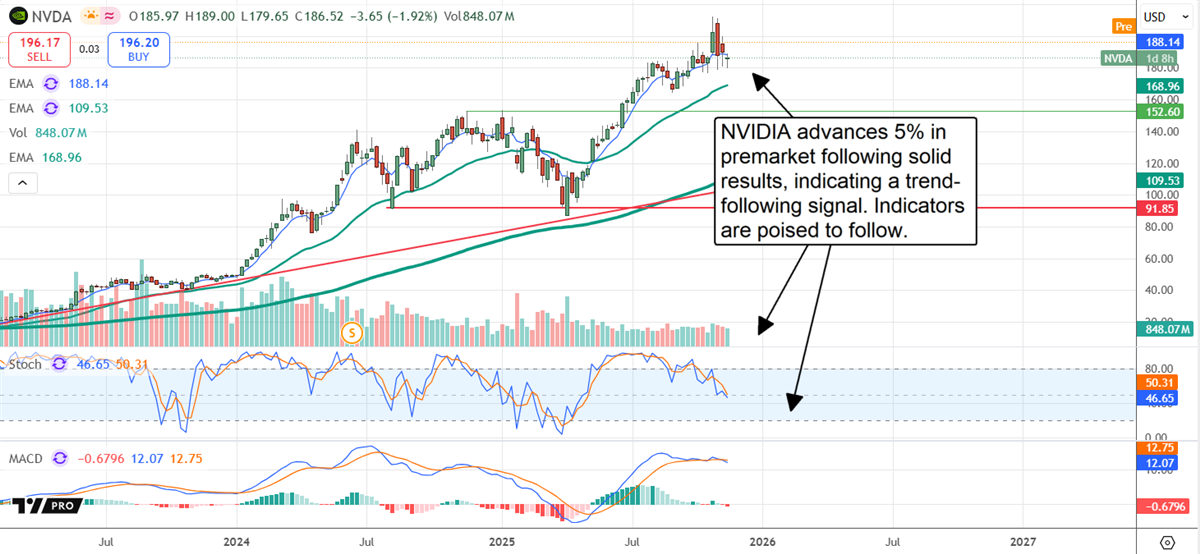
NVDA chart displaying 5% premarket advance in the stock following the Q3 earnings release.

NVIDIA’s Outlook for 2026: Analyst Forecasts Are Too Low

Looking forward, NVIDIA expects about $500 million in Blackwell and Rubin revenue over the next five quarters, including the current quarter. That figure is more than 60% higher than the consensus forecast for the year—and that’s before accounting for contributions from other business segments.

The Q3 results showed strength across the board, with double-digit growth in all segments, highlighting the company’s broad-based momentum.

In this light, NVIDIA’s 2026 analyst forecasts may be understated by as much as 100%, a gap that could push the stock toward record levels.

The analyst community was quick to respond. MarketBeat tracked nine price target revisions within the first 12 hours of the release, and all are bullish for the market.

Although there were no formal upgrades (nearly 94% of ratings already sit at Buy or higher), several firms raised price targets or reaffirmed their views.

The consensus implies about a 30% upside versus the pre-release close, while the average of the updated targets suggests a potentially larger move. The average forecast after the earnings release is currently $262, with the high-end at $350.

Notably, both low-end and high-end targets are trending higher, indicating a broad shift supported by a sizable portion of the market. A move to the high-end range would represent nearly a 100% gain from pre-earnings levels. 

Institutional activity remains a key driver of NVIDIA stock. Institutions own roughly 65% of outstanding shares; despite some selling in early Q4, they have been broadly bullish this year and are likely to resume buying in the back half of Q4 now that the results are public. 

NVIDIA’s Balance Sheet and Shareholder Value Swell

NVIDIA’s financial position adds another layer of confidence. The company’s revenue surge improved operating leverage, driving stronger margins, cash flow and profits. Earnings per share, which significantly outperformed consensus estimates, are forecast to grow in 2026 alongside revenue. 

The company’s balance sheet is notably strong. NVIDIA is net cash positive, and its cash holdings grew by about 40% year-to-date to more than $60 billion. Although the dividend yield remains modest at 0.05%, share repurchases have been meaningful—reducing the share count by roughly 1% in Q3—and are likely to continue.

NVIDIA Trigger Buy Signal

Technically, the stock looked vulnerable ahead of the Q3 release—with candlestick patterns, MACD and the stochastic oscillator all pointing to a potential top. NVIDIA’s strong earnings, however, triggered a new buy signal. Shares jumped more than 5% in pre-market trading, finding support at key trend levels. Given favorable long-term trends and solid fundamentals, NVIDIA remains well-positioned to benefit from the accelerating AI cycle.

This email message is a sponsored message from Monument Traders Alliance, a third-party advertiser of MarketBeat. Why did I receive this email content?

If you need help with your account, please contact MarketBeat’s U.S. based support team at contact@marketbeat.com.

If you would no longer like to receive promotional emails from MarketBeat advertisers, you can unsubscribe or manage your mailing preferences here.

Copyright 2006-2025 MarketBeat Media, LLC. All rights protected.
345 N Reid Pl. #620, Sioux Falls, South Dakota 57103. U.S.A..

Read More: These 5 Stocks Are Thriving Under Trump’s Presidency (Click to Opt-In)

Porter Stansberry

Hey,

Porter Stansberry again. 

Thanks for requesting your report on AI’s Final Frontier. 

(I sent the link to you in another email… 
but in case you missed it, here it is again)

Now, here’s what else I’ve got in store for you: 

Along with your AI report, you’ve also been granted complimentary access to my Daily Journal. 

This is the investing journal trusted by more than 50,000 people who want honest, unbiased investing insights to help them better grow their wealth. 

You should get your first issue of the Daily Journal tomorrow. It will look something like this, so keep an eye out for it: 

Now, if you don’t know me or my work, for the last three decades, I’ve been one of America’s leading investment analysts.  

My partners and I predicted many of the most consequential economic and financial stories… and showed our readers how to prepare for these events to both protect and grow their wealth. 

Whether it was the emerging-market crisis of the late 1990s, the bursting of the dot-com bubble, the 2008 financial crisis, the COVID collapse, or any of a dozen other turning points… 

…we’ve helped guide millions of people through these events with our independent research, analysis, and insights.  

Along the way, we’ve also recommended some of the world’s greatest investment opportunities, often years before the mainstream caught on: 

  • Walmart in 1999 
  • Amazon in 1999 
  • Microsoft in 2006  
  • Nvidia in 2016 
  • Shopify in 2016 
  • Adobe in 1999 
  • Home Depot in 2009 
  • NVR in 2007 

And that’s just a handful. 

Now, through your complimentary membership to the Daily Journal, I hope to do the same for you. My goal is to ensure you’re always on the frontlines of the biggest financial trends, stories, and opportunities. 

Your first issue should arrive tomorrow. 

While you wait, make sure you watch my Final Frontier documentary

It exposes the most important and transformational story in the financial world… one which I believe could make a potential fortune for those who get in early.

Especially if they own the little-known companies I name here.

Enjoy. 

Porter StansberryPorter & Co. © 2025 – Unsubscribe

BJ’s Wholesale Club and the Case for a Bullish Market Reversal

DividendStocks.com Newsletter

Unsubscribe

Trump’s Next Ban – Coming January 19, 2026 (shocking) (From Banyan Hill Publishing)


BJ’s Wholesale Club and the Case for a Bullish Market Reversal

Written by Thomas Hughes on November 24, 2025 

BJ's Wholesale Club storefront.

Key Points

  • BJ’s Wholesale Club is set up for a market reversal that could add 30% or more to its stock price over the next few quarters.
  • Better-than-expected earnings results and guidance affirm a robust buyback outlook.
  • Analysts and institutions are accumulating the stock, providing a strong tailwind.

BJ’s Wholesale Club’s (NYSE: BJ) stock price is set up for a bullish market reversalthat could push it to $120 or higher, representing 33% upside from late-November trading levels.

This forecast may even be conservative, as the technical setup supports continued momentum, and market sentiment is shifting. The likely outcome is that BJ’s stock will accumulate over the coming quarters, resulting in a sustained uptrend that may linger through the end of 2026.

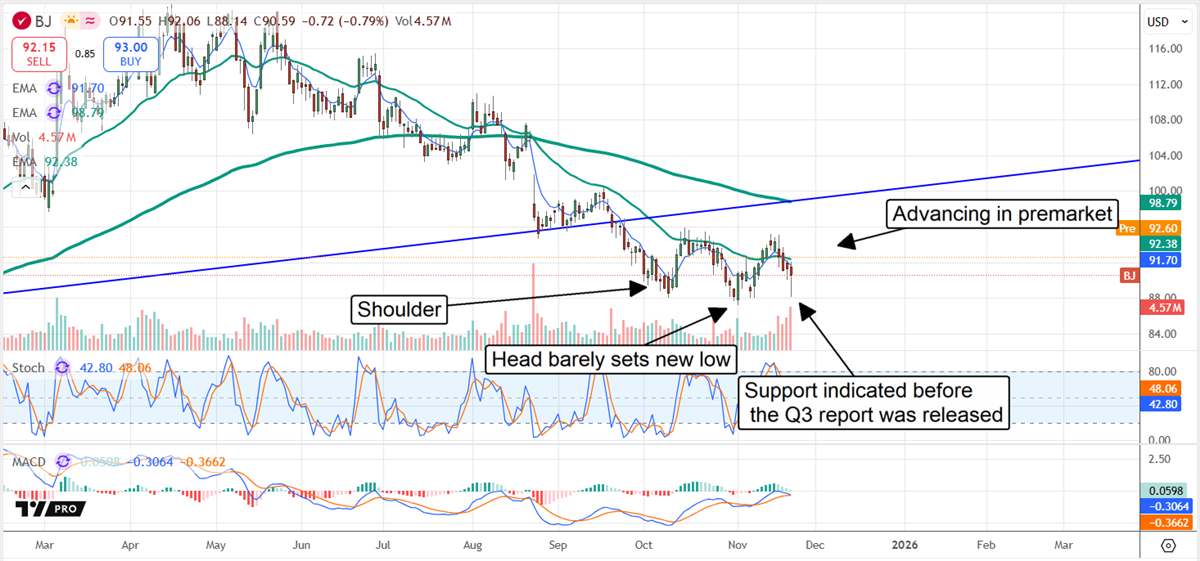
The technical picture is very bullish. BJ stock has pulled back since early 2025 but remains supported by the long-term exponential moving averages (EMAs). The daily chart shows a well-formed Head & Shoulders pattern in the process of confirmation. 

A Head & Shoulders pattern is a technical formation that signals a potential trend reversal, characterized by three peaks: a higher center (the head) flanked by two lower highs (the shoulders).

The Q3 earnings release triggered a strong pre-market rally, which reinforced support at critical levels and formed the second shoulder in the pattern.

Note the shallow depth of the head—the market did not fall far below the first shoulder before buyers stepped in, underscoring the bullishness of this indicator. The critical resistance level is near the neckline at $95 and will likely be tested before the end of 2025. 

BJ stock chart displaying bullish head and shoulders formation.

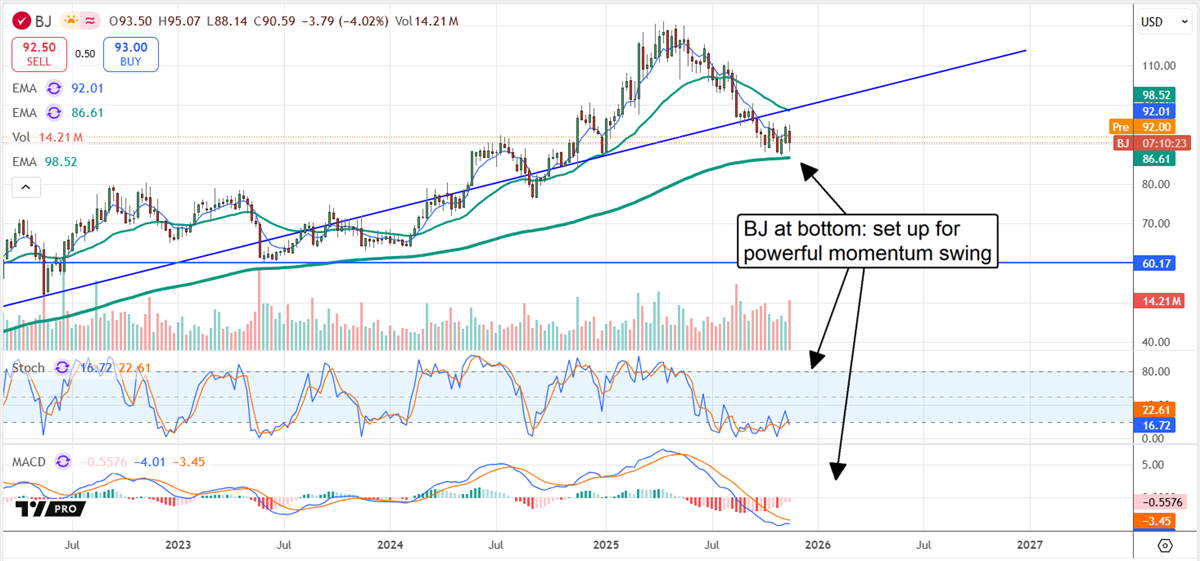
The weekly chart is just as bullish. Although the price action declined significantly, the sell-off overextended, found support at critical levels, and is set up for a trend following signal. Indicators are set up for a momentum swing that, in this time frame, could keep the market advancing for several quarters if not years. Institutional and analyst trends suggest the longer duration is more likely. 

BJ stock chart diplaying a steep decline that appears to have found support.

Buffett, Gates and Bezos Dumping Stocks (Ad)

The world’s wealthiest individuals are making huge moves with their money.

Warren Buffett just liquidated billions of shares. Bill Gates sold 500,000 shares of Microsoft. Jeff Bezos filed to sell Amazon shares worth $4.8 billion.

What is going on? One multi-millionaire believes they are preparing for a catastrophic event. But not a crash, bank run, or recession. It’s something we haven’t see in America for more than a century.For the full story, click here.

Analysts and Institutions Set Up a Deep Value Opportunity for BJ Investors

BJ’s Wholesale Club’s stock price decline was rooted in analyst sentiment, which cooled off in Q2 and Q3. This led to a reduction in price targets, pressuring the market to its November lows.

However, despite the reductions, coverage has been increasing, and the sentiment has remained firm at Moderate Buy, as the long-term outlook remains healthy.

It includes growth, cash flow, and capital returns, so with Q3 results better than forecast, the downtrend in price target revisions will likely end. 

As it stands, the consensus forecasts more than 20% upside from lows seen in November. This may be on the low side, given the earnings outlook and valuation metrics.

The stock trades at a discount to its peers and earnings projections, at about 20 times current-year earnings, suggesting the potential for a 100% to 200% increase in stock price over the next three to five years. 

The value opportunity is highlighted by the institutions, which show high confidence by owning nearly 100% of the stock, and their activity, which has been bullish all year and accelerated in the first half of Q4.

Notably, selling was also elevated earlier in the year but virtually disappeared in Q4 as price action began to bottom. With this in play, the stock price has nowhere to go but up—unless short-sellers start dumping shares into the market, which is unlikely given the circumstances. 

BJ’s Wholesale Club Has Beat-and-Raise Quarter: Reduces Share Count 1%

BJ’s Wholesale Club had a solid quarter,aligning with industry trends, producing 4.9% top-line growth. The growth was driven by an increased store count, a 1.1% comp sales increase, and a 9.8% increase in membership fees. eCommerce, the growth pillar in 2025, increased by 30% and is expected to remain strong in the upcoming quarters. 

Equally important, the margin contracted by less than expected. The result is that operating income fell by nearly 5%, net by almost 2.5%, and adjusted earnings per share (EPS) by 1.7%—all of which were less than expected by analyst consensus, leaving EPS more than a nickel ahead of target. Management also raised EPS guidance, shifting the prior high to the midpoint of the new range—possibly a cautious move that leaves room for outperformance.

Read this article online ›

Recommended Stories:

MarketBeat All Access is the premier all-in-one stock research solution that helps you identify the best stocks, monitor your portfolio, and keep track of the market.

Did you learn something from this article?

I liked this article.
I did not like this article.

Thank you for subscribing to DividendStocks.com’s daily newsletter for dividend and income investors that covers ex-dividend stocks, new dividend declarations, dividend stock ideas, and the latest market news.

If you have questions about your newsletter, feel free to email our South Dakota based support team at contact@marketbeat.com.

If you no longer wish to receive email from DividendStocks.com, you can unsubscribe.

© 2006-2025 MarketBeat Media, LLC. All rights reserved.
345 N Reid Place #620, Sioux Falls, South Dakota 57103. USA..

Check This Out: 5 Stocks That Could Double in 2026 (Click to Opt-In)