Uh oh… Wall Street’s fear index is rising.

Week Ending March 27th, 2026

Friday’s Market Moves

S&P 500 – 6,368.85 (-1.67%)

Dow Jones – 45,166.64 (-1.73%)

NASDAQ – 20,948.36 (-2.15%)

Weekly Recap

  • Equity Markets: U.S. stocks closed lower on Friday, with declines led by consumer discretionary and financials stocks. The S&P 500 is down over 7% for the year, while the Nasdaq remains in correction territory. Energy once again stood out as the top-performing sector, continuing its strong start to 2026 amid rising oil prices. Globally, Asian markets were mixed, and European markets trended lower.
  • Energy Markets: WTI crude prices moved higher amid ongoing disruptions in the Strait of Hormuz. Despite near-term volatility, opportunities continue to emerge across different asset classes.
  • Economic Data: The University of Michigan consumer sentiment index for March was revised down to 53.3, below expectations of 54.0. Rising gas prices and market volatility were cited as key drivers. Short-term inflation expectations climbed to 3.8% from 3.4%, raising concerns about persistent price pressures. Meanwhile, the S&P Global U.S. Manufacturing PMI increased to 52.4 from 51.6 in February, above the 51.3 forecast, led by a strong rise in new orders, particularly in export-driven sectors.
  • Bond Market: Yields moved higher, with the 10-year Treasury yield approaching 4.44%. The Atlanta Fed’s GDPNow model revised its Q1 GDP estimate down to 2.0% from 2.3% last week.
  • Tech & Cybersecurity: Cybersecurity stocks faced heavy selling pressure. CrowdStrike (CRWD) fell ~6% and Palo Alto Networks (PANW) dropped ~4% after reports of security risks tied to a new AI model by Anthropic. Semiconductor and memory stocks also declined sharply after Google (GOOGL) unveiled a new AI model designed to reduce memory requirements. Micron (MU) has now fallen six sessions in a row, while SanDisk, Western Digital, and Seagate each dropped over 1.5%. The PHLX Semiconductor Index (SOX) fell, with Nvidia (NVDA) hitting a three-month low.
  • Precious Metals & Crypto: Gold futures hovered near three-month lows under $4,500, influenced by reduced central bank buying. Bitcoin futures (/BTC) also dropped, signaling a broader risk-off sentiment. The Bitwise 10 Large Cap Crypto Index fell 6% week-over-week.
    • Corporate Highlights:
    • Tripadvisor (TRIP) gained following a Bank of America upgrade. 
    • AstraZeneca (AZN) rose on positive clinical trial results for a COPD treatment. 
    • Meta (META) and Alphabet (GOOGL) declined after a Los Angeles jury ruled both liable in a social media addiction case. 
    • Netflix (NFLX) increased subscription prices for the first time since January 2025. 
  • Other Key Headlines:
    • Tiger Woods Arrested: The golfer was arrested for a DUI following a rollover crash in Florida, raising questions about his health and potential participation in the upcoming Masters. 
    • Global Trade: WTO members moved forward with the first baseline digital trade rules without full consensus, highlighting progress and ongoing tensions in shaping modern trade frameworks. 
    • Legal News: Bank of America agreed to a $72.5 million settlement with victims of Jeffrey Epstein, part of a series of major legal payouts involving banks linked to his trafficking network.

_____________________________________________________________


“I smile at obstacles.” – Tiger Woods

_____________________________________________________________

Notable Stocks

  • Netflix (NFLX) 
  • Apple (AAPL)
  • Palantir (PLTR)
  • Alphabet (GOOGL)
  • Nvidia (NVDA)

Weekly Notables

Trump Signs Order to Pay TSA Workers Amid DHS Shutdown Standoff

Donald Trump signed an executive action Friday to ensure Transportation Security Administration employees receive pay after Congress failed to reach a funding agreement for the Department of Homeland Security. The move is aimed at easing mounting disruptions at U.S. airports. In the order, Trump said the administration would use “funds that have a reasonable and logical nexus to TSA operations,” calling the situation an emergency that threatens national security and strains the air travel system. Markwayne Mullin said TSA employees could begin receiving paychecks as soon as Monday.

Buffett Watch: Berkshire’s Losing Streak Extends as Market Pressures Build

Shares of Berkshire Hathaway have declined for eight consecutive trading sessions, marking their longest losing streak in more than seven years. This is the company’s longest stretch of daily losses since December 2018. Both share classes have come under pressure, with Class A shares down 4.7% and Class B shares falling 4.9% since their last gains on March 17. The decline comes amid broader market weakness driven by rising energy prices and geopolitical uncertainty tied to the Iran conflict.

Earnings Spotlight: Conagra Brands (CAG)

Conagra Brands (CAG) is expected to report Q3 2026 earnings on April 1, with analysts forecasting a decline in revenue to $2.77 billion (down 2.6%) and earnings of 40 cents per share (down 21.6%). High input costs and increased promotional spending are offsetting improvements in frozen and snack volumes, leading to expected top and bottom-line pressure.

What’s Ahead

Economic:

  • Monday (March 30): no reports
  • Tuesday (March 31): Chicago PMI, Consumer Confidence, FHFA Housing Price Index, S&P Case-Shiller Home Price Index
  • Wednesday (April 1): ADP Employment Change, Construction Spending, EIA Crude Oil Inventories, ISM Manufacturing Index, MBA Mortgage Applications Index
  • Thursday (April 2): Business Inventories, Continuing Claims, EIA Natural Gas Inventories, Factory Orders, Initial Claims
  • Friday (April 3): Nonfarm Payrolls, Unemployment, Average Hourly Earnings, Average Workweek, ISM Non-Manufacturing Index

Earnings:

  • Monday (March 30): Aura Biosciences Inc. (AURA), Bicara Therapeutics Inc. (BCAX), Fermi Inc. (FRMI), ICON PLC (ICLR), Maze Therapeutics Inc. (MAZE), Progress Software Corp. (PRGS), Rezolve AI PLC (RZLV), USA Rare Earth Inc. (USAR)
  • Tuesday (March 31): Chagee Holdings Ltd. (CHA), FactSet Research Systems Inc. (FDS), McCormick & Company (MKC), nCino Inc. (NCNO), Nike Inc. (NKE), PVH Corp. (PVH)
  • Wednesday (April 1): Cal-Maine Foods Inc. (CALM), Conagra Brands Inc. (CAG), Lamb Weston Holdings Inc. (LW), MSC Industrial Direct Co. (MSM), NovaGold Resources Inc. (NG), RH Inc. (RH), UniFirst Corp. (UNF)
  • Thursday (April 2): Acuity Inc. (AYI), AngioDynamics Inc. (ANGO), Lindsay Corp. (LNN)
  • Friday (April 3): Trilogy Metals Inc. (TMQ)

Disclaimer: We are engaged in the business of advertising and promoting companies. All content on our website is for informational purposes only and should not be construed as an offer or solicitation of an offer to buy or sell securities. Neither the information presented nor any statement or expression of opinion, or any other matter herein, directly or indirectly constitutes a solicitation of the purchase or sale of any securities. Neither the owner of Trading Wire nor any of its members, officers, directors, contractors or employees are licensed broker-dealers, account representatives, market makers, investment bankers, investment advisers, analyst or underwriters. Investing in securities, including the securities of those companies profiled or discussed on this website is for individuals tolerant of high risks. Viewers should always consult with a licensed securities professional before purchasing or selling any securities of companies profiled or discussed on Trading Wire. It is possible that a viewer’s entire investment may be lost or impaired due to the speculative nature of the companies profiled. Remember, never invest in any security of a company profiled or discussed on this website unless you can afford to lose your entire investment. Also, investing in micro-cap securities is highly speculative and carries an extremely high degree of risk. Trading Wire makes no recommendation that the securities of the companies profiled or discussed on this website should be purchased, sold or held by viewers that learn of the profiled companies through our website. 

Some of the content on this website contains “forward-looking statements.” Such statements may be preceded by the words “intends,” “may,” “will,” “plans,” “expects,” “anticipates,” “projects,” “predicts,” “estimates,” “aims,” “believes,” “hopes,” “potential,” or similar words. Forward-looking statements are not guarantees of future performance, are based on certain assumptions, and are subject to various known and unknown risks and uncertainties, many of which may be beyond a company’s control, and cannot be predicted or quantified, and, consequently, actual results may differ materially from those expressed or implied by such forward-looking statements. It is hereby noted that forward-looking statements contained herein may include everything other than historical information, involve risk and uncertainties that may affect a company’s actual results of operation. A company’s actual performance could greatly differ from those described in any forward-looking statements or announcements mentioned on this website or the websites contained within. Factors that should be considered that could cause actual results to differ include: the size and growth of the market for the company’s products; the company’s ability to fund its capital requirements in the near term and in the long term; pricing pressures; unforeseen and/or unexpected circumstances in happenings; etc. and the risk factors and other factors set forth in the company’s filings with the Securities and Exchange Commission. However, a company’s past performance does not guarantee future results. 

Generally, the information regarding a company profiled or discussed on this website is provided from public sources tradingwire.com makes no representations, warranties or guarantees as to the accuracy or completeness of the information provided or discussed. Viewers should not rely solely on the information obtained through our website or in communications originating from our website. Viewers should use the information provided by us regarding the profiled companies as a starting point for additional independent research on the companies profiled or discussed in order to allow the viewer to form his or her own opinion regarding investing in the securities of such companies. Factual statements, or the similar, made by the profiled companies are made as of the date stated and are subject to change without notice and Trading Wire has no obligation to update any of the information provided. Trading Wire, its owners, officers, directors, contractors and employees are not responsible for errors and omissions. 

From time to time certain content on this website is written and published by our employees or third parties. In addition to information about our profiled companies, from time to time, our website will contain the symbols of companies and/or news feeds about companies that are not being profiled by us but are merely illustrative of certain activity in the micro cap or penny stock market that we are highlighting. Viewers are advised that all analysis reports and news feeds are issued solely for informational purposes. Any opinions expressed are subject to change without notice. It is also possible that one or more of the companies discussed or profiled on this website may not have approved certain or any statements within the website. Trading Wire encourages viewers to supplement the information obtained from this website with independent research and other professional advice. The content on this website is based on sources which we believe to be reliable but is not guaranteed by us as being accurate and does not purport to be a complete statement or summary of the available data. Third Party Web Sites and Other Information This website may provide hyperlinks to third party websites or access to third party content.Trading Wire, its owners, officers, directors, contractors and employees are not responsible for errors and omissions nor does Trading Wire control, endorse, or guarantee any content found in such sites. Trading Wire does not control, endorse, or guarantee content found in such sites. By accessing, viewing, or using the website or communications originating from the website, you agree that Trading Wire, its owners, officers, directors, contractors and employees, are not responsible for any content, associated links, resources, or services associated with a third party website. You further agree that Trading Wire, its owners, officers, directors, contractors and employees shall not be liable for any loss or damage of any sort associated with your use of third party content. Links and access to these sites are provided for your convenience only. Trading Wire uses third parties to disseminate information to subscribers. Although we take precautions to prevent others from obtaining our subscriber list, there is a risk that our subscriber list, through no wrong doing on our part, could end up in the hands of an unauthorized party and that subscribers will receive communications from unauthorized third parties. We encourage viewers to invest carefully and read the investor issuer information available at the web sites of the United States Securities and Exchange Commission (SEC). The SEC has launched an investor-focused website to help you invest wisely and avoid fraud at www.investor.gov and filings made by public companies can be viewed at www.sec.gov and/or the Financial Industry Regulatory Authority (FINRA) at: www.finra.org. In addition, FINRA has published information at its website on how to invest carefully at www.finra.org/Investors/index.htm. 


1389 Center Dr
Park City UT 84098
US
Unsubscribe   |   Change Subscriber Options

Skip Headlines Straight to Original Research

Hi there,

Our investment research analysts are going to be releasing their next investment idea tomorrow morning, around 10:00 AM Eastern time.

It will be first sent to subscribers that sign up to receive American Market News via SMS, then later in the morning to people who subscribe to our email newsletter or read our content on our website. 

Don’t miss out on your opportunity to be among the first to see our next stock idea. Our last idea was quite popular with our subscribers.

This is a free service from American Market News. If you want to take advantage of this unique research opportunity, just click the link below to be added to our priority distribution list.

Get Research Alerts from American Market News

Jessica Mitacek
Managing Editor
American Market News


Exclusive Article from MarketBeat.com

A Q2 2026 Playbook for Navigating Market Uncertainty

Authored by Chris Markoch. Posted: 3/26/2026. 

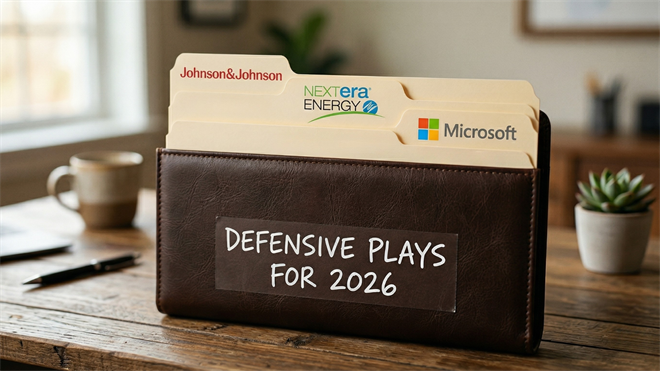
Wallet labeled “defensive plays” holding Johnson & Johnson, NextEra Energy, and Microsoft stock tabs on desk.

Key Points

  • Johnson & Johnson, NextEra Energy, and Microsoft offer a balanced mix of growth and defense, helping investors navigate uncertain market conditions.
  • Dividend strength and consistent earnings growth make JNJ and NEE reliable choices for income-focused investors seeking stability.
  • Microsoft’s Azure-driven growth and discounted valuation position it as a defensive tech stock with long-term upside potential.
  • Special ReportElon Musk: This Could Turn $100 into $100,000

Investors often live between two extremes. One is taking aggressive swings at growth stocks, including some that are highly speculative. The other is exiting equities altogether and waiting for brighter days.

There are obvious risks to both approaches. Being too aggressive can leave investors exposed to large and unnecessary losses when the market turns. Conversely, sitting out when a bullish reversal occurs prevents investors from capturing the biggest gains.

Inside the $7 trillion computium race (Ad)

The $7 Trillion Race for America’s Critical New Resource Moody’s calls it “the new oil.” Fox News calls it the “new arms race.” Elon Musk calls it “mind-blowing.” Demand is already doubling every 6 months. And on April 20, a major global event could ignite a handful of under-the-radar stocks, setting off what could be the biggest resource boom in history.Click here now for the full story

That’s a long way of saying that attempting to time the market isn’t an ideal strategy. A better approach is to own stocks that play offense and defense at the same time — the kind of strategy that can serve investors well after a quarter marked by uncertainty and elevated volatility, leaving many questions unanswered.

JNJ: Innovation With a Defensive Core

Since spinning off its consumer products division in 2023, some investors have come to view Johnson & Johnson (NYSE: JNJ) more like a technology stock, with growth increasingly anchored in innovation.

Those views are supported by a company that has shown solid year-over-year (YOY) revenue growth. Johnson & Johnson has also delivered robust earnings despite ongoing headwinds from litigation and tariffs.

Its Innovative Medicine division has successfully mitigated the impact of the patent cliff on past blockbusters like Stelara. The company’s medtech business is also beginning to show the benefits of high-growth, high-margin products, including robotics.

But with JNJ, getting hung up on the next quarter misses the point. Don’t get me wrong: 43% stock-price growth over 12 months is impressive. Still, it’s the company’s proven financial stability that provides the foundation for defensive-minded investors.

That’s one reason Johnson & Johnson is one of the rare stocks to have joined the ranks of the Dividend Kings. It has increased its dividend for 64 consecutive years, allowing generations of investors to benefit from compounding with JNJ stock.

NEE: Powering Growth the Steady Way

NextEra Energy (NYSE: NEE) is the most defensive play in this group. While it lacks the flash of some growth names, it embodies the steady offense-defense blend long-term investors crave. As North America’s largest generator of wind and solar energy, it sits at the forefront of the clean-energy transition.

What’s often overlooked is how well NextEra balances a growth mindset with predictable, regulated cash flow from its utility business, Florida Power & Light. That dual structure helps stabilize earnings, even during market turbulence or shifting rate expectations.

After a difficult 2023 that compressed its valuation under higher interest-rate pressure, NextEra has steadily rebuilt credibility by reaffirming its earnings-growth forecast of 6% to 8% annually through at least 2027. Management’s focus on disciplined capital allocation and funding projects from operations rather than debt is also helping restore investor confidence.

Dividends are another constant. NextEra is a Dividend Aristocrat that has raised its payout for 31 consecutive years, combining utility reliability with forward-looking innovation. For investors playing the long game in an uncertain macro environment, NEE offers a rare mix of defensive income and renewable-driven upside.

MSFT: A Safe Haven in Smart Tech

Microsoft (NASDAQ: MSFT) may not typically top lists of defensive stocks, but 2026 is no ordinary year. Here’s why Microsoft can be attractive to defensive-minded investors.

It starts with Azure, the company’s cloud platform, which combines compute, storage, networking, security, data and artificial intelligence (AI) into a full-stack solution. That mix of hybrid-friendly architecture, enterprise-grade security and AI integration forms the backbone of Microsoft’s competitive moat. Saying Azure drives sticky revenue is an understatement.

That part of the Microsoft story gets lost amid concerns about Copilot and the company’s fracturing partnership with OpenAI. Azure remains Microsoft’s growth engine, expanding at roughly 30% YOY.

The company is protecting that growth by investing to own its data centers. While that raises some concerns, they are largely misplaced: Microsoft is funding the expenditures with cash on hand, so shareholders face little risk of dilution.

Investors can view the current pullback as a buying opportunity. Trading around 23x earnings, MSFT is priced at a discount to its historical average and to the broader NASDAQ-100 index.


Sunday’s Bonus Article

A Market Divided on SentinelOne’s Future

Submitted by Jeffrey Neal Johnson. Article Published: 3/17/2026. 

SentinelOne logo on purple core surrounded by tangled network cables.

Key Points

  • SentinelOne recently achieved major operational milestones, including full-year profitability and significant revenue scale.
  • An unusually high volume of bullish call options indicates that sophisticated traders expect the stock’s price to rise.
  • SentinelOne’s long-term growth and profitability forecast, supported by Wall Street analysts, points toward future upside.
  • Special ReportElon Musk: This Could Turn $100 into $100,000

A perplexing scenario is unfolding around cybersecurity innovator SentinelOne (NYSE: S). The company recently reported a landmark fiscal year, hitting milestones that suggest it is gaining momentum. It crossed the coveted $1 billion annual revenue mark and, for the first time, delivered a full year of non-GAAP operating profitability. Despite these achievements, the market’s initial reaction to the results was nervous, and the stock came under immediate downward pressure.

Underneath that volatility, however, a strikingly different signal emerged. In the options market—where sophisticated traders often place high-conviction bets—bullish activity on SentinelOne surged. That created a clear division: a broader market reacting to a near-term forecast versus traders betting on a larger, potentially more profitable story.

Looking Past the Pothole on a Profitable Road

Inside the $7 trillion computium race (Ad)

The $7 Trillion Race for America’s Critical New Resource Moody’s calls it “the new oil.” Fox News calls it the “new arms race.” Elon Musk calls it “mind-blowing.” Demand is already doubling every 6 months. And on April 20, a major global event could ignite a handful of under-the-radar stocks, setting off what could be the biggest resource boom in history.Click here now for the full story

At the heart of this puzzle is the contrast between SentinelOne’s full-year performance and its conservative near-term outlook. For growth investors, scale plus profitability signals a maturing, sustainable business model, and SentinelOne’s fiscal 2026 results deliver that foundation.

  • Financial Milestones: Total revenue grew 22% to $1.001 billion. Annualized Recurring Revenue (ARR) climbed 22% to $1.12 billion, helped by a company-record $64 million in net new ARR in the final quarter. Reaching profitability reduces dependence on capital markets and signals operational discipline.
  • Platform Strength: SentinelOne is deepening customer relationships: 65% of enterprise clients now use three or more of its solutions. That deeper integration was validated by a major strategic win — securing internet infrastructure giant Cloudflare (NYSE: NET) by displacing a key competitor, widely understood to be rival CrowdStrike (NASDAQ: CRWD).
  • Diversified Growth Engines: SentinelOne is expanding beyond endpoint security. Its data solutions platform tops $130 million in ARR, while cloud security offerings exceed $160 million in ARR. These multiple growth pillars reduce reliance on any single segment.

That strong performance was briefly overshadowed by SentinelOne’s guidance for the first quarter of fiscal 2027. Management forecast revenue of $276 million to $278 million—just below analysts’ expectations—which prompted the initial sell-off.

The full-year outlook, though, is far more encouraging. SentinelOne projects fiscal 2027 revenue of $1.195 billion to $1.205 billion, roughly 20% growth. More notably, management is guiding to a full-year non-GAAP operating margin of about 10%, putting the company on a path toward the Rule of 40—a key benchmark for software investors that combines growth and profitability.

An Unmistakable Tell in the Options Market

While the stock chart initially reflected confusion, the options market sent a decisive message. On Friday, March 13, investors bought 19,630 call options on SentinelOne—about a 37% spike above the average daily volume. That surge came as the stock dipped in pre-market trading, suggesting traders viewed the weakness as a buying opportunity.

Institutional traders and other sophisticated participants often use options to place high-conviction bets with greater capital efficiency than buying shares outright. A call option gives the buyer the right to purchase a stock at a set price by a certain date. A sudden, large increase in call buying—especially amid seemingly negative headlines—is a strong indicator that experienced market participants believe the initial reaction is overdone and the stock may be undervalued.

The data reinforce that view. The volume put-to-call ratio that day was an exceptionally low 0.06. That compares bearish bets (puts) to bullish bets (calls); a 0.06 reading means bullish volume was more than 16 times higher than bearish volume, signaling pronounced positive sentiment.

SentinelOne’s intraday price action seemed to validate the optimism. After the pre-market drop, shares reversed and closed the regular session up nearly 5%. The options activity suggests traders expect the stock to rebound and that the guidance-induced dip may be transient.

Finding the Signal in the Noise

The narrative around SentinelOne is split between short-term noise and a longer-term signal. A cautious first-quarter forecast introduced volatility, but the company’s improving fundamentals and the options market’s emphatic message point to a bullish outlook. While some investors sold on the headline, others bought based on the substance of a profitable, growing enterprise.

That bullishness extends beyond the options pits. Despite trimming near-term price targets to reflect guidance, Wall Street analysts maintain a Moderate Buy consensus rating on the stock. The average price target of $19.43 implies upside of more than 30% from recent closing prices. For investors, the divergence between the initial market reaction and the surge in options activity makes a case for focusing on SentinelOne’s improving profitability, durable growth, and strategic position rather than reacting solely to a single quarter’s forecast.

Thank you for subscribing to Earnings360, a morning newsletter that summarizes quarterly earnings for public companies that trade on U.S. markets.

This email content is a sponsored email provided by American Market News, a third-party advertiser of Earnings360 and MarketBeat. 

If you have questions or concerns about your newsletter, please feel free to contact our South Dakota based support team at contact@marketbeat.com.

If you no longer wish to receive email from Earnings360, you can unsubscribe.

Copyright 2006-2026 MarketBeat Media, LLC. 
345 N Reid Place, Suite 620, Sioux Falls, South Dakota 57103. USA..

Check This Out: Secretary of Defense: This is the truth about SpaceX (Click to Opt-In)

3,500 Marines Arrive in Middle East

Read Online  |  March 29, 2026  |  E-Paper  | 🎧 Listen

“Well done is better than well said.” 

—Benjamin Franklin

Ivan Pentchoukov
National Editor

Good morning. It’s Sunday. Here are today’s top stories:

  • More than 3,500 U.S. sailors and Marines aboard the USS Tripoli have arrived in the Middle East as the Pentagon continues to build up forcesin the region.
  • Iran has agreed to allow 20 Pakistani-flagged ships to pass through the Strait of Hormuz unharmed, Pakistani Foreign Minister Ishaq Dar said, calling the development “a meaningful step toward peace.”
  • A month has passed since U.S. and Israeli forces jointly launched a surprise attack on Iran, delivering the opening blow in an ongoing effort the U.S. military has dubbed Operation Epic Fury. Here’s where things stand after four weeks of fighting.
  • American Family farms face tough challenges in today’s economy, but some young farmers are finding success—and believe their kids will, too.
  • 🍵 Health: This overlooked organ is linked to longevity, new researchsuggests.

U.S. Marines conduct a hike during a simulated amphibious assault on March 24, 2026. (U.S. Marine Corps photo by Cpl. Maksim Masloboev)

USS Tripoli Reaches Middle East With More Than 3,500 Troops

More than 3,500 U.S. sailors and Marines aboard the USS Tripoli have arrived in the Middle East as the Pentagon continues to build up forces in the region.

U.S. Central Command (CENTCOM) said on March 29 that the USS Tripoli had entered its area of responsibility. The amphibious assault ship is serving as the flagship of the Tripoli Amphibious Ready Group and the 31st Marine Expeditionary Unit, a combined force that includes ground, air, and naval elements.

One of the newest and most capable amphibious assault ships in the U.S. fleet, the USS Tripoli is designed to accommodate a larger air wing, including F-35 stealth fighter jets, V-22 “Osprey” tiltrotor aircraft, and other warplanes. It had been based in Japan before receiving orders nearly two weeks ago to deploy to the Middle East.

CENTCOM said the Tripoli brings transport aircraft, strike fighters, and amphibious assault capabilities to the region in addition to the Marines aboard.

The USS Boxer, another amphibious assault ship, along with the 11th Marine Expeditionary Unit, has also been ordered to the region from San Diego.

CENTCOM did not disclose more details on where the additional U.S. forces will be positioned, though they are likely to operate within striking distance of Iran, including near key locations such as Kharg Island, a major Iranian oil export terminal off the country’s coast.

In its most recent update on March 25, marking the fourth week of the campaign, CENTCOM said that more than 11,000 targets had been struck since the United States and Israel launched joint operations against Iran on Feb. 28. (More)

IRAN WAR

  • A spokesman for the Iran-aligned Houthi terrorist organization in Yemen said that the group had entered the Middle East conflict, launching a missile attack against Israel that Tel Aviv said was intercepted.
  • President Donald Trump said Friday that the United States likely doesn’t have to be there for NATO, noting that the alliance has provided little to no material support to U.S. military efforts against the Iranian regime.
  • A packed crowd at the Conservative Political Action Conference roared their approval as Iranian Crown Prince Reza Pahlavi urged President Donald Trump to reject leaving any faction of the Islamic regime in power.

LATEST NEWS

  • The partial shutdown of the Department of Homeland Security tied for the longest shutdown in U.S. history on March 28.
  • The Idaho legislature on Friday passed a bill that would make it a crime for anyone to use a public restroom or changing room of the opposite sex.

WORLD

  • Europe is going to need a “Trump-style revolution” to turn back the tide of illegal immigration that has changed the face of Europe, according to two former prime ministers.
  • The United States accused China of detaining Panama-flagged vessels in response to Panama’s termination of Hong Kong-based CK Hutchison’s concessions for two key ports.
  • The Chinese Communist Party has unveiled a long-term care insurance program that will require pensioners to continue contributing premiums, marking a significant shift in the country’s social welfare system and sparking public backlash.

OPINION: Charge Iran and China for Increasing US Gas Prices—by Anders Corr (Read)

🇺🇲American Thought Leaders: He Ran the World’s Biggest Payment Processor; Now He’s Taking on Social Security—Frank Bisignano (Watch)

🍿Film Review: “Wardriver” (Read)

🎵 Music: Junyi Tan: “Who Shall Find” (Listen)

ARTS & CULTURE

Many of the most memorable April Fools’ Day hoaxes rely on careful storytelling, convincing details, and just enough plausibility to make audiences hesitate before laughing. (Robert Couse-Baker/CC BY 2.0)

Pranks, the Press, and Three Presidents: Famous April Fools’ Jokes

On April 1, 1957, the usually staid British Broadcasting Corp. (BBC) reported that a Swiss region bordering Italy had produced an “exceptionally heavy spaghetti crop” that season due to the mild winter and the eradication of the spaghetti weevil. The camera panned farmers and gardeners picking spaghetti from trees, then sitting down to enjoy a supper of delicious pasta.

To be fair, spaghetti was unfamiliar to many Brits at the time. Other viewers immediately realized that the broadcasting giant had put together an elaborate April Fools’ Day joke, with a few in the audience upset that the BBC had broken character to run such nonsense. Yet many others swamped the station with phone calls, looking for details on how to grow their own spaghetti. BBC wits replied to these requests: “Place a sprig of spaghetti in a tin of tomato sauce and hope for the best.”

Older Americans will remember the Sidd Finch prank. The April 1, 1985, edition of “Sports Illustrated” ran George Plimpton’s “The Curious Case of Sidd Finch.” In this lengthy article, the well-known sportswriter reported the story of British orphan Hayden Siddhartha Finch, a 28-year-old versed in foreign languages, talented on the French horn, a Harvard dropout, and an aspirant Buddhist monk to boot, who might soon be pitching for the New York Mets. His throws across the plate were clocked at superhuman speeds as high as 168 mph.

Plimpton gleaned fictitious reactions from the team’s batters, whom Finch had supposedly pitched against in secret, and cited numerous conversations with Finch’s former fellow students and with Mets staff. The Mets went along with the gag, giving Finch a number and a locker. (More)

Today's Recipe

🎲 Games

Spot the Difference is our readers’ favorite. Play it here.

Play Spot the Difference

Play more games at Epoch Fun ➞

Play Word Wipe
Play Sweet Shuffle
Play Freecell
Play Blossom Word
Play Today’s Hurdle
Play Hidden Object

♥️ Support our mission and donate.

🎧 Prefer to listen? Get the Morning Brief podcast.

💬 Feedback? Reply to this email or write to ivanmb@epochtimes.nyc

👋 New to Morning Brief? Subscribe.

💡 Got a news tip? Connect with us confidentially.

▶️ Follow The Epoch Times on FacebookXInstagram, or Truth Social

📫 Forward this email to a friend and tell them to subscribe. (Here)

☕ Show us your love with coffee, mugs, stickers, and clothes. Check out the shop.

💼 Own a business? Reach millions of engaged readers by advertising in our newsletters.

Thanks for reading 🙏

Have a wonderful day!

—Ivan Pentchoukov, Madalina Hubert, and Kenzi Li.

Copyright © 2026 The Epoch Times, All rights reserved. 

Our mailing address is: The Epoch Times, 129 West 29th Street, Fl 8, New York, NY 10001 | Contact Us


Our Morning Brief newsletter is one of the best ways to catch up with the news. Manage your email preferences here or unsubscribe from Morning Brief here.

“I just bought 10,000 shares of a $5 stock…”

Donald Trump @ Freedom Fest

Dear Reader,

I just bought 10,000 shares of a little $5 company…

And I suggest you do the same.

I think it could be a fantastic opportunity (as I explain here.)

Similar to when I put $50k into a little-known mining company back in 1995…

Then cashed out 3 years later for about $1.3 million.

Get the details here… then decide for yourself.

Yours for peace, prosperity, and liberty, AEIOU,

Dr. Mark Skousen
Macroeconomic Strategist, The Oxford Club

P.S. I first developed a relationship with the President when he spoke at my FreedomFest conference.

And I quickly learned that he does not want the United States dependent on foreign nations for our resources.

That’s why I’m convinced his administration will take a stake in this one company.

It is the ONLY company in America capable of providing a crucial resource… 80% of which is controlled by Russia, China, and Indonesia.

Here’s the whole time-sensitive story.


Additional Reading from MarketBeat

Cintas Corporation: The Deep Value Opportunity in Plain Sight

Submitted by Thomas Hughes. Posted: 3/28/2026. 

Cintas service truck outside corporate building, representing steady business growth and institutional stability.

Key Points

  • Cintas’ March price pullback set a new long-term low, creating a deep value opportunity for buy-and-hold investors.
  • Growth and capital returns underpin the price action, which is likely to resume upward momentum before year-end.
  • Institutions and analysts help support this market, limiting the downside in 2026.
  • Special ReportElon Musk: This Could Turn $100 into $100,000

Cintas Corporation (NASDAQ: CTAS) is a deep-value opportunity few are discussing, perhaps because its business is unglamorous. Cintas delivers uniforms, laundry services, first-aid supplies and other essential services to businesses across industries and verticals. The critical point is that this must-have service generates recurring revenue, is growing, and is returning value to shareholders.

That growth is largely “self-funded,” enabled by execution and a fortress balance sheet, which supports dividends, share buybacks, and both organic and acquisitional expansion. The net result is apparent in the share price, which—aside from a post-stock-split correction—shows a long-term uptrend that is likely to continue.

Cintas Trades at Value Levels; Provides Opportunity for Buy-and-Hold Investors

Fox News calls this resource -scramble “the new arms race” (Ad)

Why is the White House suddenly building a new “Fort Knox?” Hidden inside this fortress lies a critical new resource Moody’s calls “the new oil.” Demand is doubling every 6 months, and Fox News is calling it the “new arms race.” On April 20, a major event could ignite a handful of under-the-radar stocks, setting off what could be biggest commodity boom in history.Click here for all the details.

Cintas’ stock was trading at historically low levels relative to earnings in late March amid a major acquisition. The previously stalled Unifirst (NYSE: UNF) takeover is now moving forward following unanimous board approval.

The cash-and-stock deal assigns a premium to Unifirst that is likely to be realized relatively quickly. The merger creates opportunities for consolidation, cost savings and operational efficiencies while expanding Cintas’ client base, product range and cross-selling potential. At face value, Unifirst’s business would add roughly 20% to Cintas’ revenue, and further earnings gains could be captured through business rationalization.

Cintas is not a bargain-basement stock, but it carries a premium for good reason. Its P/E typically runs in the high 30s, supported by strong cash flow quality and ongoing capital returns. The shares trade near 36X the 2026 consensus, but only about 14X versus the 2035 consensus, implying meaningful upside over time.

Cintas’ capital return program includes dividends, dividend growth and share buybacks. The dividend yield typically hovers around 1.0%, with annual increases often offset by stock price appreciation. The company is a Dividend Aristocrat with more than 40 consecutive years of dividend increases and has the capacity to continue robust growth. Double-digit compound annual dividend growth is supported by double-digit earnings gains and share-reducing buybacks.

Cintas’ share repurchases increased by approximately $250,000, or 36%, on a year-to-date basis as of the end of its third quarter. The pace of share-count reduction is modest—about 0.18%—but sufficient to offset share-based compensation and the dilutive effect of dividend increases. For investors, the effect is a stable-to-slightly-declining share count, which can reduce volatility and downside risk. Cintas is a lower-beta stock that can help dampen portfolio volatility.

Institutions Limit Downside in 2026

Institutional ownership and persistently low short interest also help keep volatility muted. Short interest tends to run around 2%, a healthy level for a blue-chip stock that supports day-to-day liquidity. Days to cover are relatively low at roughly four days, suggesting a quick exit for short sellers if price action picks up. Institutions own about 65% of the stock and have been accumulating over the trailing 12 months—net buyers in three of the last four quarters, with buying activity ramping in Q1 2026 as the share price declined.

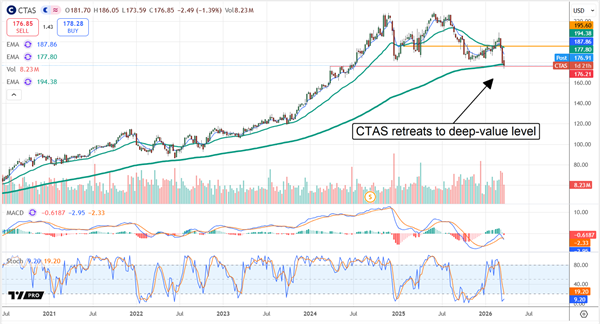
The technical price action is weak in early 2026 but shows support at an important technical level that aligns with price action in 2024. That support marks the breakout point of a previous bull-market consolidation and is likely a durable floor. If the market continues to respect the stock’s 150-week EMA, a rebound is probable. CTAS stock has retreated to this level only five times in 15 years, and each time it triggered significant rallies—the last two led to quadruple- and high-triple-digit gains, respectively.

CTAS stock chart displaying a retreat to deep value territory.

The biggest risks this year include a potential economic downturn, labor-force contraction and regulatory scrutiny of the Unifirst deal. Cintas and Unifirst already overlap in some markets, and the acquisition will make the nation’s largest uniform service even larger. The risk of a tightening labor force is real; however, the latest claims data suggest employment conditions are stable and improving versus the prior year.


Further Reading from MarketBeat

More Than Just Brains: The AI Revolution’s Nervous System

Author: Jeffrey Neal Johnson. Article Published: 3/18/2026. 

Fiber optic cables transmitting light signals between data center servers, illustrating high-speed AI network infrastructure.

Key Points

  • Lumentum’s strategic partnership with NVIDIA validates its technology and solidifies its essential role within the growing artificial intelligence supply chain.
  • Nokia is strategically pivoting to capture the AI market with end-to-end optical networking solutions designed for hyperscale data center operators.
  • The fundamental shift to optical networking for AI represents a multi-year supercycle, creating a durable tailwind for foundational hardware providers.
  • Special ReportElon Musk: This Could Turn $100 into $100,000

The investment conversation around artificial intelligence (AI) has largely focused on sophisticated software and the powerful graphics processing units (GPUs) that act as the brains of the operation. Those elements are essential, but a potentially more durable investment opportunity is emerging from the physical layer of technology. The new bottleneck isn’t processing power; it’s the network’s ability to connect thousands of processors so they can operate as a single, cohesive supercomputer.

Modern generative AI and large language models require unprecedented levels of inter-processor communication. The massive datasets used to train these models mean network speed—the system’s nervous system—has become a primary driver of performance.

Fox News calls this resource -scramble “the new arms race” (Ad)

Why is the White House suddenly building a new “Fort Knox?” Hidden inside this fortress lies a critical new resource Moody’s calls “the new oil.” Demand is doubling every 6 months, and Fox News is calling it the “new arms race.” On April 20, a major event could ignite a handful of under-the-radar stocks, setting off what could be biggest commodity boom in history.Click here for all the details.

Traditional copper cabling, long the data-center standard, cannot handle these bandwidth demands without introducing crippling latency. That physical limitation has kicked off a multi-year upgrade cycle to high-speed optical networking. This optical supercycle creates a sustained tailwind for companies building the indispensable plumbing of AI, offering a foundational way for investors to participate in the ecosystem’s growth.

Lumentum: Supplying the Speed-of-Light Components

Lumentum Holdings Inc. (NASDAQ: LITE) has emerged as a primary beneficiary of the optical upgrade, a position recently reinforced by the undisputed leader in artificial intelligence.

In early March, NVIDIA (NASDAQ: NVDA) announced a multi-billion-dollar strategic investment and purchase commitment with Lumentum to secure long-term supply of advanced laser components and 800G transceivers—critical hardware for linking clusters of AI systems.

That deal does more than support future revenue; it serves as a clear endorsement of Lumentum’s technology and cements its role in the AI supply chain, helping create a meaningful competitive moat.

The validation is already showing up in the numbers. In its most recent quarterly report, Lumentum posted a 65.5% year-over-year increase in revenue and beat earnings-per-share expectations by $0.26. Its forward guidance projects revenue growth of more than 85% for the upcoming quarter—a signal that growth is not only continuing but accelerating.

That momentum comes as the market itself expands rapidly. Lumentum is a key supplier to the global optical transceiver market, which is forecast to more than double to nearly $22.4 billion by 2029. As data-center operators accelerate AI buildouts, demand for Lumentum’s high-margin components is rising. Bolstering the investment case, Lumentum was recently added to the S&P 500 index, triggering purchases by large index funds, increasing institutional ownership and providing a stable base of demand.

Nokia: Building the Intelligent AI Superhighway

While Lumentum supplies critical components, Nokia Corporation (NYSE: NOK) leverages deep networking expertise to deliver complete, intelligent systems that form the AI data superhighway. Nokia has made a deliberate strategic pivot to capture this growing market.

On March 16, Nokia announced a suite of coherent optical solutions and routing platforms designed for AI-era networks. The move targets large, integrated contracts with hyperscale cloud providers and data-center operators that prefer end-to-end solutions from a single trusted vendor.

The strategy is already producing results in Nokia’s core segments. Its Network Infrastructure division has been a key growth driver, with the Optical Networks unit expanding 17% year-over-year in the most recent reported quarter. That growth indicates Nokia’s push into high-speed optical systems is translating into tangible financial results and market-share gains.

This progress has not gone unnoticed by Wall Street. Major firms such as Morgan Stanley have named Nokia a top pick, citing rising AI infrastructure demand as a core reason for their bullish outlook. Shifts in analyst sentiment suggest the market is beginning to price in this new growth vector for the technology giant. Nokia is using its global scale to capture part of the data-center networking market, projected to grow from about $44 billion in 2026 to more than $114 billion by 2034. As a provider of comprehensive systems, Nokia is well-positioned to benefit from that wave of capital expenditure.

2 Sides of the Same High-Growth Coin

The transition to optical networking is not a temporary trend but a foundational, multi-year supercycle required for AI’s continued advancement. The limits of older technologies have created an unavoidable shift toward optical infrastructure, presenting a clear, data-driven investment opportunity beyond the typical AI headlines.

Lumentum and Nokia offer complementary ways to play this shift. Lumentum is a high-growth, component-level play, validated and backed by NVIDIA and tied directly to the supply of essential, high-margin parts. Nokia offers a value-oriented, systems-level play, with a strategic pivot that is gaining meaningful market recognition.

For investors seeking exposure to the hardware foundation of the AI revolution, the companies building the industry’s indispensable plumbing provide a compelling and durable path to growth.

This email message is a sponsored email sent on behalf of The Oxford Club, a third-party advertiser of MarketBeat. Why did I get this email message?


This ad is sent on behalf of The Oxford Club. 105 W Monument St, Baltimore, Maryland 21201. If you would like to optout from receiving offers from The Oxford Club please click here


If you have questions or concerns about your newsletter, please contact MarketBeat’s South Dakota based support team at contact@marketbeat.com.

If you would no longer like to receive promotional emails from MarketBeat advertisers, you can unsubscribe or manage your mailing preferences here.

© 2006-2026 MarketBeat Media, LLC. 
345 N Reid Pl. #620, Sioux Falls, S.D. 57103. United States..

Check This Out: A personal warning from Martin Weiss (Please read)(From Weiss Ratings)

The “Iran Discount” ends March 31st

Dear Fellow Investor,

Gold didn’t “dip” from $5,423 to $5,000.

It was forced down.

After the Iran strikes, something inside the gold market broke.

This pullback isn’t weakness — it’s a setup.

While retail investors hesitate…

…the smart money is quietly loading up.

Not on gold.

On a little-known “Shadow Miner” positioned for what happens next.

Because on March 31st, a 90-year-old law could expose what’s really inside the vaults.

And when that happens…

..this “Iran discount” disappears overnight.

[See the ticker before the reset >>>]

“The Buck Stops Here,”

Dylan Jovine, CEO & Founder

Behind the Markets


Additional Reading from MarketBeat

Big Tech Just Got Hit—Why This Lawsuit Could Change Social Media Forever

Submitted by Nathan Reiff. Date Posted: 3/27/2026. 

Smartphone with Facebook, Instagram and YouTube apps labeled Exhibit A as judge presides over Meta and Google antitrust trial.

Key Points

  • The verdict against Meta Platforms and Google in late March 2026 in a trial surrounding the role of social media in personal injury to users may have massive implications.
  • Though the financial damages are minor for these tech giants, the verdict may pave the way for much larger legal battles and, potentially, new regulations surrounding the design of social media platforms.
  • At risk is significant volumes of ad revenue, capital expenditures potentially needed to redesign platforms, market share threats, and much more.
  • Special ReportElon Musk: This Could Turn $100 into $100,000

Popular social media platforms may now be exposed to personal-injury liability following the recent landmark case against Meta Platforms Inc. (NASDAQ: META) and Alphabet Inc. (NASDAQ: GOOG).

The tech giants behind Instagram, Facebook, and YouTube were ordered to pay millions in compensatory and punitive damages to a plaintiff who accused the companies of designing highly addictive products that harmed their mental health.

Fox News calls this resource -scramble “the new arms race” (Ad)

Why is the White House suddenly building a new “Fort Knox?” Hidden inside this fortress lies a critical new resource Moody’s calls “the new oil.” Demand is doubling every 6 months, and Fox News is calling it the “new arms race.” On April 20, a major event could ignite a handful of under-the-radar stocks, setting off what could be biggest commodity boom in history.Click here for all the details.

Those damages are small relative to the companies’ market value, but the implications—and the potential fallout—could be far more consequential for social media platforms and their investors.

Both firms’ shares fell sharply around the verdict, with Meta down about 13% and Alphabet down about 8% over a five-day period at the end of March 2026.

There may be a buying opportunity for some investors, but the larger question is whether Big Tech’s business models will be forced into broader restructuring—and, if so, how that could affect market share, valuation, and other fundamentals.

Potential Impacts on Future Trials and Products

This trial is high profile but not unique: social media companies routinely face lawsuits about their platforms. Still, the finding here could change the legal landscape and influence multiple cases expected to go to trial as soon as this year.

In the near term, that could mean more damage judgments and unwanted publicity for these and other tech giants. More importantly, investors may see Big Tech pushed into a position similar to Big Tobacco decades ago, when cigarette makers were held liable for the addictive and harmful nature of their products.

Companies like Meta and Google have long relied on Section 230 of the Communications Decency Act of 1996 to shield themselves from liability for user-posted content. There is a real risk that this defense could weaken, shifting claims toward treating platforms themselves as defective products that require redesign.

If the law evolves in that direction, major changes to services like Facebook and Instagram may follow, although the precise form of those changes is uncertain. Key features highlighted in the trial—such as infinite scroll, autoplay content, and algorithmic recommendations—could come under scrutiny and even affect how advertisements are delivered.

What Investors Should Keep In Mind

Social media is a major revenue source for companies such as Meta and Alphabet, which have depended on steadily rising engagement to drive ad sales. For example, in the last quarter of 2025 Meta reported ad revenue growth of 24% year-over-year, helped by AI-driven ad performance and roughly 3.5 billion daily users across its products.

Beyond lost ad revenue—which would itself be sizable—industry-wide legal exposure if platforms are deemed defectively designed could reach the tens of billions of dollars and create mass-arbitration risks. At that point, even mega-cap firms in the tech sector could see meaningful impacts to their financial health.

Investors should also expect companies to invest heavily to comply with any new safety regulations that may arise from this or subsequent trials.

This could compress operating margins and add to already-high capital expenditures, many of which are being driven by the costs of integrating AI into products and ads. It could also open space for alternative platforms with different designs to capture market share.

That said, the latest verdict alone may not be cause for investors to abandon META and GOOG positions. Meta’s consensus price target implies roughly 60% upside, while Alphabet’s implies about 25%—and both remain favored by many analysts.

Still, the relatively small financial impact of this single case could trigger a ripple effect with far larger consequences for social media generally and for these companies in particular.


Additional Reading from MarketBeat

AI Wingman: Kratos & Airbus’s Game-Changing Pact

Submitted by Jeffrey Neal Johnson. Date Posted: 3/16/2026. 

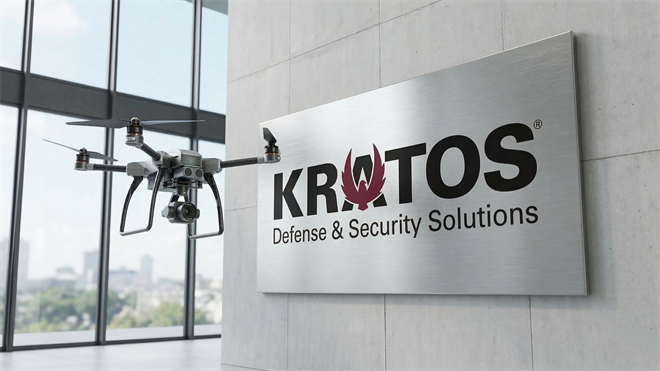
Autonomous drone hovering indoors near a brushed metal Kratos Defense & Security Solutions sign, highlighting defense technology and unmanned systems development.

Key Points

  • Kratos’s record backlog and major program wins demonstrate its successful transition into a key global defense technology provider.
  • Airbus positions itself as a lead systems integrator for Europe’s future combat cloud by partnering on a proven drone platform.
  • The transatlantic collaboration provides tangible evidence that the era of autonomous, collaborative air warfare is rapidly becoming a reality.
  • Special ReportElon Musk: This Could Turn $100 into $100,000

In a specialized facility in Manching, Germany, a pivotal shift in global defense strategy is taking shape. Two American-made Kratos (NASDAQ: KTOS) XQ-58A Valkyrie drones are being prepared for a landmark 2026 flight test equipped with a sovereign European artificial intelligence (AI)-driven mission system developed by Airbus (OTCMKTS: EADSY). While primarily a technical exercise, it also signals that the long-promised future of autonomous, collaborative warfare is arriving faster than many anticipated.

Kratos: From Disruptor to Global Power Player

The Airbus partnership is a major international endorsement for Kratos, significantly de-risking its investment case by opening a direct channel into the lucrative European defense market.

Fox News calls this resource -scramble “the new arms race” (Ad)

Why is the White House suddenly building a new “Fort Knox?” Hidden inside this fortress lies a critical new resource Moody’s calls “the new oil.” Demand is doubling every 6 months, and Fox News is calling it the “new arms race.” On April 20, a major event could ignite a handful of under-the-radar stocks, setting off what could be biggest commodity boom in history.Click here for all the details.

For investors, that validation is reinforced by a steady stream of strong financial results and program wins that indicate Kratos has reached a meaningful inflection point. The company’s strategy of delivering relevant, affordable systems now—rather than only designing concepts for later—appears to be paying off.

Kratos’s recent performance underscores this momentum. The fourth quarter of 2025 produced organic revenue growth of roughly 20% year-over-year, and the company reported a 1.3-to-1 book-to-bill ratio for the quarter.

That book-to-bill ratio is notable: a figure above 1-to-1 means the company is securing more new orders than it is billing in revenue, which indicates an expanding backlog and growing future workload.

Looking ahead, Kratos’s financial foundation appears solid, giving investors greater visibility into future performance:

  • A secure backlog: Kratos ended 2025 with a record backlog of $1.573 billion in secured future work, creating a stable revenue base.
  • A large opportunity pipeline: Beyond confirmed orders, Kratos has identified a record $13.7 billion pipeline of opportunities, representing a deep pool of potential future contracts that could sustain growth for years.

The company’s flagship platform, the Valkyrie, is central to this outlook. Before its selection for European tests, the drone was validated in the United States when it was chosen for the U.S. Marine Corps’ MUX TACAIR Collaborative Combat Aircraft (CCA) program, where Kratos is partnered with prime contractor Northrop Grumman. That dual-continent demand for the same core platform underscores its capabilities.

In response, Kratos has announced plans to scale production from roughly eight Valkyries per year to 40 by the end of 2028.

Kratos also has diversified growth drivers beyond the Valkyrie. It is an active participant in the rapidly expanding hypersonics field—a Pentagon priority—with involvement in programs such as the Multi-Service Advanced Capability Hypersonic Test Bed (MACH-TB). Revenues from its hypersonic franchise are projected to roughly double to about $400 million in 2026, providing an additional growth vector that supports the company’s valuation tied to its contract pipeline.

Airbus: Winning the Future of Air Combat

For European aerospace titan Airbus, the partnership with Kratos is a strategic, timely move. It demonstrates managerial agility, helps address challenges within legacy programs, and positions Airbus to lead the continent’s next-generation defense ecosystem.

The collaboration comes against the backdrop of well-publicized disagreements and delays that have hampered the Future Combat Air System (FCAS), Europe’s ambitious next-generation fighter jet program.

Rather than waiting for those complex, multinational issues to be resolved, Airbus is proactively securing a loyal wingman capability for key customers now.

By partnering with Kratos, Airbus avoids years of costly development. It gains immediate access to a proven, production-ready airframe and can offer a tangible solution to the German Air Force with a target in-service date of 2029—an accelerated timeline that would be difficult if starting from scratch.

This move also aligns with a broader, continent-wide push to fast-track low-cost, autonomous systems to bolster collective security.

Importantly, the deal shifts Airbus’s role from primarily a hardware manufacturer to a high-value systems integrator. Airbus will equip the Valkyrie with its proprietary MARS mission system, powered by MindShare AI software. In modern defense, value increasingly resides not only in the airframe, but in the intelligent networks that command it. By controlling this mission-system layer, Airbus positions itself to be a key node in Europe’s future combat cloud, connecting manned and unmanned platforms—a more defensible and potentially more profitable role over time.

For investors in a large-cap industrial like Airbus, the venture provides exposure to high-growth defense tech while diversifying away from the cyclical commercial aviation market. It hedges against the risks and extended timelines of traditional manned fighter programs and adds a forward-looking growth story that helps secure Airbus’s relevance in the next generation of air warfare.

A Clear Approach Vector

The Kratos-Airbus partnership is among the most tangible data points yet that the global shift toward autonomous, attritable air power is happening now. This is no longer an abstract trend discussed in strategy papers; it is a present reality with meaningful budget allocations and hardware being prepared in Germany.

The collaboration validates Kratos as a premier growth vehicle in defense technology, opening the door to a large new market. At the same time, it highlights Airbus’s strategic foresight in securing its role as a principal architect of Europe’s future defense capabilities. For investors, the alliance signals that both companies are positioned on the favorable side of a multi-decade paradigm shift in global security, offering a compelling case for long-term value creation as the definition of air power evolves.

Thank you for subscribing to Earnings360, a morning newsletter that summarizes quarterly earnings for public companies that trade on U.S. markets.

This email is a sponsored email provided by Behind the Markets, a third-party advertiser of Earnings360 and MarketBeat. 

If you need help with your newsletter, please don’t hesitate to email MarketBeat’s South Dakota based support team at contact@marketbeat.com.

If you no longer wish to receive email from Earnings360, you can unsubscribe.

Copyright 2006-2026 MarketBeat Media, LLC. All rights protected.
345 N Reid Place, Suite 620, Sioux Falls, South Dakota 57103-7078. United States of America..

Check This Out: A personal warning from Martin Weiss (Please read)(From Weiss Ratings)

The CIA Backed Palantir… Now They’re Watching This Company Next.

Dear Reader,

When the CIA backed Palantir in its earliest days, most investors didn’t even know what the company did.

Then came 9/11. Afghanistan. Bin Laden. And Palantir became a legend.

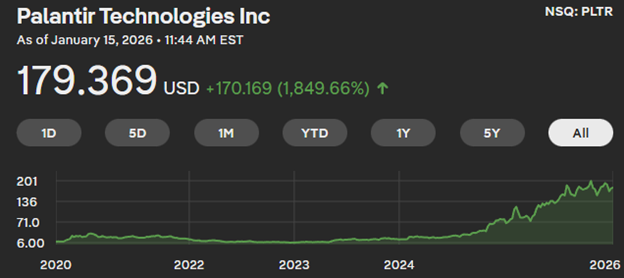
After returning more than 1,800% for investors… many are asking “What’s the next Palantir?”

Now, intelligence insiders are whispering about a new company — led by a “Silicon Valley Oppenheimer” — that could eclipse even Palantir’s rise…

And for a limited time, you can get pre-IPO exposure via a 4-letter ticker symbol revealed here:

👉 Click here now to access the free ticker symbol + urgent briefing.

Already, this company has secured over $26 billion in government contracts.

It’s backed by Peter Thiel and Andreessen Horowitz

👉 Click here to see how to stake your claim using this ticker before it’s everywhere.

Regards,

Addison Wiggin

Founder, Grey Swan Investment Fraternity

This ad is sent on behalf of Banyan Hill Publishing. P.O. Box 8378, Delray Beach, FL 33482.

If you would like to unsubscribe from receiving offers for Grey Swan, please click here.

 Stockguru LLC (dba InvestingDistrict), 2563 cherry hill ln, Hermitage, PA 16148, United StatesYou may unsubscribe or change your contact details at any time.

How high-premium environments turn chaos into income

Charles Payne here with an urgent opportunity:

The market just handed options traders a gift—and most people won’t even notice it.

Volatility is spiking.

And when that happens, option premiums surge.

Options traders love it.

And so do I!

Because while everyone else is watching their portfolios swing wildly and losing sleep over whether to sell, options traders are cashing in on the chaos.

Higher volatility = fatter premiums = BIGGER paychecks.

You can collect more income in one volatile week than you’d normally make in a month of calm markets.

The opportunities right now are exceptional. But they won’t last forever.

Volatility always settles down—and when it does, these premium levels disappear.

That’s why, in a few days, my team is hosting a free, live Power of Options Masterclass where we’re showing you exactly how to capitalize on these high-premium environments and what to do when the market gets cold.

You’ll learn how to collect significantly larger income checks. How to do it safely. 
And how to take advantage before this window closes.

This is a live session. No charge.

The full details are on the next page…

So register here while the doors are open.


Charles Payne


Exclusive Content

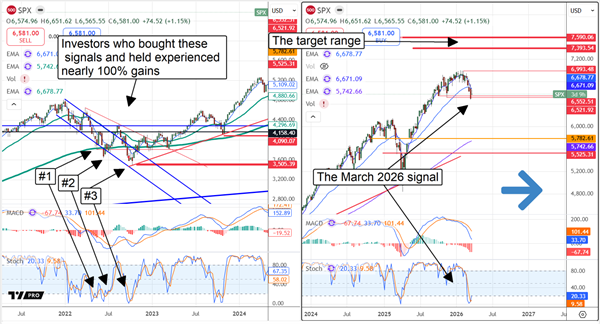
S&P 500 Fires Buy Signal With 100% Accuracy Rate: What Comes Next

Authored by Thomas Hughes. Posted: 3/25/2026. 

Stock market screen showing sharp rebound trend, reflecting AI-driven surge led by NVIDIA and S&P 500 recovery.

Key Points

  • The S&P 500 entered oversold territory in March, triggering a buy signal with 100% accuracy.
  • The index faces headwinds, but fundamentals and earnings outlook offset it.
  • Oil and inflation are risks that may keep the market trending sideways in the near-term.
  • Special ReportElon Musk: This Could Turn $100 into $100,000

The S&P 500 moved into oversold territory on its weekly candlestick charts late in March, triggering a buying signal with a 100% accuracy rate over the trailing 15-year period. “Oversold,” as measured by the stochastic indicator, describes a market pushed below a reasonable valuation — a situation in which most sellers who needed, wanted or had an excuse to sell probably already have. That leaves a bias toward buyers, which in turn increases the likelihood of an upward move, a dynamic that the signal has already confirmed.

Technical, Analyst and Valuation Trends Converge: Upside Potential Offsets Risks

Chart watchers will note there were three similar signals in 2023. The first produced only a tepid rebound, but it was followed by two stronger signals that led to more meaningful recoveries and a full market reversal. That 2023 reversal was driven largely by AI gains and has so far produced roughly a 50% rise in the index.

Fox News calls this resource -scramble “the new arms race” (Ad)

Why is the White House suddenly building a new “Fort Knox?” Hidden inside this fortress lies a critical new resource Moody’s calls “the new oil.” Demand is doubling every 6 months, and Fox News is calling it the “new arms race.” On April 20, a major event could ignite a handful of under-the-radar stocks, setting off what could be biggest commodity boom in history.Click here for all the details.

The takeaway for investors is that current signals look similar: near-term headwinds may slow price action, but fundamentals and long-term forecasts provide support. The most likely path is consolidation within the current range followed by a renewed push higher to new highs later this year.

Analyst sentiment aligns with that outlook. Barclays is the latest firm to raise its S&P 500 target, pointing to stronger-than-expected earnings and forward forecasts that offset macro headwinds. It lifted its index target to 7,650 — a 250-point increase that places the index near the high end of its expected year-end range.

S&P 500 Index chart displaying three prior buy signals and the gains that followed each.

The value is there, if not uniformly across every sector. The S&P 500 trades near 20X earnings as of late March, roughly in line with long-term averages, but market leaders show deeper discounts. NVIDIA (NASDAQ: NVDA) — the single most influential stock in the market, representing about 7% of the S&P 500’s market cap — trades at roughly 20X current-year earnings, which assigns little or no premium to the world’s leading AI company.

NVIDIA and other large-cap tech names often trade in the 30X–35X range when fully valued, implying potential upside of 50%–75% from valuation expansion alone. If long-term forward earnings projections are applied — forecasts that in some scenarios place the stock at roughly 5X projected 2035 earnings — the theoretical upside over a longer horizon can be substantially larger.

S&P Set Up to Hit 7,500 This Year

The immediate support and resistance levels given for the S&P 500 Index are 6,521.92 (support) and 6,993.48 (resistance). For the S&P 500 Index tracking ETF (NYSEARCA: SPY), the equivalent price levels are about $64.72 and $69.78.

Support is expected to be significant but could be breached; if that occurs, the next support area is near 6,400 (about $64 on SPY). Resistance could also remain firm until headwinds ease, effectively capping near-term upside to roughly 471 index points (about $4.75 on SPY). Over a longer horizon, that 471-point range implies a move toward the 7,464 level for the index ($74.65 on SPY) as a baseline target, with upside toward 7,500 at the higher end of the range.

The catalyst for such a move is likely to be multifaceted, but it will be centered on the earnings outlook. Current forecasts call for sequential acceleration in earnings growth starting in Q1 2026 and extending into Q2 and Q3, with high-teens growth projected through year-end.

These trends suggest leaders such as NVIDIA will continue to outperform, helping drive a stronger finish for the market. Other, more average companies could contribute an additional few percentage points of upside — roughly 3% to 5% — as the earnings cycle progresses. Earnings season begins in mid-April with JPMorgan Chase & Company (NYSE: JPM), but the most market-moving results may come later when NVIDIA and other AI leaders report.

Among the clear risks is oil. The conflict in Iran has pushed oil toward long-term highs, feeding cost pressures and broader inflationary forces. At these levels, oil can negatively affect corporate earnings and lead to weaker guidance, which would pressure performance. High oil prices and persistent inflation also make it less likely the Fed will cut rates, presenting another hurdle for markets to overcome.


Just For You

Energy Stocks Surge on Oil Spike: Buy, Hold, or Take Profits?

Written by Chris Markoch. Article Published: 3/25/2026. 

Oil drilling rig and storage tanks at sunset, reflecting oil supply concerns and energy market volatility.

Key Points

  • Energy stocks are rising amid geopolitical tensions, with volatility in oil prices creating both risks and opportunities for investors.
  • Chevron, Valero, and Enbridge highlight different ways to gain exposure across upstream, midstream, and downstream segments.
  • Dividend yields and pricing power make energy stocks attractive, even as investors weigh whether to take profits or remain invested.
  • Special ReportElon Musk: This Could Turn $100 into $100,000

Since hostilities against Iran escalated on Feb. 28, energy stocks have been one of the few clear winners for bullish investors. That changed briefly after a social media post by President Trump pushed the price of oil lower—and with it, many oil stocks—reminding investors that markets on a knife’s edge can move sharply on small triggers.

It’s worth noting that Chevron Corp. (NYSE: CVX)CEO Mike Wirth says markets are underpricing the potential supply shock from Iran closing the Strait of Hormuz. Wirth argues the market is trading on “scant information” and “perception.” While investors are facing a firehose of information, the accuracy of that information remains in question.

Fox News calls this resource -scramble “the new arms race” (Ad)

Why is the White House suddenly building a new “Fort Knox?” Hidden inside this fortress lies a critical new resource Moody’s calls “the new oil.” Demand is doubling every 6 months, and Fox News is calling it the “new arms race.” On April 20, a major event could ignite a handful of under-the-radar stocks, setting off what could be biggest commodity boom in history.Click here for all the details.

Investors shouldn’t simply dismiss this as an oil executive “talking his book.” Wirth runs a major integrated oil company with decades of operations in Venezuela; he has firsthand experience with what a disrupted market looks like and how long it can take to return to normal.

Even if oil avoids a worst-case outcome—like the $200-per-barrel forecast floated by Citigroup (NYSE: C)—consumers may face higher pump prices for some time. For investors who’ve stayed on the sidelines during this rally, there are still opportunities across different parts of the energy complex.

Big Oil Strength: Chevron Leads the Charge in a Tight Supply Market

On the Big Oil side, Chevron is a leading name to consider. CVX stock is up nearly 33% in 2026 and has broken out of a range it had been in since 2022.

The rally accelerated after U.S. military operations related to Venezuela; Chevron is one of the few companies permitted to operate there, which has given it a unique exposure to potential supply shifts.

It’s reasonable to ask whether CVX could pull back if hostilities in the Strait of Hormuz ease. Today Chevron trades roughly 11% above its consensus price target, but analysts have been raising those targets—most notably Piper Sandler, which boosted its target to $242 from $179.

Over the past three years, CVX has delivered a total return of about 50%. That may not thrill pure growth investors, but it underscores Chevron’s standing as a Dividend Aristocrat. For investors seeking both growth and reliable income, CVX remains attractive: even after the recent run-up, the stock yields about 3.5%, roughly $7.12 per share annually at current prices.

Refining Advantage: Valero Thrives on Volatility and Margin Expansion

If Chevron represents the upstream exposure, Valero Energy (NYSE: VLO) offers a different play: a pure refining business that can prosper when crude is volatile. That distinction makes Valero an attractive option in the current environment.

Most energy stocks move with the price of crude, but refiners like Valero make money on the spread between crude input costs and refined product prices—the crack spread. Supply disruptions that hurt producers can widen these margins and boost refiners’ profits.

Valero is the world’s largest independent petroleum refiner, operating 15 refineries across the U.S., Canada and the U.K. That scale provides a competitive moat and operational flexibility to adapt to shifting crude supply routes—an advantage if Strait of Hormuz disruptions force changes in sourcing.

VLO has climbed more than 45% in 2026 and sits about 20% above its consensus price target, though analysts have been raising forecasts. The stock looks somewhat extended, but Valero also offers steady income, with a dividend yield near 2%, about $4.80 per share annually at current prices, combining cyclical upside with income.

Midstream Stability: Enbridge Offers Income and Volume-Driven Growth 

Another way to play the energy rally is through midstream companies—the pipeline operators that act like toll booths for oil and natural gas. These businesses earn fees to move product regardless of commodity prices; their returns depend primarily on volumes, not prices.

Currently, volumes are high, with throughput near record levels in early 2026, which benefits pipeline operators.

That makes Enbridge Inc. (NYSE: ENB) worth considering. The Canada-based company manages more than 18,000 miles of pipeline and handles roughly 30% of North American crude production. It also transports about 20% of the natural gas consumed in the United States.

Over the last three years ENB has returned around 80% in total, illustrating the steady performance typical of midstream firms. The consensus price target of $65 implies nearly 20% upside from current levels, and that potential is complemented by a reliable dividend that yields about 5.1%, roughly $2.78 per share annually based on current prices. 

Thank you for subscribing to The Early Bird, MarketBeat’s 7:00 AMnewsletter that covers stories that will impact the stock market each day.

This email content is a sponsored email from Paradigm Direct, a third-party advertiser of The Early Bird and MarketBeat. 

If you need help with your subscription, feel free to contact MarketBeat’s South Dakota based support team at contact@marketbeat.com.

If you no longer wish to receive email from The Early Bird, you can unsubscribe.

© 2006-2026 MarketBeat Media, LLC. All rights protected.
345 North Reid Place, Sixth Floor, Sioux Falls, SD 57103-7078. United States of America..

Check This Out: A personal warning from Martin Weiss (Please read)(From Weiss Ratings)

GE Vernova: AI’s Thirst for Power Creates a New Class of Winner

Dear Reader,

If you’ve noticed that tech is slipping…

While commodities are surging…

And geopolitical conflicts are intensifying…

You may already be connecting the dots.

From the skirmish in Ukraine to the conflict with Iran, the world is experiencing chaos and instability in a way we haven’t seen in decades.

According to legendary forecaster and former CNBC co-host JC Parets, “It’s part of a predictable cycle.”

Parets — who famously called the crash of 2008 as well as the exact start of the 2022 bull market — calls it the Chaos Cycle.

We saw this force play out from 1999 to 2011.

And we saw another cycle from 1968 to 1981, a period that also saw intense conflict in the Middle East.

During these periods, growth stocks gradually stall…

While investments tied to real assets can soar 20x… even 30x.

JC recently filmed a short video explaining the cycle — and how he recommends playing it.

Click here to watch now.

Good investing,

Pete Campbell
Publisher, TrendLabs


Exclusive Article from MarketBeat Media

GE Vernova: AI’s Thirst for Power Creates a New Class of Winner

Authored by Jeffrey Neal Johnson. Originally Published: 3/25/2026. 

High-voltage transmission lines at sunset symbolize rising electricity demand powering AI data center growth.

Key Points

  • The unprecedented growth of artificial intelligence is creating a massive and sustained demand for new power generation, which directly benefits the company.
  • GE Vernova’s leadership in both high-efficiency gas turbines and grid modernization offers a complete end-to-end solution for AI’s power needs.
  • Strong analyst upgrades and recent dividend increases reflect growing market confidence in the company’s long-term growth trajectory and financial health.
  • Special ReportThe Biggest IPO Ever: Claim Your Stake Today

The artificial intelligence (AI) revolution is being powered by a less glamorous — but hugely consequential — utility bill. While investors often focus on the makers of advanced microchips and software, a more fundamental truth is emerging: AI’s expansion depends on access to massive, reliable, and growing supplies of electricity.

Projections show that by the end of the decade, data centers alone could consume as much electricity as entire countries. That unprecedented demand creates a clear, tangible investment theme that reaches beyond Silicon Valley to the industrial backbone powering this global transformation.

less than two weeks to prepare? (Ad)

A $1.5 trillion valuation. That is what industry experts are projecting for the highly anticipated SpaceX IPO, expected to be announced on April 20th — potentially surpassing the combined market caps of the six largest U.S. defense contractors.

Consider what Tesla’s IPO meant for early investors: a $50,000 position held for 10 years grew to $1.5 million. The SpaceX IPO is projected to be even larger.

Before April 20th, there is still a backdoor way to secure a pre-IPO stake in SpaceX. Here is how to get positioned.Claim Your Pre-IPO Position

As the market wakes up to this energy reality, GE Vernova (NYSE: GEV) is emerging as a key beneficiary. The company — a global leader in power generation and grid technology — has seen its stock reach new highs.

This rise isn’t driven by hype but by a direct link between surging power needs from AI and GE Vernova’s core business of creating and delivering electricity. As the digital world expands, companies that provide essential power infrastructure, like GE Vernova, are becoming among the most important enablers of the future.

More Intelligence, Unprecedented Power Demand

The energy challenge stems from AI’s nature. Training and running advanced models is far more energy-intensive than most traditional computing. These processes use thousands of specialized processors that run continuously, generate tremendous heat, and consume vast amounts of power.

That creates a strict operational requirement for data centers: a constant, uninterrupted flow of electricity, or baseload power. Even a momentary outage can disrupt critical workloads and cause major financial losses, so reliability is non-negotiable.

The result is a two-fold challenge for the global energy system. First, there’s an urgent need for additional power generation capacity. Second, much of the existing grid — much of it decades old — is not equipped to transmit new power supplies to the specific locations where data centers are being built. That mismatch has created a multi-billion-dollar opportunity for companies that can solve both problems.

  • New Power Plants: A surge in demand for facilities, particularly natural-gas-fired plants, that can deliver consistent 24/7power.
  • Grid Modernization: An urgent need for transformers, substations, and advanced software to upgrade and expand the electrical grid.
  • Sustainable Solutions: Growing pressure from corporations to integrate renewable energy to help offset the large carbon footprint of their data centers.

How GE Vernova Wins the Power Race

GE Vernova is well positioned to capitalize on this trend with a comprehensive portfolio across the energy value chain. Its end-to-end capabilities — from generation to delivery — give it a distinctive advantage.

The Gas Power Workhorse

Central to GE Vernova’s strategy is its Power segment, which builds and services the world’s most advanced gas turbines. The company’s flagship H-Class turbines are known for industry-leading efficiency and have become a common choice for providing the reliable baseload power data centers need.

The data back this up: GE Vernova recently reported a 65% organic increase in orders for this segment, creating a large backlog that offers strong visibility into future revenue and underscores its role in the energy build-out.

The Essential Grid

Generating electricity is only half the equation; it must also be delivered efficiently and reliably. GE Vernova’s Electrification segment supplies the hardware and software — from high-voltage transformers to grid management systems — required to modernize and expand power networks.

As utilities and data center developers invest billions to upgrade infrastructure, this segment represents a substantial, parallel revenue stream. It ensures GE Vernova benefits not only from building generation capacity but also from delivering power — a capability that has become a primary bottleneck for new data center construction.

The Competitive Edge

Other industrial companies — including Siemens Energy (OTCMKTS: SMEGF) — are also benefiting from this trend. But GE Vernova’s deep expertise and market leadership in high-efficiency gas turbines, combined with its electrification offerings, give it a meaningful competitive advantage. Its integrated approach lets the company offer a more complete solution to customers building AI infrastructure.

Market Signals Validate GE Vernova’s AI Power Play

The investment community has noticed GE Vernova’s position. That attention shows up in both its stock performance and strong institutional support — more than $50 billion in inflows over the past year versus roughly $17 billion in outflows.

Management has signaled confidence in the company’s financial outlook. It recently announced it was doubling its quarterly dividend, returning more cash to shareholders. The board also authorized a sizable stock buyback program, suggesting leadership views the shares as attractive at current levels.

Analysts have grown increasingly optimistic, often tying their bullish views to the AI-driven demand story:

  • Morgan Stanley raised its price target to $960, citing strong turbine pricing and robust electrification demand.
  • Rothschild & Co upgraded the stock from Sell to Buy and set a high target of $1,100.
  • Of the 27 analysts covering the stock, the vast majority rate it a Buy or Strong Buy, reflecting broad positive sentiment.

GE Vernova was also added to the S&P 100 index, increasing the stock’s visibility and prompting many index-tracking funds to purchase shares. That creates steady, underlying demand from some of the world’s largest investment managers.

The Foundational Power Play for the AI Era

As AI reshapes the global economy, rising electricity demand is one of its most certain byproducts. Companies that provide the foundational power infrastructure stand to benefit from sustained growth. Unlike many speculative technology stocks, GE Vernova is a tangible industrial business building indispensable infrastructure for the digital future.

For investors seeking exposure to the AI megatrend through a company with a healthy backlog, essential assets, and a clear role in global infrastructure, GE Vernova presents a compelling, long-term thesis. This is not about a single quarter’s results but about powering decades of innovation to come.


Sunday’s Featured News

Carvana’s 5-for-1 Split: Green Light for a New Growth Era

Submitted by Jeffrey Neal Johnson. Posted: 3/16/2026. 

Carvana car vending machine tower at dusk.

Key Points

  • Carvana’s decision follows record-breaking sales volume and a significant return to profitability last year.
  • The stock split aims to make share ownership more psychologically accessible for retail investors and Carvana’s team members.
  • Wall Street analysts have a positive outlook, with consensus price targets suggesting considerable potential upside from current trading levels.
  • Special ReportThe Biggest IPO Ever: Claim Your Stake Today

Carvana’s (NYSE: CVNA) board of directors recently approved its first-ever 5-for-1 forward stock split, marking a notable new chapter for the online auto retailer. The market reacted positively, with shares rising in the session after the announcement. That response underscores a broader point: Carvana’s move is more than a technical adjustment to its share count.

After navigating a dramatic turnaround, the stock split reads as a confident signal. It signals a shift from a period of recovery to a phase focused on ambitious, forward-looking growth. Executed from a position of renewed strength, the split offers insight into Carvana’s strategy and what it could mean for investors.

From Brink to Breakout Performance

less than two weeks to prepare? (Ad)

A $1.5 trillion valuation. That is what industry experts are projecting for the highly anticipated SpaceX IPO, expected to be announced on April 20th — potentially surpassing the combined market caps of the six largest U.S. defense contractors.

Consider what Tesla’s IPO meant for early investors: a $50,000 position held for 10 years grew to $1.5 million. The SpaceX IPO is projected to be even larger.

Before April 20th, there is still a backdoor way to secure a pre-IPO stake in SpaceX. Here is how to get positioned.Claim Your Pre-IPO Position

To appreciate the significance of the split, consider the foundation that made it possible. Not long ago, Carvana faced serious operational and financial challenges — including a heavy debt load and questions about profitability — that raised doubts about its future. Since then, the company has engineered one of the more notable turnarounds in recent markets, driven by sharper operations and a successful debt restructuring.

The proof is in Carvana’s 2025 financial results. The company delivered strong growth and returned to profitability, quieting many critics. Key highlights include:

  • Record Sales Volume: Carvana sold 596,641 retail units, a 43% increase year-over-year.
  • Surging Revenue: Full-year revenue rose to $20.3 billion, up 49% from the prior year.
  • A Return to Profitability: Carvana reported a full-year net income of $1.9 billion, reversing prior losses.

Fourth-quarter 2025 earnings per share came in at $4.22, well above analyst consensus of $1.10, highlighting improved operational execution. This level of financial health provides the context for the stock split, framing it as a timely and well-earned step forward for the company.

Why a Stock Split, and Why Now?

Subject to shareholder approval at the Annual Shareholder Meeting on May 5, 2026, the split will take effect on May 6, 2026. After that date, investors will receive four additional shares for every share they own, increasing the share count fivefold while reducing the per-share price to one-fifth of its previous value. For example, a $300 stock would trade at $60 after the split. The total value of an investor’s holding is unchanged by the split itself.

The primary purpose of the split is to improve accessibility. A lower per-share price can have a meaningful psychological impact: many retail investors find a $60 stock more approachable than a $300 stock, even though the underlying value remains the same. That perceived affordability can broaden the investor base.

Carvana’s leadership framed the split as an effort to keep the stock “accessible to all of our team members,” according to Chief Financial Officer Mark Jenkins. Making shares easier for employees to own can strengthen alignment between the workforce and shareholders. Executed from a position of financial strength, the split is a deliberate, confidence-expressing move whose timing is significant.

Primed for a New Wave of Interest

Beyond accessibility, the split could accelerate Carvana’s next growth phase. Management has emphasized scaling operations to capture a larger slice of the used-car market, with CEO Ernie Garcia targeting a long-term goal of selling 3 million vehicles annually.

Carvana is already expanding capabilities to support that ambition. For example, it recently rolled out same-day delivery in the competitive Los Angeles market — a move that enhances customer value and signals improving logistics and execution in key regions. A broader investor base and the added trading liquidity that often follow stock splits can provide a tailwind for an aggressive growth strategy.

The stock’s high beta of 3.60 — a measure of volatility relative to the market — can also affect how the split plays out. A beta above 1.0 indicates greater volatility, which tends to attract momentum traders seeking significant price swings. By lowering the price of entry, the split could re-engage that class of investors and spark renewed trading interest.

The Road Ahead: A Green Light from Analysts

Carvana’s 5-for-1 split functions as a symbolic capstone on its turnaround, a tactical move to broaden its shareholder base, and a potential catalyst for the company’s next growth chapter. It reflects confidence from management in both operations and balance sheet stability, shifting the narrative from recovery to expansion.

That optimism is reflected on Wall Street. Among 25 analysts covering Carvana, the consensus rating is a Moderate Buy. The average analyst price target is $440.59, implying potential upside of more than 46% from the stock’s recent trading level, suggesting many analysts see room for further valuation gains.

For investors, the stock split may mark a clear turning point — the end of a difficult recovery period and the start of a renewed push for market share and growth.

Thank you for subscribing to Earnings360, a morning newsletter that summarizes quarterly earnings for public companies that trade on U.S. markets.

This message is a sponsored message sent on behalf of Trend Labs, a third-party advertiser of Earnings360 and MarketBeat. 

If you need help with your subscription, please email MarketBeat’s South Dakota based support team at contact@marketbeat.com.

If you no longer wish to receive email from Earnings360, you can unsubscribe.

© 2006-2026 MarketBeat Media, LLC. All rights reserved.
345 N Reid Place, Sixth Floor, Sioux Falls, S.D. 57103. United States..

Daily Bonus Content: Secretary of Defense: This is the truth about SpaceX (Click to Opt-In)

My #1 AI stock for 2026 (name & ticker inside)

Investing Ideas Daily

Dear Reader,

I want to give you a free stock pick today.

No strings attached. No credit card required. Just the name, ticker, and my full analysis.

Here’s what I can tell you right now:

This company’s sales are up 28% year over year. It holds over 30,000 patents in wireless and video technology. And it just earned an A-rating in my proprietary Stock Grader system.

That’s the same system that helped me flag Nvidia back in 2005 — before its 82,000% run.

In fact, this system has identified the top-performing S&P 500 stock for 12 years running. Over the years, it has cost me $9 million to build and maintain. And right now, it’s flashing its highest possible rating on this AI play.

Click here to see which AI stock my $9 million system is flagging right now, free.

But this pick is just the beginning…

I’ve also identified three more AI stocks my system shows have the same early-stage characteristics as Nvidia did in 2005.

Click here to get the name and ticker of my #1 AI stock for 2026 in this free briefing, completely free.

Regards,

Louis Navellier

Senior Investment Analyst, InvestorPlace

P.S. My Stock Grader system has cost $9 million to build and maintain. It helped me flag Nvidia at $1 split-adjusted. Today it’s flashing its highest rating on one AI stock and I’m giving you the name free. Click here before this briefing comes down.

This ad is sent on behalf of InvestorPlace Media at 1125 N. Charles Street, Baltimore, Maryland 21201. Advertising Disclosure: This email contains paid advertisements. This email is from our associates at InvestorPlace Media.

Legal Entity Information: Investing Ideas Daily is owned and operated by Darwin Investor Network, a DBA of The Darwin Agency, Inc.

Disclaimer: Nothing in this email should be considered personalized financial advice. Always conduct your own due diligence when investing. We urge you to read our full disclaimer by clicking on the terms of use link below.

Unsubscribe: You are receiving this email as part of your complimentary subscription to the Investing Ideas Daily E-Letter. If you would like to unsubscribe, you can do so by clicking on the unsubscribe link below.Darwin Investor Network
2319 N Andrews Avenue, Fort Lauderdale, FL 33311
support@investingideasdaily.com | 1-800-496-9838Investing Ideas Daily | Privacy Policy | Terms of Use
Unsubscribe | View Online