I was born on 6 August 1956 in San Francisco, California to Janet and (the late) Richard Hovis.
I grew up in Santa Monica, California where I attended elementary, junior high school, and high school (graduating in 1974), in addition to involvement in sports and recreation (Little League +, the Boy’s Club ++). Further, it was in elementary school – St. Augustine’s By-the -Sea Parish School that I found, and made the choice to truly journey with God.
I attended Arizona State University from 1974 to 1977 – seeking to become an architect, however, I was not accepted, and, as such, I graduated with a Liberal Arts degree.
Upon graduation from Arizona State University, I attended Cal Poly San Luis Obispo and studied City and Regional Planning at the Master’s level. I successfully completed one (1) year in a two (2) year program – I did not complete the Master’s degree in City and Regional Planning – due to personal reasons.
I returned to Santa Monica where I started (October 1979) my career as graphic designer with Exxon Company, USA. I spent five years with Exxon Company, USA.
While working with Exxon Company, USA I was accepted into architectural school – Sci-Arc in Southern California, however, I did not attend preferring to stay with Exxon..
In 1982 I married Laura Flosi and in April 1983 we had our one and only child – Lauren Alain Hovis – a gift from God.
We moved to Phoenix, Arizona in 1984 from Los Angeles, where I went to work as a graphic designer with Kitchell CEM (from 1985 -1987).
From 1987 – 1995 I was an independent contractor, and a registered representative in mortgage finance, financial management, graphic design, and drafting.
Further, I attended the University of Phoenix and successfully obtained a Master’s in Business Administration (MBA) in 1982.
I was also a member of the Scottsdale Jaycees, where I became very involved in community events and projects.
In 1994, I accepted a cartography position with the Defense Mapping Agency in Reston, Virginia. As such, I relocated from Phoenix to Reston.
In 1998, I was accepted and worked as a Visual Information Officer with the Central Intelligence Agency. In 2002, I worked as a Support Officer until my retirement (due to a need for shoulder surgery) in September 2018.
Away from my Federal Government service, I have been involved in various organizations and activities in Northern Virginia.
In November of 2011, I married Rebecca Ouellette in Santa Monica, California. I reside in San Tan Valley, AZ with my two hamster - Jess and Timothy, our fish, our lizard - RJ Lizard., and our cats - Pearl and Grey.
As to hobbies, I enjoy playing sports, attending sporting events, mentoring individuals from financial management to hamsters, building models, photography, travel, multimedia design, managing partner for RJ Hamster, and jazz – smooth jazz to a samba or a bossa nova.
Love and God Bless,
Peter – aka RJ Hamster Jo hi
During the Iran war, the market’s most reliable winners haven’t been extractors or refiners. Instead, it’s the companies that own the tankers setting the market pace, especially those operating Very Large Crude Carriers (VLCCs).
VLCCs each haul around 2 million barrels of crude oil per voyage. And, before the conflict began, more than 100 of them would transit the Strait of Hormuzon a normal day. But these are not normal days.
The day-to-day updates surrounding the war in Iran are enough to give even the steadiest investor a headache. If you haven’t been following the news closely, sit down, grab a glass of water (and maybe some Dramamine), and dive into the latest recap:
July 13: President Trump reinitiates the U.S. blockade and proposes a 20% fee on cargo in exchange for safe passage on tankers transiting Hormuz.
July 14: Trump cancels plans to impose 20% toll on Hormuz traffic.
July 15: Trump considers expanding operations in Iran, including the seizure of Kharg Island.
Got all that? Good, there’s a quiz in 20 minutes before it changes again.
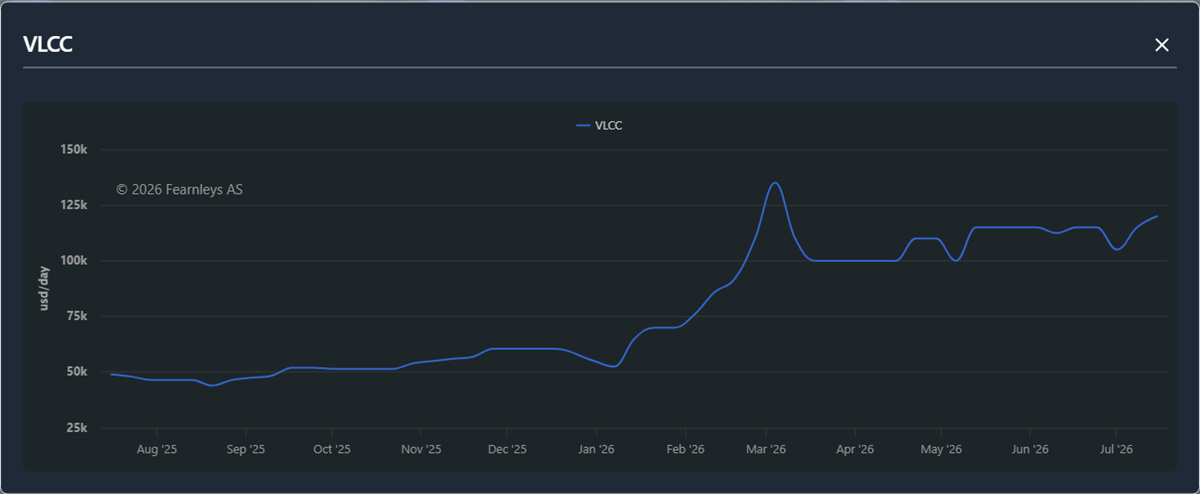
For most companies in the energy sector, relentless unpredictability is a recipe for underperformance. But rampant disruption is actually beneficial to shipping tanker companies that can charge higher rates when routes and timelines are uncertain. Rates are measured in tonne-miles, which is cargo multiplied by distance. Longer voyages increase the fees tankers charge clients, which is on top of a hefty war premium. Rates haven’t yet spiked to March levels, but are still elevated and back on the acceleration.
VLCCs can have breakevens as low as $15,000 per day, so elevated rates for extended periods are huge boosts to shipping company stocks, even if total volumes are much lower. Many Gulf ships have been rerouted around the Cape of Good Hope, causing rates to spike by 30% to 50% to offset longer voyages. And many of these companies are efficiently using higher rates to boost their bottom lines.
With the tanker trade back in full force, investors might want to consider this pair of stocks, each with a high-quality fleet and a potential catalyst on the horizon.
Frontline: Largest Fleet With an Array of Trading Routes
Frontline PLC (NYSE: FRO) operates the largest global shipping fleet with a variety of VLCCs, Aframax, and Suezmax vessels.
The company serves trading routes across the Middle East, Asia, the Americas, and Europe, and this strategic positioning enables it to be highly sensitive to rate-market volatility.
This was apparent in the company’s fiscal Q1 2026 earnings report, released late May, which showed revenue spiked 67% year-over-year (YOY).
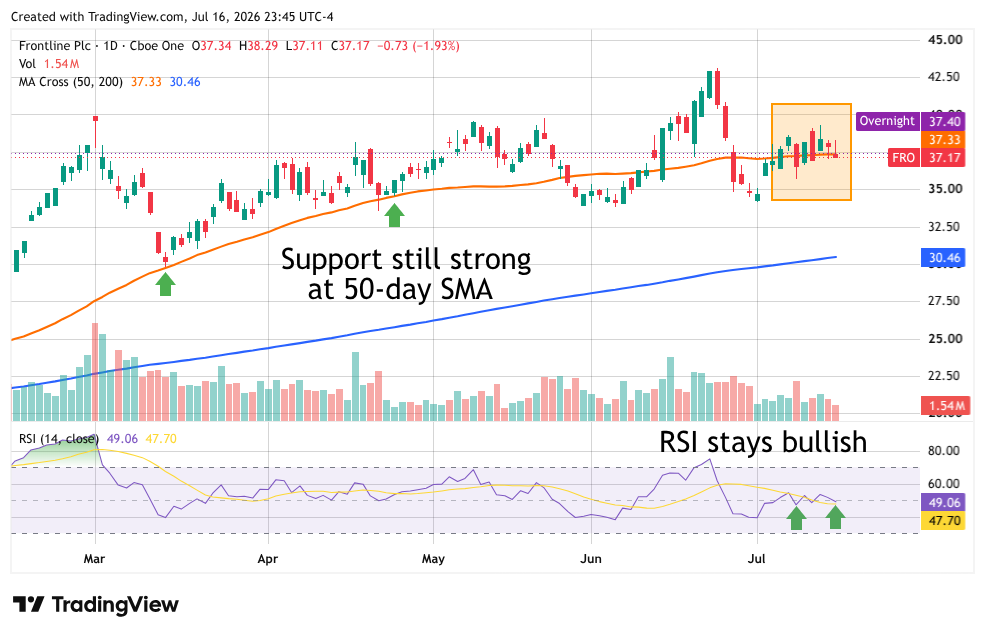
Support at the 50-day moving average has been strong for FRO shares throughout the conflict, although the stock remains stuck at the same price it was in March. But the 50-day continues to hold, and the Relative Strength Index (RSI) hints that upward momentum is brewing.
DHT Holdings: The Steady Compounder With Healthy Balance Sheet
Not only do the VLCCs owned by DHT Holdings Inc. (NYSE: DHT) have some of the lowest breakevens in the industry at around $15,000 per day, but the company itself has almost no debt (rare for a shipper) and pays a strong dividend.
Using a mix of spot and time charters, DHT transports crude oil barrels from the Gulf to refiners in Asia, North America, and Europe.
Despite having more than 50 VLCCs trapped in the Strait of Hormuz in fiscal Q1 2026, the company still reported YOY revenue growth of nearly 135%.
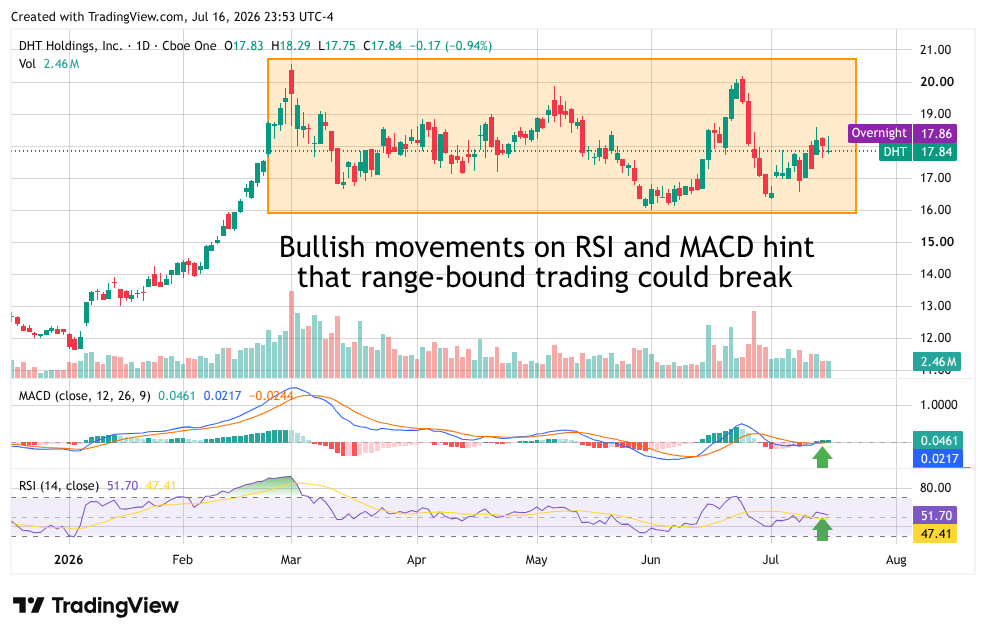
Like many of its VLCCs, DHT shares have been stuck in neutral, trading in a tight range after spiking in the buildup to the war. The stock recently spiked off the low end of this trading range, and signals on the RSI and the Moving Average Convergence Divergence (MACD) indicator show bullish momentum accelerating once again.
The company’s next earnings release is for fiscal Q2 2026 results on Aug. 5, and investors will be eagerly awaiting an update on the condition of the VLCC fleet.
Hedge fund legend Larry Benedict – who delivered a 279% return on cash in 2025 and went on a 20-year winning streak – says the SpaceX IPO wasn’t the main event. It was the trigger.
He’s identified what he calls the ‘Final Phase of Elon’s Master Plan,’ and one specific ticker he believes could see billions forced into it within days. It’s not SpaceX, Tesla, or any company you’d associate with Elon Musk. Larry is revealing the ticker free today.WATCH LARRY BENEDICT’S PRESENTATION AND GET THE ONE TICKER NOW
While much of the technology worldhas spent the past few years scrambling to bolt artificial intelligence (AI) features onto existing products, Shopify Inc. (NASDAQ: SHOP) has been playing a quieter, and potentially far smarter, game.
Rather than treating AI as a marketing add-on, the e-commerce platform has been methodically positioning itself at the very center of what’s increasingly being called agentic commerce. And that bet is now starting to look compelling.
The stock has been reflecting some of that renewed optimism, climbing about 13% over the past month. It’s worth keeping that in perspective, though, as shares are still down over 20% year to date and are trading back at December 2020 levels, which shows just how far sentiment had swung against it.
But with a fresh vote of confidence from Wall Street this week and a key earnings report now less than three weeks away, the argument that Shopify is emerging as one of the biggest long-term winners in the AI shopping shiftis gaining real traction.
Why Shopify’s Positioning Is So Compelling
The core of the bullish argument comes down to where Shopify sits in the commerce ecosystem. The company is already deeply embedded in how hundreds of thousands of merchants run their businesses, handling everything from storefronts and payments to inventory and logistics. That deep integration makes it a natural control layer for the next wave of AI-driven shopping, the point through which automated, agent-led transactions can actually flow.
This is a crucial distinction. As AI agents increasingly begin to handle shopping tasks on behalf of both merchants and consumers, whoever owns the underlying infrastructure those agents plug into stands to benefit enormously.
Shopify isn’t trying to build a flashy consumer-facing chatbot to compete for attention. It’s positioning itself as the plumbing that makes agentic commerce work in the first place, which is a far stickier and more defensible place to be.
The early evidence suggests the strategy is working. Management has pointed to a substantial increase in AI-generated orders over the past year, a clear signal that automated shopping flows are already accelerating across the platform.
Wall Street Is Starting to See It Too
The most compelling recent endorsement came earlier this week, when Jefferies upgraded Shopify to a Buy rating and raised its price target to $160, implying almost 30% upside from current levels. It views Shopify as uniquely positioned to become the infrastructure layer for agentic commerce, or as commentary neatly put it, the “agent enablement” toolkit for merchants.
The upgrade wasn’t just built on the big-picture theme. Jefferies also pointed to third-party data that bolsters confidence that Shopify’s upcoming report will beat consensus estimates, flagging that newly announced changes to Shopify’s partner program should support near-term growth while lowering the company’s long-term sales and marketing cost structure, a rare combination of a growth tailwind and a cost improvement at once.
Perhaps most interesting was the observation on pricing. Jefferies sees a price increase as likely, which would represent a meaningful source of upside heading into 2027. Shopify last raised prices in 2023 and 2024 and has since rolled out a slew of new features, most notably its AI assistant, Sidekick, while absorbing the associated costs itself. That sets up a scenario where the company has been adding significant value without yet charging for it, leaving clear room to raise prices down the line.
The Valuation Question Can’t Be Ignored
To be sure, the bull case is not without its challengers, and the biggest pushback is the one that has followed Shopify for years: valuation. Even after a difficult first half of the year for the share price, Shopify’s triple-digit price-to-earnings ratio still feels frothy. It suggests that much of its future growth could already be baked into expectations.
Scaling AI capabilities isn’t free either, and the infrastructure costs of running inference workloads at scale could weigh on margins if not carefully managed. These are fair points, and they’re the reason this isn’t a slam-dunk. But it’s also worth remembering that Shopify remains a high-quality business with strong cash generation and a solid balance sheet—exactly the attributes you want to see in a company investing for a long-term shift.
Sights Set on August’s Report
With all of this in mind, Shopify’s upcoming earnings report is shaping up to be a pivotal moment. The most important thing to watch will be the data on AI-driven revenue, particularly further evidence that AI-generated orders are accelerating, as that’s the metric that most directly validates the entire agentic thesis.
Strong second-quarter numbers, in line with what Jefferies is anticipating, would also go a long way toward justifying the recent optimism. Deliver on that front, and a stock that has been quietly clawing back gains over the past month could find itself with a lot more room to run. READ THIS STORY ONLINE
When the railroads launched in the 1860s, Andrew Carnegie didn’t profit by riding the trains – he got rich owning the steel rails they ran on. The same dynamic may be playing out today around the anticipated $1.75 trillion SpaceX IPO.
More than a year after the federal government renewed a push toward nuclear energy, the industry is building momentum thanks to a streamlined process for reactor authorization, an ambitious goal of 300 additional gigawatts of capacity by 2050, and more. The timing is crucial, as AI electricity demand continues to grow and low-carbon energy generation via nuclear facilities is particularly appealing in these contexts.
To be sure, challenges remain: sourcing the high-assay low-enriched uranium (HALEU) necessary for some next-gen reactors is difficult, and supply chain and manufacturing capacity limitations, workforce shortages, and the licensing process can all hold up the industry’s capabilities to deliver nuclear energy quickly. Still, as the industry continues to evolve and grow, a number of exchange-traded funds (ETFs) can expose investors to the many potential growth opportunities in the nuclear industry. Now may be a good time to explore these options, as a sell-off in the industry in 2026 after a previous successful run can present buy-in opportunities.
A Selective Basket of Global Nuclear Stocks
The VanEck Uranium and Nuclear ETF (NYSEARCA: NLR) is one of the oldest nuclear industry ETFs on the market, having launched in the summer of 2007. The fund’s staying power may be due to its broad strategy within the industry, allowing access to the full nuclear power generation process from the sourcing and production of input materials to companies operating power plants and more.
NLR achieves this mix despite its fairly small basket of 32 stocks. With a targeted portfolio like this, investors should expect that some names will receive sizable allocations, and indeed, the largest positions here do range up to 8% or more. Still, given its global focus, NLR is able to funnel its assets into the most stable, highest-performance nuclear stocks available worldwide, aiming for both breadth and quality.
Like many nuclear funds, NLR’s year-to-date (YTD) performance is in the red: the ETF has declined by almost 12% in 2026. This valuation reset across the industry could provide an opportunity, although investors must be willing to accept NLR’s 0.56% expense ratio while they wait for the momentum to build again.
A Unique Play on Uranium Miners With a Commodities Twist
For a more targeted play on uranium itself, investors might consider the Sprott Uranium Miners ETF (NYSEARCA: URNM). This fund invests primarily in companies involved in the uranium mining industry, including those that explore, develop, produce, or hold physical uranium. This industry is a niche one, and URNM has only 31 holdingsbased on a global screen. Given the significant overlap between URNM’s portfolio and NRL’s holdings, it’s unlikely that investors would want to hold both funds at the same time.
Three positions in URNM’s basket make up nearly half of the fund’s total assets, collectively. These include uranium providers Cameco Corp. (NYSE: CCJ)and NexGen Energy (NYSE: NXE), but the third stands out: it is a position in the Sprott Physical Uranium Trust, which holds physical uranium. Thus, URNM is in part a commodities play on uranium itself. This may help to explain why the fund is somewhat more expensive than several of its nuclear peers, with an expense ratio of 0.75%.
Despite its YTD decline, URNM offers a dividend yield of 2.59%, a passive income perk even as the nuclear industry is in the midst of a reset.
An Alternative Approach to Uranium With a Standout Dividend Yield
A competitor of URNM, the Global X Uranium ETF (NYSEARCA: URA) also focuses on the material essential for nuclear power. However, URA accesses uranium via shares of companies involved in mining and production, rather than through any type of direct investment in the commodity itself. URA has the broadest portfolio of these three ETFs, with about 56 holdings from developed markets around the world. Still, it is, in some ways, also the most concentrated: Cameco shares make up nearly a quarter of the fund.
URA’s expense ratio of 0.69% lies between the two funds’ fees above, and it has a solid asset base of $5.7 billion and a hearty trading volume to match. This makes the fund appealing to investors seeking the flexibility to make frequent trades without worrying about liquidity. It may also reflect the ETF’s strong dividend yield of 5.26%. While UFA has also slipped so far this year, it has held up better than the other uranium-focused funds on this list. READ THIS STORY ONLINE
Bank of America just revealed your expiration date. In their Bloomberg interview, they didn’t just predict the digital dollar. They gave us the timeline… 2025 to 2030. We’re in that window right now.
Once the digital dollar launches, every transaction you make will be tracked. Your spending could be controlled. Your accounts could be frozen.
The Night Owl is a financial newsletter that provides in-depth market analysis on stocks of interest to individual investors. Published by MarketBeat and Early Bird Publishing, The Night Owl is delivered around 9:00 PM Eastern Sunday through Thursday. If you give a hoot about the market, The Night Owl is the newsletter for you.
(29) And if ye be Christ’s, then are ye Abraham’s seed, and heirs according to the promise. King James VersionChange email Bible version
In all of mankind since Adam, only one person has qualified to receive the inheritance of the promises that were made to Abraham—Christ.
We can see the requirements as early as Genesis 17:1, where God says to Abraham, “Walk before Me, and be perfect.” Some Bibles translate it, “Be blameless,” which means the same thing; “Be without sin.” Christ, at the end of His life, was found to be blameless; therefore, He qualified to receive the promises. He met every condition of the Covenant, and then became the Inheritor.
Verse 29 is explaining that, if we are “in Christ” (in union with Him), then we become co-heirs with Him. We become co-inheritors with Him, if we have met the conditions the Bible gives: God has called us; we have unconditionally surrendered to God; we believe the gospel; we believe in the blood of Jesus Christ; we have been baptized; we have received the Holy Spirit; we have had hands laid on us. Then we also become “in Christ.” The picture is as if we were part of Christ’s body, and we are “in” Him. That is not actually what has occurred, but we are within the church.
Christ, being the Inheritor of the promises, then made out a will, as it were, prior to His death for the forgiveness of our sins. This will is also the New Covenant, which includes all the promises and blessings the Scriptures show us.
Christ had to die for a number of reasons. First of all, He was physical; and it is given to all men to die once (Hebrews 9:27). Another reason is that the wages of sin is death (Romans 6:23), and when our sins were placed on Him, He then came under the law and the law claimed its penalty—He died. Another reason is that He had to be transformed, glorified by means of a resurrection, because, as long as He was in the flesh, He could not inherit the promises either. One has to be eternal to inherit them; “flesh and blood cannot inherit the kingdom of God” (I Corinthians 15:50).
We may receive compensation for some links to products and services included in this email.
Sports Publishing Solutions Inc. 625 Broadway, 10th floor New York, NY. 10012 You are receiving this email because you are subscribed to the Sports Illustrated newsletter.
Jesus Christ, my God, I adore You and thank You for all the graces You have given me this day. I offer You my sleep and all the moments of this night. I place myself and all my loved ones, wherever they may be, in Your sacred side and under the mantle of Our Blessed Mother. Let Your holy angels stand watch and keep us in peace. Amen.
Quote of the Day
“You, who have power on earth to forgive sins, forgive me so that I may be refreshed.”
— St. Macrina the Younger
Today’s Meditation
When we speak of the Cross as a piece of wood, we do not think of its growth nor of its situation. Its situation is the universe; its growth dates from the “Sixth Day,” unless you would rather say that it exists and grows in the heart of the Christian when he unites himself to his divine Master. The Cross is necessary for the salvation of the world: happy the land, happy the soul willing to pay the price of it!An excerpt from What Jesus Saw From The Cross
Established in 1995, our program has faithfully formed students through a classical curriculum that counters the anti-Christian culture of our time.
Through live interactive online classes led by experienced Catholic educators, students grow within a safe, supportive online community.
Serving grades 4–12, we provide a rigorous academic foundation rooted in faith, preparing young people for their God-given vocation and for lives of leadership and service grounded in Christ.
The daily examination of conscience is an ancient Catholic practice. It’s very simple, and it’s designed to help us identify our sins and weaknesses so that we can improve and grow stronger in the spiritual life, while providing an excellent ongoing preparation for regular Confession. It consists of taking a few minutes at the end of the day to prayerfully review our actions in the light of God’s commandments, followed by the Act of Contrition.1. Reflect on the victories and losses
Actively reflecting on the high and low points of the day can help you live more intentionally and bring a renewed sense of resolve into the following day.
Review your actions, words, and thoughts today. Did you actively guard yourself against temptation? Where did sin creep in?
In what moments did you practice virtue and moral courage?
Were you attuned to the Holy Spirit’s promptings today? Where did you feel His inspiration?
Ask Him for the graces necessary to follow His Will more purposefully tomorrow.
2. Act of Contrition
O my God, I am heartily sorry for having offended Thee, and I detest all my sins because of Thy just punishments, but most of all because they offend Thee, my God, Who art all good and deserving of all my love. I firmly resolve with the help of Thy grace to sin no more and to avoid the near occasions of sin. Amen.3. Practice gratitude
It is God’s love that has brought you into existence and to this exact moment. Practice looking for His hand in your day.
Where did you feel His loving gaze upon you today?
What people or moments helped you see God in your life?
Thank God for all these moments!
Ask Him to help you recognize His blessings and providence tomorrow.
4. Renew your commitment to Christ
Remember: our Faith is founded upon a Person—Christ! Renew your personal love and devotion to Him.
Thank God for the gift of His Son Jesus and our call to be His disciples.
Tell the Lord of your desire to know Christ more personally.
If possible, set an intention for your day tomorrow. Ask Our Lord to guide you in this act.
Pray a Hail Mary, Our Father, or another beloved prayer.
Rest with God
By day the Lord commands His steadfast love; and at night His song is with me, a prayer to the God of my life.— Psalm 42:8Compline (Night Prayer)Want to help your organization reach thousands of Catholics? Click here to consider sponsoring future Night Prayers.
CPI Comes In Cool: Why It Could Revive These 3 Rate-Sensitive Stocks
Written by Dan Schmidt on July 15, 2026
Key Points
June’s cooler-than-expected CPI report reduced the odds of a July rate hike from 42% to 16.6%, easing pressure on rate-sensitive stocks.
Rate-sensitive sectors including homebuilders, REITs, and fintechs stand to benefit if the Federal Reserve delays additional interest rate hikes.
D.R. Horton, Realty Income, and SoFi Technologies each show strong underlying business performance that could improve further in a slower-rate environment.
Investors breathed a sigh of relief on Tuesday, July 14, when the Consumer Price Index (CPI) came in below consensus, signaling that inflation slowed month over month in June. The index declined 0.4%between May and June, mainly due to falling energy prices.
The annual rate of 3.5%, while still well above target, also came in below the 3.8% consensus. But the biggest relief came to rate-sensitive sectors like fintechs, Real Estate Investment Trusts (REITs), and entry-level homebuilders, many of which have been beaten down by sticky inflation, high rates, and weary consumers. While one print doesn’t equate to a trend, June’s number bodes well for this group, especially the three stocks we’ll discuss below.
Washington has taken an ownership stake in Intel, carved out a cut of Nvidia’s and AMD’s chip sales, and reportedly fielded an offer to own 5% of the largest AI company on the planet. The government is shifting from referee to shareholder in the most important technology race of the century.
When the rules change, the winning trades change with them. Some blue chips sitting in your index fund are now on the wrong side of this shift – while a select group of companies pulled into the new arrangement may be treated like national treasures.Watch the documentary to see which stocks to buy and sell now
The Hike Scare Just Lost a Few Teeth
Inflation had been creeping higher in recent months, and Federal Reserve governors like Christopher Waller had been considering voting for rate hikes as early as this month when the Federal Open Market Committee (FOMC) meets on July 29. According to CME Group’s FedWatch tool, the odds of a July rate hike reached as high as 42% on July 13, but dropped to just 16.6% the day after the cool CPI release.
The odds of a September rate hike are still nearly 60% (and cuts still appear completely off the table), but a three-month period of relief could be meaningful for the sectors we mentioned earlier. The 10-year Treasury yield dropped sharply after the CPI release, a boost for homebuilders, since 30-year fixed mortgage rates most closely track the 10-year Treasury yield. Fintechs also suffer when mortgage rates are high, as loan demand weakens and credit risk increases. They’re also frequently considered growth stocks with earnings potential, not necessarily current profits. And REITs are both a bond proxy and a real estate proxy, benefiting from lower Treasury yields and lower borrowing costs to acquire property.
While June’s report is the largest one-month CPI decline since April 2020, it’s important to understand how the calculus has shifted. Waller has said it will take several months of data to convince him inflation is actually heading in the right direction, and most of the CPI relief came from lower gasoline prices (down 9.7% month-over-month). The relief may not last, but investors are now betting on a scenario in which a single rate hike is on the table rather than multiple increases before year-end. A pause into 2027 remains a dream-world outcome, one that would likely require hypnotizing several heads of state, but the market is at least starting to price in a less aggressive path.
3 Stocks That Benefit From Rate Relief
Three stocks, one each from the REIT, homebuilder, and fintech industries, offer broad exposure to a potential slow-rate environment. Rate hikes may not be avoided entirely, and cuts still appear unlikely, but these stocks could benefit if additional hikes are pushed further out.
D.R. Horton: The Affordability Homebuilder
D.R. Horton Inc. (NYSE: DHI) is the country’s largest homebuilder by total volume, specializing in entry-level homes for first-time buyers. More than 60% of the company’s homes go to first-time buyers, a group for whom affordability is often the most crucial factor. Lower mortgage rates put more renters into the pool of buyers, and also allow DHI to boost margins by reducing the amount of buydowns and incentives it offers.
The company posted a top and bottom-line earnings beat during its Q2 2026 report in April and upgraded its full-year revenue estimates, but buydowns and incentives were one area of stress for management, with more than 70% of closings requiring a buydown. The Q3 2026 report is scheduled for July 21, so this CPI report is welcome news for management ahead of that conference call. D.R. Horton also has a policy tailwind thanks to the June passage of the 21st Century Road to Housing Act, which sent DHI shares up nearly 7% in a single session.
Realty Income: Bond-like Yields With Strong Underlying Business
Few publicly traded companies are more linked to the 10-year Treasury yield than Realty Income Corp. (NYSE: O), the long-term net-lease REIT. The company pays a 5.1% dividend with a more than 30-year track record of annual payout increases. And most importantly, this isn’t a weak REIT dependent on steady rates. The underlying business is in terrific shape, as evidenced by a Q1 2026 earnings beat, during which management raised Adjusted Funds From Operations (AFFO) and investment volume guidance. It also deployed $2.8 billion in capital at a cash yield of 7.1%, and that spread will only get healthier as funding costs fall. If the 10-year yield continues to drop and rate hikes are postponed, the stock’s biggest overhang is removed, and the 5.1% dividend can continue growing.
SoFi Technologies: Stimulating Loan Demand Improves Duration Story
SoFi Technologies Inc. (NASDAQ: SOFI) is the high beta way to play rates if the Fed stands pat. The company earns most of its income from lending, especially personal and student loans. SoFi is a nationally chartered bank with a diverse lending book, but demand for personal and student loan refinancing had been dormant during the high-rate regime. The stock is down nearly 30% year to date. However, this performance belies some promising results.
Despite the massive stock drawdown, SoFi’s Q1 2026 report was strong as revenue grew 42% year-over-year to $1.09 billion, above the anticipated $1.05 billion. The company also reported record loan originations totaling $12.2 billion. A steady-rate environment may not trigger a stampede of refinancings, but it could help revitalize the company’s sleepy student loan refinance program. Analysts at Goldman Sachs seem to agree; they boosted their price target on the stock from $17 to $21 on July 9.
Thank you for subscribing to DividendStocks.com’s daily newsletter for dividend and income investors that covers ex-dividend stocks, new dividend declarations, dividend stock ideas, and the latest market news.
If you need assistance with your account, please feel free to email MarketBeat’s South Dakota based support team at contact@marketbeat.com.
If you no longer wish to receive email from DividendStocks.com, you can unsubscribe.

 News for you, Peter5 Stocks Poised to Outperform With Their Best Growth Still AheadThese five financially strong industrial stocks are powering the AI infrastructure boom while keeping debt under control.Motley Fool 2 Stocks That Could Double by 2030Both of these stocks have a long growth runway.Motley Fool TSMC expects ‘strong, multi-year’ demand for AI chips as it ramps up Arizona investmentTSMC is seeing strong, multi-year demand for its AI chips as it invests a further $100 billion to expand its Arizona facil…Reuters Trump ally seeks makeover ahead of critical Arizona governor’s raceGov. Katie Hobbs is considered the most vulnerable Democratic incumbent in a swing state that’s been on the 2020 election …USA TODAY Arizona primary tests Trump-backed candidates, Mamdani-style challengerThese crucial congressional primary races in Arizona could provide clues about whether Republicans maintain their slim maj…USA TODAY Can the Australian model rescue the US retirement system? Trump seems to think so.President Trump says Australia’s retirement system could serve as a model for the US. Is that possible?Yahoo Finance Sausalito city manager reportedly found on someone’s yacht is arrested on suspicion of burglaryThe former director of the San Francisco Port who was just hired as a city manager in Marin County has been arrested on su…LA Times Canada to temporarily bar entry for foreigners who have recently been to Congo, against UN adviceBy Ryan Patrick Jones and Maria Cheng July 19 (Reuters) – The Canadian government said on Sunday it would deny entry to an…Reuters 9 People Injured in Mass Shooting Outside Arizona Pizza Restaurant, Suspect Shot by PolicePolice believe the shooting stemmed from an earlier confrontation between two groups of people who knew each otherPeople Chinese company demands compensation from the UK over British Steel nationalizationThe Chinese company that formerly owned British Steel demanded Sunday compensation from the U.K. government for investment…Associated Press More like this
 Today’s gamePlay Word Searchers nowFind the words by searching through a grid of random letters.
 Trending now1. Donald Trump2. Spain vs. Argentina3. Taylor Farms Lettuce4. FIFA World Cup5. Andrew Tate6. Rodri7. Cyclospora Outbreak8. National Hurricane Center9. The Open Championship10. JD Vance Baby