Conservative Headline News – Videos for Conservatives, Gun Owners and More!
— Read on conservativeheadlinenews.com/
Author Archives: RJ Hamster
I was born on 6 August 1956 in San Francisco, California to Janet and (the late) Richard Hovis.
I grew up in Santa Monica, California where I attended elementary, junior high school, and high school (graduating in 1974), in addition to involvement in sports and recreation (Little League +, the Boy’s Club ++). Further, it was in elementary school – St. Augustine’s By-the -Sea Parish School that I found, and made the choice to truly journey with God.
I attended Arizona State University from 1974 to 1977 – seeking to become an architect, however, I was not accepted, and, as such, I graduated with a Liberal Arts degree.
Upon graduation from Arizona State University, I attended Cal Poly San Luis Obispo and studied City and Regional Planning at the Master’s level. I successfully completed one (1) year in a two (2) year program – I did not complete the Master’s degree in City and Regional Planning – due to personal reasons.
I returned to Santa Monica where I started (October 1979) my career as graphic designer with Exxon Company, USA. I spent five years with Exxon Company, USA.
While working with Exxon Company, USA I was accepted into architectural school – Sci-Arc in Southern California, however, I did not attend preferring to stay with Exxon..
In 1982 I married Laura Flosi and in April 1983 we had our one and only child – Lauren Alain Hovis – a gift from God.
We moved to Phoenix, Arizona in 1984 from Los Angeles, where I went to work as a graphic designer with Kitchell CEM (from 1985 -1987).
From 1987 – 1995 I was an independent contractor, and a registered representative in mortgage finance, financial management, graphic design, and drafting.
Further, I attended the University of Phoenix and successfully obtained a Master’s in Business Administration (MBA) in 1982.
I was also a member of the Scottsdale Jaycees, where I became very involved in community events and projects.
In 1994, I accepted a cartography position with the Defense Mapping Agency in Reston, Virginia. As such, I relocated from Phoenix to Reston.
In 1998, I was accepted and worked as a Visual Information Officer with the Central Intelligence Agency. In 2002, I worked as a Support Officer until my retirement (due to a need for shoulder surgery) in September 2018.
Away from my Federal Government service, I have been involved in various organizations and activities in Northern Virginia.
In November of 2011, I married Rebecca Ouellette in Santa Monica, California. I reside in San Tan Valley, AZ with my two hamster - Jess and Timothy, our fish, our lizard - RJ Lizard., and our cats - Pearl and Grey.
As to hobbies, I enjoy playing sports, attending sporting events, mentoring individuals from financial management to hamsters, building models, photography, travel, multimedia design, managing partner for RJ Hamster, and jazz – smooth jazz to a samba or a bossa nova.
Love and God Bless,
Peter – aka RJ Hamster Jo hi
Perfect Stock Caught Trading Under Secret Name


Dear Reader,
This is just bizarre…
We have uncovered perhaps the most unusual stock we’ve ever seen.
It’s expected to see massive revenue this year – $181 billion.
The company holds over 29,000 patents in the U.S.
It pays an enormous dividend.
And yet…
It’s ultra-cheap – less than $8.
Most curious of all… it trades under a secret name that virtually no regular investor knows.
Alex Green, our Chief Investment Strategist, delivered his first-ever “TEK Talk” to deliver the scoop on this company.
You’ve got to see it.
What an amazing story. You won’t believe what happens midway through – what a shock!
See the whole thing here.
Good investing,
Matt Benjamin
Senior Macroeconomic Analyst, The Oxford Club
P.S. A huge announcement could bring this secret stock into the light. Find out what they have planned here.Advertising Disclosure: This email contains paid advertisements. This email is from our associates at Oxford Club.
Legal Entity Information: Investing Ideas Daily is owned and operated by Darwin Investor Network, a DBA of The Darwin Agency, Inc.
Disclaimer: Nothing in this email should be considered personalized financial advice. Always conduct your own due diligence when investing. We urge you to read our full disclaimer by clicking on the terms of use link below.
Unsubscribe: You are receiving this email as part of your complimentary subscription to the Investing Ideas Daily E-Letter. If you would like to unsubscribe, you can do so by clicking on the unsubscribe link below.Darwin Investor Network
2319 N Andrews Avenue, Fort Lauderdale, FL 33311
support@investingideasdaily.com | 1-800-496-9838Investing Ideas Daily | Privacy Policy | Terms of Use
Unsubscribe | View Online
New Alert [Thursday @ 9:30am ET]

March 11, 2026 | Unsubscribe
Hello!
Today’s alert did not work out. Despite early upward movement and breaking news, it was unable to deliver sustained upside.
Not every setup develops as expected, and transparency remains a core part of our process.
We are incredibly grateful for your trust, engagement, encouragement and support.
Our focus remains on highlighting opportunities with the potential for meaningful, sustainable moves, while recognizing that markets rarely move in a straight line.
To improve your odds of success, always trade with a plan.
Define your stop levels, set clear profit targets, and monitor key technical signals such as moving averages, prior highs and lows, and open or close levels that may act as support or resistance.
Looking ahead, we have a brand-new NASDAQ alert coming tomorrow morning, Thursday at 9:30 AM ET.
Right now, we are tracking several under-the-radar NASDAQ and NYSE names, and tomorrow’s alert stands out.
Based on the technical chart structure, we believe this alert has strong potential to deliver meaningful upside.
Plus, this company has a history of delivering sharp rallies.
Be ready tomorrow morning, Thursday at 9:30 AM ET.
Thank you for sticking with us. One good opportunity can make all the difference.
To get all of our updates in real-time – Click hereto sign-up for free text alerts to your phone. (*We do not charge for this service, but standard carrier message and data rates may apply.)
Please make sure our emails are landing in your inbox, not spam, so you do not miss the alert.
All alerts are released only during normal market hours to ensure all subscribers get the same fair access and to avoid after-hours volatility.
See you tomorrow morning!
SmallCapStocks Team
DISCLAIMER:
You should read and understand this disclaimer in its entirety before joining the website or email/blog list of SmallCapStocks.com (the “Publisher”). The information (collectively the “Advertisement”) disseminated by email, text or other method by the Publisher including this publication is a paid commercial advertisement and should not be relied upon for making an investment decision or any other purpose. The Publisher is engaged in the business of marketing and advertising the securities of publicly traded companies in exchange for compensation. The track record, gains, upside, and/or losses mentioned in the Advertisement, if any, should not be considered as true or accurate or be the basis for an investment. The Publisher does not verify the accuracy or completeness of any information included in the Advertisement. While the Publisher does not charge for the SMS service, standard carrier message and data rates may apply. To unsubscribe from receiving promotional text messages to your phone sent via an autodialer, using your phone reply to the sender’s phone number with the word STOP or HELP for help.You are receiving this report/release because you subscribed to receive it at our website or through a third-party site. All our newsletters include an “unsubscribe” link, and you can remove yourself at any time from our newsletters by clicking on that “unsubscribe” link. You can also contact us at info@SmallCapStocks.com to change your information at any time. By your subscription to our profiles, the viewing of this profile and/or use of our website, you have agreed and acknowledged the terms of our full disclaimer and privacy policy which can be viewed at the following link: www.SmallCapStocks.com/Disclaimer and www.SmallCapStocks.com/Privacy-Policy
Update your email preferences or unsubscribe here
© 2026 Small Cap Stocks
1969 South Alafaya Trail
Orlando, Florida 32828, United StatesPowered by beehiivTerms of Service
The Market’s Next Problem



Delivering World-Class Financial Research Since 1999
The war in Iran continues… The market doesn’t expect it to end soon… The promise of more oil was not enough… Rates might not go lower anymore… Oracle has gotten the message… Buyer beware…
Updates from the Middle East keep coming fast…
We went to bed reading about Iranian drone attacks continuing, with reported strikes on three tankers near the Strait of Hormuz and at Dubai’s airport… Then we woke up to news about Iran threatening to “target economic centers and banks” linked to the U.S. and Israel.
Meanwhile, President Donald Trump gave another interview today, saying the war would end “soon” because there was “practically nothing left to target.”
He’s talking about the military infrastructure, most likely.
But, clearly, with Iranian attacks ongoing across the Persian Gulf, it now looks like a regional war is underway… And nobody seems sure what Iranian leadership will look like tomorrow or weeks from now.
As we wrote just earlier this week, the market is showing some “less bad” signs. But the markets remain volatile. And for yet another day, it didn’t look like investors expected things to settle down anytime soon.
The promise of more oil was not enough…
When it comes to market impact, it’s all about oil (and gas)… Roughly a quarter of the world’s typical seaborne oil supply has stopped. Energy production has stopped in many cases, too, including at Qatar’s key natural gas facility.
This morning brought some relief from the International Energy Agency (“IEA”), which coordinates oil reserve policy among 32 nations, including the U.S. The IEA announced plans for the release of 400 million barrels of oil reserves, which is about a third of all the members’ emergency stockpiles.
That may sound like a lot. But before the war, that much oil passed through the Strait of Hormuz every three weeks… And we’re more than a week into the conflict already.
Also, details about the IEA’s plan are hazy.
Its announcement said that “the emergency stocks will be made available to the market over a timeframe that is appropriate to the national circumstances of each Member country and will be supplemented by additional emergency measures by some countries.”
Sounds to an objective observer like “everyone for themselves.” In any case, the news didn’t ease market concerns and arguably heightened them. Oil prices are actually higher over the past day, by about 5% for both West Texas Intermediate and Brent crude.
As we go to press, they trade at around $88 and $92 per barrel, respectively. The major U.S. stock indexes were little changed to slightly lower… with the energy sector of the S&P 500 the lone significant gainer, up 2.5%.
At least inflation hasn’t been a surprise (yet)…
This morning, the Bureau of Labor Statistics showed the consumer price index (“CPI”) rose 0.3% in February from the prior month and 2.4% year over year. On a core basis, stripping out energy and fuel prices, the CPI rose 0.2% month over month and 2.5% year over year.
All four of those readings were in line with what Wall Street expected. At a 2.4% headline increase, February’s reading matches January’s for the lowest reading since last May.
So, on first glance, the inflation data was exactly what the market would want. Lower inflation would bolster the case for the Federal Reserve to cut interest rates, as investors have been craving. But today, stocks remained lower anyway…
A big reason is that while February’s inflation reading appeared fine, it also marks a baseline for a likely worse-off report next month. And investors are already looking ahead to what may come next.
The recent surge in oil prices means more inflation…
In February, the CPI’s energy component rose 0.6% from the prior month and 0.5% from February 2025. That’s already about a 6% annualized pace. And next month, higher energy costs will show up in CPI numbers even more.
With West Texas Intermediate crude prices around $88 per barrel today, oil is up more than 15% from the end of March last year. And gasoline, which fell 5.6% year over year in February, is up more than 16% from a year ago, according to AAA.
Already, the Cleveland Fed – which runs an inflation “nowcast” – projects the CPI will climb back up to near 2.9% year over year for March’s reading.
And if the tensions with Iran send oil prices back to $100 per barrel in the next couple weeks, energy prices could drive inflation higher… which wouldn’t be good news for the broader economy.
One estimate from Apollo Global Management Chief Economist Torsten Slok is that $100 oil would boost headline inflation by 0.7 percentage points. That would put it closer to 4% than 3%, to say nothing of the Fed’s supposed 2% target.
That puts the Fed in a tough spot…
For months, we’ve been sounding alarm bells about stagflation – high inflation and high unemployment. The Fed’s typical solutions to these problems would contradict each other…
To combat rising unemployment, the Fed would typically lower rates. And as we’ve seen in the past couple of years, the Fed has raised rates with the intention of bringing inflation lower.
But right now, the Fed is worried about both higher inflation and higher unemployment. It has been in “wait and see” mode to figure out how or if it should act.
The market expects this “do nothing” stance to continue at the Fed’s policy meeting next Wednesday. Federal-funds futures traders see a 99% chance that the Fed will keep the fed-funds rate the same, according to CME FedWatch.
But we’ll be watching the Fed’s quarterly Summary of Economic Projections, due to be released as well. This is the quarterly exercise where the Fed gives its estimates for inflation, unemployment, and economic growth.
Jerome Powell’s term as Fed chair is winding down in May. Still, these projections will be important as they could provide clarity for what the Fed may or may not do before Powell hands over the reins.
Recall that Trump has nominated Kevin Warsh, who still needs to be confirmed by the Senate. Barring surprises with Warsh’s nomination, which are entirely possible, next week’s meeting is just one of two chances (along with April’s meeting) for Powell’s decisions and words to have an impact.
Our bet is that Powell signals no moves coming over the next few months while the Fed continues to wait and see what happens with inflation and employment, not wanting to rock the boat. As our colleague Mike Barrett wrote in his Select Value Opportunities weekly updatetoday…
Outgoing Fed Chair Jerome Powell will resist changing monetary policy, regardless of the worsening outlook for employment and inflation. He’ll likely leave any decisions to presumptive incoming chair Kevin Warsh, who should lead his first meeting on June 16.
But the breakout of the war in Iran sets up an interesting situation come June… and the market’s next problem.
As we’ve been writing about for the past year, the market has grown to expect lower interest rates once a new Fed chair is installed in May. But the case for cutting rates in a few months likely won’t be justified as it once was.
The bond market may be starting to show that. Today, U.S. Treasury rates moved higher across the curve… The 10-year yield reached 4.2% and the 2-year moved above 3.6%, hitting a six-month high. Further moves higher could take a bite out of stock prices.
So prepare for more volatility ahead… not just from Iran headlines, but now from how the Fed handles it, too.
An update on our AI canary…
As we’ve discussed for months, we’re tracking cloud-computing giant Oracle (ORCL) as a possible “canary in the AI coal mine“… Its performance could signal what to expect or be cautious about moving ahead.
We first got skeptical after a nearly 40% one-day spike in Oracle shares after a quarterly earnings report back in September. The company had projected growth that didn’t seem sustainable or justified given its reliance on “remaining performance obligations,” or contracted revenue that the company hasn’t received yet.
And, since then, Oracle has become increasingly dependent on debt to fuel AI growth plans… without the profitable payoffs investors can envision from other “hyperscalers.”
As our colleague and True Wealth editor Brett Eversole predicted in his presentation at our annual conference in October, Oracle may need to “go cash-flow negative” and borrow around $100 billion over the next three to five years.
And last month, Oracle took steps to prove that prediction correct. It announced plans to raise up to $50 billion in 2026 to build out cloud infrastructure for its big-name AI clients like OpenAI, Nvidia (NVDA), and Meta Platforms (META).
These expenses come even while Oracle’s cash flows are a concern. Wall Street analysts expect its free cash flow to run a $20 billion deficit in each of the next three years.
Fellow hyperscalers like Meta, Alphabet (GOOGL), and Microsoft (MSFT) produce loads of free cash flow from their existing core businesses. So they can make expensive AI investments without this deep level of debt.
Oracle has revenue coming down the road, but its cloud build-out – which it needs to meet AI demand, current and future – is happening right now.
Oracle’s shares have fallen about 50% since its all-time high in September as more investors have figured out this dynamic. It sounds like Oracle has gotten the message…
Numbers and words…
After posting strong third-quarter earnings last night, Oracle execs suggested on the company’s earnings call with Wall Street analysts that they don’t plan to borrow more money, this year at least, beyond what the company has already announced.
“Investing in AI infrastructure is capital-intensive, but our operating model is optimized to ensure profitability,” Oracle CEO Clayton Magouyrk said.
Take him at his word, I guess? Some people did. Oracle shares rose about 9% today, but buyer beware.
As Stansberry’s Credit Opportunitieseditor Mike DiBiase wrote in an update for his subscribers in December…
The only way Oracle can afford its infrastructure build-out is by borrowing. That means tens of billions of dollars of new debt.
Anyone buying Oracle stock today is betting on everything going right in two areas… Oracle’s business (like its backlog of orders generating enough profits in the future) and the AI story in general. But we remain skeptical.
Even with today’s rise, Oracle shares are still down 50% from September. And they remain below their 50-day and 200-day moving averages, technical indicators of short- and long-term trends…
At the same time, our proprietary Stansberry Score for Oracle comes in at a 64 out of 100, with a “D” grade for valuation. There are better things to buy than Oracle shares if you’re looking to put new money to work today.


Recommended Links:
Former multibillion-dollar pension-fund trader who once turned a $4.6 million profit in 24 hours says this wave of volatility is just the beginning… but his No. 1 strategy could help you double your money – over and over again – even if stocks fall from here. Click here to learn more(includes a free stock giveaway).
TOMORROW: Red-Alert Warning From Jeff Brown
Jeff Brown believes Nvidia is about to trigger a major crash on March 16. In fact, he says it’s a “sure thing.” During a special event tomorrow, March 12, he’s going to reveal why this upcoming crash is a feature of the AI boom – not a bug – why the recent volatility is just the beginning, the name and ticker of a wildly popular AI stock that could crash, the stock that could see huge gains, and more… By tomorrow, click this link to register.
New 52-week highs (as of 3/10/26): BAE Systems (BAESY), Simplify Managed Futures Strategy Fund (CTA), Omega Healthcare Investors (OHI), Starbucks (SBUX), and Sprott (SII).
In today’s mailbag, we’ve had a few more folks asking about a replay of Ten Stock Trader editor Greg Diamond’s 2026 Market Crash Summit. If you missed the debut of the event yesterday, you can watch it at your convenience here…
Also, as always, Greg’s existing Ten Stock Trader subscribers and Stansberry Alliance members have access to all his work here…
And stay tuned to the Digest for more about his latest outlook. We’ll have a special Q&A with Greg tomorrow.
All the best,
Corey McLaughlin with Nick Koziol
Baltimore, Maryland
March 11, 2026
Stansberry Research Top 10 Open Recommendations
Top 10 highest-returning open stock positions across all Stansberry Research portfolios. Returns represent the total return from the initial recommendation.InvestmentBuy DateReturnPublicationMSFT
Microsoft11/11/101,357.3%Retirement MillionaireMSFT
Microsoft02/10/121,309.7%Stansberry’s Investment AdvisoryADP
Automatic Data Processing10/09/08831.4%Extreme ValueBRK.B
Berkshire Hathaway04/01/09784.6%Retirement MillionaireSII
Sprott01/11/18784.3%Extreme ValueGOOGL
Alphabet12/15/16657.1%Retirement MillionaireWRB
W.R. Berkley03/15/12630.7%Stansberry’s Investment AdvisoryCIEN
Ciena10/20/22607.5%Stansberry Innovations ReportALS-T
Altius Minerals03/26/09591.4%Extreme ValueHSY
Hershey12/07/07565.1%Stansberry’s Investment Advisory
Please note: Securities appearing in the Top 10 are not necessarily recommended buys at current prices. The list reflects the best-performing positions currently in the model portfolio of any Stansberry Research publication. The buy date reflects when the editor recommended the investment in the listed publication, and the return shows its performance since that date. To learn if a security is still a recommended buy today, you must be a subscriber to that publication and refer to the most recent portfolio.
Top 10 Totals3Extreme ValueFerris3Retirement MillionaireDoc3Stansberry’s Investment AdvisoryPorter1Stansberry Innovations ReportEngel
Top 5 Crypto Capital Open Recommendations
Top 5 highest-returning open positions in the Crypto Capital model portfolioInvestmentBuy DateReturnPublicationBTC/USD
Bitcoin11/27/181,759.4%Crypto CapitalWSTETH/USD
Wrapped Staked Ethereum12/07/181,696.9%Crypto CapitalONE/USD
Harmony12/16/191,010.7%Crypto CapitalPOL/USD
Polygon02/26/21642.3%Crypto CapitalQRL/USD
Quantum Resistant Ledger01/19/21549.3%Crypto Capital
Please note: Securities appearing in the Top 5 are not necessarily recommended buys at current prices. The list reflects the best-performing positions currently in the Crypto Capital model portfolio. The buy date reflects when the recommendation was made, and the return shows its performance since that date. To learn if it’s still a recommended buy today, you must be a subscriber and refer to the most recent portfolio.
Stansberry Research Hall of Fame
Top 10 all-time, highest-returning closed positions across all Stansberry portfoliosInvestmentDurationGainPublicationNvidia (NVDA)^*5.96 years1,466%Venture Tech.Microsoft (MSFT)^12.74 years1,185%Retirement MillionaireInovio Pharma. (INO)^1.01 years1,139%Venture Tech.Rocket Lab (RKLB)^2.35 years1,034%Venture Tech.Seabridge Gold (SA)^4.20 years995%Sjug Conf.Berkshire Hathaway (BRK-B)^16.13 years800%Retirement MillionaireIntellia Therapeutics (NTLA)1.95 years775%Amer. MoonshotsRite Aid 8.5% bond4.97 years773%True IncomePNC Warrants (PNC-WS)6.16 years706%True Wealth SystemsMaxar Technologies (MAXR)^1.90 years691%Venture Tech.
^ These gains occurred with a partial position in the respective stocks.
* Editor Dave Lashmet closed the first leg of this Nvidia position in November 2016 for a gain of about 108%. Then, he closed the second leg in July 2020 for a 777% return. And finally, in May 2022, he booked a 1,466% return on the final leg. Subscribers who followed his advice on Nvidia could’ve recorded a total weighted average gain of more than 600%.
Stansberry Research Crypto Hall of Fame
Top 5 highest-returning closed positions in the Crypto Capital model portfolioInvestmentDurationGainAnalystBand Protocol (BAND)0.31 years1,169%Crypto CapitalTerra (LUNA)0.41 years1,166%Crypto CapitalPolymesh (POLYX)3.84 years1,157%Crypto CapitalFrontier (FRONT)0.09 years979%Crypto CapitalBinance Coin (BNB)1.78 years963%Crypto Capital
You have received this e-mail as part of your subscription to Stansberry Digest. If you no longer want to receive e-mails from Stansberry Digest click here.
Published by Stansberry Research.
You’re receiving this e-mail at pahovis@aol.com. Stansberry Research welcomes comments or suggestions at feedback@stansberryresearch.com. This address is for feedback only. For questions about your account or to speak with customer service, call 888-261-2693 (U.S.) or 443-839-0986 (international) Monday-Friday, 9 a.m.-5 p.m. Eastern time. Or e-mail info@stansberryresearch.com. Please note: The law prohibits us from giving personalized financial advice.
© 2026 Stansberry Research. All rights reserved. Any reproduction, copying, or redistribution, in whole or in part, is prohibited without written permission from Stansberry Research, 1125 N Charles St, Baltimore, MD 21201 or stansberryresearch.com.
Any brokers mentioned constitute a partial list of available brokers and is for your information only. Stansberry Research does not recommend or endorse any brokers, dealers, or investment advisors.
Stansberry Research forbids its writers from having a financial interest in any security they recommend to our subscribers. All employees of Stansberry Research (and affiliated companies) must wait 24 hours after an investment recommendation is published online – or 72 hours after a direct mail publication is sent – before acting on that recommendation.
This work is based on SEC filings, current events, interviews, corporate press releases, and what we’ve learned as financial journalists. It may contain errors, and you shouldn’t make any investment decision based solely on what you read here. It’s your money and your responsibility.
Brain-Inspired Computing

Managing Editor’s Note: Tomorrow afternoon, Jeff’s diving into Nvidia’s big announcement that he believes is about to trigger a crash…
One that could send many popular AI companies spiraling.
The announcement is coming on March 16 – less than a week away… so be sure to tune in to hear about the catalyst for the crash… and how you can prepare before it strikes.
Just go here to automatically add your name to the guest list.
Brain-Inspired Computing

Jeff Brown, Editor,
The Bleeding Edge



Before computers as we know them today were invented, they existed in a different form.
A computer was actually a job title for one who computes.
Harvard “Computers”, circa 1890
Naturally, every computation was done by hand in the absence of semiconductors.
Productivity was limited, as was output, and there was no possibility of exponential growth.
But the one metric whereby the human brain continues to outperform the most advanced computers of today is in its power efficiency.
The human brain operates at roughly 1 exaFLOPs, which is roughly equivalent to the Frontier supercomputer – currently the No. 2-ranked supercomputer in the world.
But it does so at only 20 watts of power.
That compares to the 21 mega watts required to operate Frontier.
That means that the human brain requires about 1 million times less power than a supercomputer – a remarkable difference in power efficiency.
This factor has been the motivation for some to pursue the development of biological computers, in hopes that powerful supercomputers can be built and operate on a tiny fraction of the power required by today’s data centers.
A Biological Breakthrough?
Making waves around the internet in the last week was a development at Cortical Labs, a private biological computing company in Australia.
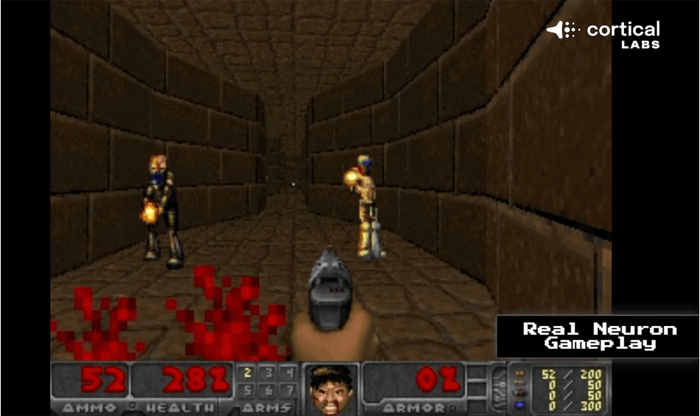
The media loved it, with splashy headlines like, “Human brain cells on a chip learned to play Doom in a week.”
Source: Cortical Labs
According to the announcement, not only did the “human brains on a chip” learn to play the computer game Doom in a week…
It did so… consuming significantly less energy than today’s computer chips.
There is some truth to what was announced.
But there is a whole lot of context that was left out.
Devil in the Details
Cortical Labs has been developing a biological computing system based on human brain cells.
Specifically, it develops human neurons that have been derived from human induced pluripotent stem cells.
Yes, this could certainly raise some ethical concerns, specifically if the neurons were sentient. But there is certainly no evidence that they are.
Putting that aside, Cortical Labs developed its CL1 biological computer, which has – at its core – a biological semiconductor that contains about 200,000 neurons.
The CL1 system shown below is designed to power the biological semiconductor and keep the neurons alive for up to six months.
We can think of the unit as a life support system for the neurons.
For comparison, however, a human brain has about 86 billion neurons, so the CL1 has about 0.0002% of the horsepower of our human brain.
Cortical Labs developed an interface for its biological computing platform that enables a developer to use the software programming language Python to utilize the CL1 system.
And collaborating with another software developer, Cortical’s biological computer was used to play the computer game Doom, which was a huge game back in 1993, a game that I well remember playing myself.
Again, the media misinterpreted the development as human brain cells learned how to play a computer game, but the details matter.
Cortical Labs figured out a way to map the video feed of the game into patterns of electrical stimulation, which they could feed to the human neurons.
When the neurons were exposed to the electrical stimulation, they would spike in response and then respond with some kind of electrical signal.
There was no way for the CL1 and the neurons to “see” the gameplay at all.
It was just an electrical response to an electrical stimulus.
After a week of training, the human neurons were capable of some level of learning.
They could eventually seek out an enemy in the game, shoot, and navigate the mazes in the game.
But, by the company’s own admission, after the training, the biological computer “plays like a beginner,” showing only a slight improvement over completely random play.
To be very clear: It had no understanding of the game, no ability to plan ahead or be strategic with the game, and no path towards gaining the ability to play anywhere near a human level.
It was nothing more than a feedback loop demonstration – just an interesting research project.
And yet, Bloomberg interpreted the development as “an experiment that could one day challenge chips from companies like NVIDIA.”
You’ve got to be kidding me.


Recommended Links
Red Alert Warning from Jeff Brown
Jeff believes Nvidia is about to trigger a major crash on March 16. In fact, he says it’s a “sure thing.” During a special event tomorrow, Thursday, March 12, at 2 p.m. ET, in you’ll discover:
- Why this upcoming crash is a feature of the AI boom, not a bug
- Why the recent volatility is just the beginning
- The name and ticker of a wildly popular AI stock that could crash
- The name of a pick that could see huge gains
- And more…
Click here to register with a single click >>>
(When you click the link, your email address will automatically be added to Jeff’s guest list.)
Up to 10x Returns From the AI Energy Boom?
If you 10x’d the oil market during the last energy boom, you could’ve turned $1,000 into $47,000. Now artificial intelligence is driving a new boom in American energy that could be worth $7 trillion. A former money manager for Saudi Arabia’s sovereign wealth fund is stepping forward with the best way to play this incredible energy boom. This has nothing to do with buying a stock, a crypto, or overhyped (and underwhelming) royalty deals. It’s an overlooked strategy with incredible upside potential and the unique ability to insulate you from the boom/bust cycle. Click here now to learn more.
An Interesting Experiment… and Just That
No, that’s not going to happen.
It is an interesting scientific experiment, probably better suited for an academic institution rather than a company in the private sector.
As we’ve been tracking closely in The Bleeding Edge for a decade, the cost-per-unit of compute using advanced semiconductor technology has been declining exponentially.
And that pace has been accelerating in the last few years.
Far more important to both industry and governments is how to scale computational performance at an accelerated pace.
There is no priority whatsoever to reduce overall power consumption.
Everyone knows that to achieve productivity gains and economic growth, computational resources must increase, and with that, so must energy production.
The well-proven adage that there are no high-income low-energy countries rings true.
All rich countries have an abundance of energy.
Scaling the Cortical Labs system is not economical, nor is it operationally efficient.
Growing, maintaining, and replacing (every six months or less) a data center of billions of neurons is arguably impossible.
And employing an electrical feedback loop system like this for meaningful computational tasks is completely unproven.
We should also keep in mind that the game Doom was so simple that it ran on a computer system with just 4 MB of RAM and a 386 processor, which is less powerful than some calculators available today.
Given these stark realities, what was the point of this announcement then?
And why all the fuss?
Follow the Money
Back in 2021, Cortical Labs did something similar with an earlier version of its biological computer.
It “trained” its system to play an even simpler game – Pong – as a proof of concept.
It used that development to eventually raise about $10 million in early 2023 to continue its research.
My guess is that Cortical Labs is getting very low on funds.
The timing of the announcement and media coverage is an obvious marketing tactic used to try to raise its next round of private funding.
While it may find some takers, an investment like this makes no sense at all.
For brain-inspired computing, a far more interesting and viable approach comes in the form of neuromorphic computing – designed to mimic the human brain and its neurons without having the difficulties associated with having to manage and care for living brain cells.
The other exciting alternative is semiconductor companies that are using analog semiconductor designs for AI inference that have dramatically lower energy use, like Unconventional AI, Mythic, and EnCharge AI.
These approaches are where the investment dollars will flow… because they can scale at the speed of semiconductor technology.
Jeff
Recent Articles
The Truth About the “AI Fear Trade”
Mar 10, 2026 • 6 min read

The Iran Oil Shock: Why Market Fear May Be Setting Up the Next Rally
Mar 9, 2026 • 7 min read

Mar 6, 2026 • 8 min read


1125 N Charles St, Baltimore, MD 21201
www.brownstoneresearch.com
To ensure our emails continue reaching your inbox, please add our email address to your address book.
This editorial email containing advertisements was sent to pahovis@aol.com because you subscribed to this service. To stop receiving these emails, click here.
Brownstone Research welcomes your feedback and questions. But please note: The law prohibits us from giving personalized advice.
To contact Customer Service, call toll free Domestic/International: 1-888-512-0726, Mon-Fri, 9am-7pm ET, or email us here.
© 2026 Brownstone Research. All rights reserved. Any reproduction, copying, or redistribution of our content, in whole or in part, is prohibited without written permission from Brownstone Research.
World Baseball Classic Pool B hangs in the balance

Wednesday, March 11

After shocking juggernaut Team USA yesterday, undefeated Italy still has work to do against Mexico in a tense matchup that will ultimately decide which two Pool B teams advance to the quarterfinals.



© 2026 MLB Advanced Media, L.P. MLB trademarks and copyrights are used with permission of Major League Baseball. Visit MLB.com. Any other marks used herein are trademarks of their respective owners.
Please review our Privacy Policy.
You (peterhovis@icloud.com) received this message because you registered to receive commercial email messages from World Baseball Classic.
Please add info@marketing.mlbemail.com to your address book to ensure our messages reach your inbox. If you no longer wish to receive commercial email messages from World Baseball Classic, please unsubscribe or log in and manage your email subscriptions.
Postal Address: World Baseball Classic, c/o MLB Advanced Media, L.P., 1271 Avenue of the Americas, New York, NY 10020.
Prepare to be Amazed: The Magic of Pilobolus at TCA
Trouble viewing email? Click here
You are subscribed to this newsletter as: peterhovis@icloud.com


BUY TICKETSLEARN MOREMORE PROMOTIONSInternationally acclaimed for its breathtaking physicality and inventive storytelling, Pilobolus transforms the human body into living sculpture. Blending dance, theater, and visual art, their avant-garde work has thrilled audiences from Broadway to the Olympics. For Tempe Center for the Arts, Pilobolus offers a signature experience: bold, imaginative, and unforgettable, aligning TCA with the world’s most innovative stages.
Don’t miss Pilobolus – one night only!
Saturday, March 28
7:30 PM
Tempe Center for the Arts

To ensure you receive our emails, please add inbox@phoenixnewtimes-insider.com to your address book.
You are receiving this advertisement newsletter because you have signed up on our website or at an event, participated in a promotion, or purchased a ticket to an event. Thank you for your patronage.
© 2026 Phoenix New Times, LLC. All rights reserved.
1201 E. Jefferson
Phoenix, AZ 85034
End Citizens United — Donate via ActBlue
End Citizens United — Donate via ActBlue
— Read on secure.actblue.com/donate/loc_ecu_email_footer-posteday_evergreen
The Prewar CPI Printed | Tankers Took Fire | Oil Regimes Still Split | The Strait Still Sets the Terms
February CPI arrived clean, but attacks near Hormuz and a record IEA reserve release kept energy risk alive. Markets absorbed the print. The strait remains the variable.
— Read on foretellmarkets.com/p/the-prewar-cpi-printed-tankers-took-fire-oil-regimes-still-split-the-strait-still-sets-the-terms
Why 95,000 Put Options Hit Financials Yesterday

Don here…
Somebody bought 95,000 put options on XLF yesterday. That is not a hedge.
Brandon Chapman flagged it in today’s session before walking through a market where every setup requires more patience than most traders can handle.
Institutions are sitting on their hands. Selling pressure evaporates before it can build momentum.
The Iran headlines couldn’t produce sustained downside. If you’re heavy right now, this tape will grind you down.
Brandon is running an encore of his Squeeze Traps webinar tomorrow at 2PM EST. He showed today how 12,000 call contracts created temporary support through gamma pressure.
The webinar teaches you how to spot those setups forming and avoid getting caught on the wrong side. Add it to your calendar.
In today’s free session replay, you’ll discover:
- How Ghost Prints reveals who is buying and who is selling in real time. Brandon broke down 12,000 Nike call contracts by matching fill prices to the bid-ask spread at the exact moment of execution. 9,500 were buys. 3,000 were sells. That distinction tells you whether institutional flow is creating upward pressure or just noise.
- The dead zone trading method that identifies exact entry and exit levels. Built from over 200 technical methods and a million data points, the algorithm calculates where each stock stops moving and where momentum resumes. Brandon showed it live on SPY, IWM, Tesla, Microsoft, Meta, and Apple.
- Why being lighter in this market is the only way to survive.Brandon has been taking 30-40% gains instead of holding for 70%. Liquidity is poor. Fills slip constantly. His advice is to treat every trade like a jab. Risk small, exit early, and live to trade another day.
- How call option buying creates temporary support at specific strike prices. When thousands of contracts get bought at one strike, dealers hedge by buying stock. That creates buoyancy at that price level. Brandon showed how Nike’s 56 strike became a magnet after the morning’s order flow. When that open interest expires, the support vanishes.
Brandon closed with a framework anyone can use. Spend 30 minutes a day scanning alerts, set up two to three trades, and decide if any are worth taking.
Most days, the best trade is the one you don’t force.
To your success,
Don Kaufman
Chief Market Strategist, TheoTRADE
Helping You Become a Better Trader…it’s What We Do. Experience TheoTrade® Today!
Whether you are a beginning, intermediate, or active trader, you will find a treasure chest of valuable trading education resources, both free and paid, that will help take your trading to the next level. We are committed to helping you become the best trader you can be.
Disclaimer: Neither TheoTrade.com or any of its officers, directors, employees, other personnel, representatives, agents or independent contractors is, in such capacities, a licensed financial adviser, registered investment adviser, registered broker-dealer or FINRA |SIPC |NFA-member firm. TheoTrade does not provide investment or financial advice or make investment recommendations. TheoTrade is not in the business of transacting trades, nor does TheoTrade agree to direct your brokerage accounts or give trading advice tailored to your particular situation. Nothing contained in our content constitutes a solicitation, recommendation, promotion, or endorsement of any particular security, other investment product, transaction or investment.Trading Futures, Options on Futures, and retail off-exchange foreign currency transactions involves substantial risk of loss and is not suitable for all investors. You should carefully consider whether trading is suitable for you in light of your circumstances, knowledge, and financial resources. You may lose all or more of your initial investment. Opinions, market data, and recommendations are subject to change at any time. Past Performance is not necessarily indicative of future results.
TheoTrade
PO Box 24790 Christiansted, Virgin Islands 00824
1 (800) 256-8876
Want to change how you receive these emails?
You can Update your preferences
 RJ Hamster