You have reinvented yourself more times than you realize — each time a little wiser, a little more you. Whatever you’re facing now is not too much for the person you’ve become. You’ve already proven that.REMEMBER WHO YOU’VE BECOME
You’re always one blessing away from a brighter day… and a bigger life. May these stories, affirmations, prayers, and insights lift your spirits and inspire you to lift others.
We have so much to look forward to, Jeff Brown Founder & CEO, Brownstone Research
Scientists found a way to make the brain clean itself of Alzheimer’s plaques. It was already inside you.
Researchers at Baylor College of Medicine discovered that star-shaped brain cells — already present in every human brain — can be activated to clear the toxic buildup that causes Alzheimer’s. They just needed the right signal.
6.9M
Americans currently living with Alzheimer’s — projected to double by 2050
Sox9
the protein that, when boosted, activates astrocytes to clear amyloid plaques
+20%
longer exercise sessions when listening to self-selected music vs. silence
■ THIS WEEK IN BRAIN SCIENCE
The brain has its own cleanup crew. Researchers just found the switch that turns it on.
Astrocytes are star-shaped support cells found throughout the brain. For years, they were considered passive scaffolding. New research from Baylor College of Medicine shows they’re anything but. When a protein called Sox9 is boosted in astrocytes, they activate and physically consume amyloid plaques — the toxic protein deposits that accumulate in Alzheimer’s disease and destroy neural function.
In mice that already showed memory problems from Alzheimer’s-like plaque buildup, boosting Sox9 reduced plaque accumulation and preserved cognitive function over time. The researchers called it a built-in process that the brain has — it just needs to be activated. This doesn’t translate to a human treatment yet. But it shifts the direction of Alzheimer’s research significantly: from trying to block plaque formation to recruiting the brain’s own cells to clear what’s already there.
In a separate study this week, researchers confirmed that listening to your own chosen workout music makes you exercise nearly 20% longer than working out in silence. The effect isn’t about distraction — it’s about perceived effort. Familiar, self-selected music reduces the brain’s interpretation of physical strain, allowing the body to sustain output longer before the discomfort signal overrides motivation.
“The brain doesn’t just accumulate damage passively. It has systems designed to clean itself. The question isn’t whether those systems exist — it’s what keeps them from working, and how to reactivate them.”
— Baylor College of Medicine research team, Nature Neuroscience 2026
■ WHAT SUPPORTS BRAIN HEALTH RIGHT NOW — BASED ON CURRENT EVIDENCE01 Walk 20 minutes daily — physical activity is the most consistent brain-protective behavior in research02 Sleep 7–8 hours — the glymphatic system clears brain waste almost exclusively during deep sleep03 Add your favorite playlist to workouts — 20% longer sessions with zero extra effort04 Eat eggs daily — choline supports acetylcholine production, the neurotransmitter memory runs on
■ WHAT AMERICA IS TALKING ABOUT
ECONOMY · INFLATION
CPI hit 3.8% in April — the highest since 2023
Gas prices drove the jump, with Iran’s conflict keeping energy costs elevated. Housing and groceries also rose. The Fed held rates at its May meeting — with inflation this high, cuts are now unlikely before late 2026 at the earliest. Mortgage rates hold at 6.8%. High-yield savings accounts at 4.5% are one of the few places where your cash is keeping pace.
RUSSIA · SECURITY
Russia test-fired its most powerful missile since the nuclear treaty expired
Putin announced a successful test launch of the RS-28 Sarmat missile — described as the world’s most powerful — months after the last remaining U.S.-Russia nuclear treaty expired. The test drew international concern. Defense analysts noted the timing: with the U.S. focused on Iran, Russia chose this week to send a strategic signal.
AI · LEGAL
ChatGPT gave drug advice that led to a teen’s death. His family is now in court.
A California family filed suit against OpenAI after their 19-year-old son died following ChatGPT’s advice that combining kratom and Xanax was safe. The case is the most consequential AI liability lawsuit yet. It raises a question that courts will now have to answer: when does an AI model become responsible for the guidance it provides?
May 13, 2026 — Power Metallic Partners with Ideon Technologies to Unlock Deep Discovery Potential at Nisk Lion Zone using Muon Tomography Read more.
Disseminated on behalf of Trident Resources
May 12, 2026 — Trident Resources Commences Regional Structural Analysis of its La Ronge Gold Belt Properties in Saskatchewan with SRK Consulting Read more.
Get real-time market analysis and stock discussions with Investing in Bizarro World. Premium members get LIVE access. Listen for two months. If you’re not satisfied, get a full refund. What do you have to lose? Subscribe now!
Disseminated on behalf of Kingsmen Resources
May 12, 2026 — Kingsmen Completes 60 km² Precision Satellite Topographic Surveys at Las Coloradas and Almoloya, Advancing Drill Targeting Across the High-Grade Parral Silver-Gold District, Chihuahua, Mexico Read more.
Disseminated on behalf of Headwater Gold
May 12, 2026 — Headwater Gold Plans Drill Program with OceanaGold at Jake Creek Project, Nevada Read more.All Press ReleasesStay updated by saving our new email address Here’s how to update your contacts to ensure you continue receiving our emails from editor@resourcestockdigest.com:
AMERICAN STOCK ADVISORSYour Daily Edge on Wall StreetTake a look at this image. You’re looking at a 114-acre site on the Tennessee-Mississippi state line…
What’s being built here could be the most ambitious project of Elon Musk’s career.
One of the only media outlets allowed inside the closely guarded facility called what they saw “absolutely amazing.”
Nvidia’s CEO called it “Superhuman”
And White House AI Czar David Sacks says “Elon is scaling this faster than anyone.”
Meanwhile, competitors are so desperate to figure out what’s going on… they’ve resorted to flying spy planes over the complex.
This is bigger than Tesla and SpaceX…
So big that a Nobel Prize winning scientist says it “could have an even greater impact on society than the internet and mobile technology.”
And I believe it’s about to trigger a 70X investment boom.
I’ve pinpointed three stocks at the center of it all.
Louis Navellier Senior Investment Analyst, InvestorPlace
This ad is sent on behalf of InvestorPlace Media at 1125 N. Charles Street, Baltimore, Maryland 21201. If you’re not interested in this opportunity, please click here.Disclaimer: This material is for informational purposes only and should not be construed as financial advice.We are often approached by other businesses with special offers for our readers. While many don’t make the cut, the message above is one we believe deserves your consideration.
American Stock Advisors [ASA] sending this newsletter on behalf of Prestige Publishing LLC 200 Continental Dr Suite 401, Newark, DE 19713, USA
WHAT THE SMART MONEY IS DOINGWEDNESDAY, MAY 13, 2026by Nate Fowler
Inflation is back. April CPI came in at 3.8% annually — above the 3.7% forecast, the highest since May 2023 — and core inflation accelerated to 2.8%, also above estimates. The S&P 500 fell 0.5% Tuesday; the Nasdaq lost 0.8%. Oil surged 3% above $101 as Trump called the ceasefire “on life support.” The U.S. government released 53.3 million barrels from the Strategic Petroleum Reserve — and prices still rose. Real wages fell 0.5% in April. CME FedWatch now shows zero rate cuts priced in for 2026. The war is in the inflation data. Today: PPI arrives, Cisco reports after the close, and the market asks whether the Fed’s next move is a cut or a hike.
Guess which tech stock is about to crash next?
No one believed Whitney Tilson when he predicted the collapse of Bear Stearns and Lehman Brothers. Or when he went on 60 Minutes exposing a company of poisoning its own customers. (The stock fell nearly 80%.) Now he has a new warning about what’s REALLY around the corner for America’s most beloved tech companies.
U.S. releases 53.3 million barrels from Strategic Petroleum Reserve 53.3M bbl
The Strategic Petroleum Reserve (SPR) is the U.S. government’s emergency oil stockpile. On Tuesday, the government released 53.3 million barrels as part of a 172-million-barrel IEA-coordinated release. WTI crude still rose 3%. When the largest coordinated release since 2022 cannot prevent prices from rising, the shortage is larger than the policy response.
Saudi Aramco CEO Amin Nasser: 100 million barrels lost per day 100M bbl/day
Saudi Aramco is the world’s largest oil company. CEO Amin Nasser said Monday the world is losing 100 million barrels of oil supply each day the war continues — roughly the entire daily global consumption. That frames Hormuz not as a disruption but an existential supply problem.
Plug Power rises 11% after reporting progress toward profitability +11%
Plug Power (PLUG) develops hydrogen fuel cell systems for industrial equipment and vehicles. Shares rose 11% Tuesday after reporting strong revenue growth and progress toward its goal of profitability by Q4 2026. With oil above $100 and gas at $4.50 nationally, the economics of hydrogen as a fuel alternative are improving with every barrel that doesn’t come through Hormuz.
Lumentum added to Nasdaq index — optics plays rise on AI data center demand LITE +5%
Lumentum Holdings (LITE) makes the optical components and lasers that connect servers inside AI data centers. Shares rose 5% Monday after Nasdaq announced it would add the company to its index. The AI supply chain keeps expanding beyond chips into the physical infrastructure that moves data at the speed of light.
Atlanta Fed GDPNow tracks Q2 growth at 3.7% 3.7% GDP
The Atlanta Fed’s GDPNow model — a real-time tracker of incoming economic data — is pointing toward 3.7% growth in Q2 2026. That is a strong number. The economy is growing and inflation is rising at the same time. That combination — growth plus rising prices — gives the Fed no clear path to cut rates and no reason to hike aggressively. It is the hardest position for a central bank.
↓
Who Sold
Exits and reductions this week
CPI 3.8% — hottest since May 2023, above estimates 3.8% YoY
The Consumer Price Index rose 0.6% in April and 3.8% year-over-year — the highest annual reading since May 2023 and 0.1 percentage point above consensus. Core CPI, which strips out food and energy, rose 0.4% monthly and 2.8% annually, both above estimates. Energy surged 17.9% YoY (gasoline +28.4%). Shelter rose 0.6% monthly. Airline fares rose 20.7% YoY. The war is in the core numbers now.
Real wages fall 0.5% — workers are losing purchasing power −0.5%
Real average hourly earnings — wages adjusted for inflation — fell 0.5% in April and are down 0.3% annually. Nominal wages rose 3.6% but prices rose 3.8%, meaning workers’ paychecks buy less than they did a year ago. When real wages turn negative, consumer spending power erodes regardless of what the stock market does.
CME FedWatch: zero rate cuts priced in for 2026 0 Cuts
The CME FedWatch tool — which tracks futures markets to estimate the probability of Fed rate moves — now shows zero rate cuts for the rest of 2026. Earlier this year, at least one quarter-point cut was priced in. Chris Zaccarelli, CIO at Northlight Asset Management, said it is now “possible that we may start pricing in rate hikes for next year.”
Nasdaq falls 0.8% as tech selloff follows hot CPI print −0.8%
The Nasdaq fell 0.8% Tuesday — its worst session in a week — led lower by growth stocks sensitive to interest rate expectations. The S&P 500 lost 0.5% and the Dow fell 198 points. Tech stocks priced on future cash flows are worth less when rates stay higher for longer. That repricing landed Tuesday morning.
Trump told reporters Monday that Iran’s response was “garbage” and the ceasefire was “on life support.” WTI crude rose above $101 Tuesday; Brent above $108. National average gas hit $4.50 per gallon. Every day the Strait of Hormuz stays closed adds supply pressure that no SPR release can offset.
⟳
Where the Money Moved
Sector performance — Tuesday, May 12, 2026 (last trading day)
Energy
+1.4%
Utilities
+0.4%
Cons. Staples
−0.2%
Financials
−0.4%
Industrials
−0.6%
Technology
−0.8%
Cons. Disc.
−1.0%Money flowing inMoney flowing out
Tuesday’s rotation after the CPI: energy was the only sector meaningfully green. Technology — which had led the market for six straight weeks — fell 0.8%. Consumer discretionary was the worst at −1.0%. When the inflation print is hot enough to flip the rate-cut narrative, the sectors that need low rates get hit first.
NATE’S TAKE
The CPI print confirmed what the market had been trading around: the war is now in the inflation data. Headline at 3.8% is one thing — energy prices will do that. But core CPI at 2.8%, above the 2.7% estimate, is different. Core strips out food and energy. When core accelerates, it means oil costs are filtering into shelter, airline fares, apparel, and services. That is not a temporary supply shock anymore. It is price-level contagion. The market’s reaction tells you exactly how it processed that distinction: the Nasdaq fell 0.8%, energy was the only sector meaningfully green, and CME FedWatch erased all remaining rate cuts for 2026. Northlight’s Chris Zaccarelli said the market may start pricing in hikes for 2027. Real wages fell 0.5% in April. Workers are losing purchasing power. The economy is growing at 3.7% according to the Atlanta Fed. Growth plus inflation plus no rate relief — that is the environment the incoming Fed chair inherits on Thursday.
◆
Who’s Hedging
What’s being priced into the market today
PPI data arrives this morning — wholesale inflation’s turn PPI Today
The Producer Price Index measures wholesale inflation before it reaches consumers. If PPI confirms the CPI story — rising input costs across the economy — it means the inflation pipeline has more pressure behind it. If PPI is milder, it suggests consumer prices are being driven by demand rather than costs, which is a different kind of inflation.
Cisco, Tencent, and Alibaba all report today Wed Earnings
Cisco Systems (CSCO) makes the networking and AI infrastructure hardware that connects data centers. It reports fiscal Q3 after today’s close, with consensus at $15.5 billion in revenue and EPS of $1.04. Cisco is up 28% this year on hyperscaler demand. Tencent and Alibaba — China’s two largest tech companies — also report today.
Gas at $4.50 nationally — up 50% since the war began $4.50/gal
National average gas reached $4.50 per gallon Tuesday (AAA) — up 50% since the war began. CPI confirmed gasoline is up 28.4% year-over-year. Hormuz stays closed, supply stays tight, and the SPR release cannot close the gap.
Memory chip ETF gained 30% in a single week — Applied Materials reports Thursday DRAM +30%
The Roundhill Memory ETF (DRAM) — which tracks companies making the memory chips used in AI servers — rose nearly 30% last week. Applied Materials (AMAT), which makes the equipment used to manufacture those chips, reports Thursday. The AI hardware supply chain is still accelerating while the rest of the market absorbs the inflation data.
Retail sales data Thursday — the consumer spending test Thu Data
April retail sales arrive Thursday. Real wages are down 0.5%, gas is at $4.50, and consumer sentiment is at all-time lows. If retail sales hold, the economy is resilient. If they fall, the squeeze has reached the register.
THE TAKEAWAY
The war is in the inflation data. CPI at 3.8%, highest since May 2023. Core at 2.8%, above estimates. Real wages fell 0.5%. Zero rate cuts priced for 2026. The U.S. released 53 million barrels from the SPR and oil still rose 3%. Gas is at $4.50. Saudi Aramco’s CEO said the world is losing 100 million barrels of daily supply. The Nasdaq fell 0.8%. PPI arrives this morning. Cisco, Tencent, and Alibaba report today. Applied Materials tomorrow. The memory chip ETF gained 30% last week. The market came into this week at records. It leaves Tuesday knowing the inflation the war created is not temporary — and the Fed has no easy answer.
The Sub-$1 Pre-IPO AI Stock Flying Under the Radar
Round closes May 14th, 2026 at 11:59 p.m. PT
Wall Street is quietly buzzing about a company some call “the operating system for the future of work.”
It’s already partnered with Meta, Samsung, Microsoft, and Qualcomm, yet few retail investors even know it exists.
Immersed built the No. 1 productivity app in the Meta Quest Store. 1.5M+ professionals use it as their primary workspace, some for up to 60 hours a week. Their Visor headset delivers 2M more pixels than Apple’s Vision Pro at 1/3 the price, with 75,000+ people already on the waitlist.
The company has reserved its NASDAQ ticker: $IMRS. Valuation has grown 4,000% since founding.
CURRENT OFFER DETAILS$0.72 per share $999minimum investment Up to 20% bonus sharesCloses May 14, 2026
This is a paid advertisement for Immersed Regulation A+ offering. Please read the offering circular at invest.immersed.com
The valuation is set by the Company and there is currently no public market for the Company’s Common Stock. NASDAQ ticker “IMRS” has been reserved by Immersed and any potential listing is subject to future regulatory approval and market conditions. Investor references reflect factual individual or institutional participation and do not imply endorsement or sponsorship by the referenced companies. Forward-looking statements appear here based on current information. They involve known and unknown risks, uncertainties, and other factors that may cause outcomes to differ.
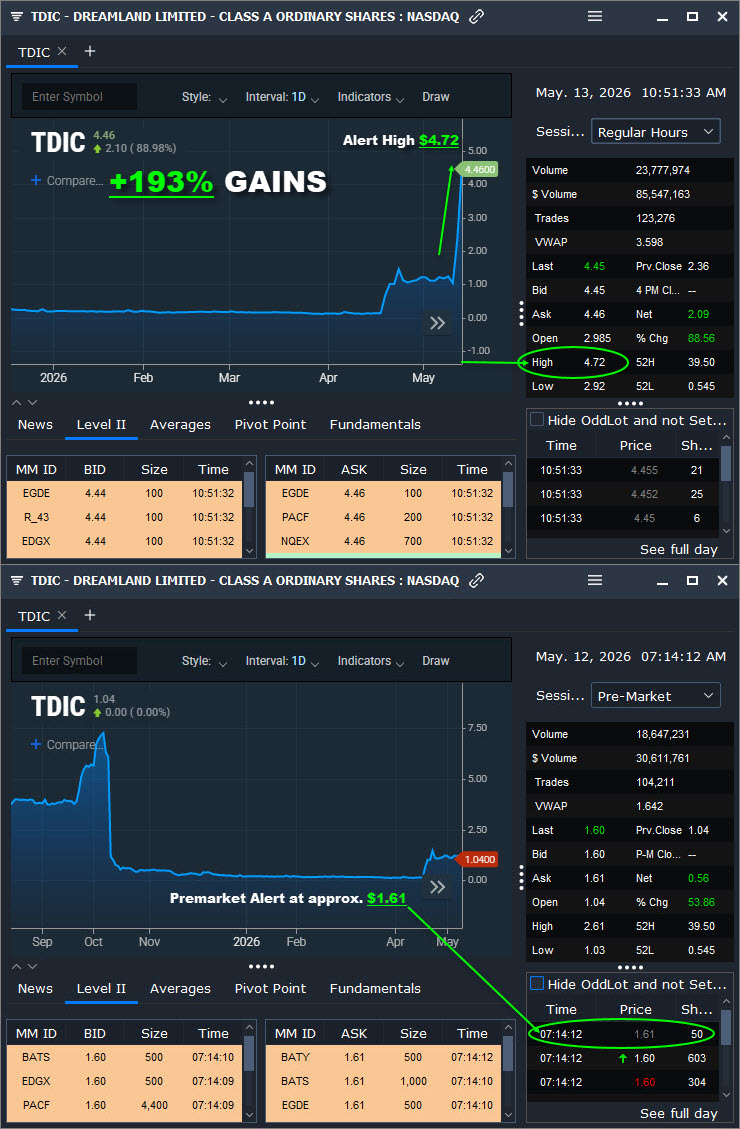
TDIC Rallies to a High of $4.72 Running Up 193% in Gains
10XProTrader Member,
This is Kevin Vander with “10XProTrader” Saying Congrats on TDIC and BZFD!
I first alerted TDIC on May 12, premarket at approx. $1.61, and it rocketed to a high of $4.72 today representing 193% gain from my alert.
Take a look at the Snapshot of Level II below.
If these types of gains I’ve just listed above interest you, which soared up +193%, I urge you to pay very close attention to my next breakout stock setup.
Get Your Alerts Faster than everyone else?
Serious traders know that every second counts in these markets. SMS Text Messages are 10X faster than email. Receive our FREE instant SMS Stock Alerts ahead by subscribing to our Mobile Alert System: Click Here!
Want an Extra Edge? Here’s how:
Get an edge on other traders by receiving our alerts and updates ahead of email by joining our Telegram or WhatsApp channels below.
Join our Telegram or WhatsApp channels for fast updates on trending companies before they land in your email inbox. Choose your platform and get plugged in:
@ 2026 10XProTrader.. All Rights Reserved. You are receiving this e-mail as part of your subscription to 10XProTrader. Nothing in this email should be considered personalized fina·ncial advice. 10XProTrader is neither a registered inve·stment adviser nor a broker/dealer. Readers are advised that this electronic publication is issued solely for information purposes only and should not be construed as an offer to s·ell or the solicitation of an offer to b·uy any sec·urity. 10XProTrader is a fina·ncial publisher that does not offer any personal fina·ncial advice or advocate the p·urchase or s·ale of any sec·urity or inve·stment for any specific individual. This communication is not a sponsored adv·ertisement.
@ 2026 10XProTrader, 340 Royal Poinciana Way Suite 317, Palm Beach, FL 33480, United States of America
Editor’s Note: Our colleague, the former $900 million hedge fund manager Larry Benedict, has discovered a way to make money from gold… WITHOUT buying a single ounce. Read on to learn more…
Dear Reader,
A former hedge fund manager has discovered a unique way to pull cash from the gold markets.
In a field full of success stories, Lam Research Corporation (NASDAQ: LRCX) has emerged as one of the clearest winners of the AI boom. As of May 7, the stock was up almost 300% over the last 12 months, more than 70% year to date, and over 30% in the past month alone.
That has been great news for investors who have ridden the move from the beginning, but the stock’s one-way run, especially in recent weeks, may be making some investors cautious right now.
Even so, Lam Research continues to attract fresh bullish attention. Strong earnings two weeks ago, growing excitement around AI infrastructure spending, and now new speculation tied to SpaceX’s ambitious semiconductor expansion plans have all added to the momentum. The result is a stock that has already soared into the proverbial stratosphere, yet analysts still argue the best may be yet to come. Let’s take a closer look at why.
Strong Earnings Confirmed the Bull Case
The biggest reason Lam Research continues to rally is that the company is no longer trading on hype alone. That may have been true a year ago, but investors are now seeing clear evidence that the underlying business is benefiting directly from the AI-driven surge in semiconductor demand.
Last month’s earnings report reinforced that view in a meaningful way. Revenue growth was strong, margins expanded, and management delivered exactly the kind of confident outlook investors were hoping for. More importantly, the company showed that demand for advanced semiconductor manufacturing equipment is continuing to accelerate as chipmakers race to expand AI-related production capacity.
This matters because Lam sits at the center of the semiconductor manufacturing ecosystem. The more aggressively companies invest in advanced chips, memory, and foundry capacity, the greater the demand for Lam’s equipment and technology.
Investors are increasingly recognizing that dynamic. As with many other companies MarketBeat has covered recently, Lam is no longer viewed as just another cyclical semiconductor stock. Instead, it is increasingly being treated as a direct infrastructure play on the AI boom itself. That distinction helps explain why the rally is continuing into May even after such enormous gains over the past 12 months.
The SpaceX News Adds Another Layer of Excitement
The other catalyst helping to fuel the latest leg of the rally came on Wednesday, May 6, in the form of reports surrounding SpaceX’s ambitious Terafab semiconductor project in Texas.
According to reports, SpaceX is planning a massive semiconductor manufacturing facility to produce its cutting-edge 2nm chips by the end of the decade, supporting its AI and robotics ambitions. Lam Research has reportedly emerged as one of the key equipment suppliers Elon Musk has contacted regarding the project.
Even though the details are still speculative, investors immediately saw the potential upside. And just as Intel Corp (NASDAQ: INTC) shares reacted earlier this week to news that Apple Inc (NASDAQ: AAPL) was considering them as a partner, Lam shares rose to fresh all-time highs.
This is exactly the kind of narrative that momentum investors love. It ties Lam Research directly to one of the hottest themes in the market while also linking the company to Elon Musk, AI, domestic manufacturing, robotics, and next-generation semiconductor infrastructure.
Whether the project ultimately reaches its full scale remains to be seen. Still, the fact that Lam is being associated with it at all further strengthens the perception that the company sits at the center of the AI infrastructure buildout.
The Rally Is Stretched, But the Trend Remains Strong
Investors should not ignore how extended the stock has become in the near term. A 300% rally over 12 months is extraordinary by any standard, and the latest leg higher has been especially aggressive.
Technically speaking, Lam Research is clearly overbought, and a period of profit-taking or consolidation would be completely normal after a move like this. Investors considering chasing the stock at current levels need to be realistic about that risk.
However, the broader setup still looks favorable. Importantly, analysts remain bullish despite the massive gains already seen. The likes of Deutsche Bank recently reiterated its Buy rating alongside a $325 price target, while Oppenheimer did the same, only with a $330 target.
For investors on the sidelines wondering whether it is worth chasing the stock at these levels, that matters, because it suggests Wall Street still sees meaningful upside ahead, even after one of the market’s strongest rallies. The stock may need time to cool off in the short term, but the bigger picture continues to point higher.
Lam Research appears well-positioned to benefit from a rare combination of strong execution, powerful industry tailwinds, and accelerating investor enthusiasm for AI infrastructure. And as long as companies keep racing to build the infrastructure powering the AI economy, Lam looks likely to remain one of the biggest winners.
Today’s Exclusive Content
CPI Card Group’s Quiet Cash Machine Faces a Digital Reality Check
Submitted by Peter Frank. Article Published: 5/4/2026.
Key Points
CPI Card Group benefits from steady demand for physical payment cards despite digital payment growth.
The Arroweye expansion boosted revenue but reduced net income due to acquisition and integration costs.
Strong cash flow supports the business, though leverage and tariffs remain ongoing risks.
Remember paying with plastic? In this age of mobile payments and online shopping, CPI Card Group (NASDAQ: PMTS) certainly does—and its business is delivering record results.
It may not be a flashy fintech, but CPI makes something that still belongs in your wallet: the physical debit and credit cards banks hand to customers every day. And believe it or not, that business was booming last year, as the company generated a record $543.5 million in revenue and $60 million in operating cash flow, up 37% from the year before.
How long this increasingly old-fashioned payment method can last is a question investors may be asking. For now, the business looks less exciting than dependable.
Record Revenue Highlights Durable Card Demand
In fact, CPI just posted the best revenue year in its history in 2025. This is a business that benefits every time a bank opens a new checking account, redesigns its card portfolio, or replaces a lost card. Someone has to make that piece of plastic, and CPI is one of the companies that does it.
Even as digital wallets dominate the headlines, underlying demand for physical cards has remained surprisingly durable. That’s good news for CPI. Last year, revenue at the company climbed 13% to $543.5 million, driven by an acquisition, contactless options, and instant issuance solutions. The company’s core debit and credit segment, in particular, grew 20% to $451.5 million.
The fourth quarter was especially strong. Revenue of $153.1 million represented a 22% year-over-year increase and marked a new quarterly record. Adjusted EBITDA for the quarter surged 34% to $29.4 million, a sign the company is becoming more efficient.
Acquisition Brings Expansion, But Pressures Earnings
A significant part of CPI’s growth story in 2025 was its $46 million, all-cash purchase of Arroweye Solutions, a specialist in on-demand digital card personalization. Arroweye helps banks and fintechs produce customized cards in smaller batches, faster than traditional manufacturing cycles allow. That’s especially valuable for the wave of challenger banks and small-business card programs that need a limited number of cards quickly.
The acquisition is already paying off. Within just eight months of ownership, Arroweye contributed $43 million in revenue to the debit and credit segment and added $6 million in adjusted EBITDA. Management has also suggested that additional integration synergies are still ahead as the company expands from a commodity card printer into a more diversified, software-enabled payments supplier.
While the acquisition contributed meaningfully to revenue, it did weigh on the bottom line. Full-year net income at CPI fell 23% from $19.5 million to $15 million. Both $6 million in acquisition and integration costs and a higher effective tax rate worked to drag down results.
Strong Cash Flow Offsets Rising Costs
Importantly, cash kept coming in. Operating cash flow reached $60 million, up 37% from 2024. That came in handy, as cash flow mostly offset the funding for Arroweye, the company said. For the year, free cash flow came in at $41 million, a 21% increase.
It’s worth noting, though, that the company’s net leverage ratio did rise slightly over the year to about 3.1 times adjusted EBITDA. For a company this size, that’s an important figure to watch. Unexpected drops in orders, further cost increases from tariffs, or additional strategic investments could make leverage more of a risk.
Market shifts also showed up in some of the numbers as CPI faced a few pressure points. The company’s prepaid debit segment came in at $93.6 million, a decline of 12% in 2025 after an unusually strong prior year. Serving the government benefits and reloadable card markets, the segment offers little clear sign of a meaningful near-term recovery.
Tariffs are another concern. CPI gets some card materials from overseas, and tariff costs reduced adjusted EBITDA by $4.4 million in 2025, the company said. The outlook for this year is no better, as it expects about $6 million in additional tariff-related expenses.
Despite those pressures, the company’s guidance points to steady, if unspectacular, growth for 2026. Revenue is expected to increase in the high single digits, adjusted EBITDA to rise in the low-to-mid single digits, and free cash flow to remain stable. Its net leverage ratio should fall back to between 2.5 and 3 times adjusted EBITDA, the company said.
Outlook Is For Steady But Modest Growth
At a company this size, analyst coverage remains unsurprisingly thin. Of the five analysts covering CPI, the overall rating is a Hold. Three analysts recommend a Buy, while one suggests Hold and one rates the stock a Sell. The average price target is $28.25, more than 60% higher than its current trading level.
Clearly, CPI is not a stock for everyone. It does not pay a dividend, so income investors will look elsewhere. The company carries leverage, operates in a niche of the financial sector that most of Wall Street ignores, and faces real questions about long-term demand.
But it just delivered record revenue and a 37% jump in operating cash flow, all while successfully integrating a strategic acquisition, and it has pledged to reduce leverage.
Assuming the world is not going fully digital anytime soon, card issuance remains a reality and a need. Physical cards for new accounts, cycle refreshes, and replacements for lost or stolen cards must come from somewhere.
This email communication is a sponsored message for Brownstone Research, a third-party advertiser of MarketBeat. Why did I receive this email?.
If you have questions or concerns about your newsletter, please feel free to email our U.S. based support team at contact@marketbeat.com.

















 RJ Hamster