They claim it’s about “modernization.” But let’s call it what it really is: full control over your money.
With the digital dollar, Washington bureaucrats could:
Monitor every single purchase you make
Dictate how much you’re allowed to spend
Block what you can (and cannot) buy
Even freeze your account with a single click
The bad news: this may be your last chance to protect your savings.
The good news: there’s still a way to legally opt out — but only if you act before the trap snaps shut.
That’s why we put together this urgent new guide: The Digital Dollar Trap.
Inside, you’ll discover exactly what this rule means for your financial freedom — and the simple moves you can take today to protect your cash and privacy.
Please don’t wait. Once the switch is flipped, your choices will vanish overnight.
RFK & President Trump Just Banned THESE 5 Toxic Food Ingredients (#3 is in Your Kitchen)RFK Jr. was just sworn in as Trump’s Health Secretary, and his first move?
Banning 5 super toxic food ingredients that have been quietly poisoning Americans for decades.
These chemicals are already banned in Europe—yet they’ve been hiding in your pantry this whole time.
Lose 30 pounds. Run a marathon. Meditate every day. Become your best self.
And we’re so focused on the distant finish lines — that we stop noticing everything in between.
A 2025 neuroscience study from UC Berkeley discovered something that reframes how we think about happiness and motivation: small daily pleasures activate the dopamine system more effectively and more sustainably than major achievements.
Why? A big goal delivers one large dopamine release — then silence. The brain adapts and immediately begins searching for the next target. This is the dopamine chase.
Small daily joys create a stable background level of satisfaction. And it’s precisely this that research links to longevity, immune resilience, and long-term mental health.
Five small pleasures with outsized neurochemical effects:
☕ First coffee in silence. Not with your phone. Not with the news. Just coffee and five minutes of owing nothing to anyone. Oxytocin + serotonin.
🌸 Fresh flowers at home. A Harvard study found that live flowers in a living space reduce anxiety and raise feelings of wellbeing measurably for three days after they appear.
📖 Ten minutes of a book that isn’t “useful.” Not self-development. Not business strategy. Just something you actually enjoy. A brain in the pleasure state of reading mirrors the same state as meditation.
🚶♀️ A route you’ve never walked before.Novelty activates the hippocampus and raises BDNF. Even one new street on the way home is a microdose of neuroplasticity.
🛁 A bath or a long shower without rushing. The rise in body temperature followed by cooling mimics your body’s natural sleep signal — and is one of the most effective natural anxiolytics available.
You don’t need to wait for vacation to feel alive. You’re already living. Start noticing.
Clean Health Journey sending this newsletter on behalf of Acceleration Marketing, LLC
You are receiving this email because you signed up for updates from Clean Health Journey.
Our goal is to share trustworthy and practical health and wellness information that supports your well-being. If you ever decide you’d prefer not to receive these updates, you can unsubscribe anytime using the link below.
Twelve months ago, I launched the Moonshot Minute portfolio with 700,000 people watching and a small group of paying members trusting me with real money. The rules were simple: find the right opportunities, size them properly, and when a position doubles, sell your original stake and let the rest ride on house money. This eliminates risk and preserves the upside.
This week, another position crossed 105% and triggered that rule. The 5th time in twelve months. Let me put that in perspective: a group of subscribers now holds five positions where their original capital has been returned in full, and they still own shares that cost them nothing. Those shares can run for years with zero risk to the original investment.
And we haven’t closed a single losing trade. Not one. Of course, I don’t expect that to always be the case, but for now, I can’t pretend it doesn’t feel good.
If you’ve been reading these essays on grid infrastructure, critical minerals, and the physical bottlenecks behind the energy transition, you already know the thesis. Every position in this portfolio traces back to the same conviction: the world is short the physical stuff that makes modern economies run. The essays tell you where to look. The portfolio tells you exactly what to buy.
Premium members, scroll down to the Premium section below for the full alert, updated guidance, and exactly what to do with this position.
And in case you missed it, the essay below is a real-time example of an important part of the overall thesis.
In January 2023, somebody walked up to a substation in Moore County, North Carolina, and fired a rifle into a 40-year-old power transformer.
Power died for 45,000 people in the dead of winter. Hospitals scrambled for generators. Elderly residents were evacuated from freezing homes. Schools went dark for days.
The FBI called it domestic terrorism. The transformer that was destroyed took over a year to replace.
I’m from a country where the lights going out wasn’t a metaphor. It was an almost daily anxiety. My family stretched every dollar, and even if we paid their power bill on time, we still sat in the dark.
I know what it feels like when the grid fails you.
The U.S. data center project pipeline hit 241 gigawatts by the end of 2025, up 159% in a single year, according to Wood Mackenzie.
Only a third of that pipeline is under active development. The rest is waiting on a grid held together by equipment older than most of the people reading this.
Four Weeks to Four Years
Everyone’s chasing AI stocks. NVIDIA. Microsoft. Meta. The market treats artificial intelligence like it runs on magic.
It runs on electricity. Massive, uninterrupted, baseload electricity. The kind that doesn’t flicker, doesn’t brown out, and doesn’t negotiate with your portfolio.
A single hyperscale data center draws 100 to 300 megawatts, enough to power a city of 80,000 people. We’re building hundreds of them.
The entire U.S. electrical grid’s peak capacity sits at roughly 1,200 gigawatts.
The 80 gigawatts of pipeline already under active development alone would represent nearly 7% of the nation’s total grid capacity, and we haven’t broken ground on most of it.
The grid can’t absorb it.
The average U.S. power transformer is over 40 years old. Lead times for new large power transformers now stretch to three to four years.
Five years ago, that wait was four to six weeks. Wood Mackenzie projects that most transformer categories will remain in shortage through at least 2030, with power transformers facing a 30% supply deficit in 2025 alone.
Factor in compounding demand from renewables, EVs, and data centers, and that timeline stretches further.
The IEA’s Electricity 2026 report projects global electricity demand will grow by an average of 3.6% per year from 2026 through 2030, roughly 50% faster than the average across the prior decade.
That forecast is built on data centers already under construction, EVs already on the road, and manufacturing already reshoring.
Physics doesn’t care about your stock picks.
259% Returns While Nobody Watched
Global grid capital expenditure topped $470 billion in 2025, a 16% increase over the prior year, according to BloombergNEF.
The U.S. alone accounted for $115 billion of that total, roughly a quarter of worldwide grid spending.
Governments and utilities are upgrading grids because the alternative is blackouts, economic paralysis, and national security failure.
One institutional research index I track closely, focused specifically on grid infrastructure companies, has generated a total return north of 259% since mid-2021, compared to roughly 65% for the S&P 500.
Year-to-date in 2026, it’s outperforming the S&P by over 24 percentage points.
Grid infrastructure stocks are crushing the S&P 500 by a margin that would make most hedge fund managers weep into their Bloomberg terminals. And almost nobody in the retail investing world is paying attention.
Why? Because transformers and substations don’t trend on Twitter. Nobody’s making TikToks about voltage regulators.
But every single AI query you run, every autonomous vehicle that charges, every Bitcoin that gets mined flows through this invisible backbone.
The steel, copper, and concrete that keep the lights on are the real AI trade.
The Grid as a Weapon of War
The U.S. Department of Defense has quietly flagged transformer shortages as a national security vulnerability.
The same grid that powers your home also powers military installations, communications networks, water treatment plants, and hospitals. A sustained grid failure is a civilization-level event.
Just this week, the President of the United States threatened to destroy every power plant and bridge in Iran, warning that it would cause an entire civilization to collapse.
The most powerful military on earth identified a nation’s electrical grid as the single most devastating target it could strike.
China controls significant portions of the supply chain for the critical minerals needed to manufacture transformers and grid components, including gallium, germanium, and heavy rare earths.
Beijing has already started restricting exports. Every restriction stretches the timeline for fixing our grid even further.
Richard Bookstaber, the Wall Street risk veteran who foreshadowed the 2008 financial crisis in A Demon of Our Own Design, wrote in The New York Times last month that today’s risk is no longer financial engineering.
He argues that our financial system has attached itself to the vulnerabilities of the physical world (power grids, water, land, supply chains) and created hazards that markets have no framework to analyze.
He’s right. Our models for detecting risk look at prices, volatility, and correlations. They have no instruments for reading a grid failure. By the time warning signs show up in market data, the damage is already done.
You can’t deploy a large language model to replace a 500-ton piece of equipment that takes four years to build.
The physical world has hard limits, and we’ve been ignoring them for decades while we financialized everything in sight.
40% More Capacity Without a Single New Wire
Grid-enhancing technologies (advanced power-flow control, dynamic line ratings) can increase capacity on existing transmission lines by 20% to 40% without building new ones.
Hitachi’s AI-powered voltage control systems are reducing hardware strain by 27%, extending transformer lifespans.
Smart grid digitization is becoming mandatory as utilities struggle to manage the dynamic load patterns created by data centers, EV charging, and distributed solar.
Companies that build, maintain, and digitize grid infrastructure are the picks and shovels of the AI revolution. The merchants who sold supplies during the Gold Rush made more reliable fortunes than the miners panning for flakes in the river.
The companies keeping the lights on are positioned to capture enormous value while everyone else fights over which chatbot wins.
In our Moonshot Minute portfolio, we’ve been building positions in this space because the thesis is simple… no grid, no AI.
Every technological revolution in history has been bottlenecked by infrastructure.
Railroads bottlenecked the Industrial Revolution. Highways bottlenecked the automobile age. Fiber optic cables bottlenecked the internet.
The AI revolution’s bottleneck is the electrical grid, and $470 billion a year is now flowing into fixing it, with that number climbing.
What You Should Do This Week
The actionable takeaway is straightforward:
Audit your portfolio for grid exposure.
If you own NVIDIA but don’t own a single company that builds, upgrades, or manages electrical infrastructure, your AI thesis has a hole in it the size of a 500-kilovolt transformer.
You’re betting on the destination without owning the road.
Look at the companies building smart meters, manufacturing transformers, upgrading transmission lines, and deploying grid-enhancing software.
Look at the utilities investing billions in infrastructure modernization. Look at the copper miners supplying the raw material that every foot of new wire requires.
The market is pricing AI software like the infrastructure is already built.
The companies building it are still trading at a fraction of the valuations being handed to software firms that can’t function without them.
What Premium Members Are Getting Right Now
You just read roughly 1,200 words of analysis that most financial newsletters would put behind a paywall. I gave it to you for free because I’d rather earn your trust than charge for your attention.
And in the Premium Section below, I name the specific companies positioned to capture the grid infrastructure buildout. I tell you when to buy, at what price, and when the thesis has played out, and it’s time to sell.
The portfolio speaks for itself.
Since launch, we’ve closed 9 trades with zero losses and an average gain of roughly 60% per position. Four positions have doubled, and on each one, I sold the original stake to lock in a full return of capital.
Those positions now ride on house money, compounding with zero risk to the original investment.
Across all 23 open positions, three out of every four are winners.
Two of those open positions are grid infrastructure plays tied directly to the thesis you just read. One is already up double digits.
The other is trading below our original entry because the market is fixated on a temporary earnings headwind from acquisitions that will be accretive within a year. The macro case has only gotten stronger since we bought it.
Premium Members get the full update below, including why the dip is an opportunity, not a warning.
That’s the difference between reading the thesis and acting on it.
I write two to three essays a week for Premium members, plus real-time alerts when it’s time to move. The next one is already drafted below.
The companies on the receiving end of that $470 billion are inevitabilities, not moonshots.
The question is whether you’ll position yourself before the rest of the market figures it out, or after, when the easy gains are gone, and everyone’s suddenly an expert on transformer lead times.
I know which side I’m on.
Double D
P.S. Here’s a screenshot of the current Moonshot Minute Portfolio. I’ve blurred out the tickers since that information is only for Premium Members, but you can see how we’ve done so far:
🔓 Premium Content Begins Here 🔒
In today’s Premium Section, an update on our grid buildout positions and how we’re playing multiple triple and double-digit winners, as well as updated guidance and a buy for a ticker we believe is set to outperform over the next 12 months.
I hope you’ve been paying attention because many of our picks are currently beating the S&P by up to 4-to-1 over the last 12 months.
Most financial newsletters charge $500, $1,000, even $5,000 per year. Why? Because they know they can.
I don’t.
I built my wealth the old-fashioned way, not by selling subscriptions.
That’s why I priced this at $25/month, or $250/year.
Not because it’s low quality, but because I don’t need to charge the typical prices other newsletters charge.
One good trade, idea, or concept could pay for your next decade of subscriptions.
The question isn’t ‘Why is this so cheap?’ The question is, ‘Why would I charge more?’
Amazing! Moonshot is hands down the best $150 decision I have ever made. Up 64% on TICKER REDACTED (so far). Can’t thank you enough for your service, advice, recommendations, insight, and every other positive accolade in the dictionary.
Very respectfully and gratefully,
CK
I’m up 71% in 6 weeks would you recommend adding to this bucket if capital allows?
MS
Hello Double D,
As it happened, I already owned some TICKER REDACTED shares when you recommended the stock. Upon your recommendation, I bought more. All told, I’m up over 70% in a month or two.
I greatly appreciate the detailed discussion you and your team provide for your recommendations.
Thank you.
A happy subscriber,
PK
I finally got some liquidity I could use and bought the stock as well as March 2026 calls yesterday morning (October 2nd) when it was at $17.80.
That is easily the best-timed investment/trade I’ve ever made, and I have your team’s perpetual hard work and research to thank for it.
Thanks again for all the hard work. You and your team push out a lot of solid research, and the effort doesn’t go unnoticed.
It is greatly appreciated,
MD
Closing at 24% gain, and enough profits to pay for 2yrs of your newsletter. Thank you for this! I especially appreciate you detailing the rationale behind your picks. As a newer investor it’s important for me to know why just as much as what.
MS
Up 68.87% on TICKER REDACTED to date, great recommendation!
BW
Thanks for the great tip on TICKER REDACTED! I bought, and just eight trading days later, it’s up 52% as of this very minute. I’m new to your newsletter, less than two months, but I have found it to be quite soundly researched and a truly invaluable source.
I’ve been actively investing for many years and have, at one time or another, subscribed to various investment advisors. None have been as useful (nor as affordable!) as the Moonshot Minute.
You, sir, do excellent work and we individual investors much appreciate it.
SD
Up 66%! Thanks.
SB
Kudos and thank you for the TICKER REDACTED recommendation. TICKER REDACTED has been awesome and I do understand/believe this to possibly be only the beginning. I bought 200 shares at $16 and another 100 at $18, the day before the surge started. Again, I am very grateful.
RH
I’ve only been with you a few weeks now, and overall, my portfolio is up 41%. Couldn’t have done it without you, DD. Thanks again.
HJP
I joined your plan about 2 months ago.
TICKER REDACTED was a real hit – and I did fully realize it yesterday for a rise – 141%. Great deal!!
IS
Just wanted to drop you a quick THANK YOU! Been a member for about a week (I wanted to see your picks for the electrical asymmetry) and I picked up some TICKER REDACTED & TICKER REDACTED. I’m already up $1,300.00 so my membership is covered for 5 years in about a week!
Keep up the great work! Again, THANKS! Glad to be a subscriber!
UnitedHealth Cash Flows Face Policy and Margin Stress
UnitedHealth still produces strong cash flow, but rising care costs and policy pressure are changing how secure that support looks for dividend investors.
Why This Matters Now
Dividend investors watch cash flow because it shows how much support stands behind income payments. That matters now for UnitedHealth because even a 1 percentage point margin move can meaningfully affect a business this large.
The company still has scale, recurring demand, and broad health care exposure. But strong cash flow alone no longer settles the dividend question when costs and regulations are both putting pressure on results.
In this article, we explore how UnitedHealth’s cash generation, margin pressure, and policy exposure affect dividend coverage, yield stability, and portfolio context.
Washington Is Running Out Of Money… And Guess Where They’ll Look Next?
When governments go broke, they take from the people.
It’s happened before, and it’s happening again.
The Department of Justicejust admitted that cash isn’t legally YOUR property.
That means Washington believes it has the power to freeze accounts, confiscate retirement savings, and drain wealth overnight.
Think this is just a theory?
Cyprus, 2013 – The government seized private savings overnight to fund a banking bailout.
Argentina, 2001 – Citizens woke up to frozen bank accounts and forced currency devaluation.
The U.S… TODAY? – The DOJ’s new claim just set the stage for the same fate.
But there’s a way out.
We’ve put together a FREE Wealth Defense Guide that shows you 3 powerful ways to keep your savings out of Washington’s reach.
No cost. No obligation. Just the information you need to fortify your financial future.
Because once they come for your wealth… there’s no undoing it.
Cash Flow Still Supports the Case
UnitedHealth’s main strength is its ability to generate large operating cash flow from recurring activity. Insurance premiums, pharmacy services, care delivery, and related fees all contribute to a wide and steady cash stream.
That matters because dividends are supported by real cash generation, not just accounting earnings. A company with recurring cash inflows usually has more room to support payouts through a weaker operating stretch.
Scale helps as well. UnitedHealth’s size spreads fixed costs and gives it more ways to absorb short-term pressure than a smaller insurer with fewer business lines.
Margin Pressure Carries More Weight
Margin shows how much profit remains after costs. In managed care and health services, margins are often thin, so even small cost changes can have a large effect on payout flexibility.
That is the key issue now. If medical costs rise faster than pricing or reimbursement, revenue can still look healthy while the room for dividends, buybacks, or debt reduction gets tighter.
This is why top-line growth can mislead. A company can keep growing sales while the quality of dividend coverage weakens underneath.
A simple sequence captures the tension:
Revenue stays firm because demand is recurring
Medical costs rise faster than expected
Margin pressure reduces flexibility around capital returns
That does not mean the dividend is immediately in danger. It means support for future dividend growth can weaken before the payout itself does.
Policy Risk Has Direct Financial Impact
Policy risk in health care is not just political noise. It can change reimbursement rates, utilization rules, compliance costs, and the economics of public programs.
For UnitedHealth, that matters because regulated business lines are a large part of the company mix. Changes tied to Medicare Advantage, oversight standards, or billing practices can affect margins even when enrollment remains steady.
That makes policy risk different from a normal business cycle. It can alter business economics rather than simply reduce demand for a quarter or two.
For dividend investors, the key point is clear: policy pressure can narrow the cushion around cash flow. The dividend may still appear covered, but the margin for error can shrink faster than the payout ratio suggests.
Optum Adds Support and Complexity
Optum gives UnitedHealth a broader earnings base than a pure insurer. Pharmacy services, care delivery, and data-driven operations all add support to total cash generation.
That diversification helps because weakness in one segment does not always hit the whole company at once. A broader platform can make total cash flow more stable than it would be in a single-line business.
But complexity matters too. Strength in one area can offset weakness in another, yet it can also make it harder to see where pressure is building first.
This table shows the central tension: UnitedHealth still has strong support, but each now comes with a visible offset.
Area
Support
Pressure
Insurance
Large premium base
Higher medical costs
Optum
Diversified cash sources
Regulatory complexity
Capital returns
Strong cash history
Less room if margins tighten
Risks and Limitations
No single article settles the full dividend case.
Cash flow can remain strong for a time even as future pressure builds
Policy outcomes are hard to judge before final rules are clear
Segment diversity can soften shocks but also hide early weakness
Balance sheet strength still matters alongside operating cash flow
Portfolio Translation
For dividend portfolios, UnitedHealth still looks better supported than many smaller health care names because of its scale and broad cash sources. At the same time, margin pressure now matters more than revenue growth in judging dividend quality. That leaves yield stability looking more supported than immediate payout stress, while dividend growth support looks less secure if policy and cost pressure persist.
Conclusion
UnitedHealth still offers the core feature dividend investors want to see: large recurring cash flow. The issue now is that policy pressure and thinner margins are changing how durable that support looks.
For income-focused portfolios, the main question is no longer cash flow alone. It is whether that cash flow can keep the same strength when cost pressure and policy risk move together.
If you want a better read on this week’s market — and a smarter way to trade it — watch the video now.
Good Trading,
Coach Brian NetPicks
P.S. Want a defined-risk way to trade Apple, Nvidia, Tesla, Amazon, Meta, Microsoft, and Alphabet options in just 1-4 days? Here’s How…
FOR EDUCATIONAL AND INFORMATION PURPOSES ONLY; NOT ADVICE. NetPicks Services are offered for educational and informational purposes only and should NOT be construed as a securities-related offer or solicitation or be relied upon as personalized financial advice. We are not financial advisors and cannot give personalized advice. There is a risk of loss in all trading, and you may lose some or all of your original investment. Results presented are not typical. Please review the full risk disclaimer: https://www.netpicks.com/risk-disclosure This email was sent to pahovis@aol.com by info@netpicks.com
16211 N Scottsdale Rd, Suite A6A #295, Scottsdale, AZ 85254
Delta Air Lines Gains Altitude: Higher Highs Are Coming
Robust Q1 results, improving margins and rising capital returns — backed by analyst upgrades and heavy institutional buying — set Delta up for fresh record highs. Oil prices and geopolitical flare-ups remain the main wildcards.
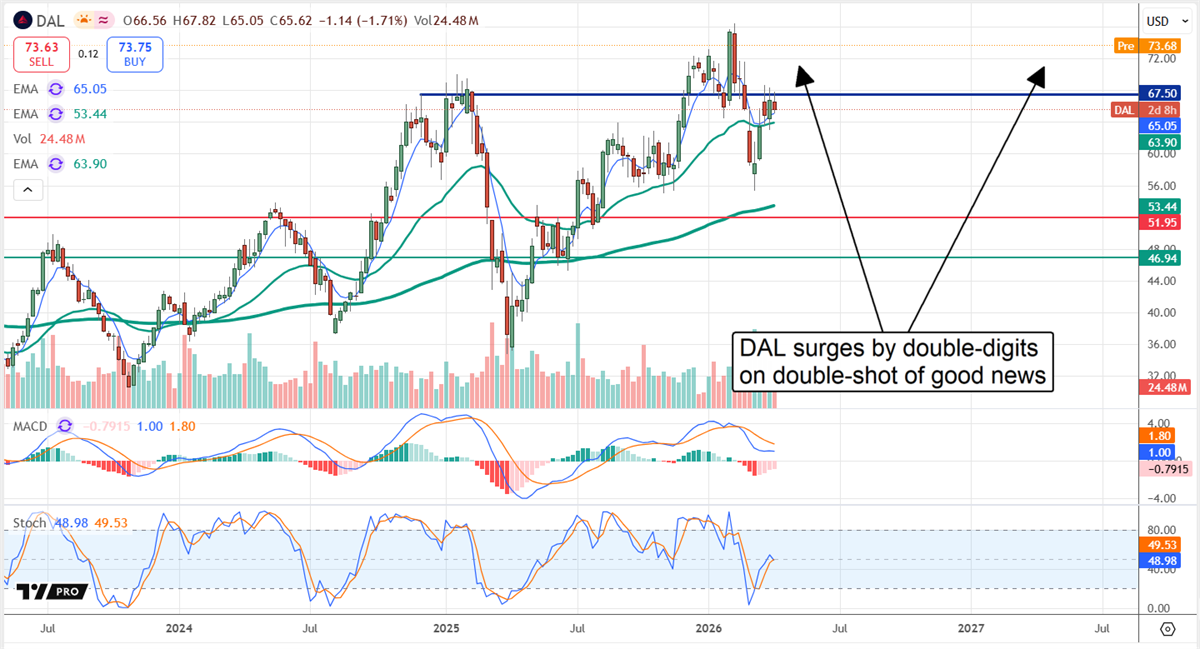
Delta Air Lines’ (NYSE: DAL) stock price surged on April 8 for two disparate reasons coincidentally occurring within a short 18-hour timespan. The first was Trump’s ceasefire deal with Iran. While sketchy, it promised at least a brief interlude in conflict, clearing the skies for travel stocks like Delta. Assuming the United States and Iran can move forward, the forecast is for record-setting results to continue and potentially gain momentum by year’s end. The second reason was the earnings results. The company’s fiscal Q1 2026 earnings release was better than expected, affirming the company’s leadership position and ability to return capital.
Cash flow and capital returns are critical elements in 2026. Higher-risk, cash-burning stocks have seen deeper corrections, while the more established blue-chip operators have outperformed.
Delta’s capital return is primarily a dividend, although buybacks are in the equation.
The dividend yields about 1% following the April stock price spike and is a reliable payment expected to increase over time. The company is producing record results, has an investment-quality balance sheet, and yet still pays less than half of its 2019 payment.
The likely outcome is that Delta continues to increase its distribution, sustaining a high-double-digit compound annual growth rate (CAGR) over the next few years.
Bill Spetrino, editor of The Dividend Machine, started with just an $8,000 IRA and invested it in a single dividend stock he calls the World’s Greatest Dividend Stock – and he’s sharing a free report that names it.
Spetrino has identified what he calls The Great American Turnaround, an economic shift driven by three catalysts he believes will reward dividend-focused investors who position early. His free bulletin outlines why waiting for markets to settle could mean paying more for the same yields.
Delta had a robust Q1 with revenue of $15.85 billion, up 12.9% to set a company record. The top line exceeded the consensus estimate by over $1 billion, or 690 basis points (bps), driven by strength across all reporting metrics. Passenger revenue grew by 7%, Cargo by 9%, and Other by 41%. Geographically, Domestic business improved by 6%, while International increased by 5%. Within the Passenger segment, growth was underpinned by higher-margin Premium and Loyalty-related business.
The better news was that nimble responses from management, including capacity reductions, helped to control costs and drive bottom-line strength. The net result is that adjusted EPS of 64 cents increased by 7 cents year over year, more than 1,200 bps better than expected, and the strengths are expected to continue in the upcoming quarters.
The only issue is fuel costs. Fuel costs are impacting the earnings outlook, but are offset by actions to recapture the margin. Guidance expects revenue growth to accelerate to the low teens in the current quarter and for earnings to be sufficient to sustain financial health, balance-sheet improvement, and capital returns. Trump’s ceasefire deal with Iran should allow oil prices to moderate, if not return to pre-war levels, and improve the earnings outlook.
Bullish Analysts Trends Underpin Delta’s Stock Price Outlook
Bullish analyst trends in place ahead of the release are unlikely to end now. The more likely scenario is that Q1 results and guidance trigger price target increases and upgrades, strengthening the Moderate Buy rating. As it stands, MarketBeat tracks 25 analysts rating Delta as a consensus Moderate Buy.
There is a 92% Buy-side bias in the rating, and the consensus target price forecasts fresh all-time highs relative to the highs set in February 2026. The critical detail is the new high, as this move breaks DAL stock out of a trading range, setting it up for a larger movement.
The high-end of the analysts’ range is $90 as of early April, approximately $14 above the February highs. However, the technical signal suggests a $20 move could be possible, relative to the breakout point, and as much as 35% in the bull case. These targets range from approximately $96 to $102.50 and could be reached before mid-year.
The post-release stock-price action was bullish. DAL stock surged in a high-conviction move, confirming support at an indicator convergence.
Support indicators include prior highs and a cluster of moving averages, which suggest short-, mid-, and long-term investment forces are aligned.
Other drivers for DAL stock include the institutions, which own about 70% of the stock and have been accumulating over the past year. The significant detail from that vector is that the $1.5-to-$1 buying balance posted for the trailing 12-month period accelerated to $3-to-$1 in Q1 2026, limiting downside and setting the stage for April’s robust rebound. The biggest risks for Delta are the war and oil prices; if they heat back up, expect the DAL stock price to be volatile.
The best investment opportunities don’t wait. Get our research and stock ideas delivered straight to your smartphone—so you never miss a market-moving opportunity. Our text alerts ensure you see timely stock ideas and professional research reports instantly, whether you’re in a meeting, commuting, or away from your desk.
Get Flat $10 Additional OFF Sports Magazine Subscriptions!
Limited Time Offer.
Subscribe to your favorite Sports magazines with up to 80% discounts + Free Shipping + No Tax! And that’s not the end, you will receive flat $10 Additional offonly at Magsstore.
Apply Coupon Code ‘COMBO10‘ at checkout to claim this additional discount.
Beckett Baseball is a monthly magazine loaded with everything you need to know about new baseball cards, Price guide and more. Beckett Basketball is a monthly magazine loaded with everything you need to know about new basketball cards, Price guide and more.
Beckett Football is a monthly magazine that features values on trading, Football cards, Price guide including new releases. Beckett Baseball is a monthly magazine loaded with everything you need to know about new baseball cards, Price guide and more.
Beckett Hockey is a monthly magazine that features values on trading, Hockey Cards, Price guide including new releases. Beckett Baseball is a monthly magazine loaded with everything you need to know about new baseball cards, Price guide and more..
Beckett Basketball is a monthly magazine loaded with everything you need to know about new basketball cards, Price guide and more. Beckett Football is a monthly magazine that features values on trading, Football cards, Price guide including new releases
Beckett Football is a monthly magazine that features values on trading, Football cards, Price guide including new releases. Beckett Hockey is a monthly magazine that features values on trading, Hockey Cards, Price guide including new releases
Magsstore is an online magazine subscriptions store. You can buy discount magazine subscriptions online at Magsstore.com. Save up to 90% + Free Shipping + No Tax + Get additional attractive offers and deals.
Editor’s Note: The New York Times calls Louis Navellier “an icon among growth investors” — and his Stock Grader system has outperformed the market by 13,126% in back tests. Right now, it’s pointing to a specific stock he believes is perfectly positioned to profit from Elon Musk’s latest AI breakthrough. Read the full recommendation below.
Buy IDCC ASAP
Buy InterDigital (IDCC) Now.
The man the New York Times called “an icon among growth investors” believes that this firm is perfectly positioned to profit from Elon Musk’s new AI breakthrough. But BEFORE you act on this information, we strongly urge you to view his full presentation.
He found this stock by using Stock Grader.
It’s a system that that’s outperformed the market by 13,126% in back tests — and gave an A rating to the top S&P 500 stock of the yearover 12 years.
He’s plowed over $9 million into building and maintaining this system — which scans over 6,000 stocks and helps him identify the stocks with the best financial health and biggest growth potential.
“War Has Caused Lasting Damage to the Dollar System”
Cracks are forming in the dollar system…
How to forearm yourself…
CNBC called this new Elon Musk opportunity “the big market event of 2026.” The New York Times predicted it “will unleash gushers of cash for Silicon Valley and Wall Street.” And Elon Musk is predicting this investment could jump 1,000x higher from here.
Dear reader,
“War Has Caused Lasting Damage to the Dollar System”… so Bloomberg informs us.
Look merely, argues Bloomberg, to central bank gold holdings:
The US’s war with Iran has put a potentially irreversible strain on the global trading system, with gold reserves having eclipsed central bank holdings of valuation-adjusted dollar assets for the first time in several decades…
Dollar-denominated reserves — ie central bank holdings — adjusted for valuation effects are now lower than gold reserves for the first time since the International Monetary Fund started publishing the data in the late 1990s…
The market has re-alighted on the age-old solution of gold as unimpeachable global collateral — to the detriment of the US currency — after growing distrust in the dollar standard and a lack of viable alternatives to assets separate from the financial system.
‘Dollar Collapse? I’ve Heard It All Before’
How many years have calamity-howlers yelled and yelled about the “coming dollar collapse” or some such?
The answer is many, many years… even decades.
Bookshelves sag and groan beneath the impossible weight of writings warning of imminent dollar collapse.
I confess that my own bookcase harbors many of them. Some of these tomes I have even read.
Yet the dollar — by all accounts — has not collapsed.
Yet now such a mainstream financial publication as Bloomberg is observing the dollar system give and wobble.
Not collapse, mind you… but give way some… as the foundation of an old building may slip a bit.
What if you got paid 42 times a year?
Not from a job. Not from the government. But from owning real American infrastructure.
That’s why the Patriot Income Plan (P.I.P.) exist. It’s a curated portfolio of 14 energy partnerships that pay distributions almost every week.
Together they pay a blended 10% per year.
One investor says he collects “$4,800 a month in distributions.”
Another claims “$80k in annual payouts.”
Another has been a P.I.P. recipient for 30 years. He recently posted online that his payments have become so large that he no longer needs to work. He just lives off the money he receives.
The math is simple: put in $10,000, expect $1,000 a year.
These aren’t gains. They’re distributions. And they arrive automatically. There’s zero requirements.
Here is evidence of forming fractures within the mortar:
Global trade in dollars has fallen to around 40% in the last few years while that in euros and the yuan has picked up… central bank holdings of Treasuries are now less than their holdings of gold; and the dollar as a share of global FX and gold central bank holdings is falling rapidly.
Yet here is the structural weak point where a fracture may expand to a crack — and a crack may expand to a potential fissure:
There’s a much deeper and long-lasting issue. The quid pro quo that forms the backbone of the global monetary system — that trade proceeds are recycled into dollar assets, allowing the US to fund cheaply, in return for security guarantees and the stability of the global system — can no longer be taken as read.
Normally we would expect that as the Strait of Hormuz is fully re-opened, dollars should eventually flow back to oil exporters, who in turn should buy Treasuries or other US assets…
That can no longer be assumed though. First, when it comes to Middle Eastern exporters such as Saudi Arabia, they have less excess savings to recycle as their economies diversify and invest more domestically.
Increasingly Grave Strain
Yet the dollar foundation itself is under threat at its base:
But it’s more critical than that. If the US is no longer seen as reliable a guarantor of stability and security, then there is a diminishing incentive to trade in dollars and recycle them back into the US. The dollar carousel that has underpinned the global monetary system is coming under increasingly grave strain.
Again, the dollar system will not come heaping down in a day, a week, a month or even a year.
It retains too many anchorings within the financial system. And the dollar retains greater structural integrity than any rival currency.
Yet the trend… the trend.
Concludes Bloomberg:
Common knowledge is often what it to takes to upset accepted norms and overturn ingrained thinking patterns. After the unilateral actions of the US in the Iran war, everyone now knows that everyone knows the rules of the game have changed.
Owning fewer dollar assets becomes increasingly logical. Now that is common knowledge, it’s hard not to see the dollar’s dominance continuing to ebb away over time, and gold’s fortunes further revived.
The Best Forearmament You Can Have
I have cited the analogy before — on several occasions in fact. Yet today I cite it once again.
How does a man descend into bankruptcy?
Gradually — then suddenly — in Mr. Hemingway’s famous telling.
And this formula, I hazard, is how the dollar collapses.
Gradually… then suddenly.
Alas, I cannot tell you when the transition from gradually to suddenly transpires.
Yet I do know that being forewarned is being forearmed.
And gold is likely the mightiest forearmament you can wield.
Brian Maher
for Freedom Financial News
P.S. Everyone is talking about Elon Musk’s Space X IPO. CNBC even called it “the big market event of 2026.” But according to tech investing legend Jeff Brown, this is NOT about launching rockets to Mars, satellite internet, or anything you’ve heard from the media.
It’s much bigger than that…
Because this IPO is a key part of Elon Musk’s secret AI masterplan (click here to see the details).
UNSUBSCRIBE Healthy Notes – reliable source for valuable advice to improve your health and enhance your overall well-being. The message above is one we believe deserves your attention.
If you no longer want to receive emails from us, please unsubscribe.