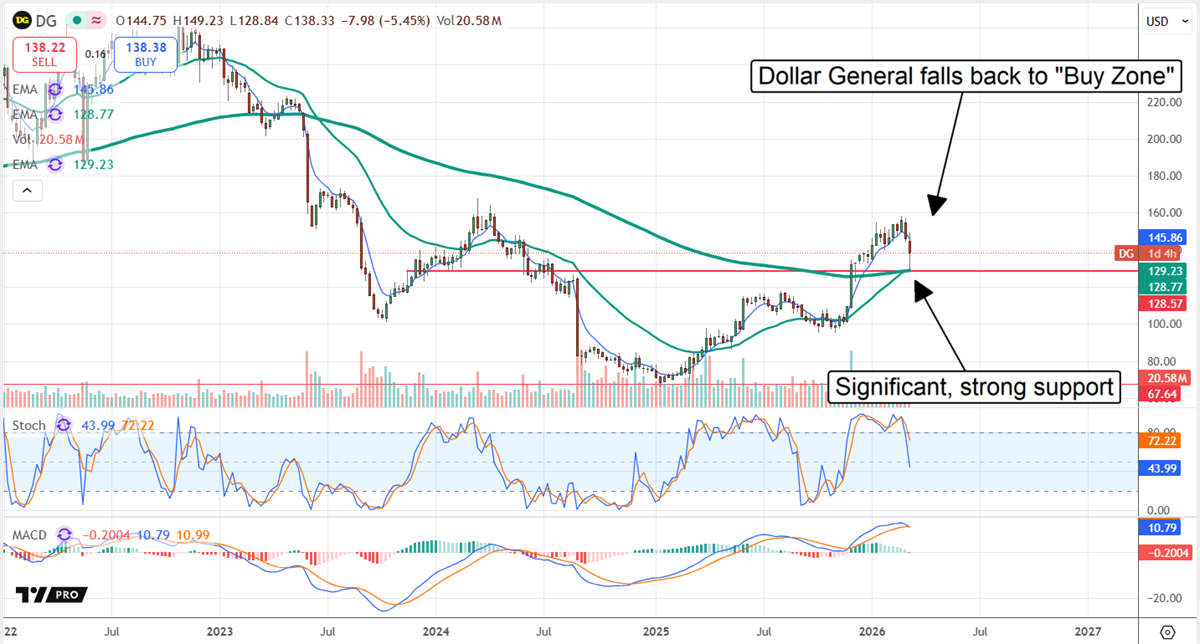
Dollar General (NYSE: DG) issued a weak 2026 forecast on March 12, sending its shares down about 10% in the subsequent opening. However, as ugly as a 10% stock price decline can be, as high as the potential for a deeper decline may be, it’s what came next that matters most. The 10% stock price pullback put the DG price in alignment with a significant support target, a target aligning with a prior breakout and reversal pattern, and the market started buying.
The stock quickly recovered half its losses, confirming support not only at this critical level but also at a pair of long-term exponential moving averages (EMAs), further strengthening the signal. Confirmation of support, along with a Golden Crossover in the EMAs, signaled a long-term bullish market shift, prompting a reversal into accumulation. Assuming the market follows through on this signal, a move below $128 is unlikely to linger if it occurs.
In 2023, Silicon Valley Bank collapsed in just 48 hours with panicked customers draining $42 billion in a single day, but it could be nothing compared to what’s coming next—through Federal Reserve Docket No. OP-1670, the government is rolling out FedNow, an instant 24/7payment hub that over 1,500 banks have already connected to, and when money moves at the speed of light, a modern bank run won’t take days. By routing every transaction through a single centralized hub, the Fed is building the ultimate kill switch for the American banking system, and when the next financial crisis hits, the Federal Reserve could instantly freeze all transfers, withdrawals, and payments nationwide to protect the system, trapping your life savings inside.Get the 4 steps to Fed-proof your savings now
Institutions Buy Dollar General Aggressively in 2026
The institutional data reported by MarketBeat suggests that this group is buying the dip in Dollar General shares. The data reflect a bullish posture on a trailing-twelve-month (TTM) basis, four consecutive quarters of bullish behavior (including the first two months of Q1 2026), buying activity, a ramping pace of buying versus selling, sequentially, and a multiyear high set in early Q1.
The takeaway, given that they own nearly 92% of the stock, is that this market is well supported and has a tailwind to assist any rebound.
Analysts also provide support, but upside may be limited until later in the year. The post-release updates included cautionary notes focused on slowing comp store sales and tepid guidance. However, most ratings and price targets were maintained, leaving the trend in place.
The current analyst forecast includes a rating from 30 analysts, a consensus Hold rating, and a 46% Buy-side bias. The bias isn’t strong, nor is the price target, which suggested the stock was fairly valued as of the close prior to the earnings report.
Among the triggers for a rebound are improvements in analysts’ forecasts, which may, in turn, be driven by an upcoming earnings release.
Dollar General Falls After Strong Report; Guides for Growth
Dollar General had a solid quarter, growing revenue by 5.9% year-over-year (YOY) to nearly $11 billion. The strength was driven by new stores and positive comps, with same-store sales up 4.3%, reflecting a 2.6% increase in traffic and a 1.7% increase in transactions. Revenue strength was also better than expected, outpacing MarketBeat’s reported consensus by 75 basis points (bps), as were the earnings. The company’s lean into rationalization, store improvements, and cost controls is paying off, resulting in widening margins. The net result was $1.93 in GAAP earnings, a nearly 15% gains compared to last year, with margins expected to remain strong.
Guidance was a concern, as management forecasts revenue growth slowing to about 3.95%, below the 4.25% consensus, but was likely to be cautious. Not only do Dollar General’s results reflect momentum at year’s end, but there is also potential for consumer tailwinds to form in 2026. Tax return season is here, and the returns are larger than in previous years, injecting capital throughout Dollar General’s consumer base.
Balance sheet highlights provide another incentive for ownership, reflecting the impact of turnaround efforts. Total assets fell slightly on a full-year basis, offset by a larger decline in liabilities. The result was a 15% increase in shareholder equity and the persistent ability to return capital. The company paused buybacks to preserve cash while it rationalized inventory and invested in store remodels, but continues to pay dividends. The distribution is worth about 1.7% as of March 2026, and investors can expect annual increases and for buybacks to resume, possibly by the fiscal year’s end.
Elon Musk’s AI Everywhere project isn’t inside Tesla—it’s a private venture with a global network of 150+ facilities embedding autonomous AI into devices everywhere, and Musk believes this could propel Tesla to become the most valuable company ever, worth more than Apple, Microsoft, Nvidia, Amazon, and Google combined. Private ventures like this are usually locked for elites, but I’ve found a legitimate brokerage backdoor under $100 with no special requirements, just a regular account, and this private play follows the same playbook as PayPal, SpaceX, Tesla, and xAI using Tesla’s proven autonomous AI copy-pasted across the world.See the 3 steps to profit before the summer regulatory shift
Dollar General Catalysts in 2026: Better Stores
Among the catalysts for Dollar General this year is its Back to Basics strategy. The company is remodeling, updating, and generally cleaning up stores, reducing inventory and improving quality, while fixing supply chain issues. The combination sets the stage for better-than-expected comps and margin, while concepts like DG Wellness and pOpshelf are helping attract and retain new customers.
MarketBeat empowers everyday investors to make better investment decisions by offering up-to-the-minute financial information and objective market analysis.
If you need help with your subscription, feel free to contact MarketBeat’s South Dakota based support team at contact@marketbeat.com.
The Department of Energy (DOE) has announced a $1.9 billion funding opportunity for projects aimed at speeding up improvements to the nation’s power grid to meet rising electricity demand while…
Mexican President Claudia Sheinbaum “should not have refused my help” in fighting criminal cartels in her country, President Donald Trump told reporters at Joint Base Andrews on March 13. Trump…
President Donald Trump on March 13 said the Iranian regime was “totally defeated and wants a deal.” “The Fake News Media hates to report how well the United States Military…
President Donald Trump directed his administration March 13 to strengthen enforcement against foreign manufacturers and sellers who falsely claim their products are American-made, as part of an executive order to…
I started rating the safety of banks in the early ’70s.
Over the last 50+ years, I’ve warned my readers about the bank failures of the 1980s and 1990s, the Dot-Com Bust, the 2008 housing collapse and more.
But today, I’m writing to you with a different kind of warning. One that genuinely frightens me.
This time, the threat to your money isn’t coming from reckless Wall Street bankers. It’s coming directly from the Federal Reserve itself.
Through a program outlined in the Federal Reserve Docket No. OP-1670 — known as “FedNow” — the government is quietly rewiring the entire American banking system.
Simply stated, the Fed is building a centralized hub that will process every transaction in the U.S. … giving it the ability to track every transfer, bill pay, purchase or donation you make in real time.
That, in turn, could give them unprecedented power to cut off your access to your savings if they decide you’re not in “compliance” with whatever their policy agenda dictates at the time.
Or maybe even confiscate your savings when the need arises like it happened in Cyprus in 2013.
In all my decades studying the U.S. economy and banking system, I’ve never seen anything as scary as this.
If you value your financial privacy …
If you believe your money belongs to you and not Washington …
P.S. The Fed is counting on the fact that ordinary Americans won’t read a 93-page document until it’s too late. I’ve read it and that’s why I’m begging you to act while you still can. Get the 4 “Fed-proof” steps right now.
More Reading from MarketBeat Media
These 2 AI Stocks Just Got a Massive S&P 500 Catalyst
Reported by Jeffrey Neal Johnson. Originally Published: 3/10/2026.
Key Points
Inclusion in the S&P 500 index triggers a substantial and predictable wave of buying from institutional investment funds.
Vertiv provides the essential power and advanced cooling solutions that are absolutely critical for running high-density AI data centers.
Lumentum’s cutting-edge optical components create the high-speed nervous system required for the rapid data transfer essential to AI models.
A shift is underway in the stock market, with two critical technology companies, Vertiv Holdings Co. (NYSE: VRT) and Lumentum Holdings Inc. (NASDAQ: LITE), seeing a surge in trading volume and investor interest. That heightened activity follows a major announcement from S&P Dow Jones Indices: both Vertiv and Lumentum will join the S&P 500.
Most investors view this as a badge of honor. Inclusion in one of the world’s most-watched indexes acts as a powerful financial tailwind: it unlocks a predictable, substantial flow of capital and creates a new dynamic for the stocks and their investors. This elevation also shines a spotlight on two businesses that are becoming increasingly essential to the infrastructure of the modern economy, driven by the rapid growth of artificial intelligence (AI).
A major force in the crypto world is quietly becoming one of gold’s most aggressive buyers — and most investors have no idea it’s happening.
A longtime gold analyst says profits from a leading stablecoin operation are being funneled into physical gold at a scale that could materially impact supply and demand. After a recent meeting with insiders, he began outlining what this trend could mean for gold prices and a small group of companies positioned to benefit.Read the full gold briefing here
The market reaction to the S&P 500 news is rooted in a phenomenon known as the index effect. The S&P 500 is the benchmark for the U.S. stock market — a curated list of the 500 largest and most influential American companies — and an estimated more than $15 trillion of assets are tied to the index.
A large portion of this capital sits in passive investment funds, such as exchange-traded funds (ETFs) and mutual funds, whose mandate is simple: mirror the performance of the S&P 500. To do that, these funds must own shares of every company in the index, with each holding weighted by market capitalization.
When a new company is added, these funds are mechanically required to buy its stock. Once inclusion is announced, the clock starts: funds must acquire positions in Vertiv and Lumentum before the change becomes effective, i.e., before the market opens on Monday, March 23, 2026. That creates a clear window for a wave of forced buying, producing a predictable surge in demand. Active traders often front-run this demand, explaining the immediate price pop, but the underlying institutional flow is what typically establishes a strong floor of support.
The AI Pillars: Fundamental Strength Behind the Technical Pop
S&P 500 inclusion is an important catalyst, but its impact is amplified because it applies to companies with timely, high-demand business models. Both Vertiv and Lumentum are key players in the global build-out of AI infrastructure — a multi-trillion-dollar trend still early in its deployment.
Vertiv: The Power and Plumbing of the AI Revolution
If AI data centers are the factories of the 21st century, Vertiv supplies the essential plumbing and power. The immense computational loads that power AI generate unprecedented heat, creating a major bottleneck for growth. Vertiv specializes in advanced power and thermal management solutions, including direct-to-chip and immersion-cooling systems, which are required to keep these high-density facilities running efficiently.
Demand for its technology is strong, positioning Vertiv to capture a significant share of the rapidly expanding data center cooling market.
Massive Order Backlog: Vertiv recently reported a $15 billion order backlog, signaling a robust pipeline of future revenue driven in large part by AI-related projects.
Strong Financial Performance:Vertiv reported earnings of $1.36 per share in its most recent quarter, comfortably beating Wall Street estimates and demonstrating solid operational execution.
Market Leadership: Its comprehensive portfolio of power and cooling solutions makes it a preferred provider for hyperscale data center operators, reinforcing its competitive advantage.
Lumentum: The Nervous System of High-Speed AI
While Vertiv builds the physical foundation, Lumentum serves as the high-speed nervous system. AI models depend on the rapid transmission of enormous datasets between thousands of chips and servers. Lumentum is a leader in optical and photonic components that enable this, manufacturing high-speed transceivers (from 800G to 1.6T) and lasers that move data at the speed of light.
A major endorsement of its technology came when Lumentum announced a strategic partnership with NVIDIA (NASDAQ: NVDA), the undisputed leader in AI chips. That collaboration further cements Lumentum’s role in the AI supply chain.
Accelerating Growth: Lumentum’s latest results showed a 65.5% year-over-year revenue increase, underscoring surging demand for its high-speed components.
Technological Edge: Lumentum is at the forefront of next-generation optical technologies, positioning it to benefit as AI networks demand ever-faster and more efficient data transfer.
Short Squeeze Potential: Lumentum currently has notable short interest. Inclusion in the S&P 500 could force some bearish investors to buy back shares to cover positions, potentially adding to upward momentum.
Beyond the Inclusion Date: A New Era of Visibility
Inclusion in the S&P 500 is a transformative event that ushers in greater visibility and credibility. It puts Vertiv and Lumentum on the radar of a much broader class of global investors and creates a more stable, long-term base of institutional ownership. This elevation often leads to increased analyst coverage and can lower the cost of capital, offering further benefits over time.
While the index effect provides a compelling near-term, technically driven tailwind, the broader significance is market validation: confirmation that these companies are large, liquid and fundamentally important. For investors, this is a powerful convergence — a predictable short-term demand catalyst shining a light on two businesses exceptionally well positioned for sustained, long-term growth at the heart of the artificial intelligence revolution.
Thank you for subscribing to StockReport.com, our daily newsletter that highlights a new stock each day.
This email is a sponsored email for Weiss Ratings, a third-party advertiser of StockReport.com and MarketBeat.
Market Signal | A Timely Investment Alert from Lindsey Hough
Editor’s Note: Silicon Valley legend Jeff Brown is forecasting that Elon Musk’s “Kardashev Project” is about to trigger the greatest wealth creation event in history. If you missed out on Tesla… Go here to see the details of what Elon has coming next or read more below.
Elon Warns of Impending “Chip Wall.” Will you be on the right side?
Elon Musk warns of the biggest bottleneck threatening the AI economy…
Without enough chips, AI will crumble, and the stocks it’s holding up will fall with it.
America’s best tech entrepreneur, Elon Musk, helped build four of the most valuable companies in history.
Now, he’s sounding the alarm about the impending chip wall threatening the AI bubble and every stock dependent on it.
Electronics giants like Dell, Samsung, and Xiaomi are already warning customers of price hikes as chips become scarce.
But Elon says he has a solution.
A solution that could soon result in the world’s first $10 trillion company as Musk takes matters into his own hands.
It’s all part of his master plan.
For the everyday American who’s worked hard to build their nest egg, this could be your last chance to get on the right side. Before the chip wall changes everything we know about the AI economy…
Preserving and even growing everything you’ve built for yourself.
February was my first losing month using the Dark Wire at TheoTRADE. I finished down 0.1%. After nine consecutive winning months, the streak ended. I’m not going to sugarcoat it.
But here’s the full picture. The markets in 2026 have been brutal. The Iran conflict has everything in a tailspin. Other traders are getting crushed. And the worst month this system produced was a fraction of a percent in the red.
March is already up 15%. And the day before yesterday I placed four trades using Dark Wire beacons — all four were winners.
Yesterday I walked through the entire system live. The overnight beacon scan. How those beacons give me a 12-hour head start on where institutional money is moving. The two-hour execution window I use every single morning.
Everything is in the replay. Watch it now before it comes down.
Disclaimer: Neither TheoTrade.com or any of its officers, directors, employees, other personnel, representatives, agents or independent contractors is, in such capacities, a licensed financial adviser, registered investment adviser, registered broker-dealer or FINRA |SIPC |NFA-member firm. TheoTrade does not provide investment or financial advice or make investment recommendations. TheoTrade is not in the business of transacting trades, nor does TheoTrade agree to direct your brokerage accounts or give trading advice tailored to your particular situation. Nothing contained in our content constitutes a solicitation, recommendation, promotion, or endorsement of any particular security, other investment product, transaction or investment.Trading Futures, Options on Futures, and retail off-exchange foreign currency transactions involves substantial risk of loss and is not suitable for all investors. You should carefully consider whether trading is suitable for you in light of your circumstances, knowledge, and financial resources. You may lose all or more of your initial investment. Opinions, market data, and recommendations are subject to change at any time. Past Performance is not necessarily indicative of future results.
TheoTrade
PO Box 24790 Christiansted, Virgin Islands 00824 1 (800) 256-8876
Two and a half months into 2026, and the S&P 500 and tech-heavy Nasdaq 100 are both down.
And if you’ve been watching the headlines, you have a good idea why: software stocks getting crushed, a new slate of global tariffs, and the Iran conflict sending oil prices up 40%.
Jeff has spent decades trading through volatile conditions like these and much, much worse. Think 1987, the dot-com bust, 2008 crash, COVID, and plenty in between.
He’s seen what happens when fear takes over. More important, he knows how to profit from it.
His tool of choice is options. But he doesn’t use them to gamble with reckless leverage.
In fact, Jeff believes you can take any stock trade idea and, with options, make more money with less risk every single time.
In this conversation, Jeff lays out why he believes much of the damage in this selloff has already been done – at least beneath the surface. And he reveals which sectors he’s watching for his next big trade.
This one’s worth your full attention.
Jeff’s track record in 2026 speaks for itself.
Seven consecutive winning trades, averaging more than 87% gains, using a straightforward approach that anyone can follow.
He did that with his unique approach to options trading, built and refined over decades in the market.
If you’d like to learn more about Jeff’s approach, but aren’t too familiar with options, his beginner-friendly Jeff Clark Trader advisory is exactly what you’re looking for.
It’s not just a “trade of the month” newsletter. It comes with a mountain of educational resources that will help get you set up to trade options the right way.
Silicon Valley insider Luke Lango is stepping forward to share how you can get a pre-IPO stake in OpenAI (for under $10). It will likely be the biggest headline of 2026, and could create THOUSANDS of new millionaires. This is the best chance to achieve the biggest gains this year. Click here for the full story.
This editorial email containing advertisements was sent to peter.hovis@gmail.combecause you are subscribed to this service. To unsubscribe or change your email preferences, please click here.
To contact Customer Service, call toll free: 866-385-2076, Mon–Fri, 9am–5pm ET, or email support@tradesmith.com.
I’m the founder of one of the largest financial research firms in the world. Over the last 26 years we’ve helped investors navigate almost every major economic cycle.
We’ve also been on the forefront of every big financial story from the rise of Bitcoin and MRNA vaccines to robotics and artificial intelligence – just to name a few.
An economic story the likes of which we’ve not seen in centuries. In fact, the last – and only time – this happened was in 1776. But now, on the eve of America’s 250th anniversary, it’s happening again.
And as you’ll discover today, the aftershock of this event could “reset” not just your personal wealth, but the entire U.S. economic system:
How you work, how you vote, how you protect and build your wealth… it’s all being turned upside down by what one famous Stanford economist says is:
“The biggest change ever… bigger than electricity… bigger than the steam engine.”
Yet almost nobody is prepared for it. So, if you’ve been watching the chaos of the past year unfold, struggling to understand what it all means… you’re about to get many – if not all – of the answers you’ve been searching for.
And, most importantly, what it all means for you, your money, and your investment portfolio in the months ahead
Because as you’ll discover, everything from the government taking stakes in companies like Intel, Lithium Americas, and MP Materials.
To Trump’s strike on Venezuela… his deal with Greenland… his seemingly never-ending slew of executive orders… and increasingly centralized grip over the economy…
All the way to the surging popularity of radical socialist politicians like Bernie Sanders, AOC, and Zohran Mamdani…
It’s all deeply and inexorably intertwined in what is, without a doubt, the most consequential story of the year.
A turning point that one Nobel Prize winner says is dividing not just the economy but our entire society.
And, as my guest and I explain, the financial decisions you make in the face of this New 1776 Moment… they could dictate whether you’re enriched, left stuck in the past, or potentially even impoverished by the seismic changes barreling down upon America.
The stocks to buy… the stocks to sell… and the three money moves to ensure you and your loved ones end up on the winning side of this new economic reality.
It’s all laid out here for you…
Good investing,
Porter Stansberry
Special Report
Market Crash Warning? Wall Street Veteran Says Mid-March Could Mark a Turning Point
Written by Bridget Bennett. Originally Published: 3/11/2026.
Key Points
Marc Chaikin, founder and CEO of Chaikin Analytics, says the midterm year has historically been the weakest phase of the presidential cycle, with peaks often forming in mid-March to early April.
Even if indexes are near highs, internal weakness in speculative and large-cap tech can show up first and foreshadow broader downside.
Preparation matters: build cash, trim weak holdings, and watch key technical levels to stay flexible if volatility rises.
When asked about the market outlook heading into mid‑March, Wall Street veteran Marc Chaikin said current conditions are unfolding much as he predicted a year ago.
Chaikin, the founder and CEO of Chaikin Analytics, has more than 50 years of experience in the stock market and is known for blending fundamental and technical analysis. His current warning is rooted in the presidential election cycle, one of the market’s longest‑tracked seasonal patterns. Historically, the second year of a presidential term—often called the midterm year—has been the weakest stretch for equities.
A major force in the crypto world is quietly becoming one of gold’s most aggressive buyers — and most investors have no idea it’s happening.
A longtime gold analyst says profits from a leading stablecoin operation are being funneled into physical gold at a scale that could materially impact supply and demand. After a recent meeting with insiders, he began outlining what this trend could mean for gold prices and a small group of companies positioned to benefit.Read the full gold briefing here
Looking at the last 17 presidential cycles, dating to the 1950s:
The second year of the cycle averaged just a 1% gain in the S&P 500.
The other three years averaged double‑digit returns.
Market peaks during midterm years often occur between mid‑March and early April.
That timing window is exactly where the market finds itself now.
Historical patterns don’t guarantee future outcomes, but Chaikin says they provide a useful framework for understanding probabilities—especially when other warning signs are emerging.
Markets Trading on Expectations, Not Fundamentals
Recent volatility highlights how sensitive markets have become to headlines and geopolitical developments.
That combination presents a difficult dilemma for the Federal Reserve.
Normally, rising inflation would push the Fed to raise rates, while weakening employment would argue for cuts. With both pressures occurring at once, the central bank’s flexibility may be limited.
Geopolitical tensions and rapidly shifting headlines add to the uncertainty. Real‑time information—often amplified through social media and political messaging—can prompt algorithmic trading systems to react instantly, accelerating short‑term market swings.
The result is an environment driven less by fundamentals and more by short‑term reactions and uncertainty.
Weakness Already Appearing Beneath the Surface
Despite the recent volatility, the broader market remains relatively close to its highs: the S&P 500 is only about 2% below its peak. For context, a correction is typically defined as a 10%–20% decline, while a bear market generally requires a 20% drop.
However, Chaikin says many popular stocks are already struggling.
Several of the so‑called Magnificent Seven—a handful of mega‑cap tech leaders—account for roughly one‑third of the S&P 500’s market value, and a number of them are already in steep downtrends. Investors heavily exposed to tech through ETFs or individual holdings like Microsoft (NASDAQ: MSFT) may be experiencing losses far larger than the overall index suggests.
These internal cracks often appear before the broader market begins to decline.
3 Ways Investors Can Protect Their Portfolios
Rather than trying to predict exactly what will happen next, Chaikin emphasizes preparation. If markets move into a correction or bear phase, investors who plan ahead will be better positioned.
The goal isn’t to exit the market completely but to create a cushion.
Cash serves two important purposes:
It reduces emotional pressure during declines.
It provides dry powder to take advantage of opportunities later.
Investors who stay fully invested during downturns often feel forced to sell at the worst possible moment.
2. Sell Weak Stocks First
If you need cash, a logical place to start is selling your weakest holdings.
Chaikin recommends trimming stocks that exhibit bearish characteristics in quantitative models such as the Chaikin Power Gauge, which evaluates companies on 20 fundamental and technical factors.
Stocks already showing bearish signals near market highs are often the most vulnerable during corrections, while stronger areas may remain resilient. Chaikin highlighted sectors currently demonstrating relative strength, including healthcare, aerospace and defense, energy, and infrastructure tied to data center expansion.
Rather than automatically buying the dip, investors may benefit from focusing on industry groups with strong momentum and fundamentals.
3. Watch Key Technical Levels
Technical indicators can provide early clues about the market’s direction.
One widely watched signal is the 200‑day moving average of the S&P 500. Many traders view it as a dividing line between longer‑term uptrends and downtrends. If the index holds above the 200‑day, pullbacks often stay contained; a decisive break below it can signal that selling pressure is widening and that a routine dip may be turning into something more serious.
Other gauges, such as the VIX volatility index, have already spiked in recent sessions. While volatility can create short‑term buying opportunities, sustained spikes often accompany periods of market stress.
Why the Best Opportunity May Come Later
Despite the cautious outlook, Chaikin remains optimistic.
Midterm years have often produced some of the best buying opportunities in the presidential cycle. Markets frequently bottom in late September or early October after months of volatility, then launch into powerful rallies. In some cases, gains following those lows have averaged more than 40% over the next 15 months.
That’s why preparation now can matter more than prediction.
Investors who maintain cash during volatile periods have the flexibility to act when prices reset. Those who stay fully invested through a sharp downturn may instead be forced to react at exactly the wrong moment.
With historical patterns pointing to a weaker midterm year and geopolitical uncertainty adding to volatility, this may be a time to focus on strengthening portfolios rather than chasing short‑term moves.
If history repeats itself, the turbulence of 2026 may not just test investors’ patience—it could ultimately create one of the most attractive buying opportunities of the entire market cycle.