I was born on 6 August 1956 in San Francisco, California to Janet and (the late) Richard Hovis.
I grew up in Santa Monica, California where I attended elementary, junior high school, and high school (graduating in 1974), in addition to involvement in sports and recreation (Little League +, the Boy’s Club ++). Further, it was in elementary school – St. Augustine’s By-the -Sea Parish School that I found, and made the choice to truly journey with God.
I attended Arizona State University from 1974 to 1977 – seeking to become an architect, however, I was not accepted, and, as such, I graduated with a Liberal Arts degree.
Upon graduation from Arizona State University, I attended Cal Poly San Luis Obispo and studied City and Regional Planning at the Master’s level. I successfully completed one (1) year in a two (2) year program – I did not complete the Master’s degree in City and Regional Planning – due to personal reasons.
I returned to Santa Monica where I started (October 1979) my career as graphic designer with Exxon Company, USA. I spent five years with Exxon Company, USA.
While working with Exxon Company, USA I was accepted into architectural school – Sci-Arc in Southern California, however, I did not attend preferring to stay with Exxon..
In 1982 I married Laura Flosi and in April 1983 we had our one and only child – Lauren Alain Hovis – a gift from God.
We moved to Phoenix, Arizona in 1984 from Los Angeles, where I went to work as a graphic designer with Kitchell CEM (from 1985 -1987).
From 1987 – 1995 I was an independent contractor, and a registered representative in mortgage finance, financial management, graphic design, and drafting.
Further, I attended the University of Phoenix and successfully obtained a Master’s in Business Administration (MBA) in 1982.
I was also a member of the Scottsdale Jaycees, where I became very involved in community events and projects.
In 1994, I accepted a cartography position with the Defense Mapping Agency in Reston, Virginia. As such, I relocated from Phoenix to Reston.
In 1998, I was accepted and worked as a Visual Information Officer with the Central Intelligence Agency. In 2002, I worked as a Support Officer until my retirement (due to a need for shoulder surgery) in September 2018.
Away from my Federal Government service, I have been involved in various organizations and activities in Northern Virginia.
In November of 2011, I married Rebecca Ouellette in Santa Monica, California. I reside in San Tan Valley, AZ with my two hamster - Jess and Timothy, our fish, our lizard - RJ Lizard., and our cats - Pearl and Grey.
As to hobbies, I enjoy playing sports, attending sporting events, mentoring individuals from financial management to hamsters, building models, photography, travel, multimedia design, managing partner for RJ Hamster, and jazz – smooth jazz to a samba or a bossa nova.
Love and God Bless,
Peter – aka RJ Hamster Jo hi
Dividend stocks are not as volatile as growth stocks, making them suitable for almost any investor! These top dividend stocks from time-tested businesses offer high yields along with massive growth potential!
While the rest of the market goes crazy for “the mother of all IPOs”, a new Elon Musk innovation is quietly being rolled out nationwide. It’s been 27 years in the making, and it could have a radical impact on how millions of people manage their money… and even collect Social Security. Here’s everything you need to know.Top 3 Industrials Stocks You’ll Regret Missing In May
Defense Secretary Pete Hegseth removed Navy Secretary John Phelan after allegations of a “land grab” over military procurement decisions. Continue Reading ➔
Information, charts, or examples contained in this email are for illustration and educational purposes only and not for individualized investment management. This message contains commercial elements, such as advertising and partner offers for which we may receive affiliate compensation. We only send these offers to those who have opted into our newsletter.
If you wish to no longer receive these offers, click on the unsubscribe link at the bottom of this email. Past performance is not indicative of future results. For these reasons, we strongly suggest trading in a DEMO/Simulated account.
The information provided by us is for educational and informational purposes only. We make no representations or warranties concerning the products, practices, or procedures of any company or entity mentioned or recommended in this email and have not determined if the statements and opinions of the advertiser are accurate, correct, or truthful.
If you use, act upon, or make decisions in reliance on information contained in this email or any external source linked within it, you do so at your own peril and agree to hold us, our officers, directors, shareholders, affiliates, and agents without fault.
2967 Dundas St. W. #990, Toronto, ON M6P 1Z2 | Phone Number: 917.672.7040
Nothing published by The Oxford Club should be considered personalized investment advice. Although our employees may answer your general customer service questions, they are not licensed under securities laws to address your particular investment situation. No communication by our employees to you should be deemed personalized investment advice. We allow the editors of our publications to recommend securities that they own themselves. However, our policy prohibits editors from exiting a personal trade while the recommendation to subscribers is open. In no circumstance may an editor sell a security before subscribers have a fair opportunity to exit. The length of time an editor must wait after subscribers have been advised to exit a play depends on the type of publication. All other employees and agents must wait 24 hours after publication before trading on a recommendation.
Any investments recommended by The Oxford Club should be made only after consulting with your investment advisor and only after reviewing the prospectus or financial statements of the company.
Protected by copyright laws of the United States and international treaties. The information found on this website may only be used pursuant to the membership or subscription agreement and any reproduction, copying or redistribution (electronic or otherwise, including on the world wide web), in whole or in part, is strictly prohibited without the express written permission of The Oxford Club, LLC, 105 West Monument Street, Baltimore, MD 21201.
Last week, a highly unexpected deal in artificial intelligence was announced…
Some might say it was the kind of deal that would only happen when hell freezes over.
It was a deal for AI computational resources – signed by SpaceXAI (the new name for SpaceX) and Anthropic, one of the leading frontier AI model companies.
And it was a big one.
SpaceXAI agreed to lease the resources of its Colossus 1 AI data center in South Memphis, Tennessee, to Anthropic.
Colossus 1, a site that I’ve visited, shattered all records for what was possible in architecting, constructing, and commissioning what became the world’s largest homogenous cluster of GPUs at the time.
xAI managed to string together 220,000-230,000 GPUs in a record 122 days – a jaw-dropping feat that had the rest of the industry shaking their heads and asking, “How is that possible?”
And Anthropic wanted access to this engineering marvel. Its interest in doing business with SpaceXAI is simple to understand… pure necessity.
Compute Can’t Keep Up with Demand
Anthropic’s biggest shortcoming as a company is that it lacked the computational resources to support the demand to access its frontier AI models.
Unlike OpenAI, Google (GOOGL), Meta (META), Microsoft (MSFT), or Amazon (AMZN), Anthropic’s business strategy has been to lease computational resources, rather than build out its own AI data centers to support its frontier AI models.
Google and Amazon have been Anthropic’s largest compute partners to date…
Just last month, Anthropic signed a deal to spend more than $100 billion with Amazon Web Services (AWS) to gain access to 5 gigawatts of compute to train and run Anthropic’s AI Claude.
Part of the Anthropic/Amazon deal also included a $5 billion investment into Anthropic made by Amazon, “with up to an additional $20 billion in the future.” This is above the $8 billion Amazon had already invested in Anthropic.
Days ago, Anthropic announced that it commits to spending $200 billion with Google Cloud over the next five years.
Part of that deal is for Google to invest up to $40 billion in Anthropic. $10 billion will be invested now with the additional $30 billion to be invested upon Anthropic meeting agreed-upon milestones.
And while small in comparison, last week Anthropic committed $1.8 billion to gain additional compute resources from content delivery network (CDN) giant Akamai (AKAM).
Last November, Anthropic committed to spending $30 billion for compute from Microsoft’s Azure cloud services division and to contract additional compute capacity up to 1 gigawatt.
Part of the Microsoft deal is for Microsoft to invest $10 billion into Anthropic, and NVIDIA to invest $5 billion in Anthropic.
The numbers are mind-boggling, and yet they still make sense if we understand the demand for using Claude, the computational needs for AGI, and ultimately artificial superintelligence (ASI).
The only divergence from Anthropic’s strategy for leasing computational resources was an announcement made last November.
Anthropic’s Infrastructure Bind
Shown below, Anthropic agreed to invest $50 billion in “American computing infrastructure,” choosing to partner with Fluidstack to build data centers in Texas and New York.
Source: Anthropic
The announcement was structured in such a way to highlight that it would be creating 2,400 construction jobs and 800 permanent jobs in the U.S.
The announcement even went so far as to state this…
[The project] will help advance the goals in the Trump administration’s AI Action Plan to maintain American AI leadership and strengthen domestic technology infrastructure.
From my analysis, it’s obvious that this deal was designed to buy goodwill from the U.S. government.
Anthropic has long been known for having developed the most biased AI designed to push political narratives. It has also tried to restrict the U.S. government in how its AI is used.
These points eventually led to a banning of the use of Anthropic by the U.S. Department of War, as Anthropic was deemed a “supply chain risk to national security.”
But the reality is that even without the U.S. government’s business, Anthropic’s business has been booming, and it needs far more compute that it currently has access to.
Which leads us to the deal with SpaceXAI, and why it came as such a surprise.
It has been no secret that Elon Musk has never liked what Anthropic has been building.
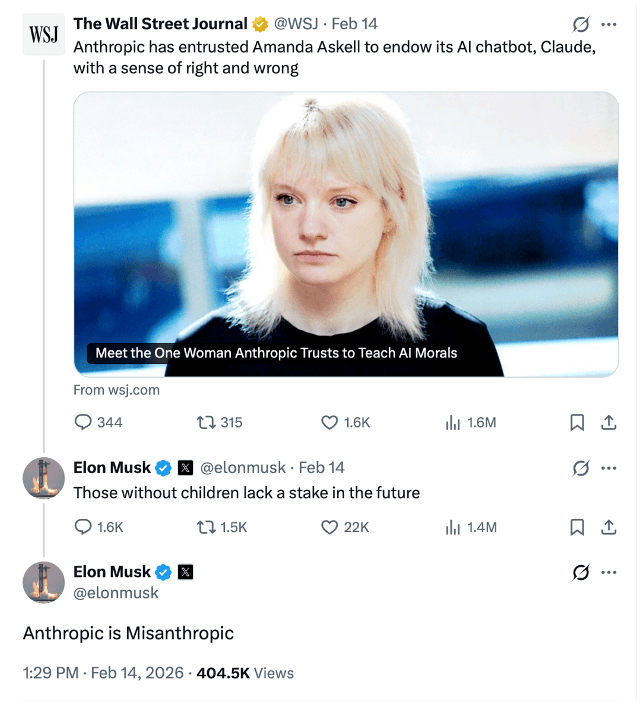
He went to far as to label Anthropic as “evil” and a company that hates Western civilization.
Source: Elon Musk
The irony of Anthropic’s name has been particularly poignant to Musk, noting that “Anthropic is Misanthropic.”
Musk has consistently taken issue with Anthropic over the last year because of how Anthropic programs mistruths into its models.
Anthropic has been abusing its current position, much in the same way that Google, Meta, and Microsoft did during the pandemic, something that I find dangerous and yes… evil.
It’s a certainty that the people of Anthropic don’t care much for Musk, either…
But without the additional computational resources, Anthropic was in a bind.
SpaceX is already valued at $1.75 trillion before a single share trades publicly. The investors who got rich on SpaceX got in years ago. Larry Benedict – who didn’t have a losing year for 20 consecutive years – says while the world is fixated on the IPO, billions of dollars are quietly being set up to flow into ONE forgotten ticker. He’s revealing the name completely free. Click here to see where Larry is actually positioning his readers – and why it isn’t SpaceX.
In the previous four windows, a backtest shows you could have made as much as 2,866%, 665%, and 1,800%. Now, it’s opening again on May 15. Louis Navellier’s new 53-stock watchlist was created for exactly this moment. Learn how to get the watchlist for FREE here.
Dealing with the Devil
SpaceXAI has something that Anthropic’s other providers don’t have: excess available AI computational resources.
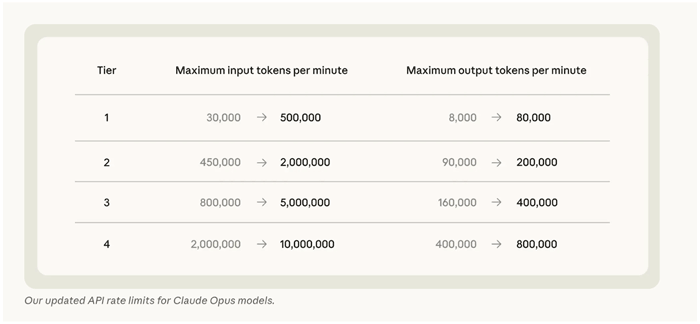
This is evidenced by Anthropic’s announcement last week:
Anthropic is doubling Claude Code’s five-hour rate limits for Pro, Max, Team, and seat-based Enterprise plans…
Removing the peak hours limit reduction on Claude Code for Pro and Max accounts…
And raising its API rate limits considerably for Claude Opus models.
Just have a look at the dramatic rate limit increases in the table below…
Source: Anthropic
The demand for Anthropic’s AI has been so severe that it has been forced to limit the usage for its customers.
This became a massive problem in recent months, so much so that it cut the deal with SpaceXAI.
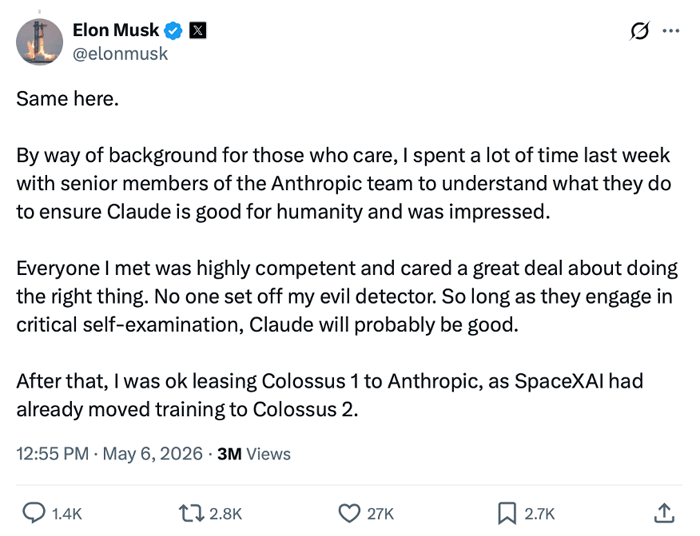
Meanwhile, Musk’s willingness to conduct business with (mis)Anthropic was such an about-face that it required some explanation from Musk.
Smartly, he met with the Anthropic team to evaluate whether he would be all right doing business with them.
It wasn’t without a caveat, though.
“So long as they engage in critical self-examination, Claude will probably be good.”
That certainly suggests that if Anthropic doesn’t clean up its act and stick to the truth, the deal could be at risk.
Many journalists misunderstood and mistook the deal to suggest that SpaceXAI has given up on its aspirations to become the world’s leading AI model, the first to AGI, and ultimately ASI.
“They” also suggested that SpaceXAI didn’t have use for its own AI data center capacity, so it decided to lease it out.
They’re all so wrong.
Out with the Old, In with the New
xAI’s Colossus 1 was its first foray into building an AI data center.
It was a record-breaking feat, one that showed the industry was possible.
But xAI didn’t rest. It immediately built Colossus 2, which now stands at 550,000 GPUs and is the largest homogenous AI data center in the world.
xAI is also known as being the most efficient at training its AI models, meaning it can achieve more with less compute.
SpaceXAI is leasing out its “old” AI data center to Anthropic and keeping its most advanced AI data center to itself.
Anthropic gets what it needs immediately, and SpaceXAI immediately starts getting paid for AI computational resources, giving it a source of revenue leading up to its IPO.
Musk also demonstrates his willingness to work on fair and reasonable terms with a competitor, something that Musk has demonstrated with SpaceX and even Tesla.
And if that’s not exciting enough, part of the Anthropic/SpaceXAI deal is to further the partnership to develop “multiple gigawatts of orbital AI compute capacity.”
Not only is SpaceXAI now competing directly with Google, Amazon, Microsoft, and Oracle for terrestrial web services, it is already cutting deals to dominate in orbital web services (OWS), a completely new industry.
To ensure our emails continue reaching your inbox, please add our email address to your address book.
This editorial email containing advertisements was sent to pahovis@aol.com because you subscribed to this service. To stop receiving these emails, click here.
Brownstone Research welcomes your feedback and questions. But please note: The law prohibits us from giving personalized advice.
To contact Customer Service, call toll free Domestic/International: 1-888-512-0726, Mon-Fri, 9am-7pm ET, or email us here.
P.S. Reply to this email with your favorite stock so your email provider can send future email to the right place. To keep our emails in your primary inbox, follow these whitelisting tips.
Information, charts, or examples contained in this email are for illustration and educational purposes only and not for individualized investment management. This message contains commercial elements, such as advertising and partner offers for which we may receive affiliate compensation.
If you wish to no longer receive these offers, click on the unsubscribe link at the bottom of this email. Past performance is not indicative of future results. For these reasons, we strongly suggest trading in a DEMO/Simulated account.
The information provided by us is for educational and informational purposes only. We make no representations or warranties concerning the products, practices, or procedures of any company or entity mentioned.
If you use, act upon, or make decisions in reliance on information contained in this email, you do so at your own peril and agree to hold us without fault.
2967 Dundas St. W. #990, Toronto, ON M6P 1Z2 | 917.672.7040
Biotech is transforming healthcare through cutting-edge therapies and research. Billions are flowing into the sector. These 3 companies are positioned at the forefront of the next wave of innovation.
How do Wall Street’s billionaire elites win big even while average investors are losing their life savings all around them? One Wall Street legend has the answers, the proof to back it up, and a system designed to level the playing field. More Info ➔Why Is Rackspace Technology Stock Gaining Monday?
Retail investors talked up five hot stocks this week (May 4 to May 8) on X and Reddit’s r/WallStreetBets: AMD, EBAY, SMCI, UBER, and RKLB. More Info ➔
Information, charts, or examples contained in this email are for illustration and educational purposes only and not for individualized investment management. This message contains commercial elements, such as advertising and partner offers for which we may receive affiliate compensation. We only send these offers to those who have opted into our newsletter.
If you wish to no longer receive these offers, click on the unsubscribe link at the bottom of this email. Past performance is not indicative of future results. For these reasons, we strongly suggest trading in a DEMO/Simulated account.
The information provided by us is for educational and informational purposes only. We make no representations or warranties concerning the products, practices, or procedures of any company or entity mentioned or recommended in this email and have not determined if the statements and opinions of the advertiser are accurate, correct, or truthful.
If you use, act upon, or make decisions in reliance on information contained in this email or any external source linked within it, you do so at your own peril and agree to hold us, our officers, directors, shareholders, affiliates, and agents without fault.
2967 Dundas St. W. #990, Toronto, ON M6P 1Z2 | Phone Number: 917.672.7040
The 2026 IPO calendar is taking shape ‐ and it’s unusually concentrated.
Instead of a scattershot list of early‐stage hopefuls, the pipeline includes a handful of large private companies, each dominating a different segment of the economy.
At one end of the spectrum sits a global connectivity network. At another, the infrastructure powering enterprise AI.
There’s a digital finance platform generating margins that resemble software, not banking. And much more. And they all bring unique standout qualities to the table.
Fear is a powerful emotion. Fear of missing out might even be more potent.
Case in point: the rally in chips.
The immediate impulse might be to jump in. If you’re in that camp, a more measured approach might be to use options and risk less capital.
Privacy Policy | Advertiser DisclosureDISCLAIMER: Stocks and options trading have large potential rewards, but also large potential risk. You must be aware of the risks and be willing to accept them in order to invest in the stocks and options markets. Don’t trade with money you can’t afford to lose. This is neither a solicitation nor an offer to Buy/Sell stocks or options. No representation is being made that any account will or is likely to achieve profits or losses similar to those discussed in this report. The past performance of any trading system or methodology is not necessarily indicative of future results. All trades, patterns, charts, systems, etc., discussed in this report are for illustrative purposes only and not to be construed as specific advisory recommendations. Information contained in this correspondence is intended for informational purposes only and was obtained from sources believed to be reliable. Information is in no way guaranteed. No guarantee of any kind is implied or possible where projections of future conditions are attempted.
Stockguru LLC (dba InvestingDistrict), 2563 cherry hill ln, Hermitage, PA 16148, United StatesYou may unsubscribe or change your contact details at any time.
I want to talk to a specific group of you for a minute.
Some of you have heard me talk about The 10 AM Bell over the last few weeks. You’ve read the emails. You’ve seen the numbers I’ve shared. And you’ve been sitting on the same question the whole time:
“Is this actually a fit for me?”
I get it. It’s a fair question. And it’s the right one to ask before you commit your time, your money, and your attention to anything in this business.
So this Wednesday at 3:00 PM Eastern, I’m putting on a special event.
It’s for the fence-sitters.
Everyone who’s been looking at The 10 AM Bell from the outside, wondering whether it’s the real thing, wondering whether it works for someone like them, wondering whether the year I just had is repeatable. This event is built specifically for you. To give you one last chance to fully evaluate it, in my own voice, with every receipt on the table, before the door shuts on Thursday.
Here’s what just happened.
453 winning trades. 11 winning months out of 12. A $5,000 account turned into $14,459 — a 189% return. Done before lunch, every single morning.
The best 12-month run any individual trader has ever produced at TheoTrade. Same market every other trader was looking at. Same screen. Same morning hours. Different bell. Completely different year.
While the 9:30 grinders were getting chopped up in the morning panic — chasing the spike, taking the stop-runs, losing $400 by 10:15 with the whole day still ahead — I was waiting 30 minutes. Waiting for the dust to settle. Waiting for the 10 AM Bell. Done by lunch. Every morning.
On Wednesday, I’m going to walk you through every month of that year.
And I’m going to bring two new things to this one I haven’t shared before.
First, a new deep dive into how the system actually works — the depth I would only normally go to in a paid setting. Second, news for anyone who’s been on the fence about whether to install The 10 AM Bell into their own trading. The people in the room hear it first.
Thursday, May 14, I start working with a new group of traders to install The 10 AMBell into their trading — and this opportunity shuts behind them. Wednesday afternoon is the door. Thursday morning, it shuts.
Save your spot and the full 12-month track record report will hit your inbox immediately. Read the receipts before Wednesday. Then show up and let me tell you the rest.
Wednesday, May 13. 3:00 PM Eastern. Live. This one is for the fence-sitters. I’d love to see you there.
Blake Young
The 10 AM Bell
P.S. If you’ve been watching from the sidelines — this is the one I want you in the room for. Wednesday at 3 PM Eastern. After Thursday, year two starts and the door shuts behind it.Save your seat here.
Disclaimer: Neither TheoTrade.com or any of its officers, directors, employees, other personnel, representatives, agents or independent contractors is, in such capacities, a licensed financial adviser, registered investment adviser, registered broker-dealer or FINRA |SIPC |NFA-member firm. TheoTrade does not provide investment or financial advice or make investment recommendations. TheoTrade is not in the business of transacting trades, nor does TheoTrade agree to direct your brokerage accounts or give trading advice tailored to your particular situation. Nothing contained in our content constitutes a solicitation, recommendation, promotion, or endorsement of any particular security, other investment product, transaction or investment.Trading Futures, Options on Futures, and retail off-exchange foreign currency transactions involves substantial risk of loss and is not suitable for all investors. You should carefully consider whether trading is suitable for you in light of your circumstances, knowledge, and financial resources. You may lose all or more of your initial investment. Opinions, market data, and recommendations are subject to change at any time. Past Performance is not necessarily indicative of future results.
TheoTrade
PO Box 24790 Christiansted, Virgin Islands 00824 1 (800) 256-8876
Earlier today, my colleague Chris Graebe sent you the message below. I asked my team to forward it to you again tonight for one specific reason.
I’m greatly concerned about the 10 popular household stocks our system just flagged as “Must-Sells.”
When the market fully absorbs the reality of the $38 trillion debt — and how the oil shock from the Middle East conflict accelerates that crisis — holding any of these 10 names could cost you years of portfolio gains.
That’s why you need to get rid of these stocks TODAY.
More details in Chris’s message below. See it and take preventive steps fast.
Martin
———- Forwarded message ——— From: Chris Graebe <issues@e.weissratings.com> Sent: Thursday, April 09, 2025 9:45 AM
Dear Reader,
America’s rapidly surging debt is no secret.
But for years, Wall Street and Washington have treated our $38 trillion national debt like a problem for tomorrow.
A crisis they can just keep kicking down the road.
However, the conflict in the Middle East over the last two weeks just violently accelerated the timeline.
With the Strait of Hormuz locked down, oil is surging. And analysts are predicting $150 a barrel if this drags on.
When oil spikes like that, inflation roars back into the economy.
In the past, the government would try to print, cut, or borrow its way out of an inflation shock.
But you cannot do that when you’re sitting on a $38 trillion mountain of debt and paying $1 trillion a year as interest on it.
In short, this match has just hit a powder keg.
And it’s going to trigger a radical, violent shift in the U.S. stock market.
Popular household stocks that looked untouchable a month ago could get gutted. And another set of overlooked stocks could go for massive, historic runs.
That’s why I rushed to get this special broadcast live this morning.
Inside, I pull back the curtain on a 100-year-old market signal.
It’s the exact same data-driven signal that called the bank collapses of the 1980s, the 2008 financial crisis, and the 2020 crash.
I’m not going to ask you to read a 50-page economic report to understand this. I’ve laid it all out in a new video presentation that’s officially live as of a few minutes ago.
On April 25, SLB (NYSE: SLB) reported one of its more difficult quarters in years. Yet that may be the least important thing about this oilfield services leader, formerly known as Schlumberger.
While organic revenue fell, margins compressed, and earnings declined, the company’s digital business continued to grow, NVIDIA (NASDAQ: NVDA) expanded its partnership, and management bought back stock. Shares in the company have soared nearly 40% this year.
When the SpaceX IPO launches, most retail investors will be locked out. The banks, funds, and insiders get in early – while everyone else waits on the sidelines.
But one small infrastructure supplier – a critical piece Musk can’t scale the Colossus network without – is still trading well under institutional radar. A new briefing reveals the name and ticker at no cost.
The short-term and long-term narratives may be pointing in opposite directions, but that tension is exactly where the opportunity may lie for investors.
SLB’s Core Business Is Under Pressure
The oilfield services industry is often difficult. These days, it is tougher than usual. Even with oil surging from below $70 a barrel to over $100 in just one month, global tensions were front and center in SLB’s first-quarter results.
SLB kicked off the year with Q1 revenue of $8.7 billion, up roughly 3% from a year earlier. But that figure can be misleading. ChampionX, a production chemicals company SLB bought in 2025, contributed $838 million in revenue during the quarter and $199 million of adjusted earnings before interest, taxes, depreciation, and amortization (EBITDA).
Without that contribution, the organic picture was not pretty. Even with ChampionX included, the company’s adjusted EBITDA fell 12% year over year (YOY), while the margin compressed 346 basis points. That means the company needs to work harder to convert revenue into profit. Excluding ChampionX, underlying revenue would have declined 7% YOY.
Earnings followed a similar pattern. Net income came in at $752 million, with diluted earnings per share of 50 cents, down from 58 cents a year earlier. Even adjusted, earnings per share (EPS) were 52 cents, still about 20 cents below the year-ago figure.
More notably, free cash flow for the quarter turned negative, though the unusual dip stemmed from seasonal patterns and the ChampionX integration. Over the full year 2025, SLB generated approximately $4.1 billion in free cash flow.
Middle East Tensions Weighed on Results
The culprit for much of the decline is, for the most part, front-page news. The war in the Middle East led SLB to issue a rare mid-quarter warning in March, indicating that earnings would likely take a 6-9 cent-per-share hit from disruptions and added costs.
The company also said first-quarter revenue would come in below expectations as it curtailed activity, suspended travel, and pulled back on some projects in the region. Shares reacted immediately, capping a 10-day, 13% slide below $45. Results in late April reflected these warnings, and the stock held its ground.
SLB Bets Heavily on Digital Growth
But while the pressures show up in the top-line numbers, what lies beneath is more transformative.
SLB’s digital business grew roughly 9% YOY, reaching $640 million in quarterly revenue. The company also announced in late March that it had expanded its work with NVIDIA to industrialize AI for the energy sector.
With annual recurring revenue from digital crossing $1 billion, this is a major pivot. It has the potential to take SLB beyond its long history of drilling services and into higher-margin technology as it pushes further into software, data analytics, and AI-driven reservoir modeling tools sold to energy companies.
Instead of a company dependent on the volatile well construction and oilfield cycles, SLB is potentially moving toward the kind of predictable, subscription-like cash flows that can help smooth out these disruptions.
The Company Continues Rewarding Shareholders
That would be good news for shareholders. As of April, the company said precise guidance for the current quarter was “challenging” given the tensions in the Middle East.
Even with the pressure, SLB continued returning capital to shareholders in the first three months of the year.
Overall, SLB has committed to return more than $4 billion to shareholders in 2026 through dividends and buybacks.
Management’s full-year guidance calls for revenue in a range of $36.9 billion to $37.7 billion, with EBITDA margins broadly in line with 2025 levels.
That suggests modest but real growth from a challenging starting point.
It also points to an expectation that this year’s early softness may be partially offset by a stronger second half, assuming Middle East operations normalize and ChampionX synergies build.
Wall Street Still Expects Further Gains
Analysts broadly agree.
SLB stock currently carries a consensus Moderate Buy rating, with average 12-month price targets implying a modest upside from recent levels. Of the 23 analysts covering the stock, 19 rate it a Buy, three have it at Hold, and one rates it a Sell.
Overall, the consensus price target is around $60, slightly above the current price. UBS has assigned SLB stock the highest target of $69.
Investors Are Paying for Long-Term Quality
Clearly, SLB is not a bargain-basement stock. With shares trading at a trailing price-to-earnings ratio in the mid-20s, investors are paying a premium for a franchise that is temporarily underperforming its own history.
But the company remains the most technologically sophisticated oilfield services provider in the world. It has capabilities in deepwater drilling, well construction, reservoir performance, and now digital services. Its competitors in the energy sector, including Halliburton (NYSE: HAL) and Baker Hughes (NASDAQ: BKR), have not yet caught up.
Playing the energy sector is always risky in the short term. Investors who want near-term earnings or deeply discounted valuations will probably look elsewhere. But for patient investors willing to hold through unpredictable events and a bumpy transition, SLB is a compelling combination of quality, income, and long-term strategic positioning.
Nasdaq +1.71% to records. S&P 500 +0.84%. Brian “Axelrod” stayed conservative, played the flow, and still closed 5/5 on official trades.
▸ BRIAN’S TAKE
Safe First. Green Always.
“Still a very news-driven, emotional market where technicals are watered down — so I was more conservative than normal to be SAFE first and foremost. Hope you guys banked and ended green as well. Another green week for the books.”
★ MEMBER REPLY · RANGER
“100% is not a fluke…. it is solid trading. Congratulations @Brian.”
That’s the kind of trader you want in your corner. Not someone swinging for the fences every session — someone who reads the tape, respects the conditions, and keeps the green weeks stacking.
▸ TRADE ALGO LIVE · SEASON 8
See the dark pool plays before they explode.
Join our analysts live as they break down the unusual flow our scanner is picking up — in real time, with real entries and exits.RESERVE MY SEAT →
Limited seats · No replay sent
— The TradeAlgo Team
▎ MORE FROM TRADEALGO
▸ LIVE WEBINAR · WEDNESDAY
Wealth Series Core
The foundational training that walks you through how to read flow, time entries, and build a long-term portfolio. Wednesday at3pm PT / 6pm ET.SAVE MY SEAT →
▸ AI TRADE SIGNALS
The Signal
Our AI-driven signal system surfaces the highest-conviction trades the moment they trigger — directly from the same flow models our analysts use live.EXPLORE THE SIGNAL →
The information provided is for educational purposes only and does not constitute investment advice. Trading options involves substantial risk of loss and is not suitable for all investors. Past performance is not indicative of future results. Always do your own research before making any investment decision.
Delivering World-Class Financial Research Since 1999
A ‘garbage’ proposal from Iran… What ‘everybody’ is ignoring… ‘Nobody’ is thinking… The AI boom keeps ‘booming’… Where to put new money to work in AI now…
There’s no end in sight for the war in Iran…
After promises of progress, the latest headlines suggest we’re no closer to the end of the conflict in Iran than we were when the war began at the end of February.
Late last week, zero ships reportedly traveled through the Strait of Hormuz for three consecutive days.
And today, President Donald Trump said from the White House that “the ceasefire is on massive life support.”
What about the proposal to end the war that Iranian officials presented to the U.S. over the weekend? It was a “piece of garbage,” Trump said. “I didn’t even finish reading it.”
According to reports, there were various points of contention, but the biggest was about Iran’s possession of enriched nuclear material. As Trump has said repeatedly, he doesn’t want Iran to “have a nuclear weapon.”
The Wall Street Journal wrote about the Iranian “multipage” proposal last night…
The latest response doesn’t resolve the U.S. demand for commitments in advance on the fate of Iran’s nuclear program and its stockpile of highly enriched uranium. Instead, Iran is proposing an end to the fighting and a gradual opening of the Strait of Hormuz to commercial traffic as the U.S. lifts its blockade on Iranian ships and ports, the people said.
Nuclear issues would be negotiated over the next 30 days, they said. Iran proposes to have some of its highly enriched uranium diluted and the rest transferred to a third country, the people said.
Maybe that was the point where Trump stopped reading…
“Totally unacceptable,” he posted on Truth Social yesterday about the proposal… after which oil futures started rising again. Brent crude and West Texas Intermediate prices are both up about 3% in the past 24 hours to around $104 and $98 per barrel, respectively.
When the inmates are running the asylum…
Trump also touched on another heart of the matter today, which we’ve written about before.
That’s the apparent battle for power withinIran between the parliamentary folks the U.S. has been negotiating with and the hard-liners in the Islamic Revolutionary Guard intent on fighting indefinitely.
“The moderates are dying to make a deal. And then you have the lunatics, and I guess they’re a little bit afraid of the lunatics,” Trump said.
Barring a sudden and large change of heart by any of the parties involved, a likely way to end the immediate conflict – and the gridlocked Strait of Hormuz – would be for the U.S. or its allies to further attack the Revolutionary Guard forces who clearly continue to wield enough power in Iran to keep the strait closed.
I (Corey McLaughlin) am not saying what’s “right” or “wrong.” I’m just stating the reasonable outcome at this point – more war.
Another option would be a popular uprising. But we’ve seen no signs of that among the Iranian people. So either bombs will start flying again eventually or the U.S. calls it quits, which seems unlikely. Meanwhile, the world will deal with the reduced energy supply.
The consequences are piling up…
After a pullback at the end of last week, oil prices rose again over the past day. That makes sense, given global oil supplies continuing to drop… and energy prices rising.
In the U.S., the average price for a gallon of regular gasoline remains above $4.50… and now, after more than two months of war, the White House says it wouldn’t mind if Congress voted to suspend the federal gas tax.
Still, that would only cut gas prices by around 20 cents a gallon and 25 cents for diesel, while costing the federal government about a half billion dollars per week. (More debt, more inflation, anyone?)
Elsewhere, fuel rationing continues in Asia and Europe, which are experiencing the brunt of essentially 20% of the world’s typical oil supply being out of commission.
Yesterday, in India, prime minister Narendra Modi called on citizens to work from home – drawing comparisons to pandemic-era policies – or at least take public transit in an effort for Indians to consume less gasoline.
Mr. Market shrugged off the news… and the AI boom keeps ‘booming’…
The major U.S. stock indexes were slightly higher today, with many names from the AI ecosystem leading the way. The benchmark S&P 500 Index gained 0.2%.
Shares of Nvidia (NVDA) were up almost 2% to a new record high… And Micron Technology (MU) was up more than 6%, for a roughly 150% gain since March 30.
AI “optical networking” stocks were the biggest winners in the S&P 500. Lumentum (LITE), Coherent (COHR), and Corning (GLW) were up 16%, 13% and 11%, respectively, on the heels of a partnership announced last week between Nvidia and Corning to build three new manufacturing facilities in North Carolina and Texas.
The deal has signaled that Nvidia could be gearing up to replace copper in its data-center technology with Corning’s fiber-optic glass.
Stansberry Innovations Reportsubscribers are sitting on a 577% gain in Lumentum, which editor John Engel recommended in April 2021 because of the company’s position of strength and potential for growth in the optical-networking space.
But market sentiment about these stocks looks a bit frothy right now. This quote got my attention today…
“The tech boom is just too powerful to let the fact that energy prices are high affect the U.S. economy or the U.S. stock market,” Jay Hatfield, founder and CEO at Infrastructure Capital Advisors told CNBC. “Everybody’s tuning out the Middle East.”
It reminds me of a pillar of risk management we always try to keep in mind. When “everybody” is doing something – in this case, tuning out the Middle East – a “surprise” can catch “everyone” off guard.
And he highlighted the danger of being part of the crowd when it’s in consensus.
Dan cited investor Howard Marks’ April 2007 essay, “Everyone Knows,” which Marks published to his Oaktree Capital clients six months before the S&P 500 peaked ahead of the great financial crisis. The U.S. benchmark went on to fall nearly 60% through March 2009.
Dan wrote…
As Marks wrote at the time…
What’s clear to the broad consensus of investors is almost always wrong.
And he continued…
Take, for example, the investment that “everyone” believes to be a great idea. In my view by definition it simply cannot be so.
If everyone likes it, it’s probably because it has been doing well… it’s likely the price has risen to reflect a level of adulation from which relatively little further appreciation is likely… [and that] there’s significant risk that prices will fall if the crowd changes its collective mind and moves for the exit.
Dan went on say that “Everyone Knows” is the flip side of “Nobody Thinks”…
Everyone Knows stocks aren’t going anywhere but up… And every little dip is a buying opportunity. Nobody Thinks a major bear market is about to begin.
Everyone Knows the Federal Reserve supports the stock and bond markets and won’t let them crash. Nobody Thinksthe Fed is playing a dangerous game by doing nothing to disabuse investors of that horribly naïve assumption.
Everyone Knows passive investing flows into index funds and exchange-traded funds are so powerful that the big stock indexes are highly unlikely to fall far without another pandemic or global economic shutdown… And even then, it would be just another short-term dip to buy. Nobody Thinks passive investing flows can move in the opposite direction and that investors can sell without reference to underlying business fundamentals as manically as they bought.
Everyone Knows value investing is dead and buying fast-growing companies is the only way to make money in the stock market. Nobody Thinks the old cycles are still intact and that – just like at the peak of the dot-com boom – great companies’ share prices are about to fall 80%, making this a great time to buy cheap value stocks and sell overvalued growth stocks.
Everyone Knows the stock market will never fall more than 20% in a single day as it did in 1987 because they’ll shut down the exchange when the S&P 500 is down that much. Nobody Thinks stocks can fall more than 20% in a single day because the market is not a man-made machine but a natural phenomenon… And mankind doesn’t control nature.
If you take nothing else from today’s Digest, let it be this reminder: think for yourself.
“The consensus is dangerous,” Dan wrote in his essay.
We understand that it’s not easy watching certain stocks melt up, but it’s dangerous to chase these stocks higher – especially the longer the behavior continues.
After nearly four years of big gains for well-known names like Nvidia, be smart about where to put new money to work in the AI trend today…
Look to the bottlenecks…
If AI’s footprint is going to be everything that “everybody” thinks it is – or even a fraction of that – we’re going to need a heck of a lot more energy in the years ahead. Electricity demand, prices, and public frustration have already been rising, in part, thanks to AI and data centers.
And the U.S. energy grid is becoming increasingly strained. That’s bad news for daily life, but presents an opportunity in the companies well positioned to help America meet its growing energy demand.
Over the past two years, our colleague Gabe Marshank has been studying the AI power crisis and where the biggest opportunities for your money may be. And he has put together an incredible presentation with more details.
In the free presentation, Gabe reveals some overlooked infrastructure power plays poised for massive upside… and what he’s calling a “Hormuz Dividend” – a company he considers a “toll taker” on energy infrastructure. To learn more, click here.
And Stansberry Alliance members and Gabe’s Market Maven subscribers can check out this latest research here.
While most investors are white-knuckling their way through 2026’s volatility, Gabe Marshank – who made TWO $100 million trades at the world’s most powerful hedge funds – says a completely overlooked corner of the market is about to go on a tear upward. In fact, it’s now a matter of life and death. He’s calling this straightforward move his “THIRD $100 MILLION TRADE.” And for a limited time, he’s sharing the details for free.
Before becoming a Wall Street legend, Louis Navellier spent four years inside America’s federal banking system. Now, he has used that experience to identify 53 small-cap stock ideas to take full advantage of when the new Fed regime takes over on May 15. Get all 53 stocks here for free.
New 52-week highs (as of 5/8/26): ABB (ABBNY), Altius Minerals (ALS.TO), Applied Materials (AMAT), Advanced Micro Devices (AMD), ASML (ASML), Broadcom (AVGO), BHP (BHP), Alpha Architect 1-3 Month Box Fund (BOXX), CBOE Global Markets (CBOE), Cisco Systems (CSCO), Datadog (DDOG), DigitalOcean (DOCN), iShares MSCI Emerging Markets ex China Fund (EMXC), EnerSys (ENS), iShares MSCI South Korea Fund (EWY), Fanuc (FANUY), FirstCash (FCFS), Alphabet (GOOGL), Hewlett Packard Enterprise (HPE), Intel (INTC), KraneShares Global Humanoid Robotics and Physical AI Index Fund (KOID), Keyence (KYCCF), Lamar Advertising (LAMR), LXP Industrial Trust (LXP), Mueller Industries (MLI), Invesco WilderHill Clean Energy Fund (PBW), Construction Partners (ROAD), Roku (ROKU), ProShares Ultra Technology (ROM), U.S. Global Sea to Sky Cargo Fund (SEA), ProShares Ultra S&P 500 (SSO), UnitedHealth (UNH), and State Street SPDR S&P Semiconductor Fund (XSD).
“Corey, When quoting Andy Challenger in Thursday’s Digest, “Technology companies continue to announce large-scale cuts and are leading all industries in layoff announcements. They are also often citing AI spend and innovation. Regardless of whether individual jobs are being replaced by AI, the money for those roles is.” I disagree with the big tech companies line that these layoffs are all due to AI. It does, however, add a ‘nice guy’ spin to the story by big tech.
“As an investor, saving money helps the bottom line, which in turn helps the price of the underlying investment. However, the main job losses are happening in the customer service area, which aren’t high paying engineering jobs AND the coders/programmer’s jobs, which are high paying jobs. BTW as a senior, I absolutely HATE, those endless customer service center drill down questioning by AI, as I yell, ‘TALK TO A PERSON’, but I digress.
“What big tech is doing in reality is moving a lot of these high paying engineering jobs to India, at a much lower salary. It started with Covid and work from home and our home-grown engineers training others and has progressed with the now, exorbitant H-IB visa policies. Hiring in India of these newly pre-trained individuals in on the rise in India, which doesn’t require those high fee visas and much lower salaries than in the U.S.
“Yes, AI is the biggest investment thesis currently. I do dislike hearing an incorrect ‘excuse’ for job losses currently taking place at most tech companies. I speak from experience as our son is deeply embedded in the tech area here in Seattle. Yes, he tells me, coders are losing their jobs, as AI is making huge strides in that area. He is a senior UX researcher and is challenged by worldwide meetings including teams in India and east and west coast ‘hubs’. These meetings take place at all hours, as teams are assembled to discuss the newest projects and deliverables.
“So far, he tells me, customer service and coding are the big breaks from AI, along with meeting/data summations and the use of LLM’s (large language models), which does help bottom lines. Nothing new to your readership, as this is discussed quite often.
“The biggest challenge’s occurring in his field is how to monetize AI (as discussed by your writers) to substantiate this huge amount of expenditure taking place. I agree with your contributors, as there will be winners and losers on this horizon. We, as subscribers, are absorbing everything you folks uncover and divulge to us!” – Subscriber S.R.
Corey McLaughlin comment: Thanks for the note. Great discussion to have. And regarding “monetizing AI” and the potential winners and losers, as I mentioned above, a great place to look is our colleague Gabe Marshank’s latest recommendations…
Existing Market Maven and Alliance members can find them here. If you’re interested in joining them, check out Gabe’s free presentation for more details, including his take on the AI story and a trade setup that he says is similar to a pair of $100 million trades he made during his hedge-fund days.
All the best,
Corey McLaughlin Baltimore, Maryland May 11, 2026
Stansberry Research Top 10 Open Recommendations
Top 10 highest-returning open stock positions across all Stansberry Research portfolios. Returns represent the total return from the initial recommendation.InvestmentBuy DateReturnPublicationMSFT Microsoft11/11/101,374.8%Retirement MillionaireMSFT Microsoft02/10/121,340.2%Stansberry’s Investment AdvisoryGOOGL Alphabet12/15/16887.1%Retirement MillionaireCIEN Ciena10/20/22865.2%Stansberry Innovations ReportADP Automatic Data Processing10/09/08822.7%Extreme ValueBRK.B Berkshire Hathaway04/01/09768.5%Retirement MillionaireALS-T Altius Minerals03/26/09702.7%Extreme ValueSII Sprott01/11/18656.6%Extreme ValueWRB W.R. Berkley03/15/12610.2%Stansberry’s Investment AdvisoryLITE Lumentum04/15/21577.5%Stansberry Innovations Report
Please note: Securities appearing in the Top 10 are not necessarily recommended buys at current prices. The list reflects the best-performing positions currently in the model portfolio of any Stansberry Research publication. The buy date reflects when the editor recommended the investment in the listed publication, and the return shows its performance since that date. To learn if a security is still a recommended buy today, you must be a subscriber to that publication and refer to the most recent portfolio.
Top 10 Totals3Extreme ValueFerris3Retirement MillionaireDoc2Stansberry Innovations ReportEngel2Stansberry’s Investment AdvisoryPorter
Top 5 Crypto Capital Open Recommendations
Top 5 highest-returning open positions in the Crypto Capital model portfolioInvestmentBuy DateReturnPublicationBTC/USD Bitcoin11/27/182,085.7%Crypto CapitalWSTETH/USD Wrapped Staked Ethereum12/07/181,920.5%Crypto CapitalONE/USD Harmony12/16/191,013.0%Crypto CapitalPOL/USD Polygon02/26/21644.6%Crypto CapitalQRL/USD Quantum Resistant Ledger01/19/21415.9%Crypto Capital
Please note: Securities appearing in the Top 5 are not necessarily recommended buys at current prices. The list reflects the best-performing positions currently in the Crypto Capital model portfolio. The buy date reflects when the recommendation was made, and the return shows its performance since that date. To learn if it’s still a recommended buy today, you must be a subscriber and refer to the most recent portfolio.
^ These gains occurred with a partial position in the respective stocks. * Editor Dave Lashmet closed the first leg of this Nvidia position in November 2016 for a gain of about 108%. Then, he closed the second leg in July 2020 for a 777% return. And finally, in May 2022, he booked a 1,466% return on the final leg. Subscribers who followed his advice on Nvidia could’ve recorded a total weighted average gain of more than 600%.
Stansberry Research Crypto Hall of Fame
Top 5 highest-returning closed positions in the Crypto Capital model portfolioInvestmentDurationGainAnalystBand Protocol (BAND)0.31 years1,169%Crypto CapitalTerra (LUNA)0.41 years1,166%Crypto CapitalPolymesh (POLYX)3.84 years1,157%Crypto CapitalFrontier (FRONT)0.09 years979%Crypto CapitalBinance Coin (BNB)1.78 years963%Crypto Capital
You have received this e-mail as part of your subscription to Stansberry Digest. If you no longer want to receive e-mails from Stansberry Digestclick here.
Published by Stansberry Research.
You’re receiving this e-mail at pahovis@aol.com. Stansberry Research welcomes comments or suggestions at feedback@stansberryresearch.com. This address is for feedback only. For questions about your account or to speak with customer service, call 888-261-2693 (U.S.) or 443-839-0986 (international) Monday-Friday, 9 a.m.-5 p.m. Eastern time. Or e-mail info@stansberryresearch.com. Please note: The law prohibits us from giving personalized financial advice.
Any brokers mentioned constitute a partial list of available brokers and is for your information only. Stansberry Research does not recommend or endorse any brokers, dealers, or investment advisors.
Stansberry Research forbids its writers from having a financial interest in any security they recommend to our subscribers. All employees of Stansberry Research (and affiliated companies) must wait 24 hours after an investment recommendation is published online – or 72 hours after a direct mail publication is sent – before acting on that recommendation.
This work is based on SEC filings, current events, interviews, corporate press releases, and what we’ve learned as financial journalists. It may contain errors, and you shouldn’t make any investment decision based solely on what you read here. It’s your money and your responsibility.
 Clear, systematic insights and strategic market analysis to inform confident investing decisions.Top 5 Rock-Solid Dividend Stocks With High-Yield – Ad











 Stay sharp with curated market trends, timely analysis, and actionable strategies.






 ● LIVE TODAY