You are receiving this email because you subscribed to Trade of the Day. Trade of the Day is published by Monument Traders Alliance, LLC.
To stop receiving special invitations and offers from Trade of the Day, please click here. Please note: This will not impact the fulfillment of your subscription in any way.
To cancel by mail or for any other subscription issues, write us at: Trade of the Day | 14 West Mount Vernon Place |Baltimore, MD 21201 North America: 800.507.1399 | International: +1.443.353.4977 Website | Privacy Policy Keep the emails you value from falling into your spam folder. Whitelist Trade of the Day.
Please do not reply to this email as it goes to an unmonitored inbox.
Nothing published by Monument Traders Alliance should be considered personalized investment advice. Although our employees may answer your general customer service questions, they are not licensed under securities laws to address your particular investment situation. No communication by our employees to you should be deemed personalized investment advice. We allow the editors of our publications to recommend securities that they own themselves. However, our policy prohibits editors from exiting a personal trade while the recommendation to subscribers is open. In no circumstance may an editor sell a security before subscribers have a fair opportunity to exit. The length of time an editor must wait after subscribers have been advised to exit a play depends on the type of publication. All other employees and agents must wait 24 hours after publication before trading on a recommendation.
Any investments recommended by Monument Traders Alliance should be made only after consulting with your investment advisor and only after reviewing the prospectus or financial statements of the company.
Protected by copyright laws of the United States and international treaties. The information found on this website may only be used pursuant to the membership or subscription agreement and any reproduction, copying or redistribution (electronic or otherwise, including on the world wide web), in whole or in part, is strictly prohibited without the express written permission of Monument Traders Alliance, LLC, 14 West Mount Vernon Place, Baltimore, MD 21201.
On Sunday evening, August 15, 1971, Richard Nixon interrupted regular television programming.
He spoke for 15 minutes.
By the time he finished, the gold standard was over. The dollar was no longer backed by anything except the government’s word. And every dollar in every American’s savings account had quietly changed — not in number, but in what it actually meant.
Nixon didn’t ask Congress. He didn’t hold a debate. He used a single executive authority and by Monday morning the monetary world had shifted.
The people who saw it coming had already moved. Gold tripled in three years. Over the next decade it went up twenty times.
The people who didn’t understand what was happening watched their savings quietly lose value for a decade. They never recovered it.
Here’s what the financial press isn’t saying clearly:
Trump has that same executive authority today.And his own advisors are now openly saying the reversal of what Nixon did is on the table.
If he acts, it moves fast. There are two ways this plays out. Both of them move gold in the same direction.
We put together a free briefing on exactly what Nixon did, why Trump is the first president positioned to reverse it, and the one move Americans can make right now to be on the right side of what comes next.
Free. 30 seconds to request.
Nixon didn’t warn anyone before that Sunday nightbroadcast.
Diversification is powering NerdWallet (NASDAQ: NRDS). The question for investors is whether the economy, consumers, and their internet habits will cooperate.
NerdWallet began as a credit card comparison tool. Today the business spans credit cards, personal loans, mortgages, banking, insurance, small-business products, investing, and student loans.
Veteran trader Bill Poulos is giving away his ‘Simple Options Trading For Beginners’ book – normally $29.97 – at no charge.
Inside, he reveals the one options technique that took him 11 years to find, why more strategies often lead to more losses, and the 10-minute nightly routine that replaced his 8-hour trading days.Grab your free copy of Simple Options Trading For Beginners today
That broader mix proved useful last year. After a sharp drop in credit card revenue in the year’s final quarter, gains in personal loans, banking, and auto insurance helped offset the decline.
Whether that momentum can be sustained is what investors are watching.
A Vertical Shift Brought a Strong Performance
On the surface, NerdWallet had an impressive 2025. The company reported revenue of $836.6 million, up 22% from $687.6 million in 2024. Full-year GAAP net income rose 60% to $48.7 million. Non-GAAP operating income doubled to $96 million, and adjusted EBITDA reached $145 million, up 35%.
Operating cash flow nearly doubled to $131.6 million, and the company finished 2025 with $98.3 million in cash and equivalents — roughly 50% more than a year earlier — with relatively little debt.
Fourth-quarter results were also strong. The company delivered a record $225.4 million in revenue, up 23% year over year, and earnings per share of $0.19, both above analysts’ estimates.
Traffic Dependency Remains a Core Risk
Despite the strong results, NerdWallet’s stock has been volatile and mostly lower in recent months. Much of the market’s skepticism is justified: the company’s model still depends heavily on attracting consumers searching for financial products.
When Google changes its algorithm — as it has in recent years — revenue in some NerdWallet categories can fall quickly. The company has been diversifying away from pure SEO reliance, but that strategy has increased spending on paid marketing to acquire customers. Maintaining or increasing those expenses could continue to pressure margins.
Marketing Costs Rise as Organic Traffic Falls
The company’s recent results illustrate both the benefits and the costs of its strategy. GAAP net income for the fourth quarter was $14 million, down 64% from a year earlier, weighed down by a rise in sales and marketing expenses.
That increase reflects a deliberate shift toward performance marketing and other paid channels. As consumers migrate to AI-driven search results, organic Google traffic has declined, weakening referrals for NerdWallet’s credit card vertical and others.
Credit card revenue fell 24% in the fourth quarter, and small- to medium-sized business products declined about 12%. To counter the loss of organic traffic, the company increased performance marketing spending by 40% last year to $417 million.
Where diversification helped was in other verticals. Loans revenue surged 141% year over year to $42.3 million in the fourth quarter. Banking-product revenue rose 57% to $52.9 million, and insurance — the company’s largest revenue generator — increased 13% to $81.2 million.
Diversification Helps But Adds New Risks
That shift worked in 2025, but leaning on loans as a growth driver introduces a different risk: sensitivity to the credit cycle. Loan-originating businesses perform well when consumers borrow freely and lenders compete for customers; they can cool quickly if the economy slows, credit standards tighten, or interest rates rise.
Loans, banking, and insurance are also highly competitive within the financial services sector. NerdWallet faces bank-owned comparison sites and deep-pocketed rivals such as Credit Karma, owned by Intuit (NASDAQ: INTU). Competing effectively requires ongoing product and marketing investment, which can limit profitability unless revenue growth keeps pace.
Management’s guidance for 2026 reflects that caution. For the first quarter, NerdWallet expects revenue of $224–$232 million and adjusted EBITDA of $40–$44 million, compared with $225.4 million in revenue and $36.7 million in adjusted EBITDA in the fourth quarter.
For the full year, the company is targeting GAAP operating income of $72–$89 million and adjusted EBITDA of $143–$158 million, roughly maintaining 2025 profitability levels.
Offsetting some concerns, NerdWallet — which does not pay a dividend — has expanded its share repurchase authorization twice since late last year, increasing the cap from $75 million to $225 million.
Outlook Shows Cautious Expectations
Those adjustments, risks, and uncertainties have left analysts cautious. The eight analysts covering the company collectively carry a Hold rating.
Ratings break down as four Buys, three Holds, and one Sell. The average 12-month target price is $15 per share — roughly 40% upside but only modestly above where the stock started the year (see chart).
NerdWallet isn’t a buy-and-forget stock. Credit-cycle exposure, search traffic dependency, and intense competition are real risks, and the shares can sell off even on otherwise good results if investors focus on specific line items. How much AI continues to pressure search traffic, how the economy and consumers behave through the next cycle, and whether NerdWallet’s diversification is broad enough — those will be the key questions for investors in the year ahead.
More Reading from MarketBeat Media
Amazon Takes a Bite Out of Hims: What Its GLP-1 Entrance Means
Written by Leo Miller. Date Posted: 4/28/2026.
Key Points
After Hims reached a key deal with Novo Nordisk, Amazon rained on the company’s parade.
Amazon is launching its own weight management platform, offering popular GLP-1s.
Amazon’s cost and delivery advantages put Hims in a difficult competitive position.
Under the agreement, Novo will allow Hims to sell branded versions of its Ozempic and Wegovy injectables, as well as the Wegovy pill. Novo also dropped its lawsuit against Hims. With Novo’s revenues under pressure, Hims will serve as a sales channel for Novo products in the U.S.
Veteran trader Bill Poulos is giving away his ‘Simple Options Trading For Beginners’ book – normally $29.97 – at no charge.
Inside, he reveals the one options technique that took him 11 years to find, why more strategies often lead to more losses, and the 10-minute nightly routine that replaced his 8-hour trading days.Grab your free copy of Simple Options Trading For Beginners today
But Hims now faces competition from one of the largest consumer companies in the world: Amazon.com (NASDAQ: AMZN). In mid-April, Amazon added a weight management offering to its One Medical platform, a move that sent HIMS shares down about 4%. Here’s how Amazon is positioning itself and what it could mean for Hims going forward.
Amazon Enters GLP-1 Game Through One Medical
Amazon says the Wegovy pill and Foundayo, Eli Lilly and Company’s (NYSE: LLY) recently approved oral GLP-1 (clinical name orforglipron), will be available through One Medical. Cash-pay prices for the oral drugs start as low as $149 per month, which is broadly in line with Hims’ pricing.
Amazon will also offer injectables for Wegovy and Zepbound, Lilly’s popular weight-loss drug. Cash-pay prices for injectables start as low as $299 per month. While Zepbound pricing matches Hims, Hims currently lists Wegovy injectables starting at $199.
Both Hims and One Medical require a membership fee. On this front, Amazon has a clear advantage: Amazon Prime members can add a One Medical membership for just $9 a month or $99 per year. By comparison, Hims charges $39 for the first month and $149 per year thereafter.
Amazon is also offering same-day GLP-1 delivery to nearly 3,000 cities and plans to expand to 4,500 cities by the end of 2026. Hims notes delivery times of “as early as two days to a week.”
Amazon’s Lower Cost, Faster Delivery: A Problem for Hims
Even if Amazon isn’t explicitly trying to undercut Hims on drug pricing, its lower membership fee and faster delivery create a compelling value proposition for consumers. For example, an injectable Wegovy prescription through One Medical would cost roughly $3,700 per year before taxes for Amazon Prime members; the same prescription through Hims would total above $4,000. For injectable Zepbound, the difference is starker — near $3,700 annually on One Medical versus more than $5,000 at Hims.
These price and delivery differences pose a meaningful competitive challenge. Capital One estimates roughly 180.1 million Amazon Prime members in the U.S., so for a large share of the population it may not make economic sense to choose Hims over One Medical. An Amazon Prime membership costs about $139 per year, meaning a consumer could pay less overall by bundling Prime with a One Medical membership than by subscribing directly to Hims.
That said, whether consumers will actually switch is uncertain. Hims has built a sizable customer base of over 2.5 million subscribers and remains a fast-growing business. Sales reached $2.35 billion in 2025, up 59% year over year, although analysts expect growth to moderate to about 16% in 2026.
Hims is no stranger to competition — several similar companies have entered the market in recent years — but none match the scale and reach that Amazon brings.
Hims Faces Greater Competition, Mixed Analyst Support
It will likely take several quarters to see whether Amazon’s entry materially hurts Hims’ growth. Hims’ next earnings report will cover Q1 2026, before One Medical’s GLP-1 launch. Given Amazon’s position as one of the most powerful consumer companies globally, the long-term risks to Hims are real.
Analysts remain divided on Hims stock. MarketBeat currently tracks 13 Hold ratings, four Buys, and one Sell.
The MarketBeat consensus price target near $32.50 implies roughly 10% upside. However, targets updated after the company’s February earnings report are less optimistic, averaging about $26.30 — a level that implies roughly 10% downside.
Thank you for subscribing to DividendStocks.com’s daily newsletter for dividend and income investors that covers ex-dividend stocks, new dividend declarations, dividend stock ideas, and the latest market news.
This email communication is a sponsored message from Reagan Gold Group, a third-party advertiser of DividendStocks.com and MarketBeat.
If you need help with your account, please email MarketBeat’s South Dakota based support team at contact@marketbeat.com.
If you no longer wish to receive email from DividendStocks.com, you can unsubscribe.
“Every language is a temple, in which the soul of those who speak it is enshrined.”
— Oliver Wendell Holmes, Sr.
Ivan Pentchoukov National Editor
Good morning. It’s Tuesday. Here are today’s top stories:
A civic rebellion against property taxes is emerging in the United States. Public K–12 school spending now exceeds $1 trillion annually, and citizen groups say they’ve had enough.
Florida Gov. Ron DeSantis signed into law a new congressional map that could add four districts favorable for Republicans ahead of a high-stakes midterm election this year.
A special election for the Michigan state senate today will decide control of the state’s upper legislative chamber.
Iran carried out strikes on an Emirati oil port amid a U.S. operation to reopen the Strait of Hormuz on May 4, testing the ceasefire between Washington and Tehran. U.S. President Donald Trump stopped short of saying that the pact has been violated.
🍵 Health: Six powerful benefits of bodyweight training that will make you love it.
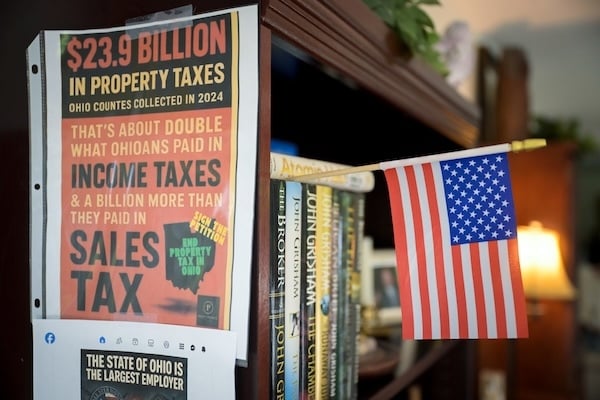
A poster on a bookcase inside Ron Shumate’s home in Springfield Township, Ohio, on April 21, 2026. (Glenn Hartong for The Epoch Times)
MIDDLEBURG HEIGHTS, Ohio—At a petition table inside a Cleveland area gun show on a drizzly Saturday afternoon, citizens talk of an American Dream derailed.
There’s the elderly couple who paid off their mortgage decades ago but can’t afford the property taxes on their home. Their local government, theoretically, can seize the property and auction it off to someone else if the annual bills remain unpaid.
Then there’s the recent retiree who took a part-time job at Lowe’s to pay property taxes on his rental property and avoid raising his tenants’ rent.
Add empty nesters who can’t downsize to smaller houses because interest rates are too high, farmers describing an impossible situation, and recent college graduates groaning about moving further away from home to an affordable place.
Show goers, guns and ammo in hand, pause at Beth Blackmarr’s table on their way out and share with her those concerns. If 413,000 residents throughout the Buckeye State sign a petition before July 1, a public vote to eliminate local property taxes will appear on the November ballot.
If the signature count falls short, whatever is collected can be applied the following year, or however long it takes, said Blackmarr, media coordinator and a main volunteer for the 3,000-plus member Citizens for Property Tax Reform group.
“We are really hurting in Ohio,” she told The Epoch Times. “People never thought they’d be in this situation.”
Ohio isn’t alone. Forty-six states and the District of Columbia already have limits on annual local property tax levy increases, and leaders in Florida and Texas are pursuing additional legislation to limit government “flexibility” in how it raises revenues, according to a September report from McKinsey and Co., a global management consulting firm whose clients include state and local governments.
Schools, already strapped for cash, hang in the balance. School districts struggle with declining student enrollment, unfunded mandates, state and federal aid loss largely due to skyrocketing Medicaid costs, and spiking employee health insurance costs.
On the local level, mayors and town boards face similar challenges as they try to continue providing public safety, utilities, and infrastructure services.
Fed-up homeowners say it’s high time to try another way to pay their community’s civil servants, perhaps through higher sales tax or state income tax rates, along with slashing administrative bloat in schools and city halls.
“Let the state find a way where 100 percent of the population pays for education,” Ron Shumate, one of Blackmarr’s volunteers from suburban Cincinnati, told The Epoch Times. “They give profit-making businesses a break, but not us.” (More)Sponsored by NativePath
Health experts say many older adults unknowingly lack a key mineral needed for hydration, muscle function, and energy. A simple “salty drink” is gaining attention for supporting daily balance – without sugar or artificial ingredients. See the 7 reasons doctors are talking about it.Read Now ➜
POLITICS
President Donald Trump on May 4 touted his economic policies, from tax cuts and tariffs to deregulation, at a White House event for small-business owners from across the country. He said the United States is thrivingdespite conflict in the Middle East.
The federal government is taking steps to tackle what it described as the overprescribing of antidepressants and other psychiatric drugs, Health Secretary Robert F. Kennedy Jr. said at an event focused on “mental health and overmedicalization.”
The U.S. Supreme Court took the unusual step of making its recent ruling to limit the use of race in redistricting effective ahead of the usual 32-day waiting period.
The U.S. Department of Justice is suing Minnesota over the state’s climate lawsuit against major energy companies.
Federal law enforcement should target drug cartels and their supply lines, and Americans should work to create a drug-free nation, the office that is tasked with fighting drug addiction said in its updated strategy. “We will take the fight to the enemy with a relentless offense,” Sara Carter, director of the Office of National Drug Control Policy, said in a letter accompanying the nearly 200-page strategy document. “The era of containment has failed.”
LATEST NEWS
Video game retailer GameStop has proposed buying eBay in a $55.5 billion cash-and-stock deal.
A Washington-based human rights organization today filed a federal complaint against the National Education Association, alleging that the teachers union discriminated against its Jewish members and promoted a hostile environment throughout K–12 public schools.
Officials from the Chinese consulate in Vancouver met with a city hall official in April to pressure the city not to allow Shen Yun to perform at the Queen Elizabeth Theatre, which is owned by the City of Vancouver.
Former New York City Mayor Rudy Giuliani is recovering from pneumonia but is still hospitalized in “critical but stable condition,” his spokesperson said Monday.
OPINION
Amid Changing Political Winds, Latin America Is at a Turning Point—by Conrad Black (Read)
What Killed Spirit Airlines—by Jeffrey A. Tucker (Read)
Beijing Cannot and Will Not Take the IMF’s Sage Advice—by Milton Ezrati (Read)
A farmer rides a donkey past bales of wheat hay and palm trees in the village of Maraziq, about 30 kilometers south of Giza in Egypt, on May 4, 2026. (Khaled Desouki / AFP via Getty Images)
📸 Day in Photos: Military Drills, 2026 Met Gala, and Meat Industry Investigation (Look)
🎙️ Podcast: Shadow fleet, Chinese teapots, U.S. blockade, sanction evasions, and a renewed fear of the Chinese regime, all ahead of the Trump-Xi summit in mid-May. China Watch connects all the dots for you. (Listen)
Dancer Xiuxian Yin (R) accepts a proclamation from the city of San Marcos, Calif., on behalf of Shen Yun Performing Arts, from Councilmember Danielle LeBlang. (NTD Television)
Yin Xiuxian’s father was detained in a labor camp at the time Yin was born—not because he had committed a crime, but because he refused to give up his faith in Falun Dafa while living in communist China.
Three days after Yin’s birth, police barged into their home and threatened to also arrest his mother, Zhang Wanxia, if she didn’t renounce her faith. Before Yin turned 2, they followed through—a group of police raided the house and dragged the mother away from her crying son to illegally detain her. She was kept at a brainwashing center for more than six months.
Later, in September 2003, Zhang was illegally sentenced to two years of forced labor. Because she refused to renounce her faith, her sentence was extended by one month beyond her initial term. At the labor camp, she suffered brutal persecution, including 15 days of sleep deprivation and prolonged torture, including being hung up by handcuffs.
Yin’s childhood was marked by family separation. He stayed with his paternal grandparents and remembered they were living under constant fear and anxiety due to the Chinese authorities’ persistent harassment. They never knew whether his parents might return home that day or when the next home raid might occur.
Yin told The Epoch Times that what happened on his seventh birthday epitomizes what his childhood was like. Back then, he was still too young to understand why his family was persecuted by Chinese authorities.
That morning, Yin excitedly asked his father if he could please buy him a birthday cake—a big one if possible. His father agreed, and that evening Yin waited for his father to come home from work. (More)
🎲 Games
Spot the Difference is our readers’ favorite. Play it here.
Our mailing address is: The Epoch Times, 129 West 29th Street, Fl 8, New York, NY 10001 | Contact Us
Our Morning Brief newsletter is one of the best ways to catch up with the news. Manage your email preferences here or unsubscribe from Morning Brief here.
*Disclaimer: The opinions expressed in this advertisement are exclusively those of the advertiser and do not represent our views or positions. This material is promotional in nature and should not be mistaken for news, research or editorial content.
With the national debt hitting $38 trillion and growing $8 billion daily, this intelligence report is more critical than ever. But we may have to take it down soon.
Why?
The report exposes how Trump’s $3 trillion spending bill created an artificial bubble in your 401(k).
It reveals why your “safe” retirement investments are actually the riskiest.
It shows the precious metals strategy that protects wealth when fake money systems collapse.
Sherwin-Williams pointed to elevated mortgage rates — which are weighing on the housing market — as a reason to expect softer do-it-yourself (DIY) consumer demand. The weakness isn’t limited to new construction: the company said existing homeowners are cutting back on remodeling projects. Perhaps more troubling for investors, management sees no clear signs of a near-term reversal.
Veteran trader Bill Poulos is giving away his ‘Simple Options Trading For Beginners’ book – normally $29.97 – at no charge.
Inside, he reveals the one options technique that took him 11 years to find, why more strategies often lead to more losses, and the 10-minute nightly routine that replaced his 8-hour trading days.Grab your free copy of Simple Options Trading For Beginners today
Adding to concerns are higher producer costs tied to geopolitical tensions in the Middle East. The company faces increased expenses for raw materials, energy inputs and transportation, and plans selective price increases to offset some of that pressure. How effective those hikes will be amid weakening demand remains uncertain.
Solid Earnings Show Resilience in a Weak Housing Market
The April 28 report was solid. Sherwin-Williams posted adjusted earnings per share (EPS) of $2.35, beating expectations of $2.28 and rising about 4% year over year. The company also reiterated its full-year 2026 guidance, with a midpoint forecast of $11.70; adjusted EPS for full-year 2025 was $11.45.
Revenue of $5.67 billion topped estimates of $5.56 billion and was 6.7% higher than the $5.31 billion reported in Q1 2025. Management guided to low- to mid-single-digit revenue growth for the full year.
Overall, the results suggest Sherwin-Williams is leveraging its channel relationships and leading brands to navigate the current business cycle.
Valuation Concerns May Limit Near-Term Upside
One issue investors must weigh is valuation. Analysts trimmed price targets ahead of the report, and the consensus price target of $375.33 as of April 30 sits roughly 15% below the stock price. The company also trades at a P/E ratio near 31x, a premium to the S&P 500 (around 27x) and the Specialty Chemicals sector (around 23x).
That said, Sherwin-Williams has a healthy balance sheet. Operating cash flow of $139.1 million marked a substantial improvement from the -$61.1 million reported in Q1 2025, supporting the view that SHW has the financial discipline to weather a down cycle.
Dividend Growth and Long-Term Compounding Remain Key
Before the earnings report, Sherwin-Williams announced a quarterly dividend of $0.80 per share, payable June 8 to shareholders of record on May 22.The company is a Dividend Aristocrat, having increased its dividend for 48 consecutive years — two years shy of Dividend King status.
Investors should keep a long-term perspective. Prior to the post-earnings dip, SHW had delivered a total return of just over 30% over the past five years, reflecting housing-market softness. Over 10 years and longer, total returns illustrate the company’s role as a compounder of both growth and value in a portfolio.
These problems are material and could justify a lower valuation; Sherwin-Williams’ best course is to control the controllables.
In the near term that means delivering slow, steady growth. Growth could accelerate if the housing market improves — for example, if mortgage rates fall following one or more cuts to the federal funds rate in 2026.
Tuesday’s Bonus Story
The Volatility Harvester That Thrives in Market Chaos
Submitted by Peter Frank. Article Published: 4/27/2026.
Key Points
Virtu Financial profits from market volatility by capturing trading spreads across massive daily volumes.
Earnings surged in 2025, but results remain highly dependent on unpredictable market conditions.
The stock price looks efficient, but volatility-driven earnings make long-term consistency uncertain.
For investors who welcome market swings, Virtu Financial (NYSE: VIRT) has many appealing features. Most companies shy away from volatility; Virtu is built to harvest it.
The company is one of the largest electronic market makers in the United States, sitting at the center of billions of stock, options and ETF trades every day.
Veteran trader Bill Poulos is giving away his ‘Simple Options Trading For Beginners’ book – normally $29.97 – at no charge.
Inside, he reveals the one options technique that took him 11 years to find, why more strategies often lead to more losses, and the 10-minute nightly routine that replaced his 8-hour trading days.Grab your free copy of Simple Options Trading For Beginners today
The result: a business that delivered one of its strongest years on record in 2025, with earnings that nearly doubled year over year. But Virtu’s results can be volatile, and with an unpredictable CBOE Volatility Index so far this year, forecasting 2026 is difficult.
The question for Virtu investors is whether last year’s performance — and a world prone to turbulence — will persist.
While Virtu earns money in calm markets, it benefits disproportionately from volatility. When markets are quiet and spreads tighten, earnings compress. When markets are turbulent and spreads widen, earnings expand. Last year was a clear example: overall trading volume, on- and off-exchange, rose by some measures nearly 45% year over year — the kind of activity that fueled Virtu’s results.
2025 Results Show Strong Momentum
The numbers illustrate the point. For the fourth quarter of 2025, Virtu reported earnings per share (EPS) of $1.85, beating the analyst consensus of $1.12 by 65%. Revenue for the quarter reached $969.9 million, far surpassing the $513.5 million analysts expected. Elevated market volatility produced net trading income of $664.9 million that quarter and a net income margin of 28.9%.
The quarter capped a similarly strong year. Total revenue for the 12 months reached $3.6 billion, up 26.2%, with net trading income of $2.44 billion and a net income margin of 25.1%. Diluted EPS for 2025 was $5.14, up from $2.97 a year earlier, and adjusted EBITDA rose to about $1.4 billion. By year-end, Virtu held $1.06 billion in cash, up from $872.5 million a year earlier, giving the company solid financial flexibility.
Shareholder Returns Remain Modest
Virtu is not a buy-and-forget stock for many investors. Although the stock is up around 45% this year and more than 25% over the past 12 months, its history shows notable swings.
Virtu pays 96 cents a share annually, roughly a 2% yield at recent prices. The payout ratio is under 20%, suggesting some capacity to increase the dividend. Combined with $135.3 million in share buybacks last year, total capital returned to shareholders is higher than the dividend alone. With a price-to-earnings ratio (P/E) near 9x trailing earnings, the market appears skeptical about the sustainability of results rather than the quality of the underlying business.
Regulatory Risks Remain a Concern
There are clear risks. Capital markets could slow again, reducing trading activity and compressing Virtu’s earnings. More significantly, the firm’s activities attract regulatory scrutiny. High-frequency trading and market making raise questions about the security of “order flow” and customer data. Part of Virtu’s revenue depends on payment for order flow from brokerages, a practice regulators have examined for years.
In December, a broker-dealer subsidiary, Virtu Americas LLC, agreed to a $2.5 million civil penalty with the Securities and Exchange Commission to settle allegations it failed to maintain adequate safeguards around customers’ confidential trading information. While the penalty was small financially, it underscored a vulnerability that, if repeated, could lead to larger regulatory consequences and pressure on earnings.
Analyst Views Remain Divided
Given the earnings sensitivity to market conditions, analysts remain split on Virtu. Of the seven analysts covering the stock, four rate it Buy, two rate it Hold and one rates it Sell. The consensus is a Moderate Buy, with an average price target of $46 — slightly below the stock’s current trading level.
The division is understandable: when a company’s results depend heavily on overall market activity, forecasting future performance is challenging.
Built for Volatility, Priced for Patience
Virtu Financial is an unusual investment in the financial sector. It’s not a straightforward compounder for every investor, but it thrives when markets rattle portfolios. Its 2025 performance was impressive — earnings nearly doubled, cash rose above $1 billion, and the dividend remains well covered. With a P/E of about 9x trailing earnings and a sub-20% payout ratio, the valuation appears reasonable.
That said, Virtu’s earnings are inherently unpredictable. If market volatility subsides, earnings could moderate. When markets become chaotic, Virtu tends to perform well. Given today’s uncertain environment, the future of Virtu is anyone’s guess.
Thank you for subscribing to The Early Bird, MarketBeat’s 7:00 AMnewsletter that covers stories that will impact the stock market each day.
This email communication is a paid sponsorship provided by American Alternative, a third-party advertiser of The Early Bird and MarketBeat.
If you need assistance with your subscription, please feel free to contact our U.S. based support team at contact@marketbeat.com.
If you no longer wish to receive email from The Early Bird, you can unsubscribe.
Copyright 2006-2026 MarketBeat Media, LLC. 345 North Reid Place #620, Sioux Falls, SD 57103-7078. USA..
Reaching boys and girls with the Gospel of Jesus Christ through Operation Christmas Child shoebox gifts isn’t just a year-end opportunity. It’s a year-round adventure!Learn More
Prayerfully consider becoming a year-round volunteer. If you’re wondering what that might look like for you, check out the following roles:
We’ll help you find the position that best fits your unique talents and interests, and provide you with great resources to help you succeed. You’ll serve on a team in your local community and join a worldwide network of over 10,000 volunteers who are passionate about sharing God’s love through shoebox gifts. Check out our website to discover more of the benefits of serving with us year-round.
Declare His glory among the nations! Psalm 96:3
Operation Christmas Child® is a project of Samaritan’s Purse®.Franklin Graham, President
Stocks pulled back Monday as geopolitical caution collided with an otherwise resilient earnings backdrop, leaving bulls on defense after April’s historic run. The central tension is energy security versus broader risk appetite: fresh Iranian strikes on UAE oil infrastructure and a U.S. warship turned back in the Strait of Hormuz reignited fears that the conflict could widen, steepening Treasury yields and sending oil sharply higher. Market breadth, already narrow heading into the session, offered little cushion.
The Hormuz developments reshuffled sector positioning in a hurry. With the Strait effectively contested, energy became the one pocket of strength while rate-sensitive sectors felt the squeeze as the 10-year yield climbed to its highest level in over a month, pushing mortgage rates back above 6.5%. The Fed’s firmly on-hold posture, reinforced by three dissents against any easing bias at the last meeting, left no policy backstop for the selloff.
On the corporate tape, energy names like APA and Diamondback led the session, reflecting direct exposure to higher oil. Seagate surged after a blowout storage earnings report, feeding the AI infrastructure demand narrative. eBay jumped after GameStop proposed a nearly $56 billion acquisition, a headline that overshadowed eBay’s own fundamentals. Palantir climbed into its earnings report after the close. Traders are watching AMD’s Tuesday earnings report.
NVIDIA (NASDAQ: NVDA) CEO Jenson Huang says the company has 0% GPU market share in China, but that’s only the official picture. It makes no direct sales to China, as the advanced Blackwell lineup is banned, and the firm’s H200s are heavily restricted. There is, however, a booming gray market in w…READ THE FULL STORY
Every AI bull run eventually collides with a hard physical constraint. Right now, that constraint is power. Rob Spivey, director of research at Altimetry Research, has spent months mapping the energy infrastructure buildout behind the AI boom—and his findings point to a specific kind of company tha…READ THE FULL STORY
Struggling stocks are signaling confidence ahead, recently announcing substantial share buyback authorizations. These names are looking to buy shares at what they likely view as depressed prices, providing positive signals to investors going forward. Netflix’s Buyback Capacity Hits 8% of Market Cap…READ THE FULL STORY
51% of Americans expect a major stock market meltdown – and former $200M money manager Jeff Clark says what we’re seeing now is just the beginning of a significant economic shift.
Once a struggling brick-and-mortar retailer, GameStop is now swinging for a much bigger stage. GameStop (NYSE: GME) CEO Ryan Cohen made his move, announcing the intended acquisition of eBay (NASDAQ: EBAY), but now faces many challenges. The primary challenge is execution, as integrating the two pl…READ THE FULL STORY
Top hyperscaler companies reported earnings in the final week of April, and received a mixed reaction from investors. The day after reporting, Google’s parent company, Alphabet (NASDAQ: GOOGL), was the clear winner, rising by a whopping 10%. Amazon.com (NASDAQ: AMZN) took second place, but still ro…READ THE FULL STORY
Over 1,500 banks have voluntarily enrolled in FedNow, the Federal Reserve’s centralized transaction system outlined in Federal Reserve Docket No. OP-1670, designed to track, flag, and potentially freeze your daily spending.
Banks are joining in exchange for lower transaction fees – savings they keep rather than pass on to customers. In return, the government gains around-the-clock visibility into your transactions, political donations, and private transfers.
Martin D. Weiss, PhD, founder of Weiss Ratings, has released an urgent briefing detailing 4 legal steps to help structure your savings before FedNow expands further.SEE THE 4 STEPS TO HELP FED-PROOF YOUR SAVINGS TODAY
Tyson Foods (NYSE: TSN) is no headline-making growth story, but it is a quality consumer staple whose stock price is setting up for big gains. Consumer trends and commodity prices underpin its business and outlook, indicating steady growth and cash flow, which is the operational detail. Cash flow e…READ THE FULL STORY
Dividends are on the rise for key names across chips, utilities, and transportation. This includes one of the semiconductor industry’s highest-yielding stocks. Investors are taking notice as this name is just now getting its feet wet in the artificial intelligence (AI) buildout. Qualcomm Sees Hyper…READ THE FULL STORY
This earnings season has delivered a clear message: the companies leading this market are not just holding up in a challenging macro and geopolitical environment, they are accelerating and growing at an impressive pace. Five of some of the the most closely watched names in the market all reported Q…READ THE FULL STORY
A $2 trillion IPO doesn’t happen in a vacuum. Before SpaceX ever trades on a public exchange, the infrastructure powering its reusable rockets and AI-driven systems is already running through a handful of publicly traded companies—and according to Dylan Jovine, founder of Behind the Markets, most i…READ THE FULL STORY
Shares of aerospace and defense giant Lockheed Martin Corporation (NYSE: LMT) took a heavy hit following the release of its Q1 2026 earnings report on April 23, extending a sharp pullback that has now seen the stock fall as much as 27% since early March highs. That makes the setup especially impor…READ THE FULL STORY
Advanced Micro Devices, Inc. operates as a semiconductor company worldwide. It operates through Data Center, Client, Gaming, and Embedded segments. The company offers x86 microprocessors and graphics processing units (GPUs) as an accelerated processing unit, chipsets, data center, and professional GPUs; and embedded processors, and semi-custom system-on-chip (SoC) products, microprocessor and SoC development services and technology, data processing unites, field programmable gate arrays (FPGA), …
Should I Buy Advanced Micro Devices Stock? AMD Bull and Bear Case Explained
These insights were generated using artificial intelligence. They are based on proprietary MarketBeat data, news articles, and custom LLM A.I. algorithms. This analysis of Advanced Micro Devices was last updated on Thursday, April 30, 2026 at 6:04 PM.
Advanced Micro Devices Bull Case
The current stock price is around $323, reflecting strong market interest and potential for growth.
Analysts have recently upgraded their earnings per share (EPS) estimates for FY2026, indicating positive financial performance expectations.
Advanced Micro Devices, Inc. has a solid market capitalization of approximately $526.94 billion, showcasing its strong position in the semiconductor industry.
With a consensus rating of “Moderate Buy” from analysts, there is a general optimism about the company’s future performance.
The company has a low debt-to-equity ratio, suggesting financial stability and lower risk for investors.
Advanced Micro Devices Bear Case
The stock has experienced volatility, with a recent decline of about 3.4%, which may concern risk-averse investors.
Despite positive upgrades, some analysts have set lower price targets, indicating potential caution in the market.
Insider selling activity has been noted, which could signal a lack of confidence from company executives regarding future performance.
The high price-to-earnings (P/E) ratio suggests that the stock may be overvalued compared to its earnings, which could deter value investors.
Market conditions can be unpredictable, and the semiconductor industry is subject to rapid changes that may impact performance.
The Early Bird is a daily email newsletter powered by MarketBeatthat covers the top stories that will impact the stock market each day. Read your copy every morning at 7:00 AM Eastern so that you can “catch the worm” when the market opens.
Over the past week, there have been several moments on campus that I think tell quite a story about what makes us who we are. Last Tuesday, we gathered at St. Francis Xavier for our final all-school liturgy of the year, our Transitions Mass. It is our tradition that, at the end of Mass, the seniors “pin” the juniors and pass on the mantle of leadership. I was particularly struck last week by the sincerity of our seniors in that moment and in the embraces they exchanged afterward.
A few minutes later, Mass ended and the recessional hymn, Reckless Love, began. It was a striking scene to witness 1,400 adolescent boys, arms around each other’s shoulders, singing in full voice about the overwhelming, never-ending, reckless love of God.
This past Saturday, I witnessed 21 of our students receive the Sacraments of Initiation, completing their months-long journey of preparation to be fully received into the Church. Just as striking was that many chose classmates as their sponsors, a powerful expression of Brophy brotherhood.
In the days since, I’ve been thinking about the connection between these moments, the sincerity of our seniors, our student body singing arm in arm, the courage of young men choosing to deepen their faith, and the example of a life fully given in service to God and others. These are not separate stories; they are links in a chain that forms a brotherhood that lasts a lifetime.
The events of this past week have also caused me to wonder how many of our alumni have followed a path similar to Fr. Pabst’s and are serving today in ordained ministry.
We would like to know.
If you are a Brophy alumnus currently serving in ordained ministry (in any faith tradition), or if you know someone who is, I ask that you please take a moment to complete this form. Our hope is to gather these names so that we can better connect these men to the faith life of our school community.
Thank you for your help with this and for the many ways you support Brophy.
Jeff Bezos has sold over $30 billion of Amazon stock since 2002.
Anyone who used Bezos’s selling as a signal would have bailed out of Amazon at the first SEC filing and missed the run from a split-adjusted $1 to over $200.
That selling is what made Bezos the second-richest person on the planet, and the financial media still treats it as a warning.
That is the trap insider selling sets, and the financial media falls for it every quarter.
Last year alone, Mark Zuckerberg sold $2.2 billion of Meta stock.
The headlines treated it as a warning sign, and Meta gained 82% the same year. Zuckerberg was selling into all-time highs, and the financial press called it bearish anyway.
The Research Says…
Bill Gates has been selling Microsoft for 30 years, and Microsoft has gone from under $50 to over $400 during that time. The Walton family’s selling pattern works the same way: billions of dollars unloaded over two decades while Walmart kept making all-time highs. The pattern is the same every time.
This is not a small data error. It’s an entire framework that financial media has been getting wrong for forty years.
The academic literature is unambiguous on this.
A study by Francois Brochet at Boston University found that insider sales “have often been found to bear little to no association with subsequent stock returns,” and academic research going back to the 1980s has reached the same conclusion.
Insider buying predicts returns, while insider selling predicts nothing.
Here’s why…
SPONSORED
Reagan’s Tech Prophet Issues Warning
George Gilder handed President Reagan the first microchip that helped create $6.5 trillion in wealth over the last 40 years. Now he’s stepping forward with an even bigger prediction about what’s being built in the Arizona desert.
He believes 3 little-known companies will explode when a bombshell announcement just days from now. Smart investors are already positioning themselves.
Insiders sell for reasons that have nothing to do with the company’s prospects:
Diversification because their entire net worth is tied up in one stock
Estate planning because they have to
Lifestyle because they want a house or a yacht or – in Larry Ellison’s case – an entire Hawaiian island
Tax advice because their accountants recommend it as standard practice.
The taxes are actually the cleanest explanation.
When a founder sells stock at long-term capital gains rates, they pay 20%, but if they took the same money as salary, they would pay 37%. The tax code rewards insider selling, which makes it a feature of the wealth-management system rather than a verdict on the business.
Wall Street has gamed this so thoroughly that some founders pay zero tax on their lifestyle by never selling any shares.
Ellison funds his life by borrowing against his Oracle stock, deducting the interest, never repaying the principal, and keeping the shares intact for the next generation. This is how the actual rich operate.
The opposite transaction is the only one that matters.
When an insider uses their personal account to buy their own company’s stock with cash, they are doing so for one reason: they think it is going up.
YOUR ACTION PLAN
Insiders are already loaded with options, restricted stock, and equity grants. The last thing they need is more shares, which is why a personal-account purchase is the only insider signal worth tracking.
I started buying a select group of software stocks last week based on exactly that signal.
The insider buying inside this group has been some of the heaviest I have seen in the tech sector in years, and the stocks are all sitting at or near 52-week lows because the market has been throwing them out with the AI panic.
The setup looks like the kind that pays for years.
The names and the position structure are inside The War Room.
Wharton’s Jeremy Siegel says Trump is “the most pro-stock market president we’ve had in our history.”
And the numbers back it up.
During Trump’s first term, innovative companies soared:
TradeDesk jumped 2,500%
Digital Turbine soared 8,000%
Enphase Energy returned 9,700%
Now, with Trump’s new economic blueprint in place, investment expert Alexander Green has identified a handful companies set to lead the next wave of wealth creation…
And Alex is revealing their names and ticker symbols, free of charge.
You are receiving this email because you subscribed to Trade of the Day. To unsubscribe from Trade of the Day, click here.
Questions? Check out our FAQs. Trying to reach us? Contact us here. Please do not reply to this email as it goes to an unmonitored inbox.
To cancel by mail or for any other subscription issues, write us at: Trade of the Day | 14 West Mount Vernon Place | Baltimore, MD 21201 North America: 800.507.1399 | International: +1.443.353.4977 Website | Privacy Policy Keep the emails you value from falling into your spam folder. Whitelist Trade of the Day.
Nothing published by Monument Traders Alliance should be considered personalized investment advice. Although our employees may answer your general customer service questions, they are not licensed under securities laws to address your particular investment situation. No communication by our employees to you should be deemed personalized investment advice. We allow the editors of our publications to recommend securities that they own themselves. However, our policy prohibits editors from exiting a personal trade while the recommendation to subscribers is open. In no circumstance may an editor sell a security before subscribers have a fair opportunity to exit. The length of time an editor must wait after subscribers have been advised to exit a play depends on the type of publication. All other employees and agents must wait 24 hours after publication before trading on a recommendation.
Any investments recommended by Monument Traders Alliance should be made only after consulting with your investment advisor and only after reviewing the prospectus or financial statements of the company.
Protected by copyright laws of the United States and international treaties. The information found on this website may only be used pursuant to the membership or subscription agreement and any reproduction, copying or redistribution (electronic or otherwise, including on the world wide web), in whole or in part, is strictly prohibited without the express written permission of Monument Traders Alliance, LLC, 14 West Mount Vernon Place, Baltimore, MD 21201.
“I caught Intel at $80. The same setup just fired on four more.”
Nate Bear, Lead Technical Tactician, Monument Traders Alliance
Intel ran from $80 to $100 in weeks, and it had nothing to do with luck or a guru tip.
It was a specific weekly squeeze setup that fires right after a big earnings beat. The pattern is simple: a stock gaps up on the report, consolidates for a few weeks, then continues higher into the next leg.
That EXACT signal just fired on four more names this earnings season.
The first is a software stock that just broke out of a base it spent months building, with last week’s earnings beat coming in close to double the expected move.
Next is a steadier energy name with a clean flag pattern, the kind of trade that does not light your hair on fire but pays consistently.
Then there’s a $12 stock with a beautiful weekly squeeze setting up into its own earnings catalyst.
And the fourth is my favorite chart in the entire market right now. It is a cup and handle pattern on a stock I already have a position in, and the target is significantly higher.
All four are in the consolidation or breakout phase right now, which means the continuation moves are still ahead.
This is the same clean earnings winner playbook that caught Intel at $80. No prediction required, no trend-fighting.
You are receiving this email because you subscribed to Trade of the Day Wake-Up Watchlist. To unsubscribe from Trade of the Day Wake-Up Watchlist, click here.
Questions? Check out our FAQs. Trying to reach us? Contact us here. Please do not reply to this email as it goes to an unmonitored inbox.
To cancel by mail or for any other subscription issues, write us at: Trade of the Day | 14 West Mount Vernon Place | Baltimore, MD 21201
Nothing published by Monument Traders Alliance should be considered personalized investment advice. Although our employees may answer your general customer service questions, they are not licensed under securities laws to address your particular investment situation. No communication by our employees to you should be deemed personalized investment advice. We allow the editors of our publications to recommend securities that they own themselves. However, our policy prohibits editors from exiting a personal trade while the recommendation to subscribers is open. In no circumstance may an editor sell a security before subscribers have a fair opportunity to exit. The length of time an editor must wait after subscribers have been advised to exit a play depends on the type of publication. All other employees and agents must wait 24 hours after publication before trading on a recommendation.
Any investments recommended by Monument Traders Alliance should be made only after consulting with your investment advisor and only after reviewing the prospectus or financial statements of the company.
Protected by copyright laws of the United States and international treaties. The information found on this website may only be used pursuant to the membership or subscription agreement and any reproduction, copying or redistribution (electronic or otherwise, including on the world wide web), in whole or in part, is strictly prohibited without the express written permission of Monument Traders Alliance, LLC, 14 West Mount Vernon Place, Baltimore, MD 21201.
(4) Abide in Me, and I in you. As the branch cannot bear fruit of itself, unless it abides in the vine, neither can you, unless you abide in Me. (5) “I am the vine, you are the branches. He who abides in Me, and I in him, bears much fruit; for without Me you can do nothing. New King James VersionChange email Bible version
There comes a point in the lives of all of God’s children when we are brought face to face with this fact, forcing us to acknowledge our utter powerlessness and inability to carry out God’s will on our own. This can be very uncomfortable and humbling, as much of this world’s culture is based on ideas of individualism, personal achievement, and living life under one’s own power.
So, we tend to avoid acknowledging our weakness, our helplessness, and our absolute inability to accomplish spiritual things—on our own. Our human nature is disposed to glory in what it has done and can do on a physical level, yet that nature is wholly insufficient for producing spiritual fruit. But wherever pride remains, we bristle at the suggestion that we are not up to any task. All too often, we may mentally—or even verbally—agree with Jesus’ words here, but at the first opportunity, we try to do things without Him.
A strong, dramatic contrast to this appears in the example and words of Christ. We know that He was God in the flesh, and that He had all the resources of the universe at His disposal. Yet, the details and structure of that reality can easily slip from our minds. Consider this sampling of verses showing that Jesus harbored no notion that He was doing things by His own power:
» Then Jesus answered and said to them, “Most assuredly, I say to you, the Son can do nothing of Himself, but what He sees the Father do; for whatever He does, the Son also does in like manner.” (John 5:19; emphasis ours throughout.)
» I can of Myself do nothing. As I hear, I judge; and My judgment is righteous, because I do not seek My own will but the will of the Father who sent Me. (John 5:30)
» Then Jesus said to them, “When you lift up the Son of Man, then you will know that I am He, and that I do nothing of Myself; but as My Father taught Me, I speak these things.” (John 8:28)
» For I have not spoken on My own authority; but the Father who sent Me gave Me a command, what I should say and what I should speak. (John 12:49)
» Do you not believe that I am in the Father, and the Father in Me? The words that I speak to you I do not speak on My own authority; but the Father who dwells in Me does the works. (John 14:10)
Clearly, while Jesus was in the flesh, He had no ability in Himself that was different from any other man’s. He was flesh and subject to the same limitations as any other fleshy human. What He did have, though, was a perfect union with the Father, which was the source of all that He accomplished. The source of His authority, His power, His life-giving words, His rebukes, His judgments, the miracles, His responses to carnal men, His ability to submit to all kinds of evil without being overcome by it, and His willingness to be tortured and killed by His own creations—everything that He said and did was a result of His being in perfect alignment and agreement with His Father. Because He knew the Father’s will, all He had to do was ask the Most High God to do something that human flesh could not, and it was done.
However, as we read, He could do nothing of Himself, making us exactly like Him in this regard. We are made to depend on God. We are made for union with Him, and nothing works properly without that. Our carnality tries to assert and maintain a measure of independence, but Jesus did exactly the opposite.
Not only did He proclaim that His Father was doing these things, but He also declared frequently that He and His Father were one. There was perfect union. In Him was no independent spirit, and consequently, the Father accomplished tremendous things through Him.
Jesus really means that without Him we can do nothing. Within the immediate context, the “doing” refers to bearing fruit that will glorify God. If we expand the context all the way back to the beginning of His discourse in John 13, we find other things He told them to do that cannot truly be done without Him. He instructed His disciples to keep His commandments, to keep His words, and to loveone another as He had loved them. Trying to do those things without Christ will result in fruit that does not glorify the Father, because we are incapable of doing them correctly or fully on our own!
Consider verses 4-5 in the Phillips translation:
You can produce nothing unless you go on growing in me. I am the vine itself, you are the branches. It is the man who shares my life and whose life I share who proves fruitful. For apart from Me you can do nothing at all.
This clarifies that producing spiritual fruit is not simply a matter of believing Jesus or being forgiven through His blood. He says we will not produce anything unless we “go on growing in [Him].”