What Happens When the AI Bubble Pops?

Everyone is talking about the AI bubble. Even people with no money in the markets are sounding the alarm.

Houston breaks down why in yesterday’s Daily below and what it means for the stocks sitting in your retirement account right now.

But here’s what most people aren’t talking about.


While the biggest tech stocks in the world swing violently on every earnings report, a handful of companies are quietly winning. They’re not the flashy AI names making headlines. They’re the ones building the infrastructure behind it all. The energy. The grid. The data centers.

And subscribers who got positioned in these stocks back in December are now outperforming the S&P 500 by 3x. One position already delivered a 139% win.

Another has 1,833% upside potential still ahead.

You don’t have to guess which AI stock wins. You just have to own the ones that get paid no matter what.

In case you missed it, here’s Big T’s Digital Asset Daily

You know it’s serious when the economic conversation spills over onto the usually “fun” side of social media.

A few days ago, a post crossed my Instagram feed with this warning: “The AI bubble is 17x larger than the dot-com bubble,” it read. “And 4x larger than the 2008 Financial crisis.”

People swarmed the comments. They wanted to know what happens to their savings… or the cash under the mattress… if the bubble pops.

“What if I’ve avoided AI this whole time?” one person asked. “How will it affect me?”

They’re not wrong to ask. If we look at the last two bubbles, the effects when they popped rippled beyond people’s stock accounts.

The dot-com crash contributed to an eight-month recession in 2001. By the spring of 2004, an estimated 403,300 jobs had been lost in the IT sector alone.

The effects of the 2008 crash were even deeper.

A Frontline article published in 2012 (four years after the stock market’s collapse) showed that:

  • There were still 12.5 million people out of work, not saving for retirement, and not contributing to the GDP.
  • The government had poured about $23 trillion into a host of programs and bailouts.
  • Real estate had lost roughly $7 trillion, stocks $11 trillion, and retirement accounts another $3.4 trillion.
  • The Census Bureau’s 2010 estimate said 46.2 million people were in poverty – the largest number in 52 years.

I’m not saying this to scare you. But with the AI bubble getting bigger each day, we can’t afford to bury our heads in the sand.

And what nobody mentioned in that discussion I read last week was the story we’ve been tracking in these pages. Yet it provides the clearest answer to the one question that kept coming up: What can I do about it?

One Market, Two Signals

On April 17, I wrote to you about the Crude Oil Civil War we’re seeing. You can read that full essay here. The short version is this: There’s a civil war happening in the crude oil markets, and most people don’t know it’s connected to the AI bubble.

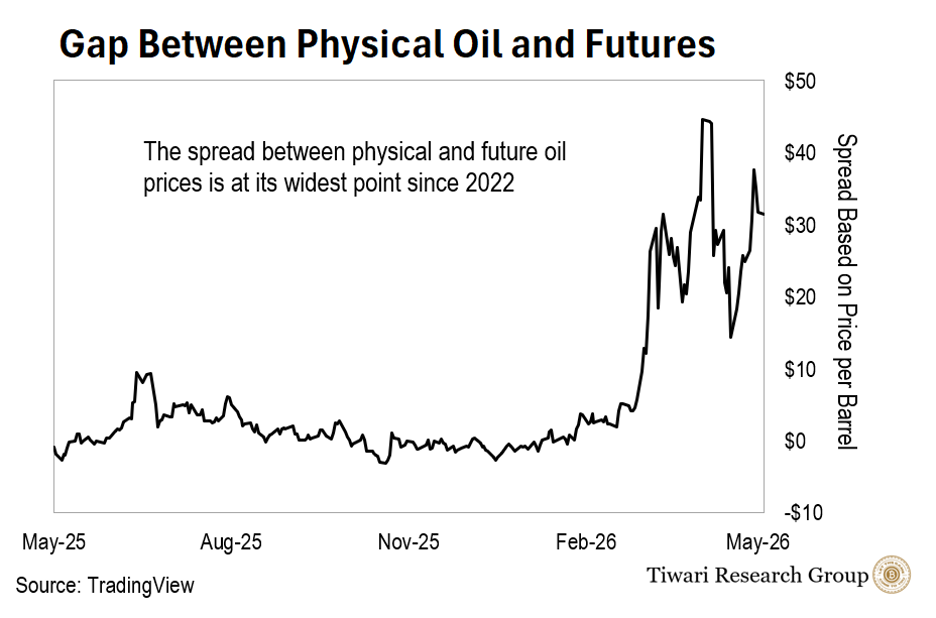
What’s happening is that the “right now” price for physical oil is telling a very different story than the “future” price traders expect to pay in the months ahead.

You can see that in the chart below, which shows the gap (or “spread”) between physical oil prices and futures prices.

That gap hasn’t been this high since 2022, when Russia invaded Ukraine.

What does it mean?

On one hand, the physical market is screaming “shortage.” Buyers need barrels NOW, and they’re paying anything to get them.

That’s because the Iran conflict has a chokehold on the Strait of Hormuz. That’s the narrow waterway through which roughly 20% of global oil supply passed before the war started in February.

On the other hand, traders are saying, “This is temporary. It’ll resolve soon.”

The problem is the market has been saying that for two months. And yet, as you can see, the gap is not really getting any smaller.

This matters because oil touches the price of everything we buy. The longer prices stay high, the more every airline, trucking fleet, chemical plant, and utility in the world will see its primary input cost rise.

And oil prices just hit fresh wartime highs on Friday.

Some of that exposure is hedged, but those hedges don’t last forever. It can take 6-12 months for the full effects to show up. By the time most people feel it, the damage is already done.

Why the “Smart” Money Is Trapped

The irony is that, at the exact moment oil is making historic moves, the institutions managing your retirement savings are legally handcuffed from owning it.

Take CalSTRS, one of the largest pension funds in America. It manages $368 billion in public equities. Between 2022 and 2025, it slashed its traditional (fossil fuels) energy weighting by 36% and moved $30 billion into low-carbon investments.

That’s exactly what I showed you on Wednesday. The “smart” money is being forced to follow ESG mandates in what could be one of the most profitable periods for oil.

Even when we zoom out to all of energy combined, it’s still one of the most underowned sectors in the market. In 2008, it represented 15% of the S&P 500.

Today, it sits at only 3.5%. Compare that to the IT sector, which represents an enormous 32% of the market.

That is a generational abandonment of energy in favor of tech. And history shows us what happens when an unloved sector gets an unexpected catalyst. It snaps back violently.

We saw this back in 2020, when energy hit a record-low weight of just 2% of the S&P 500. Most investors left it for dead after Covid lockdowns crushed oil demand.

That was a mistake. Energy went from the worst-performing sector in 2020 to the top performer in 2021. It gained 46% vs. the S&P 500’s 27%.

By 2022, energy was the only sector in the S&P 500 that finished positive, up 58%. Ten other sectors fell, and the broader index dropped 19%.

That’s a roughly 315% cumulative gain from the unloved bottom over two years, in the most hated sector in the market.

This time, with the physical oil market flashing stress signals, Daily Editor Teeka Tiwari believes we’ll see an even sharper snapback.

Just last week, Al Jazeera published a piece that asked, “When will the Strait of Hormuz be ‘safe’ for commercial shipping again?” The answer boiled down to: Not anytime soon. From that April 28 article:

About 2,000 ships remain stranded in the Gulf. Even if the strait reopens to all traffic, the United States has said it could take six months to clear mines it believes have been laid by Iran.

That is one reason maritime insurers cancelled “war risk” insurance for tankers traveling through the strait in March.

Al Jazeera reported this could push premiums up to 5% of hull value. Before the war, that number was only about 0.25%.

Hull value refers to what the ship itself is worth. Think of it like an insurance appraisal on the vessel, the same way your home has an appraised value before you can insure it. A 5% premium tells us insurers are still pricing the Strait of Hormuz like a war zone, not a shipping lane.

In other words, the crude market is only getting more fractured. And when oil sends mixed signals like this, it usually means the stress has not yet fully worked its way through the economy… and the household names in your retirement portfolio.

The “Paycheck” Strategy for This Market

This is where the oil story connects to the AI bubble.

If oil keeps rising, costs rise across the economy. That matters for every company. But it matters most for the companies already priced for perfection.

The first wave of AI gains went to the obvious names: Nvidia, AMD, Meta, Microsoft, and the rest of the high-flying tech giants.

But those stocks are now swinging violently. One day, investors are questioning whether AI companies will follow through on their promises. The next day, the same stocks are ripping higher.

We saw this with last week’s earnings. Meta and Microsoft beat analyst expectations, and yet they crashed 9% and 4%. Why? Because investors got spooked on AI spending.

That kind of volatility is exactly what we’d expect in a crowded trade. Teeka has been sounding the alarm on this since late last year. And in the January 6Daily, he wrote:

Right now, Alphabet, Amazon, Meta, Microsoft, Nvidia, and Tesla are trading at an average weighted earnings multiple of 56x. That means you have to be willing to pay up to $56 today for every $1 the company earns in a year.

These names are trading at more than 2.5x the entire S&P 500. If that’s not a red flag, I don’t know what is.

We’re not interested in chasing that. Instead, Big T believes the biggest winners from AI won’t necessarily be the flashy tech names everyone is buying today.

The real gains will come from blue-chip companies using AI to improve their margins, cut costs, and boost productivity.

That’s exactly what Teeka’s “Nvidia’s $16 Trillion Paycheck Program” is designed to do. It doesn’t involve buying a single share of Nvidia. It doesn’t involve chasing risky AI startups. And it doesn’t require you to guess which chatbot wins.

Instead, it focuses on a select group of blue-chip companies positioned to benefit from AI adoption while paying reliable dividends along the way. The next scheduled payout is May 15. You can learn more about it here before that deadline.

The bottom line is this: Even people with no money in the markets are starting to sound the alarm on the AI bubble. In times like these, you don’t want to play a high-stakes guessing game.

You want to own the companies built to win no matter what happens next… and get paid while everyone else is guessing.


Don’t Watch the Future Happen. Own It!


Houston Molnar

Update your email preferences or unsubscribe here

© 2026 Tiwari Research Group

1607 Ponce De Leon Ave
San Juan, Puerto Rico 00909, Puerto Rico

Satellite Confirms: Elon Musk Activating Strange ‘Dark Energy’ Across U.S. South

 TrendAdvisorStay sharp with curated market trends, timely analysis, and actionable strategies.Satellite Confirms: Elon Musk Activating Strange ‘Dark Energy’ Across U.S. South – Ad

Confirmed by satellites 300 miles above the Earth’s surface… Elon Musk is rolling out a breakthrough technology that could replace our need for foreign oil and ignite a $10 trillion boom a small group of stocks. Learn how you can investCramer Highlights Nike, Amazon, Nvidia Stock To Investors: ‘Why Would You Sell It?’

Jim Cramer shared thoughts on dozens of stocks for members of the CNBC Investing Club. Here’s his opinion about 3 of the top picks. More Info ➔Discover 3 Stocks Projected to Dethrone Nvidia (NVDA) – Ad

Futurist and Stock Analyst, Eric Fry, published a brand-new research report naming three outsider stocks have the power to completely disrupt the “seemingly invincible” Mag 7. For the time being, this research report is available through this page – at no charge. Get your free copy right here.Iran Threatens To Shut Strait Of Hormuz If US Continues Blockade— Hours After Saying Route ‘Completely Open’

Iran warned it could shut the Strait of Hormuz if the U.S. continues its blockade, even as Washington forces ships to turn back. More Info ➔Federal Reserve faces unorthodox leadership change: Warsh enters, Powell remains

WASHINGTON (AP) — President Trump’s pick to lead the Federal Reserve, , has said he wants to bring “regime change” to the central bank, but if confirmed by the Senate he will find a Fed already transformed by the . More Info ➔Trump Just Named His Secret AI Project. It’s Called “Golden Dawn.” – Ad

When a secretive project gets a name, it means we’re closer to a breakthrough than most people think. When Golden Dawn launches, it could instantly leapfrog ChatGPT, Gemini, and Grok – and trigger a $100 trillion reset of the AI markets. Louis Navellier is revealing the one stock at the center of it – down to the ticker – but only through May 5. Go here to get the details, free.Strait of Hormuz Closed Again, Iran Says ‘Under the Strict Management and Control of the Armed Forces’

Iran’s military announced that the strait had “returned to its previous state” and “is under the strict management and control of the Armed Forces.” More Info ➔Trump Calls Off Talks: ‘They Can Call Us Any Time They Want’

President Trump told Fox News on Saturday that envoys Steve Witkoff and Jared Kushner will no longer be heading to Pakistan for talks with Iran. More Info ➔7 Basic Materials Stocks to Buy to Anchor Your Portfolio – Ad

The movement of basic materials stocks requires investors to keep a keen eye on the state of the economy to determine profitability. Raw materials such as plastic, steel, and lumber will always be in demand. Here are 7 stocks to take advantage of the growing demand! 

Get The Top StocksBy clicking the link above you will automatically opt-in to receive emails from FinStrategist and agree to Privacy PolicyA humanoid robot sprints to victory in Beijing, beating the human half-marathon world record

BEIJING (AP) — A humanoid robot that won a for robots in Beijing on Sunday ran faster than the human world record in a show of China’s technological leaps.  More Info ➔Congresswoman Bought Bitcoin Dip In March: Here’s How Much Her Trade Was

The trading activity of members of Congress continues to draw attention from retail investors, with potential conflicts of interest based on timing of trades and committee assignments signaling red flags around the transactions. More Info ➔How We Zeroed in on a 2660-Bagger Stock – Ad

In 22 consecutive years of “buy” signals, our system has not had a single losing year. With an average gain of 305% across every single “buy” signal, including the stocks that didn’t work out. I’m giving away the names and ticker symbols of 3 stocks our system just upgraded to “Buy” completely free, right inside this video. Watch the broadcast and get your 3 free stock picks now.Scaramucci: Trump Is Trying To Sink Vance Because ‘Trump Wants To Be the Last Republican President’

Anthony Scaramucci says that President Trump’s battles with Pope Leo XIV are intended to box in Vice President Vance by turning Vance’s Catholic identity into a political vulnerability. More Info ➔Who was invited to dinner with King Charles: Justices, business leaders and Palm Beach friends

WASHINGTON (AP) — It was the hottest ticket in town — a white-tie dinner with King Charles III and Queen Camilla , where nearly 130 guests dined on Dover sole meunière and sampled a beehive-shaped chocolate dessert with honey from the . More Info ➔Wall Street’s Most Accurate Analysts Spotlight On 3 Materials Stocks Delivering High-Dividend Yields

During market uncertainty, investors turn to dividend-yielding stocks. Benzinga offers latest analyst ratings & news on high-yield stocks in materials sector. More Info ➔What’s Going On With AMD Stock Monday?

Advanced Micro Devices Inc. (NASDAQ: AMD) trades lower ahead of results. See key support levels and price forecasts here. More Info ➔Amazon’s Next Gold Mine Is Worth $1.3 Trillion: Transport Stocks Begin Paying For It

BofA’s Justin Post says Amazon Supply Chain Services opens a $1.3 trillion logistics TAM. Each 1% share = $13B in revenue. Transports stay under pressure. More Info ➔Charlie Munger Once Recalled Childhood Marbles Strategy That Shaped His Investing Mindset For Life: ‘I Would Never Play For Stakes Unless…’

Charlie Munger showed how a childhood marble strategy of only betting when he had the edge evolved into a lifelong investing philosophy. More Info ➔

Information, charts, or examples contained in this email are for illustration and educational purposes only and not for individualized investment management. This message contains commercial elements, such as advertising and partner offers for which we may receive affiliate compensation. We only send these offers to those who have opted into our newsletter.

If you wish to no longer receive these offers, click on the unsubscribe link at the bottom of this email. Past performance is not indicative of future results. For these reasons, we strongly suggest trading in a DEMO/Simulated account.

The information provided by us is for educational and informational purposes only. We make no representations or warranties concerning the products, practices, or procedures of any company or entity mentioned or recommended in this email and have not determined if the statements and opinions of the advertiser are accurate, correct, or truthful.

If you use, act upon, or make decisions in reliance on information contained in this email or any external source linked within it, you do so at your own peril and agree to hold us, our officers, directors, shareholders, affiliates, and agents without fault.

2967 Dundas St. W. #990, Toronto, ON M6P 1Z2 | Phone Number: 917.672.7040

© 2026 Musth | TrendAdvisor | All rights reserved. 
UNSUBSCRIBE

Tired of Missing Out?

Tired of Missing Out?

If you missed Amazon at $18… Apple at $22… or Google at $85…

You can still stake a claim in ChatGPT BEFORE their Trillion Dollar IPO. [ad]

Free Ticker Revealed Here (Act by June 11)

The $7 Trillion Race for America’s Critical New Resource

Moody’s calls it “the new oil.” Fox News calls it the “new arms race.” Elon Musk calls it “mind-blowing.” Demand is already doubling every 6 months.

 And on May 19, a major global event could ignite a handful of under-the-radar stocks, setting off what could be the biggest resource boom in history. [ad]

Click here now for the full story

Get Paid Every Time Oil Moves

Instead of guessing oil prices, some investors focus on the infrastructure behind it.

Pipelines act like toll roads – generating steady cash flow as energy moves. [ad]

Learn how to tap into itShould you buy Series I bonds amid higher inflation? What experts say

  • Newly purchased Series I bonds are paying 4.26% annual interest through Oct. 31, up from the 4.03% yield offered through April 30.

Privacy Policy | Advertiser DisclosureDISCLAIMER: Stocks and options trading have large potential rewards, but also large potential risk. You must be aware of the risks and be willing to accept them in order to invest in the stocks and options markets. Don’t trade with money you can’t afford to lose. This is neither a solicitation nor an offer to Buy/Sell stocks or options. No representation is being made that any account will or is likely to achieve profits or losses similar to those discussed in this report. The past performance of any trading system or methodology is not necessarily indicative of future results. All trades, patterns, charts, systems, etc., discussed in this report are for illustrative purposes only and not to be construed as specific advisory recommendations. Information contained in this correspondence is intended for informational purposes only and was obtained from sources believed to be reliable. Information is in no way guaranteed. No guarantee of any kind is implied or possible where projections of future conditions are attempted.

Stockguru LLC (dba InvestingDistrict), 2563 cherry hill ln, Hermitage, PA 16148, United StatesYou may unsubscribe or change your contact details at any time.

AI’s Biggest Bottleneck Is…


Managing Editor’s Note: Today, we’re handing the reins to our friend and colleague Jason Bodner.

Longtime Brownstone Research members may remember Jason as a regular contributor from years past. With a Wall Street resume that spans decades, Jason specializes in quantitative strategies that identify high upside, “outlier” stocks.

Today, he shows why the AI trade is becoming multi-faceted. The big question now isn’t how fast an AI can “think,” but how quickly it can “remember.”

Read on…

AI’s Biggest Bottleneck Is…

Jason Bodner

Contributing Editor, The Bleeding Edge


For the last two years, the AI story has been dominated by compute. Faster chips, bigger clusters, more GPUs.

That made sense. More intelligence requires more processing power. As Jeff has discussed in The Bleeding Edge before, AI compute is currently doubling roughly every six months – a pattern that is accelerating.

But something has changed. The focus is no longer solely on how fast AI can think. That problem is being addressed by photonics, fiber optics, and systems moving data near the speed of light.

The constraint today is different. We are now also limited by how fast AI can remember.

Intelligence Factories

AI systems don’t just compute. They constantly retrieve data. Every prompt, every model output, every training run depends on moving enormous amounts of information into the chip at the right time. That’s where things start to break.

Even the most advanced AI chips spend a meaningful amount of time idle, not because they lack power, but because they are waiting for data. That delay comes from memory, not compute.

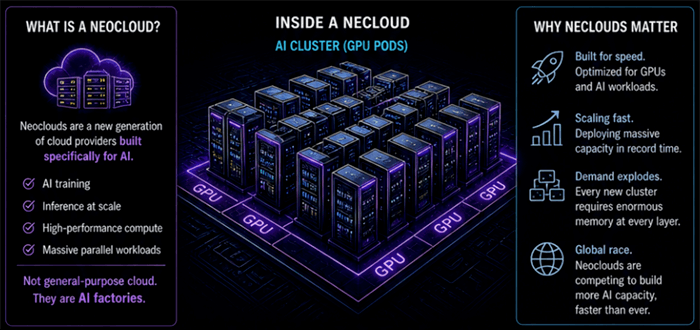
A major driver is the rise of neoclouds. These are a new generation of specialized cloud providers built specifically for AI workloads, compared to traditional hyperscaler cloud solutions. Instead of running general applications, they are building massive GPU clusters for training and inference.

Think of them as factories for intelligence. And these factories require memory at every layer – fast memory to feed the chip, working memory for active datasets, and large-scale storage for everything else.

As these systems scale, memory demand does not grow gradually. It accelerates.

image
image

Recommended Links


How a $900M “Market Wizard” Went 20 Years Without a Single Losing Year

Larry Benedict’s hedge fund, Banyan Capital, generated $274 million in verified profits for clients like JPMorgan, the Bank of New York, the Canadian government, and Saudi National Commercial Bank. His fund went 20 straight years without a single losing year. The kind of record that earned Larry his own chapter in one of the legendary “Market Wizards” book series alongside Paul Tudor Jones and Ray Dalio. Now, on Thursday, May 7, at 8 p.m. ET, Larry’s sharing a method for pocketing a year’s worth of S&P 500 gains in one day… over and over again, without buying, selling or holding a single stock. Free. Click here to automatically reserve your seat.
(When you click the link, your email address will be added to the event guest list.)


Millionaire Warns: “Move Your Money Now.”

Larry Benedict generated $274 million in profits for his clients by knowing where money flows when the Federal Reserve shifts. He says Trump’s Fed Takeover is triggering the most significant shift in U.S. markets in nearly 20 years. He’s already identified the one ticker he expects billions to flood into… and he’s giving away the name for free.
Click here to get the full details before the window closes.


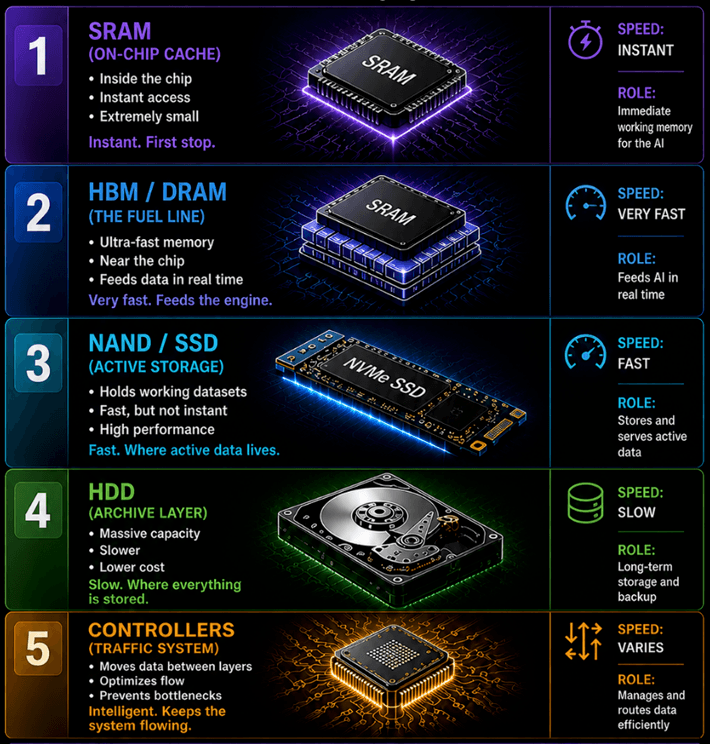
The Memory Hierarchy

Memory is not one thing. It’s a hierarchy. At the top sits SRAM, or Static Random Access Memory. This is on-chip memory. It is effectively instant, but extremely small.

Next is DRAM and HBM. DRAM, or Dynamic Random Access Memory, sits close to the processor and delivers data quickly. HBM, or High Bandwidth Memory, goes further by stacking memory next to the chip to move large amounts of data at once.

Beyond that is NAND flash. This is non-volatile memory that retains data without power. SSDs use NAND to store active datasets and models. It is fast, but not immediate.

Further out are HDDs or Hard Disk Drives. These prioritize capacity over speed and store large volumes of data at lower cost.

Controllers manage how data moves between these layers, so the system does not stall.

Each layer has a role, and each runs at a different speed. The further the data is from the chip, the longer it takes to arrive. Data can now move at extraordinary speeds. The problem is getting it to the right place at the right time.

Memory does not deliver data in a steady stream. It arrives in bursts, at different speeds, from different layers. It resembles a workforce commuting from different parts of a city, all arriving at different times.

That is why performance does not scale perfectly. The chip is only as effective as the system feeding it.

The Memory Shock

Memory has always been cyclical.

Jeff Brown knows this better than anybody. Here’s how he described the phenomenon in the August 2020 edition of The Near Future Report:

Most forms of memory are considered to be commodities. If you can get the same density, processing rates, and power consumption, manufacturers typically go with the cheapest provider prices when supply is greater than demand.

When demand is high and supply is low, memory manufacturers enjoy high margins through higher pricing. The semiconductor industry then tends to overbuild production capacity, attracted by the high margin. Over time, supply exceeds demand, and margins drop.

That was true historically, but AI is introducing a new kind of memory demand shock. Building new capacity takes years and billions of dollars. Supply is concentrated among a small number of players. In memory, the big three are Micron (MU), Samsung, and SK Hynix.

Demand can surge within quarters. When that imbalance appears, prices do not gradually rise. They spike. We are already seeing it. DRAM prices rose approximately 50% in 2025. NAND pricing is recovering. Margins are expanding across the industry. Some executives are already signaling shortages extending years into the future.

Recent earnings tell the story.

When Micron reported Q2 earnings in March, the results were downright shocking. The company reported $12.20 earnings-per share (EPS). In Q2 of the previous year, that figure was $1.56. That’s nearly 7X growth… in one year.

Revenue is beating expectations, growth rates are accelerating, and guidance is aggressive and may still prove conservative. This is not a short-term bump. It is the early stage of a structural shift.

AI is increasing demand not just for compute, but for everything that supports it. Now, the focus is shifting to bottlenecks. And memory is one of the most critical.

Regards,

Jason Bodner
Contributing Editor, The Bleeding Edge

P.S. Hi, Jeff’s managing editor here.

We hope you enjoyed this special issue from our friend and colleague, Jason Bodner. You’ll be hearing more from him soon, so be sure to stay tuned.

As a note, we also want to remind readers that our colleague over at The Opportunistic Trader, Larry Benedict, is broadcasting a special event this Thursday.

Markets have been volatile this year. It’s the sort of environment traders like Larry thrive in.

That’s why he’s unveiling his one-ticker strategy that gives people a shot at more gains in a single day than the S&P 500 typically delivers in an entire year, over and over again, without ever buying, selling, or holding a single stock.

You can go here to sign up with one click to join him for this strategy session on Thursday at 8 p.m. ET.

Recent Articles

Control, Don’t Vibe

May 4, 2026 • 5 min read

It’s Full Steam Ahead for the Hyperscalers

May 1, 2026 • 10 min read

Esse Quam Videri

Apr 30, 2026 • 5 min read

1125 N Charles St, Baltimore, MD 21201
www.brownstoneresearch.com

To ensure our emails continue reaching your inbox, please add our email address to your address book.

This editorial email containing advertisements was sent to pahovis@aol.com because you subscribed to this service. To stop receiving these emails, click here.

Brownstone Research welcomes your feedback and questions. But please note: The law prohibits us from giving personalized advice.

To contact Customer Service, call toll free Domestic/International: 1-888-512-0726, Mon-Fri, 9am-7pm ET, or email us here.

© 2026 Brownstone Research. All rights reserved. Any reproduction, copying, or redistribution of our content, in whole or in part, is prohibited without written permission from Brownstone Research.

Privacy Policy | Terms of Use

🧨Beat & Bleed: Palantir Nails Q1 By 38%, Gets Pistol Whipped Anyway

May 05, 2026 

🧨Beat & Bleed: Palantir Nails Q1 By 38%, Gets Pistol Whipped Anyway As Chips Yeet Market to ATH’s… 

Define “suffering from success”… 

AK-47 (read: Palantir CEO Alex Karp) brought the manifesto, the receipts, and the swagger… and the market still mailed him a -7 magazine. For context, Q1 revenue ripped to $1.63 billion versus a $1.54 billion estimate. EPS came in at $0.33 versus $0.24… which clocks in at a 38% beat, all while revenue growth hit the companies highest ever at 85%. Oh, and Temu-Doc Brown raised the full-year guide to $7.64 billion. And investors STILL emptied the clip. 

Y tho? 

Well for one, Palantir trades at 46 times forward revenue while every other defense and AI peer trades 8 to 12. The Pentagon’s philosopher-CEO didn’t lose because of his numbers. He lost because, after a year-long parabolic run, his stock now needs to deliver this exact quarter every quarter until 2031 just to stand still. Translation: AK ran the table and the market said the table itself was the problem. Woof.

Meanwhile in stonk land, the rest of the screen was green. The chip aisle paced it as Intel popped 14%, Sandisk ripped 12%, and Micron tacked on 11%. The Nasdaq cleared 25,223 and the S&P punched through 7,272…  both fresh ATHs, both set Friday and broken before lunch today. (Imagine being a Palantir investor today. Actually don’t.)

Elsewhere, Devon Energy got a love letter from Raymond James. Analyst John Freeman cranked the rating to strong buy from outperform and bumped the price target to $72… which is another 40% upside on top of the 40% Devon’s already done in 2026. The Coterra merger closes on or around May 7 with Freeman expecting asset sales after. In Raymond James’ own words: “DVN has embraced AI more than any other operator (including the majors).” Translation: Devon put the vibes in vibe coding. 

Amongst today’s chaos, we also had a crypto exchange buy a 100-year-old share registry. Bullish (former NYSE President Thomas Farley’s new grift)  is buying transfer agent Equiniti from private-equity Siris Capital for $4.2 billion ($1.85B debt + $2.35B stock). The headline reads “crypto goes legit.” The fine print says a Wall Street guy who left for crypto wrote a $4.2 billion check to buy back a regulated TradFi utility handling 20 million shareholders and $500 billion in annual payments. The deal closes January 2027. Stock popped 12%. The blockchain bros and the boomer share registries are now technically married… and their kids are going to be insufferable.

As for oil, it cracked. WTI dipped 4% to $101, Brent shed 3% to $109, on the back of Pistol Pete Hegseth’s Pentagon press conference declaring the ceasefire “certainly holds”. Never mind that Iran has fired on commercial vessels nine f*king times since the truce, lobbed 15 missiles at the UAE Monday, and the U.S. just sunk seven Iranian boats this week. Two American commercial ships made it through the Strait under Project Freedom escort. Hundreds of others are still bottled up in the Persian Gulf. Regardless, everything is fine, says the Pentagon. 

Oh, and the loose ends from the bench are DuPont (+8%) and AB InBev (+8%) both posted clean quarterly beats while nobody was watching. So yeah… that was Tuesday for ya. Palantir crushed earnings and got crushed for it while the chip aisle yeeted the market to new ATH’s. Love or hate to see it. Depending on what you own. Until next time, friends… 

If you read all of this, congrats for having a 10 second attention span (better than me). As always, here’s our heatmap for today.

PORTER & CO: “The Most Asymmetric Opportunity In The Market Today”

This Massive Financial Paradox Is A Screaming Buy

A boring “value” stock with $20 billion of a misunderstood asset that Wall Street isn’t accounting for could see upside as high as 25x.

See This Opportunity Now

“By clicking here, you will be subscribed to receive emails from Porter’s Daily Journal. Porter’s Daily Journal is read by 50,000 of the world’s best-informed investors.”

Karp Unloads “Best Software Ever” Speech as Palantir’s $1.5M Per Employee Stat Breaks the Internet

Are you not entertained?!?

Frodo Baggin’s favorite stock (read: Palantir) just dropped another earnings report… and it was so good we got another all-time-quote from its fearless leader, Alex Karp.

Many folks (my hand is up) thought that after Donnie Politics took the time to shoutout Palantir on Truth Social including putting the actual ticker symbol in the Tweet… that maybe Palantir was on the strugglebus.

So how good were Q1 numbers? Oh nothing crazy, Palantir only increased revenue 85%, posting the fastest growth since…

Read The Full Article HERE 

Elon Cuts a $1.5M “Oops Fee” to the SEC… Caps Off $44B Twitter Heist With a Parking Ticket

Number of days in a row that Elon’s been mentioned in the news involving a lawsuit: (infinity).

After years of both sides playing the longest fingerpointing game in history… Elon has finally wrapped up the lawsuit tied to his 2022 Twitter buying spree… and the grand total came out to a very intimidating $1.5 million. Which is, about how much his child support payments equal out to every week (for just one kid).

And in case you forgot, that’s on a $44 BILLION deal. (Go ahead and put Elon’s lawyer who negotiated this into the “Lawyer Hall of Fame” right next to…

Read The Full Article HERE 

☕ Market Gossip

> Microsoft Xbox CEO overhauls leadership amid sinking sales: ‘We need to evolve how we work’ (CNBC): Sharma’s Karma’s a b*tch… 

> Google, Microsoft to Give US Agency Early Access to AI Models (Bloomberg): Voluntary, as in “or else”…

> Airbnb co-founder taps Peter Arnell as first US chief brand architect (TechCrunch): Did Tropicana sign off on this? (iykyk) 

> SEC advances Trump-backed proposal to end mandatory quarterly earnings reports (CNBC): “I was born too early.” – Bernie Madoff, probably… 

Apple Gets Caught Sniffing Around Intel Behind TSMC’s Back, INTC Moons to New ATH’s

“Ain’t nuthin’ to f*k wit!” – Wu-Tang ClanLip-Bu Tan 

Apple just got caught with one hand in Intel’s foundry and the other in Samsung’s, and TSMC is the wife about to find the receipts.

In short, Intel popped 14% today after a report announced that Cupertino is in “early-stage” talks with both companies to fab the main processors for U.S. devices, breaking seventeen years of near-total TSMC monogamy. Stock smashed through to a new all-time high…. Aaaaand just like that, the chipmaker that was being eulogized eight months ago is now up roughly 330% since Uncle Sam took his 10% stake last August.

For context, the receipts show zero orders placed (so far). The talks are “early-stage.” Apple “has concerns about using technology that is not made by” TSMC, per the same report. Cook flirted, the engineers are not yet impressed, and now we’re watching Intel add roughly $50 billion in market cap on what is, technically, vapor.

Doesn’t matter though. April was Intel’s best month in its fifty-five years on the Nasdaq (+114%). Nvidia wrote a $5 billion check in September. Lip-Bu Tan’s Intel just rebought its own… 

Read The Full Article HERE 

Andy Jassy’s Industry Body Count Adds A Brown Truck As Logistic Empire Goes Open Season…

Live look at all of our delivered packagestoday (thanks, Jassey) 

Temu-Jeff Bezos is officially that guy who nukes 100 year old industries just for fun. In case you haven’t heard, Amazon launched Amazon Supply Chain Services yesterday with the goal of opening its logistics network to outside businesses for the first time.

Naturally, investors of UPS and FedEx gave up the ghost as shares cratered 9%-10% on both. Meanwhile, P&G, 3M, American Eagle, and Lands’ End were named as the launch customers. Bigly. 

Friendly reminder, Carol Tomé (read: UPS CEO) has spent the last 18 months telling Wall Street that the plan at UPS was to pull AWAY from Amazon and chase higher-margin business. She cut 48,000 jobs in 2025. She announced another 30,000 in January. She called the whole thing the “Amazon glide-down.” Her exact words on the call: “2026 will be an inflection point.” Sure as hell was. 

Now, Amazon’s bringing 80,000 trailers, more than… 

Read The Full Article HERE 

“WTF” Meme of the Day

Story continues to take the wildest turns…

Oh, and one more thing…

What did you think about today’s newsletter?

🧨🧨🧨Loved it 🧨🧨It was ok 🧨Disliked it 

1  

2  

Update your email preferences or unsubscribe here

23 Downing Street
Newark, NJ 07105, United StatesTerms of Service 

The Best Way to Invest in Gold

Shield

AN OXFORD CLUB PUBLICATION

Loyal reader since August 2025 

View in browser

Editor’s Note: A small, $6 gold mining stock has been quietly setting up for what could be the biggest move in the past 25 years.

That’s why Chief Income Strategist Marc Lichtenfeld is targeting 100% returns in the short term… and possibly 1,000% or more over the next 24 to 36 months.

The next few days could be crucial.

Click here to see why.

– James Ogletree, Senior Managing Editor

MARKET TRENDS

The Best Way to Invest in Gold

Marc Lichtenfeld, Chief Income Strategist, The Oxford Club

The price of gold is about $1,000 off of its all-time high, which was reached in January.

That gives investors who are bullish an opportunity to get in before it climbs again and makes a new high.

There are lots of ways to own gold.

SPONSORED

Trump Admin to Pump $1 Billion into this “Off-the-Radar” AI Stock

The U.S. government pumped more than $1 billion into Intel.

The stock popped 128%. It pumped $400 million into MP Materials.

The stock popped 200%. It bought 10% of Trilogy Metals.

The stock popped 500%.

And now, Trump has chosen this AI stock for a $1 billion payday.

Click here for the full story and stock pick (free).

You could buy physical gold like bars or coins, but then you have to keep it somewhere.

Coins are a little easier to store if you have a bank vault, though you have to pay for it every year. A home safe would probably do the job as long as it can’t be moved or broken into.

Bars are a little tougher to store. If you have a meaningful amount, then you need a sizable vault or safe.

You can pay to have them stored somewhere, but then you don’t physically have them, which is often the point of owning the actual metal.

Another option is the SPDR Gold Trust(NYSE: GLD). This ETF is backed by physical gold, and its objective is to track the price of gold bullion. Despite its expenses, it is a pretty good proxy for the price of gold.

However, there’s a better way to take advantage of an anticipated surge in gold: owning shares of gold miners.

Here’s why…

A miner has fixed costs to pull the gold out of the ground. If it costs $1,500 an ounce to mine the gold and gold costs $3,000, the miner makes $1,500. But if gold rises to $4,000, a 33% increase, the miner’s profit is now $2,500, or 67% higher. If gold reaches $6,000, or a 100% increase, the miner’s profit is $4,500, or 200% higher.

If all things remained equal, that should move the stock price of the miner sharply higher than the price of the metal. If gold rose 100% and the company’s earnings rose 200%, the stock should increase at a 2-1 ratio to the price of gold.

In reality, investors pay for earnings growth, so it’s likely that the miner’s valuation would increase even more.

SPONSORED

$1,300 into $45,000 in just 4 MONTHS?!

Over the past few months, everyday Americans have been reporting BIG returns from a brand-new trading strategy…

Including one top success story who reported that she grew her $1,300 to $45,000 in just 4 months.

It’s now easier than ever thanks to a brand-new AI.

See here to see the full details.

If the stock were trading at 10 times earnings when gold was at $3,000, perhaps it would trade for 15 times earnings when gold rises to $6,000 and the company’s profits have tripled, boosting its outperformance even more.

This is why gold miners – especially smaller ones that suddenly see their profits soar – take off in gold bull markets.

The VanEck Gold Miners ETF (NYSE: GDX) is a way to get exposure to mining stocks.

It tends to hold larger stocks. The average market cap among its holdings is $48 billion.

Its largest holdings are the gold mining giants you are probably familiar with, such as…

  • Agnico Eagle Mines (NYSE: AEM)
  • Newmont (NYSE: NEM)
  • Barrick Mining (NYSE: B).

Those three stocks make up 30% of the portfolio.

If you prefer to go smaller, you can invest in the VanEck Junior Gold Miners ETF (NYSE: GDXJ).

This portfolio has an average market cap of $9 billion, so we’re not talking real small cap stocks.

The top three holdings are…

  • Alamos Gold (NYSE: AGI), which has a $16 billion market cap
  • Equinox Gold (NYSE: EQX), with an $11 billion market cap
  • Coeur Mining (NYSE: CDE), whose market cap is $18 billion.

To get the maximum leverage, I believe you want to go even smaller.

Do keep in mind, though, that the small junior miners have more risk. These are speculative stocks that have the potential to soar, but make sure you can handle the elevated risk.

When researching junior gold miners, look for companies that are already profitable with healthy balance sheets. That should increase your profits if gold rises and reduce your risk if it doesn’t.

If you like the idea of physical gold, there’s nothing wrong with it. Physical gold can give peace of mind.

But if big profits are what you’re after, look to the miners – especially the smaller ones – to take advantage of the next move higher for gold.

Good investing,

Marc

P.S. There’s an exclusive group of junior gold miners that don’t rise in tandem with the price of gold.

Instead, they wait.

They coil like a spring while gold grabs all the headlines… and then – for reasons I explain here – they start running higher.

Much higher.

It’s all part of a repeatable and predictable pattern I’ve discovered that I call “The Gold Stock Lag.”

If you want the opportunity to exploit this situation… just click here to see my full presentation.

BUILD AND PROTECT YOUR WEALTH

Get Marc’s Top 5 Dividend Stocks (FREE PICKS)

You’re Not a “Micro-Looter”… You’re a Thief

The Most Powerful Monthly Pattern in the Market

Wall Street’s Most Misunderstood Signal Just Fired Again

MORE FROM WEALTHY RETIREMENT

The Best Way to Invest in Gold

Two Philosophers Reveal Their Secrets to Untold Riches

Finding Profit in a Crisis: How the Supply Chain Bottleneck Creates Opportunity

BEN Stock: Is the Market Overlooking This $1.7 Trillion Asset Manager?

FacebookLinkedInEmail SharePush Alert

SPONSORED

The ’23 Enigma’: The Most Powerful Monthly Pattern in the Market

Every 23rd day, a powerful market anomaly occurs. Now, you can learn how to exploit it for potential payouts of as much as $9,550, $12,150, and even $18,400 within a month starting with as little as $5,000.

Discover Marc Lichtenfeld’s breakthrough strategy today.

You are receiving this email because you subscribed to Wealthy Retirement.
Wealthy Retirement is published by The Oxford Club.

Questions? Check out our FAQs. Trying to reach us? Contact us here.
Please do not reply to this email as it goes to an unmonitored inbox.

Privacy Policy | Whitelist Wealthy Retirement | Unsubscribe

© 2026 The Oxford Club, LLC All Rights Reserved
The Oxford Club | 105 West Monument Street | Baltimore, MD 21201
North America: 866.237.0436 | International: +1.443.353.4540
Oxfordclub.com

Nothing published by The Oxford Club should be considered personalized investment advice. Although our employees may answer your general customer service questions, they are not licensed under securities laws to address your particular investment situation. No communication by our employees to you should be deemed personalized investment advice. We allow the editors of our publications to recommend securities that they own themselves. However, our policy prohibits editors from exiting a personal trade while the recommendation to subscribers is open. In no circumstance may an editor sell a security before subscribers have a fair opportunity to exit. The length of time an editor must wait after subscribers have been advised to exit a play depends on the type of publication. All other employees and agents must wait 24 hours after publication before trading on a recommendation.

Any investments recommended by The Oxford Club should be made only after consulting with your investment advisor and only after reviewing the prospectus or financial statements of the company.

Protected by copyright laws of the United States and international treaties. The information found on this website may only be used pursuant to the membership or subscription agreement and any reproduction, copying or redistribution (electronic or otherwise, including on the world wide web), in whole or in part, is strictly prohibited without the express written permission of The Oxford Club, LLC, 105 West Monument Street, Baltimore, MD 21201.

REF: 000142349377

They Mocked His $30K Call

Tuesday, May 5, 2026

Tired of searching for a strategy that doesn’t require a little bit of “creativity?”

Blake Young’s no-nonsense strategy combines mathematics and common sense that will make you wonder why you didn’t think of it sooner.

24.8% average monthly account growth. Best documented track record in TheoTrade history. Not a strategy on paper — live trades, real timestamps, real money.

Thursday, May 7th at 2PM ET, Blake shows you the full system for free.

👉 Register now and get the Track Record Report sent instantly →

Don here…

Weeks ago Gianni told subscribers the Nasdaq was heading to 29,000 to 30,000. He was laughed at, insulted, and scoffed at.

Today the Nasdaq is up 1.5% and printing fresh all-time highs.

The S&P 500 is pressing into the highs of the day with 7,400 in its sights. Semiconductors ripped nearly 5% to a new all-time high.

Now Gianni says the last bullish domino is starting to fall.

That domino is crypto. After weeks of calling it the final holdout, today’s price action confirmed the breakout.

Here is what Gianni broke down in tonight’s video:

  • Cipher Mining, IREN, and Hut 8 are all hitting new all-time highs as crypto stocks break out. Gianni is watching this group as the cleanest measure of risk appetite in the market.
  • MicroStrategy reports earnings tonight. A close above $185 to $190 opens the door for a move back to $270 to $280 and ends what Gianni called the Michael Saylor apology tour.
  • Gianni booked Intel for a 100% gain on the rally to $100 in the Million Dollar Challenge portfolio last week. The Philadelphia Semiconductor Index has since ripped nearly 5% to fresh highs.

One more counterintuitive signal is worth flagging. Bombs were flying in the Strait of Hormuz yesterday and crude oil is still down today.

Gianni says the risk profile in crude is changing. A break of $100 opens the door for a slide back to $90.

👉 Click here to watch Gianni break down the crypto breakout, the MicroStrategy earnings setup, and the oil signal flying under the radar

To your success,

Don Kaufman
Chief Market Strategist, TheoTRADE

The Market’s No. 1 Trading Guide, Free

This is the perfect time to make sure you’re up to speed on your trading know-how. So I want to ensure you’ve read our free Rebel’s Guide to Trading Options – it covers all the basics of trading options. Like everything we do, the course is in plain  English. It’s specially geared toward beginners but all traders will get something out of it. Yours absolutely free, of course – right here…

Recent Media Appearances by TheoTrade

Jeff Bierman talks A.I. with YahooFinance LIVE

Click here to watch and read the interview >>>

Follow Us on Twitter for Free Market Updates Throughout the Day: https://twitter.com/TheoTrade

NEW MEDIA CHANNEL – JOIN TheoTRADE on RUMBLE

TheoTrade Rumble Channel

NEED HELP? LOOKING FOR MORE ADVANCED TRAINING? CALL OUR VIP CONCIERGE SUPPORT TEAM: (623) 244-5657

For live updates throughout the week join the TotalTheo® Unlimited Monthly Streaming: https://theotrade.com/all/

Get 6 Months Membership Access for FREE

Click Here to Open and Fund a NEW tastytrade Account

Follow these step by step directions:

1.  To open an account with tastytrade and enjoy an additional 6 months of TheoTRADE membership, start by clicking the button below..

2. Follow the directions on that page to open a new account.

3. Fund the account with a minimum of $2,000 in the next 30 days and keep open for at least 6 months.

4.  IMPORTANT: After the new account is open AND funded email support@theotrade.com so we can verify your new account.  Please note it may take us up to one week to verify your account from the time you email us.

5.  TheoTrade will then provide you membership access for 6 months!

Click here to get started now…

NEED HELP? LOOKING FOR MORE ADVANCED TRAINING? CALL OUR VIP CONCIERGE TEAM: (623) 244-5657

Warm regards,

Don Kaufman

Disclaimer: Neither TheoTrade or any of its officers, directors, employees, other personnel, representatives, agents or independent contractors is, in such capacities, a licensed financial adviser, registered investment adviser, registered broker-dealer or FINRA|SIPC|NFA-member firm. TheoTrade does not provide investment or financial advice or make investment recommendations. TheoTrade is not in the business of transacting trades, nor does TheoTrade agree to direct your brokerage accounts or give trading advice tailored to your particular situation. Nothing contained in our content constitutes a solicitation, recommendation, promotion, or endorsement of any particular security, other investment product, transaction or investment. Trading Futures, Options on Futures, and retail off-exchange foreign currency transactions involves substantial risk of loss and is not suitable for all investors. You should carefully consider whether trading is suitable for you in light of your circumstances, knowledge, and financial resources. You may lose all or more of your initial investment. Opinions, market data, and recommendations are subject to change at any time. Past Performance is not necessarily indicative of future results.

WARNING: If you UNSUBSCRIBE, you will be removed from ALL email lists, including any paid subscription emails. To opt out of this list only and keep other access, forward this email to support@theotrade.com and say “remove me from this particular email list.” Unsubscribe

TheoTrade
16427 N Scottsdale Rd
Suite # 410
Scottsdale, Arizona 85254
United States
1 (800) 256-8876

The Options Market Already Knows


Don here…

Anyone watching block trades in late April had the Intel and Micron setups before the rally started. By the time those names hit financial media this week, the move was already half over.

That’s the problem most retail traders never solve. They stare at price action and try to reverse-engineer why things move.

Brandon Chapman calls the fix “starting with the block.” You let institutional money tell you what matters, then you analyze only those names instead of chasing every ticker in the universe.

The options market is the tail that wags the dog. If you ignore the option chain, you miss the forces actually driving price.

In today’s free session replay, you’ll discover:

  • Why dealer hedging drives intraday price action more than fundamentals do. Positive gamma stabilizes prices around a level while negative gamma accelerates moves in both directions.
  • How high short interest names like Groupon, Wendy’s, and ARRY produce such anomalous upside moves. Shorts buy calls to hedge, dealers carry massive negative delta, and the squeeze potential becomes mechanical.
  • The information one institutional block trade gives you all at once. Symbol, direction, target price, and time frame in a single print, often days before the catalyst hits.
  • Why the stories on Intel and Micron were already written in late April. If you’re chasing those names this week, you’re trading the second half of a move that institutional money positioned for weeks ago.

Most retail traders miss this fundamental point. Markets move when option positioning forces dealers to hedge their books.

That’s mechanical and predictable. It’s the framework professionals use to stay ahead of the move instead of reacting to it after the fact.

The framework removes guesswork from earnings trading. Once you see how a block print delivers symbol, direction, target, and time frame in one signal, you start spotting these setups everywhere.

→ Watch Brandon explain how institutional block trades reveal earnings setups before the catalyst hits and which three names are positioned right now

To your success, 

Don Kaufman
Chief Market Strategist, TheoTRADE

P.S. Want to see the Block Hunter in action? Join Brandon at 2PM tomorrow when he breaks down the biggest institutional tradese of the day and how to play them. Click Here to add the event to your calendar.


Helping You Become a Better Trader…it’s What We Do. Experience TheoTrade® Today!

Whether you are a beginning, intermediate, or active trader, you will find a treasure chest of valuable trading education resources, both free and paid, that will help take your trading to the next level. We are committed to helping you become the best trader you can be.

Disclaimer: Neither TheoTrade.com  or any of its officers, directors, employees, other personnel, representatives, agents or independent contractors is, in such capacities, a licensed financial adviser, registered investment adviser, registered broker-dealer or FINRA |SIPC |NFA-member firm. TheoTrade does not provide investment or financial advice or make investment recommendations. TheoTrade is not in the business of transacting trades, nor does TheoTrade agree to direct your brokerage accounts or give trading advice tailored to your particular situation. Nothing contained in our content constitutes a solicitation, recommendation, promotion, or endorsement of any particular security, other investment product, transaction or investment.Trading Futures, Options on Futures, and retail off-exchange foreign currency transactions involves substantial risk of loss and is not suitable for all investors. You should carefully consider whether trading is suitable for you in light of your circumstances, knowledge, and financial resources. You may lose all or more of your initial investment. Opinions, market data, and recommendations are subject to change at any time. Past Performance is not necessarily indicative of future results.

TheoTrade

PO Box 24790 Christiansted, Virgin Islands 00824
1 (800) 256-8876

support@theotrade.com

Want to change how you receive these emails?

You can Update your preferences

Theotrade.com  |  Privacy Policy

Must Read: AI Isn’t Done, but the Leaders Might Be

Ad Image

Market360 logo

AI Isn’t Done, but the Leaders Might Be

VIEW IN BROWSER

Editor’s Note:  Prefer to listen? You can now listen to today’s issue by clicking here.

Most investors assume the biggest gains in a new technology come from the companies that build it first. That’s not usually how it works.

My colleague Eric Fry believes that’s exactly what’s happening with AI right now.

The Magnificent Seven stocks led the first phase of the AI boom. But as Eric puts it, their best days may already be in the rearview mirror. 

Meanwhile, as spending rises and competition increases, a new group of companies is already starting to benefit.

These are firms hiding in plain sight, not typically thought of as AI companies.

So if you’ve felt like you missed the AI trade, it may not be too late. The next phase could look very different from the first, and it may offer a second chance.

In the guest essay below, Eric explains where this shift is happening and what it could mean for investors.

He also breaks it down in detail in a recent free presentation, including the specific companies he believes are best positioned as this next phase unfolds.

You can watch the full presentation here.

Hello, Reader.

It’s no surprise that It’s a Wonderful Life ranks No. 1 on the American Film Institute’s 100 YEARS…100 CHEERS list of the most inspiring films of all time.

Reluctant hero George Bailey recognizes the immense value of his existence with the help of his guardian angel. (Remember: Every time a bell rings, an angel gets its wings.)

It’s a timeless example of the power of a second chance.

Image

We investors appreciate a good do-over, too.

Luckily, missed opportunities often return in new forms, offering another chance to get it right.

The AI Boom brought immense wealth to early investors. Those who bought Nvidia Corp. (NVDA) shortly after the launch of OpenAI’s ChatGPT in late 2022 would have achieved over 1,000% gains today.

For several years, Nvidia and the other so-called Magnificent Seven technology stocks have driven the entire U.S. stock market, their soaring valuations lifting index funds, pension portfolios, and retirement accounts across the country.

But the financial slack they once enjoyed is disappearing. It’s only a matter of time before they lose ground.

So, to those who watched others make huge gains in AI stocks and now think, “I missed it”…

You didn’t miss it. The real money hasn’t yet been made.

This is your second chance.

Of course, I’m no mystical guardian angel. But I’d like to update the cinematic turn-of-phrase: “When the market bell rings, a second chance it often brings.”

In today’s Smart Money, I’ll share why the heyday of the Mag 7 companies is decidedly over – and why the next opportunity may be forming in a very different part of the market.

What lies ahead is one of the most compelling second chances I’ve seen in my decades-long career.

No Hollywood magic necessary.

Recommended Link

Jonathan Rose: “If I lost EVERYTHING and started over with $1,000, here’s how I’d make it all back…”

A 25-year market pro just shared his 2026 “comeback plan.” His name is Jonathan Rose. He made $10.59 million in profits at a proprietary trading firm and taught his method to more than 100 professional traders. But if he had to start over with just $1,000 — how would he do it? Not AI stocks. Not crypto. Not an IPO. Instead, he’d use one simple strategy that’s shown 98% average gains across 117 consecutive trade recommendations. Now, he’s sharing how anyone can learn this approach for themselves in 7 daysor less. Click here to watch Jonathan’s free presentation.

Mag 7 AI Spending Hits New Highs

While the Mag 7 companies – Nvidia, Meta Platforms Inc. (META), Microsoft Inc. (MSFT), Alphabet Inc. (GOOGL), Apple Inc. (APPL), Amazon.com Inc. (AMZN), and Tesla Inc. (TSLA) – delivered the first wave of massive AI returns, they won’t deliver the second. Or the biggest.

They have staked their futures on a massive AI bet, evident from their latest earnings reports. But those bets rely on rosy assumptions about a future that may not come to pass.

All but Nvidia reported earnings over the last two weeks, and all declared an increase in AI spending and infrastructure.

Meta raised its 2026 capital expenditure (capex) – the funds spent on big, long-term investment – forecast to roughly $125 billion–$145 billion, while Alphabet increased capex to $180 billion–$190 billion. Tesla plans to spend more than $25 billion on capex in 2026, a massive increase from the $9 billion it spent in 2025.

Microsoft said it is continuing heavy capital spending on data centers and AI infrastructure to keep up with demand; and Apple reported that its research and development spending reached a record high as it continues investing in AI features and Apple Intelligence. (The company is still spending far less on AI infrastructure than Meta, Microsoft, Alphabet, or Amazon.)

Last year alone, Amazon, Microsoft, Meta, and Alphabet collectively poured nearly $300 billion into capital expenditure. That figure will more than double this year to an eye-watering $635 billion.

As the hyperscalers deplete their cash reserves to build AI infrastructure, they are tapping the credit markets for additional financing. Annual issuance of debt tied to AI and data centers surged from $166 billion in 2023 to $625 billion last year.

Of course, the chief executives of Amazon, Microsoft, Meta, and Alphabet are not novices. They understand that they may be overinvesting.

As Alphabet CEO Sundar Pichai has argued, “The risk of underinvesting is dramatically greater than the risk of overinvesting.” Meta CEO Mark Zuckerberg has made essentially the same case.

This is the logic of what economists call a “prisoner’s dilemma.” Each individual player acts rationally given their own circumstances, but the collective result is that everyone overinvests simultaneously, competition destroys returns, and the industry as a whole burns the very value it set out to create.

OpenAI, the prominent poster child of the AI boom, also offers a fascinating case study in the arithmetic of ambition. The company lost approximately $8 billion last year on revenues of just $12 billion. This year will be worse, and 2027 worse still. OpenAI expects its losses to double to $17 billion in 2026 and double again to $35 billion in 2027.

To be clear, the leading technology companies are not “zeros.” They generate robust revenues, profits, and cash flows from their existing businesses. Furthermore, AI may well prove as transformative as its most enthusiastic cheerleaders claim.

But AI is becoming a “cost center” rather than a powerful growth driver. That means that even if revenues keep growing, margins may compress, expectations reset, and valuation multiples shrink.

The question is not whether AI will change the world – it certainly will – but how successfully the leading AI companies will capitalize on that change.

The Second Chance Ahead

Too often, investors assume that the builders of a new technology will automatically capture huge returns from that technology. But that’s rarely the case.

The Magnificent Seven may remain magnificent for some time yet. But the foundations beneath them are far less solid than the mythology suggests – and the distance from the current altitude to the ground below is very, very far.

That’s why I’ve been recommending that investors steer clear of the priciest, diciest AI names and pivot toward the vast universe of stocks that offer a more compelling risk-reward profile.

This is where the second chance lies.

The initial phase of the AI Boom brought gains to those that pioneered the technological revolution – the very companies now burning through cash. Be careful; don’t get too close to the flames.

The next chance won’t come from these aged “moneymakers.” The likes of the Mag 7 are headed for retirement.

Instead, it will come from the companies using the technology that they have built.

These are firms hiding in plain sight, not typically thought of as AI companies. And yet, they are becoming AI companies quickly, effectively, and without nosebleed valuations. This means self-directed investors can get in at ordinary, or even low, valuations for companies that can grow rapidly in the future.

It’s like getting in on Nvidia all of those years ago.

I detail these “second chance companies” in my latest presentation. This is when the real money will be made.

And it’s an opportunity I don’t want you to miss out on.

Click here to watch my free, special broadcast.

Regards,

Eric Fry's signature

Eric Fry
Editor, The Speculator

P.S. Eric has been ahead of some of the biggest macro and tech trends of the past decade — and this may be one of his most important calls yet. His latest presentation lays out exactly why the AI story is shifting… and which under-the-radar companies could benefit most. If you’ve been waiting for a smarter entry point into AI, this is well worth your time.

InvestorPlace

The Backlash to “Train Your Replacement” Begins

Ad Image
InvestorPlace Digest Logo

The cold math behind Oracle’s mass layoffs… the Prisoner’s Dilemma, live and in person… Luke Lango describes the backlash that could end the AI bull run… Eric Fry with where the smart money goes now… make money before 2028

VIEW IN BROWSER

The layoff itself wasn’t all that noteworthy…

It was what this employee – “Jill” – had been doing in the months leading up to her dismissal.

Oracle (ORCL) had asked her, and others on her team, to document their workflows.

Not long after completing that work – after Oracle had secured a detailed, step-by-step roadmap for training its AI how to do her job – the company let her go.

Here she is from her recent interview with Time:

It really makes you feel used and abused. 

They’re having you do something, it’s recorded, and then they’re going to replace you with whatever you just built.

Jill (a pseudonym she used for fear of retaliation) is one of roughly 30,000 workers Oracle just laid off as the company pivots aggressively toward AI – both internally and in the booming business of building AI data centers.

Meanwhile, Oracle’s chairman and CTO, Larry Ellison, briefly became the richest man in the world last fall after his company reported its best growth quarter in 15 years. That operational outperformance looks poised to continue, thanks in part to cost savings coming from the recent spate of firings.

This is the Prisoner’s Dilemma, playing out in real time

Regular Digest readers will recognize exactly what just happened.

In our April 6 Digest, I dove into the Prisoner’s Dilemma created by AI, laying out five versions of the same structural trap it has introduced across our economy.

Here’s what I wrote about the worker’s dilemma specifically:

Your boss has made it clear: use AI. Increase your productivity. Stay competitive.

So, you do. You adopt every tool available, automate the repetitive work, produce more output in less time. You become more valuable to your employer in the short term.

But here’s what you’re also doing: mapping your own job in granular detail so that a future, more intelligent version of AI can replace you.

Every workflow you automate, every task you hand to a model, every process you optimize – you’re demonstrating exactly what your role consists of and how it can be done without you.

The worker who doesn’t incorporate AI loses their job first. The worker who embraces AI loses it last. But the worker who uses AI accelerates the transition toward a robotic workforce for all other human workers coming after him.

That was written three weeks before Oracle’s “train your AI replacement” story broke nationally.

But Time’s story, published this past Friday, found that Oracle ran a deliberate data-collection program – asking employees to document their workflows, their knowledge, their institutional expertise – and then used the results to train the systems that made those employees redundant.

Here’s Time:

[Another fired employee] was also instructed to train AI systems on her work. 

While she was scared about the outcome of this training, she felt trapped in a catch-22.

“We were training AI to replace us, but the AI is the only way we can get through our workload,” she says. 

“You’re behind on all your deadlines, and your hand is forced.”

That is the exact Prisoner’s Dilemma I flagged. The rational choice – comply or fall behind – produces an outcome no individual worker chose.

Oracle isn’t alone…

In early spring, just weeks after Mark Zuckerberg purchased a $170 million compound on Miami’s “Billionaire Bunker” island, Meta (META) announced 8,000 layoffs – while simultaneously deploying software to log the keystrokes and screen activity of its U.S. employees to build AI agents designed to automate their work.

It’s hard to imagine that more Meta layoffs aren’t out on the horizon.

Recommended Link

Jonathan Rose: “If I lost EVERYTHING and started over with $1,000, here’s how I’d make it all back…”

A 25-year market pro just shared his 2026 “comeback plan.” His name is Jonathan Rose. He made $10.59 million in profits at a proprietary trading firm and taught his method to more than 100 professional traders. But if he had to start over with just $1,000 — how would he do it? Not AI stocks. Not crypto. Not an IPO. Instead, he’d use one simple strategy that’s shown 98% average gains across 117 consecutive trade recommendations. Now, he’s sharing how anyone can learn this approach for themselves in 7 daysor less. Click here to watch Jonathan’s free presentation.

The backlash has begun…

The Oracle and Meta stories aren’t isolated. They’re just the most visible data points in a pattern that is building toward something politically significant.

About two weeks ago, Futurismcataloged some of the recent examples of public anger directed at AI, calling it “a powder keg.”

Here are a few stories cited from the article:

  • A man allegedly lobbed a Molotov cocktail at OpenAI CEO Sam Altman’s house.
  • An Indianapolis city councilman reported that someone fired a dozen bullets at his home, leaving a handwritten note reading “No Data Centers.”
  • In Missouri, voters fired half their city council over a recently approved $6 billion data center deal.
  • Across rural America, small towns are fighting back against data centers that strain local power grids and water supplies.
image

This is no longer just snarky Twitter grumbling.

It’s a physical, political expression of the same resentment felt by former Big Tech employees who just trained their AI replacements.

The AI industry is aware of this backlash and appears to be trying to soothe some of the frustration

For example, OpenAI recently argued in an industrial policy paper that we could shift the tax burden from human labor to capital and move to a four-day workweek.

Microsoft’s (MSFT) CEO Satya Nadella has said that companies must invest in people as aggressively as they invest in technology, suggesting that the “efficiency dividend” should fund widespread apprenticeships.

And Anthropic has advocated for $10,000 subsidies per trainee to incentivize companies to re-train rather than fire workers (funded by you, the taxpayer – not Anthropic).

Despite such posturing, reports find that the public is increasingly skeptical about AI.

Last fall, Pew Research put some numbers on this:

Americans remain far more concerned (50%) than excited (10%) about the increased use of AI in daily life. Concern is up from 37% in 2021.

More Americans, on balance, think AI will make people worse than better at key human abilities, such as thinking creatively or forming meaningful relationships with other people.

Two weeks ago, the title of an article from The New Republic summed it up best:

The AI Industry is Discovering That the Public Hates It

Our technology expert Luke Lango sees this building into a market-moving event

This is where the story becomes directly relevant to your portfolio…

Luke – editor of Innovation Investor – has been tracking this backlash, and he believes it’s carrying us toward one outcome…

The eventual end of the AI bull market.

To be clear, we’re not talking tomorrow, or even next year. But Luke believes it’s coming – and on a specific and identifiable timeline.

Here he is explaining:

The force that will derail the AI Boom is not a technological failure, demand collapse, or even a recession.

It is politics — specifically, a populist backlash against AI that is already building momentum, fueled by the growing economic pain hitting American households right now. 

And it’s on a trajectory to reach full force right around the 2028 presidential election cycle.

Luke’s case is built on three compounding pressure points: rising energy costs from data center construction that are landing directly on residential electricity bills… accelerating AI-attributed layoffs across major employers… and widening wealth inequality.

His projection is that by 2027, anti-AI messaging will become a dominant political narrative.

From Luke:

Any politician who runs on “you should be in charge of this technology, not them” will already have majority support before they’ve said another word. 

And a cross-the-aisle convergence makes this doubly dangerous for the AI industry: Republicans and Democrats are now equally concerned about AI in daily life.

This is a bipartisan pressure cooker.

Luke expects that AI-curbing legislation will arrive in 2029 – we’re talking AI taxes, restrictions on data center construction, and labor displacement provisions.

But here’s what’s critical for us to recognize today…

The market will begin pricing this risk before the bills are even introduced.

Remember, the markets always look out into the future, trying to price in today what’s coming tomorrow.

Here’s Luke with the practical takeaway for your portfolio:

That is the scenario that ends the AI Boom. And it is not a remote tail risk.

Make your money now. 

The window for transformational wealth creation in this AI cycle is the next two to three years.

So, what’s the portfolio action step today?

Let’s begin with what it’s not…

Buy anything claiming it’s an AI stock.

Luke’s warning cuts both ways. The window to profit is open – but so is the trap door if you get into the wrong AI play (see the recent SaaSmageddon blowup).

As we’ve been covering in recent Digests, our global macro expert Eric Fry has been carefully mapping out this distinction.

His take is that the AI story is shifting in a way that will catch millions of portfolios flat-footed – and the mistakes investors make in the next 12 months could impact their portfolios for years to come.

Here he is to explain:

Cisco dropped 80% after the dot-com bubble burst and only recently surpassed its 2000 peak 25 years later. 

Investors who bought near the 2000 peak and held on would have seen their significant gains disappear, resulting in over a decade of waiting just to break even.

Given the current landscape of the AI market, I believe today’s AI Builders will face similar disadvantages.

Eric ties the internet buildout to today’s AI buildout, concluding that the hyperscalers are pouring hundreds of billions into AI infrastructure, and borrowing heavily to do it. But this will turn AI into a cost center for them rather than a growth engine.

So, watch for margin compression…followed by valuation compression.

Eric is urging investors to find safer opportunities elsewhere

Specifically, the companies applying AI rather than building it.

These are businesses embedding autonomous intelligence into their existing operations – improving margins, reducing headcount costs, expanding capacity – without nosebleed valuations and without a monster infrastructure bet riding on uncertain returns.

He adds a specific catalyst worth noting: on May 19, Alphabet (GOOGL) is expected to announce a radical new autonomous AI platform to 1.8 billion users.

Eric believes that announcement will force the market to finally reckon with how quickly the AI story is shifting – and which companies are actually positioned for what comes next.

He’s laid out his full thinking, including the specific names he’s watching, in a free broadcast you can watch right here.

If Luke’s two-to-three-year window is the timeline, and the leadership rotation Eric is describing is already underway, getting into the right names now is critical – and his broadcast is a good place to figure out if you’re in those right names.

Just a heads-up – we’ll be taking down Eric’s presentation tomorrow, so this is last call.

Wrapping up…

These aren’t disconnected stories – they’re the same story at different stages.

Luke’s advice is to make your money now. Eric’s advice is to make sure you’re making it in the right places. His free broadcast is where those two ideas meet.

We’ll keep you updated.

Have a good evening,

Jeff Remsburg

(Disclaimer: I own MSFT and GOOGL)

InvestorPlace